
Learning learning is the process by which behavior
Learning “learning is the process by which behavior is organized or changed through practice or training”(Kingsley and Garry-1957) characteristics 1 -learning is the change in behavior 2 -learning is a continuous -womb to tomb 3 -It is the product of activity &Environment 4 -helps to develop the personality 5 -learning helps in proper adjustment 6 -transferable from one situation to another 7 -learning involves reconstruction of knowledge. �

Factors influencing learning A: LEARNER VARIABLE � � � � Maturation: Complete in natural growth. Motivation: willingness of action Mental ability: general faculties of mind(OADR) Attention: Mental focus Attitude: is an expression of favor or disfavor Interest : psychological state of engagement Past experience: The things learned before
B: TASK VARIABLE: material � � � Length of the learning material: Lngth +>T>D Meaningfulness: simple to learn Difficulty level: D+ <Lng, Forgetting more and fast Organization of material: simple to complex C: METHOD VARIABLE 1: Spaced(distributed) v/s Massed Learning: Spaced: Taking enough time (it is good for lengthy content) Massed: at a sitting 2: Whole v/s Part Learning: Content Meaningful: whole method is ok Parts are more connected than whole-parts method
3: Recitation: read the content at number of times. when fails to recall at a particular point, learn that part again. 4: Over learning: practice continued beyond the point of first errorless reproduction; it enables better retention and recall. 5: Method of loci: This is one of the oldest mnemonic techniques, where items to be learned are associated with familiar locations. Recalling and retention strength increases.
ATTENTION � Ø Ø “Attention is the process of getting an object or thought clearly before the mind, Ross-1951)” Attention is focusing of consciousness on a particular object. Attention is constantly shifting. -Marginal consciousness -Central consciousness Attention is selective-select to suit our interest and attitude Attention is a state of preparedness
TYPES OF ATTENTION 1 -Involuntary/Non-volitional attention v We attend to an object or an idea without making any conscious efforts on our part. Ex: -Mothers attention towards her crying child sudden loud noise. 1 -Voluntary/Volitional attention v It demands conscious efforts on our partnot done whole heartedly-clear goals Ex: -answering questions in an examination hall, looking the calendar �
Factors affecting attention � These factors may be broadly classified as EXTERNAL & INTERNAL factors. A: EXTERNAL factors: characteristic of the stimulus/the favorable environmental conditions. q Nature of the stimulus: all types of stimuli are not able to bring the same degree of attention ex: -a picture attracts attention more rapidly than words. Colored >black and white.
� � Intensity and size of the stimulus compared to the weak signal the intense stimulus attracts more attention. loud noise, bright light, strong smell. large object catch our attention than small. Contrast, change and variety strike attention more easily than the sameness and absence of change. ex: -Clock, maps and charts contrast: Capitals in small lettered sentence
Repetition of stimulus we may ignore a stimulus at first instance but when it is repeated several times, it captures our attention ex: -a misspelt word is more likely to be noticed if it comes twice in the same paragraph than one. - During lecture � Movement of the stimulus a moving stimulus catches our attention more quickly than a stimulus that does not move. Ex: -advertisement –moving electric lights �
� B: INTERNAL factors Same as learner variable SPAN OF ATTENTION Attention span is the amount of concentrated time on a task without becoming distracted. It varies with context and nature of the task Research by Dianne Dukette and David Cornish(2009)-adults can sustain attention for 20 mnts. Visual attention, Techistroscope: machine auditory attention-tape (how many items, recorded after a particular time) �
MOTIVATION Guilford ”A motive is a particular internal factor or condition that tends to initiate and sustain activity” exam days: boy who is learning to cycle -Like fuel for engine, motive leads our behavior -it explains ‘why’ of behavior -there can be one motive behind different actions (soldier)and different motives behind same action(begger).
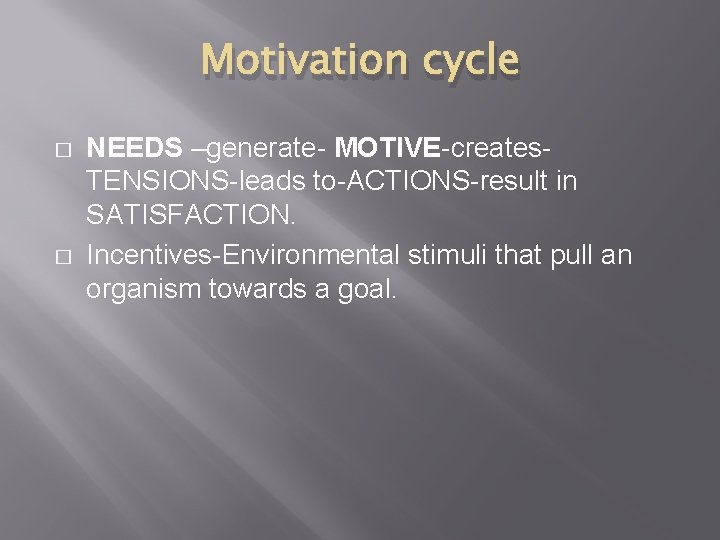
Motivation cycle � � NEEDS –generate- MOTIVE-creates. TENSIONS-leads to-ACTIONS-result in SATISFACTION. Incentives-Environmental stimuli that pull an organism towards a goal.
Kinds of motivation 1 -Natural/Intrinsic Motivation � -”performing an activity for its own sake” � The source of satisfaction lies within the task Ex: -a good cricket -player playing cricket 2 -Unnatural/Extrinsic Motivation “performing an activity to obtain an external reward or avoid punishment” The source of satisfaction does not lie within the task. Ex: -Reading books to pass the examination. 3 -Achievement Motivation(Ac. M)-Mc. Clelland -motivation to achieve success-to the highest level. �
� 4 -Avoidance motivation(Av. M); motivation to avoid failure. If Ac. M>Av. M =will try to achieve the task � If. Av. M>Ac. M= will try to avoid the situation How to develop Achievement motivation? -setting up a goal -maintaining pleasant atmosphere -linking the new learning with past experience -adopting effective methods of teaching -using appropriate audio visual aids -providing immediate feed back of achievement -Promoting competition and co-operation �
-praise and blame -reward and punishment -promoting ego -involvement
TRANSFER OF LEARNING � “Transfer refers to the transfer of knowledge, training and habits acquired in in one situation to another situation” Sorenson, 1948
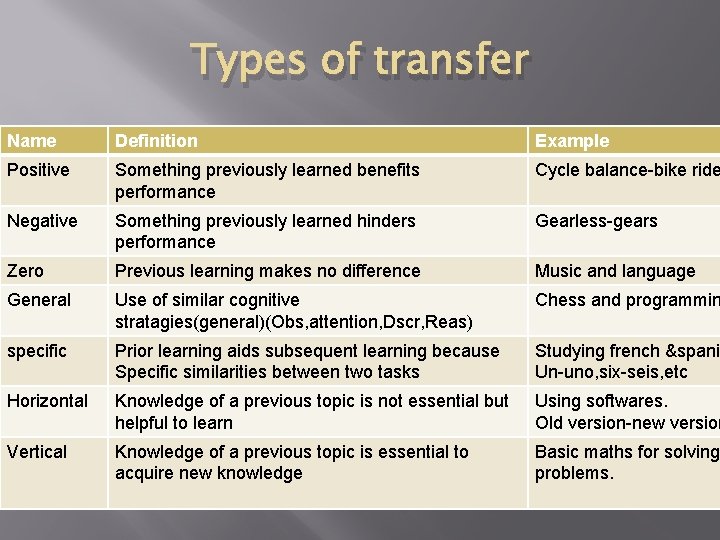
Types of transfer Name Definition Example Positive Something previously learned benefits performance Cycle balance-bike ride Negative Something previously learned hinders performance Gearless-gears Zero Previous learning makes no difference Music and language General Use of similar cognitive stratagies(general)(Obs, attention, Dscr, Reas) Chess and programmin specific Prior learning aids subsequent learning because Specific similarities between two tasks Studying french &spani Un-uno, six-seis, etc Horizontal Knowledge of a previous topic is not essential but helpful to learn Using softwares. Old version-new version Vertical Knowledge of a previous topic is essential to acquire new knowledge Basic maths for solving problems.
- Slides: 17