
LEARNING LANGUAGES EFFECTIVELY Tips and tricks WHAT ARE

- Slides: 13
LEARNING LANGUAGES EFFECTIVELY Tips and tricks
WHAT ARE YOUR LEARNING HABITS? I watch films and TV in English. I’m worried that people don’t understand me when I speak English, so I prefer to stay quiet. I read a lot in English. Mostly news on the Internet, but sometimes books too. I never study English in my free time. I record new words, look them up in a dictionary and keep a record of them in my notebook. I use on-line software and apps for learning English. I talk a lot in English in my free time. I’m afraid to make mistakes when I speak or write. I listen for new expressions and imitate fluent
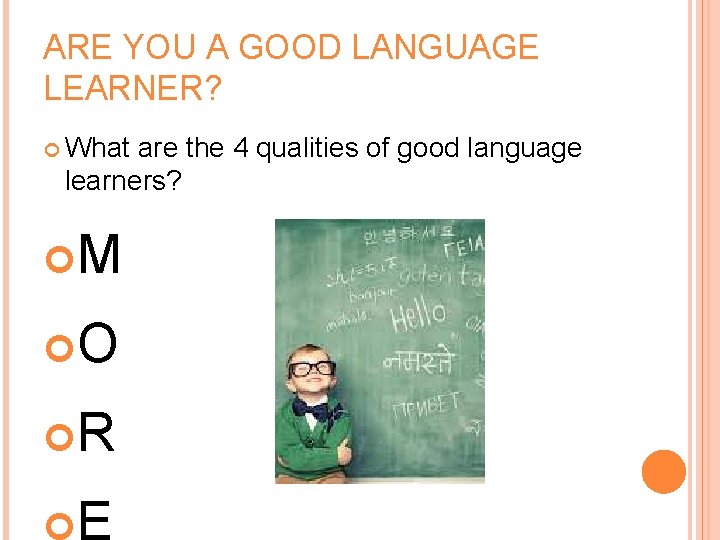
ARE YOU A GOOD LANGUAGE LEARNER? What are the 4 qualities of good language learners? M O R E
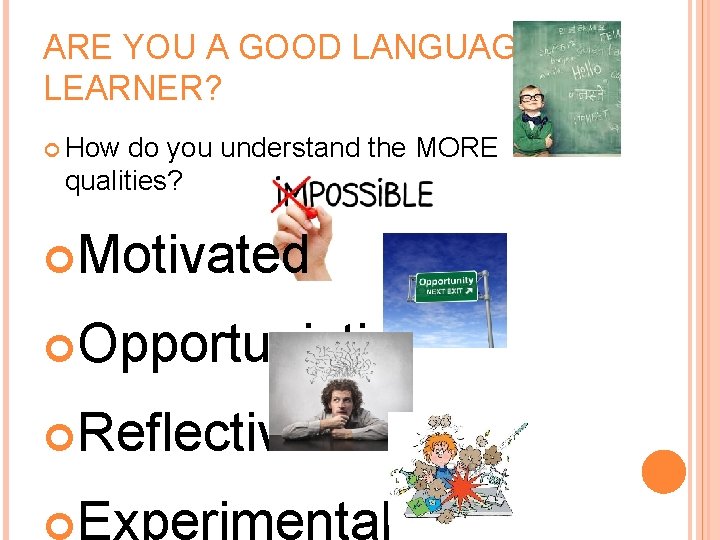
ARE YOU A GOOD LANGUAGE LEARNER? How do you understand the MORE qualities? Motivated Opportunistic Reflective Experimental
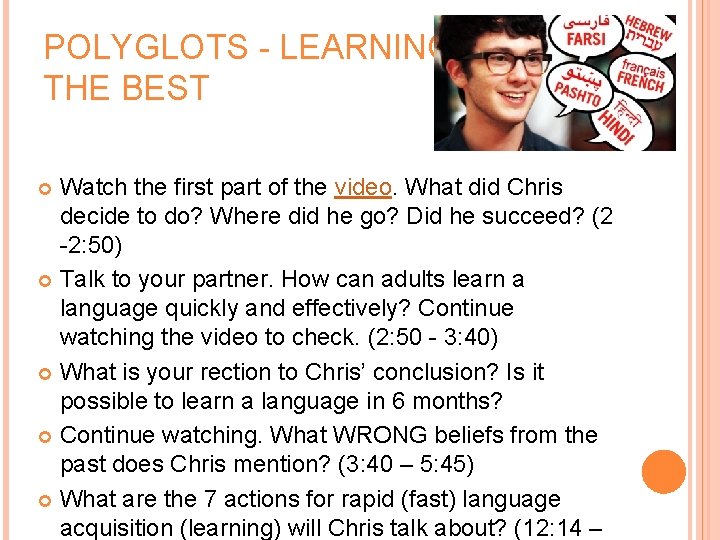
POLYGLOTS - LEARNING FROM THE BEST Watch the first part of the video. What did Chris decide to do? Where did he go? Did he succeed? (2 -2: 50) Talk to your partner. How can adults learn a language quickly and effectively? Continue watching the video to check. (2: 50 - 3: 40) What is your rection to Chris’ conclusion? Is it possible to learn a language in 6 months? Continue watching. What WRONG beliefs from the past does Chris mention? (3: 40 – 5: 45) What are the 7 actions for rapid (fast) language acquisition (learning) will Chris talk about? (12: 14 –
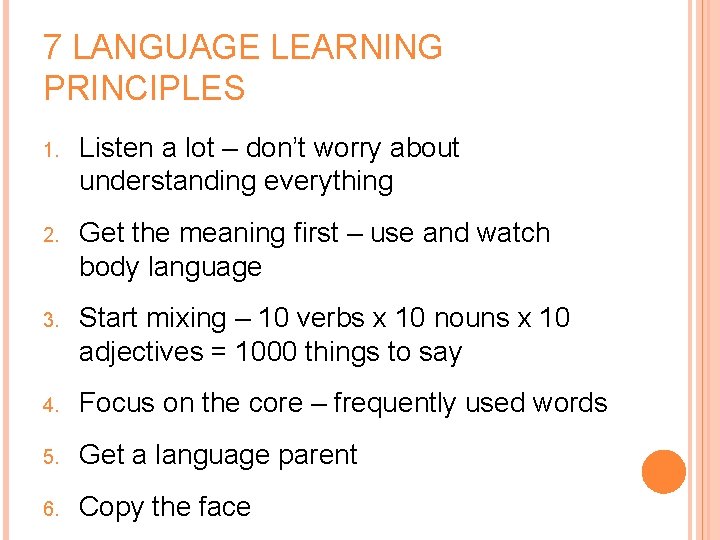
7 LANGUAGE LEARNING PRINCIPLES 1. Listen a lot – don’t worry about understanding everything 2. Get the meaning first – use and watch body language 3. Start mixing – 10 verbs x 10 nouns x 10 adjectives = 1000 things to say 4. Focus on the core – frequently used words 5. Get a language parent 6. Copy the face
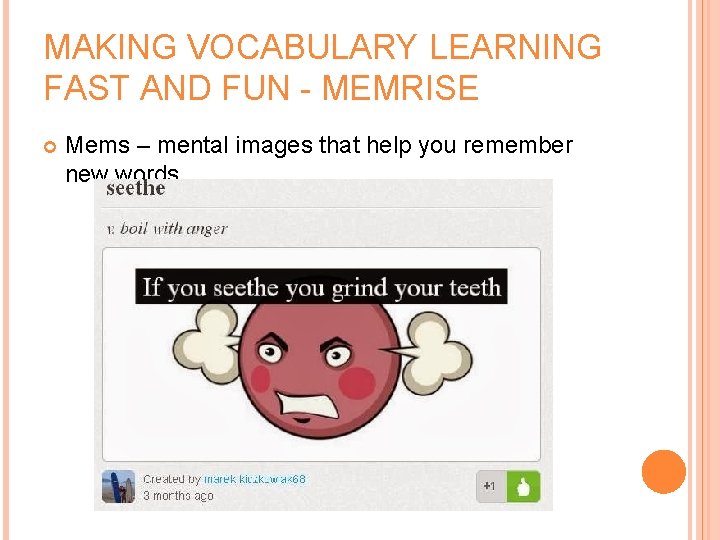
MAKING VOCABULARY LEARNING FAST AND FUN - MEMRISE Mems – mental images that help you remember new words
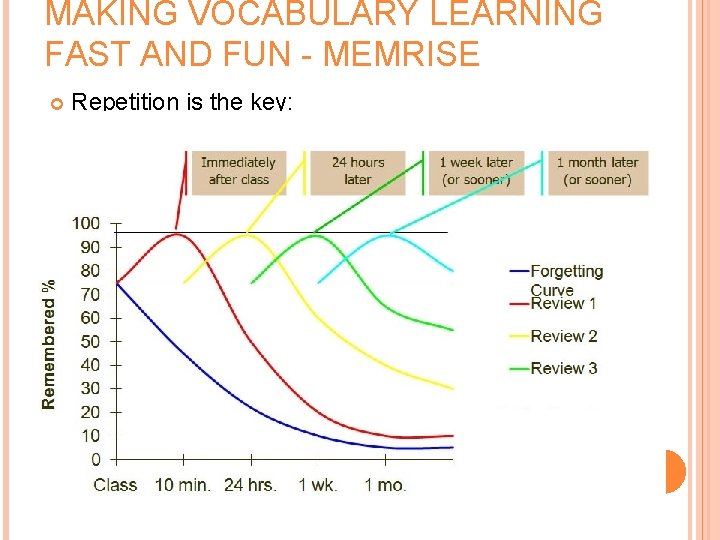
MAKING VOCABULARY LEARNING FAST AND FUN - MEMRISE Repetition is the key:
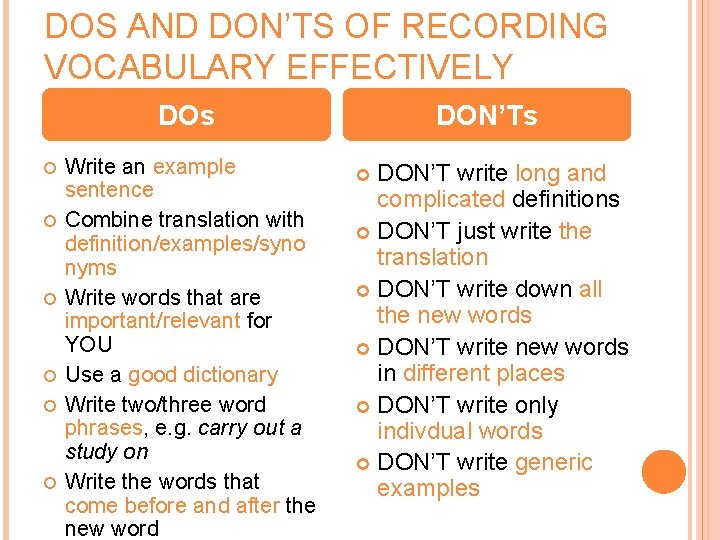
DOS AND DON’TS OF RECORDING VOCABULARY EFFECTIVELY DOs Write an example sentence Combine translation with definition/examples/syno nyms Write words that are important/relevant for YOU Use a good dictionary Write two/three word phrases, e. g. carry out a study on Write the words that come before and after the new word DON’Ts DON’T write long and complicated definitions DON’T just write the translation DON’T write down all the new words DON’T write new words in different places DON’T write only indivdual words DON’T write generic examples
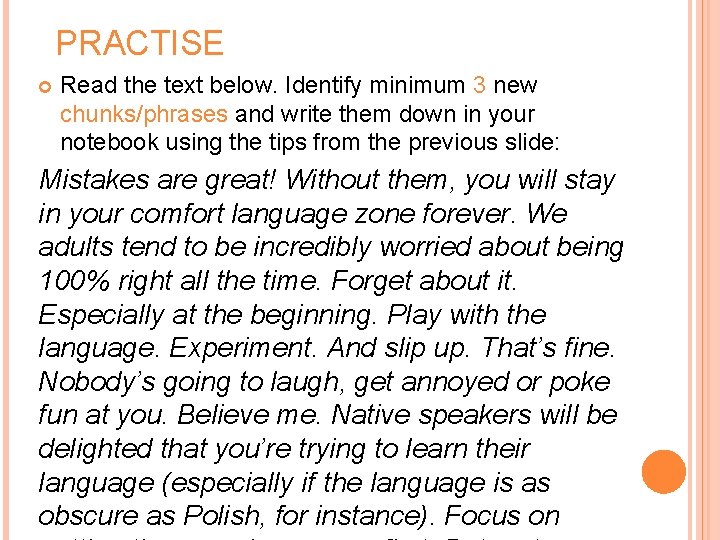
PRACTISE Read the text below. Identify minimum 3 new chunks/phrases and write them down in your notebook using the tips from the previous slide: Mistakes are great! Without them, you will stay in your comfort language zone forever. We adults tend to be incredibly worried about being 100% right all the time. Forget about it. Especially at the beginning. Play with the language. Experiment. And slip up. That’s fine. Nobody’s going to laugh, get annoyed or poke fun at you. Believe me. Native speakers will be delighted that you’re trying to learn their language (especially if the language is as obscure as Polish, for instance). Focus on
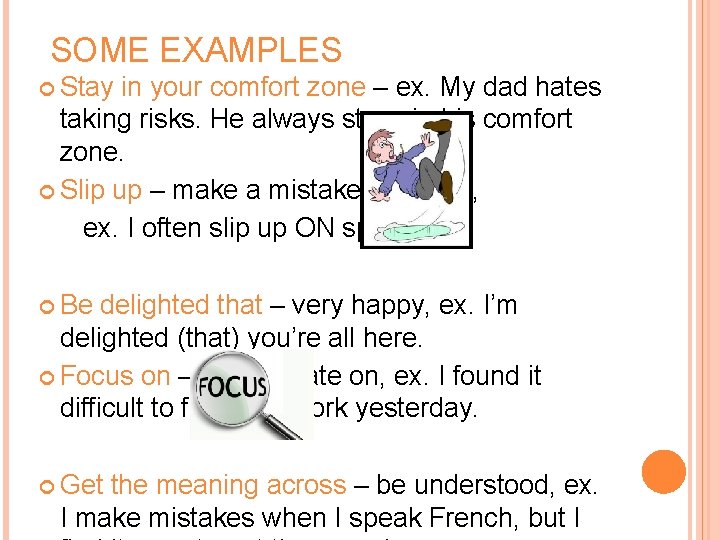
SOME EXAMPLES Stay in your comfort zone – ex. My dad hates taking risks. He always stays in his comfort zone. Slip up – make a mistake, informal, ex. I often slip up ON spelling. Be delighted that – very happy, ex. I’m delighted (that) you’re all here. Focus on – concentrate on, ex. I found it difficult to focus on work yesterday. Get the meaning across – be understood, ex. I make mistakes when I speak French, but I
YOUR TASK FOR FRIDAY Log in to Memrise at www. memrise. com Find a new course and learn 5 new words Download the app and practise on your phone Read one of the articles and watch one of the videos from the next slide. Write down at least 3 interesting things
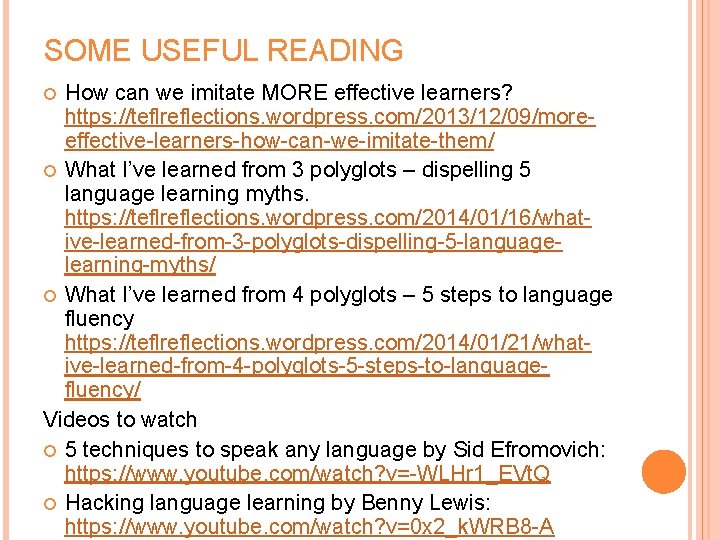
SOME USEFUL READING How can we imitate MORE effective learners? https: //teflreflections. wordpress. com/2013/12/09/moreeffective-learners-how-can-we-imitate-them/ What I’ve learned from 3 polyglots – dispelling 5 language learning myths. https: //teflreflections. wordpress. com/2014/01/16/whative-learned-from-3 -polyglots-dispelling-5 -languagelearning-myths/ What I’ve learned from 4 polyglots – 5 steps to language fluency https: //teflreflections. wordpress. com/2014/01/21/whative-learned-from-4 -polyglots-5 -steps-to-languagefluency/ Videos to watch 5 techniques to speak any language by Sid Efromovich: https: //www. youtube. com/watch? v=-WLHr 1_EVt. Q Hacking language learning by Benny Lewis: https: //www. youtube. com/watch? v=0 x 2_k. WRB 8 -A