
Learning Language through the Arts Visual Arts Music














- Slides: 54
Learning Language through the Arts: Visual Arts, Music, and Drama BY: AMY E. LINGENFELTER ENGLISH LANGUAGE FELLOW 2013 -14
Quotes about the Arts: • “Whoever neglects the arts when he is young has lost the past and is dead to the future” – Sophocles • “All religions, arts, and sciences are branches of the same tree” – Albert Einstein • “Art is not the imitation of life, it’s the manifestation and advancement of the human soul. ” – Me • “A great teacher is a great artist and teaching is the greatest of the arts since the medium is the human mind and spirit rather than the brush. ” – John Steinbeck
Training Objectives: • Teachers will learn research on using art, music, drama, and dance effectively in the English language classroom. • Teachers will see how these elements have been, and can be, applied to their own language classroom.
Do You Agree or Disagree? • I sometimes use at least one of the arts in my English classes (visual arts, music, drama, and/or dance). • Having skills in the arts is not important in today’s society. • Children know that learning a new language is difficult. • It is the teacher’s job to make learning fun. • The arts makes things more fun. • Every student learns in a different way • Students need to learn the same concept in different ways to retain information
Benefits of Using the Arts to Teach a Second Language: • Art, creativity, and movement are keys to cognitive growth and retention of information • The key to learning and retaining information is making associations. The arts helps students make them! • Art and creativity stimulates multiple parts of the brain, which leads to higher levels of retention • Art “kisses the brain!”
Benefits of Using the Arts to Teach a Second Language: • “Research about the brain suggests that by instructing through multiple learning pathways, more dendritic pathways of access” will be created. This can be achieved by absorping formation through the 5 several senses (sight, sound, smell, touch, and taste) or by creating crosscurricular connections. • This information is stored temporarily, and the brain decides what to do with the acquired data. ”
Benefits of Using the Arts to Teach a Second Language: • “The more of these stimuli that are activated, the more impact the data has on the brain. • When more regions of the brain store data about a subject, there is more interconnection and cross-referencing of data from multiple storage areas in response to a single cue, meaning one has learned rather than memorized. ” – Wolfe, P. (2001).
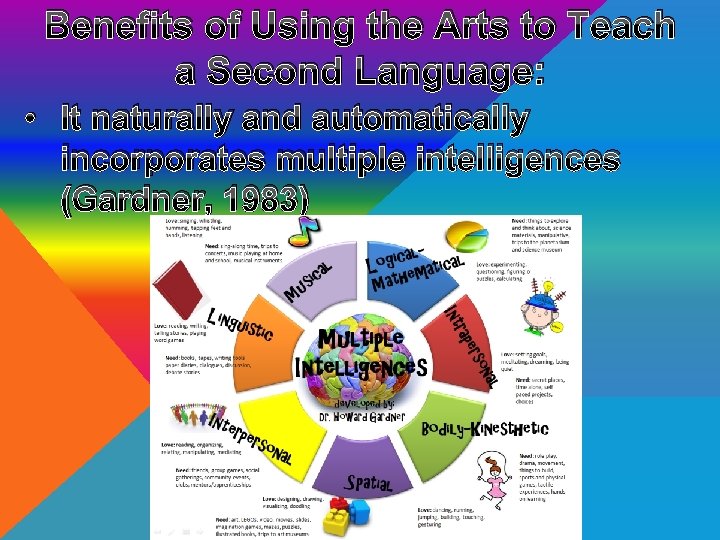
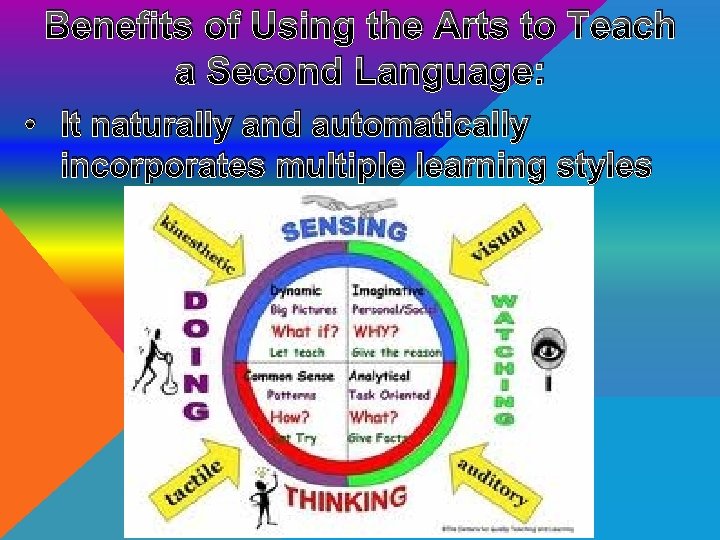
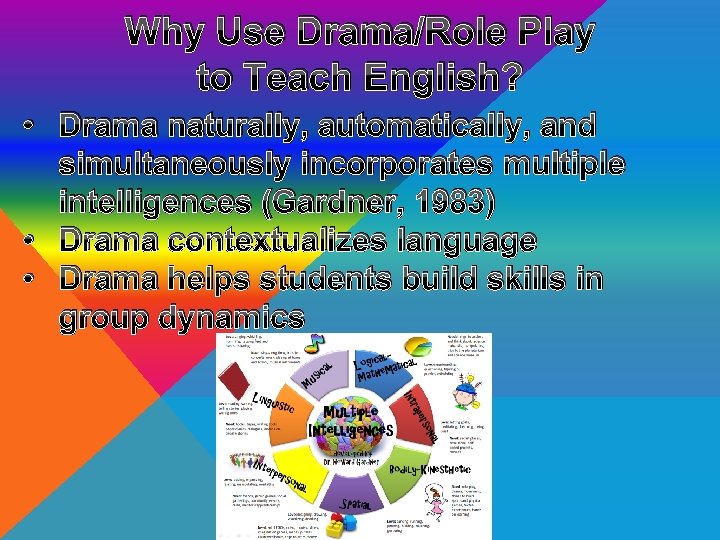
Benefits of Using the Arts to Teach a Second Language: • It naturally and automatically incorporates multiple intelligences (Gardner, 1983)
Benefits of Using the Arts to Teach a Second Language: • It naturally and automatically incorporates multiple learning styles
Benefits of Using the Arts to Teach a Second Language: • It makes learning English fun! • It imitates, improves on, and makes more fun students’ real lives • It allows for creative and individual expression • It incorporates and accompanies all aspects of language and can be used to teach almost language point • It activates the spiritual, “unseen” side of students
Benefits of Using the Arts to Teach a Second Language: • Students have the opportunity to… ü Express themselves ü Explore language freely ü Explore feelings and find out about themselves and others ü Develop cooperation, care, consideration and control ü Develop language skills (listening reading, writing and speaking) ü Explore a fantasy word of their own creation
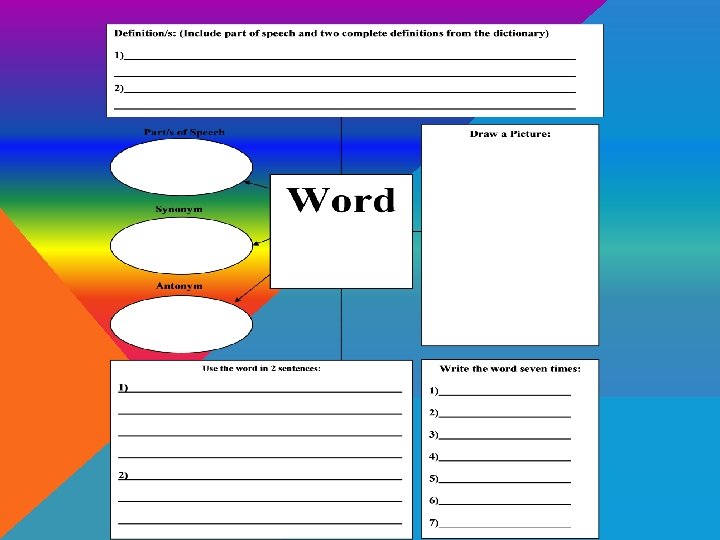
Benefits of Using the Arts to Teach a Second Language: • When you have students sketch something to illustrate what they’re learning, reading or writing, they make stronger associations and retain the information better! • For example, drawing an image that reminds students of the meaning of the word
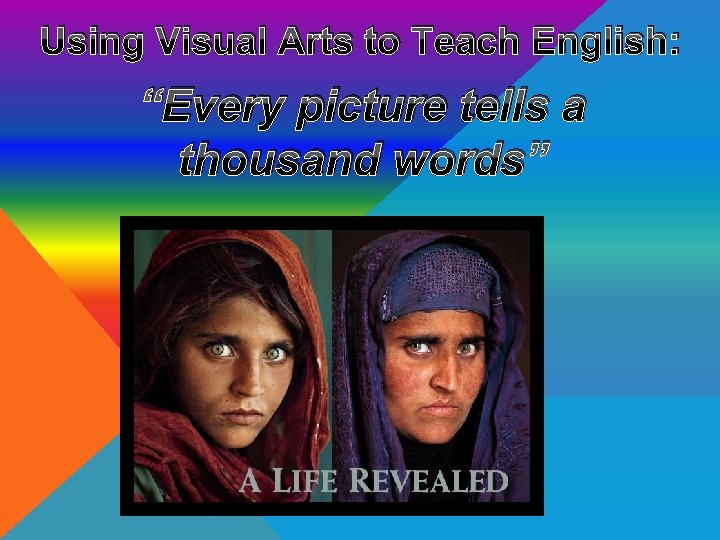
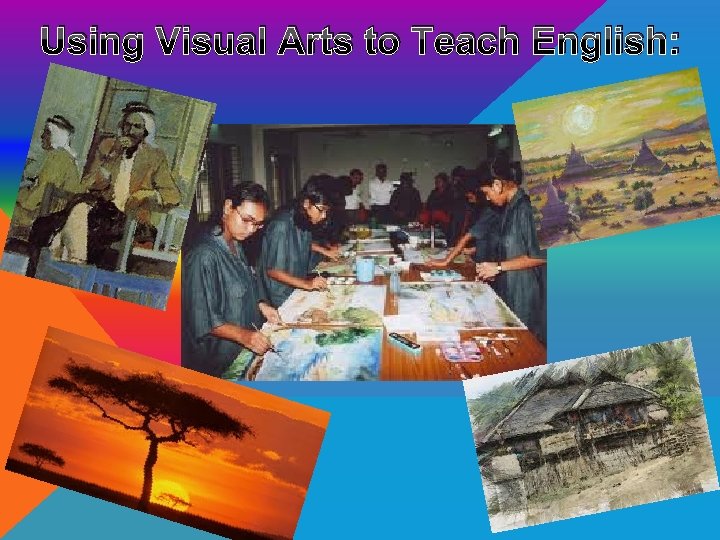
Using Visual Arts to Teach English: “Every picture tells a thousand words”
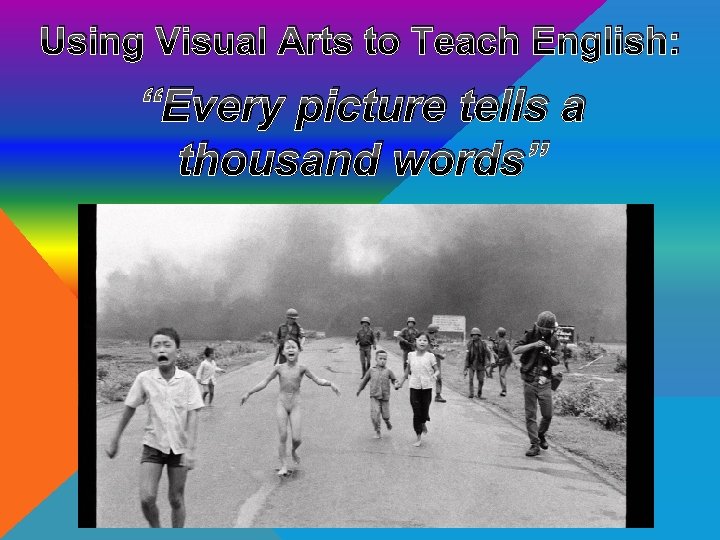
Using Visual Arts to Teach English: “Every picture tells a thousand words”
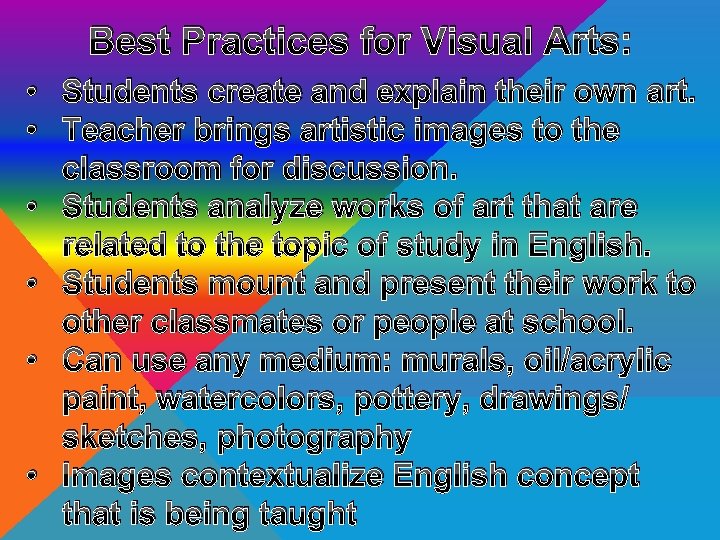
Best Practices for Visual Arts: • Students create and explain their own art. • Teacher brings artistic images to the classroom for discussion. • Students analyze works of art that are related to the topic of study in English. • Students mount and present their work to other classmates or people at school. • Can use any medium: murals, oil/acrylic paint, watercolors, pottery, drawings/ sketches, photography • Images contextualize English concept that is being taught
Best Practices for Visual Arts: • Artwork can be used to teach a variety of grammar points and vocabulary, including but not limited to: • Colors, shapes, sizes • Locations • Prepositions of all kinds • Adjectives • Verbs (process, how to, commands, present progressive, past perfect, etc. ) • Vocabulary to name objects in artwork or class themes • Grammar of all kinds (“there is/are”)
Best Practices for Visual Arts: • Themes of artwork can be based on students’ real lives and backgrounds • Artwork can be used to tell the students’ life story or an aspect of their life in English and utilize narrative story- telling • Can be one work or a series of works used to tell the story • Image or story can be accompanied by a written explanation/description in English • Summative presentation is key! • The possibilities for topics are endless!
Using Visual Arts to Teach English:
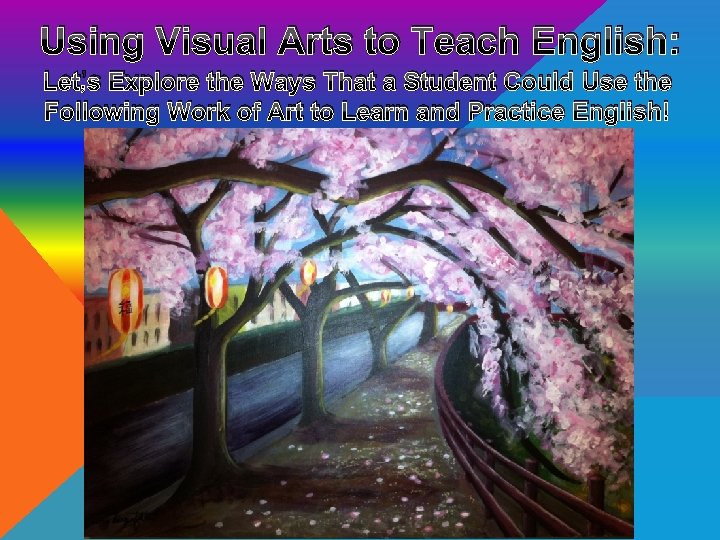
Using Visual Arts to Teach English: Let’s Explore the Ways That a Student Could Use the Following Work of Art to Learn and Practice English!
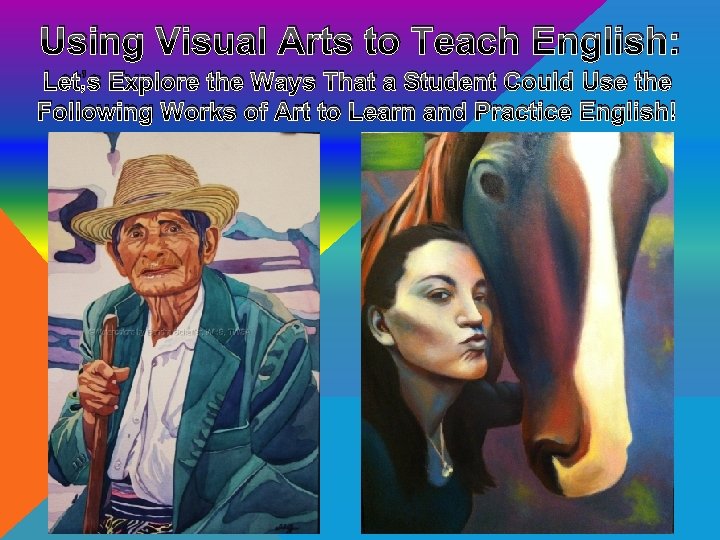
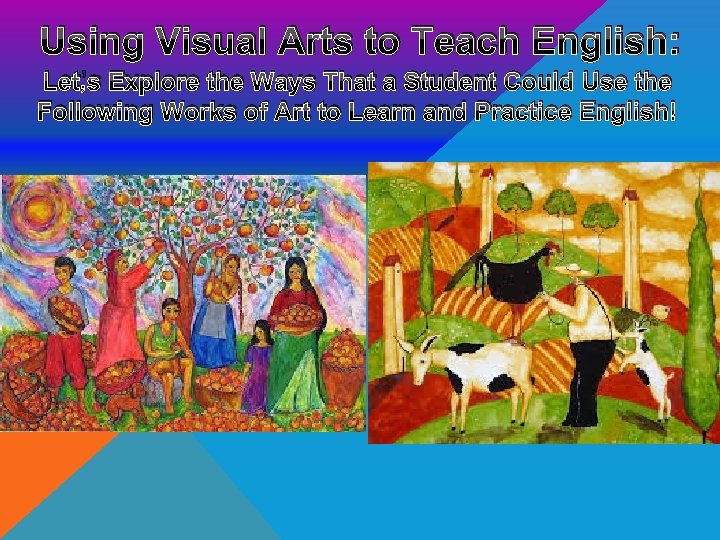
Using Visual Arts to Teach English: Let’s Explore the Ways That a Student Could Use the Following Works of Art to Learn and Practice English!
Using Visual Arts to Teach English: Let’s Explore the Ways That a Student Could Use the Following Works of Art to Learn and Practice English!
Music Research: • “Developments in brain-based research note that central featuers of music and language are housed near one another in the human brain, suggesting they may share features of “grammar” that orders musical elements and language elements similarly. ” - Lems, 2005
Music Research: • Songs (especially pop songs) provide learners with repetitive, focused, (yet open-ended) lyrics that allow for a myriad of teaching opportunities for teaching grammar, vocabulary, idioms, and listening comprehension. -Murphey, 1992.
Best Practices for Music: • Use songs with English lyrics • Students create their own lyrics to rythym of music • Repetitive lyrics help! • Cloze/“Fill-in-the-blanks” of lyrics while listening to song • Begin or end a lesson with a song • Use actions, body movements, gestures to accompany songs and poems (e. g. clapping, jumping)
Best Practices for Music: • • Use puppets to accompany music Students create personal songbooks Use song, lyrics, and poem charts Use lyrics to teach vocabulary, grammar, almost anything! • Use lyrics to teach elements of poetry: ryhming words, stanza/refrain, rythm, imagery, melody, meter, form
Sources for Songs: • • • www. americanenglish. state. gov www. bussongs. com www. songsforteaching. com www. tefltunes. com www. eslcafe. com Your own You. Tube, CD player, and/or i. Tunes library!
Drama Research: • Teaching through drama “makes students aware that English is not just words, structures, and idioms, but it is a lively, dramatic and versatile means of communcation. ” - Zalta, 2006
Why Use Drama/Role Play to Teach English? • Teaching through drama makes the language come alive! • Students more likely to internalize the language when they perform it • Drama and role play motivates and engages students in the language • Drama imitates real-life situations and authentic language contexts • Drama is familiar and fun to students • Drama helps students build speaking and listening confidence
Why Use Drama/Role Play to Teach English? • Drama naturally, automatically, and simultaneously incorporates multiple intelligences (Gardner, 1983) • Drama contextualizes language • Drama helps students build skills in group dynamics
Best Practices for Drama/Role Play: • • Choose the right activity Start small and brief Give constant feedback Build off of what students have done in the classroom. • Practice makes perfect! • Present your drama to a group of people that is valuable for the students. • Record the drama so students and teachers can be self-reflective about their performance
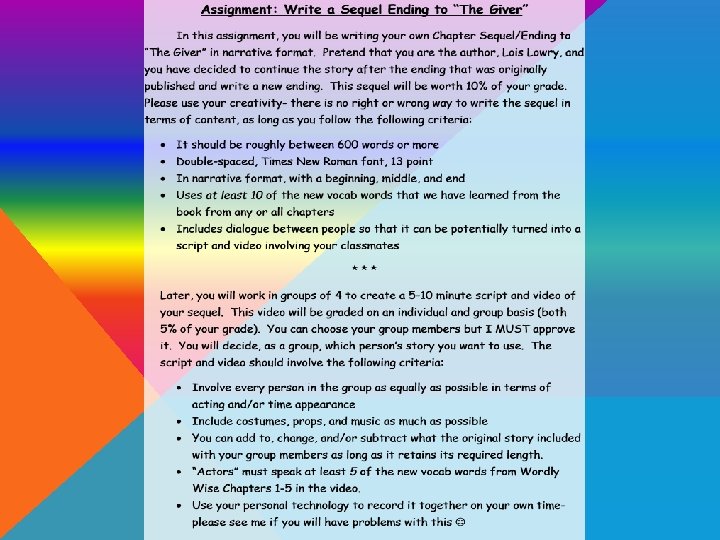
Drama/Role Play Activity Ideas: • • Miming stories and games Transform stories into mini-plays Students perform dramatic productions Write scripts and use as writing opportunities Use technology to film a movie/play Create improvisation or comedy routines Drama can mimic a real-life situation that has or could occur in students’ lives Can be a springboard from previous written activities (narrative stories, “sequels” from stories they read, etc. )
Drama/Role Play Activity Ideas: • Use drama to practice language previously learned (vocab, grammar, etc. ) • Great way to teach and practice authentic English, idioms, conversational English
Example of Student Drama: • Students wrote a sequel of a book they read in narrative form • In groups, they created a script based on the best sequel for a movie • They filmed the movie and presented it to the class
Example of Student Drama:
THE END! THANK YOU! • ANY QUESTIONS? • MY CONTACT INFO: • My Website: www. peopleleap. com (go to “Resources > “Downloadable Documents, Learning Links, Reading Links, and Teacher Links!”) • My email: utopia 747@gmail. com