
Learning Ladder Clinic Leading your scholars to success





- Slides: 48
Learning Ladder Clinic: Leading your scholars to success SUMMER INSTITUTE JULY 2012
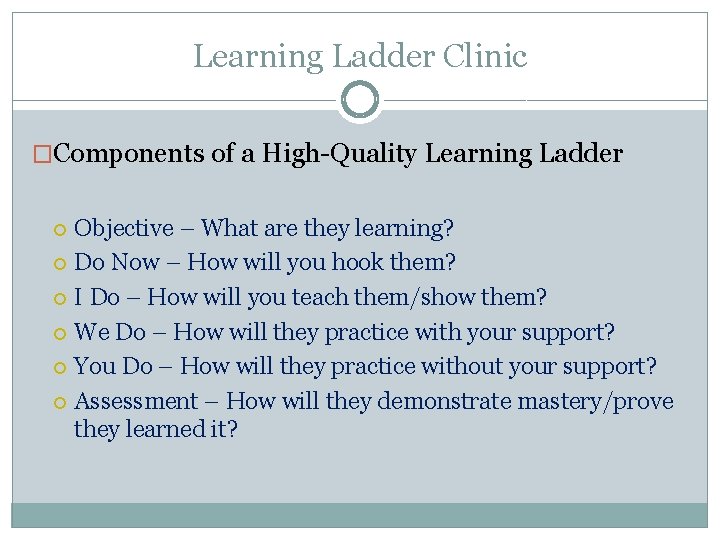
Learning Ladder Clinic �Components of a High-Quality Learning Ladder Objective – What are they learning? Do Now – How will you hook them? I Do – How will you teach them/show them? We Do – How will they practice with your support? You Do – How will they practice without your support? Assessment – How will they demonstrate mastery/prove they learned it?
Writing a High Quality Objective SUMMER INSTITUTE JULY 2012
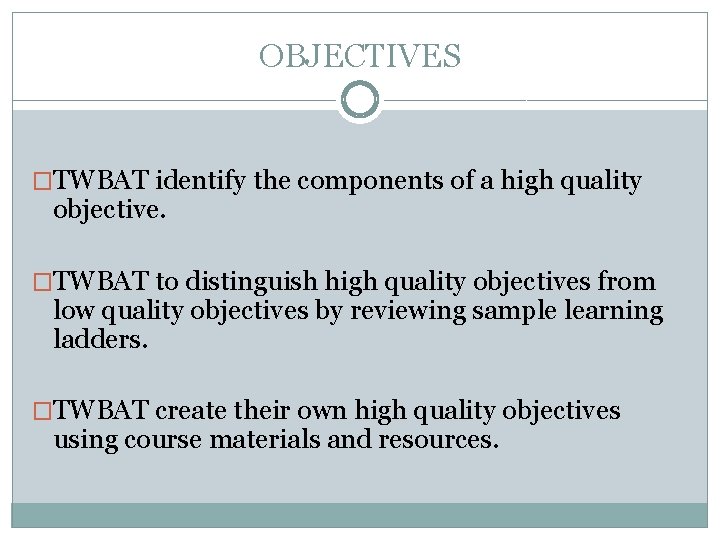
OBJECTIVES �TWBAT identify the components of a high quality objective. �TWBAT to distinguish high quality objectives from low quality objectives by reviewing sample learning ladders. �TWBAT create their own high quality objectives using course materials and resources.
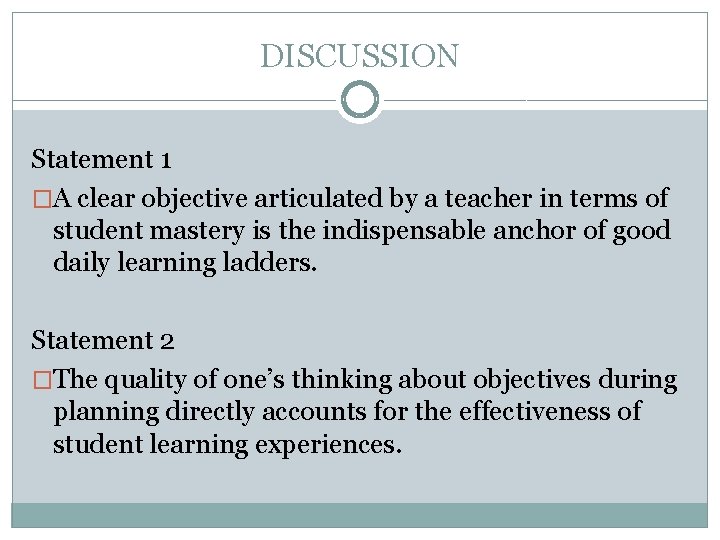
DISCUSSION Statement 1 �A clear objective articulated by a teacher in terms of student mastery is the indispensable anchor of good daily learning ladders. Statement 2 �The quality of one’s thinking about objectives during planning directly accounts for the effectiveness of student learning experiences.
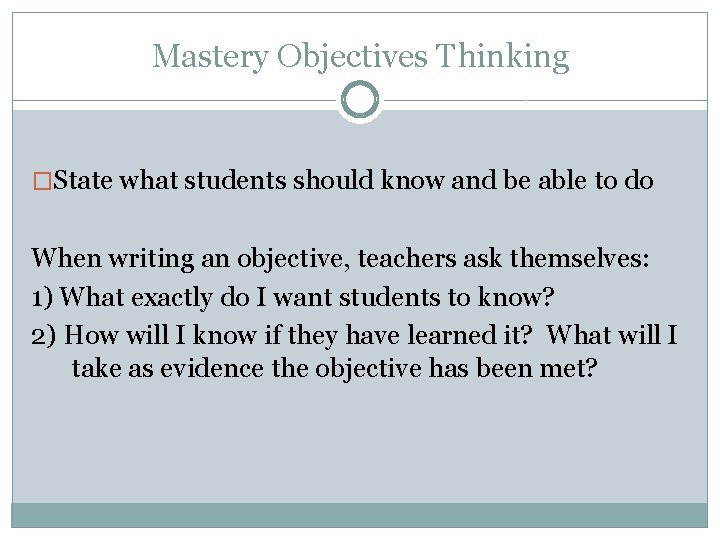
Mastery Objectives Thinking �State what students should know and be able to do When writing an objective, teachers ask themselves: 1) What exactly do I want students to know? 2) How will I know if they have learned it? What will I take as evidence the objective has been met?
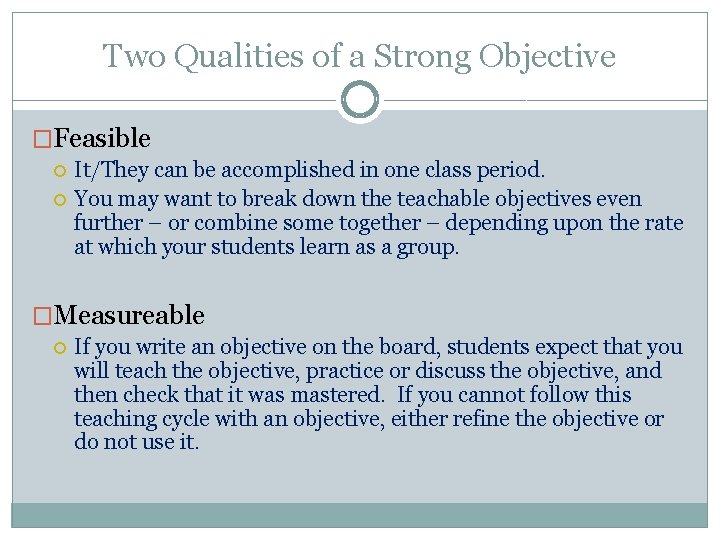
Two Qualities of a Strong Objective �Feasible It/They can be accomplished in one class period. You may want to break down the teachable objectives even further – or combine some together – depending upon the rate at which your students learn as a group. �Measureable If you write an objective on the board, students expect that you will teach the objective, practice or discuss the objective, and then check that it was mastered. If you cannot follow this teaching cycle with an objective, either refine the objective or do not use it.
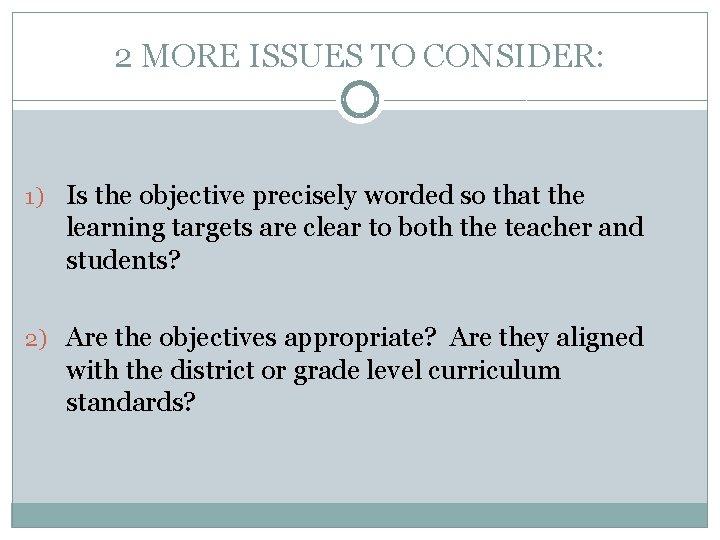
2 MORE ISSUES TO CONSIDER: 1) Is the objective precisely worded so that the learning targets are clear to both the teacher and students? 2) Are the objectives appropriate? Are they aligned with the district or grade level curriculum standards?
Discussion: Objectives from Teaching Resources �Additional resources may already state objectives. Be careful not to merely use the list of learning objectives – you may want to create additional objectives for your individual class’s needs and state expectations.
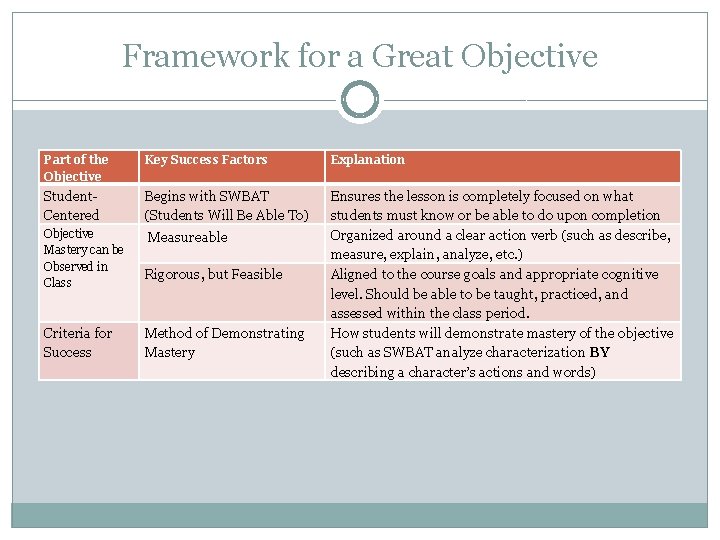
Framework for a Great Objective Part of the Objective Key Success Factors Explanation Student. Centered Begins with SWBAT (Students Will Be Able To) Ensures the lesson is completely focused on what students must know or be able to do upon completion Organized around a clear action verb (such as describe, measure, explain, analyze, etc. ) Aligned to the course goals and appropriate cognitive level. Should be able to be taught, practiced, and assessed within the class period. How students will demonstrate mastery of the objective (such as SWBAT analyze characterization BY describing a character’s actions and words) Objective Mastery can be Observed in Class Criteria for Success Measureable Rigorous, but Feasible Method of Demonstrating Mastery
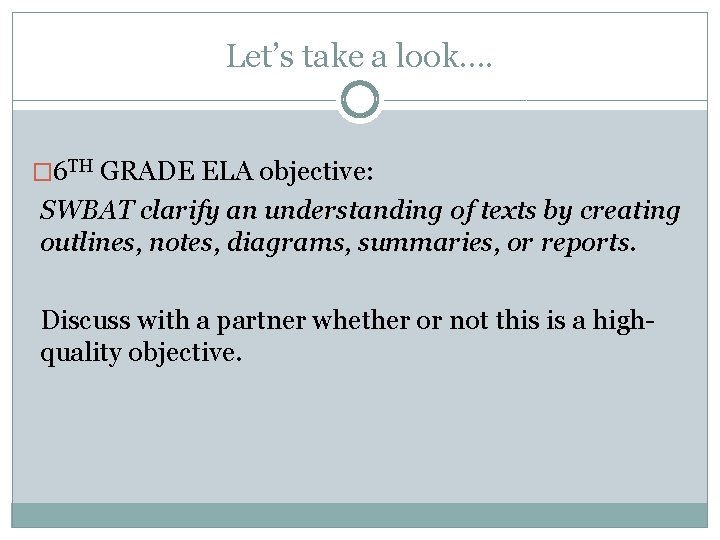
Let’s take a look…. � 6 TH GRADE ELA objective: SWBAT clarify an understanding of texts by creating outlines, notes, diagrams, summaries, or reports. Discuss with a partner whether or not this is a highquality objective.
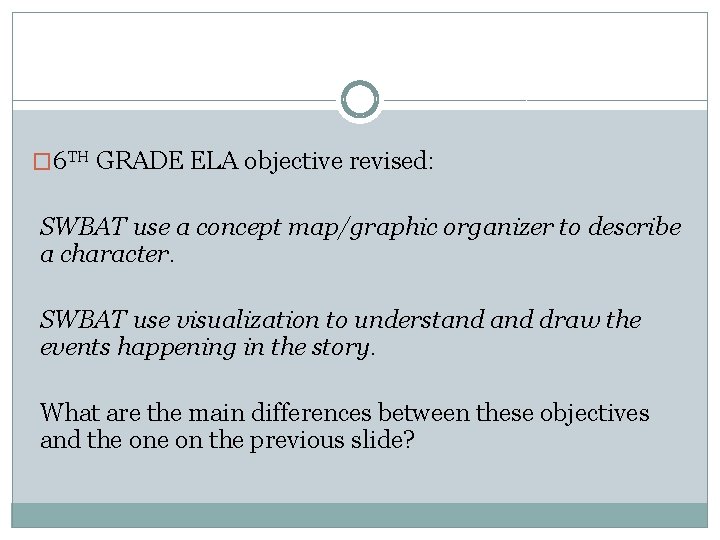
� 6 TH GRADE ELA objective revised: SWBAT use a concept map/graphic organizer to describe a character. SWBAT use visualization to understand draw the events happening in the story. What are the main differences between these objectives and the on the previous slide?
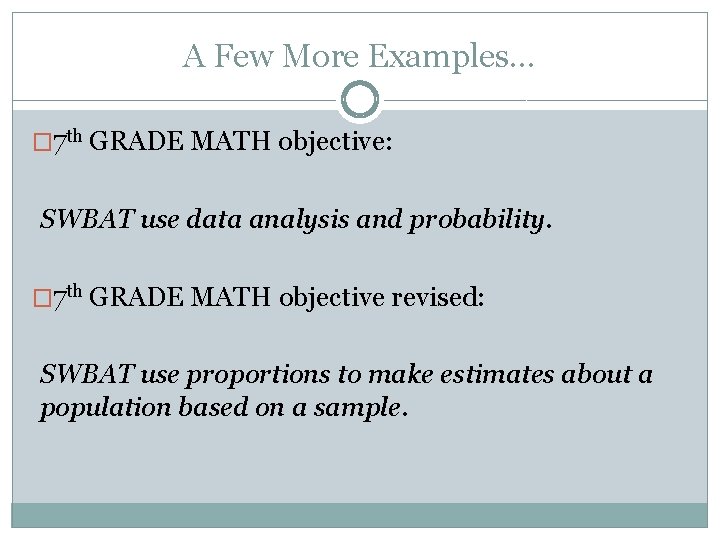
A Few More Examples… � 7 th GRADE MATH objective: SWBAT use data analysis and probability. � 7 th GRADE MATH objective revised: SWBAT use proportions to make estimates about a population based on a sample.
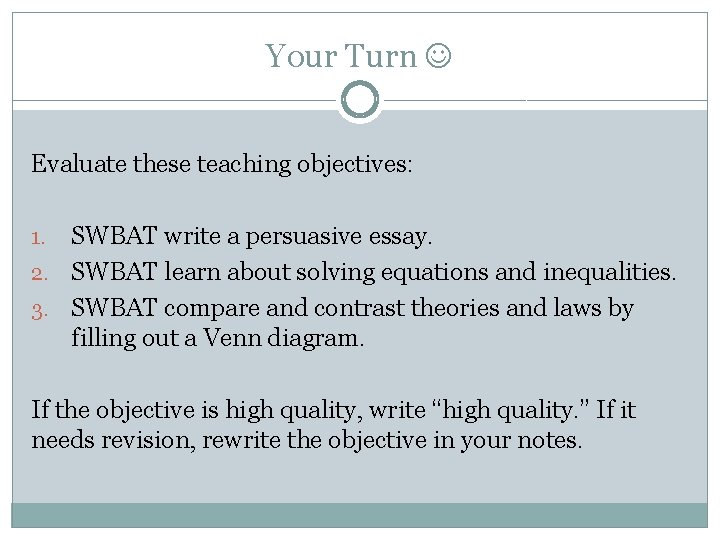
Your Turn Evaluate these teaching objectives: SWBAT write a persuasive essay. 2. SWBAT learn about solving equations and inequalities. 3. SWBAT compare and contrast theories and laws by filling out a Venn diagram. 1. If the objective is high quality, write “high quality. ” If it needs revision, rewrite the objective in your notes.
Reflection: Session OBJECTIVES �TWBAT identify the components of a high quality objective. �TWBAT to distinguish high quality objectives from low quality objectives by reviewing sample learning ladders. �TWBAT create their own high quality objectives using course materials and resources. Learner-centered? Feasible and Measureable? Criteria for Success?
Practice �In your content team, begin writing daily objectives you will teach for the first week of school. Use your unit plan to guide what knowledge and skills they’ll need to know.
Assessments and Do Nows SUMMER INSTITUTE JULY 2012
Assessment What is it? � Method of determining whether students have mastered the lesson objective(s) � Aligned to lesson objective � Multiple opportunities for students to demonstrate mastery Main Purposes � Gauge whether or not students can apply the skills and knowledge of the objective ON THEIR OWN � Inform future teaching/re-teaching of material (whole-class and individual)
Assessment Types �See Handout
Practice �Using your first objective from above, start drafting an assessment that, if completed correctly, will demonstrate mastery over the objective.
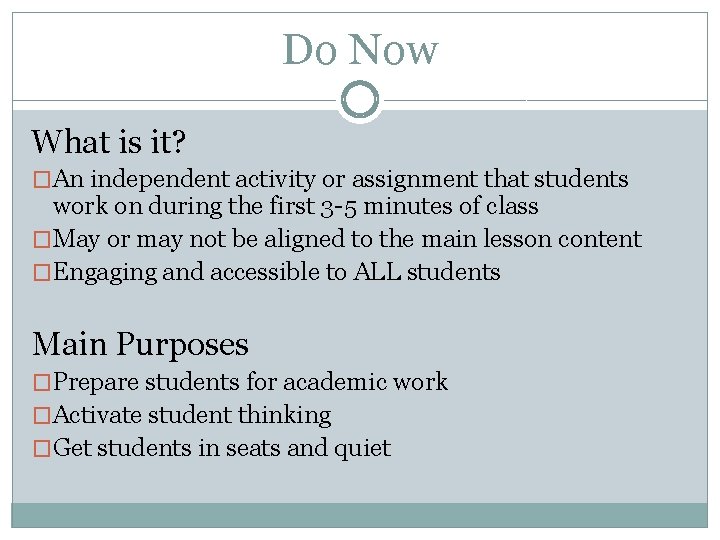
Do Now What is it? �An independent activity or assignment that students work on during the first 3 -5 minutes of class �May or may not be aligned to the main lesson content �Engaging and accessible to ALL students Main Purposes �Prepare students for academic work �Activate student thinking �Get students in seats and quiet
Do Now Types �Engage Students in New Content (Hook) �Review Previously Taught Material �Brain Boosters
Practice �Looking at the objective and assessment you’ve been working on, create a Do Now activity that achieves one of the main purposes of a Do Now.
Writing a High Quality I Do SUMMER INSTITUTE JULY 2012
Do Now �Recall a time when you were leaning something for the first time. Did you catch on quickly? Why? Did it take you a longer time? Why? �Consider what makes effective vs. ineffective instruction.
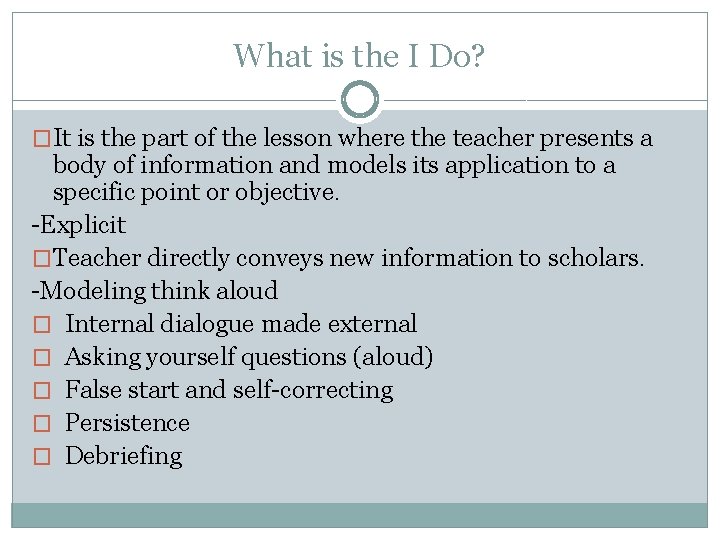
What is the I Do? �It is the part of the lesson where the teacher presents a body of information and models its application to a specific point or objective. -Explicit �Teacher directly conveys new information to scholars. -Modeling think aloud � Internal dialogue made external � Asking yourself questions (aloud) � False start and self-correcting � Persistence � Debriefing
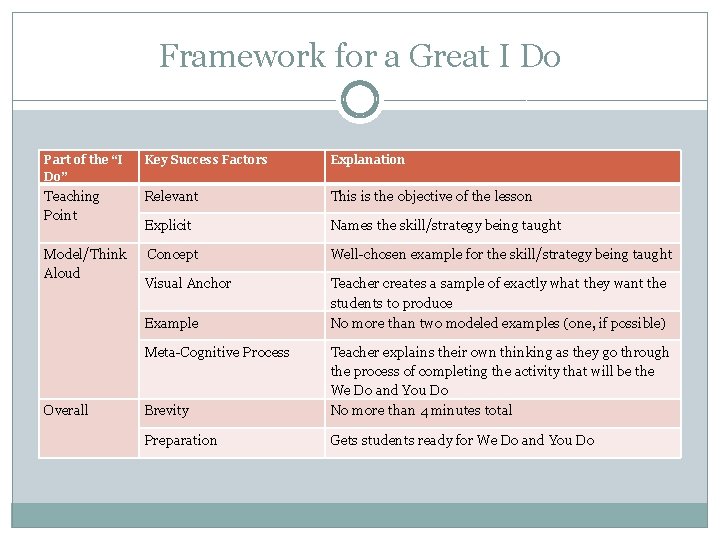
Framework for a Great I Do Part of the “I Do” Key Success Factors Explanation Teaching Point Relevant This is the objective of the lesson Explicit Names the skill/strategy being taught Model/Think Aloud Concept Well-chosen example for the skill/strategy being taught Visual Anchor Teacher creates a sample of exactly what they want the students to produce No more than two modeled examples (one, if possible) Example Meta-Cognitive Process Overall Brevity Teacher explains their own thinking as they go through the process of completing the activity that will be the We Do and You Do No more than 4 minutes total Preparation Gets students ready for We Do and You Do
Example vs. Exemplar Look at the sample learning ladders in your packet (MS Science). Compare the I Do in each one by asking: Is it relevant? Is it explicit? Is there evidence of a model/think-aloud? Is it relatively brief? Will it prepare students to perform the task on their own?
Your turn �Select an objective you will need to teach within the first two weeks of school. �In content area groups, begin to plan how you will teach and model this objective during the I Do of the lesson.
Check �What makes a quality I Do? (5 components) �What makes a quality Objective? (4 components)
Writing a High Quality We Do SUMMER INSTITUTE JULY 2012
OBJECTIVES �TWBAT to describe the framework of a great We Do. �TWBAT identify a high quality We Do in a learning ladder. �TWBAT begin to plan the We Do portion of an upcoming lesson.
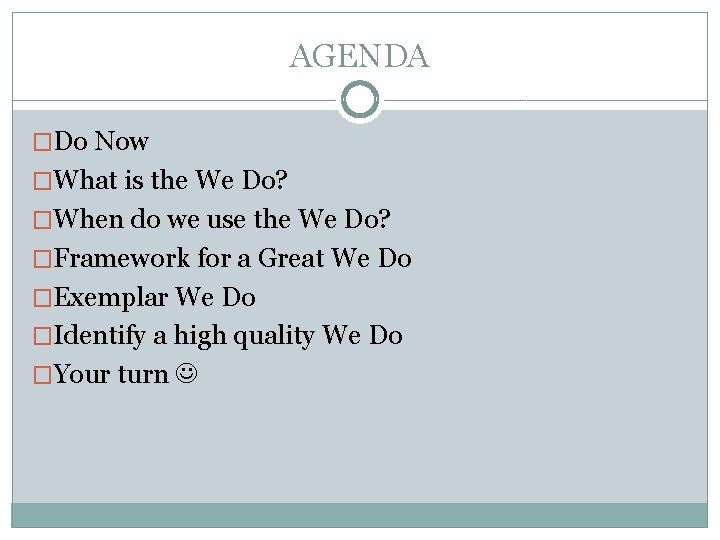
AGENDA �Do Now �What is the We Do? �When do we use the We Do? �Framework for a Great We Do �Exemplar We Do �Identify a high quality We Do �Your turn
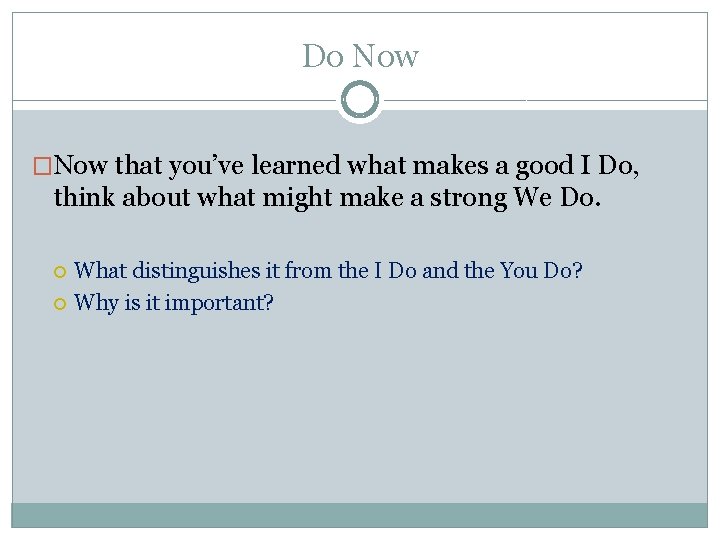
Do Now �Now that you’ve learned what makes a good I Do, think about what might make a strong We Do. What distinguishes it from the I Do and the You Do? Why is it important?
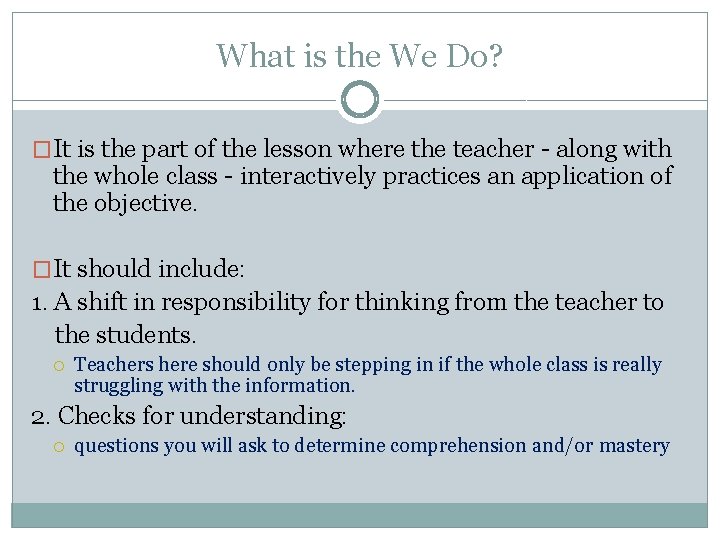
What is the We Do? �It is the part of the lesson where the teacher - along with the whole class - interactively practices an application of the objective. �It should include: 1. A shift in responsibility for thinking from the teacher to the students. Teachers here should only be stepping in if the whole class is really struggling with the information. 2. Checks for understanding: questions you will ask to determine comprehension and/or mastery
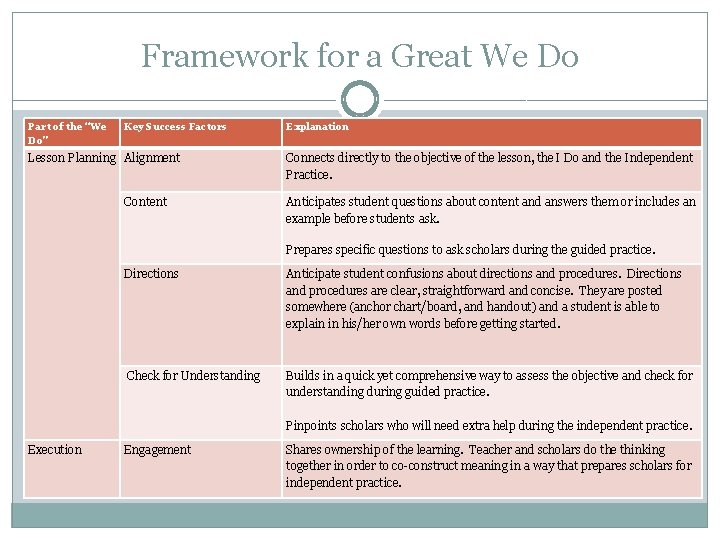
Framework for a Great We Do Part of the “We Do” Key Success Factors Lesson Planning Alignment Content Explanation Connects directly to the objective of the lesson, the I Do and the Independent Practice. Anticipates student questions about content and answers them or includes an example before students ask. Prepares specific questions to ask scholars during the guided practice. Directions Anticipate student confusions about directions and procedures. Directions and procedures are clear, straightforward and concise. They are posted somewhere (anchor chart/board, and handout) and a student is able to explain in his/her own words before getting started. Check for Understanding Builds in a quick yet comprehensive way to assess the objective and check for understanding during guided practice. Pinpoints scholars who will need extra help during the independent practice. Execution Engagement Shares ownership of the learning. Teacher and scholars do the thinking together in order to co-construct meaning in a way that prepares scholars for independent practice.
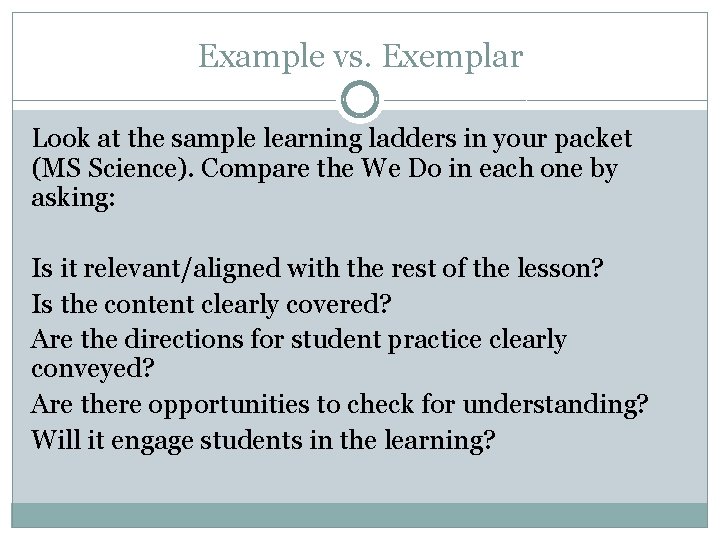
Example vs. Exemplar Look at the sample learning ladders in your packet (MS Science). Compare the We Do in each one by asking: Is it relevant/aligned with the rest of the lesson? Is the content clearly covered? Are the directions for student practice clearly conveyed? Are there opportunities to check for understanding? Will it engage students in the learning?
Your turn �Continue working on the learning ladder from the I Do session. �In content area groups, begin to plan how students will practice this skill during the We Do of the lesson.
Check �What makes a quality We Do? (5 components) �What makes a quality I Do? (5 components) �What makes a quality Objective? (4 components)
Writing a High Quality You Do SUMMER INSTITUTE JULY 2012
OBJECTIVES �TWBAT to describe the framework of a great You Do. �TWBAT identify a high quality You Do in a learning ladder. �Begin planning the You Do portion of an upcoming lesson.
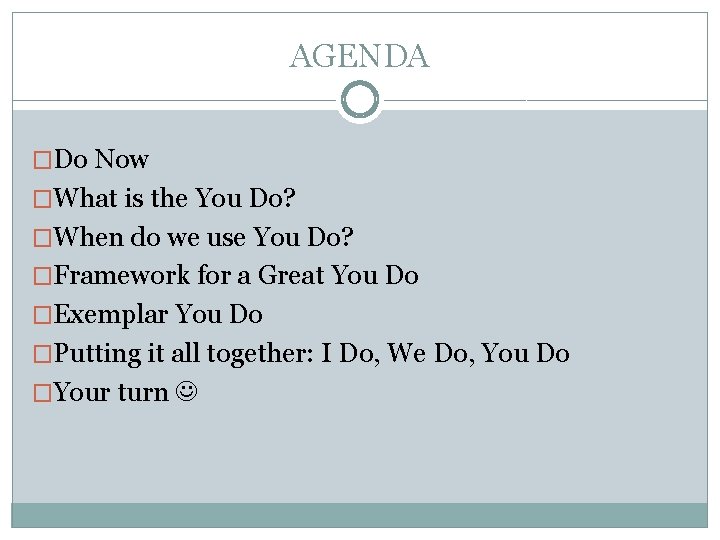
AGENDA �Do Now �What is the You Do? �When do we use You Do? �Framework for a Great You Do �Exemplar You Do �Putting it all together: I Do, We Do, You Do �Your turn
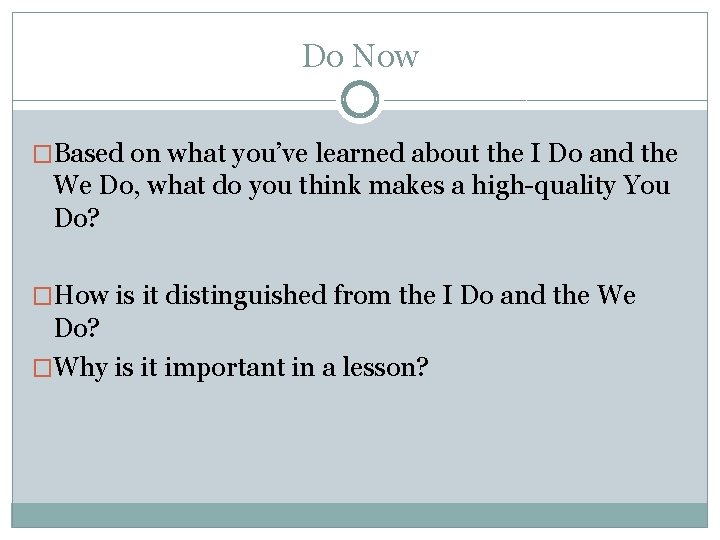
Do Now �Based on what you’ve learned about the I Do and the We Do, what do you think makes a high-quality You Do? �How is it distinguished from the I Do and the We Do? �Why is it important in a lesson?
What is the You Do? �It is the part of the lesson where students individually practice a written application of the objective.
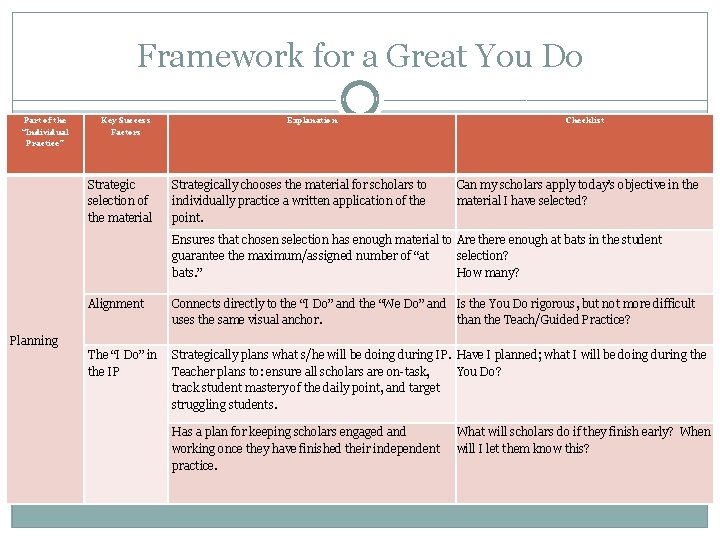
Framework for a Great You Do Part of the “Individual Practice” Key Success Factors Strategic selection of the material Explanation Strategically chooses the material for scholars to individually practice a written application of the point. Checklist Can my scholars apply today’s objective in the material I have selected? Ensures that chosen selection has enough material to Are there enough at bats in the student guarantee the maximum/assigned number of “at selection? bats. ” How many? Alignment Connects directly to the “I Do” and the “We Do” and Is the You Do rigorous, but not more difficult uses the same visual anchor. than the Teach/Guided Practice? The “I Do” in the IP Strategically plans what s/he will be doing during IP. Have I planned; what I will be doing during the Teacher plans to: ensure all scholars are on-task, You Do? track student mastery of the daily point, and target struggling students. Planning Has a plan for keeping scholars engaged and working once they have finished their independent practice. What will scholars do if they finish early? When will I let them know this?
Example vs. Exemplar �Look at the sample learning ladders in your packet (MS Science). Compare the You Do in each one by asking: Is it relevant/aligned to the rest of the lesson and objective? Do students have enough opportunity to practice? Is it the same level of rigor as the other parts of the lesson? Is there a clear plan for teacher actions? Will students be engaged in the learning?
Your turn �Continue working on the learning ladder from the We Do session. �In content area groups, begin to plan how students will practice this skill during the You Do of the lesson.
Check �What makes a quality You Do? (5 components) �What makes a quality We Do? (5 components) �What makes a quality I Do? (5 components) �What makes a quality Objective? (4 components)