
Learning journeys and success perspectives on conceptual threshold


- Slides: 60
Learning journeys and success: perspectives on conceptual threshold crossings for graduate students and supervisors – particular focus on the literature review Gina Wisker 1
Some thoughts The best masters or doctorate is the one you finish and hand in. 2
�This research and these ideas arise from working at postgraduate level, then with postgraduates �Asking �What makes good research learning? �How do you know you are working at a conceptual critical and creative enough level for successful postgraduate work? �What are the signs of this and how do they relate to the stages of the research learning? �How do you move beyond stuck places? �How can supervisors, communities and your own behaviours nudge the learning development and recognition of it? 3
Overview �Threshold concepts (Meyer and Land 2006) �Conceptual threshold crossings (Wisker, Kiley, Robinson 2008 --) �Early work (Wisker, Kiley, Trafford & Leshem) has started to identify threshold concepts and conceptual thresholds at the research education level (EARLI 2007, QPR 2006, 2008, Threshold concepts conferences 2006, 2008, 2010, 2012; EARLI 2009) �Postgraduates’ experiences with threshold concepts and conceptual threshold crossing �Supervisors’ experiences of identifying students’ conceptual 4 threshold crossing and ‘nudging’ them across.
�Conceptual Threshold Crossing in Doctoral Learning Journeys �We developed the notion of conceptual threshold crossings to identify moments when postgraduate students make learning leaps and begin to work at a more conceptual critical and creative fashion�Developed from threshold concepts in the disciplines 5
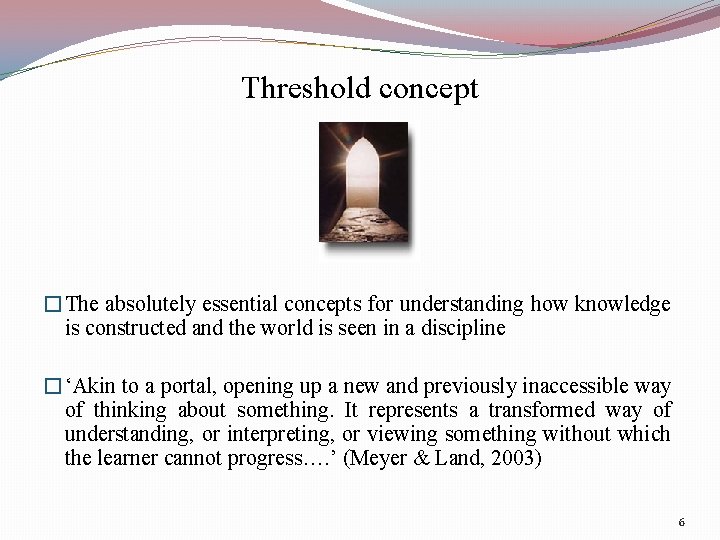
Threshold concept �The absolutely essential concepts for understanding how knowledge is constructed and the world is seen in a discipline �‘Akin to a portal, opening up a new and previously inaccessible way of thinking about something. It represents a transformed way of understanding, or interpreting, or viewing something without which the learner cannot progress…. ’ (Meyer & Land, 2003) 6
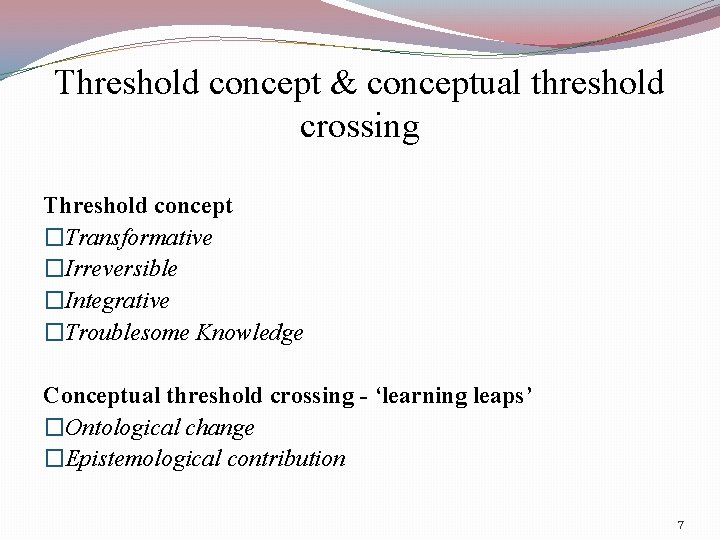
Threshold concept & conceptual threshold crossing Threshold concept �Transformative �Irreversible �Integrative �Troublesome Knowledge Conceptual threshold crossing - ‘learning leaps’ �Ontological change �Epistemological contribution 7
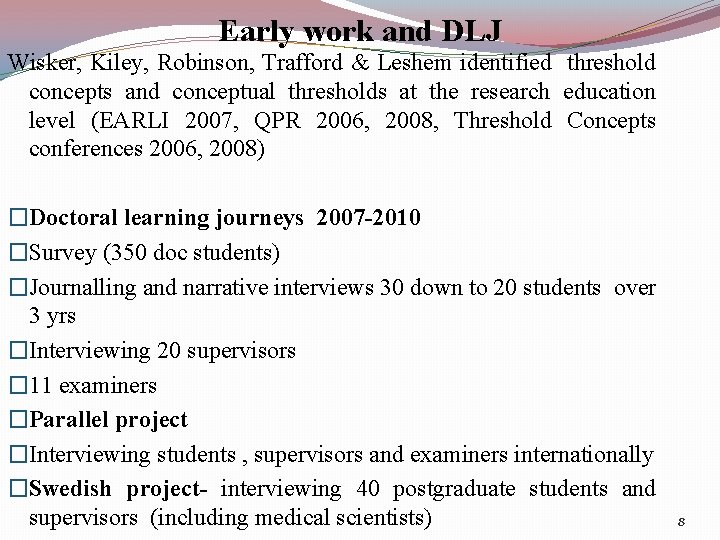
Early work and DLJ Wisker, Kiley, Robinson, Trafford & Leshem identified threshold concepts and conceptual thresholds at the research education level (EARLI 2007, QPR 2006, 2008, Threshold Concepts conferences 2006, 2008) �Doctoral learning journeys 2007 -2010 �Survey (350 doc students) �Journalling and narrative interviews 30 down to 20 students over 3 yrs �Interviewing 20 supervisors � 11 examiners �Parallel project �Interviewing students , supervisors and examiners internationally �Swedish project- interviewing 40 postgraduate students and supervisors (including medical scientists) 8
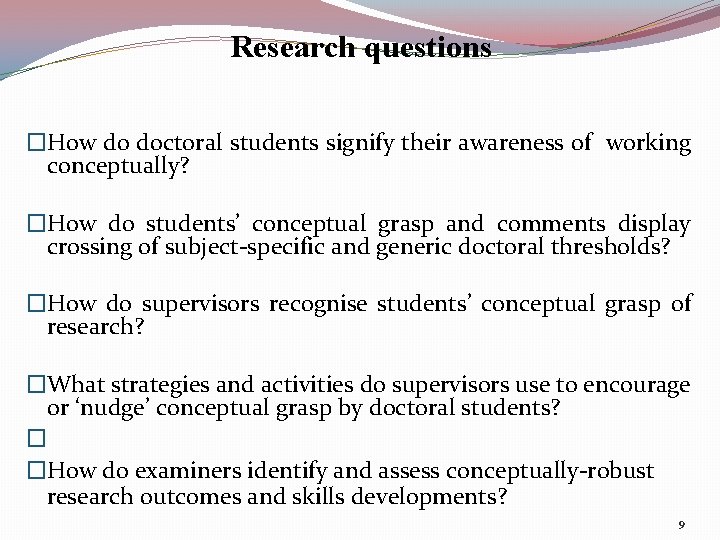
Research questions �How do doctoral students signify their awareness of working conceptually? �How do students’ conceptual grasp and comments display crossing of subject-specific and generic doctoral thresholds? �How do supervisors recognise students’ conceptual grasp of research? �What strategies and activities do supervisors use to encourage or ‘nudge’ conceptual grasp by doctoral students? � �How do examiners identify and assess conceptually-robust research outcomes and skills developments? 9
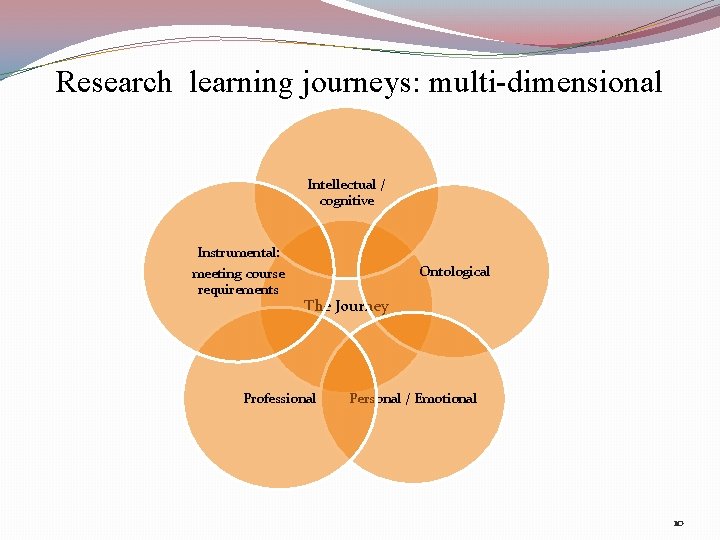
Research learning journeys: multi-dimensional Intellectual / cognitive Instrumental: meeting course requirements Ontological The Journey Professional Personal / Emotional 10
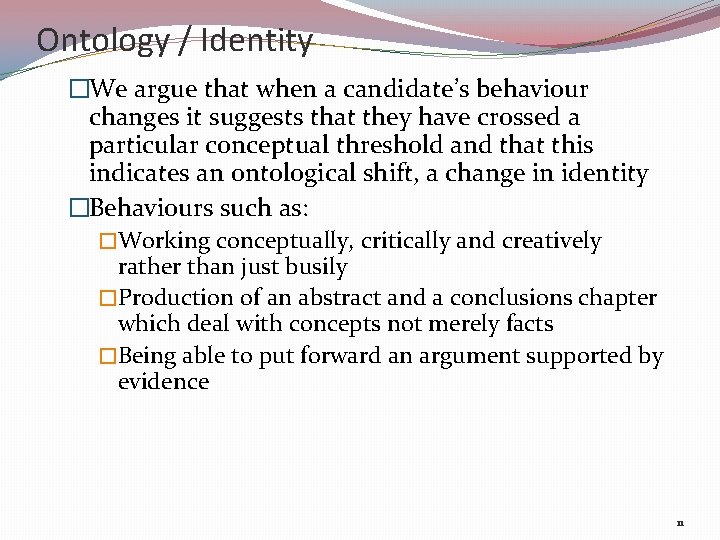
Ontology / Identity �We argue that when a candidate’s behaviour changes it suggests that they have crossed a particular conceptual threshold and that this indicates an ontological shift, a change in identity �Behaviours such as: �Working conceptually, critically and creatively rather than just busily �Production of an abstract and a conclusions chapter which deal with concepts not merely facts �Being able to put forward an argument supported by evidence 11
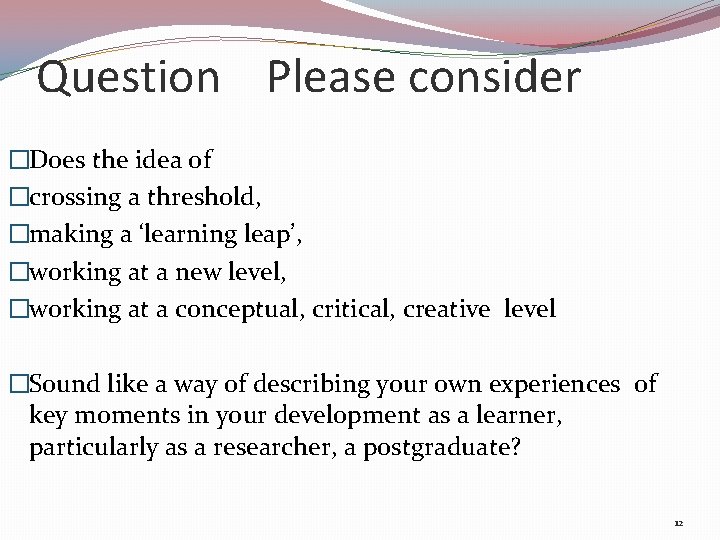
Question Please consider �Does the idea of �crossing a threshold, �making a ‘learning leap’, �working at a new level, �working at a conceptual, critical, creative level �Sound like a way of describing your own experiences of key moments in your development as a learner, particularly as a researcher, a postgraduate? 12
Themes from the survey of 350 doctoral students in the UK �Discovery – the identification of a new theory, theorist or concept that encapsulates thinking �Synthesis – the bringing together of two or more concepts to create a new concept �Verbal – the discovery of new ways of thinking as a result of discussion or the recognition of knowledge sufficient to defend a position However�Mechanical – almost superficial adoption of conceptual position to satisfy requirements of discipline �Innate – ‘I always thought this way’ 13
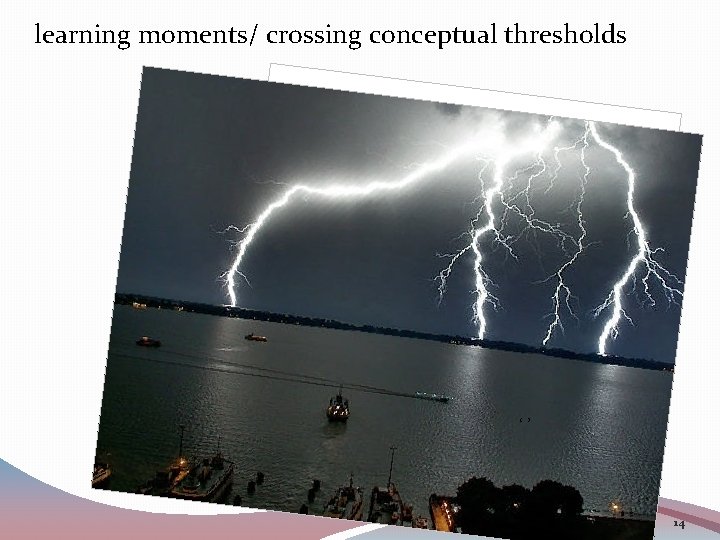
learning moments/ crossing conceptual thresholds ‘’ 14
Learning moments where students indicate conceptual threshold crossing In both the survey and interviews, postgraduate students have used a variety of metaphors to describe their learning journeys and experiences. Learning leaps are often described metaphorically, in visual terms (‘a lightbulb moment’) or kinaesthetic terms (‘things clicked into place’) � as are moments where students feel they are stuck, e. g. ‘I hit a brick wall’. The learning moments are more likely to occur when researchers : � Identify research questions; � In the literature review-Determine relationships between existing theories and their own work; � devise methodology and engage with methods; � Analyse and interpret data � See self as ‘researcher’, practitioner within field, e. g. sociologist � Become part of academic community � Contribute knowledge, engaging in debate � Take ownership of and responsibility for work � Reach conclusions - conceptual as well as factual. � Present to peers and others. 15
Student responses: crossing a conceptual threshold. . �In terms of learning moments I think you have those small or medium moments every now and again, don’t you, when you read and you are exposed to new ideas and you think ah now, I’ve got it and then actually a couple of weeks later you’re a bit further but then you have another one of those moments and so you kind of gradually I guess get closer and closer to the final thing, the final shape of your theories and ideas about it. �(2 nd year Philosophy student) 16
�A couple of weeks ago I found that things have stopped …mentally I found myself up against a brick wall… I just felt that I was kind of stuck and it wasn’t moving and it was all bitty, I’d done all these chunks of work but I couldn’t really see how they fitted together and yeah so I reached quite a crisis point. Especially when I got negative feedback I just felt quite down hearted about it and, but like I say I think having the supervision, talking it through, taking a step back from everything, taking it to bits and being questioned about everything and then having to simplify everything, in order to present. I mean over a couple of days - my supervision was one day and my presentation was the next day… �I came out of that whole process feeling that I could kind of see it, I could see that there was shape there… I can see shapes. �(1 st year Gender Studies student) 17
�What can you do to nudge your students to work at a �Conceptual critical creative level? ? �Eg overview, 3 min thesis, presentations (refining it right down to simplify and clarify) 18
�Supervisor nudges �Supervision in a rescrch gro incorporating all levels - learn from each other, drive to succeed and improve �Encourage to read more, (and cleverly) analyse and extract rather than copy and paste �Ask people 2 things to delve into reading-evaluative comments alongside the comment from someone they’re reading �Use supportive evidence (not just copy from one) �Presentations 6 slides – helps focus down peers �Google wisely �Critique sup st, provoking to understand concepts and to develop the ‘I can’ mentality. And help shape project �Help develop foundation in writing skills first �Talk through the reading –help them find solutions �Regular deadlines and benchmarks �Force the research process eg journal club, involved at different parts of the organisation- arranging things themselves 19
Identifying conceptual threshold crossings �A stage/stages when students develop project ownership and researcher identity �New ideas- feeling the work becoming ‘clever’ �Theoretical breakthrough-literature review �Fieldwork breakthrough �Breakthrough in accepting supervisors’ guidance �New perspectives and more complex understanding enabled by dialogue, casting new light �A gradual process �A single process �A series of learning leaps 20
The literature review �This is where � 1) students start to work at a conceptual critical creative level (although initially it often looks like a hard slog and descriptive writing) � 2) students star t engaging in a dialogue in the field and writing. 21
What are the characteristics of a good literature review/ theoretical perspectives chapter? 22
Literature review �Our work with supervisors to support the development of the literature review/theoretical perspectives chapter –identifies this as a crucial moment /moments for ‘learning leaps’ conceptual threshold crossing �Where students begin to see their own work in a dialogue with �Theorists �Others using similar/ same theories in critical practice �See how they contribute to the field 23
Developing critical thinking as part of dealing with the literature Critical thinking is crucial in postgraduate research much of this involves questioning and problematising accepted ideas and information much of it involves engaging in a dialogue with others who have developed theories, carried out research Creating a dialogue between theoretical perspectives and research activity 24
� I ask �Have you identified theorists? �The critical users of these theories in practice? �The main contribution you are making to this dialogue between these experts �A good literature review is characterised by �Engagement with theories and experts in critical dialogue to which your work contributes �Eg ‘Previous work by…. . indicates…while the findings of …. seem to suggest that…. . My work with. . . argues that…and in so doing refutes…. 25
Suggestions to students undertaking a literature review �Read widely (more than you need)for context & debates �Take careful notes & record sources �Summarise only in order to engage in critical debate- your arguments arise from, relate to, are underpinned by the experts-content & methods 26
�Reading into the field is only one of the tasks �If you are unaware of debates in the field you might merely recreate them �You need to work out where your research engages with the debates and what it can add �Summary �Synthesis �Evaluation and reflection �Engagement in critique �Argument and dialogue with own work �Contribution to meaning –something new which is your own 27
�You continue to draw on the literature throughout the dissertaion with threads running through -underpinning, feeding into conceptual findings �Keep reading- but know where to stop 28
�(for students) Please Discuss�Who are YOUR main theorists? �Who are you reading in relation to theory and to method? �What are the debates in these areas ? �And how does YOUR work engage in a dialogue with these debates? �Are you working at a critical level? �How does this show in your expression? Not merely descriptive? ? ? �Is it theorised or merely stated? �Are you working at a conceptual level showing the contribution to knowledge new ideas, new meaning, understanding of meaning �how is this indicated in the choice of words, shape, links, claims? 29
Activities to identify the characteristics of sound use of literature in writing You can work from models of a key essay and ‘process it’ in terms of its introduction of the issues and major developments in the field, in context introduction and development of the major arguments , conflicts, trends and the work of (I)the major theorists (2) the major writers/researchers who put theories into practice 30
Modelling an activity �Read examples of essays which use a wide variety of literature �How do they use the literature ? �Is it a dead list? , is it merely summarised? , �Is there any organisation into themes? Issues, or developments, or contradictions or arguments in the field? 31
�Is it vague ? Too broad? Too narrow? Disorganised? Leading too widely? (remember boundaries!) �Do they summarise to add to debates ? �Do the texts read and written about here engage with the arguments developed by the author? �Is the discussion of the literature working at a summarising level or a conceptual level? �Is it properly referenced? And does it use quotation and extract appropriately? 32
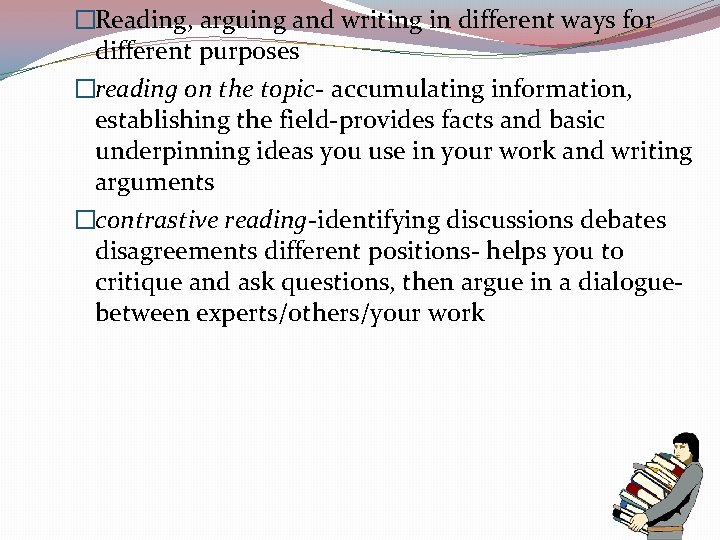
�Reading, arguing and writing in different ways for different purposes �reading on the topic- accumulating information, establishing the field-provides facts and basic underpinning ideas you use in your work and writing arguments �contrastive reading-identifying discussions debates disagreements different positions- helps you to critique and ask questions, then argue in a dialoguebetween experts/others/your work 33
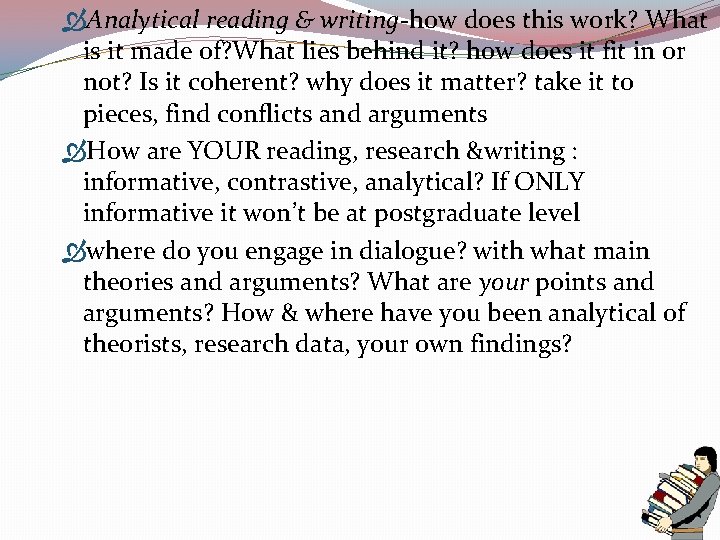
Analytical reading & writing-how does this work? What is it made of? What lies behind it? how does it fit in or not? Is it coherent? why does it matter? take it to pieces, find conflicts and arguments How are YOUR reading, research &writing : informative, contrastive, analytical? If ONLY informative it won’t be at postgraduate level where do you engage in dialogue? with what main theories and arguments? What are your points and arguments? How & where have you been analytical of theorists, research data, your own findings? 34
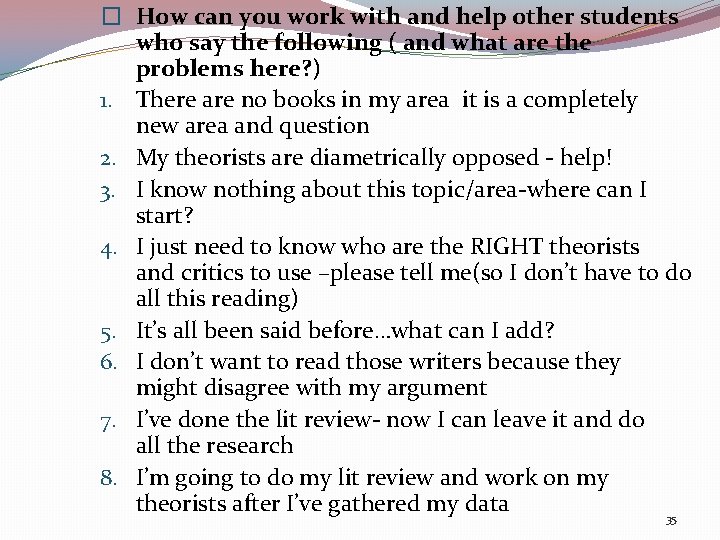
� How can you work with and help other students who say the following ( and what are the problems here? ) 1. There are no books in my area it is a completely new area and question 2. My theorists are diametrically opposed - help! 3. I know nothing about this topic/area-where can I start? 4. I just need to know who are the RIGHT theorists and critics to use –please tell me(so I don’t have to do all this reading) 5. It’s all been said before…what can I add? 6. I don’t want to read those writers because they might disagree with my argument 7. I’ve done the lit review- now I can leave it and do all the research 8. I’m going to do my lit review and work on my theorists after I’ve gathered my data 35
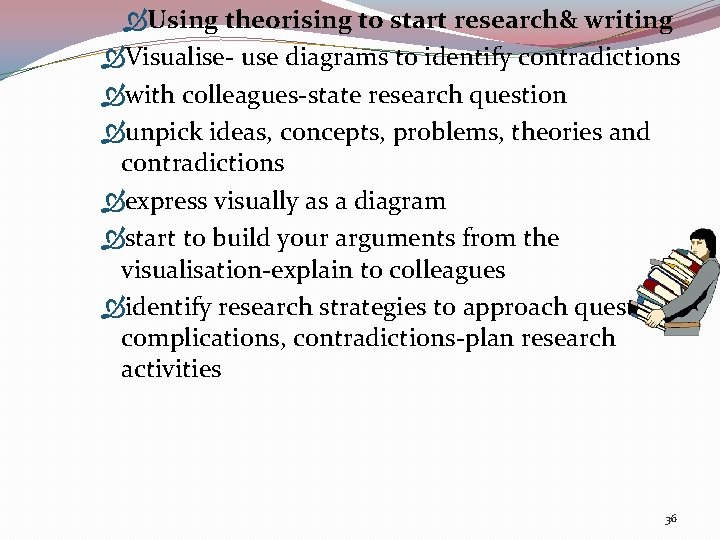
Using theorising to start research& writing Visualise- use diagrams to identify contradictions with colleagues-state research question unpick ideas, concepts, problems, theories and contradictions express visually as a diagram start to build your arguments from the visualisation-explain to colleagues identify research strategies to approach questions, complications, contradictions-plan research activities 36
Breaking blocks �Free writing-limited time, without stopping loosely round topic-frees up, then hone �‘Splurge’ writing about the topic, first thoughts, ungrammatical/punctuated/poor wording-developing ideas-return and shape �Start where you feel you have something to say- in the middle , in a section �annotate with scrawl-type up later &refine 37
�Write with a partner/colleague/in a writing groupshare, discuss, shape �Co referee then co edit each other’s work-ground rules, positive advice �Produce some staged work- annotated bibliography- explore key points of key texts indicating dialogue between them, and with own work 38
�Read through and critically evaluate a key essay in the field for: �establishing research question/main points, argument, intellectual rigour, engagement in dialogue with the literature & theories/ theorists , themes, evidence to back up claims, both conceptual & factual conclusions �coherence, organisation, clear abstract, introduction sets context, ability to sequence &hierarchise ideas & arguments- links between paragraphs & sections, referencing 39
Levels of work �Descriptive �Summarise �Synthesise �Critique �Analyse �Conceptualise �Problematise �Evaluate �Contribute something new �You might start anywhere with this developmental process- probably you need to do all of it at different stages 40
Becoming a researcher-identity-developing a ‘voice’ ‘As time goes on and you start to, you almost develop this skin that is academic and this persona within yourself and as you… get the feedback that comes back and you’re thinking about you’re doing this the right way and so you begin to start, it’s like watching a butterfly I suppose emerge from chrysalis pupa or pupa chrysalis and so on like that and so you begin to develop and I think as that goes on then you gain a certain amount of confidence. ’ 41
Becoming part of an Academic Community ‘A big learning experience for me has been that doing a doctorate is not a search for the truth but is really just taking part in a conversation. This doesn’t stop me thinking that an 'expert' knows all of the answers and I suppose this is about confidence on my part… [But they don’t have my experience] So how can they know everything? and what I have to offer is just as important as theirs, and I suppose that is also a learning experience in that when I sit with the 'learned' in a conference I feel confident in challenging them as I now see myself as a peer. ’ 42
Integration �And then there are these wonderful moments where things just slot into place, but only after a long engagement and in depth knowledge …then suddenly all relates to each other, like my argument is revealing itself to me. Of course this isn’t the case… I can’t really explain what happens, but it does feel like the pieces of my puzzle physically move towards each other. (S 10) 43
Nudges �Some of the visual prompts and metaphors I use to support students’ thinking then acting 44
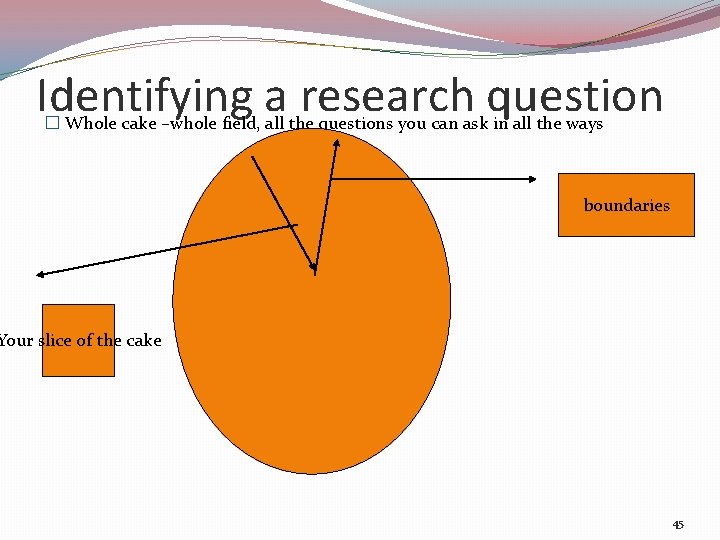
Identifying a research question � Whole cake –whole field, all the questions you can ask in all the ways boundaries Your slice of the cake 45
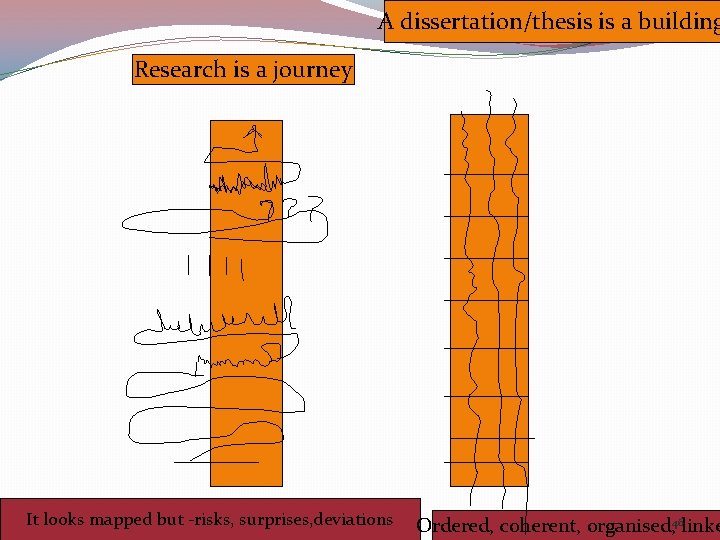
A dissertation/thesis is a building Research is a journey It looks mapped but -risks, surprises, deviations Ordered, coherent, organised, 46 linke
(student) ‘A beautifully architected building is fairly misleading. It is the work, the result of being up here on the journey. ’ ‘No wonder it is so daunting for the rest of us to consider constructing such a building, because we are not actually anywhere near where we could build it. A mud hut is as much as I could hand in at the moment. ‘ 47
48
Supervisors �Supervisors’ comments (from parallel research) on recognising students’ work that evidences that they have: �acquired and owned various threshold concepts, and �crossed conceptual thresholds �In the following discussions, posts and interviews, supervisors identify their recognition of threshold crossing, and their thoughts about what ‘nudges’ students across. �How can they identify the crossing moments and the qualities? �How can they nudge? �what are YOUR views? 49
Support provided by supervisors and community �Confidence building �Suggestions on literature search �Encourage students to experiment �Students involvement with research community (seminars, conferences, and group study) 50
Supervisors: Increased confidence Well, they’ve got an extra dose of confidence. They’ve got an extra dose of clarity. They’re more confident, they’re clearer, and they’re probably very inspired to go and do something else quickly, to take advantage of those changes. I think that’s right. (S 8) 51
Writing �In terms of the reports they can give to you, you can see they’ve become more sophisticated in their thought process, they’re more sophisticated in their analysis of what they’re looking at and as to how they’re thinking (S 9) 52
Improved writing Well, there are times when students start bringing you written work that begins to look like it could go in the final thesis, whereas initially it doesn’t. In that sense, you know, there’s a point at which the first time you say to a student, “Look you’ve written something here which I could see could go in the final thesis, ” that for them is a very significant moment, I think. In that sense their whole thinking has moved forward between that and the last piece of written work (S 7) 53
Conference presentation They could be things that happen externally, they could be somebody does a conference presentation and they realise that their work is comparable with other people presenting (S 6) 54
Confidence building through challenging I think it’s very important that, you know, the supervisors are able to challenge what the student is writing down and actually saying about the literature. Sometimes students are a bit frightened about critically appraising other people’s work. it’s not until they get to the end of their Ph. D, when they’ve transferred, and you say right, now it’s time to go back and have a look at this chapter, see what you think about these people’s writing now, and it comes back and it’s quite different. So I think there is something in there about building confidence and I think you can do that, you can try to do it early on. (S 7) 55
�When they are writing that’s when I work really hard with the students. They send me each chapter sometimes several chapters. It’s me that goes through the threshold. 56
57
Overall what helps-… �Ensuring a boundaried (doable) and conceptual enough question �Early focus on conceptual framework, methodology and methods �Very close reading and focus on dialoguing with experts in the literature review/theoretical perspectives chapter �Oral prompting of conceptual, critical work individually in supervisions and in groups �Prompt feedback encouraging conceptual and critical work �Models, dialogues, pointing out contradictions and tensions and urging incorporation for critical conceptual engagement 58
59
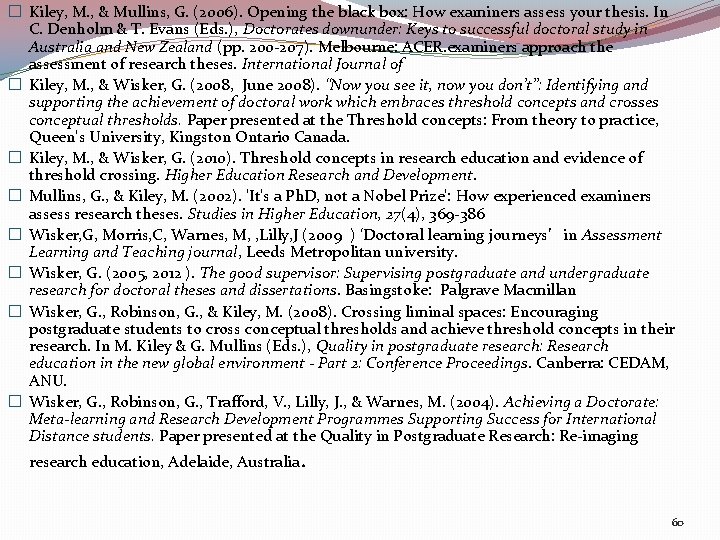
� Kiley, M. , & Mullins, G. (2006). Opening the black box: How examiners assess your thesis. In C. Denholm & T. Evans (Eds. ), Doctorates downunder: Keys to successful doctoral study in Australia and New Zealand (pp. 200 -207). Melbourne: ACER. examiners approach the assessment of research theses. International Journal of � Kiley, M. , & Wisker, G. (2008, June 2008). “Now you see it, now you don’t”: Identifying and supporting the achievement of doctoral work which embraces threshold concepts and crosses conceptual thresholds. Paper presented at the Threshold concepts: From theory to practice, Queen's University, Kingston Ontario Canada. � Kiley, M. , & Wisker, G. (2010). Threshold concepts in research education and evidence of threshold crossing. Higher Education Research and Development. � Mullins, G. , & Kiley, M. (2002). 'It's a Ph. D, not a Nobel Prize': How experienced examiners assess research theses. Studies in Higher Education, 27(4), 369 -386 � Wisker, G, Morris, C, Warnes, M, , Lilly, J (2009 ) ‘Doctoral learning journeys’ in Assessment Learning and Teaching journal, Leeds Metropolitan university. � Wisker, G. (2005, 2012 ). The good supervisor: Supervising postgraduate and undergraduate research for doctoral theses and dissertations. Basingstoke: Palgrave Macmillan � Wisker, G. , Robinson, G. , & Kiley, M. (2008). Crossing liminal spaces: Encouraging postgraduate students to cross conceptual thresholds and achieve threshold concepts in their research. In M. Kiley & G. Mullins (Eds. ), Quality in postgraduate research: Research education in the new global environment - Part 2: Conference Proceedings. Canberra: CEDAM, ANU. � Wisker, G. , Robinson, G. , Trafford, V. , Lilly, J. , & Warnes, M. (2004). Achieving a Doctorate: Meta-learning and Research Development Programmes Supporting Success for International Distance students. Paper presented at the Quality in Postgraduate Research: Re-imaging research education, Adelaide, Australia . 60