
Learning is a never ending process Warm Welcome







- Slides: 69
Learning is a never ending process Warm Welcome PGDM-2013 -15 ge ge d e wl n ha c Ex & In form atio n Ce ntre o Kn KEIC – Always at Your Service ge 7/5/13 Gatew a owled n K o t y
I Love KEIC Campaign Only Students can write Well absolutely - KEIC and the staff running it are both totally cool “Rockstars” in their own right. - A complete savior in every situation of knowledge quest for us “MICAns” be it assignments, competition or creative presentations. KEIC is the answer. -How to be a “Rockstar”? Learn from KEIC team and look no elsewhere. Experience the rocking show of KEIC at MICA. Ritu Jhajharia (Batch: - 2011 -2013) [22 -03 -2012] 7/5/13
Information Literacy Programme By KEIC Team Member 7/5/13
Knowledge Worker • • • Dr. Shailesh R. Yagnik Mr. Niraj R. Patel (Pursuing Ph. D. ) Dr. Lavji Zala Mr. Ashok Chauhan (Pursuing BLIS) Mr. Bhikhabhai Chuahan, (Pursuing MLIS) Mr. Anil Chauhan 7/5/13
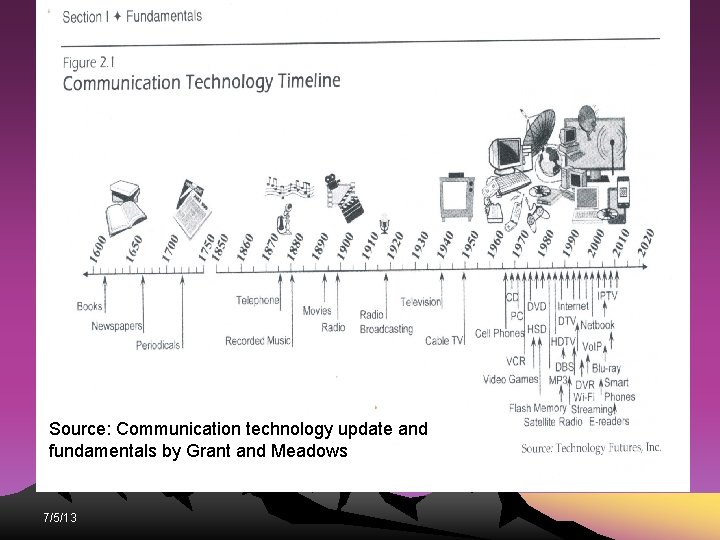
Communications Timeline 1790 1690 Source: Communication technology update and fundamentals by Grant and Meadows 7/5/13
The Power of Knowledge 7/5/13
(6 Letters)______From Knowledge 7/5/13
Information Literacy Programme • Introduction • Data/Information/Knowledge • Requirements Analysis • Knowledge Management • Information Sources/KEIC/Libraryonline • Literature Search • Plagiarism • Citing Reference 7/5/13
Knowledge Exchange & Information Centre (KEIC) 7/5/13
WHY KEIC ? Update the information/knowledge Assignment Submission Presentation, Project Literature Survey, Research/Dissertation Placement 7/5/13
Introduction • Users Driven – Role in selection and Recommendations • Timings - Monday 9 a. m. – Saturday 10 p. m. - Sunday 9 a. m. – 6 p. m. • keiconline 24/7 • Eight books per member (No Library card) for one month • No Periodicals will be Issued • No baggage’s inside the library • Mobile (silent mode) and not to attend a call inside the KEIC 7/5/13
New Initiatives • Discussion Room • Human Book 7/5/13
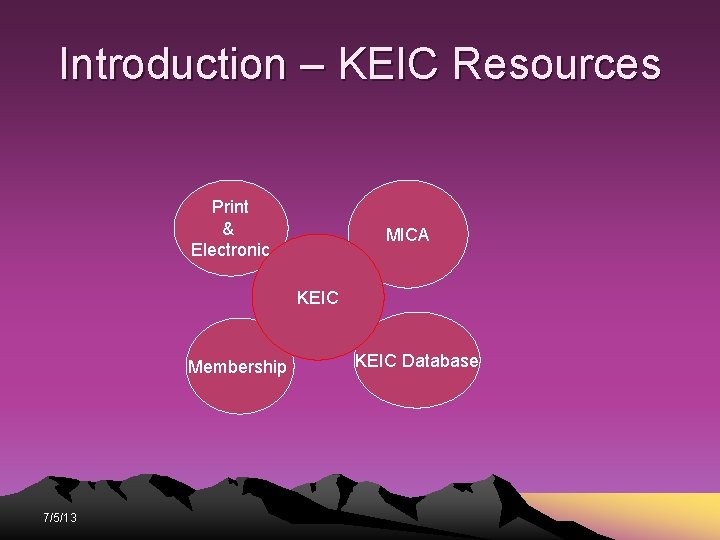
Introduction – KEIC Resources Print & Electronic MICA KEIC Membership 7/5/13 KEIC Database
Membership • Advertising – International • Advertising Research Foundation (ARF), USA • American Academy of Advertising (AAA), USA – National • • 7/5/13 Audit Bureau of Circulations (ABC), Mumbai The Advertising Club Bombay (ACB), Mumbai The Advertising Standards Council of India (ASCI) Indian Society of Advertisers (ISA), Mumbai
Membership • Communication – International • Asian Media Information and Communication Centre of India (AMIC), Singapore • Association for Education in Journalism and Mass Communication (AEJMC), USA • Broadcast Education Association (BEA), Washington, USA • International Communication Association (ICA), USA 7/5/13
Membership • Library and Info. Science – National • Ahmedabad Library Network (ADINET), Ahmedabad • The British Council Library, Ahmedabad • Vikram Sarabhai Library (IIMA) • INDEST – AICTE Consortium • UGC Info. Net Digital Library Consortium (Inflibnet) • DELNET, New Delhi 7/5/13
Membership • Management – International • Design Management Institute (DMI), USA • European Case Clearing House (ECCH), UK – National • • 7/5/13 All India Management Association (AIMA), New Delhi Association of Indian Management Scholars (AIMS), Pune Consumer Education and Research Society (CERS), Ahmedabad Federation of Indian Chambers of Commerce and Industry (FICCI), New Delhi
Interlibrary Loan • National Institute of Design, Ahmedaad • Dhirubhai Ambani Institute of Information & Communication Technology, Gandhinagar • Indian Institute of Technology, Gandhinagar • DELNET, New Delhi 7/5/13
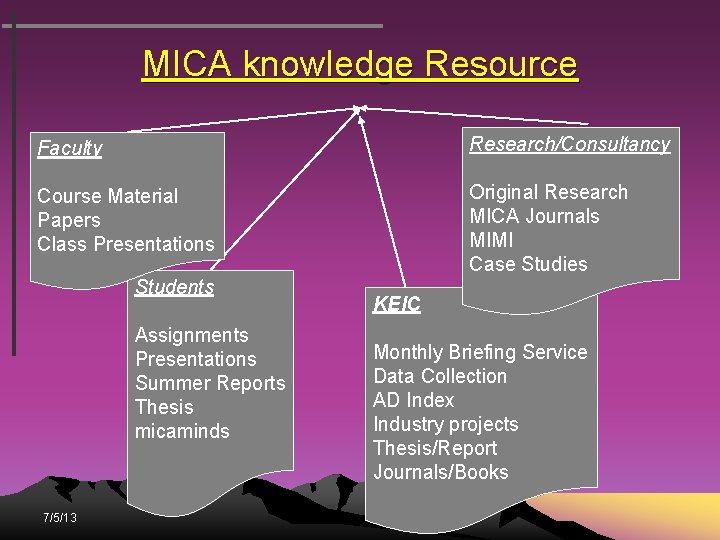
MICA knowledge Resource Faculty Research/Consultancy Course Material Papers Class Presentations Original Research MICA Journals MIMI Case Studies Students Assignments Presentations Summer Reports Thesis micaminds 7/5/13 KEIC Monthly Briefing Service Data Collection AD Index Industry projects Thesis/Report Journals/Books
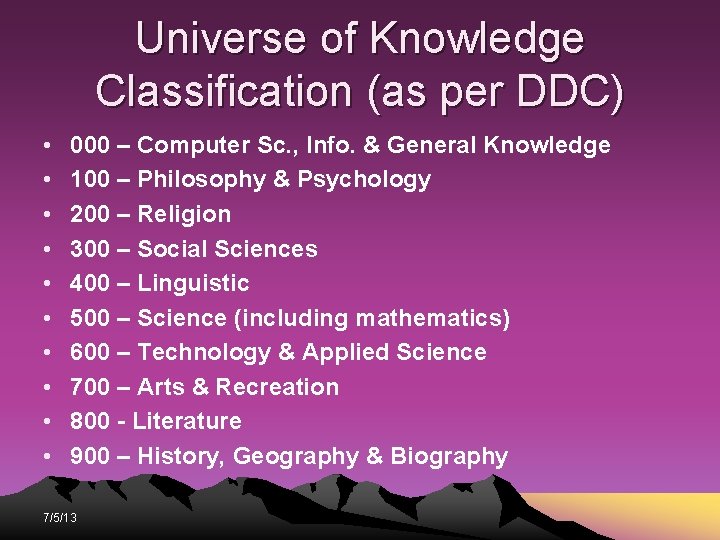
Universe of Knowledge Classification (as per DDC) • • • 000 – Computer Sc. , Info. & General Knowledge 100 – Philosophy & Psychology 200 – Religion 300 – Social Sciences 400 – Linguistic 500 – Science (including mathematics) 600 – Technology & Applied Science 700 – Arts & Recreation 800 - Literature 900 – History, Geography & Biography 7/5/13
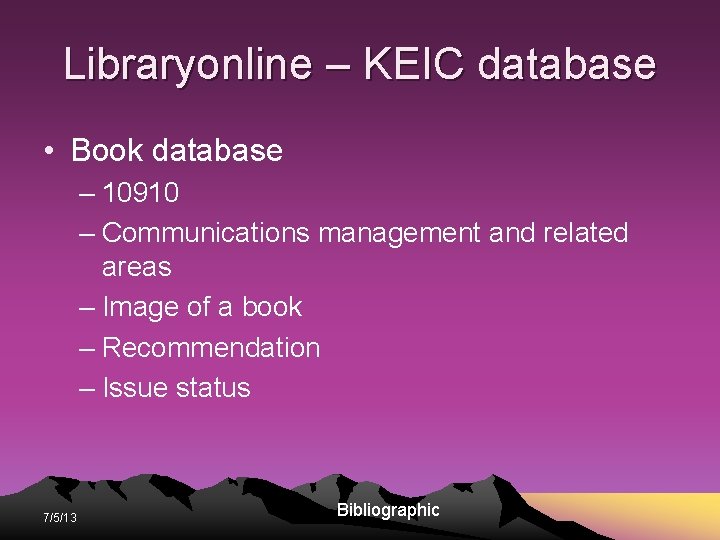
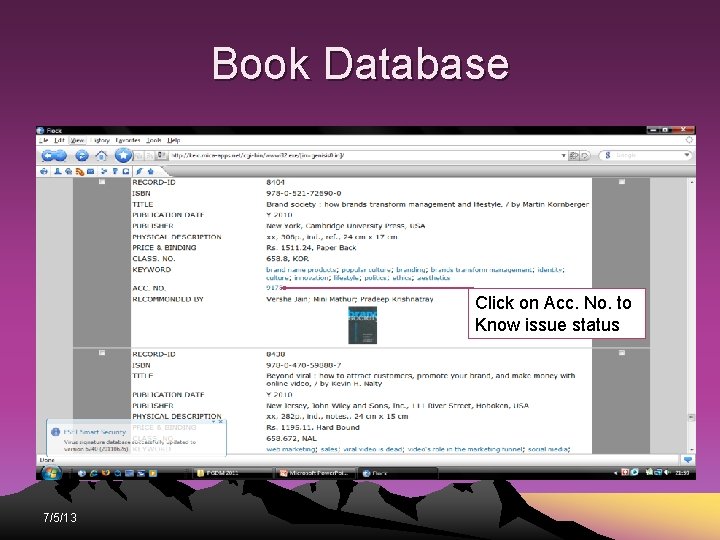
Libraryonline – KEIC database • Book database – 10910 – Communications management and related areas – Image of a book – Recommendation – Issue status 7/5/13 Bibliographic
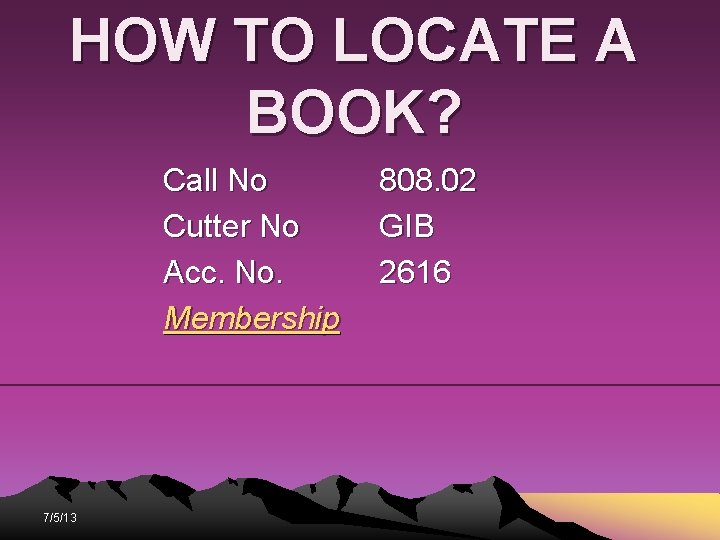
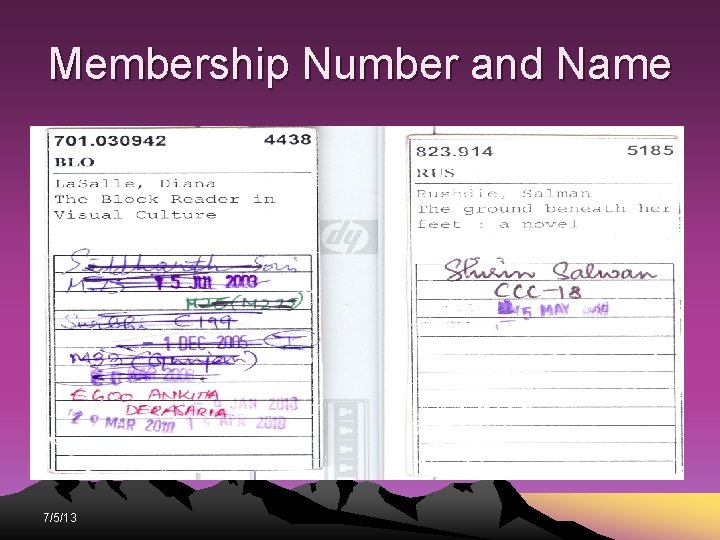
HOW TO LOCATE A BOOK? Call No Cutter No Acc. No. Membership 7/5/13 808. 02 GIB 2616
Book Database Click on Acc. No. to Know issue status 7/5/13
Membership Number and Name 7/5/13
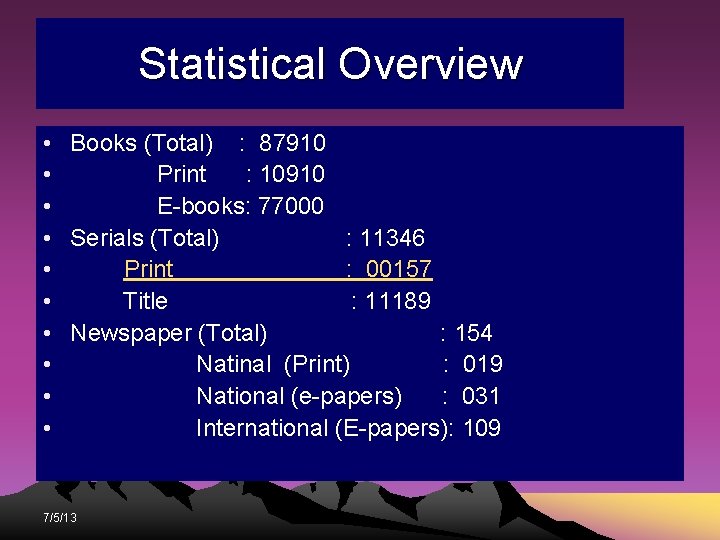
Statistical Overview • Books (Total) : 87910 • Print : 10910 • E-books: 77000 • Serials (Total) : 11346 • Print : 00157 • Title : 11189 • Newspaper (Total) : 154 • Natinal (Print) : 019 • National (e-papers) : 031 • International (E-papers): 109 7/5/13
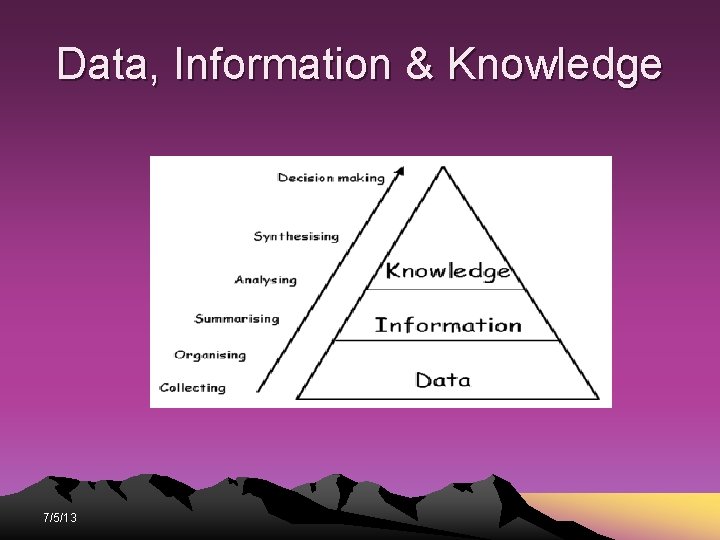
Data, Information & Knowledge 7/5/13
Requirement Analysis • New Product Launch – Identifying business opportunity – Design and development – Positioning – Sales channels – Distribution – Advertising – Public Relations 7/5/13
Knowledge Management 7/5/13
Knowledge Management – Tacit 7/5/13
Knowledge Management - Explicit 7/5/13
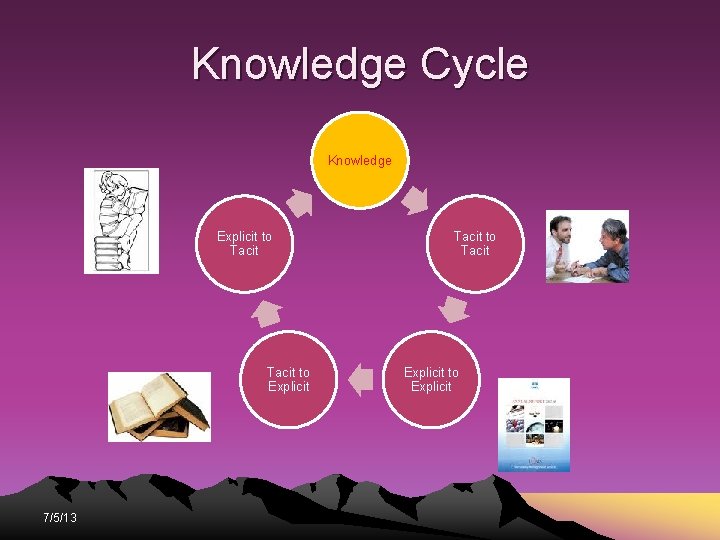
Knowledge Cycle Knowledge Explicit to Tacit to Explicit 7/5/13 Tacit to Tacit Explicit to Explicit
Literature search 7/5/13
CONDUCTING LITERATURE SEARCH Literature search is the means to bridge the gap that has created because of vast literature and lack of time to update regularly oneself. 7/5/13
When to do a research • A literature review always comes first and proceeds the final formulation of a research question and the implementation of the study 7/5/13
Why Review The Literature • To familiarize yourself with previous research on your select topic • To critically determine the level of theory and knowledge development relevant to your problem • To determine the relevance of the current research • To determine a rationale for the selection of your research strategy 7/5/13
How will the review help the research • Become aware of how others approached and resolved problems • Direct your research in different ways • Inability to find literature that will support your position of strengthen a theory or hypothesis • Help design your research based on previous good or flawed research 7/5/13
How to conduct of literature search • • • 7/5/13 Determine when to do a research Delimit what is searched Access data base for periodicals and documents Organize the information Critically evaluate the literature Write the literature review
Writing the literature review • The writing of the literature review is to justify your research, or for a manuscript describe the completed research project • The literature review should not only present an overview but should also critically examine the previous research 7/5/13
SOURCES OF INFORMATION Primary Secondary Tertiary Non-Documentary Internet 7/5/13
PRIMARY SOURCE First published records of original research and development or description of new application or new interpretation of an old theme or idea. Primary sources are published in variety of forms 7/5/13
SECONDARY SOURCES Information are those which either compiled from or refer to primary sources of information. This information is Modified, Selected Recognized. 7/5/13
TERTIARY SOURCES Contain information distilled and collected from primary and secondary sources. Bibliography of bibliographies Directories Guide to Literature 7/5/13
NON-DOCUMENTARY SOURCES Formal - Organization Informal - Individual 7/5/13
SEARCH STRATEGY • Subject/Topic (Impact of TV on Children) • Scope (sources) • Time Period to be Covered • Avoid Duplication 7/5/13
SEARCH STRATEGY Name: Eyeglasses UT: Spectacles BT: Optical Devices NT: Sunglasses RT: Contact Lenses Brand Name, Generic Name Company Name 7/5/13
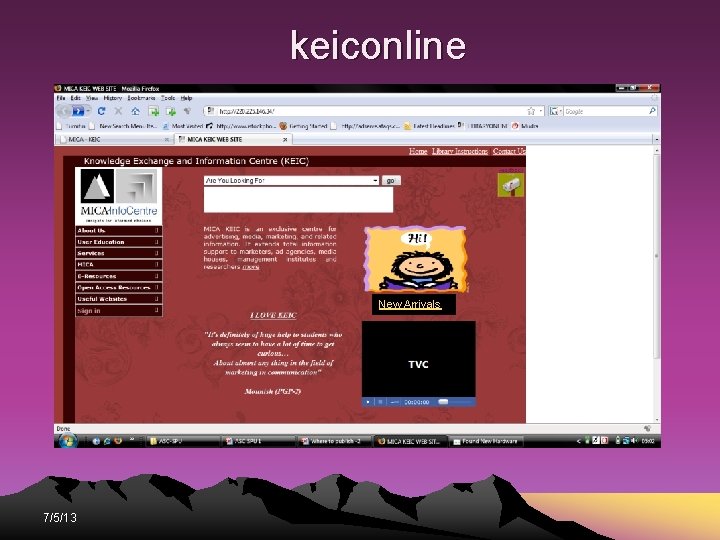
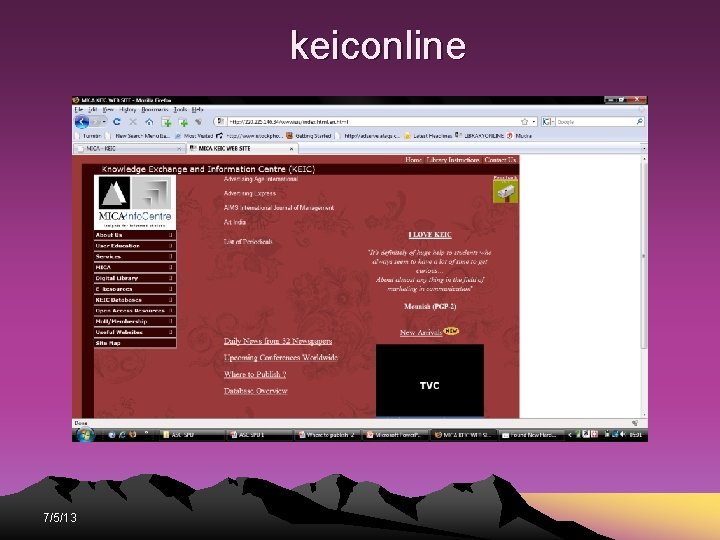
KEIC Access • IP Address: http: //keic. mica-apps. net/ or 10. 0. 0. 5 • User name: pgp 1 • Password: firstone 7/5/13
keiconline New Arrivals 7/5/13
keiconline 7/5/13
Important Sources • Census of India • TAM (TRP) • Audit Bureau of Circulations & Indian Newspaper Society (IRS) • White Book 2012 -13 • NCAER • NSSO • CSO • Planning Commission • RBI 7/5/13
Thank You KEIC – Always at Your Service 7/5/13
Style Manual • Modern Language Association (MLA) • American Psychological Association (APA) • Chicago Style Manual • American Marketing Association (AMA) • American Anthropological Association (AAA) 7/5/13
When to cite? • Work of those individuals who have directly influenced your work – Ideas – Theories – Research 7/5/13
Citing reference • Citation of an article implies that you have personally read and cited work. 7/5/13
Why Cite Sources? • Provide a way to give proper credit to the sources used in writing the paper • Enables the reader to find the information for themselves • Adds credibility and provides strength for arguments 7/5/13
How to cite sources? • Quoting from a source (copying from the source word to word) • Summarizing or rephrasing information from a source into one’s own words • Demonstrating awareness about previous research 7/5/13
In-Text References • Direct Quote (Mid-sentence) – Use the author’s surname followed immediately by the copyright year in brackets and the page or paragraph for non-paginated materials from which the information was copied in brackets at the end of the sentence Or Direct Quote (at the end) – Use the author’s surname, copy right year, and page or paragraph in brackets at the end of the sentence immediately after the quotation marks 7/5/13
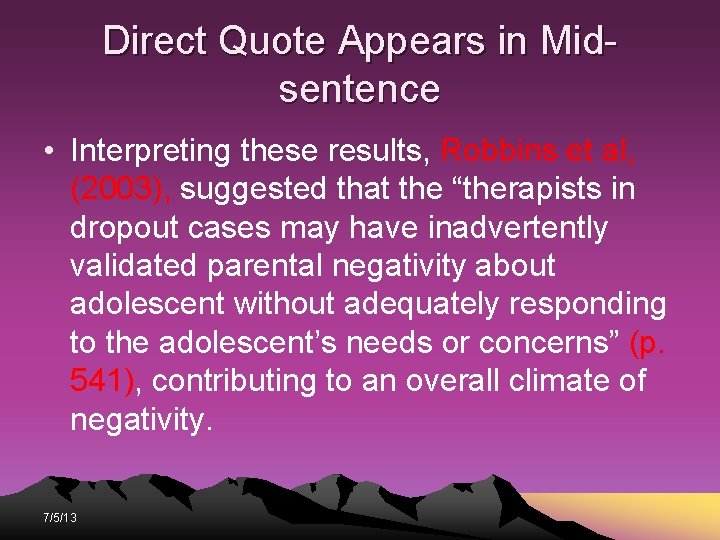
Direct Quote Appears in Midsentence • Interpreting these results, Robbins et al, (2003), suggested that the “therapists in dropout cases may have inadvertently validated parental negativity about adolescent without adequately responding to the adolescent’s needs or concerns” (p. 541), contributing to an overall climate of negativity. 7/5/13
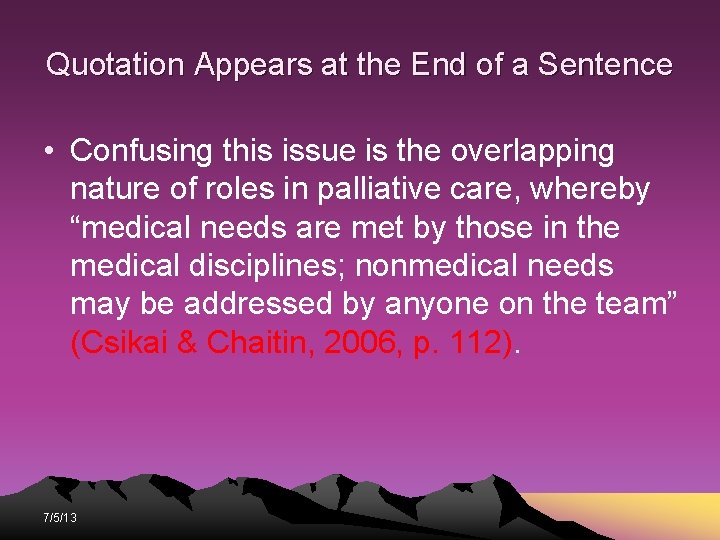
Quotation Appears at the End of a Sentence • Confusing this issue is the overlapping nature of roles in palliative care, whereby “medical needs are met by those in the medical disciplines; nonmedical needs may be addressed by anyone on the team” (Csikai & Chaitin, 2006, p. 112). 7/5/13
Paraphrasing • If you are paraphrasing an idea from another work, you only have to make reference to the author and year of publication in your in-text reference, but APA guidelines encourage you to also provide the page number (although it is not required. ) • According to Jones (1998), APA style is a difficult citation format for first-time learners. • APA style is a difficult citation format for first-time learners (Jones, 1998, p. 199). 7/5/13
Plagiarism 7/5/13
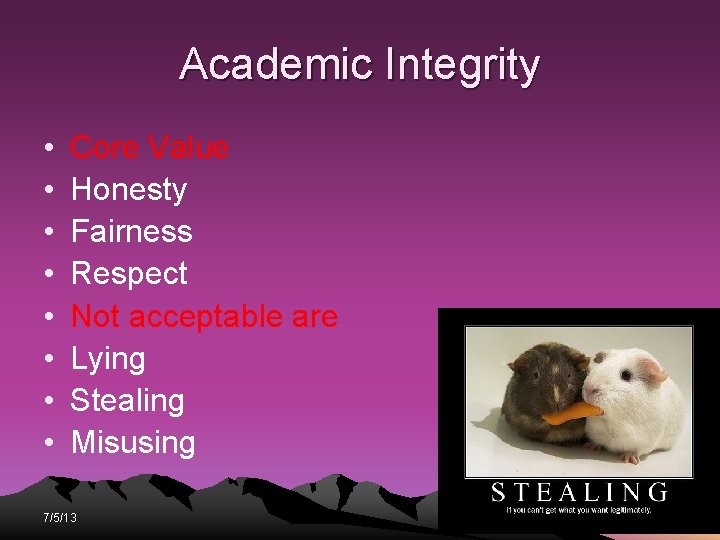
Academic Integrity • • Core Value Honesty Fairness Respect Not acceptable are Lying Stealing Misusing 7/5/13
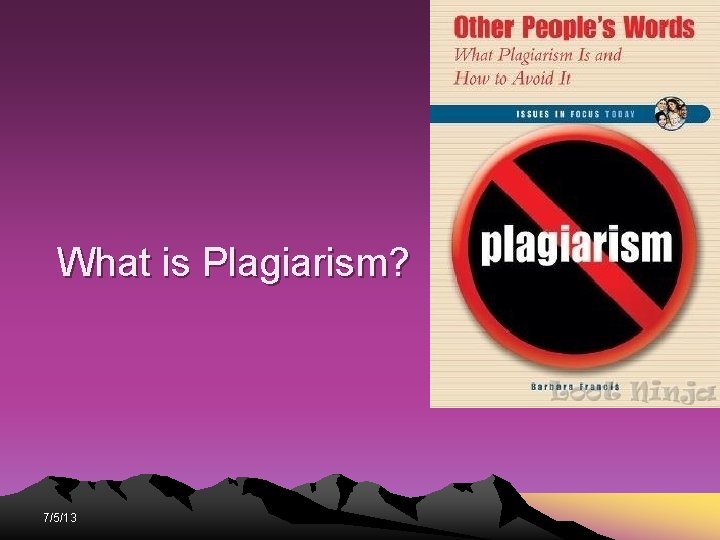
What is Plagiarism? 7/5/13
Definition 7/5/13
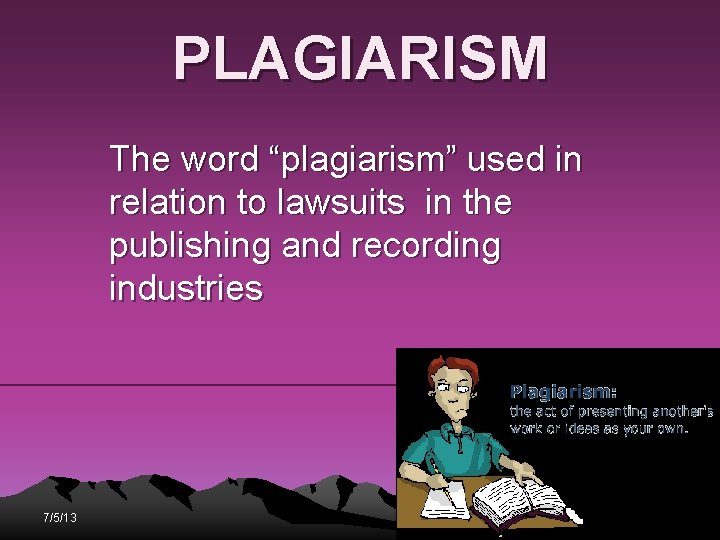
PLAGIARISM The word “plagiarism” used in relation to lawsuits in the publishing and recording industries 7/5/13
ACADEMIC PLAGIARISM Plagiarism is to give the impression that you have written of thought something that you have borrowed from someone else 7/5/13
ACADEMIC PLAGIARISM Plagiarism is the act of using another person’s ideas or expressions in your writing without acknowledging the source 7/5/13
ACADEMIC PLAGIARISM Plagiarism often carries severe penalties, ranging from failure in a course to expulsion from school 7/5/13
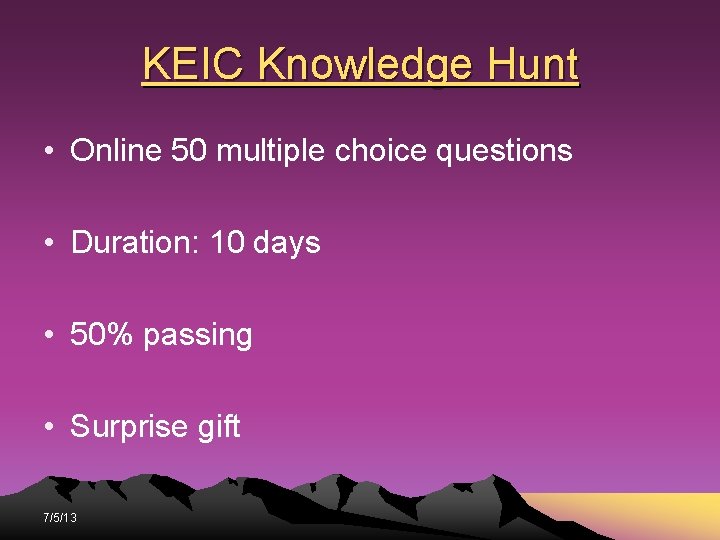
KEIC Knowledge Hunt • Online 50 multiple choice questions • Duration: 10 days • 50% passing • Surprise gift 7/5/13
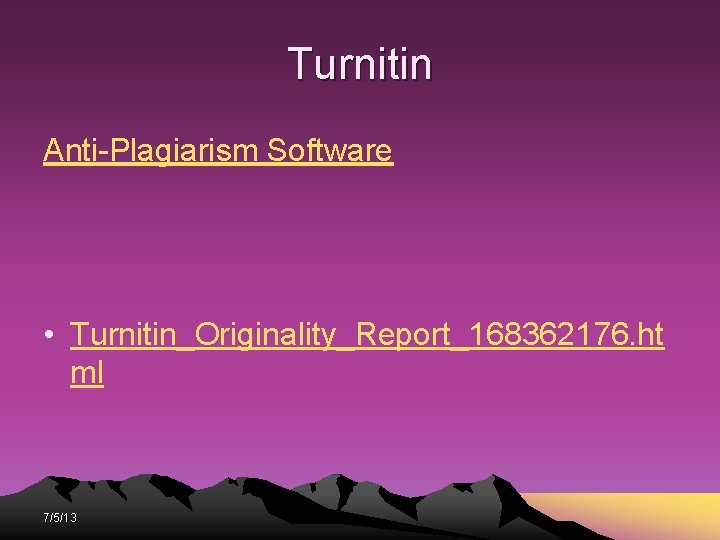
Turnitin Anti-Plagiarism Software • Turnitin_Originality_Report_168362176. ht ml 7/5/13