
Learning III Learning styles an introduction Module 3
- Slides: 30
Learning III Learning styles: an introduction Module 3 learning III
• Learning theory • Your Learning style Module 3 learning III
PROBLEM • Students learn in different ways • They information process in different ways Module 3 learning III
Learning Styles – Mc. Carthy, Kolbe, Jung – Assumption: everyone can learn (drive ) – Style based on heredity and upbringing – Active reflectors: learn by thinking Vary assignment – Concrete / abstract: direct experience – Vary instruction Module 3 learning III
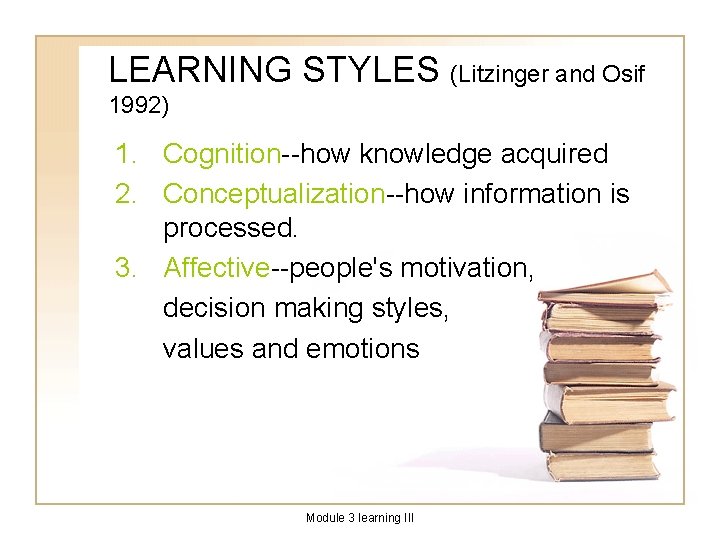
LEARNING STYLES (Litzinger and Osif 1992) 1. Cognition--how knowledge acquired 2. Conceptualization--how information is processed. 3. Affective--people's motivation, decision making styles, values and emotions Module 3 learning III
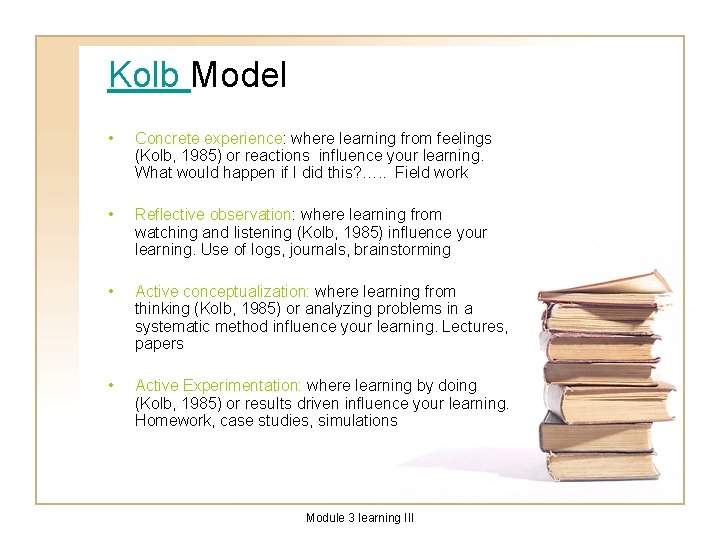
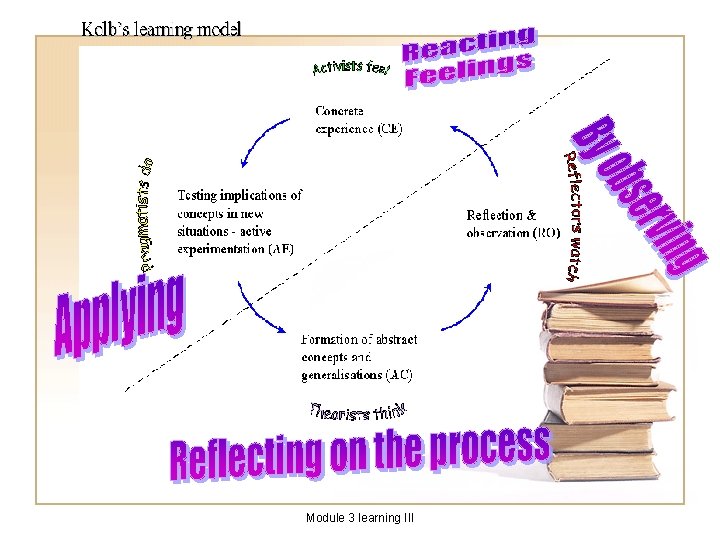
Kolb Model • Concrete experience: where learning from feelings (Kolb, 1985) or reactions influence your learning. What would happen if I did this? …. . Field work • Reflective observation: where learning from watching and listening (Kolb, 1985) influence your learning. Use of logs, journals, brainstorming • Active conceptualization: where learning from thinking (Kolb, 1985) or analyzing problems in a systematic method influence your learning. Lectures, papers • Active Experimentation: where learning by doing (Kolb, 1985) or results driven influence your learning. Homework, case studies, simulations Module 3 learning III
Module 3 learning III
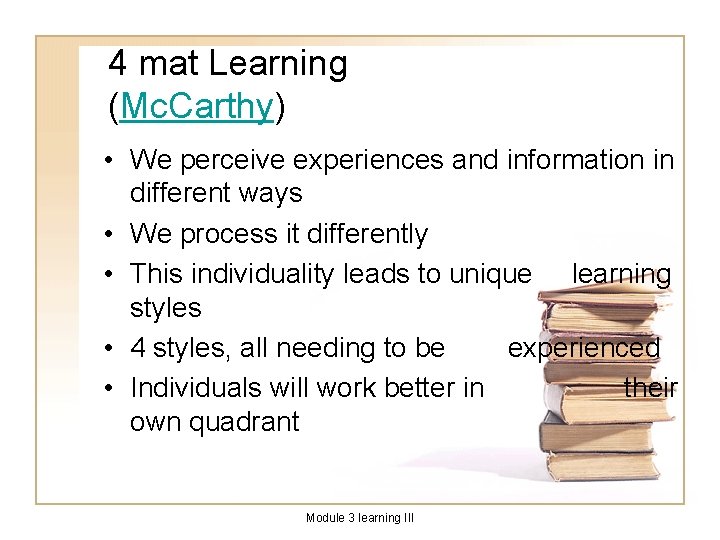
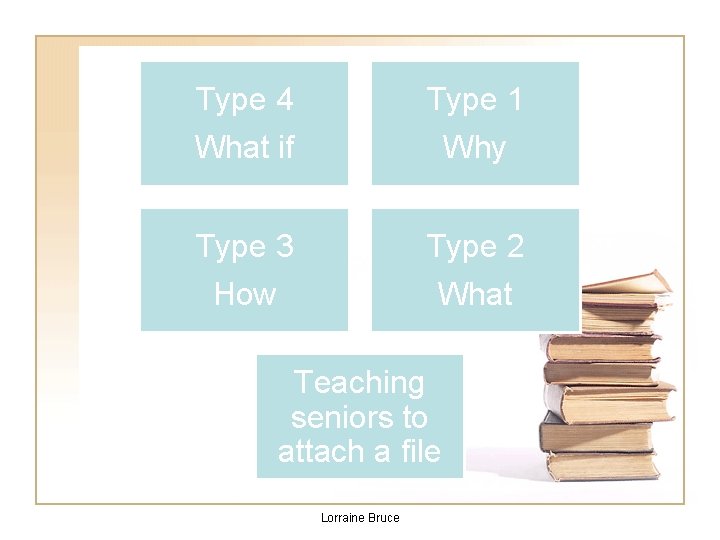
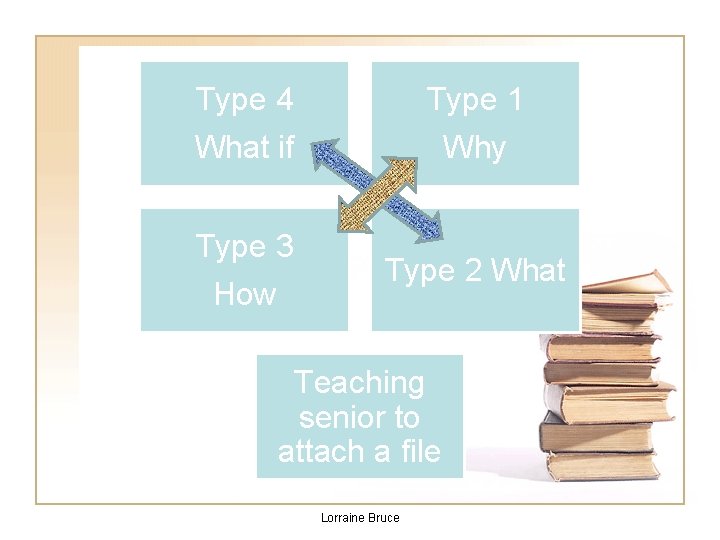
4 mat Learning (Mc. Carthy) • We perceive experiences and information in different ways • We process it differently • This individuality leads to unique learning styles • 4 styles, all needing to be experienced • Individuals will work better in their own quadrant Module 3 learning III
Type 4 Type 1 What if Why Type 3 Type 2 How What Teaching seniors to attach a file Lorraine Bruce
Type 4 Type 1 What if Why Type 3 How Type 2 What Teaching senior to attach a file Lorraine Bruce
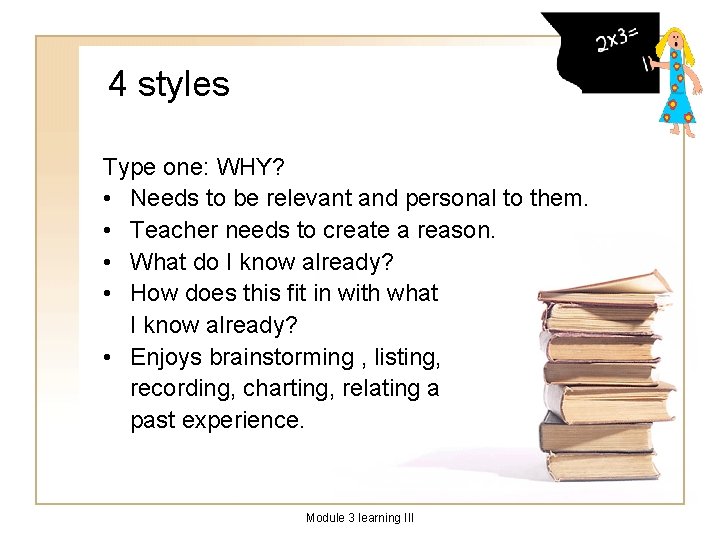
4 styles Type one: WHY? • Needs to be relevant and personal to them. • Teacher needs to create a reason. • What do I know already? • How does this fit in with what I know already? • Enjoys brainstorming , listing, recording, charting, relating a past experience. Module 3 learning III
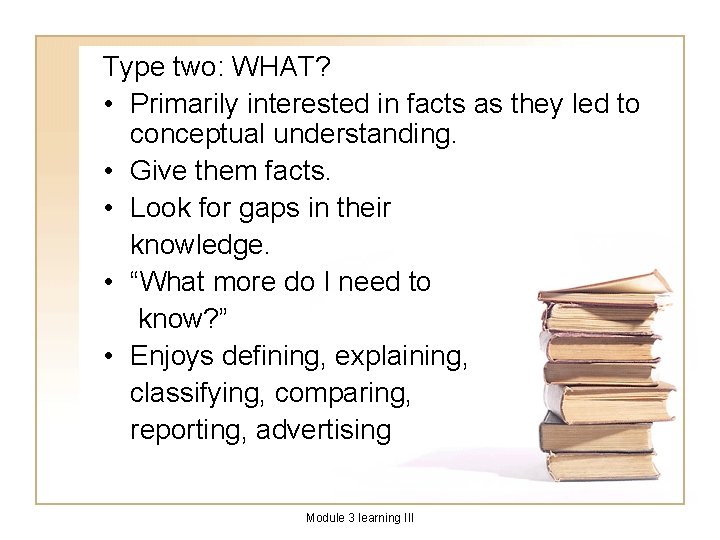
Type two: WHAT? • Primarily interested in facts as they led to conceptual understanding. • Give them facts. • Look for gaps in their knowledge. • “What more do I need to know? ” • Enjoys defining, explaining, classifying, comparing, reporting, advertising Module 3 learning III
Type three: HOW? • Interested in how things work. • Teachers need to let them try it. • Look for ways of applying what they already know • Enjoy demonstrating, interpreting, constructing, making models, mapping, collage, giving a talk Module 3 learning III
Type 4: WHAT IF? • Primarily interested in self discovery. • Let them teach it to themselves and others • Looks beyond what they have learnt or need to know • Enjoys predicting, improving, developing, inventing, judging, recommending, developing an action plan Module 3 learning III
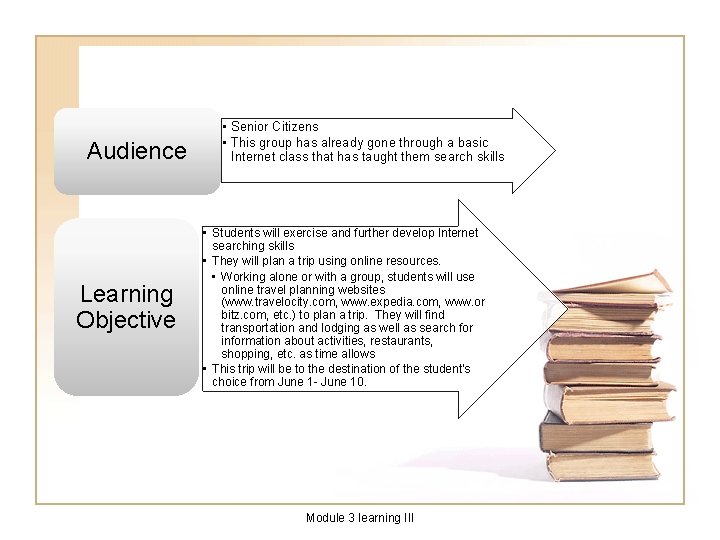
Audience Learning Objective • Senior Citizens • This group has already gone through a basic Internet class that has taught them search skills • Students will exercise and further develop Internet searching skills • They will plan a trip using online resources. • Working alone or with a group, students will use online travel planning websites (www. travelocity. com, www. expedia. com, www. or bitz. com, etc. ) to plan a trip. They will find transportation and lodging as well as search for information about activities, restaurants, shopping, etc. as time allows • This trip will be to the destination of the student's choice from June 1 - June 10. Module 3 learning III
Why? Have a class discussion about student's past travel planning experiences. They will talk about: what methods they usually use, what they like and dislike about the methods, how long it usually takes, what are some things they'd like to be able to do? After this discussion is well underway, the teacher can demonstrate how being able to use the Internet for their travel planning will meet the needs they've established. An opportunity for this learning style to brainstorm might be facilitated through the "bonus" searches for information about activities, restaurants, shopping, etc. that the lesson plan mentions above. Maybe a question like, "What else can you find on the different travel sites -- either on the site itself or linked through the site to another? Module 3 learning III
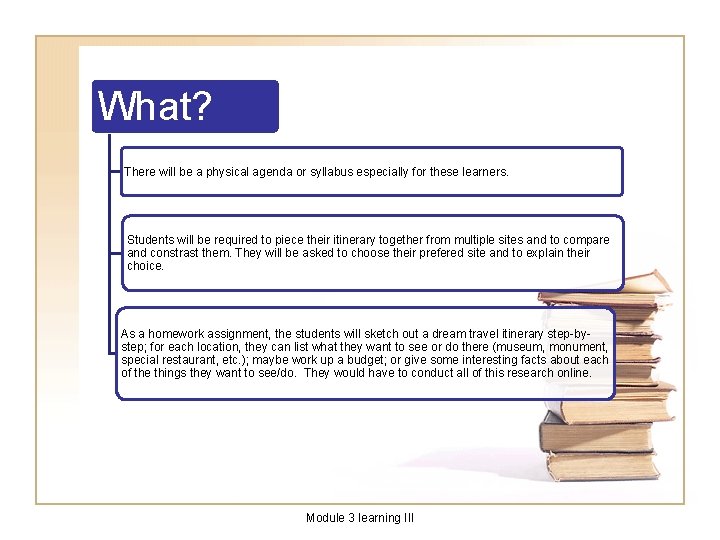
What? There will be a physical agenda or syllabus especially for these learners. Students will be required to piece their itinerary together from multiple sites and to compare and constrast them. They will be asked to choose their prefered site and to explain their choice. As a homework assignment, the students will sketch out a dream travel itinerary step-bystep; for each location, they can list what they want to see or do there (museum, monument, special restaurant, etc. ); maybe work up a budget; or give some interesting facts about each of the things they want to see/do. They would have to conduct all of this research online. Module 3 learning III
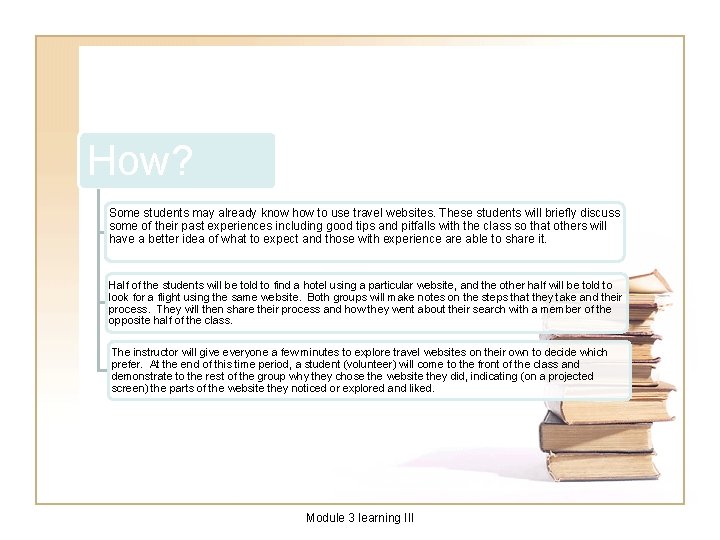
How? Some students may already know how to use travel websites. These students will briefly discuss some of their past experiences including good tips and pitfalls with the class so that others will have a better idea of what to expect and those with experience are able to share it. Half of the students will be told to find a hotel using a particular website, and the other half will be told to look for a flight using the same website. Both groups will make notes on the steps that they take and their process. They will then share their process and how they went about their search with a member of the opposite half of the class. The instructor will give everyone a few minutes to explore travel websites on their own to decide which prefer. At the end of this time period, a student (volunteer) will come to the front of the class and demonstrate to the rest of the group why they chose the website they did, indicating (on a projected screen) the parts of the website they noticed or explored and liked. Module 3 learning III
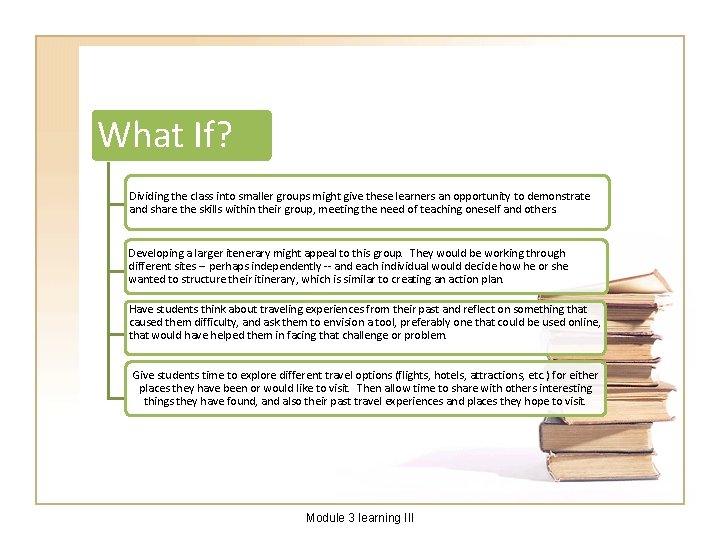
What If? Dividing the class into smaller groups might give these learners an opportunity to demonstrate and share the skills within their group, meeting the need of teaching oneself and others. Developing a larger itenerary might appeal to this group. They would be working through different sites -- perhaps independently -- and each individual would decide how he or she wanted to structure their itinerary, which is similar to creating an action plan. Have students think about traveling experiences from their past and reflect on something that caused them difficulty, and ask them to envision a tool, preferably one that could be used online, that would have helped them in facing that challenge or problem. Give students time to explore different travel options (flights, hotels, attractions, etc. ) for either places they have been or would like to visit. Then allow time to share with others interesting things they have found, and also their past travel experiences and places they hope to visit. Module 3 learning III
Module 3 Learning II 20
Online learning challenges • Text based learning- fine • For other who learn by hearing, seeing, doing, or reflecting critically- we need to work a little harder to vary instruction to cater for them. Lorraine Bruce
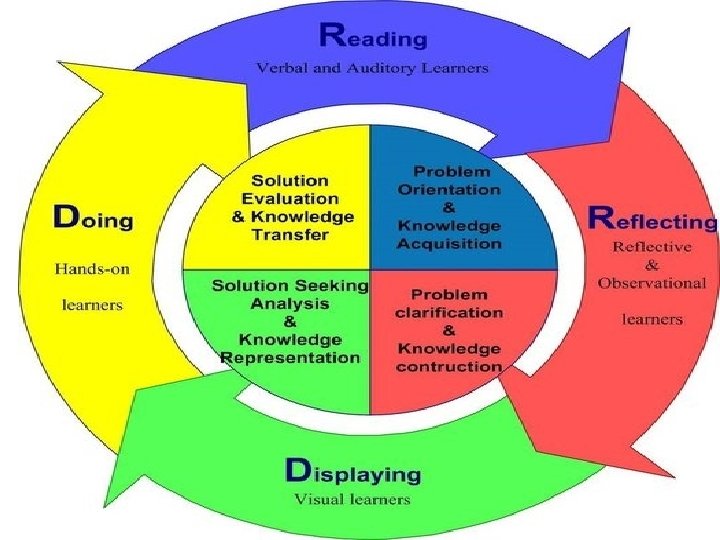
R 2 D 2: Read, Reflect, Display, and Do Bonk and Zhang (2008) • Read — targets auditory and visual learners • Reflect — targets reflective and observational learners • Display — targets visual learners • Do — targets tactile and kinesthetic learners Lorraine Bruce
Lorraine Bruce
Target Group: Senior Citizens Learning Objective: Determining reliable healthcare sources on the web. Senior citizens encounter numerous barriers and limitations when using the internet. These limitations make it difficult to find reliable and up to date health information and resources. By using the Bonk and Zhang Learning Model (Read, Reflect, Display and Do) we will propose different learning activities that promote successful web searching for reliable health care. Module 3 learning III
Doing (Hands on Learners) POSSIBLE LEARNING ACTIVITIES 1. ) Establish a “Senior Health Care Hour” at the local public library computer lab, so senior citizens have can experiment with various online resources in a social environment 2. ) Record videos of seniors explaining their own experiences and sharing tips for others 3. ) Training opportunities at the library: With the help of librarians, seniors would be able to learn how to locate, evaluate and navigate quality health information. 4. ) Ask for volunteers to help teach the next class. 5. ) Ask for senior “mentors. ” These volunteers will be able to help other seniors if a librarian is not available. 6. ) Break up into groups to practice certain techniques. Then meet together at the end of the class for each group to share their new skill. Module 3 learning III
Reading (Verbal and Auditory Learners) POSSIBLE LEARNING ACTIVITIES 1. ) Lead seniors through webquests that show them reliable and unreliable sites. 2. ) Provide online chats with healthcare professionals. 3. ) Invite guest speakers on the topic to speak at a senior center (health care professionals, doctors, representatives from credible websites) 4. ) Provide a virtual guest speaker or record a presentation that can be watched online. 5. ) Provide links to credible sites so seniors can read info on their own time. - Example: http: //www. usa. gov/Topics/Seniors. shtml 6. ) Presentation with clear writing, graphics and individual copies for following along. 7. ) Provide brochures, pamphlets with a list of health information resources and help Module 3 learning III
Displaying (Visual Learners) POSSIBLE LEARNINGACTIVITIES 1. ) Create a retirement home team to make posters of the best websites to be displayed near computers 2. ) Using Jing (or a similar tool), make a step by step video showing how to navigate websites. 3. ) Provide virtual tours of healthcare facilities and websites. Create a poster showing with reminders (Do's and Don't's) or rather best use practices for searching for web information. Module 3 learning III
Reflecting (Reflective and Observational Learners) POSSIBLE LEARING ACTIVITIES 1. ) Ask interested senior citizens to read articles or websites on this topic and provide a summary for their peers 2. ) Give seniors guided one-on-one instruction with websites every week, encourage them to keep a journal to reflect on their experiences. 3. ) Activities that allows room for reflection through either discussion, possibly a survey or brief one on one meetings with trainers 4. ) Ask seniors who have taken the class to return and share with a new class what they learned and how the class benefitted them. 5. ) At the end of the class, have the seniors help make the pamphlet for take home use. The ideas will be fresh in their heads and they will remember more. Module 3 learning III
Design activities to cater to the various learning styles within your class. Use either Mc. Carthy or Bonk and Zhang Teaching email seniors Facebook for teens Lorraine Bruce
Determining learning styles Learning style inventory Learning Style Module 3 learning III