
Learning How do we learn 1 Classical conditioning
- Slides: 56
Learning How do we learn? 1. Classical conditioning 2. Operant conditioning 3. Learning by Observation
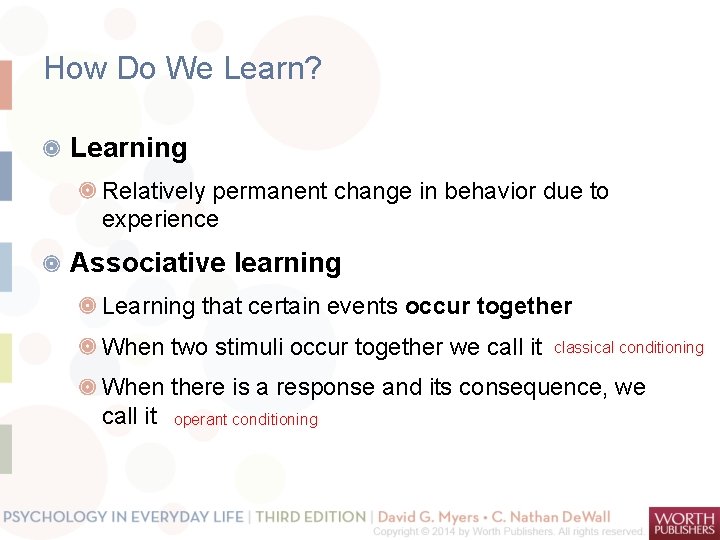
How Do We Learn? Learning Relatively permanent change in behavior due to experience Associative learning Learning that certain events occur together When two stimuli occur together we call it classical conditioning When there is a response and its consequence, we call it operant conditioning
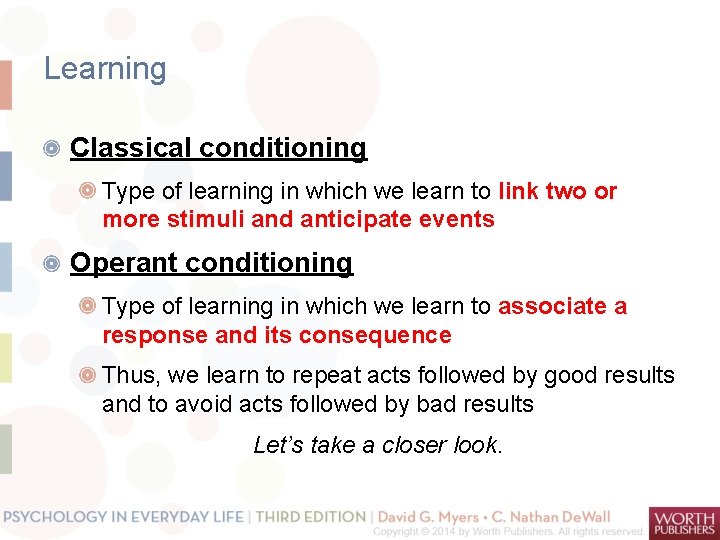
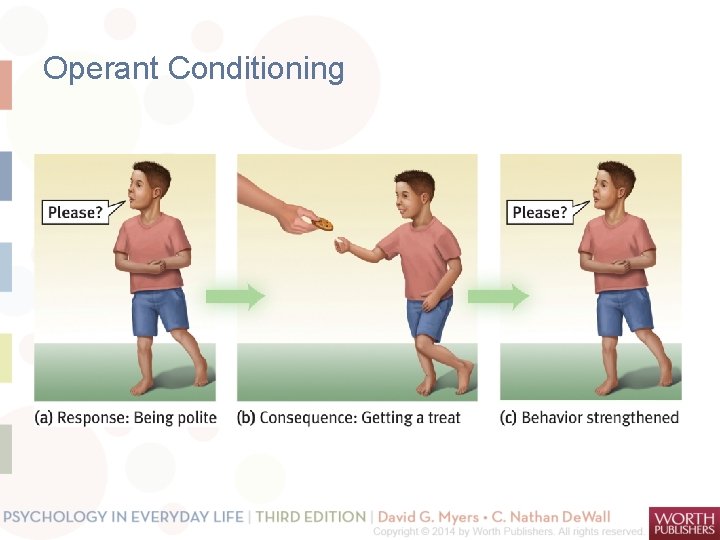
Learning Classical conditioning Type of learning in which we learn to link two or more stimuli and anticipate events Operant conditioning Type of learning in which we learn to associate a response and its consequence Thus, we learn to repeat acts followed by good results and to avoid acts followed by bad results Let’s take a closer look.
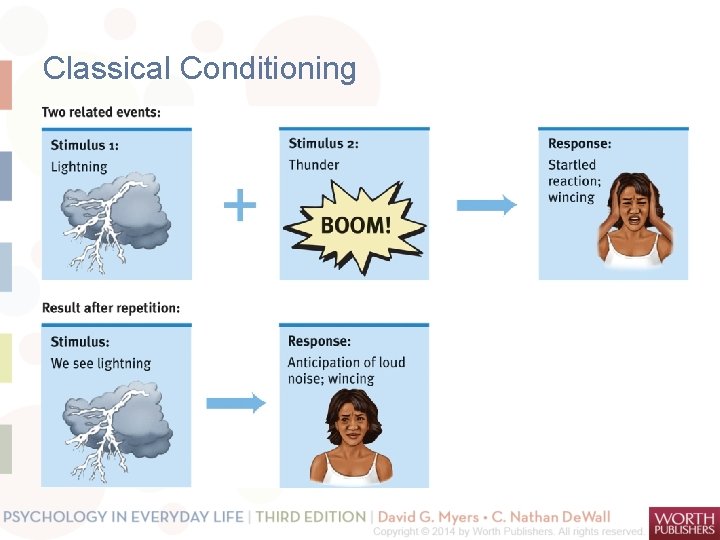
Classical Conditioning
Operant Conditioning
Classical & Operant Conditioning are not the only forms of learning Observational learning, another form of cognitive learning, is learning from others’ experiences
Why are habits, such as having something sweet with that cup of coffee, so hard to break?
Classical Conditioning
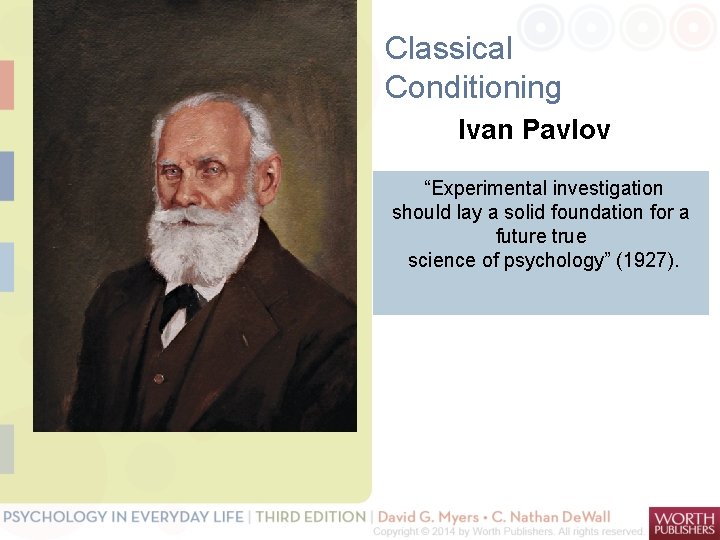
Classical Conditioning Ivan Pavlov “Experimental investigation should lay a solid foundation for a future true science of psychology” (1927).
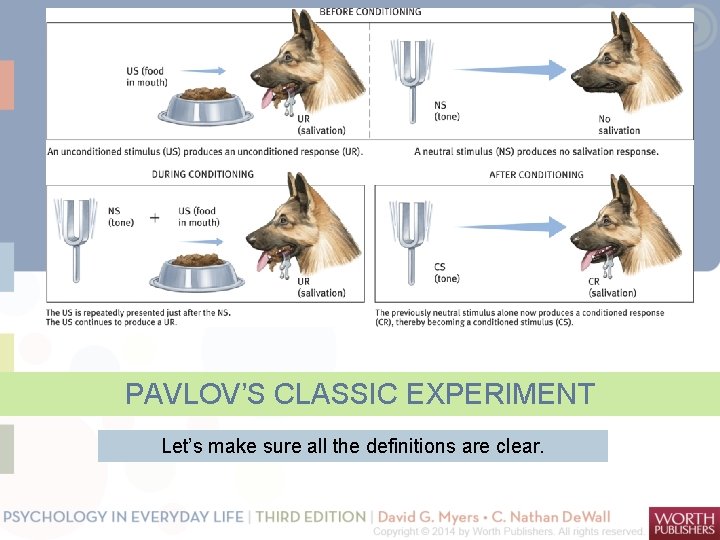
PAVLOV’S CLASSIC EXPERIMENT Let’s make sure all the definitions are clear.
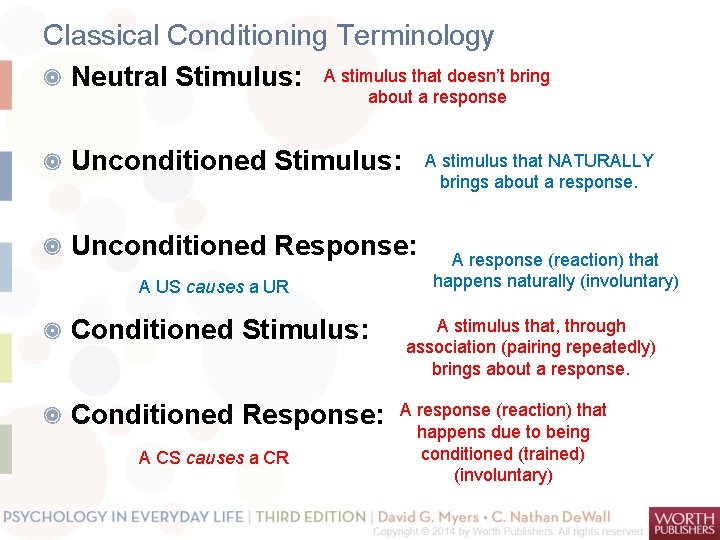
Classical Conditioning Terminology Neutral Stimulus: A stimulus that doesn’t bring about a response Unconditioned Stimulus: A stimulus that NATURALLY brings about a response. Unconditioned Response: A US causes a UR Conditioned Stimulus: Conditioned Response: A CS causes a CR A response (reaction) that happens naturally (involuntary) A stimulus that, through association (pairing repeatedly) brings about a response. A response (reaction) that happens due to being conditioned (trained) (involuntary)
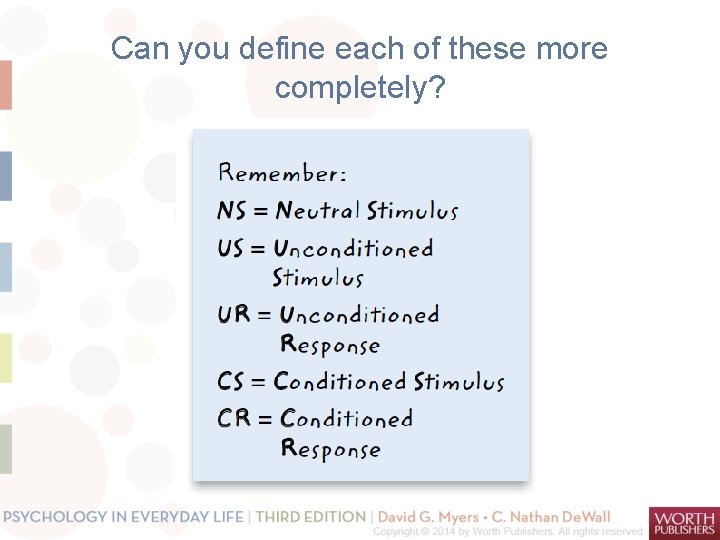
Can you define each of these more completely?
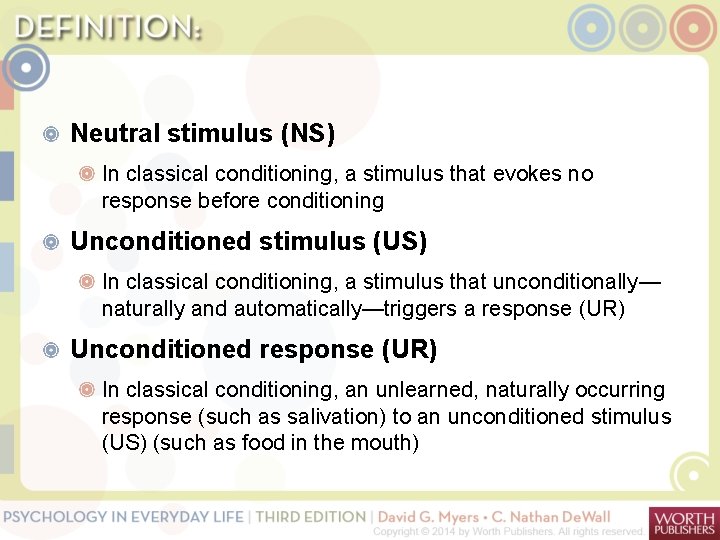
Neutral stimulus (NS) In classical conditioning, a stimulus that evokes no response before conditioning Unconditioned stimulus (US) In classical conditioning, a stimulus that unconditionally— naturally and automatically—triggers a response (UR) Unconditioned response (UR) In classical conditioning, an unlearned, naturally occurring response (such as salivation) to an unconditioned stimulus (US) (such as food in the mouth)
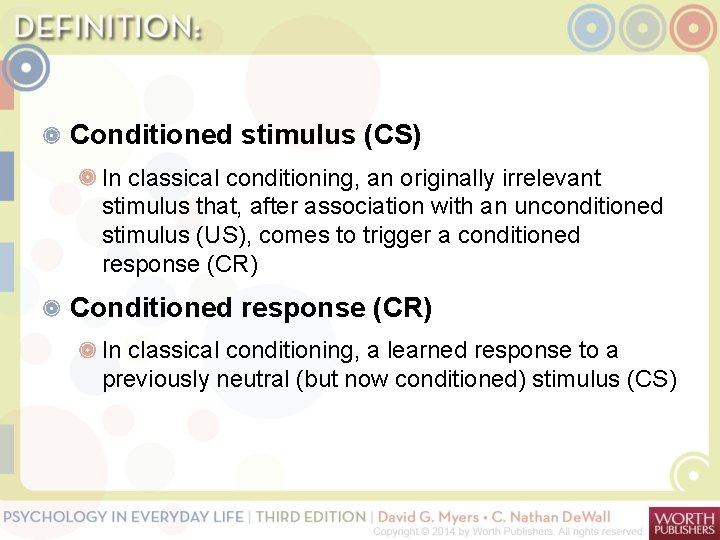
Conditioned stimulus (CS) In classical conditioning, an originally irrelevant stimulus that, after association with an unconditioned stimulus (US), comes to trigger a conditioned response (CR) Conditioned response (CR) In classical conditioning, a learned response to a previously neutral (but now conditioned) stimulus (CS)
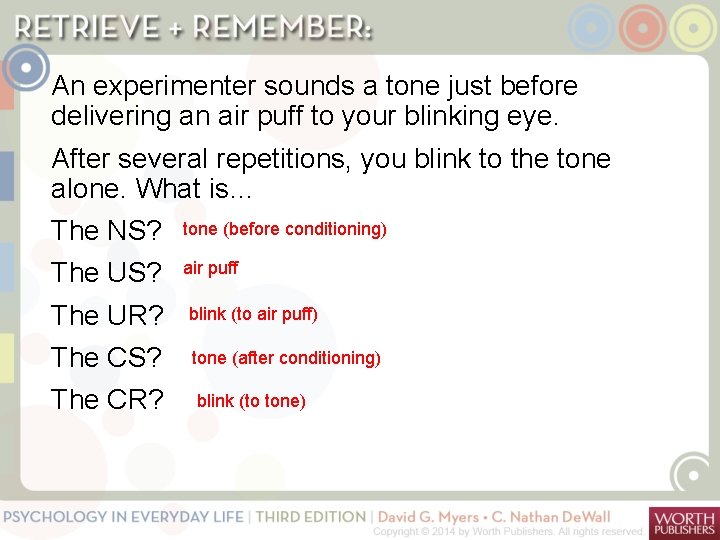
An experimenter sounds a tone just before delivering an air puff to your blinking eye. After several repetitions, you blink to the tone alone. What is… The NS? tone (before conditioning) The US? air puff The UR? blink (to air puff) The CS? tone (after conditioning) The CR? blink (to tone)
Classical Conditioning Acquisition First stage in classical conditioning Place where link between the NS and US is learned
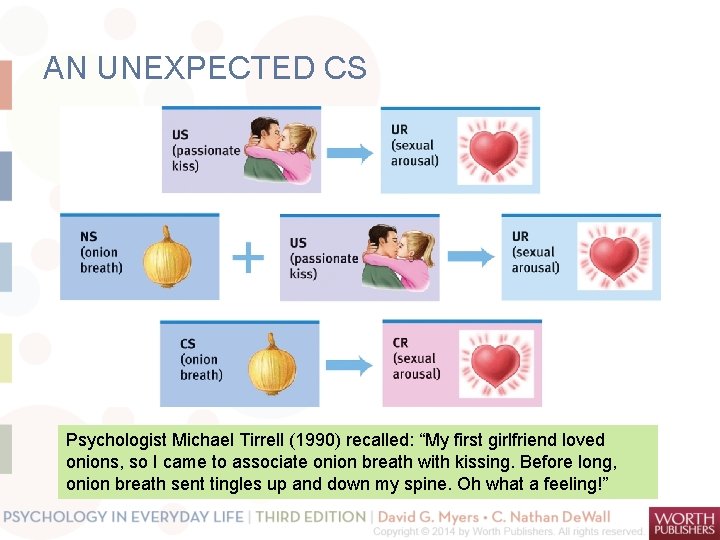
AN UNEXPECTED CS Psychologist Michael Tirrell (1990) recalled: “My first girlfriend loved onions, so I came to associate onion breath with kissing. Before long, onion breath sent tingles up and down my spine. Oh what a feeling!”
In horror movies, sexually arousing images of women are sometimes paired with violence against women. Based on classical conditioning principles, what might be an effect of this pairing?
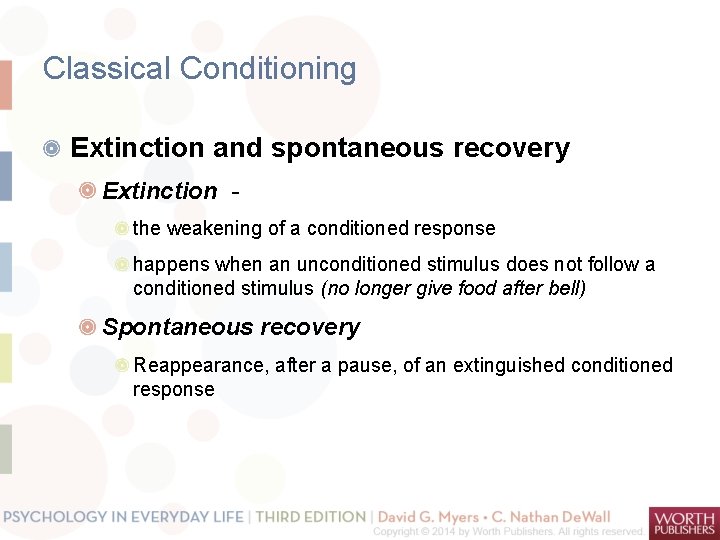
Classical Conditioning Extinction and spontaneous recovery Extinction the weakening of a conditioned response happens when an unconditioned stimulus does not follow a conditioned stimulus (no longer give food after bell) Spontaneous recovery Reappearance, after a pause, of an extinguished conditioned response
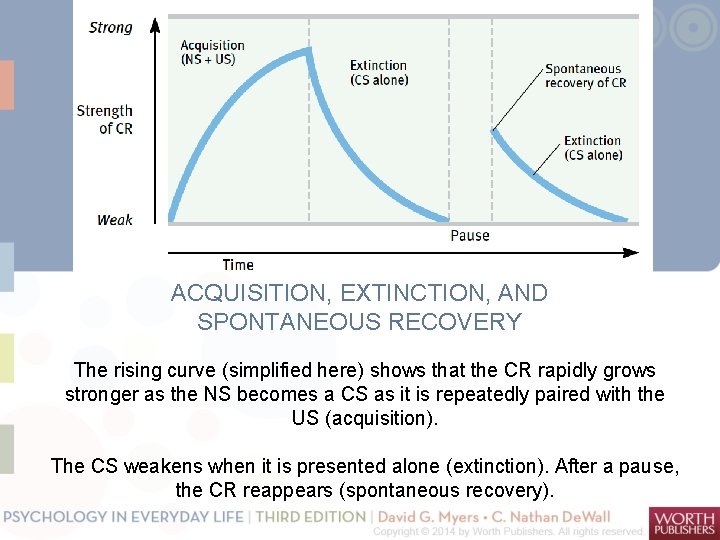
ACQUISITION, EXTINCTION, AND SPONTANEOUS RECOVERY The rising curve (simplified here) shows that the CR rapidly grows stronger as the NS becomes a CS as it is repeatedly paired with the US (acquisition). The CS weakens when it is presented alone (extinction). After a pause, the CR reappears (spontaneous recovery).
The first step of classical conditioning, when an NS becomes a CS, is called____. When a US no longer follows the CS, and the CR becomes weakened, this is called ____.
Classical Conditioning Generalization The tendency, after conditioning, to respond similarly to stimuli that resemble the conditioned stimulus Discrimination ability to tell the difference between a conditioned stimulus and other irrelevant stimuli
If the aroma of cake baking makes your mouth water, what is the US? The CR?
Classical Conditioning in Everyday Life Pavlov’s principles influence human health and well- being in a variety of ways Examples Patients can develop classically conditioned sideeffects to drugs given as cancer treatments Former drug users often feel a craving when they are again in the drug-using context
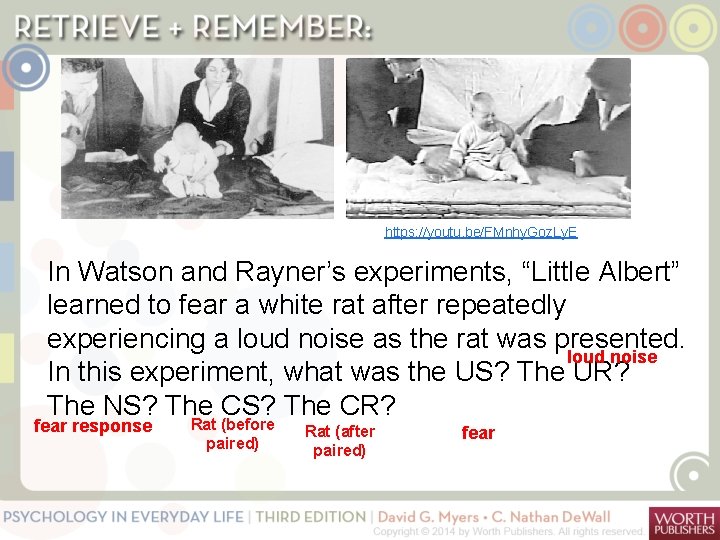
https: //youtu. be/FMnhy. Goz. Ly. E In Watson and Rayner’s experiments, “Little Albert” learned to fear a white rat after repeatedly experiencing a loud noise as the rat was presented. loud noise In this experiment, what was the US? The UR? The NS? The CR? fear response Rat (before paired) Rat (after paired) fear
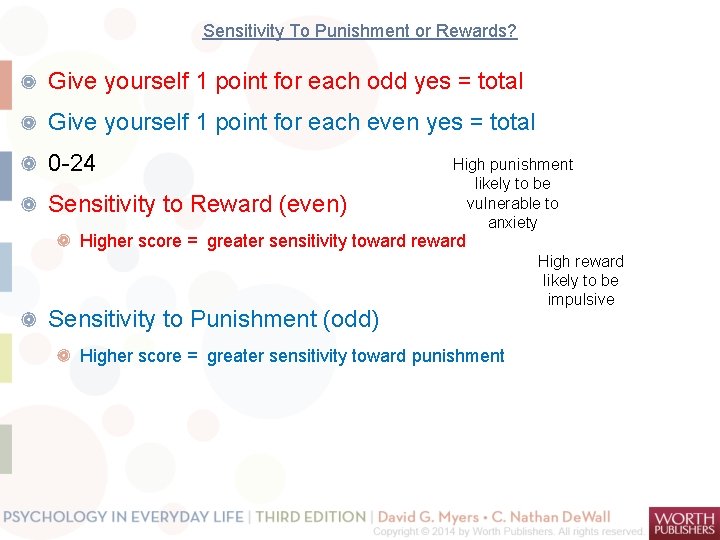
Sensitivity To Punishment or Rewards? Give yourself 1 point for each odd yes = total Give yourself 1 point for each even yes = total 0 -24 Sensitivity to Reward (even) High punishment likely to be vulnerable to anxiety Higher score = greater sensitivity toward reward Sensitivity to Punishment (odd) Higher score = greater sensitivity toward punishment High reward likely to be impulsive
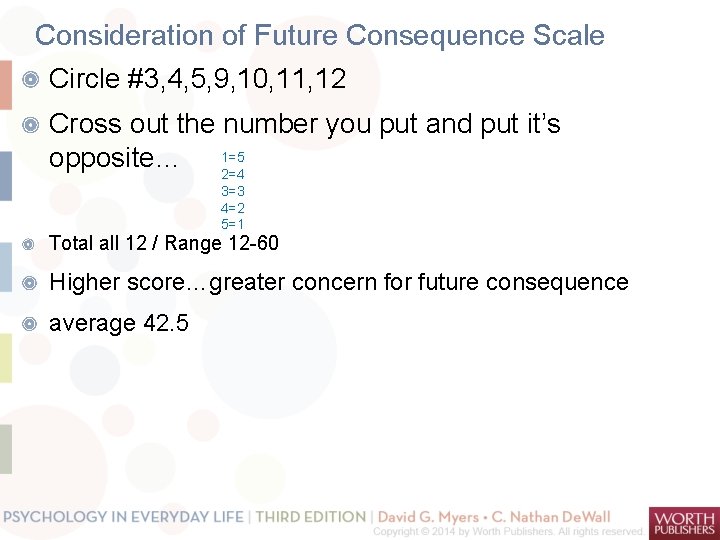
Consideration of Future Consequence Scale Circle #3, 4, 5, 9, 10, 11, 12 Cross out the number you put and put it’s opposite… 1=5 2=4 3=3 4=2 5=1 Total all 12 / Range 12 -60 Higher score…greater concern for future consequence average 42. 5
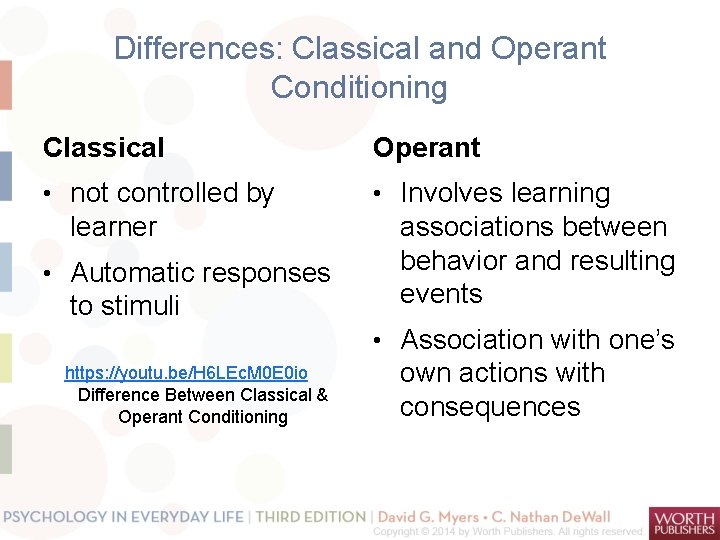
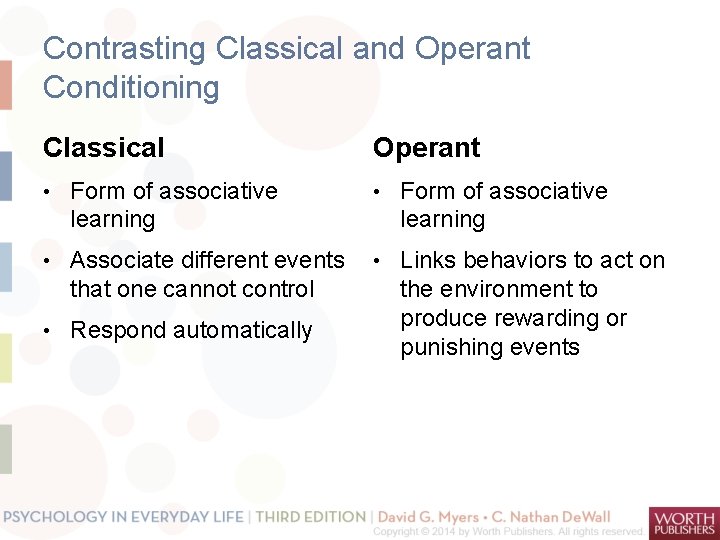
Differences: Classical and Operant Conditioning Classical Operant • not controlled by • Involves learning learner • Automatic responses to stimuli associations between behavior and resulting events • Association with one’s https: //youtu. be/H 6 LEc. M 0 E 0 io Difference Between Classical & Operant Conditioning own actions with consequences
With ____ conditioning, we learn associations between events we do not control. With ____ conditioning, we learn associations between our behavior and resulting events.
Operant Conditioning Skinner’s experiments Rewarded behavior is likely to be repeated Shaping behavior Teach a behavior in small steps Successive approximations Reinforcer An event that increases the frequency of a preceding response
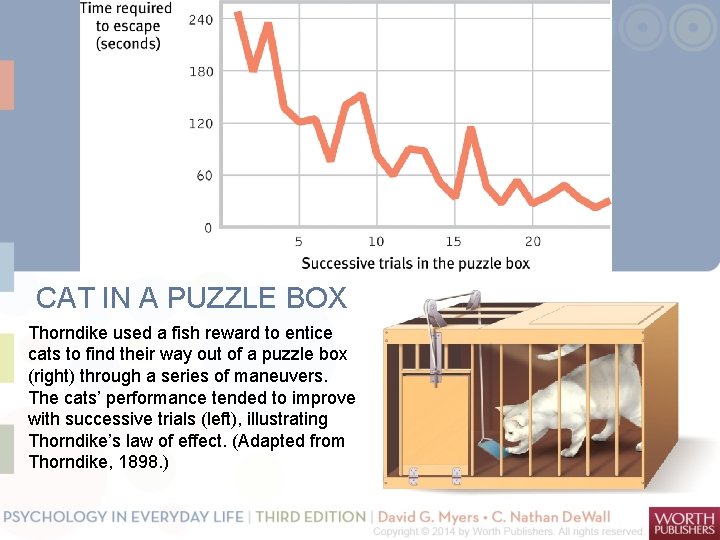
CAT IN A PUZZLE BOX Thorndike used a fish reward to entice cats to find their way out of a puzzle box (right) through a series of maneuvers. The cats’ performance tended to improve with successive trials (left), illustrating Thorndike’s law of effect. (Adapted from Thorndike, 1898. )
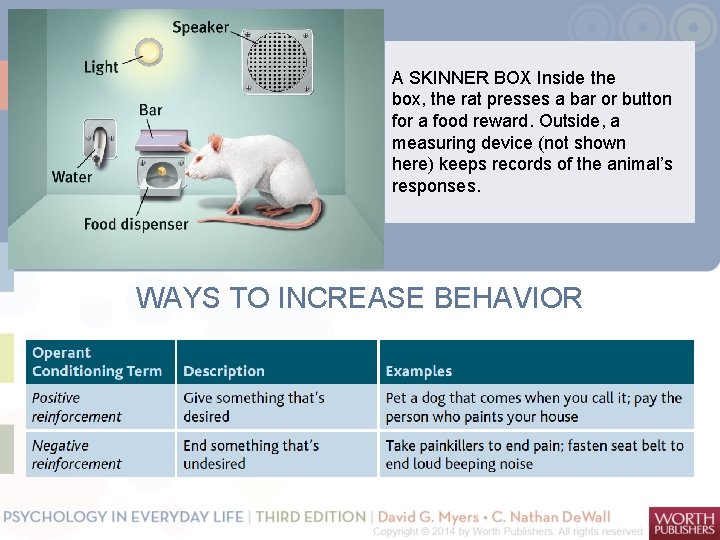
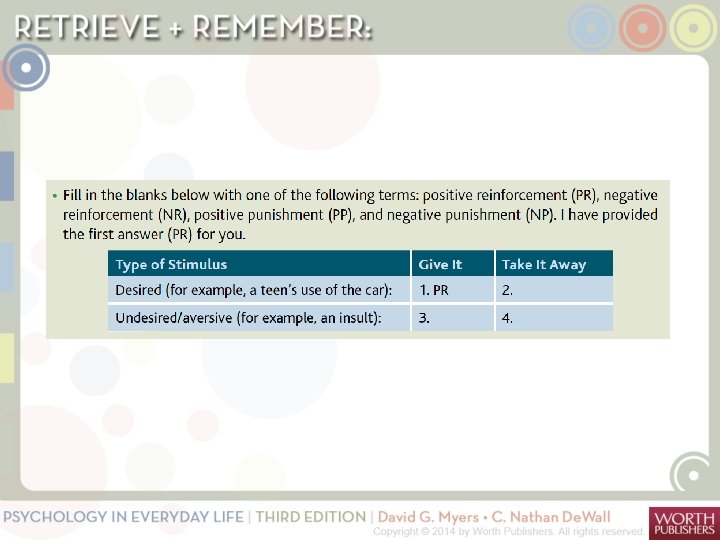
Types of Reinforcers Positive reinforcement Increases behaviors by presenting positive stimuli Is anything that, when presented after a response, strengthens the response Negative reinforcement Increases behaviors by stopping or reducing negative stimuli Is anything that, when removed after a response, strengthens the response Is not punishment
A SKINNER BOX Inside the box, the rat presses a bar or button for a food reward. Outside, a measuring device (not shown here) keeps records of the animal’s responses. WAYS TO INCREASE BEHAVIOR
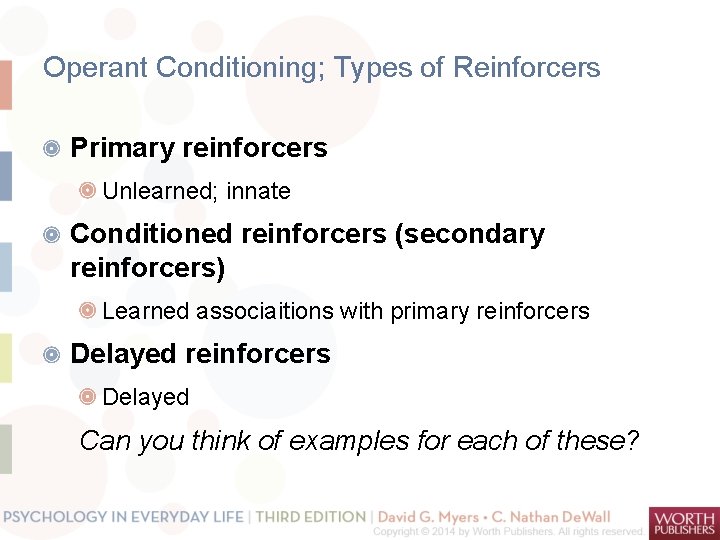
Operant Conditioning; Types of Reinforcers Primary reinforcers Unlearned; innate Conditioned reinforcers (secondary reinforcers) Learned associaitions with primary reinforcers Delayed Can you think of examples for each of these?
Telemarketers are reinforced by which schedule? People checking the oven to see if the cookies are done are on which schedule? Airline frequent-flyer programs that offer a free flight after every 25, 000 miles of travel are using which reinforcement schedule?
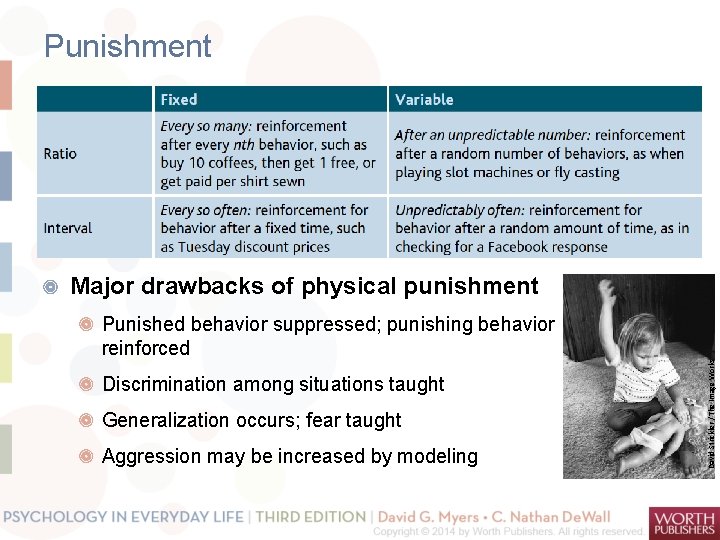
Punishment Ways to decrease behavior Punished behavior suppressed; punishing behavior reinforced Discrimination among situations taught Generalization occurs; fear taught Aggression may be increased by modeling David Strickler / The Image Works Major drawbacks of physical punishment
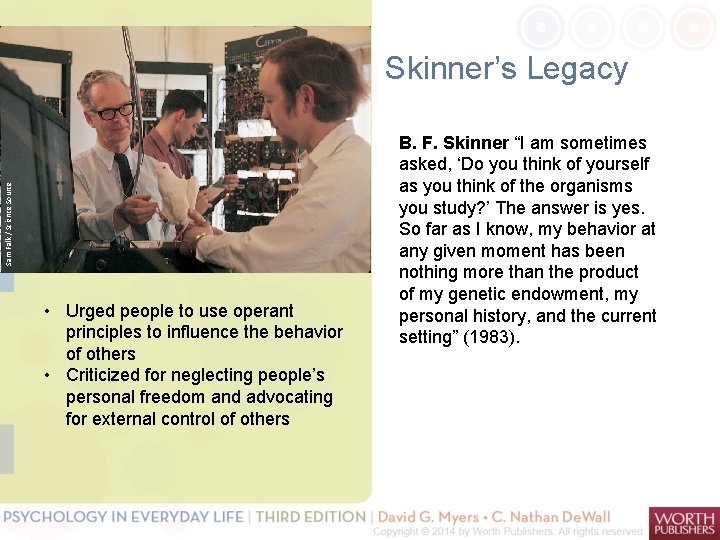
Sam Falk / Science Source Skinner’s Legacy • Urged people to use operant principles to influence the behavior of others • Criticized for neglecting people’s personal freedom and advocating for external control of others B. F. Skinner “I am sometimes asked, ‘Do you think of yourself as you think of the organisms you study? ’ The answer is yes. So far as I know, my behavior at any given moment has been nothing more than the product of my genetic endowment, my personal history, and the current setting” (1983).
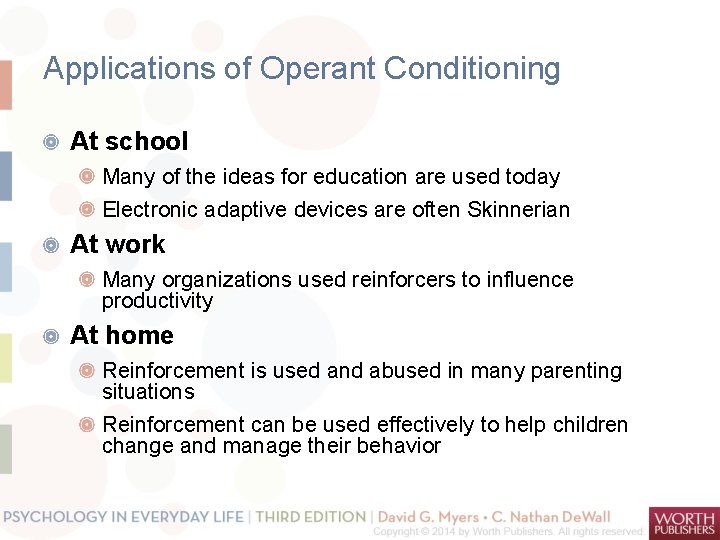
Applications of Operant Conditioning At school Many of the ideas for education are used today Electronic adaptive devices are often Skinnerian At work Many organizations used reinforcers to influence productivity At home Reinforcement is used and abused in many parenting situations Reinforcement can be used effectively to help children change and manage their behavior
Ethan constantly misbehaves at preschool even though his teacher scolds him repeatedly. Why does Ethan’s misbehavior continue, and what can his teacher do to stop it?
Contrasting Classical and Operant Conditioning Classical Operant • Form of associative learning • Associate different events • Links behaviors to act on that one cannot control the environment to produce rewarding or punishing events • Respond automatically
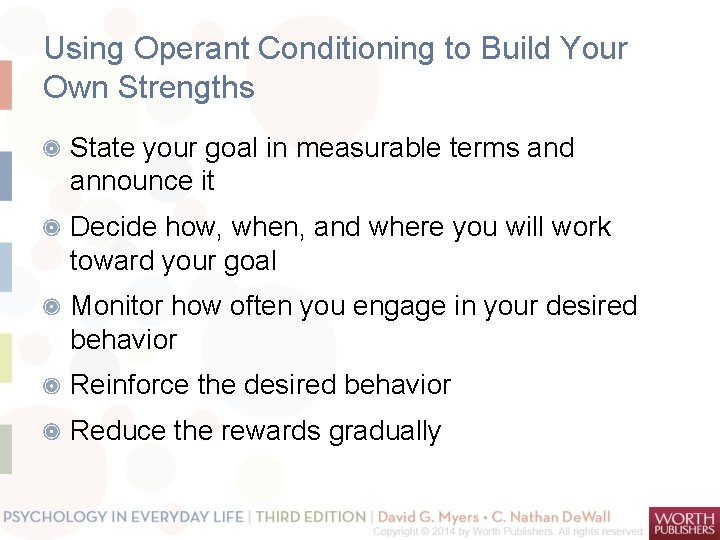
Using Operant Conditioning to Build Your Own Strengths State your goal in measurable terms and announce it Decide how, when, and where you will work toward your goal Monitor how often you engage in your desired behavior Reinforce the desired behavior Reduce the rewards gradually
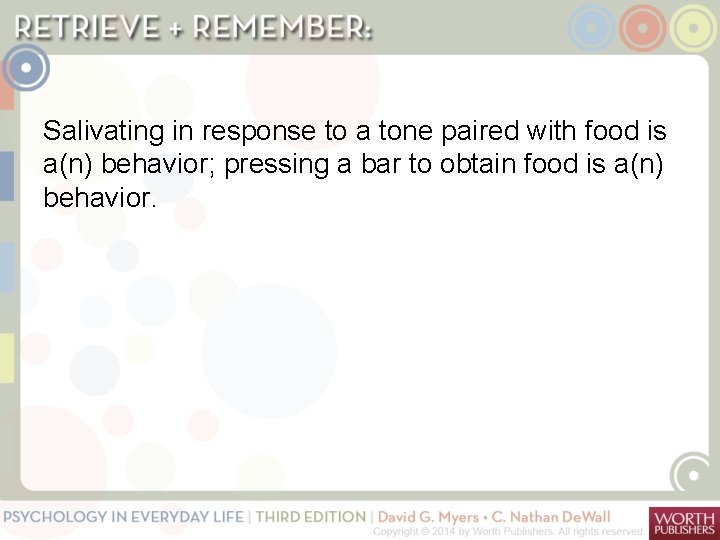
Salivating in response to a tone paired with food is a(n) behavior; pressing a bar to obtain food is a(n) behavior.
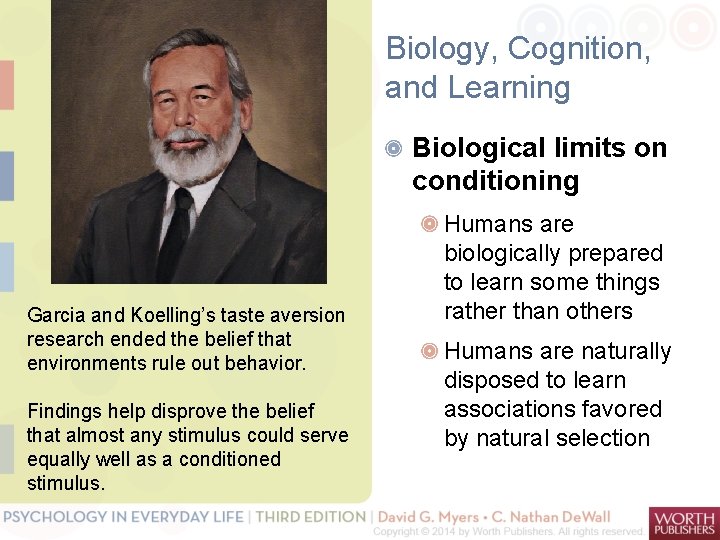
Biology, Cognition, and Learning Biological limits on conditioning Garcia and Koelling’s taste aversion research ended the belief that environments rule out behavior. Findings help disprove the belief that almost any stimulus could serve equally well as a conditioned stimulus. Humans are biologically prepared to learn some things rather than others Humans are naturally disposed to learn associations favored by natural selection
How did Garcia and Koelling’s taste aversion studies help disprove the belief that almost any stimulus (tastes, sights, sounds) could serve equally well as a conditioned stimulus? Explain.
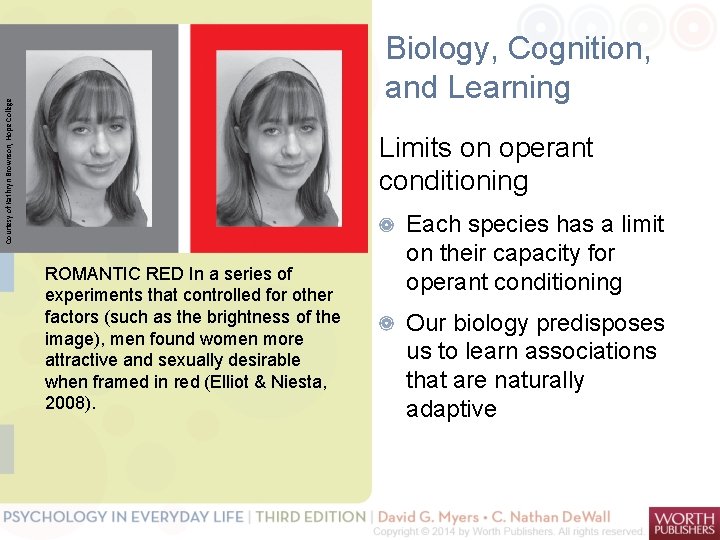
Courtesy of Kathryn Brownson, Hope College Biology, Cognition, and Learning Limits on operant conditioning ROMANTIC RED In a series of experiments that controlled for other factors (such as the brightness of the image), men found women more attractive and sexually desirable when framed in red (Elliot & Niesta, 2008). Each species has a limit on their capacity for operant conditioning Our biology predisposes us to learn associations that are naturally adaptive
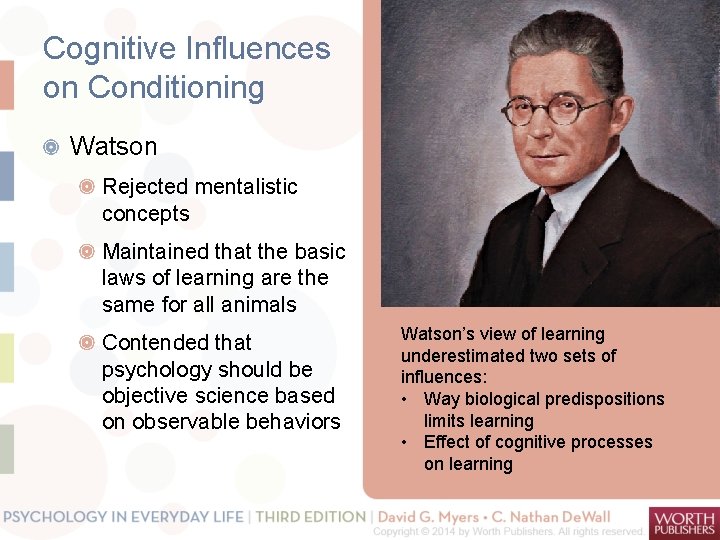
Cognitive Influences on Conditioning Watson Rejected mentalistic concepts Maintained that the basic laws of learning are the same for all animals Contended that psychology should be objective science based on observable behaviors Watson’s view of learning underestimated two sets of influences: • Way biological predispositions limits learning • Effect of cognitive processes on learning
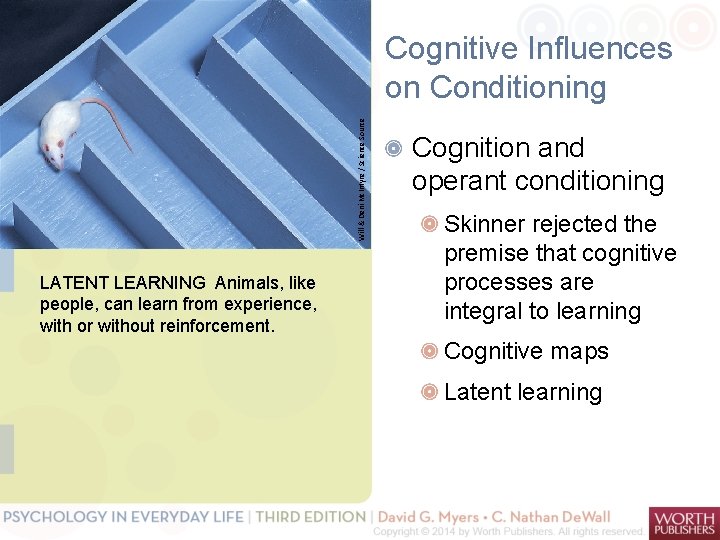
Will & Deni Mc. Intyre / Science Source Cognitive Influences on Conditioning LATENT LEARNING Animals, like people, can learn from experience, with or without reinforcement. Cognition and operant conditioning Skinner rejected the premise that cognitive processes are integral to learning Cognitive maps Latent learning
Cognitive map Mental image of the layout of one’s environment Latent learning Learning that is not apparent until there is an incentive to demonstrate it Intrinsic motivation Desire to perform a behavior for its own sake Extrinsic motivation Desire to perform a behavior to gain a reward or avoid a punishment
Learning by Observation Thinking critically about: Does viewing media violence trigger violent behavior?
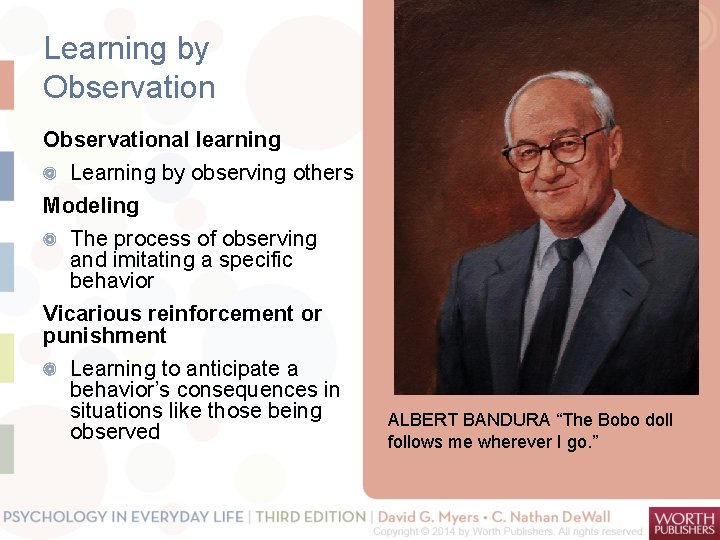
Learning by Observational learning Learning by observing others Modeling The process of observing and imitating a specific behavior Vicarious reinforcement or punishment Learning to anticipate a behavior’s consequences in situations like those being observed ALBERT BANDURA “The Bobo doll follows me wherever I go. ”
Learning by Observation Mirrors and imitation in the brain Mirror neuron Fires when we perform certain actions and when we observe others performing those actions Provides a neural basis for imitation and observational learning
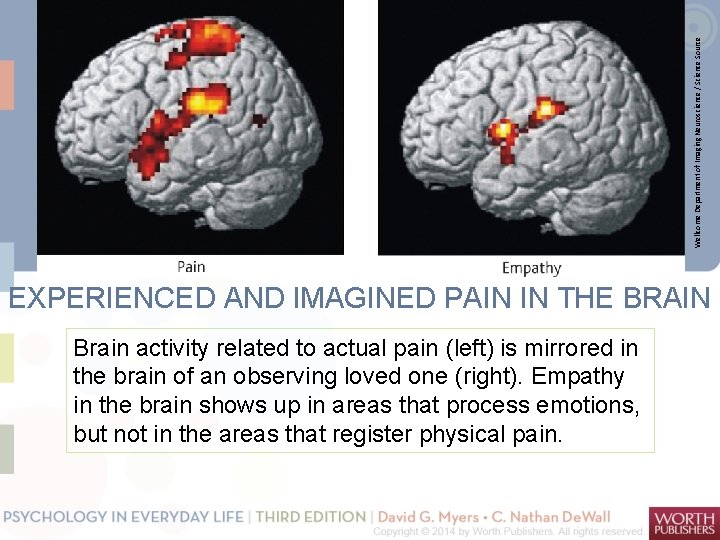
Wellcome Department of Imaging Neuroscience / Science Source EXPERIENCED AND IMAGINED PAIN IN THE BRAIN Brain activity related to actual pain (left) is mirrored in the brain of an observing loved one (right). Empathy in the brain shows up in areas that process emotions, but not in the areas that register physical pain.
Applications of Observational Learning Prosocial effects Prosocial behavior models can have a prosocial effect Effectiveness is related to consistency in actions and words Antisocial effects Observational learning can have adverse effects Early childhood environments with high levels of aggression, TV, and videos are powerful sources of observational learning
DOES VIEWING MEDIA VIOLENCE TRIGGER VIOLENT BEHAVIOR? Correlational studies In U. S. and Canada, homicide rates doubled as TV was introduced and spreading Elementary schoolchildren exposed to media violence fought more and had a greater risk for violent behavior as teens. Experimental studies Violence-viewing effect stems from two factors Media models prompt imitation Prolonged exposure to violence desensitizes viewers