
LEARNING GOALS Overview of safety rules 08 31



- Slides: 31
LEARNING GOALS: • Overview of safety rules! 08 -31 - 11 • Science is an ongoing process that is a self correcting way of learning. • Following directions and using equipment properly promotes a safe and accident free lab environment. Proper tools and precise measurement equals accurate quantitative data. WARM-UP: 1) In the cleaning pennies lab, which solution “cleaned” the best? Ketchup Vinegar 2) What is one thing we could change in the “cleaning pennies” experiment? Agenda 1) Warm-Up (5 min) 2) Measurement WS (20 min) 3) Biomolecules Notes (30 mins) Type of solution, type of coin, temp. of solution etc. HOMEWORK DUE: Contracts & Binder
When you see the Copy the notes!
Where do we get our nutrients? Macromolecules, Vitamins and Minerals
�Our body needs essential nutrients for growth, health and overall well being. We cannot be sedentary and deny our body these essentials and be healthy. �You need to be aware of the vital nutrients, vitamins and minerals available in everyday foods.
What are the four main types of macromolecules? 1. Carbohydrates 2. Lipids 3. Proteins 4. Nucleic Acids
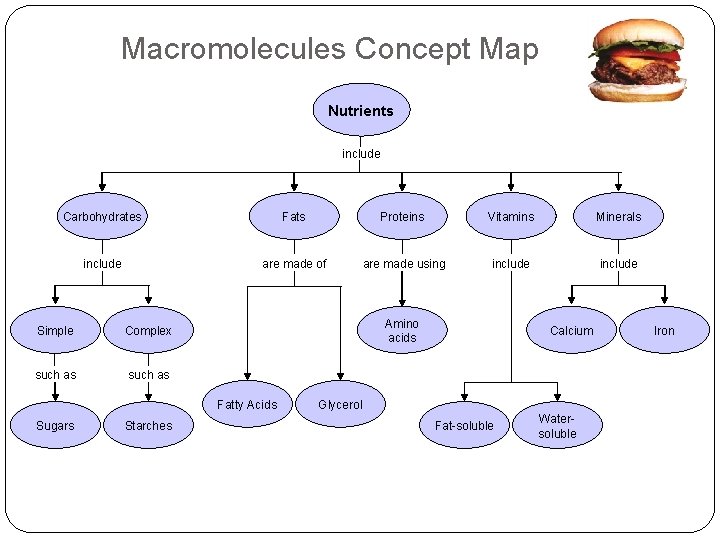
Macromolecules Concept Map Section 38 -1 Nutrients include Carbohydrates Fats Proteins Vitamins Minerals include are made of are made using include Simple Complex such as Amino acids Fatty Acids Sugars Starches Calcium Glycerol Fat-soluble Watersoluble Iron
Macromolecule s = Large organic molecules �Monomers (small molecules) �Polymers (large molecules)
Macromolecules �Carbohydrates (sugars & starch) �Lipids(fats) �Proteins �Nucleic Acids (DNA & RNA)
Carbohydrates �Monosaccharides (simple sugars) i. e. C 6 H 12 O 6 - glucose �Disaccharides (double sugars) i. e. sucrose – table sugar �Polysaccharides (complex sugars) starch, cellulose, and glycogen
Carbohydrate Functions �Quick energy foods. �Storage: Plants starch Animals glycogen
Lipids (FATS) �Molecules that store the most energy for living systems �Made of C, H, O �Insoluble in water
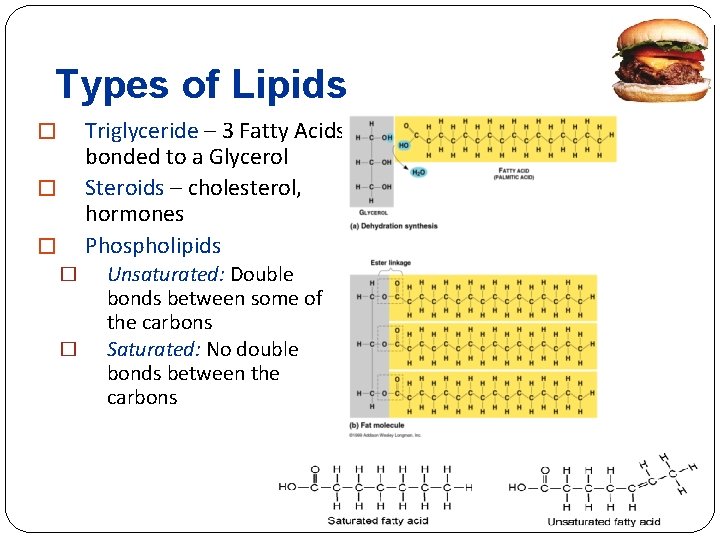
Types of Lipids Triglyceride – 3 Fatty Acids bonded to a Glycerol Steroids – cholesterol, hormones Phospholipids � � � Unsaturated: Double bonds between some of the carbons Saturated: No double bonds between the carbons
Lipid Functions �Important in cell membrane �High energy food �Protects vital organs �Insulates the body �Stores food for later use
Protein Function �Most Abundant-50% of Dry Wt �Essential to Life �Build structure �Movement: Makes up muscle tissue (ex. actin and myosin). �Transport: Carries oxygen in an organism (ex. hemoglobin). �Immunity: Helps fight off foreign invaders antibodies). �Enzymes: Speed up chemical reactions (ex. amylase and trypsin). (ex.
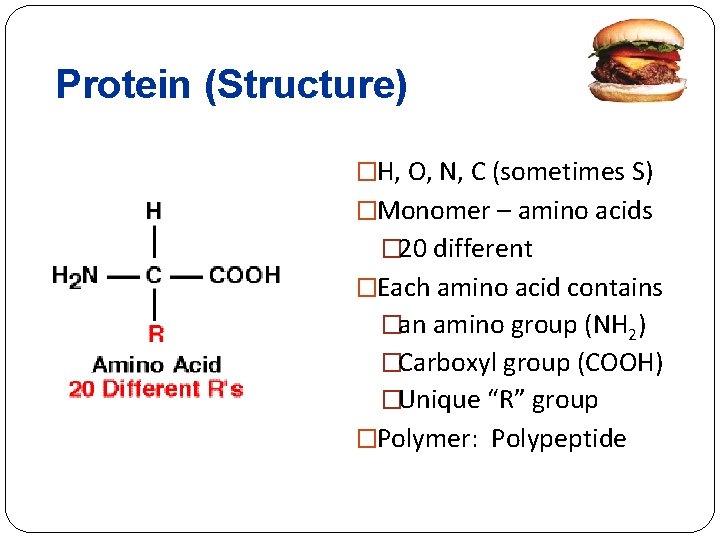
Protein (Structure) �H, O, N, C (sometimes S) �Monomer – amino acids � 20 different �Each amino acid contains �an amino group (NH 2) �Carboxyl group (COOH) �Unique “R” group �Polymer: Polypeptide
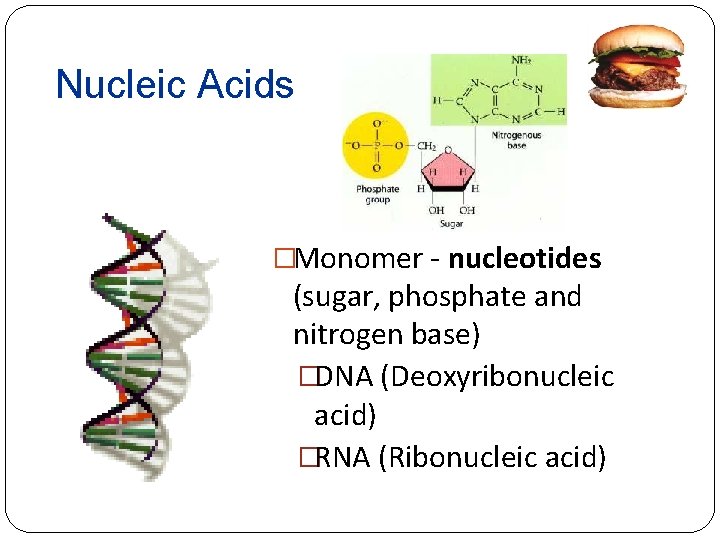
Nucleic Acids �Monomer - nucleotides (sugar, phosphate and nitrogen base) �DNA (Deoxyribonucleic acid) �RNA (Ribonucleic acid)
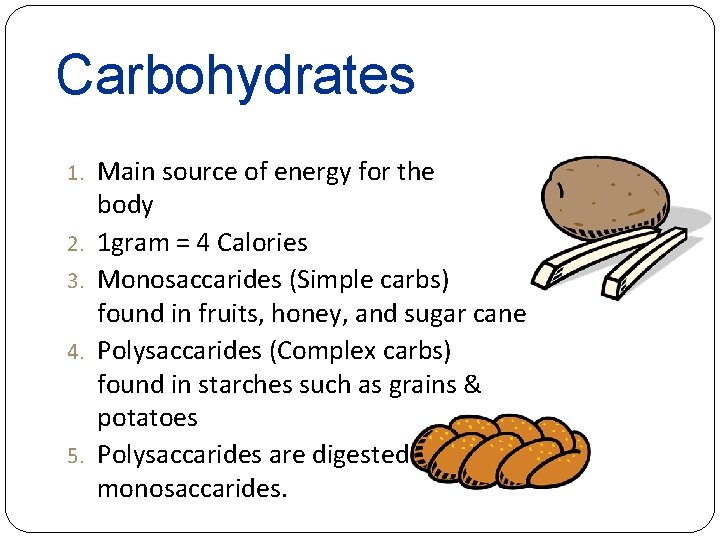
Carbohydrates 1. 2. 3. 4. 5. Main source of energy for the body 1 gram = 4 Calories Monosaccarides (Simple carbs) found in fruits, honey, and sugar cane Polysaccarides (Complex carbs) found in starches such as grains & potatoes Polysaccarides are digested into monosaccarides.
Fats Fat is broken down into glycerol and fatty acids. 1 gram = 9 Calories 2. Essential fatty acids found in vegetable oils 3. Help body absorb certain vitamins 4. Used to produce 1. Cell membranes 2. Myelin sheaths 3. Hormones 1.
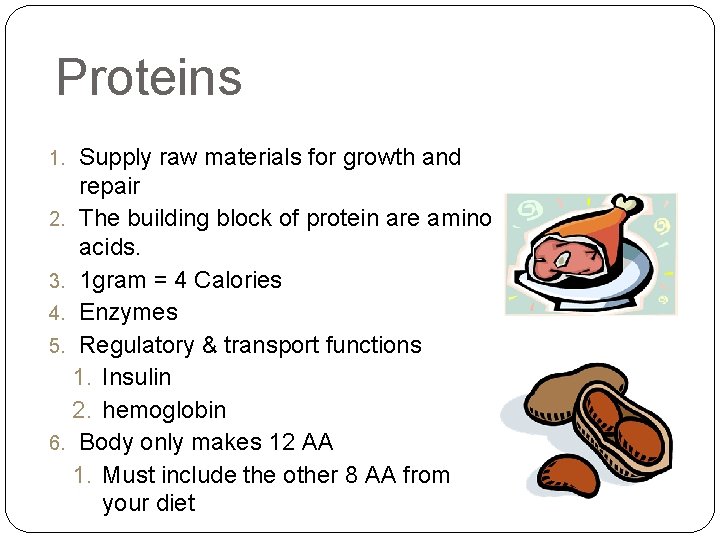
Proteins Supply raw materials for growth and repair 2. The building block of protein are amino acids. 3. 1 gram = 4 Calories 4. Enzymes 5. Regulatory & transport functions 1. Insulin 2. hemoglobin 6. Body only makes 12 AA 1. Must include the other 8 AA from your diet 1.
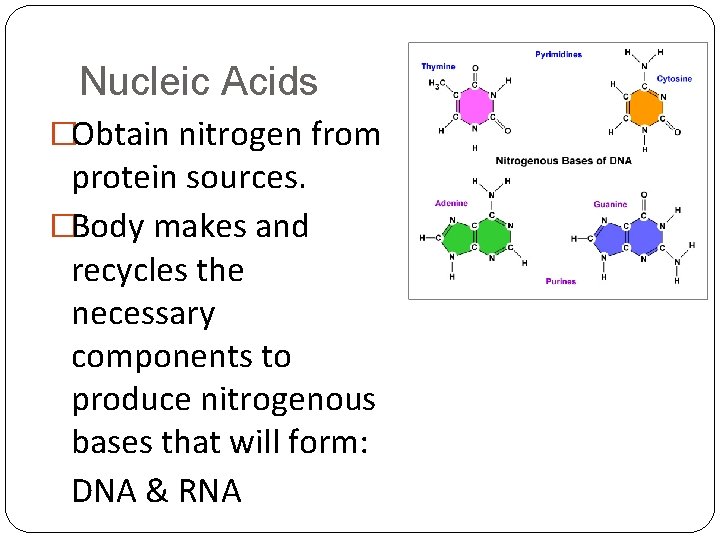
Nucleic Acids �Obtain nitrogen from protein sources. �Body makes and recycles the necessary components to produce nitrogenous bases that will form: DNA & RNA
Vitamins 1. 2. 3. 4. 5. Organic molecules that help regulate body processes Often work with enzymes Most must be obtained from food Vitamin deficiencies and overdose have serious consequences There are 2 types of Vitamins: 1. Fat Soluble 2. Water Soluble
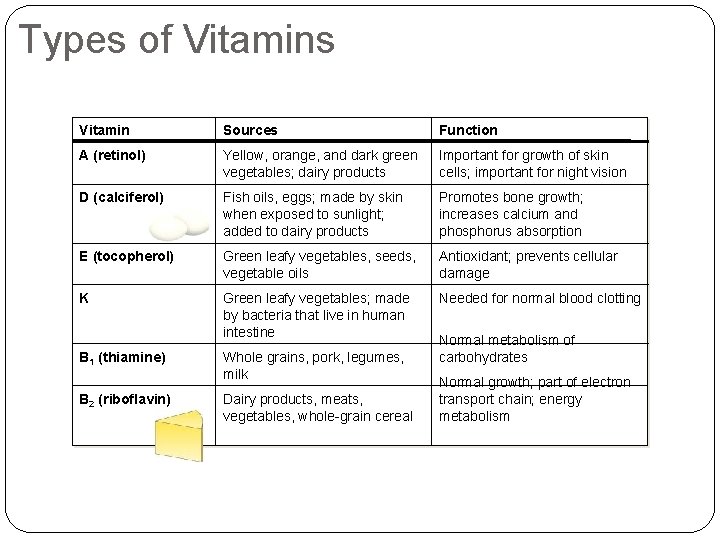
Types of Vitamins Vitamin Sources Function A (retinol) Yellow, orange, and dark green vegetables; dairy products Important for growth of skin cells; important for night vision D (calciferol) Fish oils, eggs; made by skin when exposed to sunlight; added to dairy products Promotes bone growth; increases calcium and phosphorus absorption E (tocopherol) Green leafy vegetables, seeds, vegetable oils Antioxidant; prevents cellular damage K Green leafy vegetables; made by bacteria that live in human intestine Needed for normal blood clotting B 1 (thiamine) B 2 (riboflavin) Whole grains, pork, legumes, milk Dairy products, meats, vegetables, whole-grain cereal Normal metabolism of carbohydrates Normal growth; part of electron transport chain; energy metabolism
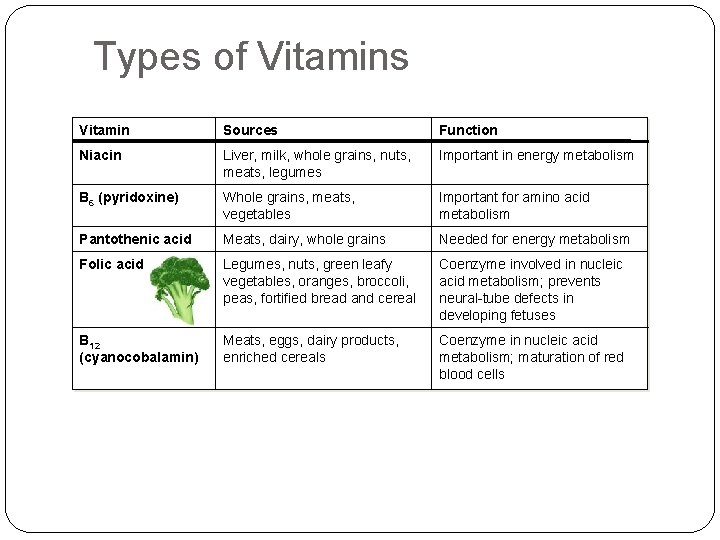
Types of Vitamins Vitamin Sources Function Niacin Liver, milk, whole grains, nuts, meats, legumes Important in energy metabolism B 6 (pyridoxine) Whole grains, meats, vegetables Important for amino acid metabolism Pantothenic acid Meats, dairy, whole grains Needed for energy metabolism Folic acid Legumes, nuts, green leafy vegetables, oranges, broccoli, peas, fortified bread and cereal Coenzyme involved in nucleic acid metabolism; prevents neural-tube defects in developing fetuses B 12 (cyanocobalamin) Meats, eggs, dairy products, enriched cereals Coenzyme in nucleic acid metabolism; maturation of red blood cells
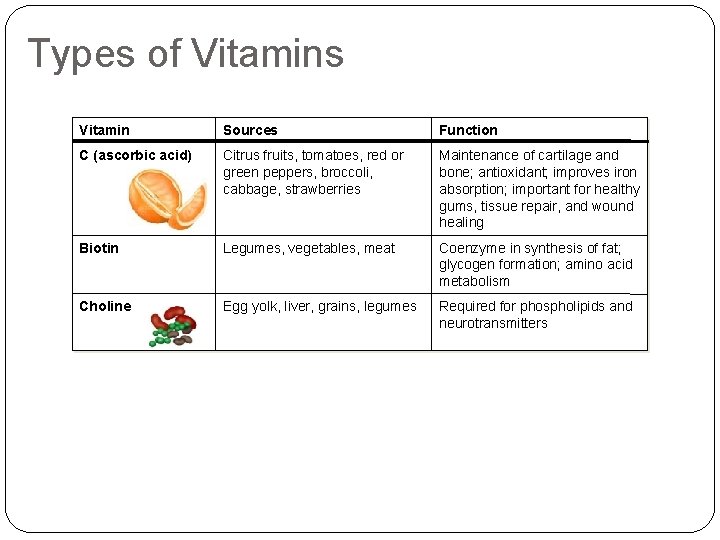
Types of Vitamins Vitamin Sources Function C (ascorbic acid) Citrus fruits, tomatoes, red or green peppers, broccoli, cabbage, strawberries Maintenance of cartilage and bone; antioxidant; improves iron absorption; important for healthy gums, tissue repair, and wound healing Biotin Legumes, vegetables, meat Coenzyme in synthesis of fat; glycogen formation; amino acid metabolism Choline Egg yolk, liver, grains, legumes Required for phospholipids and neurotransmitters
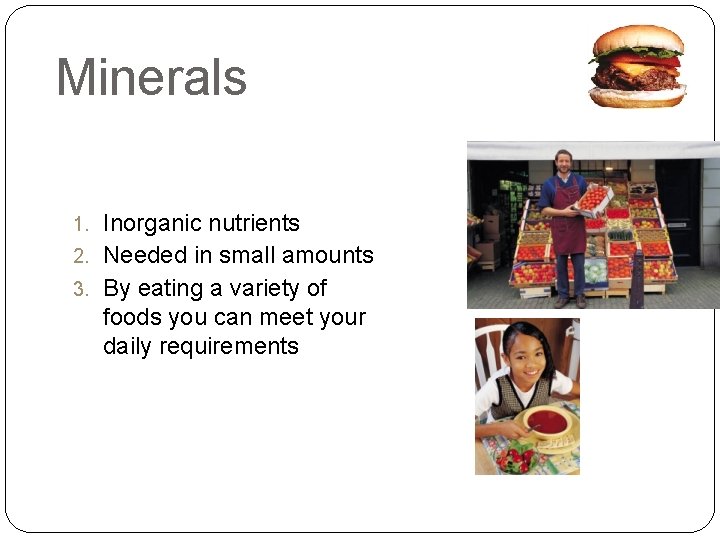
Minerals Inorganic nutrients 2. Needed in small amounts 3. By eating a variety of foods you can meet your daily requirements 1.
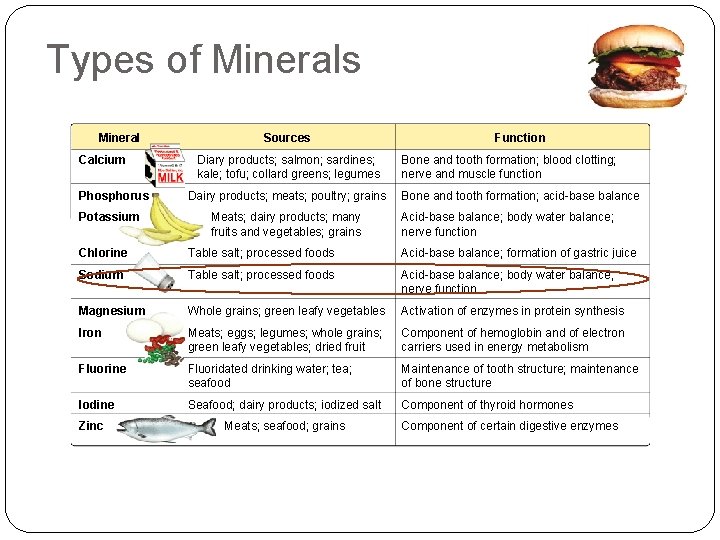
Types of Minerals Mineral Calcium Phosphorus Potassium Sources Diary products; salmon; sardines; kale; tofu; collard greens; legumes Dairy products; meats; poultry; grains Meats; dairy products; many fruits and vegetables; grains Function Bone and tooth formation; blood clotting; nerve and muscle function Bone and tooth formation; acid-base balance Acid-base balance; body water balance; nerve function Chlorine Table salt; processed foods Acid-base balance; formation of gastric juice Sodium Table salt; processed foods Acid-base balance; body water balance; nerve function Magnesium Whole grains; green leafy vegetables Activation of enzymes in protein synthesis Iron Meats; eggs; legumes; whole grains; green leafy vegetables; dried fruit Component of hemoglobin and of electron carriers used in energy metabolism Fluorine Fluoridated drinking water; tea; seafood Maintenance of tooth structure; maintenance of bone structure Iodine Seafood; dairy products; iodized salt Component of thyroid hormones Zinc Meats; seafood; grains Component of certain digestive enzymes
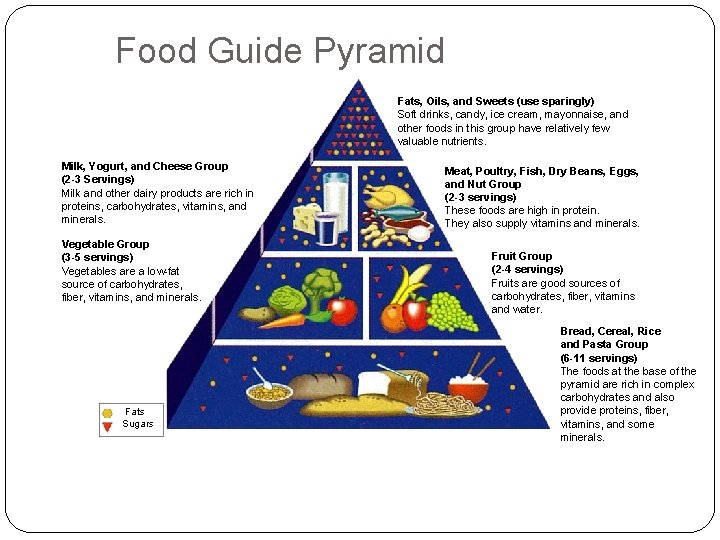
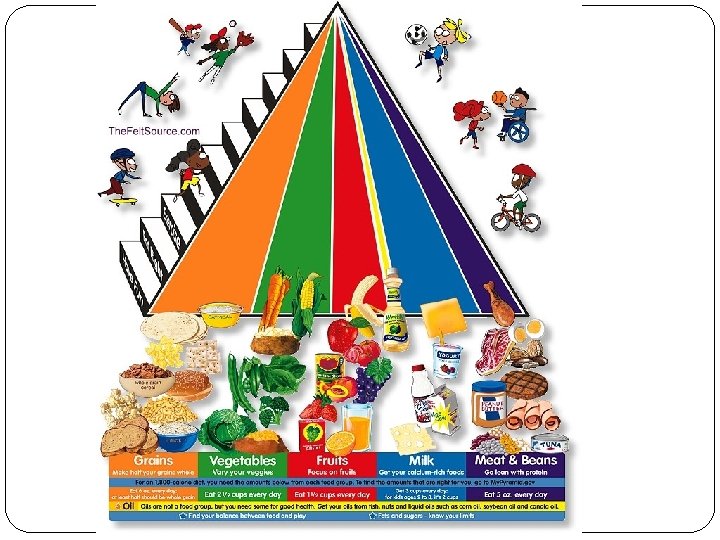
Food Guide Pyramid Section 38 -1 Fats, Oils, and Sweets (use sparingly) Soft drinks, candy, ice cream, mayonnaise, and other foods in this group have relatively few valuable nutrients. Milk, Yogurt, and Cheese Group (2 -3 Servings) Milk and other dairy products are rich in proteins, carbohydrates, vitamins, and minerals. Vegetable Group (3 -5 servings) Vegetables are a low-fat source of carbohydrates, fiber, vitamins, and minerals. Fats Sugars Meat, Poultry, Fish, Dry Beans, Eggs, and Nut Group (2 -3 servings) These foods are high in protein. They also supply vitamins and minerals. Fruit Group (2 -4 servings) Fruits are good sources of carbohydrates, fiber, vitamins and water. Bread, Cereal, Rice and Pasta Group (6 -11 servings) The foods at the base of the pyramid are rich in complex carbohydrates and also provide proteins, fiber, vitamins, and some minerals.
Food labels Activity Work on numbers 14 and 15 on second page until the whole class is done with the first part of the worksheet. Then we will discuss numbers 10 -13
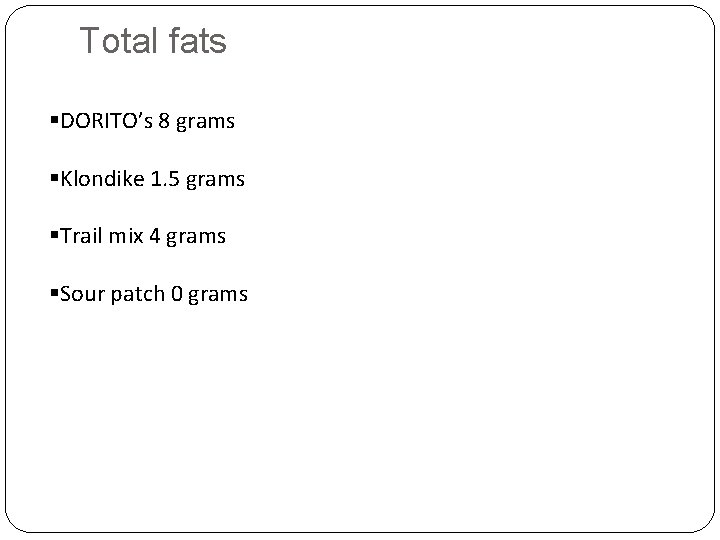
Total fats §DORITO’s 8 grams §Klondike 1. 5 grams §Trail mix 4 grams §Sour patch 0 grams
DUE TODAY: • Bimolecules Notes (KEEP) “Every act of creation is first an act of destruction. ” Pablo Picasso DUE NEXT CLASS: • SAFETY CONTRACT & Syllabus contract • Binder/spiral/KLEENEX