
Learning Goals Difference between Power Influence What are
Learning Goals • Difference between Power & Influence • What are effective influence tactics for supervisors, subordinates and peers • Why are they effective
What is power • Having personal or positional resources to change situations or people’s attitudes & behaviors Yukl, 1989
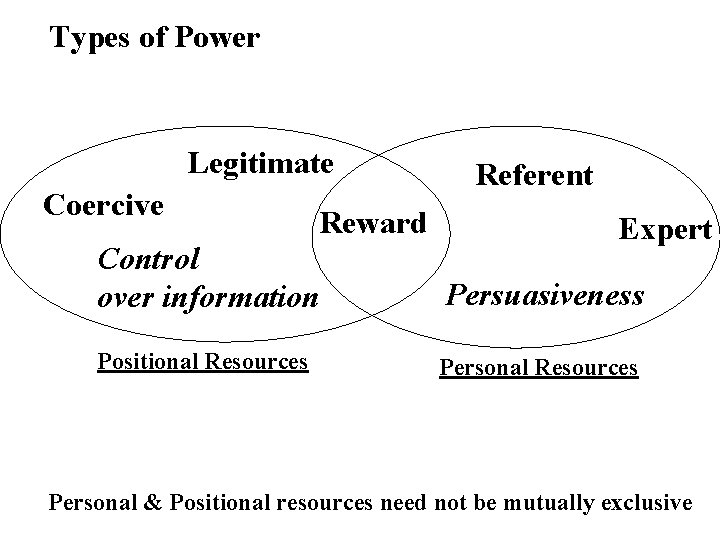
Types of Power Legitimate Coercive Reward Referent Expert Control over information Persuasiveness Positional Resources Personal & Positional resources need not be mutually exclusive
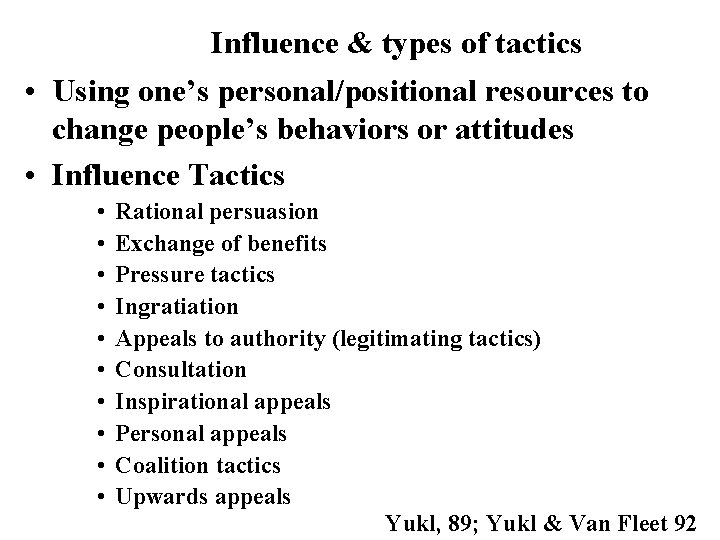
Influence & types of tactics • Using one’s personal/positional resources to change people’s behaviors or attitudes • Influence Tactics • • • Rational persuasion Exchange of benefits Pressure tactics Ingratiation Appeals to authority (legitimating tactics) Consultation Inspirational appeals Personal appeals Coalition tactics Upwards appeals Yukl, 89; Yukl & Van Fleet 92
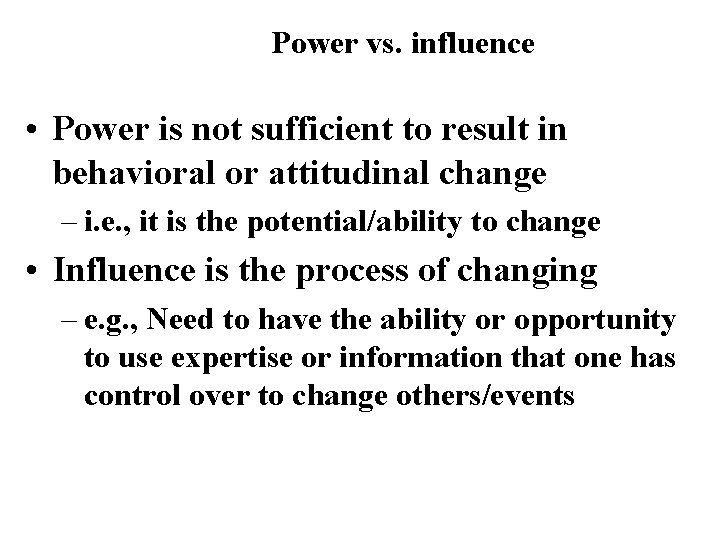
Power vs. influence • Power is not sufficient to result in behavioral or attitudinal change – i. e. , it is the potential/ability to change • Influence is the process of changing – e. g. , Need to have the ability or opportunity to use expertise or information that one has control over to change others/events
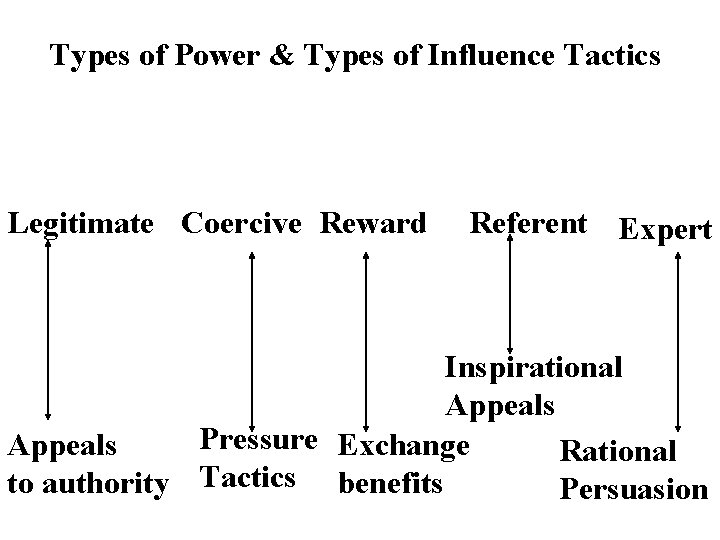
Types of Power & Types of Influence Tactics Legitimate Coercive Reward Referent Expert Inspirational Appeals Pressure Exchange Appeals Rational to authority Tactics benefits Persuasion
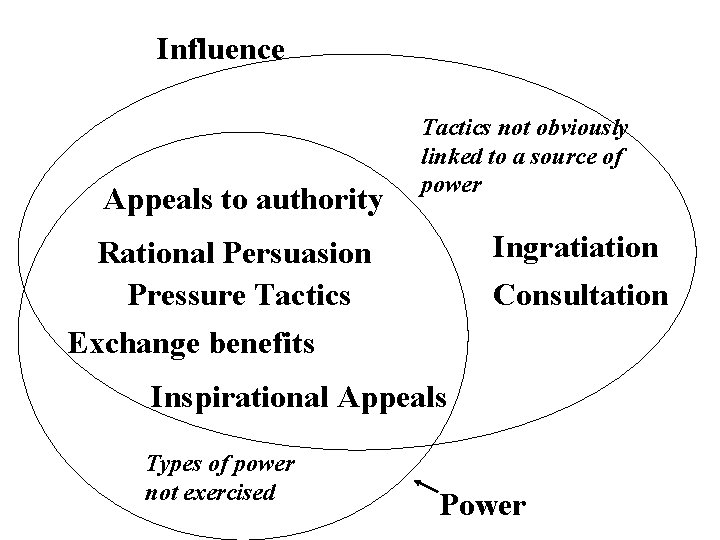
Influence Appeals to authority Tactics not obviously linked to a source of power Ingratiation Consultation Rational Persuasion Pressure Tactics Exchange benefits Inspirational Appeals Types of power not exercised Power
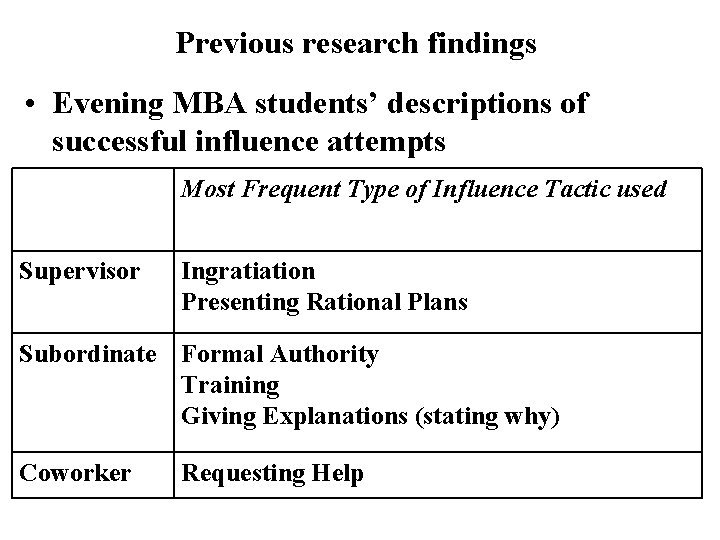
Previous research findings • Evening MBA students’ descriptions of successful influence attempts Most Frequent Type of Influence Tactic used Supervisor Ingratiation Presenting Rational Plans Subordinate Formal Authority Training Giving Explanations (stating why) Coworker Requesting Help
Why are certain tactics successful w/supervisors • Rational explanation: – By using logical argument and facts you persuade the other that the request is practical and can result in task objectives • Ingratiation – Making supervisor feel good, or like you so that s/he can be influenced by you
Why are certain tactics successful w/subordinates • Legitimating tactics – Persuading subordinate to do what you want because you have the authority/right to ask him/her to do so bec. of your position or bec. it is organizational ‘policy’
Current Research • Practicing managers descriptions of one successful and one unsuccessful influence tactic on different types of targets – Study 1=supervisor – Study 2=subordinate – Study 3=peer • 250 influence tactics
Most frequent tactics used to influence Supervisors • Presenting a rational explanation – E. g. , Quantitative analysis, documentation w/data • Telling, arguing or talking w/out support – E. g. , I would like a raise…(no reason given) • Presenting a complete plan – E. g. Anticipating & overcoming counter-arguments or potential obstacles to implement plan • Being persistent – Used in combination with other tactics
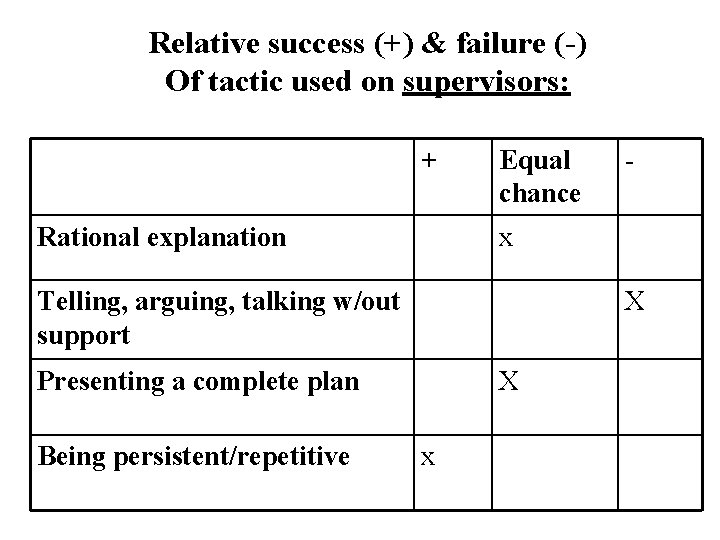
Relative success (+) & failure (-) Of tactic used on supervisors: + Rational explanation Equal chance x Telling, arguing, talking w/out support X Presenting a complete plan Being persistent/repetitive - X x
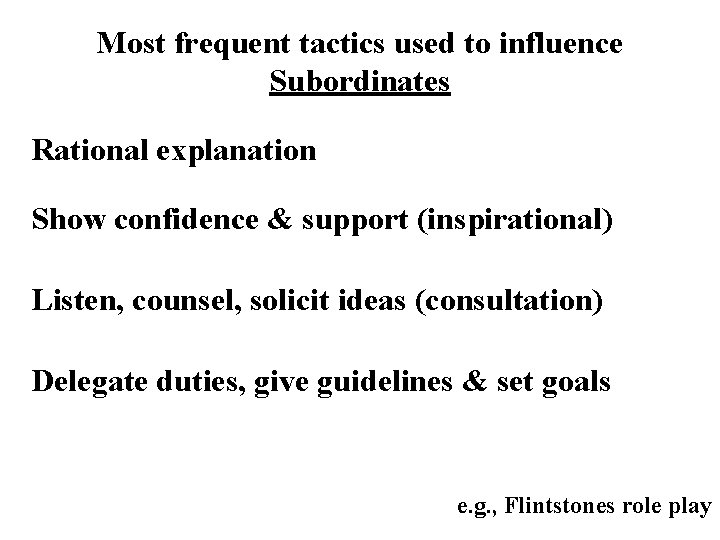
Most frequent tactics used to influence Subordinates Rational explanation Show confidence & support (inspirational) Listen, counsel, solicit ideas (consultation) Delegate duties, give guidelines & set goals e. g. , Flintstones role play
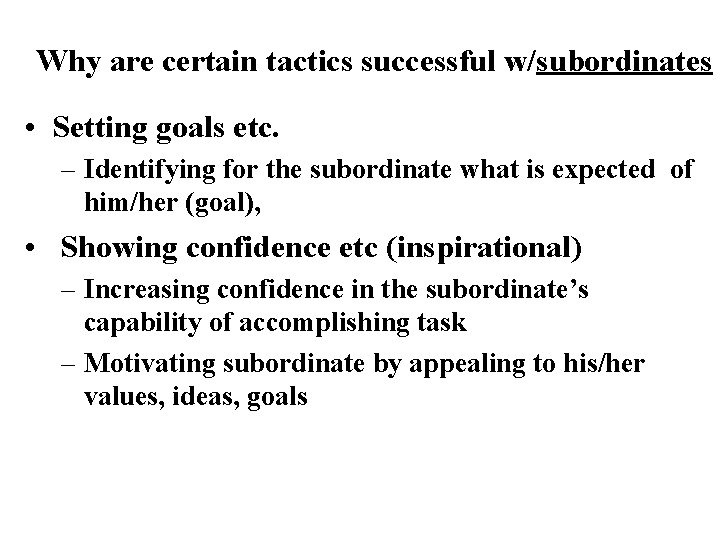
Why are certain tactics successful w/subordinates • Setting goals etc. – Identifying for the subordinate what is expected of him/her (goal), • Showing confidence etc (inspirational) – Increasing confidence in the subordinate’s capability of accomplishing task – Motivating subordinate by appealing to his/her values, ideas, goals
Why are certain tactics successful w/subordinates • Soliciting ideas (Consultation) – Seeking subordinate participation in planning an activity that subordinate will be involved in or modifying the activity to deal with subordinate concerns/suggestions on how to carry it out
Most frequent tactics used to influence Peers Rational explanation Show support of others: using agreement of others as a reason for peer to agree Present an example of a parallel situation: using success in other situations as a reason Threaten: imply negative consequences for not agreeing
Today’s learning • Distinction b/w power & influence • Research on influence tactics used on subordinates, supervisors & peers – Learning Check – What are the common tactics that are successful for all types of targets? Examples? – Unique tactics to use on subordinates? Examples? – What are successful vs. unsuccessful tactics on supervisors? Examples?

Material in article that could be on exam but is not covered in class due to time constraints
Implications of this & other research • Types of tactics – Combination of tactics is better than any one tactic – People try positive tactics first, then negative (especially for downward influence) • Targets of influence – Wider variety of approaches used to influence downwards • Reciprocal influence relationships – Are used against each other – Outside the organization are important
5 Steps to become an influential manager 1. Develop reputation as expert 2. Time spent on relationship should be based on work needs 3. Develop network of resource persons who can be called upon for assistance 4. Choose correct combination of influence tactics based on objective and target to be influenced 5. Communicate influence tactics effectively
1. Develop a reputation as an expert • • • Most commonly used, but 50% chance of success Continually build on knowledge base (acquire) Publicize one’s expertise
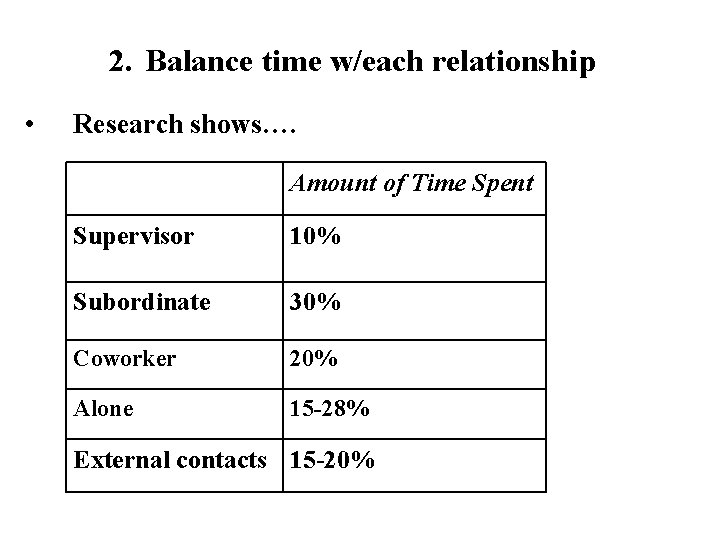
2. Balance time w/each relationship • Research shows…. Amount of Time Spent Supervisor 10% Subordinate 30% Coworker 20% Alone 15 -28% External contacts 15 -20%
2. Balance time w/each relationship • Spend at least 75% time w/peers & supervisors so as to spend time where influence is most needed to accomplish organizational goals • Competition/power inhibits people from spending time w/peers/supervisors
3. Develop network of resource persons • • Contact w/others & independence of one’s position relative to others Control over information flow Rotate jobs frequently Establish & maintain strong friendships to ensure obligation and cooperation Seek commonality w/other managers
4. Choose correct combination of influence tactics • • • Depending on target & objective More approaches were used on subordinates Combination of tactics is more successful – Use rational explanations, parallel examples, support of others, – Influence attempts to be ‘timed’ – Be persistent & repetitive
5. Communicate influence tactics effectively • • Know the needs, values of targets Present influence attempts based on target Listen & appreciate more when dealing w/upward or lateral targets See & hear more, be flexible in behavior depending on person – Face-face, group meetings, memos
- Slides: 27