
Learning Goals 1 2 3 4 5 I

- Slides: 43
Learning Goals 1. 2. 3. 4. 5. I will be able to explain the challenges facing 21 st Century managers I will be able to describe the characteristics and performance of a successful organization. I will be able to define what is a manager and what are the levels of management I will be able to identify characteristics and skills a successful manager needs. I will be able to explain the four functions of management.
Management Fundamentals Chapter 1
Learning Goal #1 �I will be able to explain the challenges facing 21 st Century managers
The 21 st Century Workplace � Today’s ◦ ◦ ◦ workplace is one in which: Organizations must adapt to change Economy is global Innovation and technology drive the economy Economy is knowledge based Best employers value people!
What do you think are some challenges of working in the 21 st Century workplace?
6 Challenges of Working in the New Economy � Intellectual Capital � Globalization � Technology � Diversity � Ethics � Careers
1. Intellectual Capital � People ◦ What they know, what they learn, what they do with it are the foundation of the organization � Intellectual Capital � Knowledge Worker ◦ Shared knowledge/collective brainpower of the organization ◦ Someone whose mind is a critical asset; someone who adds to collective brainpower
2. Globalization � National boundaries of business world have virtually disappeared � People and countries are increasingly interconnected � Globalization ◦ The worldwide interdependence of resources, markets, and competition of the new economy
3. Technology � Transformation ◦ ◦ of the workplace through: Internet Computers Information technology Automation � Increasing demand for knowledge workers � Skills need to be continually updated and mastered
4. Diversity � Workforce Diversity ◦ Differences in age, gender, race, religion, sexual orientation and able-bodiedness � Diverse workforces provide both challenges and opportunities for organizations � Organizations can tap rich talent pool and help everyone to their full potential by valuing diversity � Businesses are improving but inequalities still exist
4. Diversity � Prejudice ◦ Preconceived opinion or attitude not based on reason or experience ◦ Becomes discrimination when minority members are treated unfairly or denied full benefits of membership � Glass Ceiling Effect ◦ Subtle form of discrimination ◦ Prevents women and minorities from rising above a certain level in organizations
5. Ethics � Moral principles that determine “good” or “bad” behaviour � Law requires corporations to have board of directors to look out for interests of shareholders � Corporate Governance ◦ Board of directors actively looking at the activities of corporation to hold management socially responsible � Ethics has become important in today’s business world
6. Careers � Shift from previous generation � Today’s workers: ◦ Will not all work full time ◦ Won’t work for one large employer for duration of career ◦ Are more likely to change jobs and employers ◦ Need skills that are portable and current ◦ Need to upgrade skills
Why do you think these things are problems? � Intellectual Capital � Globalization � Technology � Diversity � Ethics � Careers
Ø Which of the 6 challenges do you believe creates the greatest challenge for employees/employers to overcome? Why?
Jigsaw - Form new groups based on your answers. ◦ E. g. all globalization get together � As a group decide on three reasons why your topic is the biggest challenge. � Create two examples of your challenge in the workplace � How would you solve each example � Present information to class
In Partners: Create a promotional poster that would make people aware of your choice of challenge.
Self Quiz � What are the six challenges that 21 st Century managers are facing? �
Learning Goal 2 I will be able to describe the characteristics and performance of a successful organization.
Activity – Group of 2 or 3 � Create an organization (any company) � What type of employees do you need to have to run your company? (e. g. CEO, manual labourers) � Group your employees into 3 groups. � How did you decide on your final groupings? � What common characteristics did your employees have?
What is an Organization? � Collection of people working together to achieve a common purpose � Allows members to achieve results far beyond reach of individual accomplishment � All organizations have a broad purpose: ◦ Provide useful goods or services that return value to society and satisfy customer needs
Characteristics of Organizations � Three characteristics: ◦ Purpose: to create a good or service ◦ Division of labour: different tasks assigned to different people ◦ Hierarchy of authority: a level-by level management structure of increasing responsibility
Group Work - In groups of 2 or 3 � Back to your organization. You and your group need figure out what the three characteristics of YOUR organization will look like. � Characteristics ◦ What is your organization’s purpose? ◦ How will you divide the labour in your organization? (already partially done in previous activity) ◦ What will be the hierarchy of authority be in your organization?
Measuring Organizational Performance � Organizations perform well when resources are used efficiently and customers served well � Performance measured in many ways ◦ Productivity �Quality and quantity of work done in relation to resources used ◦ Performance Effectiveness �Measures how well output goals are met �E. g. , meeting production targets each day ◦ Performance Efficiency �Measures costs associated with output
In YOUR organization decide on how you are measuring performance in regards to; ◦ Productivity ◦ Performance Effectiveness ◦ Performance Efficiency
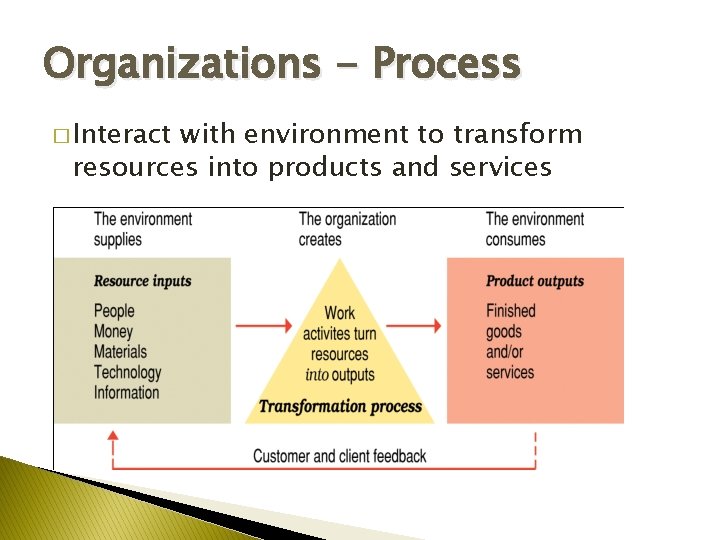
Organizations - Process � Interact with environment to transform resources into products and services
Back to your organization - again � Explain the process your organization goes through. (resource inputs, transformation, finished goods and services, client feedback)
Learning Goals Revisited 1. 2. I will be able to explain the challenges facing 21 st Century managers I will be able to describe the characteristics and performance of a successful organization. New Goals 3. I will be able to define what is a manager and what are the levels of management 4. I will be able characteristics and skills a successful manager needs. 5. I will be able to explain the four functions of management.
� https: //www. youtube. com/watch? v=UJS 9 Jr. FD u. Ro
What is a Manager? �A person who supports and is responsible for the work of others � Responsible for the overall accomplishments and performance of a team, group or the entire organization � Support subordinates whose tasks represent real work of organization � Key Responsibility: ◦ To help others achieve high performance
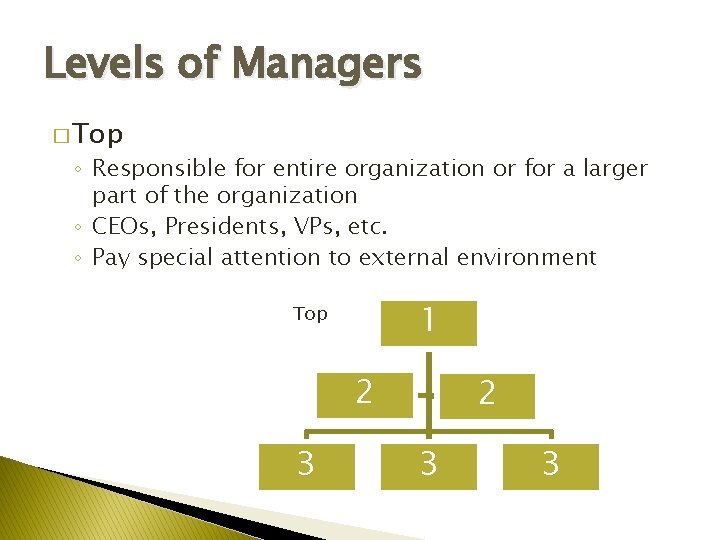
Levels of Managers � Top ◦ Responsible for entire organization or for a larger part of the organization ◦ CEOs, Presidents, VPs, etc. ◦ Pay special attention to external environment 1 Top 2 3 3
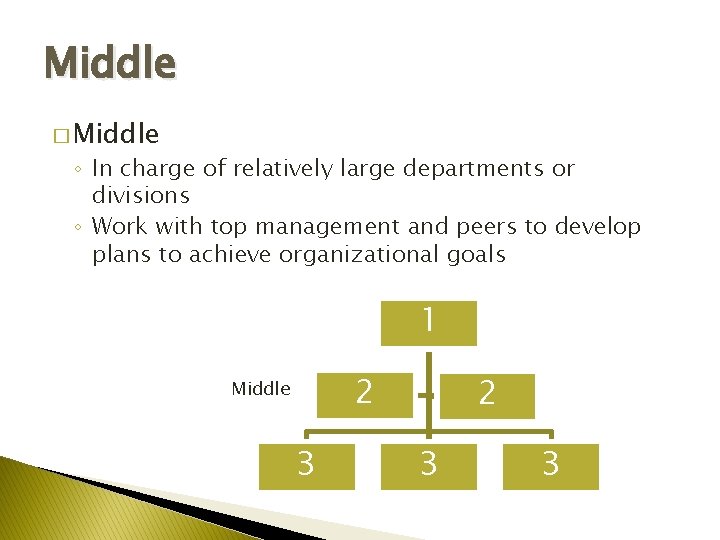
Middle � Middle ◦ In charge of relatively large departments or divisions ◦ Work with top management and peers to develop plans to achieve organizational goals 1 2 Middle 3 2 3 3
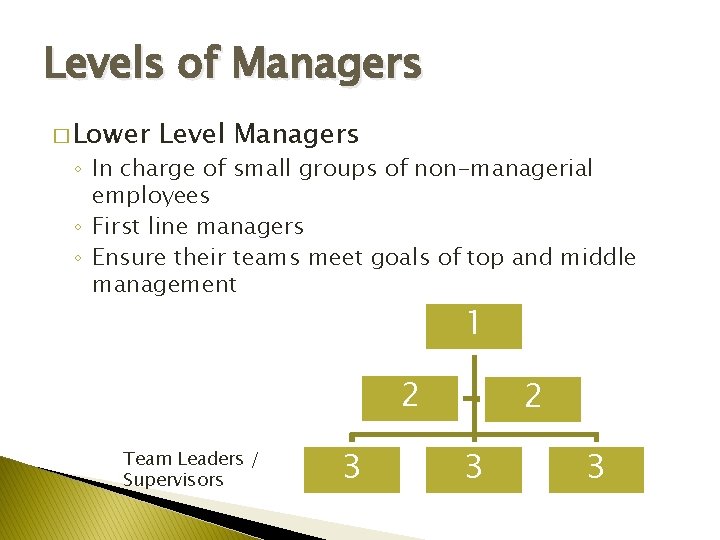
Levels of Managers � Lower Level Managers ◦ In charge of small groups of non-managerial employees ◦ First line managers ◦ Ensure their teams meet goals of top and middle management 1 2 Team Leaders / Supervisors 3 2 3 3
What do Managers do?
What do Managers do? � Plan meetings � Make work schedules � Inform and clarify goals and tasks � Seek recommendations for improvement � Performance appraisal � Recommend pay increases and new job assignments � Recruit, develop and train new employees � Encourage high performance � Inform high levels of team needs � Coordinate with other teams
Managerial Performance � All managers must be accountable ◦ Accountability: requirement to answer to higher authority � Managers are accountable for achieving results while maintaining high quality of work life environment � Quality of Work Life ◦ Quality of human experiences in workplace ◦ Includes: �Fair pay safe work conditions �Opportunities to learn opportunities to progress �Pride in work and organization
As managers (partners), write down how you would provide; �Fair pay �Opportunities to learn �Pride in work and organization �safe work conditions �opportunities to progress
Managerial Performance � High ◦ ◦ performing managers: Build working relationships Help others develop skills and competencies Foster teamwork Create work environment of performance and satisfaction How would a manager meet the above criteria?
Managerial Success � Skills and characteristics leading to managerial success: ◦ ◦ ◦ Communication Teamwork Self-management Leadership Critical thinking Professionalism � What would each of these skills look like in the workplace?
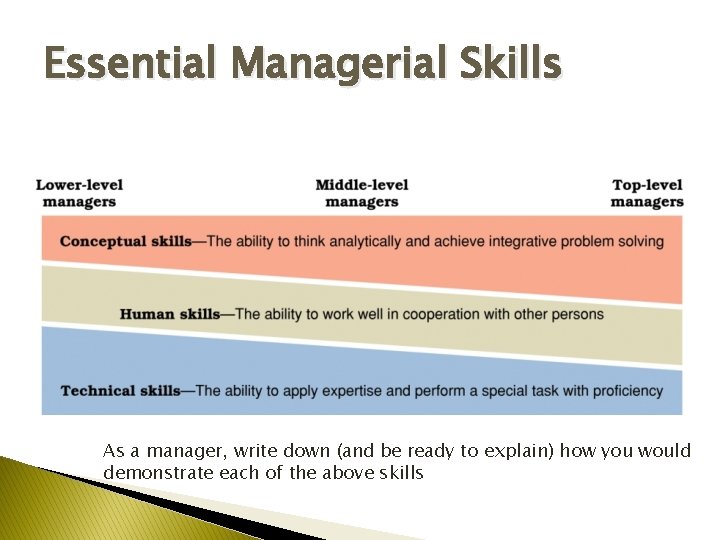
Essential Managerial Skills As a manager, write down (and be ready to explain) how you would demonstrate each of the above skills
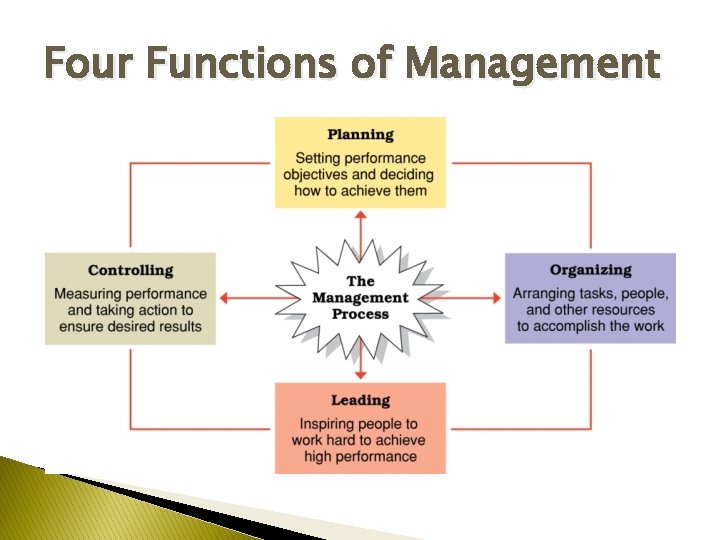
LG 5: Four Functions of Management � Planning ◦ Setting goals and deciding how to accomplish them � Organizing ◦ Arranging tasks, resources and work of individuals and groups to meet goals � Leading ◦ Inspiring and influencing others to work to meet goals � Controlling ◦ Measuring results, comparing results to goals and taking action as needed
Four Functions of Management
You are the manager of a new company and must perform the four functions of a manager. (leading, organizing, planning, controlling). In groups, come up with an example of how you would perform the four functions of management.