
Learning gem 5 Jason LowePower http www lowepower
- Slides: 66
Learning gem 5 Jason Lowe-Power http: //www. lowepower. com/jason/learning_gem 5/ 2/5/2017 © Jason Lowe-Power <jason@lowepower. com> 1
What is gem 5? Michigan m 5 + Wisconsin GEMS = gem 5 “The gem 5 simulator is a modular platform for computersystem architecture research, encompassing system-level architecture as well as processor microarchitecture. ” Nathan Binkert, Bradford Beckmann, Gabriel Black, Steven K. Reinhardt, Ali Saidi, Arkaprava Basu, Joel Hestness, Derek R. Hower, Tushar Krishna, Somayeh Sardashti, Rathijit Sen, Korey Sewell, Muhammad Shoaib, Nilay Vaish, Mark D. Hill, and David A. Wood. 2011. The gem 5 simulator. SIGARCH Comput. Archit. News 39, 2 (August 2011), 1 -7. DOI=http: //dx. doi. org/10. 1145/2024716. 2024718 2/5/2017 © Jason Lowe-Power <jason@lowepower. com> 2
This tutorial This is going to interactive Work along with me for best results Ask questions!! 2/5/2017 © Jason Lowe-Power <jason@lowepower. com> 3
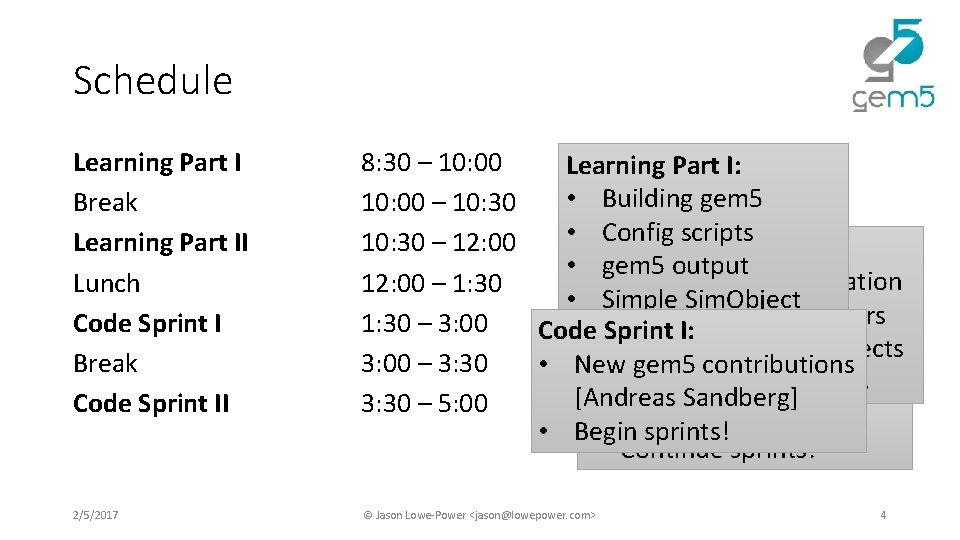
Schedule Learning Part I Break Learning Part II Lunch Code Sprint I Break Code Sprint II 8: 30 – 10: 00 Learning Part I: • Building gem 5 10: 00 – 10: 30 • Config scripts 10: 30 – 12: 00 Learning Part II: • gem 5 output • Event-driven simulation 12: 00 – 1: 30 • Simple Sim. Object • Sim. Object parameters 1: 30 – 3: 00 Code Sprint I: • Memory system objects 3: 00 – 3: 30 • New gem 5 contributions • Other gem 5 features [Andreas Sandberg] 3: 30 – 5: 00 Code Sprint II: • Begin sprints! • Continue sprints! 2/5/2017 © Jason Lowe-Power <jason@lowepower. com> 4
Building gem 5 http: //learning. gem 5. org/book/part 1/building. html 2/5/2017 © Jason Lowe-Power <jason@lowepower. com> 5
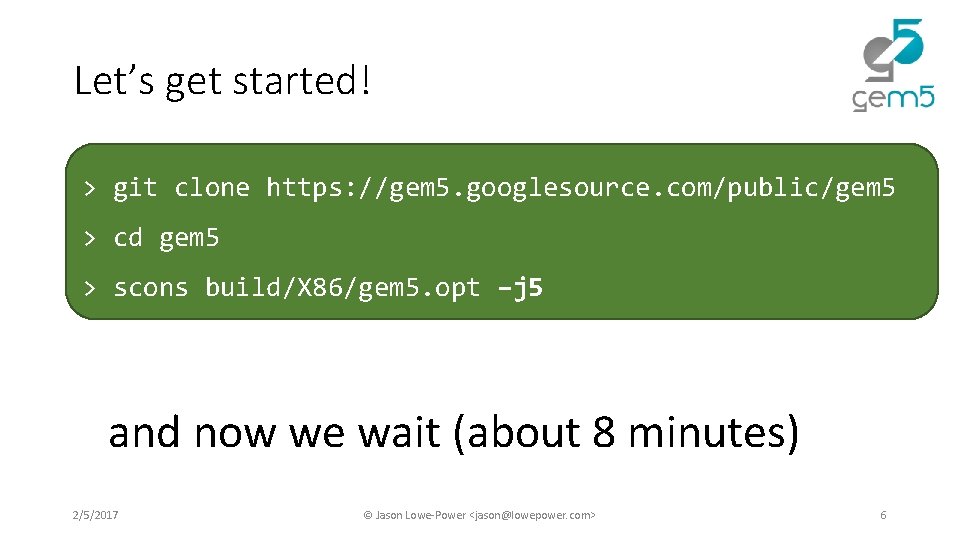
Let’s get started! Switch! > git clone https: //gem 5. googlesource. com/public/gem 5 > cd gem 5 > scons build/X 86/gem 5. opt –j 5 and now we wait (about 8 minutes) 2/5/2017 © Jason Lowe-Power <jason@lowepower. com> 6
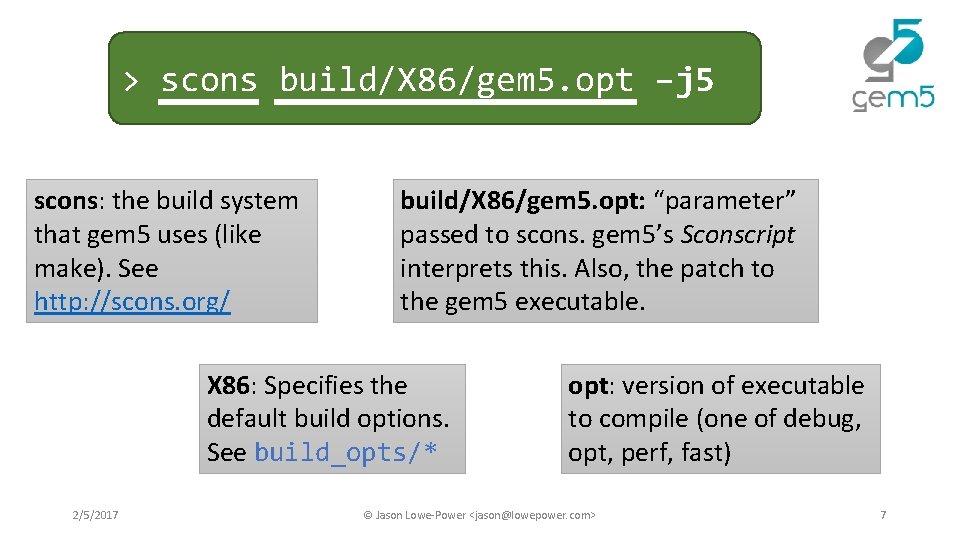
> scons build/X 86/gem 5. opt –j 5 scons: the build system that gem 5 uses (like make). See http: //scons. org/ build/X 86/gem 5. opt: “parameter” passed to scons. gem 5’s Sconscript interprets this. Also, the patch to the gem 5 executable. X 86: Specifies the default build options. See build_opts/* 2/5/2017 opt: version of executable to compile (one of debug, opt, perf, fast) © Jason Lowe-Power <jason@lowepower. com> 7
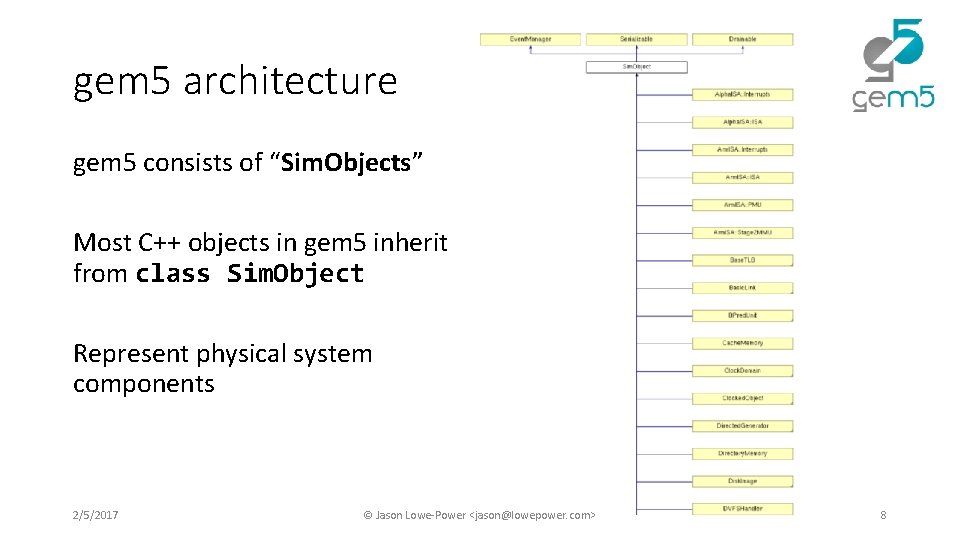
gem 5 architecture gem 5 consists of “Sim. Objects” Most C++ objects in gem 5 inherit from class Sim. Object Represent physical system components 2/5/2017 © Jason Lowe-Power <jason@lowepower. com> 8
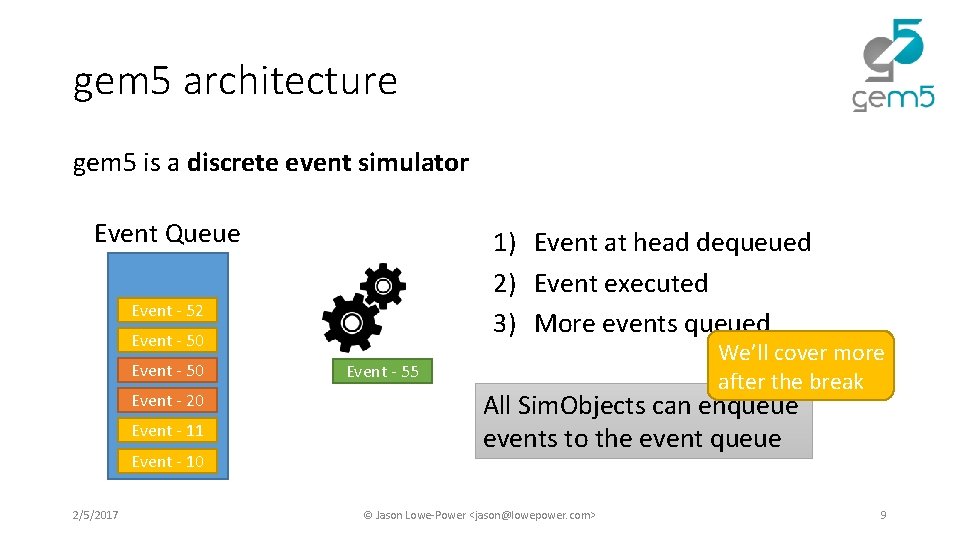
gem 5 architecture gem 5 is a discrete event simulator Event Queue 1) Event at head dequeued 2) Event executed 3) More events queued Event - 52 Event - 50 Event - 20 Event - 11 Event - 10 2/5/2017 Event - 55 We’ll cover more after the break All Sim. Objects can enqueue events to the event queue © Jason Lowe-Power <jason@lowepower. com> 9
gem 5 configuration scripts http: //learning. gem 5. org/book/part 1/simple_config. html http: //learning. gem 5. org/book/part 1/cache_config. html 2/5/2017 © Jason Lowe-Power <jason@lowepower. com> 10
gem 5 user interface gem 5 completely controlled by Python scripts Scripts define system to model All (C++) Sim. Objects exposed to Python So… let’s make one! 2/5/2017 © Jason Lowe-Power <jason@lowepower. com> 11
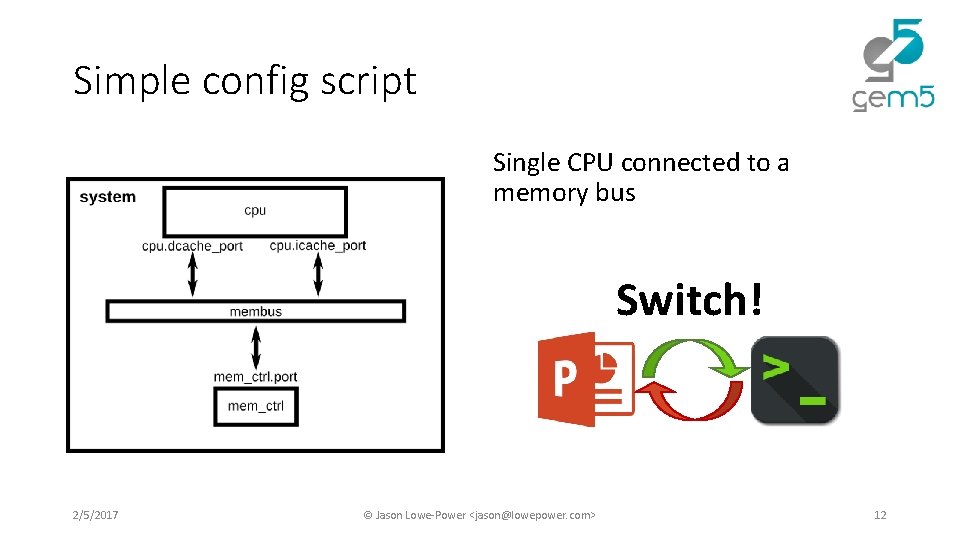
Simple config script Single CPU connected to a memory bus Switch! 2/5/2017 © Jason Lowe-Power <jason@lowepower. com> 12
Simple config script http: //learning. gem 5. org/book/_downloads/simple. py 2/5/2017 © Jason Lowe-Power <jason@lowepower. com> 13
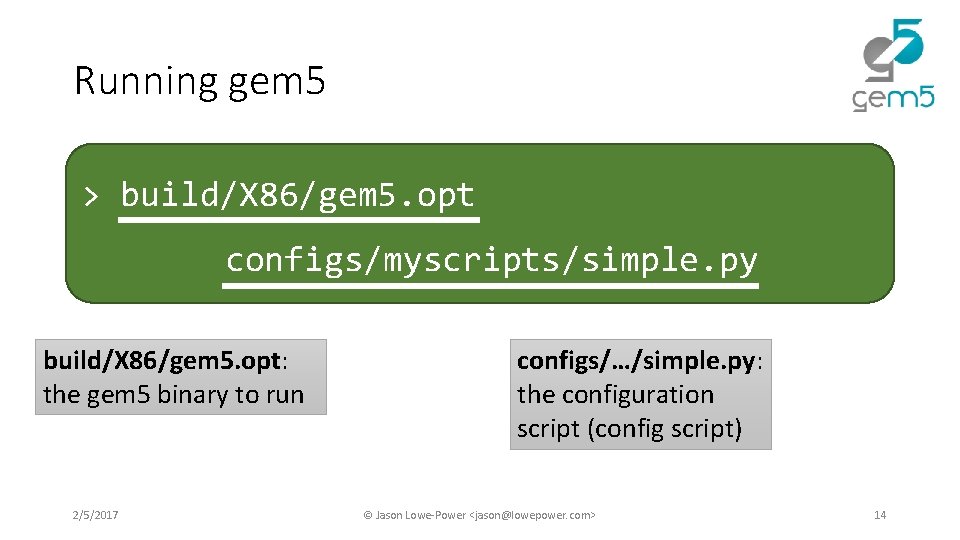
Running gem 5 > build/X 86/gem 5. opt configs/myscripts/simple. py build/X 86/gem 5. opt: the gem 5 binary to run 2/5/2017 configs/…/simple. py: the configuration script (config script) © Jason Lowe-Power <jason@lowepower. com> 14
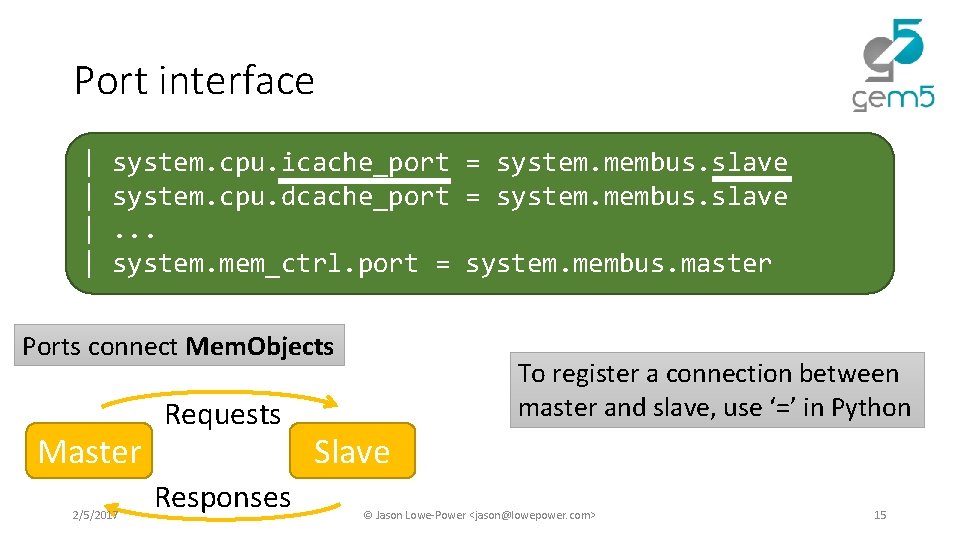
Port interface | | system. cpu. icache_port = system. membus. slave system. cpu. dcache_port = system. membus. slave. . . system. mem_ctrl. port = system. membus. master Ports connect Mem. Objects Master 2/5/2017 Requests Responses To register a connection between master and slave, use ‘=’ in Python Slave © Jason Lowe-Power <jason@lowepower. com> 15
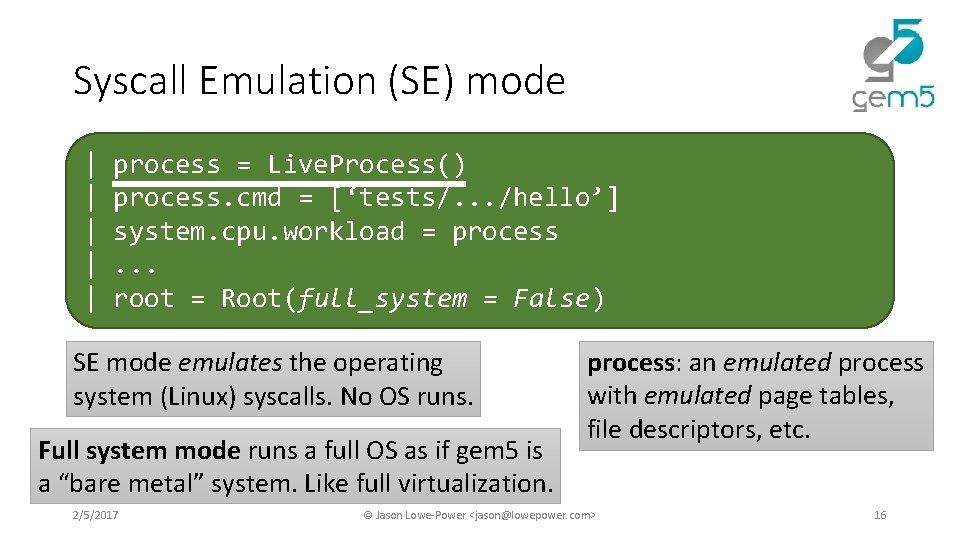
Syscall Emulation (SE) mode | | | process = Live. Process() process. cmd = [‘tests/. . . /hello’] system. cpu. workload = process. . . root = Root(full_system = False) SE mode emulates the operating system (Linux) syscalls. No OS runs. Full system mode runs a full OS as if gem 5 is a “bare metal” system. Like full virtualization. 2/5/2017 process: an emulated process with emulated page tables, file descriptors, etc. © Jason Lowe-Power <jason@lowepower. com> 16
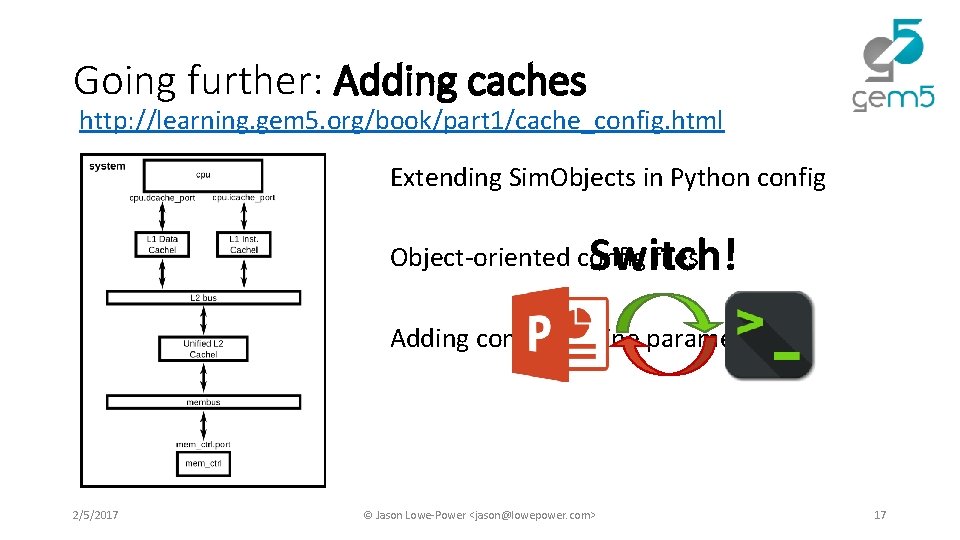
Going further: Adding caches http: //learning. gem 5. org/book/part 1/cache_config. html Extending Sim. Objects in Python config Switch! Object-oriented config files Adding command-line parameters 2/5/2017 © Jason Lowe-Power <jason@lowepower. com> 17
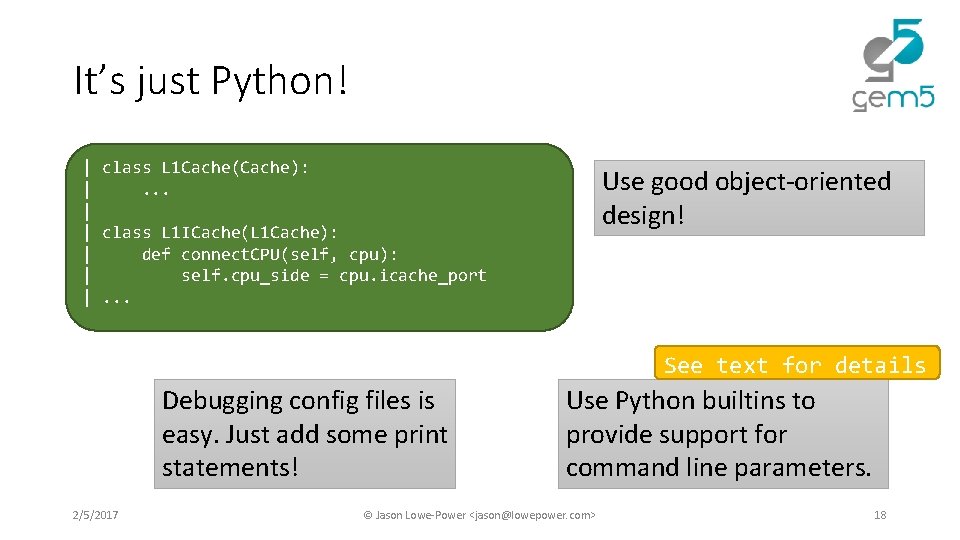
It’s just Python! | class L 1 Cache(Cache): |. . . | | class L 1 ICache(L 1 Cache): | def connect. CPU(self, cpu): | self. cpu_side = cpu. icache_port |. . . Use good object-oriented design! See text for details Debugging config files is easy. Just add some print statements! 2/5/2017 Use Python builtins to provide support for command line parameters. © Jason Lowe-Power <jason@lowepower. com> 18
Understanding gem 5 output http: //learning. gem 5. org/book/part 1/gem 5_stats. html 2/5/2017 © Jason Lowe-Power <jason@lowepower. com> 19
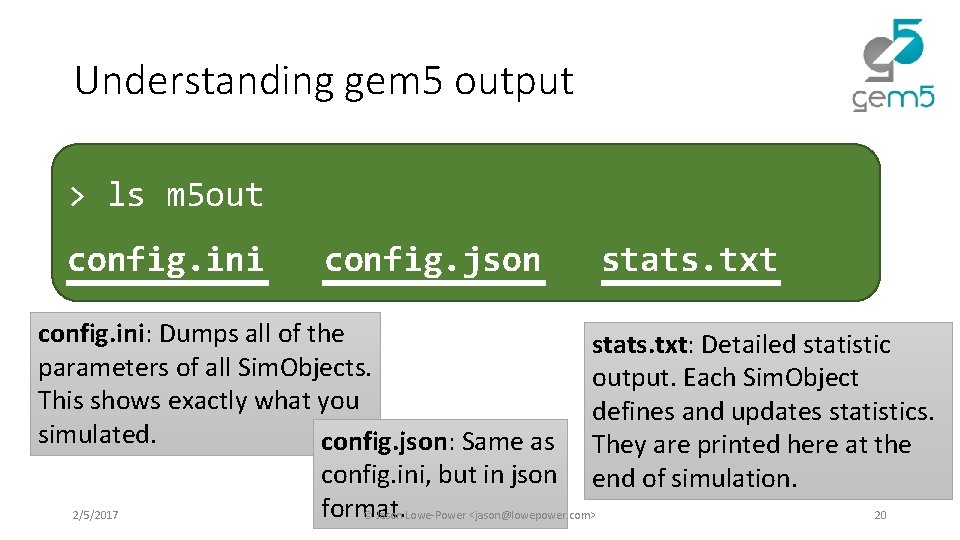
Understanding gem 5 output > ls m 5 out config. ini config. json stats. txt config. ini: Dumps all of the stats. txt: Detailed statistic parameters of all Sim. Objects. output. Each Sim. Object This shows exactly what you defines and updates statistics. simulated. config. json: Same as They are printed here at the config. ini, but in json end of simulation. format. 2/5/2017 © Jason Lowe-Power <jason@lowepower. com> 20
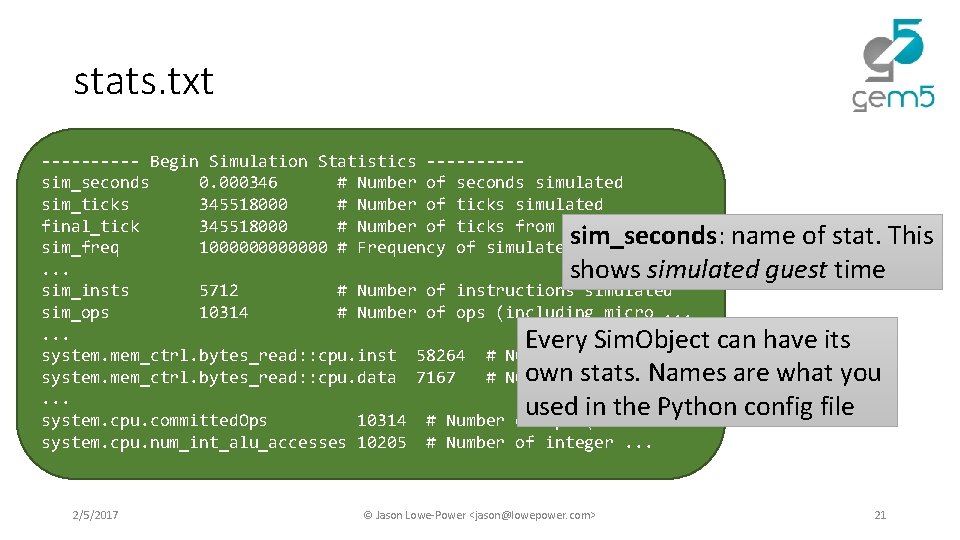
stats. txt Switch! ----- Begin Simulation Statistics -----sim_seconds 0. 000346 # Number of seconds simulated sim_ticks 345518000 # Number of ticks simulated final_tick 345518000 # Number of ticks from beginning. . . sim_freq 1000000 # Frequency of simulatedsim_seconds: name of stat. This ticks. . . shows simulated guest time sim_insts 5712 # Number of instructions simulated sim_ops 10314 # Number of ops (including micro. . . Every Sim. Object can have its system. mem_ctrl. bytes_read: : cpu. inst 58264 # Number of bytes. . . own stats. Names are what you system. mem_ctrl. bytes_read: : cpu. data 7167 # Number of bytes. . . used in the Python config file system. cpu. committed. Ops 10314 # Number of ops (. . . system. cpu. num_int_alu_accesses 10205 # Number of integer. . . 2/5/2017 © Jason Lowe-Power <jason@lowepower. com> 21
A simple Sim. Object http: //learning. gem 5. org/book/part 2/helloobject. html 2/5/2017 © Jason Lowe-Power <jason@lowepower. com> 22
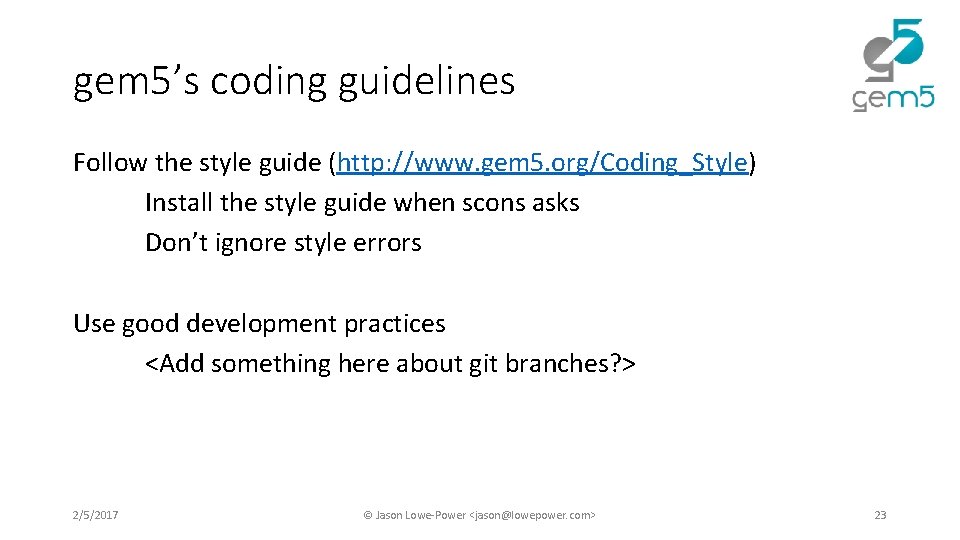
gem 5’s coding guidelines Follow the style guide (http: //www. gem 5. org/Coding_Style) Install the style guide when scons asks Don’t ignore style errors Use good development practices <Add something here about git branches? > 2/5/2017 © Jason Lowe-Power <jason@lowepower. com> 23
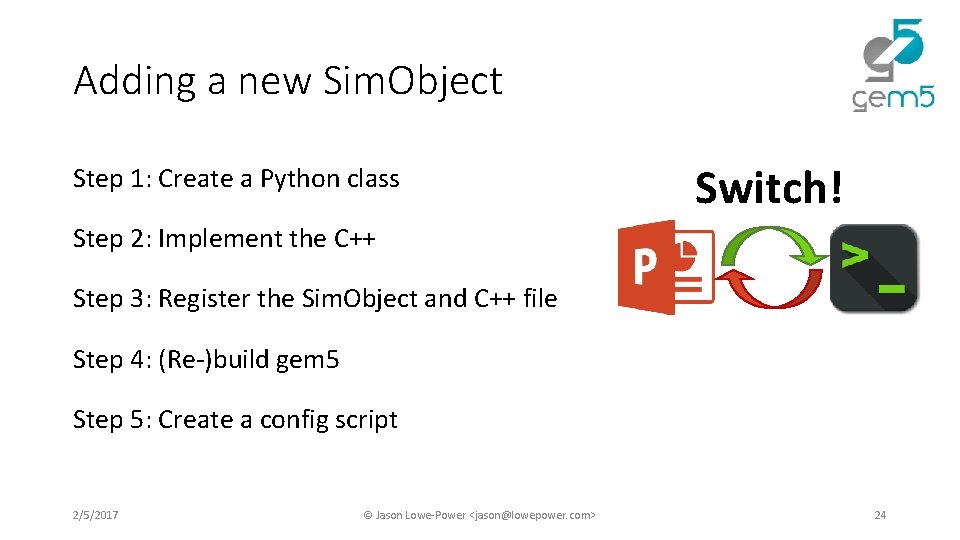
Adding a new Sim. Object Step 1: Create a Python class Switch! Step 2: Implement the C++ Step 3: Register the Sim. Object and C++ file Step 4: (Re-)build gem 5 Step 5: Create a config script 2/5/2017 © Jason Lowe-Power <jason@lowepower. com> 24
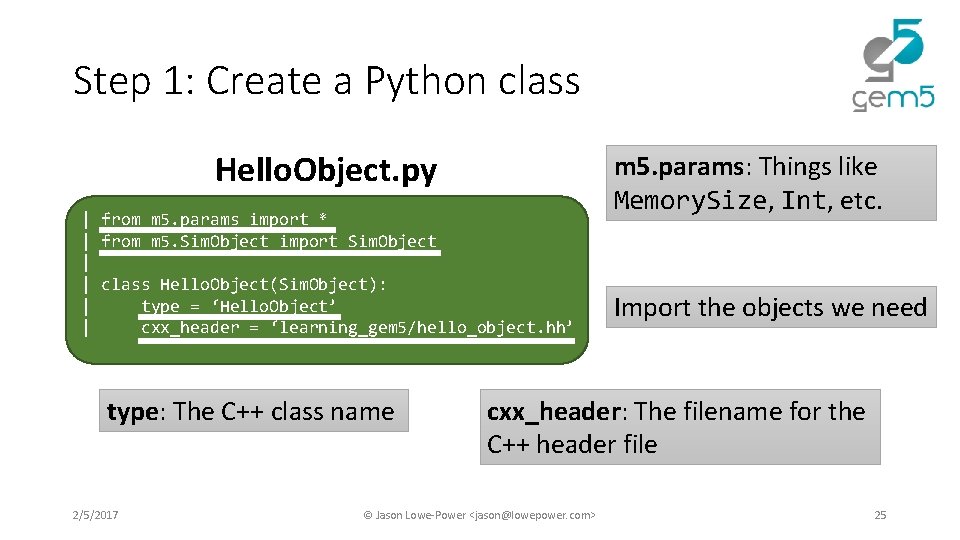
Step 1: Create a Python class Hello. Object. py | from m 5. params import * | from m 5. Sim. Object import Sim. Object | | class Hello. Object(Sim. Object): | type = ‘Hello. Object’ | cxx_header = ‘learning_gem 5/hello_object. hh’ type: The C++ class name 2/5/2017 m 5. params: Things like Memory. Size, Int, etc. Import the objects we need cxx_header: The filename for the C++ header file © Jason Lowe-Power <jason@lowepower. com> 25
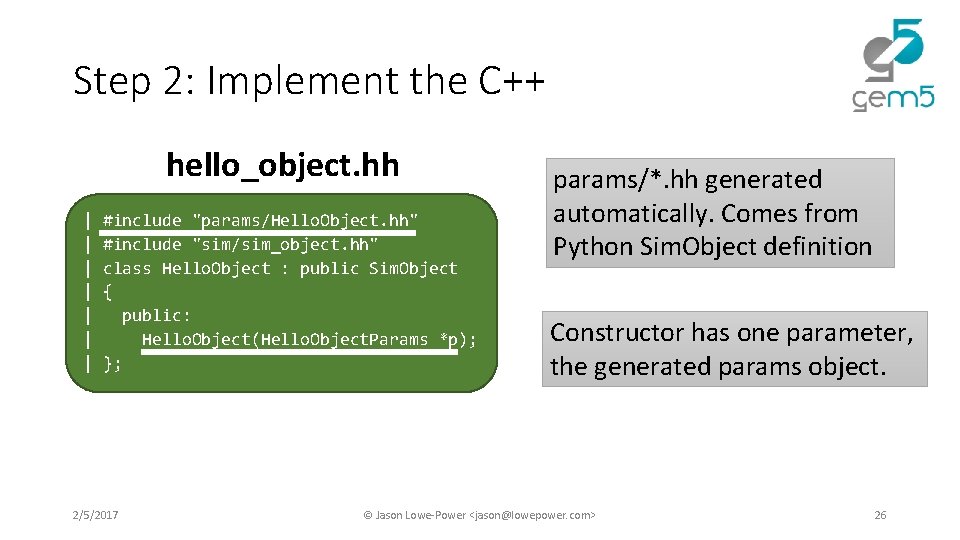
Step 2: Implement the C++ hello_object. hh | | | | #include "params/Hello. Object. hh" #include "sim/sim_object. hh" class Hello. Object : public Sim. Object { public: Hello. Object(Hello. Object. Params *p); }; 2/5/2017 params/*. hh generated automatically. Comes from Python Sim. Object definition Constructor has one parameter, the generated params object. © Jason Lowe-Power <jason@lowepower. com> 26
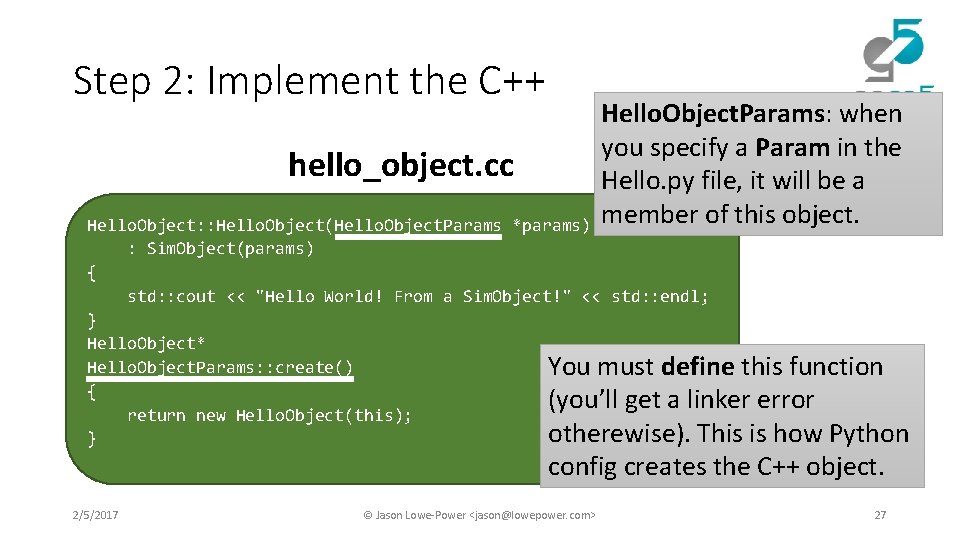
Step 2: Implement the C++ Hello. Object. Params: when you specify a Param in the Hello. py file, it will be a member of this object. hello_object. cc Hello. Object: : Hello. Object(Hello. Object. Params *params) : Sim. Object(params) { std: : cout << "Hello World! From a Sim. Object!" << std: : endl; } Hello. Object* Hello. Object. Params: : create() You must define this function { (you’ll get a linker error return new Hello. Object(this); otherewise). This is how Python } config creates the C++ object. 2/5/2017 © Jason Lowe-Power <jason@lowepower. com> 27
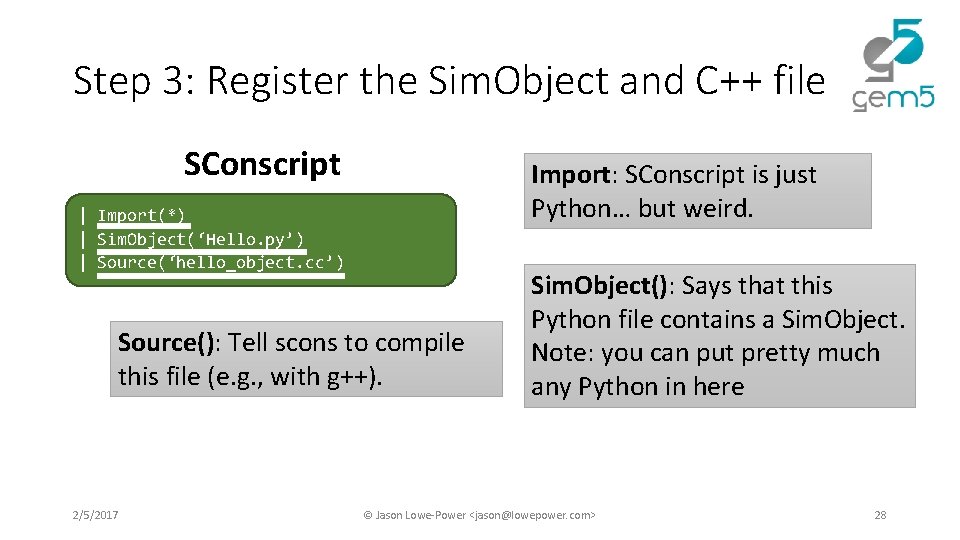
Step 3: Register the Sim. Object and C++ file SConscript Import: SConscript is just Python… but weird. | Import(*) | Sim. Object(‘Hello. py’) | Source(‘hello_object. cc’) Source(): Tell scons to compile this file (e. g. , with g++). 2/5/2017 Sim. Object(): Says that this Python file contains a Sim. Object. Note: you can put pretty much any Python in here © Jason Lowe-Power <jason@lowepower. com> 28
Step 4: (Re-)build gem 5 2/5/2017 © Jason Lowe-Power <jason@lowepower. com> 29
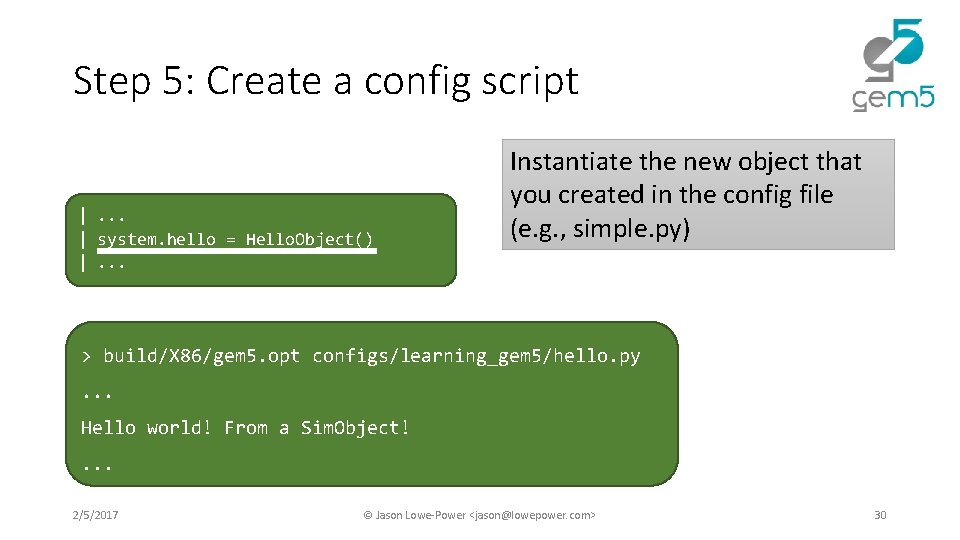
Step 5: Create a config script |. . . | system. hello = Hello. Object() |. . . Instantiate the new object that you created in the config file (e. g. , simple. py) > build/X 86/gem 5. opt configs/learning_gem 5/hello. py. . . Hello world! From a Sim. Object!. . . 2/5/2017 © Jason Lowe-Power <jason@lowepower. com> 30
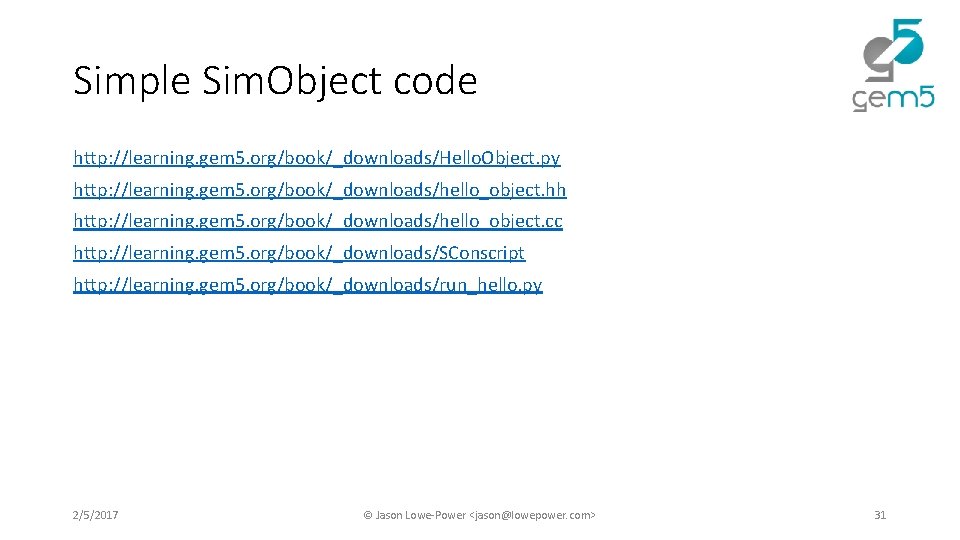
Simple Sim. Object code http: //learning. gem 5. org/book/_downloads/Hello. Object. py http: //learning. gem 5. org/book/_downloads/hello_object. hh http: //learning. gem 5. org/book/_downloads/hello_object. cc http: //learning. gem 5. org/book/_downloads/SConscript http: //learning. gem 5. org/book/_downloads/run_hello. py 2/5/2017 © Jason Lowe-Power <jason@lowepower. com> 31
Debug support in gem 5 http: //learning. gem 5. org/book/part 2/debugging. html 2/5/2017 © Jason Lowe-Power <jason@lowepower. com> 32
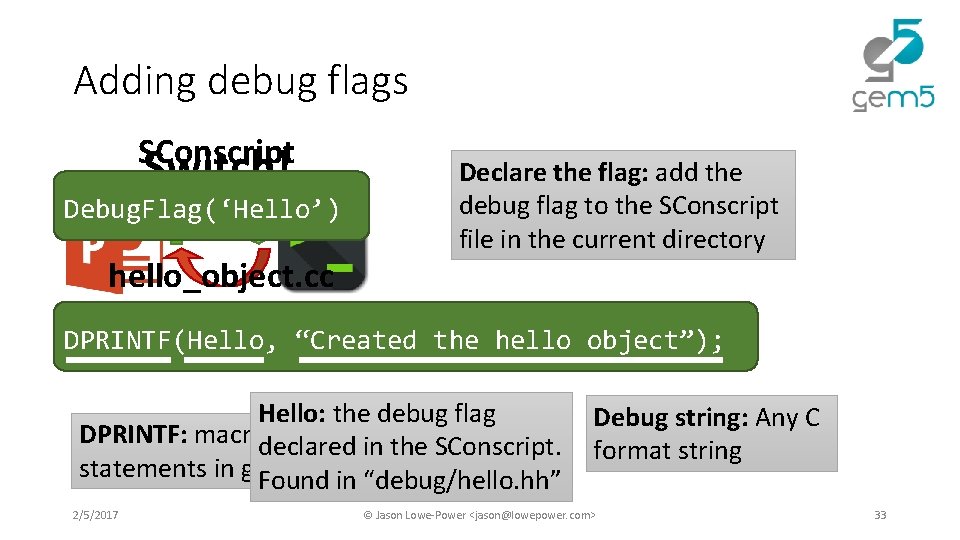
Adding debug flags SConscript Switch! Debug. Flag(‘Hello’) hello_object. cc Declare the flag: add the debug flag to the SConscript file in the current directory DPRINTF(Hello, “Created the hello object”); Hello: the debug flag DPRINTF: macro for debug declared in the SConscript. statements in gem 5 Found in “debug/hello. hh” 2/5/2017 Debug string: Any C format string © Jason Lowe-Power <jason@lowepower. com> 33
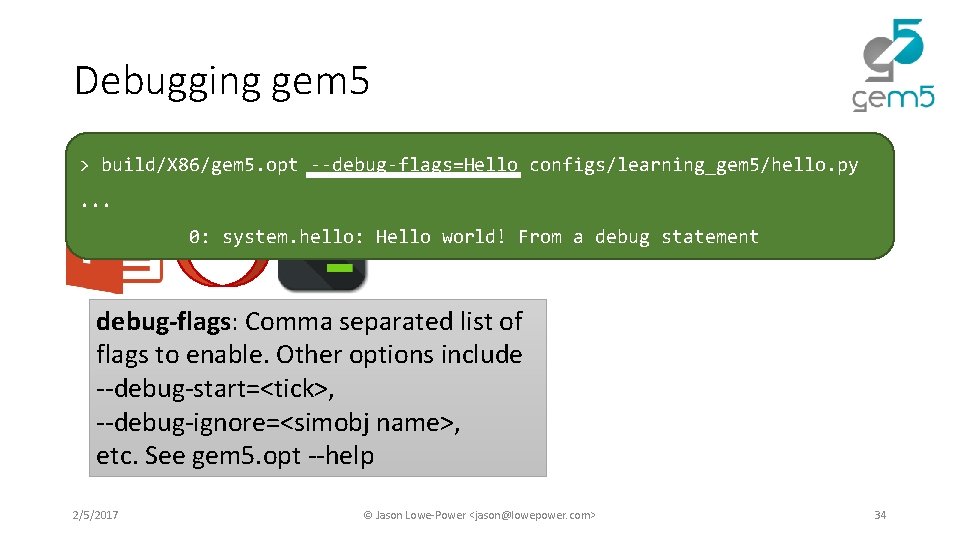
Debugging gem 5 Switch! > build/X 86/gem 5. opt --debug-flags=Hello configs/learning_gem 5/hello. py. . . 0: system. hello: Hello world! From a debug statement debug-flags: Comma separated list of flags to enable. Other options include --debug-start=<tick>, --debug-ignore=<simobj name>, etc. See gem 5. opt --help 2/5/2017 © Jason Lowe-Power <jason@lowepower. com> 34
Event-driven programming http: //learning. gem 5. org/book/part 2/events. html 2/5/2017 © Jason Lowe-Power <jason@lowepower. com> 35
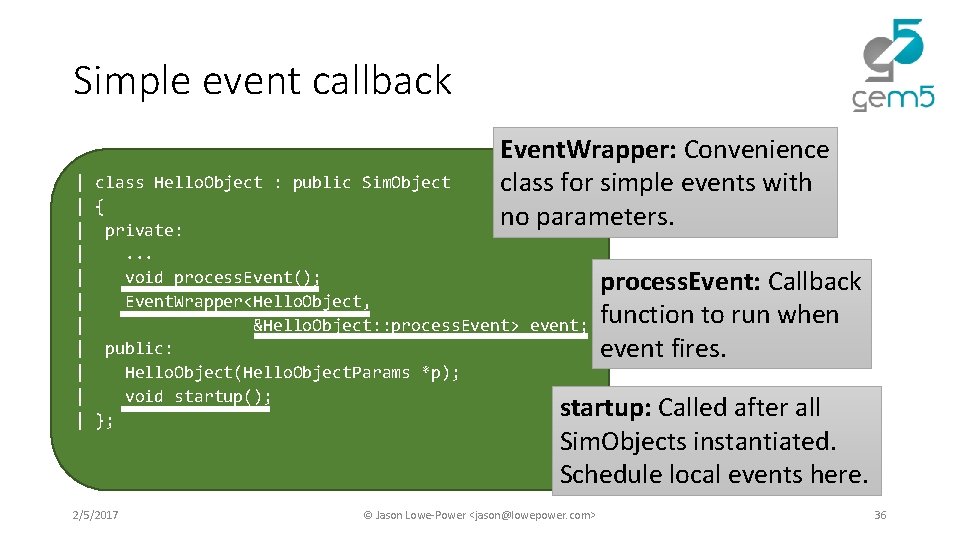
Simple event callback Switch! Event. Wrapper: Convenience class for simple events with no parameters. | class Hello. Object : public Sim. Object | { | private: |. . . | void process. Event(); process. Event: Callback | Event. Wrapper<Hello. Object, | &Hello. Object: : process. Event> event; function to run when | public: event fires. | Hello. Object(Hello. Object. Params *p); | void startup(); startup: Called after all | }; Sim. Objects instantiated. Schedule local events here. 2/5/2017 © Jason Lowe-Power <jason@lowepower. com> 36
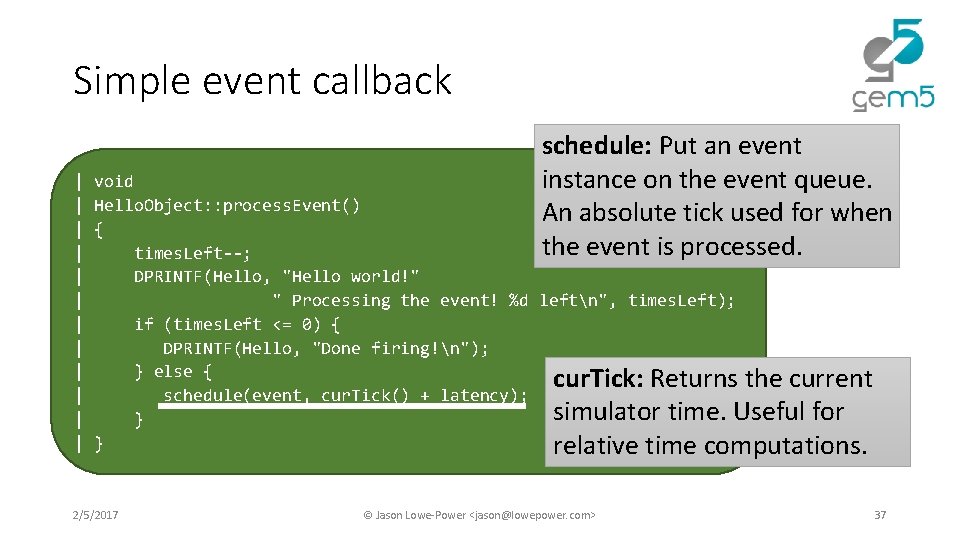
Simple event callback | | | Switch! schedule: Put an event instance on the event queue. An absolute tick used for when the event is processed. void Hello. Object: : process. Event() { times. Left--; DPRINTF(Hello, "Hello world!" " Processing the event! %d leftn", times. Left); if (times. Left <= 0) { DPRINTF(Hello, "Done firing!n"); } else { cur. Tick: Returns the current schedule(event, cur. Tick() + latency); simulator time. Useful for } } relative time computations. 2/5/2017 © Jason Lowe-Power <jason@lowepower. com> 37
Event Sim. Object code http: //learning. gem 5. org/book/_downloads/hello_object 1. hh http: //learning. gem 5. org/book/_downloads/hello_object 2. cc 2/5/2017 © Jason Lowe-Power <jason@lowepower. com> 38
Sim. Object parameters http: //learning. gem 5. org/book/part 2/parameters. html 2/5/2017 © Jason Lowe-Power <jason@lowepower. com> 39
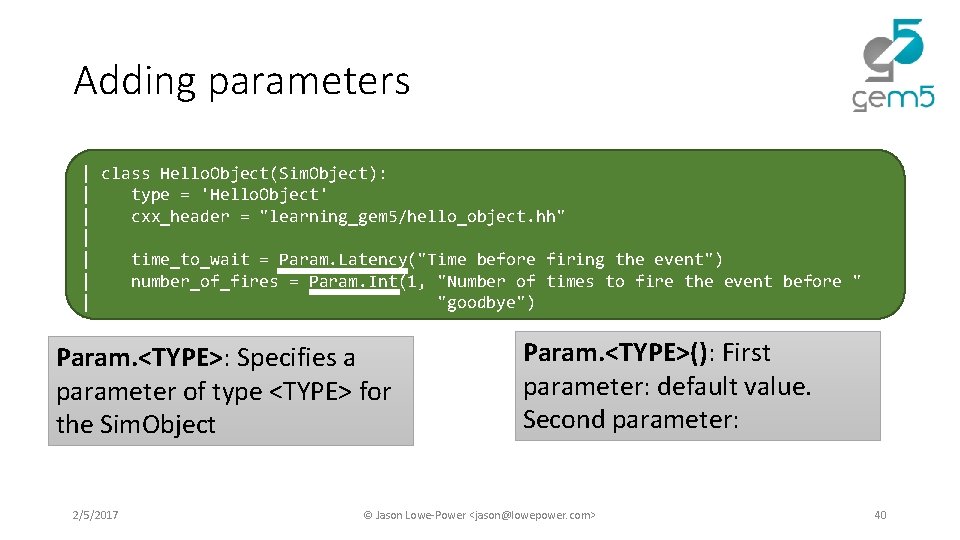
Adding parameters Switch! | class Hello. Object(Sim. Object): | type = 'Hello. Object' | cxx_header = "learning_gem 5/hello_object. hh" | | time_to_wait = Param. Latency("Time before firing the event") | number_of_fires = Param. Int(1, "Number of times to fire the event before " | "goodbye") Param. <TYPE>: Specifies a parameter of type <TYPE> for the Sim. Object 2/5/2017 Param. <TYPE>(): First parameter: default value. Second parameter: © Jason Lowe-Power <jason@lowepower. com> 40
Going further: More parameters http: //learning. gem 5. org/book/part 2/parameters. html Included types (e. g. , Memory. Size, Memory. Bandwidth, Latency) Using a Sim. Object as a parameter Sim. Object-Sim. Object interaction 2/5/2017 © Jason Lowe-Power <jason@lowepower. com> 41
Mem. Objects http: //learning. gem 5. org/book/part 2/memoryobject. html 2/5/2017 © Jason Lowe-Power <jason@lowepower. com> 42
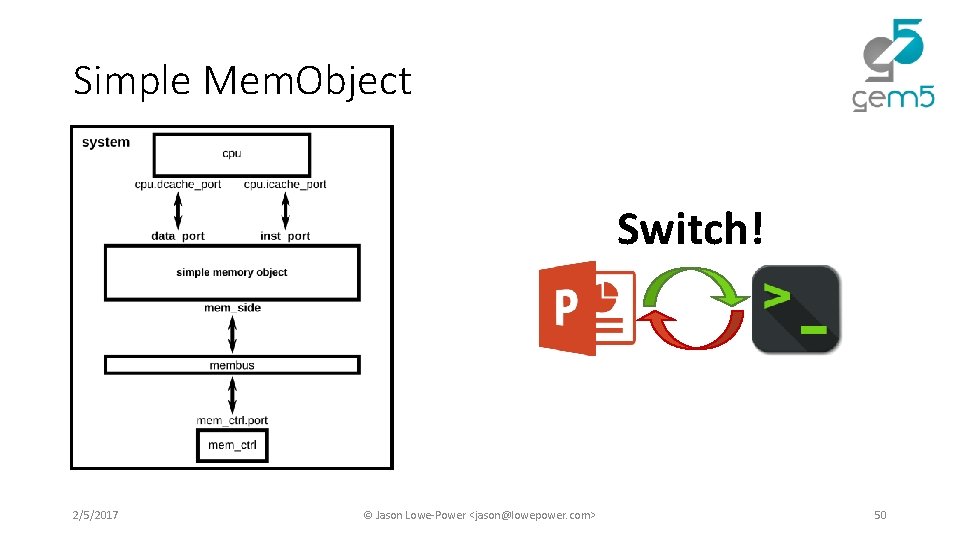
Mem. Object that is part of gem 5’s memory system both classic caches and Ruby are Mem. Objects Allowed to have Master. Ports and Slave. Ports 2/5/2017 © Jason Lowe-Power <jason@lowepower. com> 43
Packets Unit of transfer between Mem. Objects Packets pass between Master and Slave ports Packets have Request Command Data Much more… 2/5/2017 © Jason Lowe-Power <jason@lowepower. com> 44
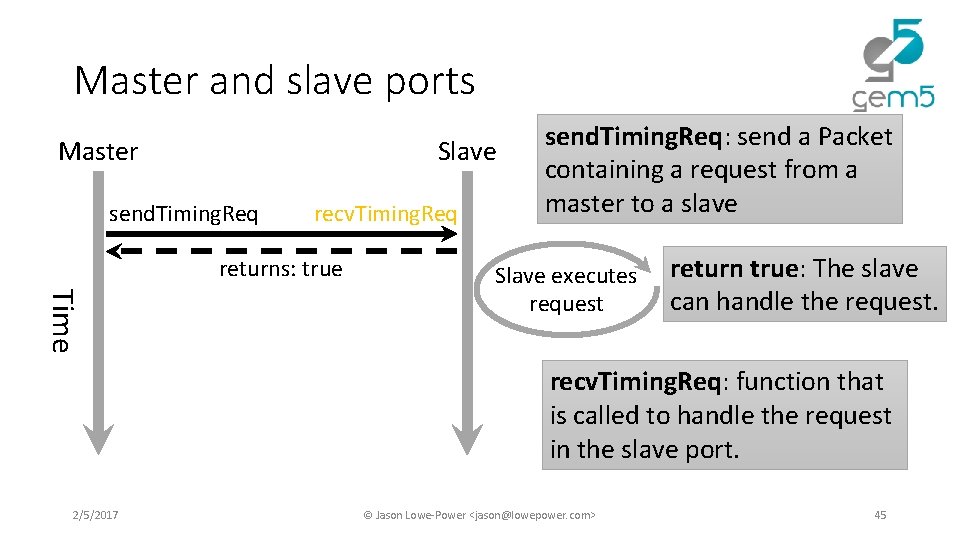
Master and slave ports Master Slave send. Timing. Req recv. Timing. Req returns: true send. Timing. Req: send a Packet containing a request from a master to a slave Time Slave executes request return true: The slave can handle the request. recv. Timing. Req: function that is called to handle the request in the slave port. 2/5/2017 © Jason Lowe-Power <jason@lowepower. com> 45
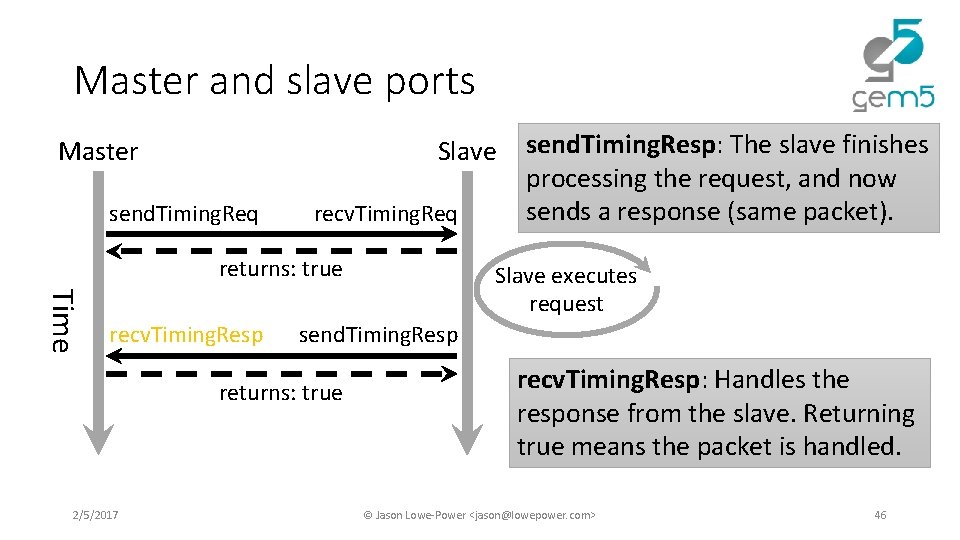
Master and slave ports Master Slave send. Timing. Req recv. Timing. Req returns: true Time recv. Timing. Resp Slave executes request send. Timing. Resp returns: true 2/5/2017 send. Timing. Resp: The slave finishes processing the request, and now sends a response (same packet). recv. Timing. Resp: Handles the response from the slave. Returning true means the packet is handled. © Jason Lowe-Power <jason@lowepower. com> 46
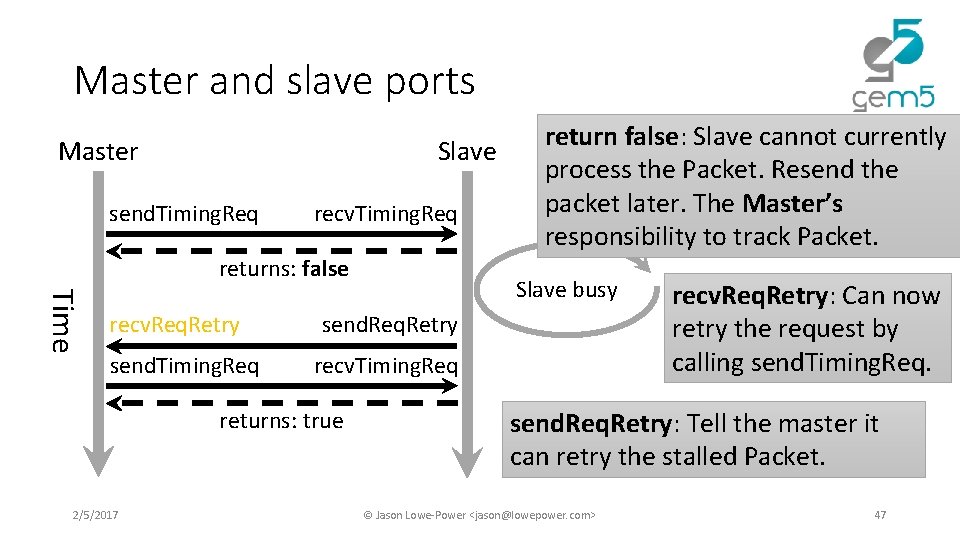
Master and slave ports Master Slave send. Timing. Req recv. Timing. Req returns: false Time recv. Req. Retry send. Timing. Req Slave busy send. Req. Retry recv. Timing. Req returns: true 2/5/2017 return false: Slave cannot currently process the Packet. Resend the packet later. The Master’s responsibility to track Packet. recv. Req. Retry: Can now retry the request by calling send. Timing. Req. send. Req. Retry: Tell the master it can retry the stalled Packet. © Jason Lowe-Power <jason@lowepower. com> 47
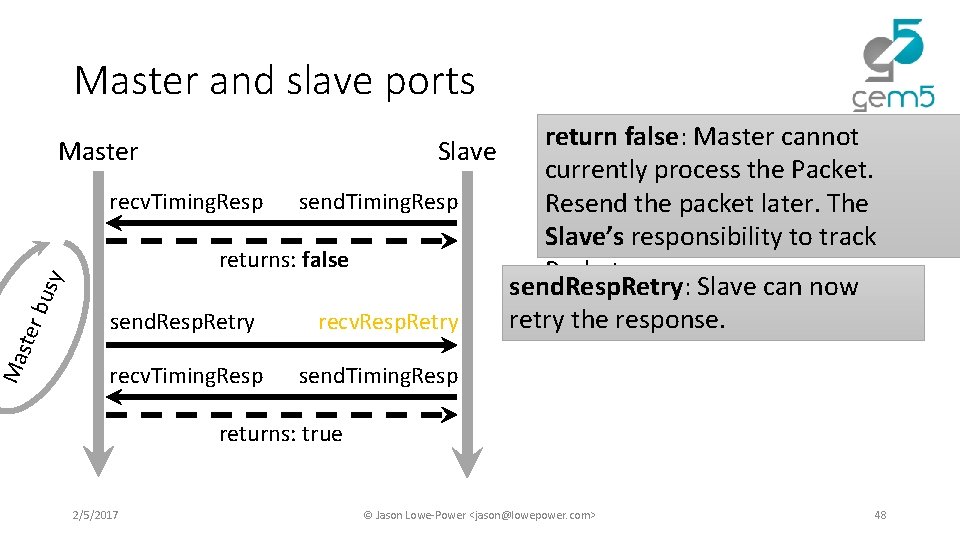
Master and slave ports Ma ster bus y return false: Master cannot Master Slave currently process the Packet. recv. Timing. Resp send. Timing. Resp Resend the packet later. The Slave’s responsibility to track returns: false Packet. send. Resp. Retry: Slave can now retry the response. send. Resp. Retry recv. Timing. Resp send. Timing. Resp returns: true 2/5/2017 © Jason Lowe-Power <jason@lowepower. com> 48
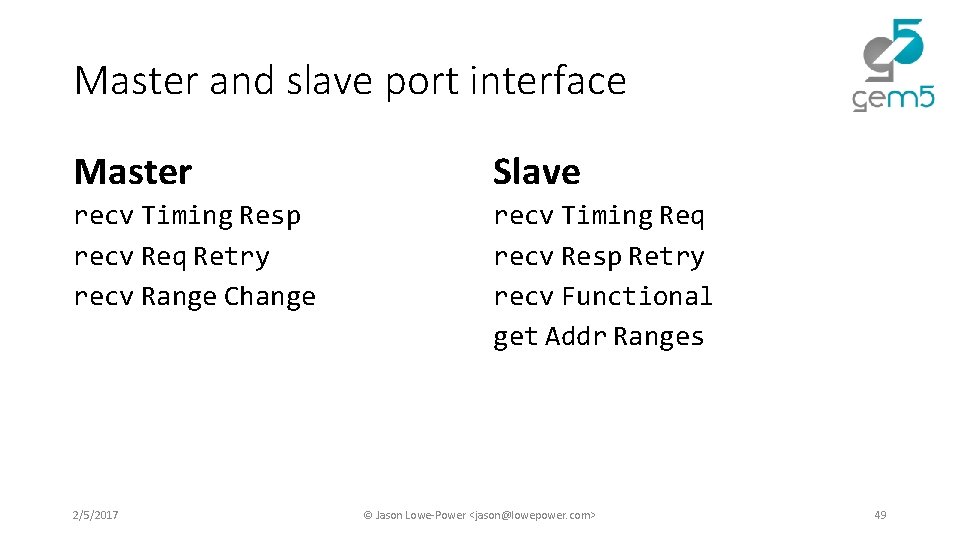
Master and slave port interface Master Slave recv Timing Resp recv Req Retry recv Range Change recv Timing Req recv Resp Retry recv Functional get Addr Ranges 2/5/2017 © Jason Lowe-Power <jason@lowepower. com> 49
Simple Mem. Object Switch! 2/5/2017 © Jason Lowe-Power <jason@lowepower. com> 50
Going further: Implementing a cache http: //learning. gem 5. org/book/part 2/simplecache. html Full implementation of a uniprocessor cache (no coherence support) Emulation concepts (using STL for associative data) Vector ports, clocked objects, upgrading and creating packets 2/5/2017 © Jason Lowe-Power <jason@lowepower. com> 51
Other gem 5 concepts A random assortment 2/5/2017 © Jason Lowe-Power <jason@lowepower. com> 52
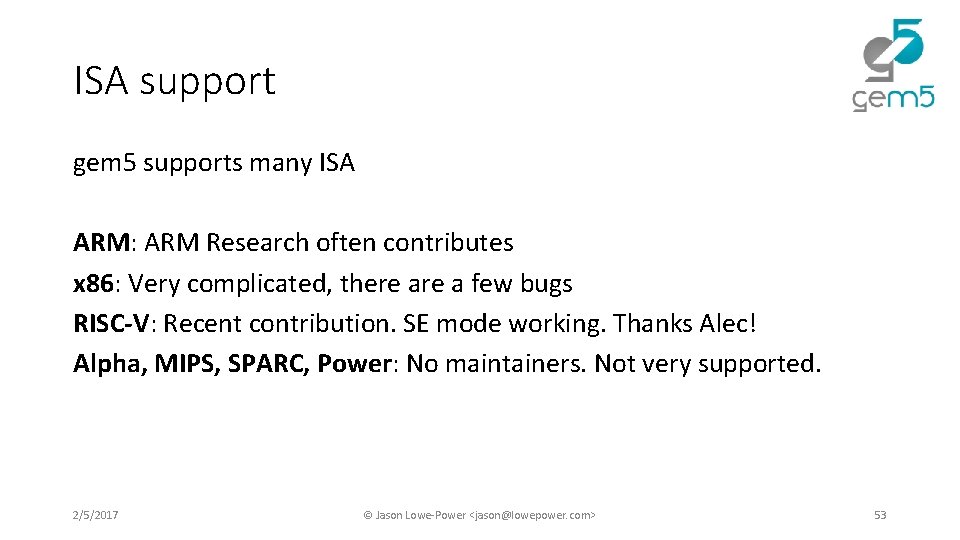
ISA support gem 5 supports many ISA ARM: ARM Research often contributes x 86: Very complicated, there a few bugs RISC-V: Recent contribution. SE mode working. Thanks Alec! Alpha, MIPS, SPARC, Power: No maintainers. Not very supported. 2/5/2017 © Jason Lowe-Power <jason@lowepower. com> 53
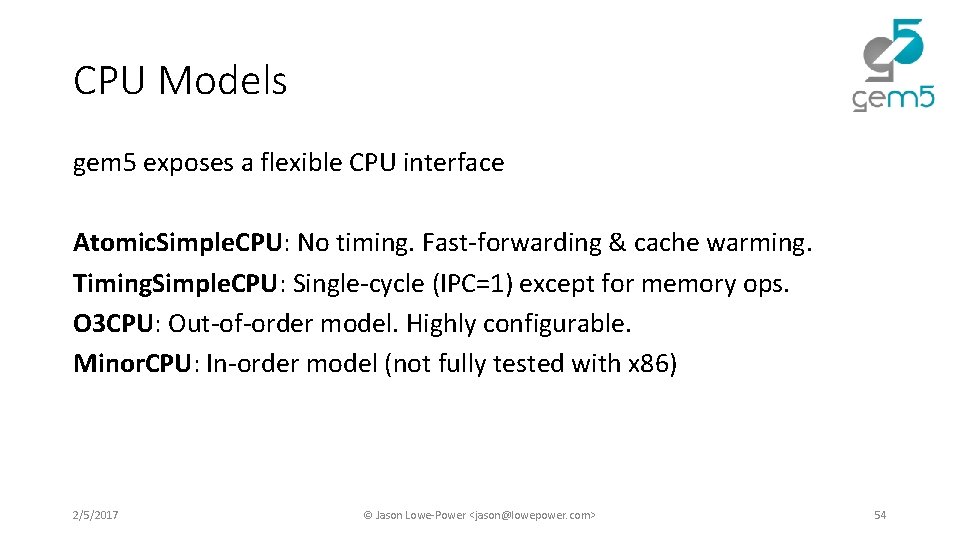
CPU Models gem 5 exposes a flexible CPU interface Atomic. Simple. CPU: No timing. Fast-forwarding & cache warming. Timing. Simple. CPU: Single-cycle (IPC=1) except for memory ops. O 3 CPU: Out-of-order model. Highly configurable. Minor. CPU: In-order model (not fully tested with x 86) 2/5/2017 © Jason Lowe-Power <jason@lowepower. com> 54
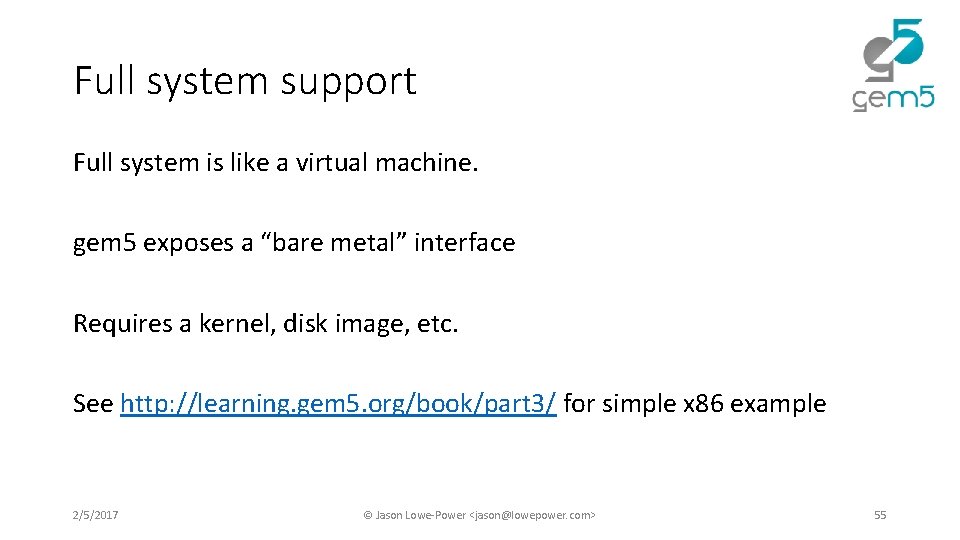
Full system support Full system is like a virtual machine. gem 5 exposes a “bare metal” interface Requires a kernel, disk image, etc. See http: //learning. gem 5. org/book/part 3/ for simple x 86 example 2/5/2017 © Jason Lowe-Power <jason@lowepower. com> 55
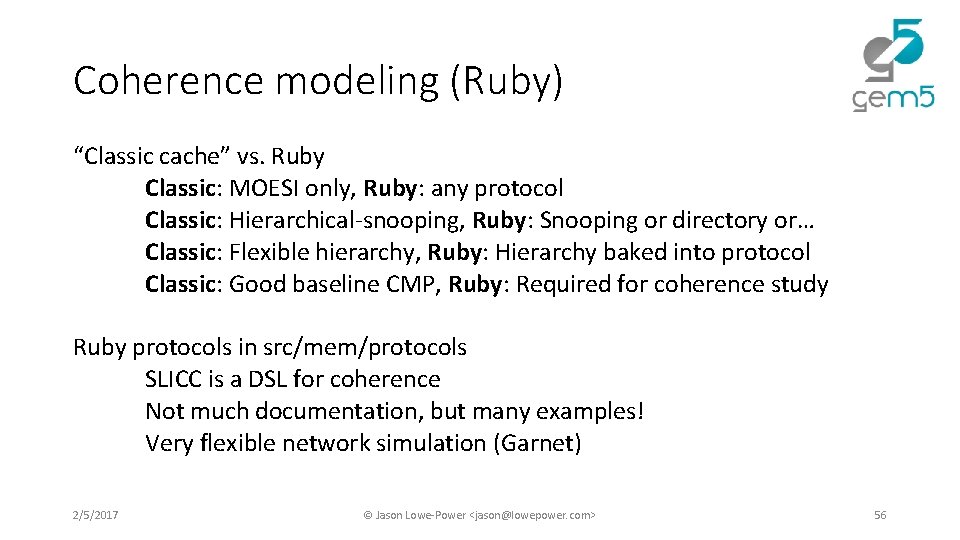
Coherence modeling (Ruby) “Classic cache” vs. Ruby Classic: MOESI only, Ruby: any protocol Classic: Hierarchical-snooping, Ruby: Snooping or directory or… Classic: Flexible hierarchy, Ruby: Hierarchy baked into protocol Classic: Good baseline CMP, Ruby: Required for coherence study Ruby protocols in src/mem/protocols SLICC is a DSL for coherence Not much documentation, but many examples! Very flexible network simulation (Garnet) 2/5/2017 © Jason Lowe-Power <jason@lowepower. com> 56
GPU and device models AMD recently released a HSAIL GPU model (src/gpu-compute) Many devices supported for FS simulation Ethernet (and multi-system simulation) VNC for graphics IDE controllers for disks Most devices are functional-only 2/5/2017 © Jason Lowe-Power <jason@lowepower. com> 57
Other features Probes and tracing Remote GDB Dynamically-linked binaries in SE mode Power modeling And many, many others 2/5/2017 © Jason Lowe-Power <jason@lowepower. com> 58
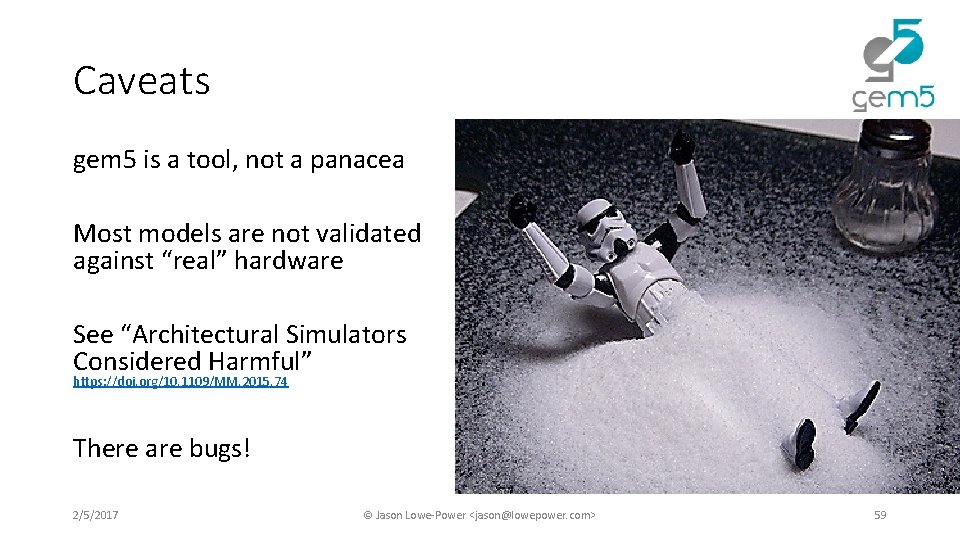
Caveats gem 5 is a tool, not a panacea Most models are not validated against “real” hardware See “Architectural Simulators Considered Harmful” https: //doi. org/10. 1109/MM. 2015. 74 There are bugs! 2/5/2017 © Jason Lowe-Power <jason@lowepower. com> 59
Getting (more) help Main gem 5 wiki: http: //gem 5. org/ My book: Learning. gem 5. org https: //github. com/powerjg/learning_gem 5 Mailing lists: http: //gem 5. org/Mailing_Lists gem 5 -users: General user questions (you probably want this one) gem 5 -dev: Mostly code reviews and high-level dev talk gem 5 QA (like Stack. Overflow): http: //qa. gem 5. org/ 2/5/2017 © Jason Lowe-Power <jason@lowepower. com> 60
Backup slides Mostly from other versions of this tutorial 2/5/2017 © Jason Lowe-Power <jason@lowepower. com> 61
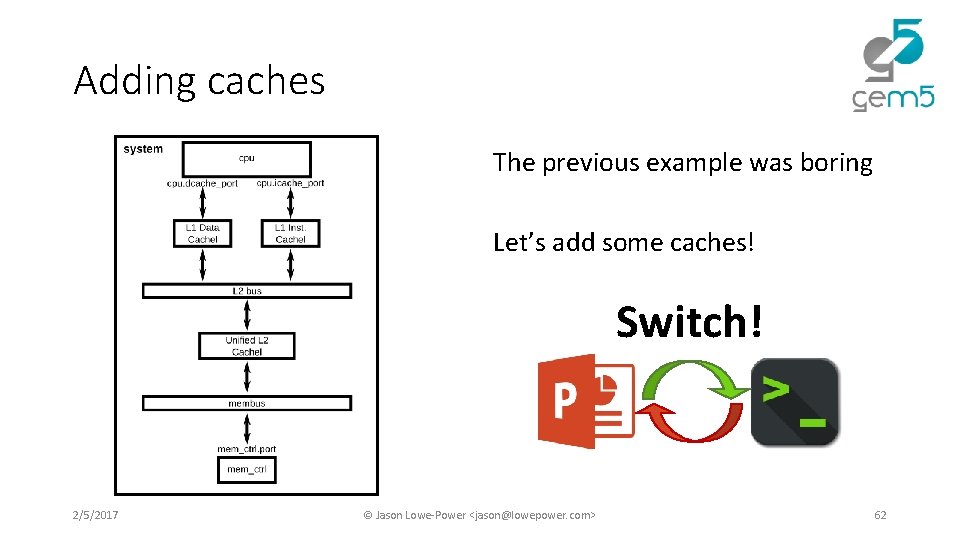
Adding caches The previous example was boring Let’s add some caches! Switch! 2/5/2017 © Jason Lowe-Power <jason@lowepower. com> 62
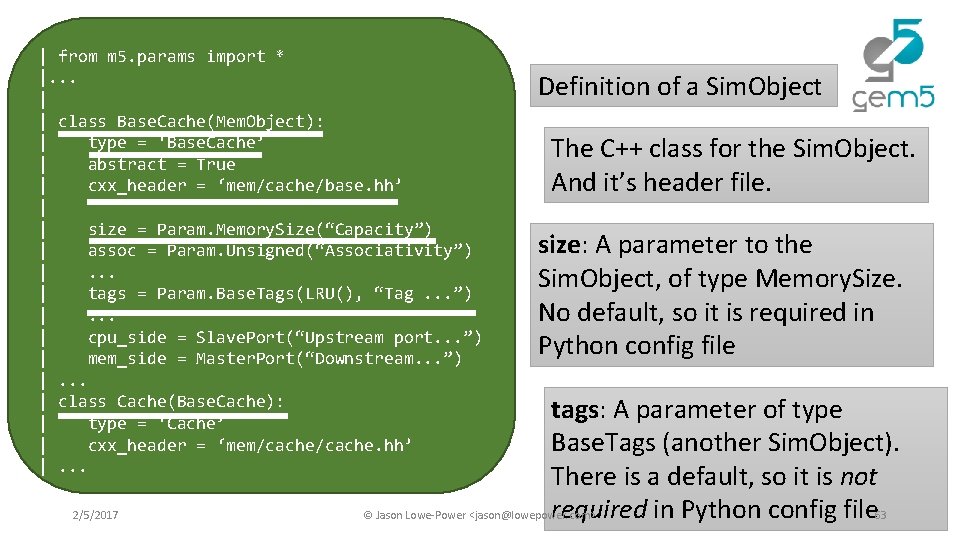
| from m 5. params import * |. . . | | class Base. Cache(Mem. Object): | type = ‘Base. Cache’ | abstract = True | cxx_header = ‘mem/cache/base. hh’ | | size = Param. Memory. Size(“Capacity”) | assoc = Param. Unsigned(“Associativity”) |. . . | tags = Param. Base. Tags(LRU(), “Tag. . . ”) |. . . | cpu_side = Slave. Port(“Upstream port. . . ”) | mem_side = Master. Port(“Downstream. . . ”) |. . . | class Cache(Base. Cache): | type = ‘Cache’ | cxx_header = ‘mem/cache. hh’ |. . . 2/5/2017 Definition of a Sim. Object The C++ class for the Sim. Object. And it’s header file. size: A parameter to the Sim. Object, of type Memory. Size. No default, so it is required in Python config file tags: A parameter of type Base. Tags (another Sim. Object). There is a default, so it is not required in Python config file 63 © Jason Lowe-Power <jason@lowepower. com>
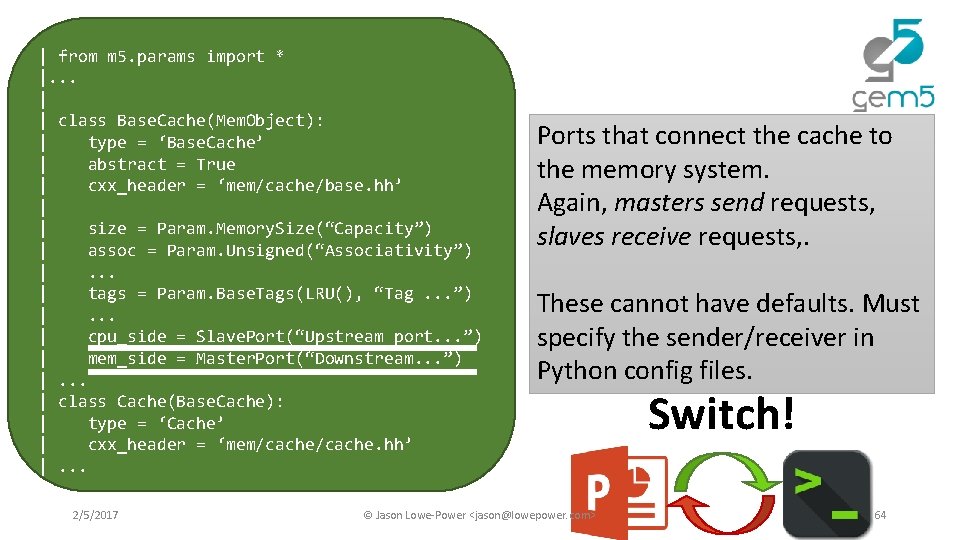
| from m 5. params import * |. . . | | class Base. Cache(Mem. Object): | type = ‘Base. Cache’ | abstract = True | cxx_header = ‘mem/cache/base. hh’ | | size = Param. Memory. Size(“Capacity”) | assoc = Param. Unsigned(“Associativity”) |. . . | tags = Param. Base. Tags(LRU(), “Tag. . . ”) |. . . | cpu_side = Slave. Port(“Upstream port. . . ”) | mem_side = Master. Port(“Downstream. . . ”) |. . . | class Cache(Base. Cache): | type = ‘Cache’ | cxx_header = ‘mem/cache. hh’ |. . . 2/5/2017 Ports that connect the cache to the memory system. Again, masters send requests, slaves receive requests, . These cannot have defaults. Must specify the sender/receiver in Python config files. © Jason Lowe-Power <jason@lowepower. com> Switch! 64
Cache scripts http: //learning. gem 5. org/book/_downloads/caches. py http: //learning. gem 5. org/book/_downloads/two_level. py 2/5/2017 © Jason Lowe-Power <jason@lowepower. com> 65
Next time… How to make changes to gem 5 Adding new Sim. Objects What’s in gem 5 Let me know (powerjg@cs. wisc. edu) anything specific to cover! 2/5/2017 © Jason Lowe-Power <jason@lowepower. com> 67