
LEARNING FROM THE PAST TO ENHANCE THE FUTURE


- Slides: 27
LEARNING FROM THE PAST TO ENHANCE THE FUTURE: ETHICS ISSUES AND TRAINING NEEDS OF RURAL COUNSELING PRACTITIONERS Jane Warren Amanuel Haile Asfaw Avis Garcia University of Wyoming Professional Studies Department Counselor Education Program
Research Team � � � Jane Warren-University of Wyoming-Department of Professional Studies - Counseling program Amanuel Haile Asfaw- University of Wyoming-Department of Professional Studies - Counseling program Carrie Ahls - University of Wyoming-Department of Professional Studies -Counseling program Johnna Carlene Nunez -University of Wyoming-Department of Social Work program Jennifer Weatherford -University of Wyoming-Department of Professional Studies-Educational Research program Noor Syamilah Zakaria - University of Wyoming-Department of Professional Studies - Counseling program
Outline � � � � Ice breaker-Your most difficult ethical challenge this last year Ethics in counseling Ethics challenges in rural settings Our research Relevance of our research Apply to your own wellness Apply to your ethical challenge Dialogue
The Best of Times-The Worst of Times… � � � Imagine for a few minutes your most difficult ethical challenge you had this year What made it difficult? What did you do?
The Best of Times-The Worst of Times… � � Share your insights with someone next to you… Brief discussion…
Ethics in Counseling � � � Professional—to profess to do (Ponton & Duba, 2009) Ethics make a profession, a profession…
Ethics in Counseling � Counseling defined (ACA) Counseling is a professional relationship that empowers diverse individuals, families, and groups to accomplish mental health, wellness, education, and career goals. …. . a basic framework and that each participating organization is welcome to add a statement that fleshes out the particular specialty or area of focus.
Ethics in Counseling Ethical Practice � � � ACA Codes-APGA-1961 -Ist codes 5 revisions since 1961 ( every 7 -10 years) March 2014 most recent changes � Why? ? ?
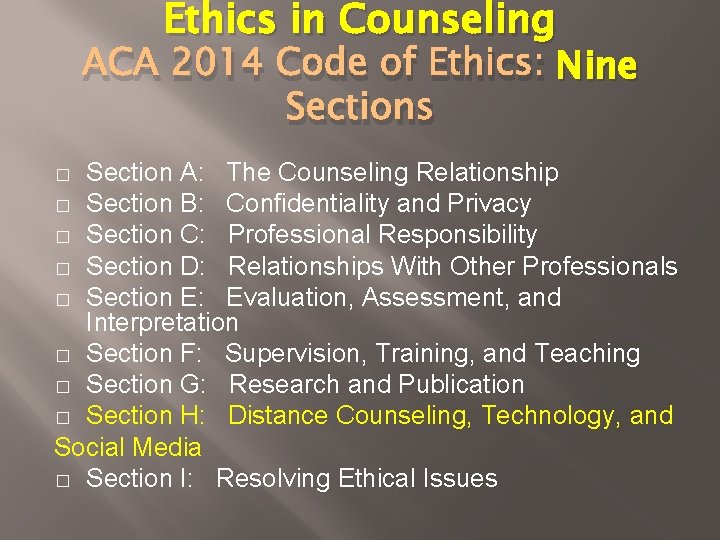
Ethics in Counseling ACA 2014 Code of Ethics: Nine Sections Section A: The Counseling Relationship � Section B: Confidentiality and Privacy � Section C: Professional Responsibility � Section D: Relationships With Other Professionals � Section E: Evaluation, Assessment, and Interpretation � Section F: Supervision, Training, and Teaching � Section G: Research and Publication � Section H: Distance Counseling, Technology, and Social Media � Section I: Resolving Ethical Issues �
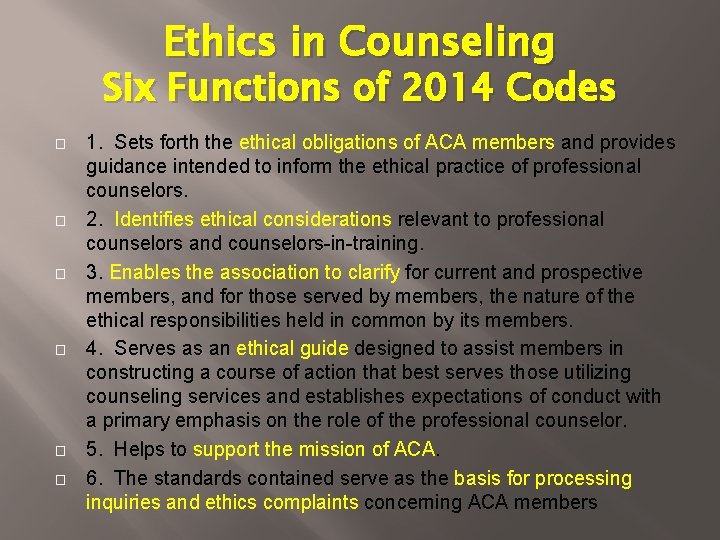
Ethics in Counseling Six Functions of 2014 Codes � � � 1. Sets forth the ethical obligations of ACA members and provides guidance intended to inform the ethical practice of professional counselors. 2. Identifies ethical considerations relevant to professional counselors and counselors-in-training. 3. Enables the association to clarify for current and prospective members, and for those served by members, the nature of the ethical responsibilities held in common by its members. 4. Serves as an ethical guide designed to assist members in constructing a course of action that best serves those utilizing counseling services and establishes expectations of conduct with a primary emphasis on the role of the professional counselor. 5. Helps to support the mission of ACA. 6. The standards contained serve as the basis for processing inquiries and ethics complaints concerning ACA members
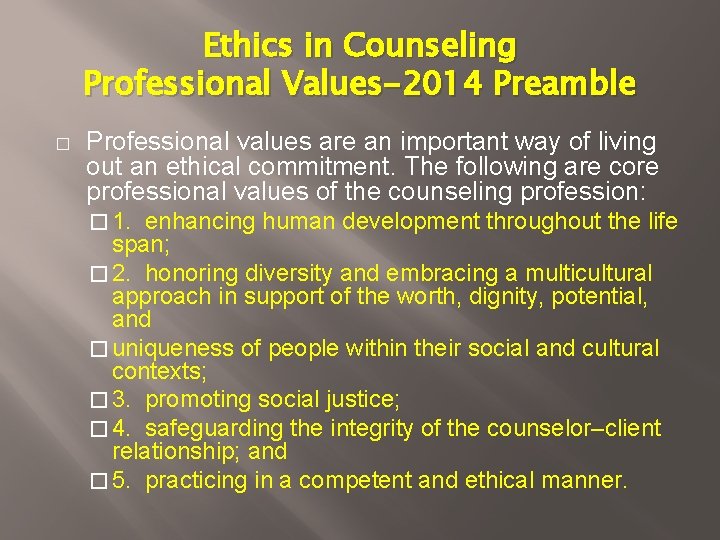
Ethics in Counseling Professional Values-2014 Preamble � Professional values are an important way of living out an ethical commitment. The following are core professional values of the counseling profession: � 1. enhancing human development throughout the life span; � 2. honoring diversity and embracing a multicultural approach in support of the worth, dignity, potential, and � uniqueness of people within their social and cultural contexts; � 3. promoting social justice; � 4. safeguarding the integrity of the counselor–client relationship; and � 5. practicing in a competent and ethical manner.
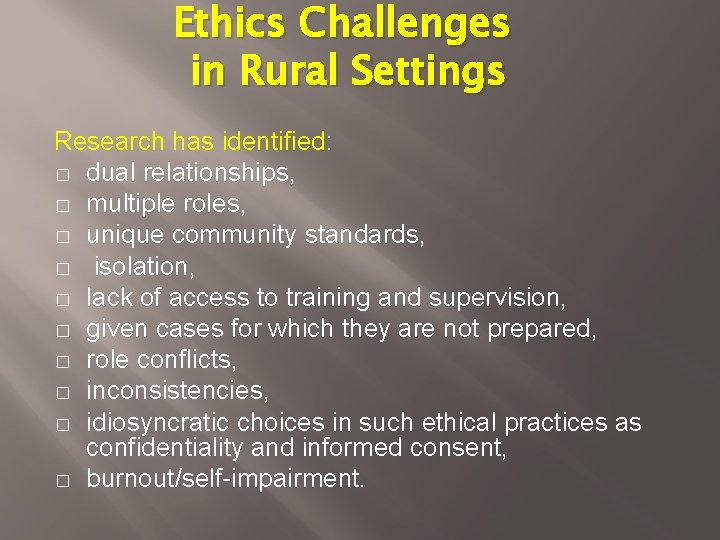
Ethics Challenges in Rural Settings Research has identified: � dual relationships, � multiple roles, � unique community standards, � isolation, � lack of access to training and supervision, � given cases for which they are not prepared, � role conflicts, � inconsistencies, � idiosyncratic choices in such ethical practices as confidentiality and informed consent, � burnout/self-impairment.
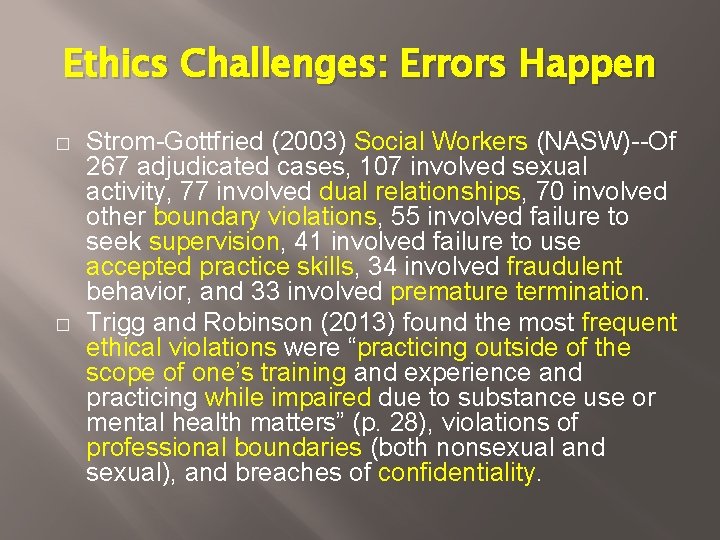
Ethics Challenges: Errors Happen � � Strom-Gottfried (2003) Social Workers (NASW)--Of 267 adjudicated cases, 107 involved sexual activity, 77 involved dual relationships, 70 involved other boundary violations, 55 involved failure to seek supervision, 41 involved failure to use accepted practice skills, 34 involved fraudulent behavior, and 33 involved premature termination. Trigg and Robinson (2013) found the most frequent ethical violations were “practicing outside of the scope of one’s training and experience and practicing while impaired due to substance use or mental health matters” (p. 28), violations of professional boundaries (both nonsexual and sexual), and breaches of confidentiality.
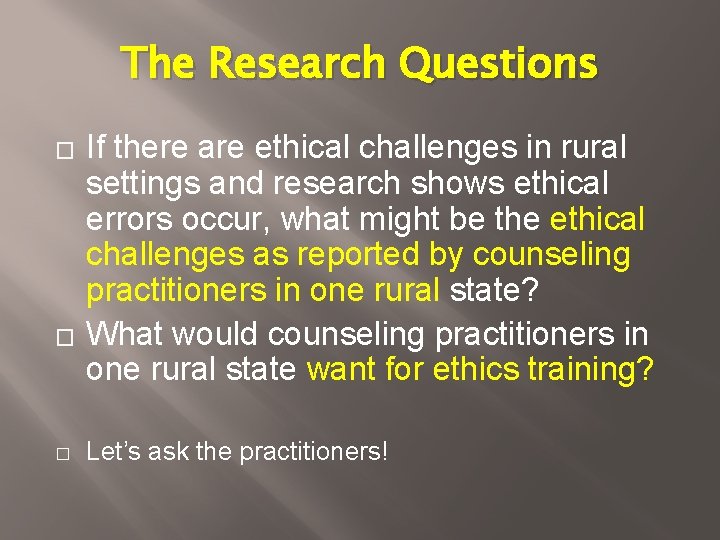
The Research Questions � � � If there are ethical challenges in rural settings and research shows ethical errors occur, what might be the ethical challenges as reported by counseling practitioners in one rural state? What would counseling practitioners in one rural state want for ethics training? Let’s ask the practitioners!
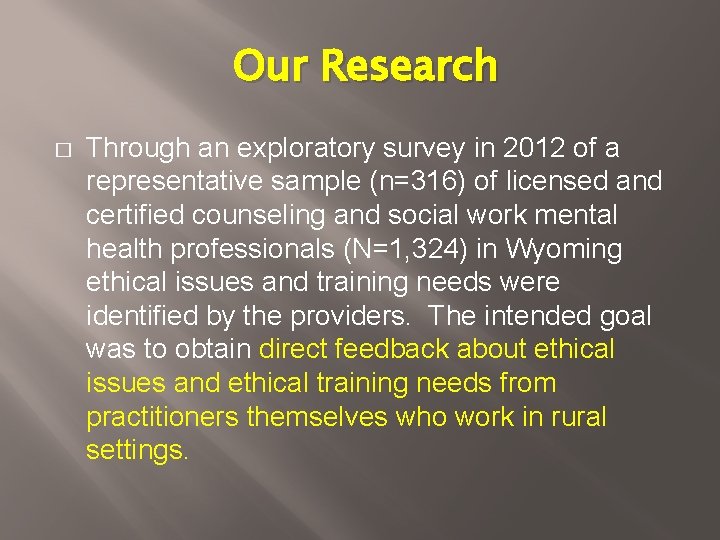
Our Research � Through an exploratory survey in 2012 of a representative sample (n=316) of licensed and certified counseling and social work mental health professionals (N=1, 324) in Wyoming ethical issues and training needs were identified by the providers. The intended goal was to obtain direct feedback about ethical issues and ethical training needs from practitioners themselves who work in rural settings.
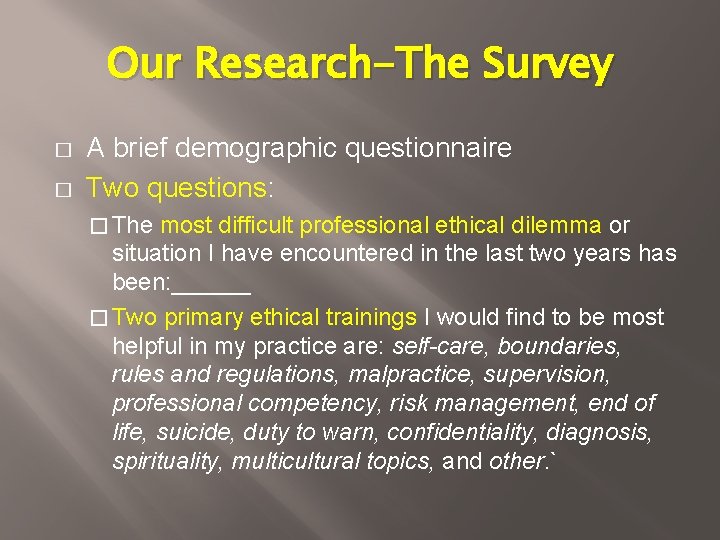
Our Research-The Survey � � A brief demographic questionnaire Two questions: � The most difficult professional ethical dilemma or situation I have encountered in the last two years has been: ______ � Two primary ethical trainings I would find to be most helpful in my practice are: self-care, boundaries, rules and regulations, malpractice, supervision, professional competency, risk management, end of life, suicide, duty to warn, confidentiality, diagnosis, spirituality, multicultural topics, and other. `
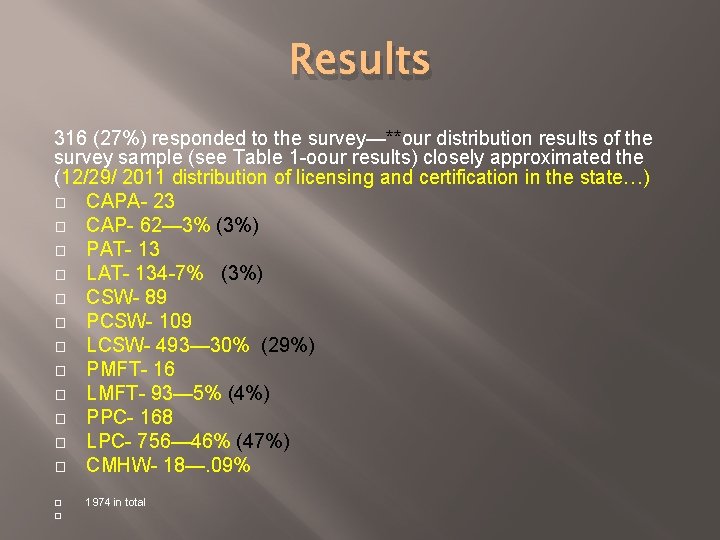
Results 316 (27%) responded to the survey—**our distribution results of the survey sample (see Table 1 -oour results) closely approximated the (12/29/ 2011 distribution of licensing and certification in the state…) � CAPA- 23 � CAP- 62— 3% (3%) � PAT- 13 � LAT- 134 -7% (3%) � CSW- 89 � PCSW- 109 � LCSW- 493— 30% (29%) � PMFT- 16 � LMFT- 93— 5% (4%) � PPC- 168 � LPC- 756— 46% (47%) � CMHW- 18—. 09% � � 1974 in total
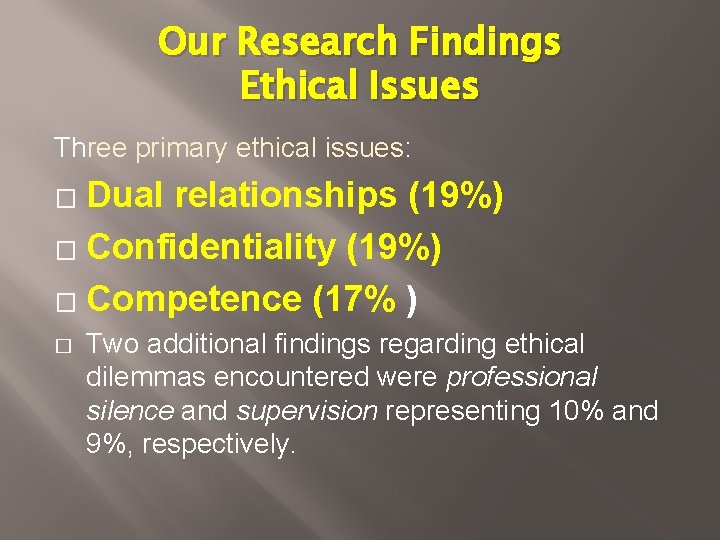
Our Research Findings Ethical Issues Three primary ethical issues: Dual relationships (19%) � Confidentiality (19%) � Competence (17% ) � � Two additional findings regarding ethical dilemmas encountered were professional silence and supervision representing 10% and 9%, respectively.
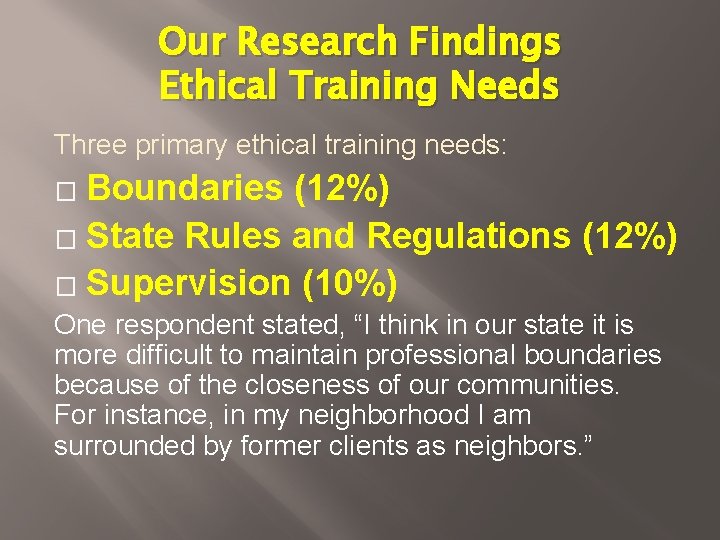
Our Research Findings Ethical Training Needs Three primary ethical training needs: Boundaries (12%) � State Rules and Regulations (12%) � Supervision (10%) � One respondent stated, “I think in our state it is more difficult to maintain professional boundaries because of the closeness of our communities. For instance, in my neighborhood I am surrounded by former clients as neighbors. ”
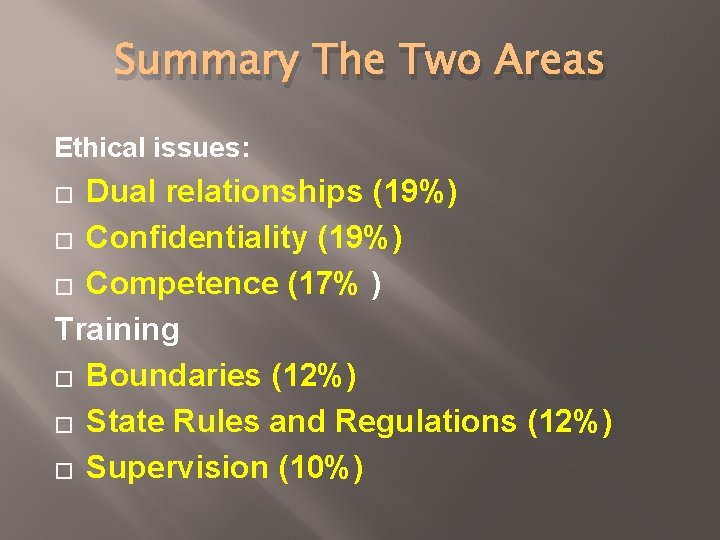
Summary The Two Areas Ethical issues: Dual relationships (19%) � Confidentiality (19%) � Competence (17% ) Training � Boundaries (12%) � State Rules and Regulations (12%) � Supervision (10%) �
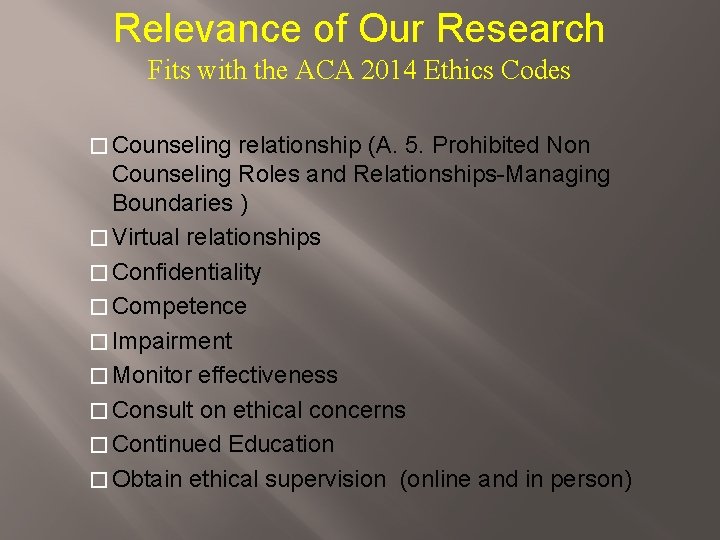
Relevance of Our Research Fits with the ACA 2014 Ethics Codes � Counseling relationship (A. 5. Prohibited Non Counseling Roles and Relationships-Managing Boundaries ) � Virtual relationships � Confidentiality � Competence � Impairment � Monitor effectiveness � Consult on ethical concerns � Continued Education � Obtain ethical supervision (online and in person)
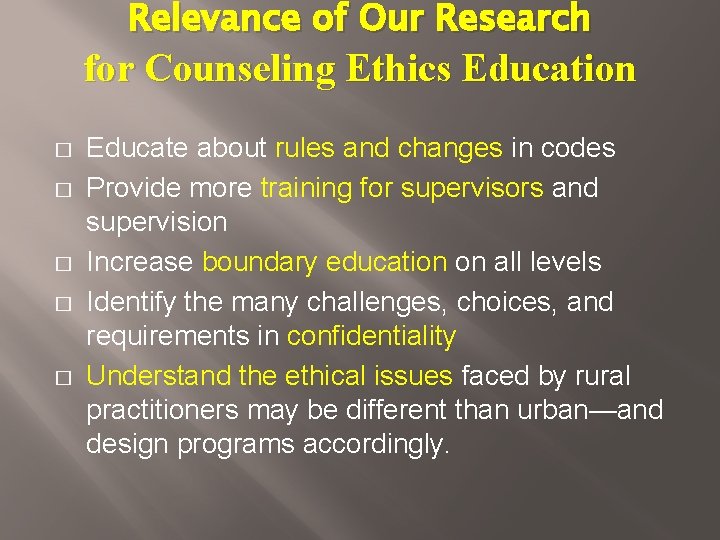
Relevance of Our Research for Counseling Ethics Education � � � Educate about rules and changes in codes Provide more training for supervisors and supervision Increase boundary education on all levels Identify the many challenges, choices, and requirements in confidentiality Understand the ethical issues faced by rural practitioners may be different than urban—and design programs accordingly.
Relevance of Our Research For Our Profession � � � Promote dialogue among practitioners about ethical challenges and actions Encourage compassion for practitioners Promote wellness for all counseling practitioners
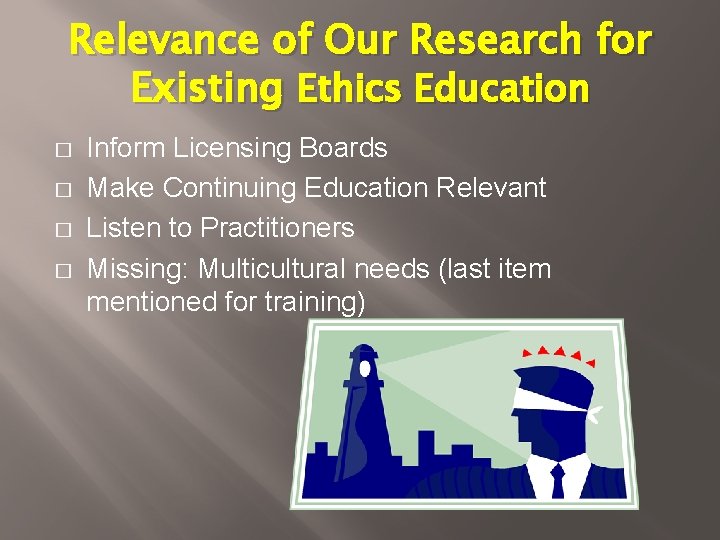
Relevance of Our Research for Existing Ethics Education � � Inform Licensing Boards Make Continuing Education Relevant Listen to Practitioners Missing: Multicultural needs (last item mentioned for training)
Apply to Your Ethical Challenge What have you learned and what might you do now differently, if anything? Dialogue �
Questions/Discoveries
References � � . Harrison, R. L. , & Westwood, M. J. (2009). Preventing vicarious traumatization of mental health therapists: Identifying protective practices. Psychotherapy Theory, Research, Practice, Training, 46, 203 -219. doi: 10. 1037/a 0016081 Maltzman, S. (2011). An organizational selfcare model: Practical suggestions for development and implementation. Counseling Psychologist, 39, 303 -319. doi: 10. 1177/0011000010381790