
Learning from Observations Chapter 18 Through 18 3
Learning from Observations Chapter 18 Through 18. 3. 5 1
Outline • Learning agents • Inductive learning • Decision tree learning 2
Learning • Learning is essential for unknown environments, – i. e. , when designer lacks omniscience • Learning is useful as a system construction method, – i. e. , designer might not know how to solve the problem • Learning modifies the agent's decision mechanisms to improve performance over time 3
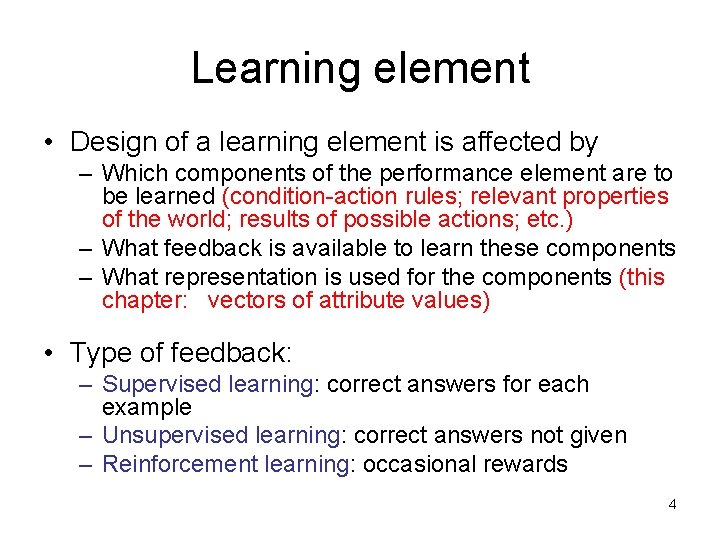
Learning element • Design of a learning element is affected by – Which components of the performance element are to be learned (condition-action rules; relevant properties of the world; results of possible actions; etc. ) – What feedback is available to learn these components – What representation is used for the components (this chapter: vectors of attribute values) • Type of feedback: – Supervised learning: correct answers for each example – Unsupervised learning: correct answers not given – Reinforcement learning: occasional rewards 4
Inductive Learning • When the output y is one of a finite set of values, the learning problem is called classification • When y is a number (such as earnings or tomorrow’s temperature), then the learning problem is called regression 5

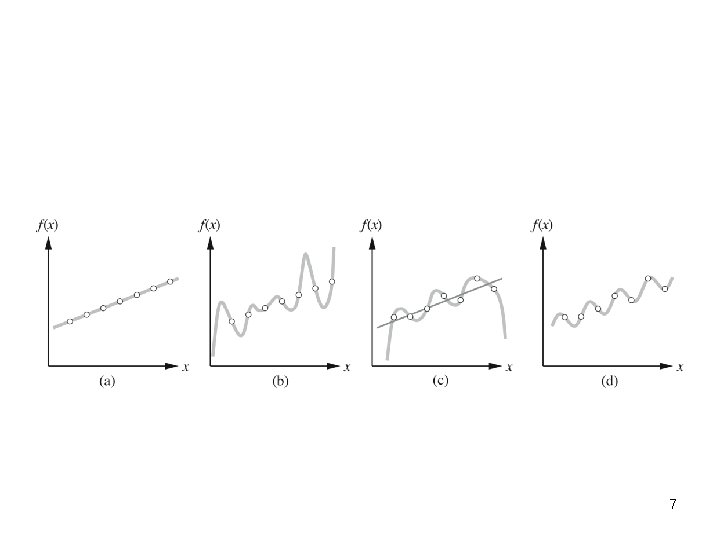
Inductive learning • Simplest form: learn a function from examples f is the target function An example is a pair (x, f(x)) Problem: find a hypothesis h such that h ≈ f given a training set of examples 6
7
Learning decision trees Problem: decide whether to wait for a table at a restaurant, based on the following attributes: 1. Alternate: is there an alternative restaurant nearby? 2. Bar: is there a comfortable bar area to wait in? 3. Fri/Sat: is today Friday or Saturday? 4. Hungry: are we hungry? 5. Patrons: number of people in the restaurant (None, Some, Full) 6. Price: price range ($, $$$) 7. Raining: is it raining outside? 8. Reservation: have we made a reservation? 9. Type: kind of restaurant (French, Italian, Thai, Burger) 10. Wait. Estimate: estimated waiting time (0 -10, 10 -30, 30 -60, >60) 8
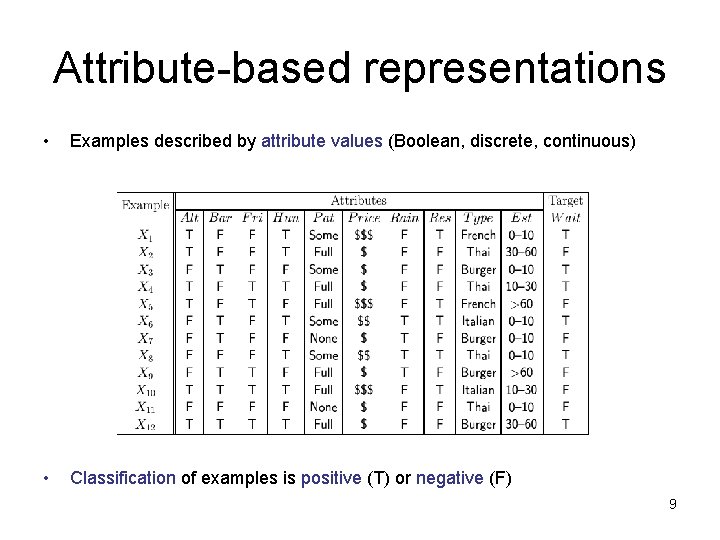
Attribute-based representations • Examples described by attribute values (Boolean, discrete, continuous) • Classification of examples is positive (T) or negative (F) 9
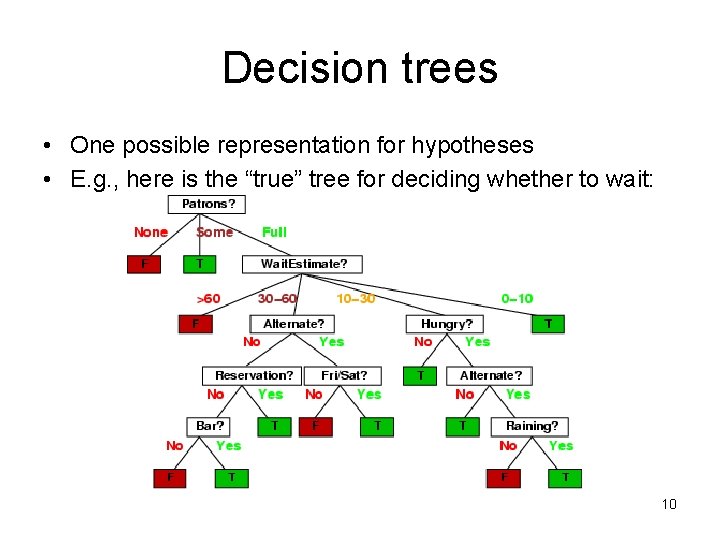
Decision trees • One possible representation for hypotheses • E. g. , here is the “true” tree for deciding whether to wait: 10
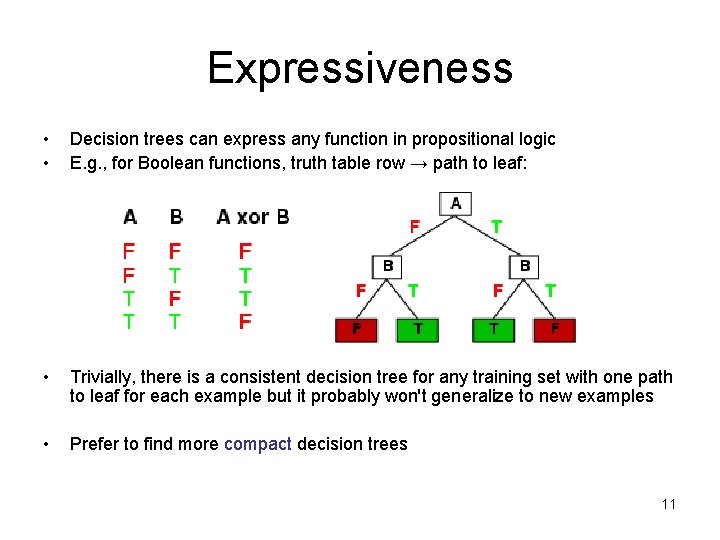
Expressiveness • • Decision trees can express any function in propositional logic E. g. , for Boolean functions, truth table row → path to leaf: • Trivially, there is a consistent decision tree for any training set with one path to leaf for each example but it probably won't generalize to new examples • Prefer to find more compact decision trees 11
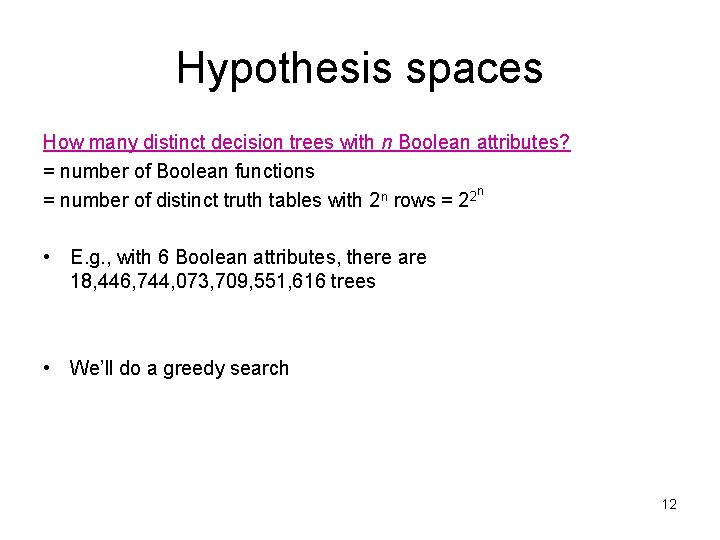
Hypothesis spaces How many distinct decision trees with n Boolean attributes? = number of Boolean functions n = number of distinct truth tables with 2 n rows = 22 • E. g. , with 6 Boolean attributes, there are 18, 446, 744, 073, 709, 551, 616 trees • We’ll do a greedy search 12
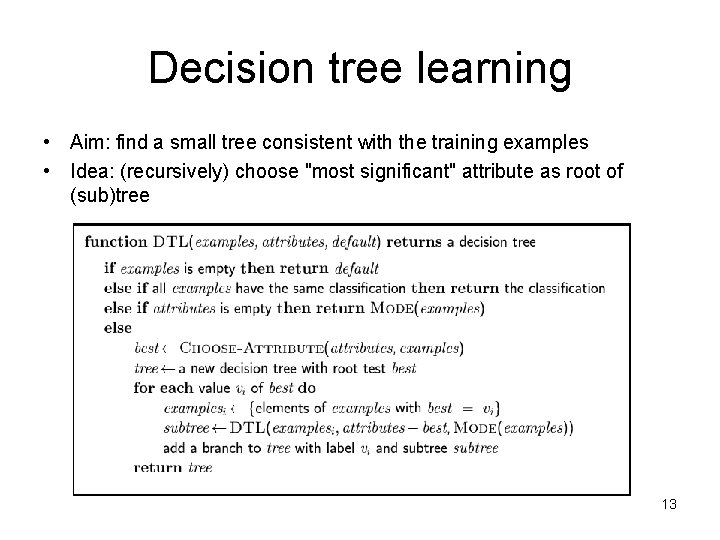
Decision tree learning • Aim: find a small tree consistent with the training examples • Idea: (recursively) choose "most significant" attribute as root of (sub)tree 13
• Example in class 14
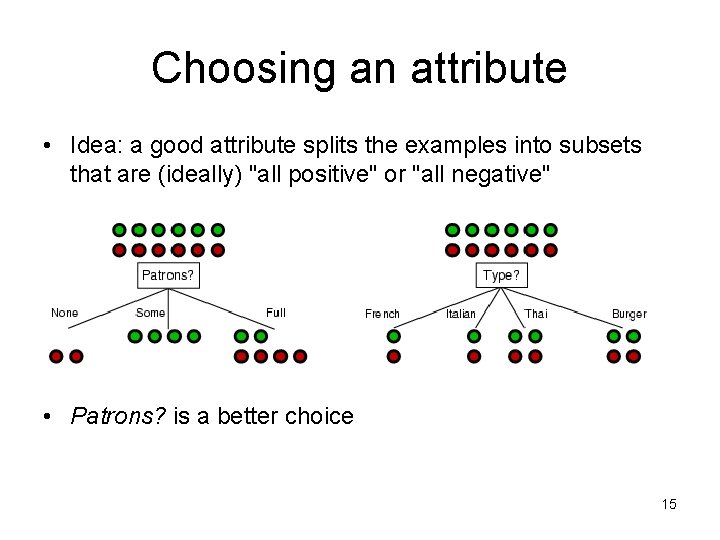
Choosing an attribute • Idea: a good attribute splits the examples into subsets that are (ideally) "all positive" or "all negative" • Patrons? is a better choice 15
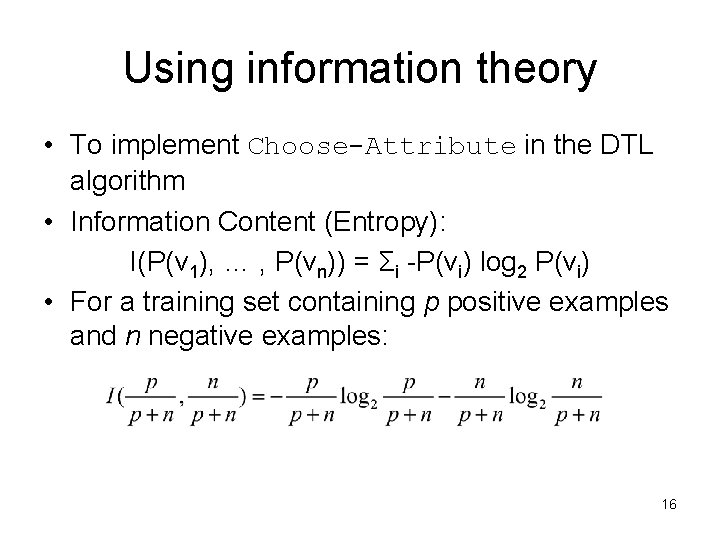
Using information theory • To implement Choose-Attribute in the DTL algorithm • Information Content (Entropy): I(P(v 1), … , P(vn)) = Σi -P(vi) log 2 P(vi) • For a training set containing p positive examples and n negative examples: 16
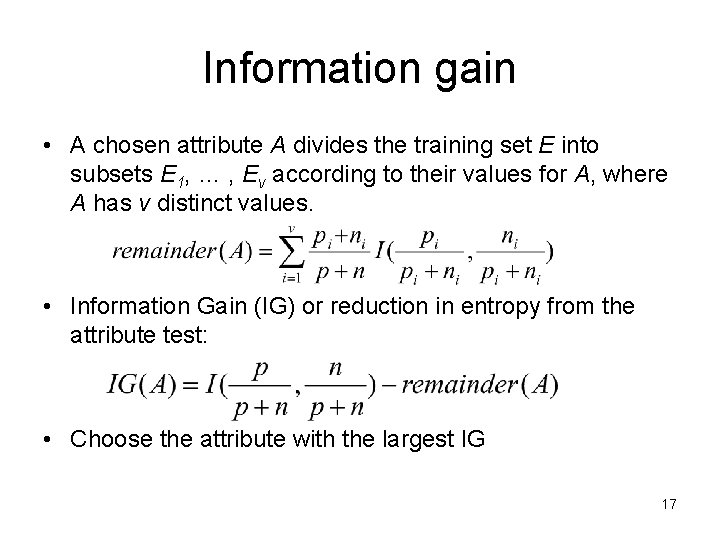
Information gain • A chosen attribute A divides the training set E into subsets E 1, … , Ev according to their values for A, where A has v distinct values. • Information Gain (IG) or reduction in entropy from the attribute test: • Choose the attribute with the largest IG 17
Information gain For the training set, p = n = 6, I(6/12, 6/12) = 1 bit Consider the attributes Patrons and Type: Patrons has the highest IG of all attributes and so is chosen by the DTL algorithm as the root 18
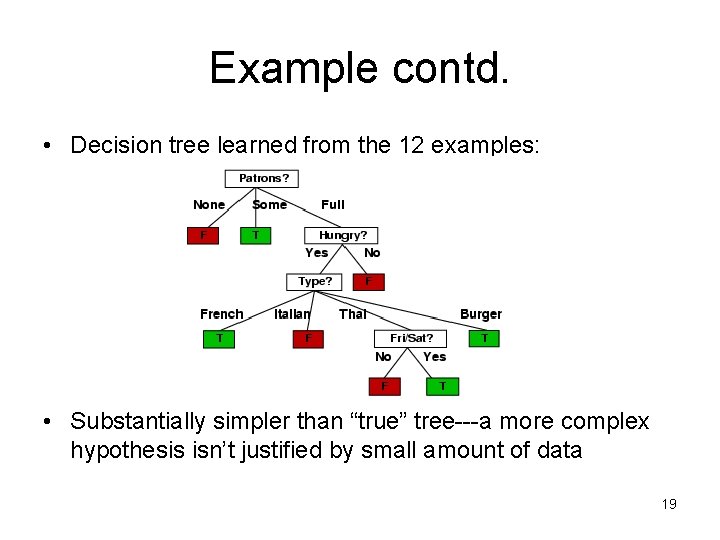
Example contd. • Decision tree learned from the 12 examples: • Substantially simpler than “true” tree---a more complex hypothesis isn’t justified by small amount of data 19
• Learning algorithm versus classifier (class) 20
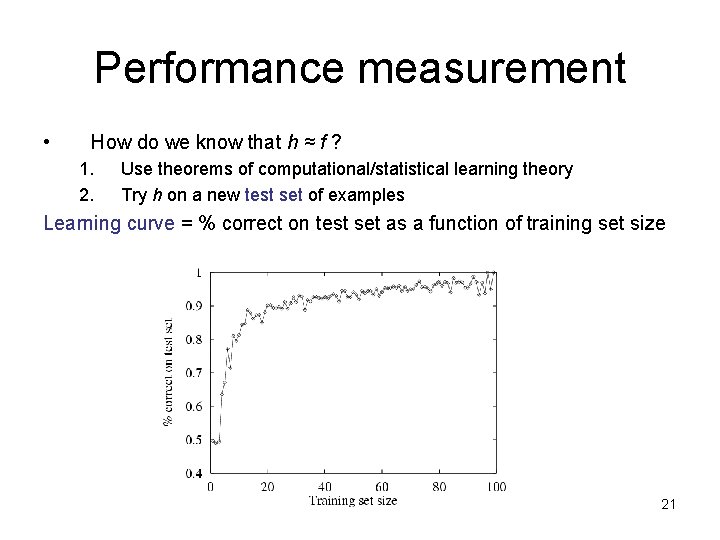
Performance measurement • How do we know that h ≈ f ? 1. 2. Use theorems of computational/statistical learning theory Try h on a new test set of examples Learning curve = % correct on test set as a function of training set size 21
Evaluating Inductive Hypotheses • Accuracy of hypotheses on training data is obviously biased since the hypothesis was constructed to fit this data. • Accuracy must be evaluated on a separate test set. • Average over multiple train/test splits to get accurate measure of accuracy. • K-fold cross validation averages over K trials using each example exactly once as a test case. 22
K-Fold Cross Validation Randomly partition data D into k disjoint equal-sized subsets P 1…Pk For i from 1 to k do: Use Pi for the test set and remaining data for training Average results over all K folds. Accuracy: % correct For class C: Precision: #True C & System’s answer is C/#System’s answer is C Recall: #True C & System’s answer is C / # True C F 1 -measure: 2 * (precision * recall / (precision + recall)) 23
K-Fold Cross Validation Comments • Every example gets used as a test example once and as a training example k– 1 times. • All test sets are independent; however, training sets overlap significantly. . • Standard method is 10 -fold. • If k is low, not sufficient number of train/test trials; if k is high, test set is small and test variance is high and run time is increased. • If k=|D|, method is called leave-one-out cross validation. 24
Overfitting • Overfitting can occur with any type of learner • The model describes random error or noise rather than the underlying pattern • For decision tree induction, “pruning” is use to combat overfitting. • Starting with nodes with only examples as children, eliminate attributes that fail a significance test. [That’s all you need to know] 25
Summary • Learning needed for unknown environments, lazy designers • Learning agent = performance element + learning element • For supervised learning, the aim is to find a simple hypothesis approximately consistent with training examples • Decision tree learning using information gain • Learning performance = prediction accuracy measured on test set 26
- Slides: 26