
Learning from Earthquakes Loss Adjusting in Italy Carlo
- Slides: 19
Learning from Earthquakes Loss Adjusting in Italy Carlo Tozzi Spadoni, Senior Partner Sinaia, 21 st May 2013
SUMMARY 1. Earthquakes: different occurrences, common patterns; 2. Loss Prevention: Technical Norms are useful, but not enough; 3. Loss Adjusters: those to rely upon when it’s too late for others to step in.
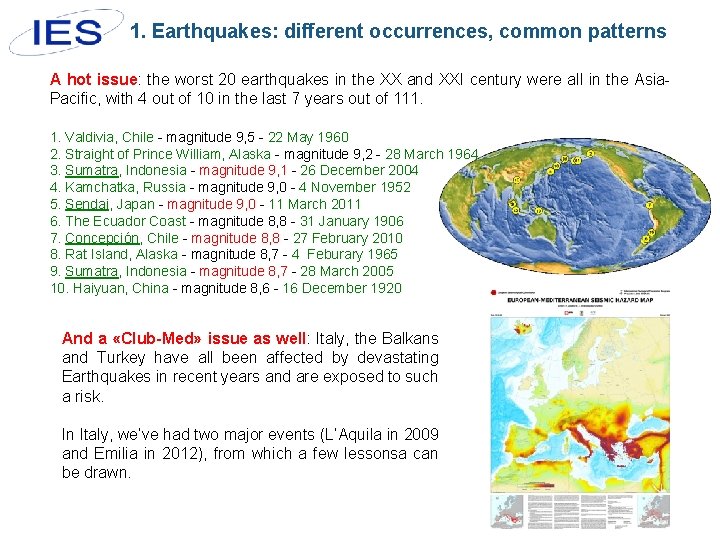
1. Earthquakes: different occurrences, common patterns A hot issue: the worst 20 earthquakes in the XX and XXI century were all in the Asia. Pacific, with 4 out of 10 in the last 7 years out of 111. 1. Valdivia, Chile - magnitude 9, 5 - 22 May 1960 2. Straight of Prince William, Alaska - magnitude 9, 2 - 28 March 1964 3. Sumatra, Indonesia - magnitude 9, 1 - 26 December 2004 4. Kamchatka, Russia - magnitude 9, 0 - 4 November 1952 5. Sendai, Japan - magnitude 9, 0 - 11 March 2011 6. The Ecuador Coast - magnitude 8, 8 - 31 January 1906 7. Concepción, Chile - magnitude 8, 8 - 27 February 2010 8. Rat Island, Alaska - magnitude 8, 7 - 4 Feburary 1965 9. Sumatra, Indonesia - magnitude 8, 7 - 28 March 2005 10. Haiyuan, China - magnitude 8, 6 - 16 December 1920 And a «Club-Med» issue as well: Italy, the Balkans and Turkey have all been affected by devastating Earthquakes in recent years and are exposed to such a risk. In Italy, we’ve had two major events (L’Aquila in 2009 and Emilia in 2012), from which a few lessonsa can be drawn.
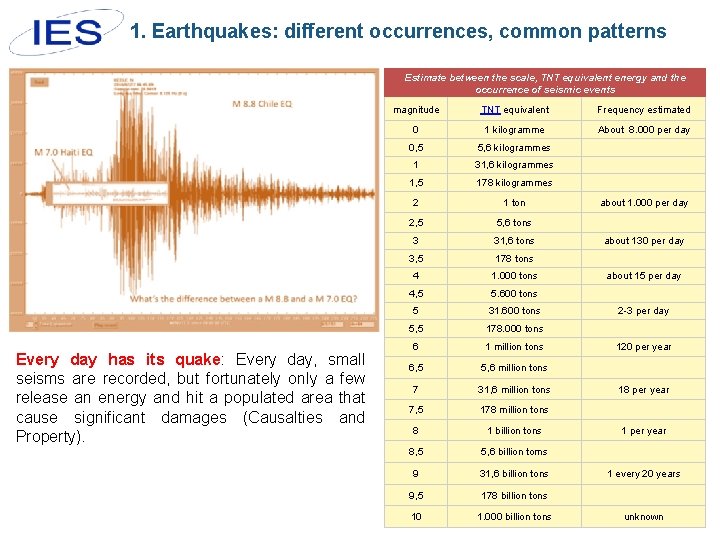
1. Earthquakes: different occurrences, common patterns Estimate between the scale, TNT equivalent energy and the occurrence of seismic events Every day has its quake: Every day, small seisms are recorded, but fortunately only a few release an energy and hit a populated area that cause significant damages (Causalties and Property). magnitude TNT equivalent Frequency estimated 0 1 kilogramme About 8. 000 per day 0, 5 5, 6 kilogrammes 1 31, 6 kilogrammes 1, 5 178 kilogrammes 2 1 ton 2, 5 5, 6 tons 3 31, 6 tons 3, 5 178 tons 4 1. 000 tons 4, 5 5. 600 tons 5 31. 600 tons 5, 5 178. 000 tons 6 1 million tons 6, 5 5, 6 million tons 7 31, 6 million tons 7, 5 178 million tons 8 1 billion tons 8, 5 5, 6 billion toms 9 31, 6 billion tons 9, 5 178 billion tons 10 1. 000 billion tons about 1. 000 per day about 130 per day about 15 per day 2 -3 per day 120 per year 18 per year 1 every 20 years unknown
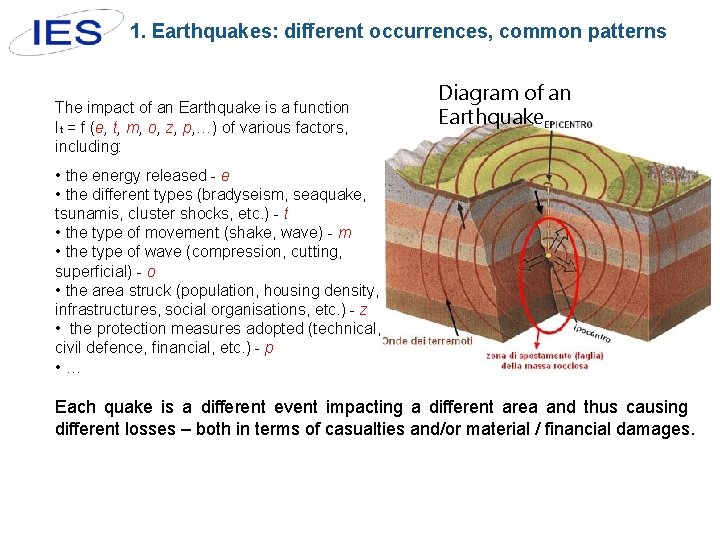
1. Earthquakes: different occurrences, common patterns The impact of an Earthquake is a function It = f (e, t, m, o, z, p, …) of various factors, including: Diagram of an Earthquake • the energy released - e • the different types (bradyseism, seaquake, tsunamis, cluster shocks, etc. ) - t • the type of movement (shake, wave) - m • the type of wave (compression, cutting, superficial) - o • the area struck (population, housing density, infrastructures, social organisations, etc. ) - z • the protection measures adopted (technical, civil defence, financial, etc. ) - p • … Each quake is a different event impacting a different area and thus causing different losses – both in terms of casualties and/or material / financial damages.
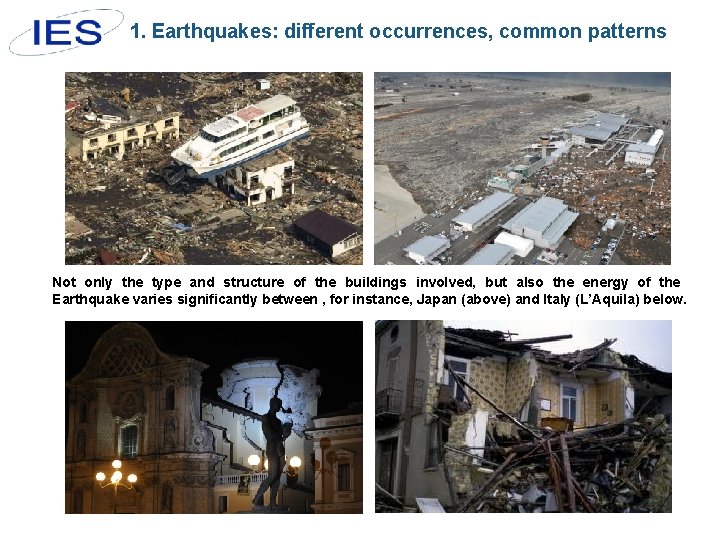
1. Earthquakes: different occurrences, common patterns Not only the type and structure of the buildings involved, but also the energy of the Earthquake varies significantly between , for instance, Japan (above) and Italy (L’Aquila) below.
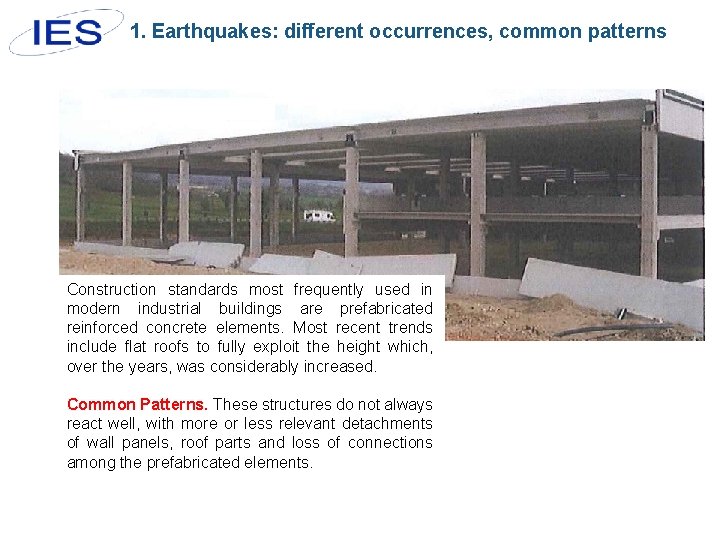
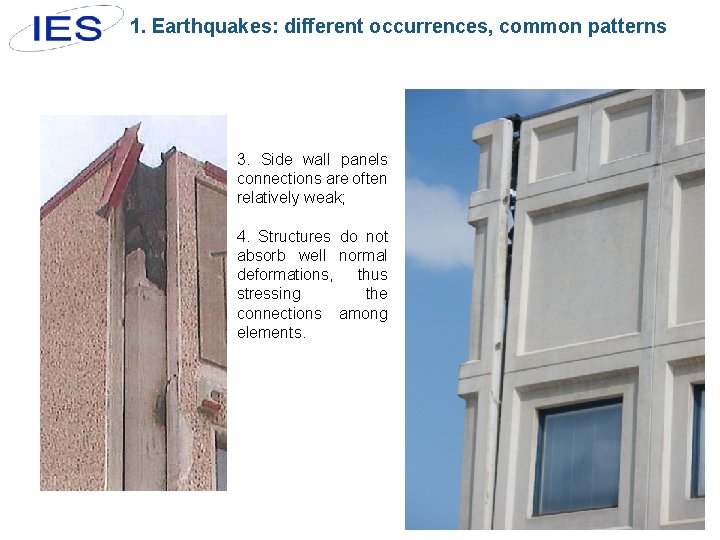
1. Earthquakes: different occurrences, common patterns Construction standards most frequently used in modern industrial buildings are prefabricated reinforced concrete elements. Most recent trends include flat roofs to fully exploit the height which, over the years, was considerably increased. Common Patterns. These structures do not always react well, with more or less relevant detachments of wall panels, roof parts and loss of connections among the prefabricated elements.
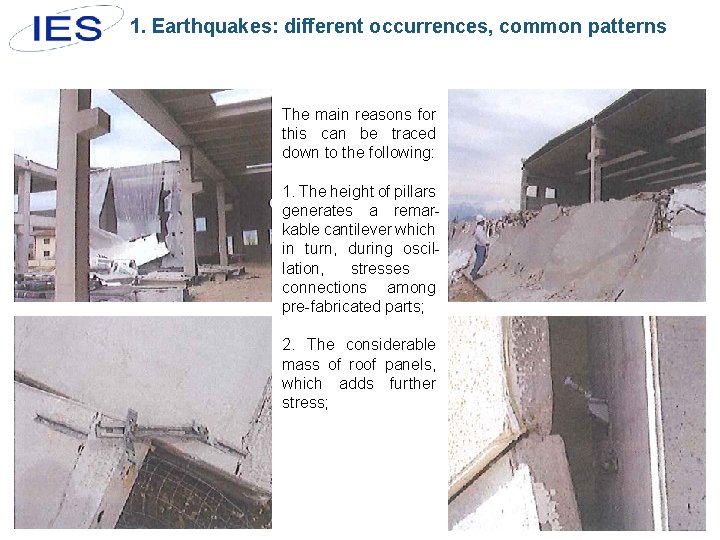
1. Earthquakes: different occurrences, common patterns The main reasons for this can be traced down to the following: 1. The height of pillars generates a remarkable cantilever which in turn, during oscillation, stresses connections among pre-fabricated parts; 2. The considerable mass of roof panels, which adds further stress;
1. Earthquakes: different occurrences, common patterns 3. Side wall panels connections are often relatively weak; 4. Structures do not absorb well normal deformations, thus stressing the connections among elements.
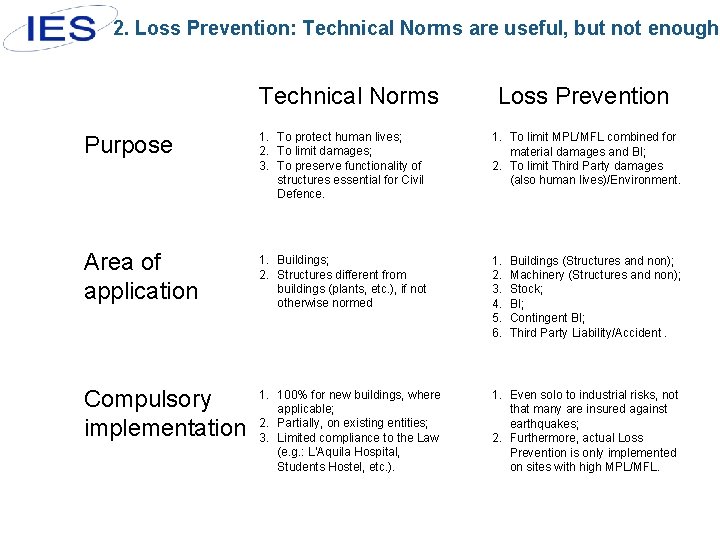
2. Loss Prevention: Technical Norms are useful, but not enough Technical Norms Loss Prevention Purpose 1. To protect human lives; 2. To limit damages; 3. To preserve functionality of structures essential for Civil Defence. 1. To limit MPL/MFL combined for material damages and BI; 2. To limit Third Party damages (also human lives)/Environment. Area of application 1. Buildings; 2. Structures different from buildings (plants, etc. ), if not otherwise normed 1. 2. 3. 4. 5. 6. Compulsory implementation 1. 100% for new buildings, where applicable; 2. Partially, on existing entities; 3. Limited compliance to the Law (e. g. : L’Aquila Hospital, Students Hostel, etc. ). 1. Even solo to industrial risks, not that many are insured against earthquakes; 2. Furthermore, actual Loss Prevention is only implemented on sites with high MPL/MFL. Buildings (Structures and non); Machinery (Structures and non); Stock; BI; Contingent BI; Third Party Liability/Accident.
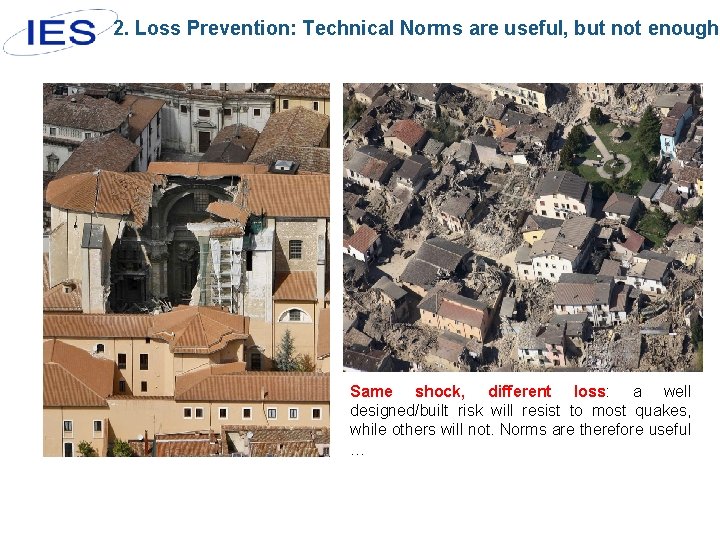
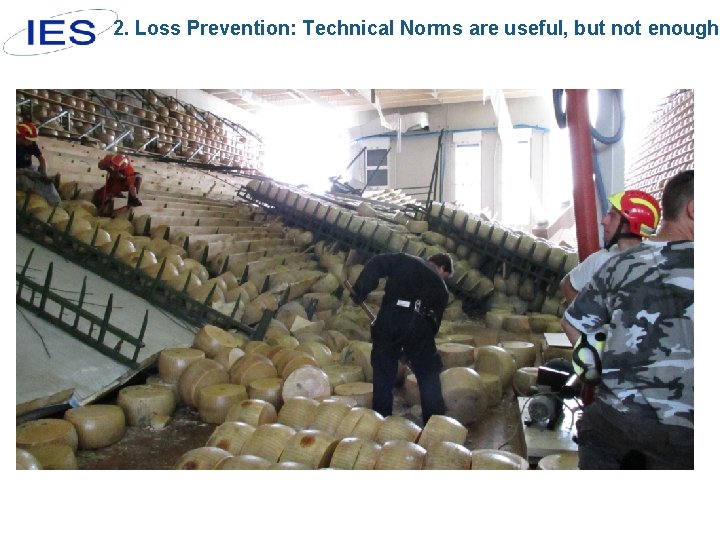
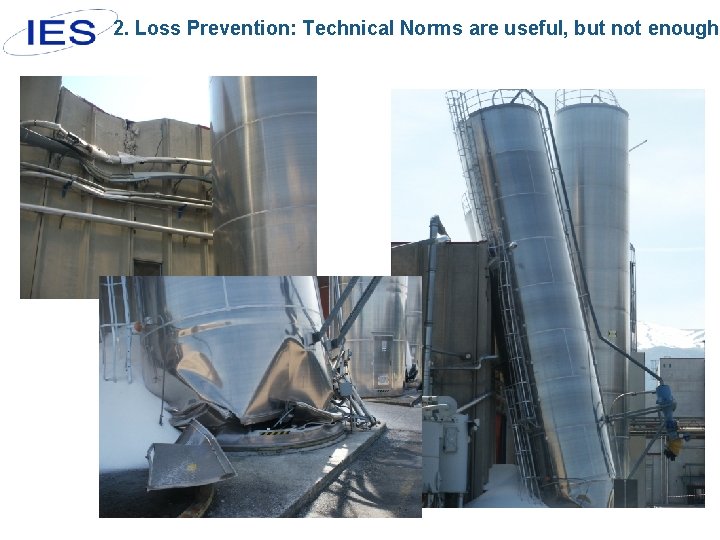
2. Loss Prevention: Technical Norms are useful, but not enough Same shock, different loss: a well designed/built risk will resist to most quakes, while others will not. Norms are therefore useful …
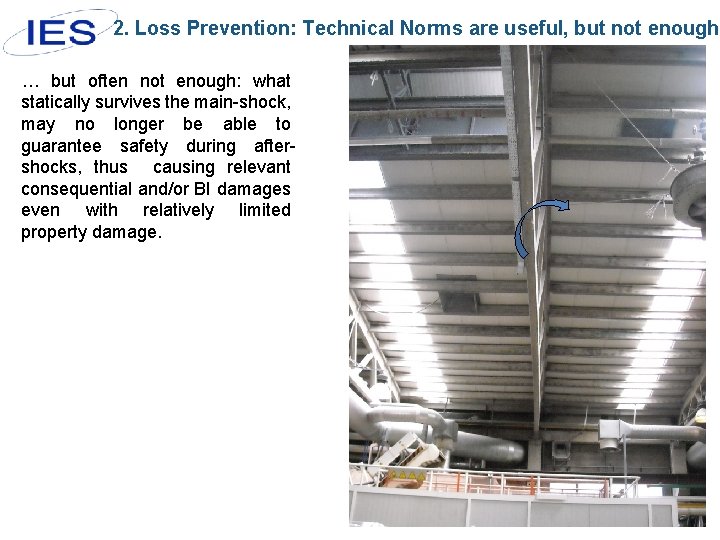
2. Loss Prevention: Technical Norms are useful, but not enough … but often not enough: what statically survives the main-shock, may no longer be able to guarantee safety during aftershocks, thus causing relevant consequential and/or BI damages even with relatively limited property damage.
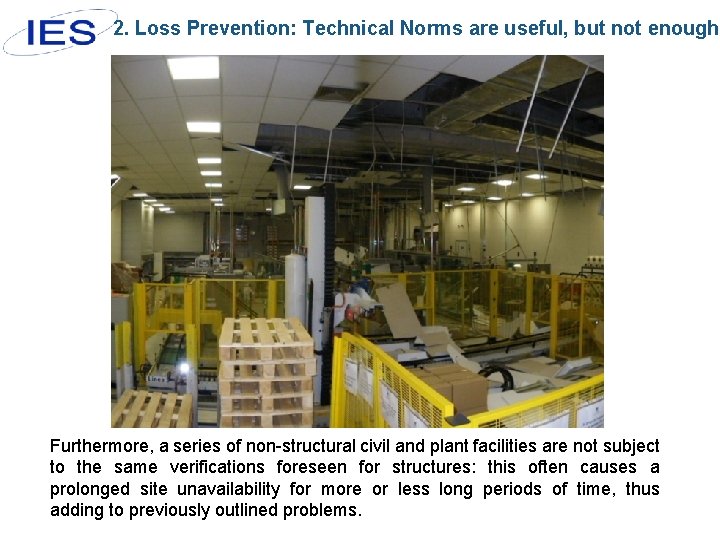
2. Loss Prevention: Technical Norms are useful, but not enough Furthermore, a series of non-structural civil and plant facilities are not subject to the same verifications foreseen for structures: this often causes a prolonged site unavailability for more or less long periods of time, thus adding to previously outlined problems.
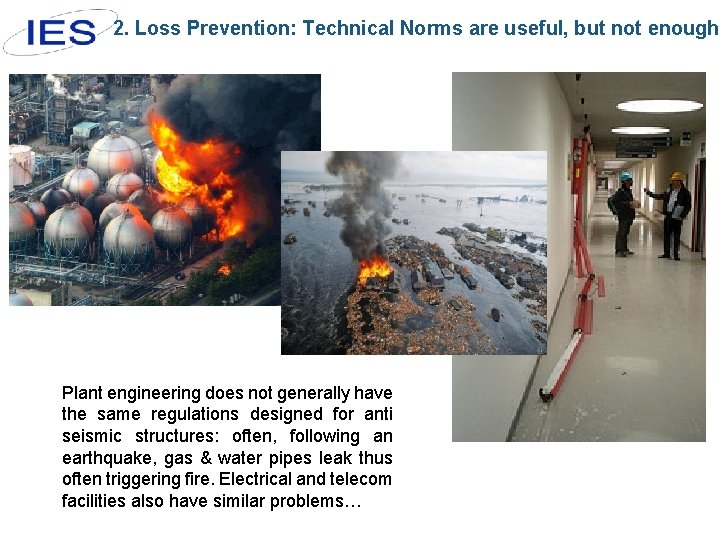
2. Loss Prevention: Technical Norms are useful, but not enough Plant engineering does not generally have the same regulations designed for anti seismic structures: often, following an earthquake, gas & water pipes leak thus often triggering fire. Electrical and telecom facilities also have similar problems…
2. Loss Prevention: Technical Norms are useful, but not enough
2. Loss Prevention: Technical Norms are useful, but not enough
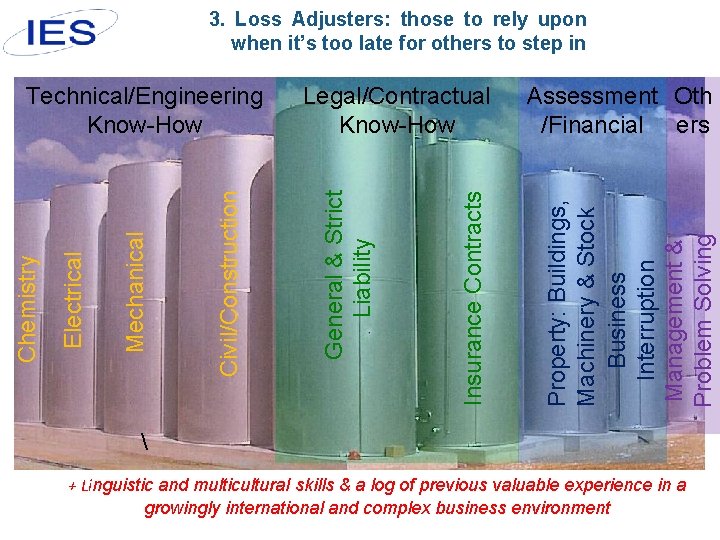
3. Loss Adjusters: those to rely upon when it’s too late for others to step in Assessment Oth /Financial ers Property: Buildings, Machinery & Stock Business Interruption Management & Problem Solving Insurance Contracts Legal/Contractual Know-How General & Strict Liability Civil/Construction Mechanical Electrical Chemistry Technical/Engineering Know-How + Linguistic and multicultural skills & a log of previous valuable experience in a growingly international and complex business environment
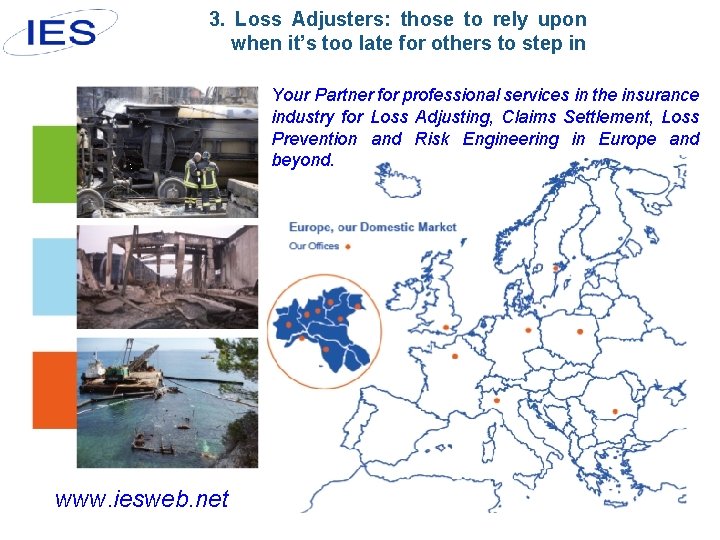
3. Loss Adjusters: those to rely upon when it’s too late for others to step in Your Partner for professional services in the insurance industry for Loss Adjusting, Claims Settlement, Loss Prevention and Risk Engineering in Europe and beyond. www. iesweb. net
3. Loss Adjusters: those to rely upon when it’s too late for others to step in WHAT OUR MISSION: we are determined to provide: üpremium-quality professional services in the domains of Insurance Loss Adjusting, Risk Engineering, Corporate Claims Management and the development of Insurance Knowledge and Competence TO üto the Insurance Market, protecting the interests of Principals appointing us and/or retaining our services HOW üin an independent, honest, transparent, cost-effective and profitable way BY üenhancing the growth and exploiting the individual talent, professional know-how and skills of our staff, through team-work and a solid organization framework WITH ümarket bench-mark engineering, financial, legal and insurance knowledge within a multilingual and multicultural environment WHY üto the general benefit and growth of the wider Insurance Market (Insurers, Policyholders, Claimants, Brokers, Authorities and various Professionals) and that of our own employees, professionals and stakeholders