
Learning for everyone Observing Child Development Observations that
Learning for everyone… Observing Child Development Observations that record development are vitally important. Let’s get them right!

Learning for everyone… Observing Child Development Ø Observing the development of children can be fascinating. Each child is a unique individual. Children develop as they grow and learn new complex skills. Ø The sequence of development is the same for all children. An individual's ability progresses at different rates depending on inherited characteristics and the nurturing that child receives.
Learning for everyone… Observing Child Development Ø Growth and development will progress well when a child's basic needs for food, warmth, sleep, exercise, encouragement and love are met by reliable adult carers. Ø Development is holistic including physical, intellectual, emotional and social aspects. These areas of development are integrated into a whole special individual
Learning for everyone… Observing Child Development Ø Observing a child's unique development is a rewarding skill to learn. As with all new skills observation requires practice. Please come and see each separate page for more information on interesting things to observe in a child's development

Learning for everyone… Observing Child Development Ø Physical development is to do with movement: gross, or large, movement of limbs and fine manipulative movement of fingers. Ø Physical development depends on growth of the body and nervous system so that messages from the brain can be carried to the muscles to stimulate them to move. Ø Diet is important with protein for growth, calcium and vitamin D for strong bones.
Learning for everyone… Observing Child Development Ø Outdoor play provides fresh air for oxygen, sunlight for well being and vitamin D and space to run freely. Ø Physical development stimulates children's curiosity and enables them to explore their environment. Ø Adults need to provide a safe environment and safe objects to explore.
Learning for everyone… Observing Child Development Ø Gross motor skills involve whole body movement. Ø Learning to run and jump requires strength, suppleness, stamina and lots of practice
Learning for everyone… Development Of Fine Manipulative Skills Ø Dexterity using equipment - gripping, holding, drawing, colouring, painting, tracing, writing, cutting, gluing, threading, sewing, building. Ø Exploring sand, water and dough - touching, poking, feeling, squeezing, pouring, filling, emptying. Ø Using tools in woodwork and construction hammering, tapping, sawing.
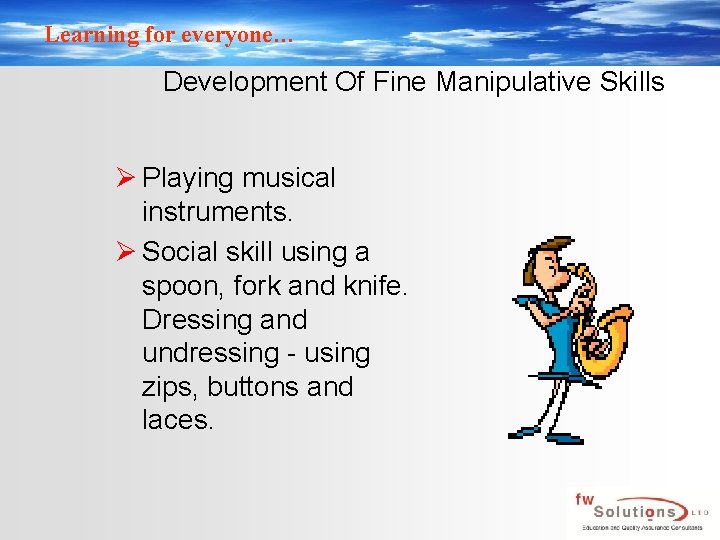
Learning for everyone… Development Of Fine Manipulative Skills Ø Playing musical instruments. Ø Social skill using a spoon, fork and knife. Dressing and undressing - using zips, buttons and laces.
Learning for everyone… Development Of Gross Motor Skills Ø Walking, running and climbing. Hopping, skipping and jumping. Sliding, dancing, and swimming. Ø Bending, stretching and carrying large objects. Pushing and pulling toys. Ø Ball skills - rolling, kicking, throwing and catching. Ø Awareness of body in space. Ø Exploring movement in space. Ø Experiencing speed.
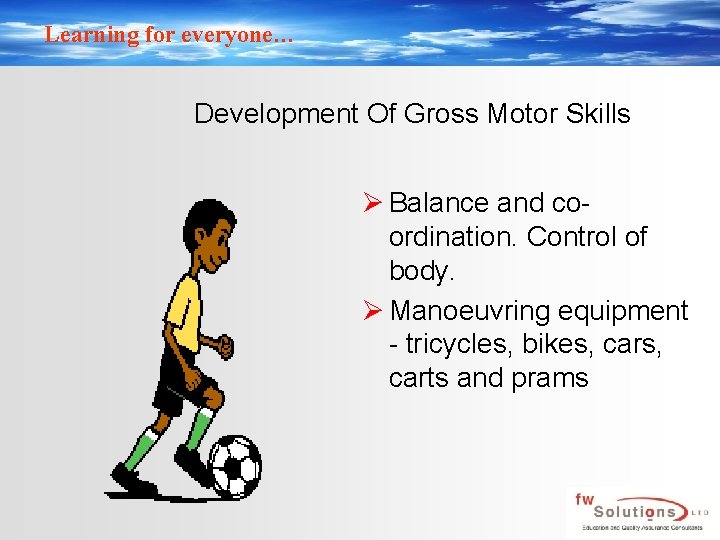
Learning for everyone… Development Of Gross Motor Skills Ø Balance and coordination. Control of body. Ø Manoeuvring equipment - tricycles, bikes, carts and prams
Learning for everyone… Observing Intellectual Development Ø Intellectual Development includes: Ø Intellect or mind. Ø Cognition meaning to know. Ø Thinking and reasoning. Ø Knowledge and understanding. Ø Memory and learning. Ø Imagination and creativity. Ø Concentration and attention.
Learning for everyone… Observing Intellectual Development Ø Problem Solving What happens if I press this button? How does a jigsaw puzzle fit together? Where do I wear a hat? Ø Perception through the senses - sight, sound, touch, taste, smell. Ø Concept Formation - hot and cold, big and little, under and over, time, colours, shapes, numbers, letters, weight, volume.
Learning for everyone… Observing Intellectual Development Ø Children learn about their world in various ways. Ø Younger children use their senses to experience surroundings and objects as they look, listen, feel, smell and taste. Ø Children have little sense of danger, so adults help their investigation by providing safe toys, everyday objects and places to explore.
Learning for everyone… Observing Intellectual Development Ø As children more acquire language they learn by asking questions. Ø 2 year olds ask "What's that? " "Who's that? " 3 year olds ask "Where? " Ø 4 year olds ask "Why? " "When? " and "How? " Ø Children need language to promote intellectual development.
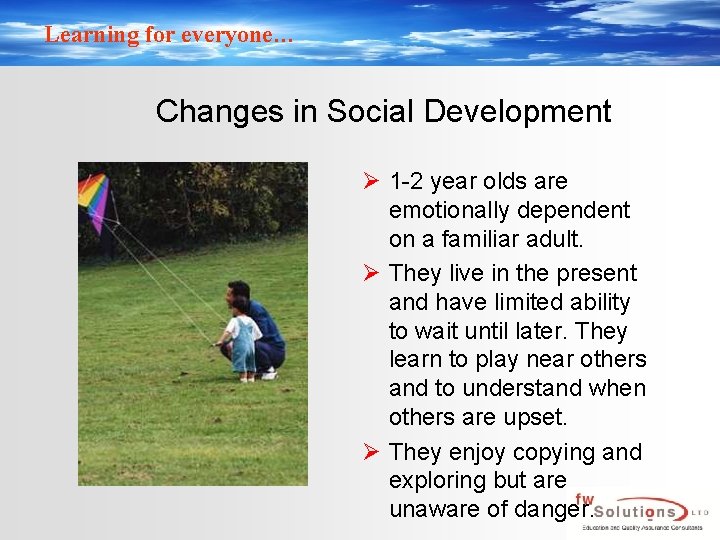
Learning for everyone… Changes in Social Development Ø 1 -2 year olds are emotionally dependent on a familiar adult. Ø They live in the present and have limited ability to wait until later. They learn to play near others and to understand when others are upset. Ø They enjoy copying and exploring but are unaware of danger.
Learning for everyone… Observing Intellectual Development Ø Adults nurture their intellect by describing what is happening in the child's everyday world using simple words, answering the children's questions, listening attentively to the children and by encouraging speech by asking open questions for the children to answer.
Learning for everyone… Observing Intellectual Development Ø Children enjoy the fun of finding out and problem solving for themselves through creativity and imaginative play. Ø It helps to have stimulating toys, books and to be involved in planning play activities.
Learning for everyone… Observing Intellectual Development Ø Imitation and repetition are effective ways to learn. Ø Children use these strategies to repeat enjoyable actions and gain some success, to learn language by repeating sounds, in writing by copying the shapes of letters and words, in role-play by copying adults and stories, and in morality by imitating the example of people who are significant to them. Ø Adults are a role model for children.
Learning for everyone… Observing Intellectual Development Ø Understanding basic concepts of colour, shape, letters, numbers, heat, light, gravity, living and non-living things, time and the meaning of right and wrong, is complicated but children learn through their own experience and by trial and error.
Learning for everyone… Observing Intellectual Development Ø When adults provide the opportunities to learn new skills and give support and encouragement so each child gains some success, they are providing perfect conditions to nurture intellectual development.
Learning for everyone… Observing Social Development Ø Learning the skills and attitudes which enable individuals to live easily with other members of their community observing codes of acceptable behaviour and customs.
Learning for everyone… Observing Social Development Ø form of greeting Ø attitude to dress Ø morals Ø hygiene Ø religion Ø eating habits
Learning for everyone… Social Roles and Behaviour. Ø learning appropriate and acceptable behaviour from positive role models Ø playing approved social roles - gender, child, parent, pupil, friend Ø developing appropriate social attitudes to like people and enjoy friendships
Learning for everyone… Social Skills Ø to share Ø to take turns Ø to accept rules Ø to communicate with others Ø to be independent in dressing, personal hygiene and at mealtimes
Learning for everyone… Social Play. Ø solitary - playing alone Ø parallel - playing alongside, but not with, another child Ø associative - using the same toys and equipment, but playing alone Ø co-operative - sharing toys and ideas in playing together
Learning for everyone… Personal Development. Ø self-esteem is valuing yourself as a person Ø positive self-image is seeing yourself as a worthwhile person Ø self-confidence is knowing you can cope easily with people and situations Ø self-reliance is a desire to be independent
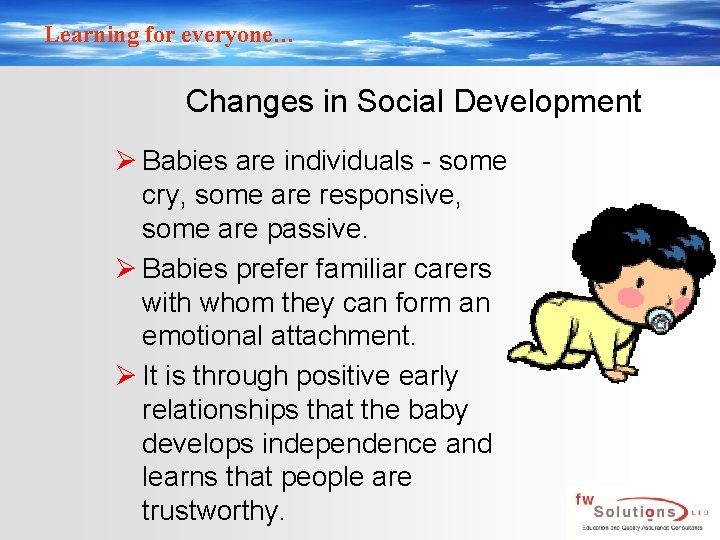
Learning for everyone… Changes in Social Development Ø Babies are individuals - some cry, some are responsive, some are passive. Ø Babies prefer familiar carers with whom they can form an emotional attachment. Ø It is through positive early relationships that the baby develops independence and learns that people are trustworthy.
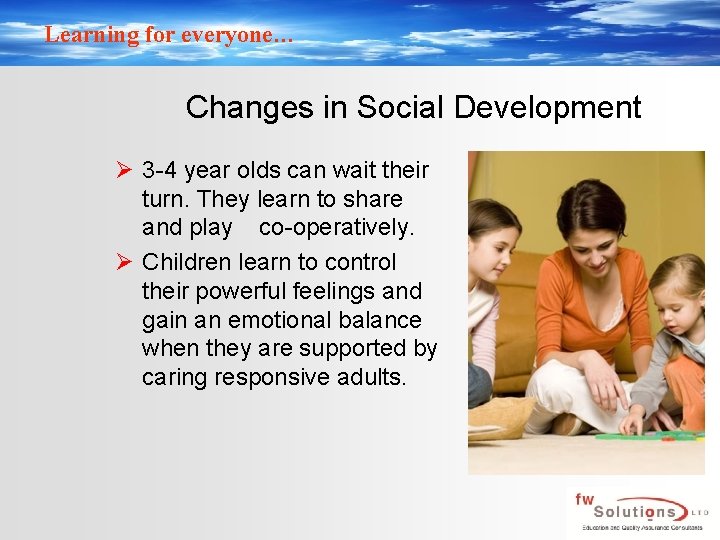
Learning for everyone… Changes in Social Development Ø 3 -4 year olds can wait their turn. They learn to share and play co-operatively. Ø Children learn to control their powerful feelings and gain an emotional balance when they are supported by caring responsive adults.
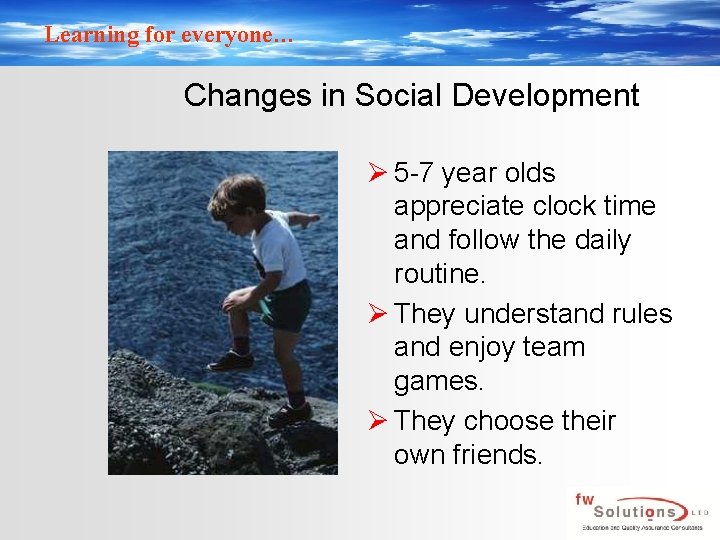
Learning for everyone… Changes in Social Development Ø 5 -7 year olds appreciate clock time and follow the daily routine. Ø They understand rules and enjoy team games. Ø They choose their own friends.
- Slides: 30