
Learning Econometrics in a Problem Based Learning Curriculum
Learning Econometrics in a Problem Based Learning Curriculum with the Tablet PC: An experiment in 1: 1 computing Steven C. Myers The University of Akron WIPTE 2007 Purdue University June 11 -12, 2007 Learnecon. blogspot. com Go. Zips. uakron. edu/~myers@uakron. edu
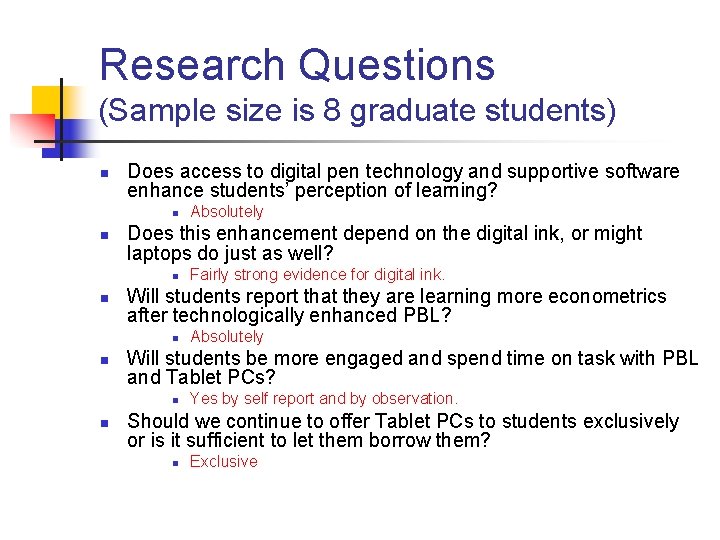
Research Questions (Sample size is 8 graduate students) n Does access to digital pen technology and supportive software enhance students’ perception of learning? n n Does this enhancement depend on the digital ink, or might laptops do just as well? n n Absolutely Will students be more engaged and spend time on task with PBL and Tablet PCs? n n Fairly strong evidence for digital ink. Will students report that they are learning more econometrics after technologically enhanced PBL? n n Absolutely Yes by self report and by observation. Should we continue to offer Tablet PCs to students exclusively or is it sufficient to let them borrow them? n Exclusive
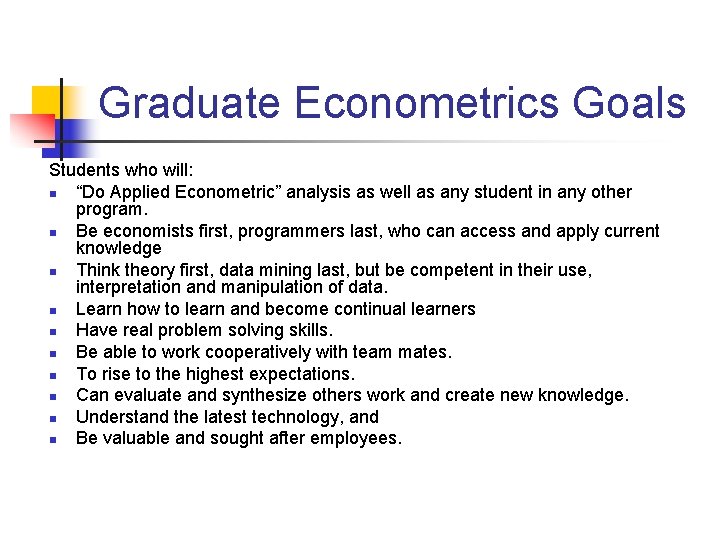
Graduate Econometrics Goals Students who will: n “Do Applied Econometric” analysis as well as any student in any other program. n Be economists first, programmers last, who can access and apply current knowledge n Think theory first, data mining last, but be competent in their use, interpretation and manipulation of data. n Learn how to learn and become continual learners n Have real problem solving skills. n Be able to work cooperatively with team mates. n To rise to the highest expectations. n Can evaluate and synthesize others work and create new knowledge. n Understand the latest technology, and n Be valuable and sought after employees.
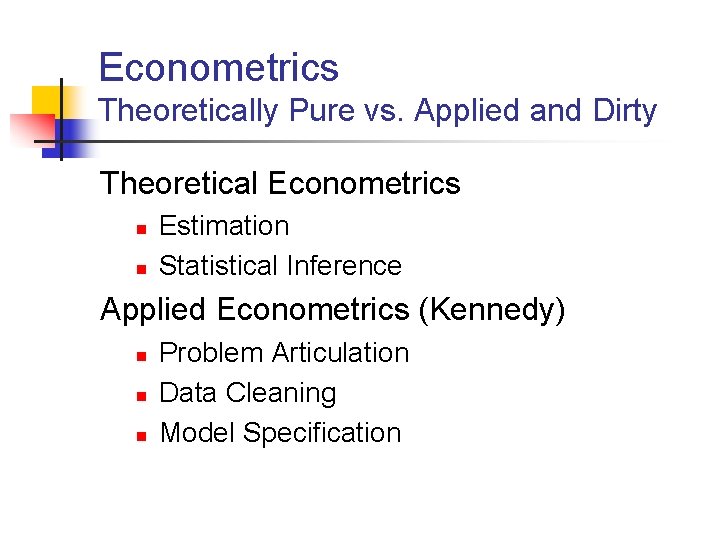
Econometrics Theoretically Pure vs. Applied and Dirty Theoretical Econometrics n n Estimation Statistical Inference Applied Econometrics (Kennedy) n n n Problem Articulation Data Cleaning Model Specification
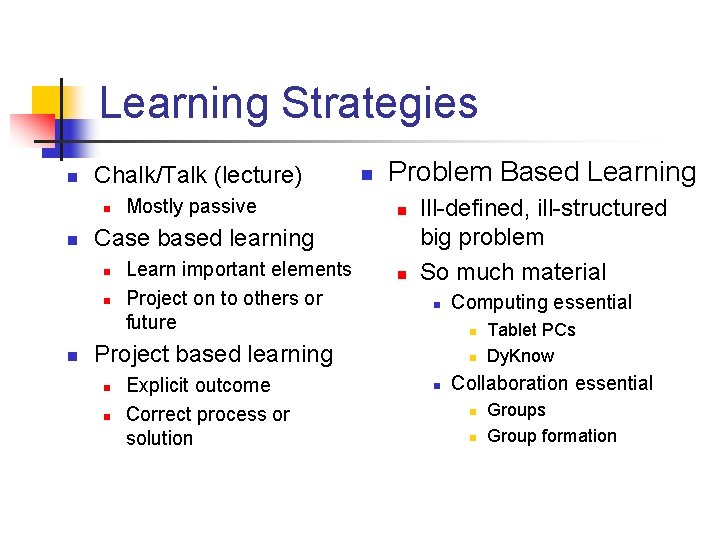
Learning Strategies n Chalk/Talk (lecture) n n Problem Based Learning n Case based learning n n n Mostly passive n Learn important elements Project on to others or future n Ill-defined, ill-structured big problem So much material n n Project based learning n n Explicit outcome Correct process or solution Computing essential n n Tablet PCs Dy. Know Collaboration essential n n Groups Group formation
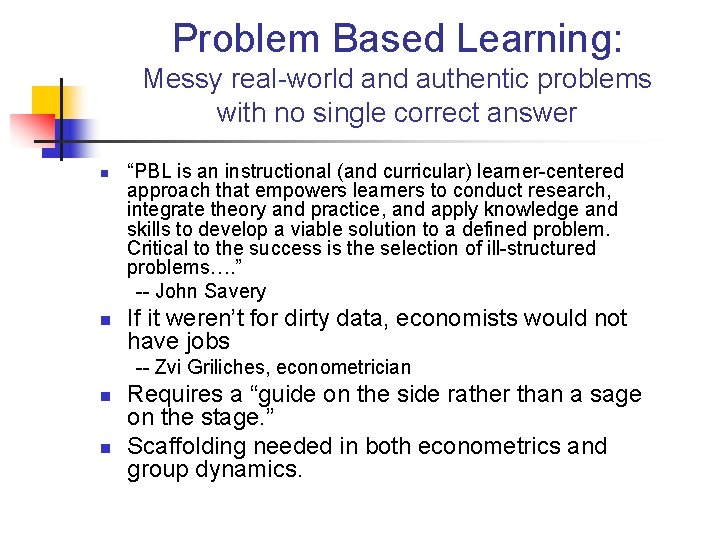
Problem Based Learning: Messy real-world and authentic problems with no single correct answer n n “PBL is an instructional (and curricular) learner-centered approach that empowers learners to conduct research, integrate theory and practice, and apply knowledge and skills to develop a viable solution to a defined problem. Critical to the success is the selection of ill-structured problems…. ” -- John Savery If it weren’t for dirty data, economists would not have jobs -- Zvi Griliches, econometrician n n Requires a “guide on the side rather than a sage on the stage. ” Scaffolding needed in both econometrics and group dynamics.

Problem Based Learning n n Ill-structured problems and free inquiry Student’s responsible for their own learning Integrated learning Collaboration is essential n n Self and peer assessments Authentic tasks Measurement of student progress in knowledge and process. Must be integral to the curriculum
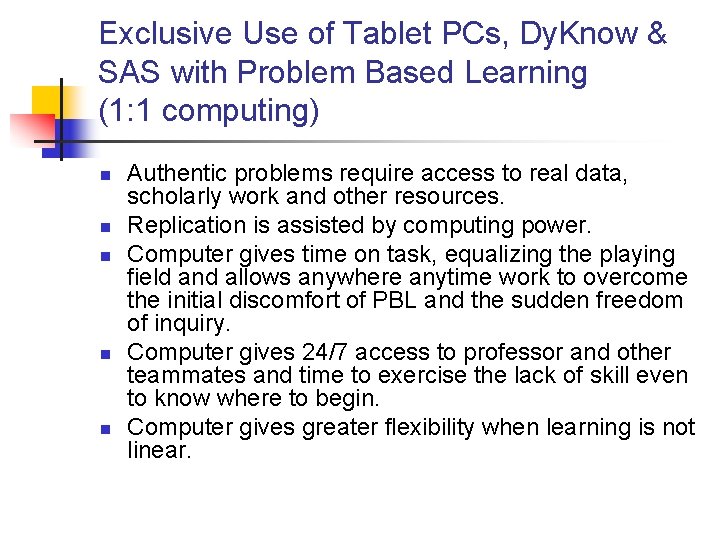
Exclusive Use of Tablet PCs, Dy. Know & SAS with Problem Based Learning (1: 1 computing) n n n Authentic problems require access to real data, scholarly work and other resources. Replication is assisted by computing power. Computer gives time on task, equalizing the playing field and allows anywhere anytime work to overcome the initial discomfort of PBL and the sudden freedom of inquiry. Computer gives 24/7 access to professor and other teammates and time to exercise the lack of skill even to know where to begin. Computer gives greater flexibility when learning is not linear.
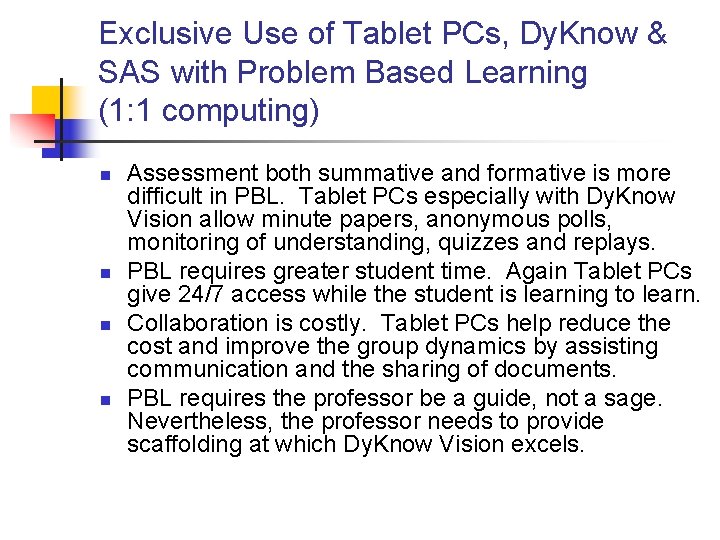
Exclusive Use of Tablet PCs, Dy. Know & SAS with Problem Based Learning (1: 1 computing) n n Assessment both summative and formative is more difficult in PBL. Tablet PCs especially with Dy. Know Vision allow minute papers, anonymous polls, monitoring of understanding, quizzes and replays. PBL requires greater student time. Again Tablet PCs give 24/7 access while the student is learning to learn. Collaboration is costly. Tablet PCs help reduce the cost and improve the group dynamics by assisting communication and the sharing of documents. PBL requires the professor be a guide, not a sage. Nevertheless, the professor needs to provide scaffolding at which Dy. Know Vision excels.
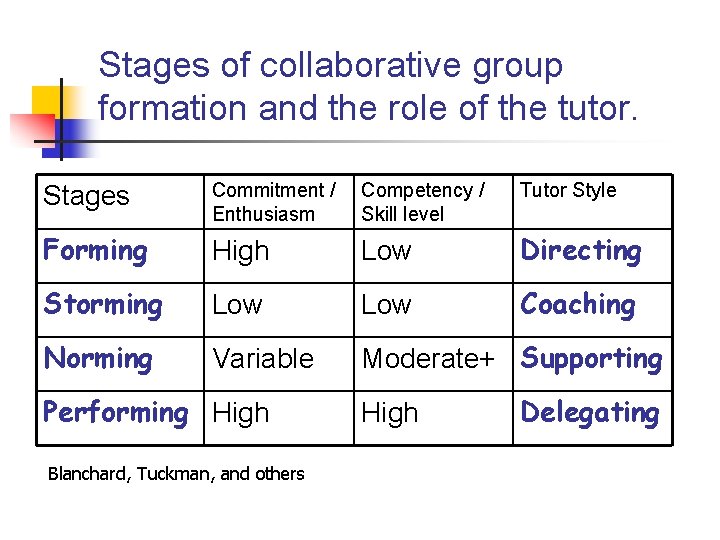
Stages of collaborative group formation and the role of the tutor. Stages Commitment / Competency / Enthusiasm Skill level Tutor Style Forming High Low Directing Storming Low Coaching Norming Variable Moderate+ Supporting Performing High Blanchard, Tuckman, and others High Delegating
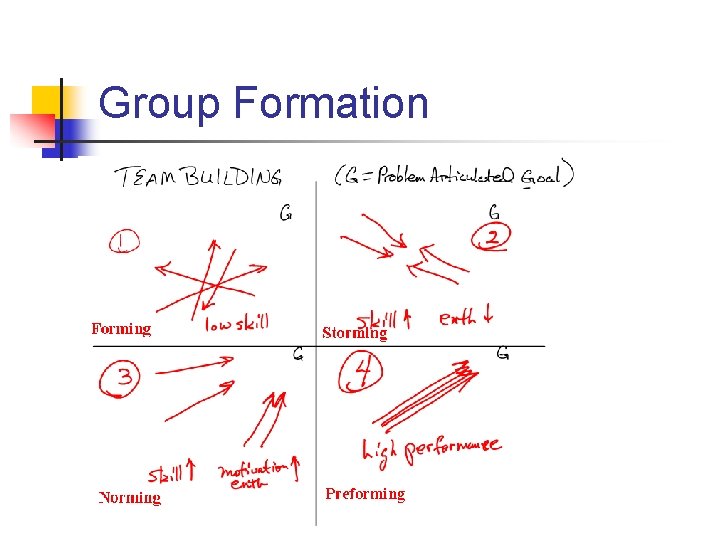
Group Formation
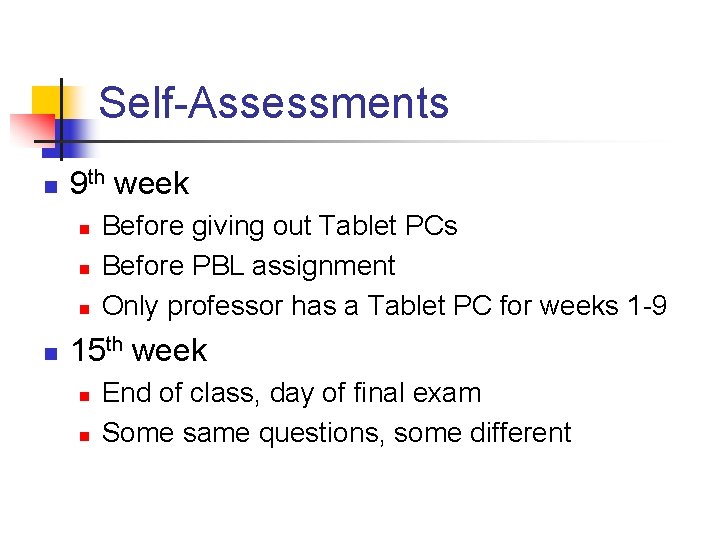
Self-Assessments n 9 th week n n Before giving out Tablet PCs Before PBL assignment Only professor has a Tablet PC for weeks 1 -9 15 th week n n End of class, day of final exam Some same questions, some different
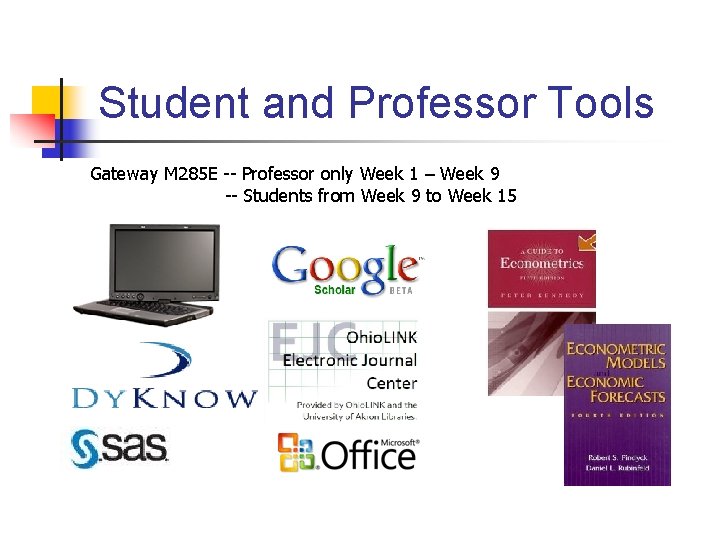
Student and Professor Tools Gateway M 285 E -- Professor only Week 1 – Week 9 -- Students from Week 9 to Week 15
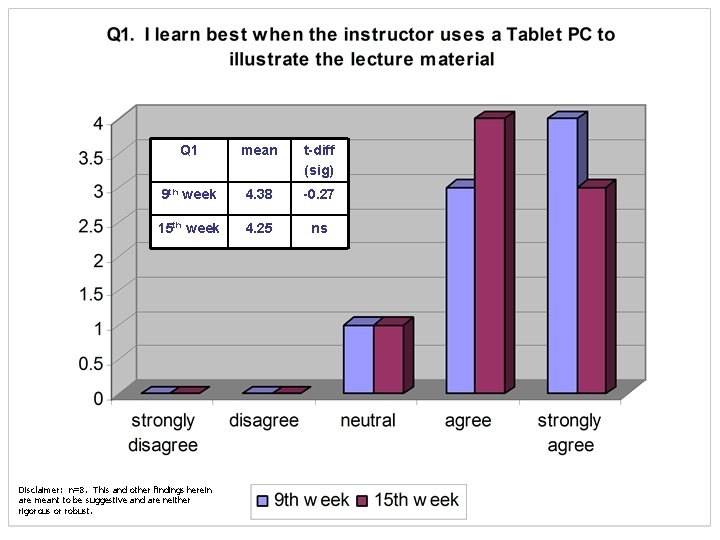
Q 1 mean t-diff (sig) 9 th week 4. 38 -0. 27 15 th week 4. 25 ns Disclaimer: n=8. This and other findings herein are meant to be suggestive and are neither rigorous or robust.
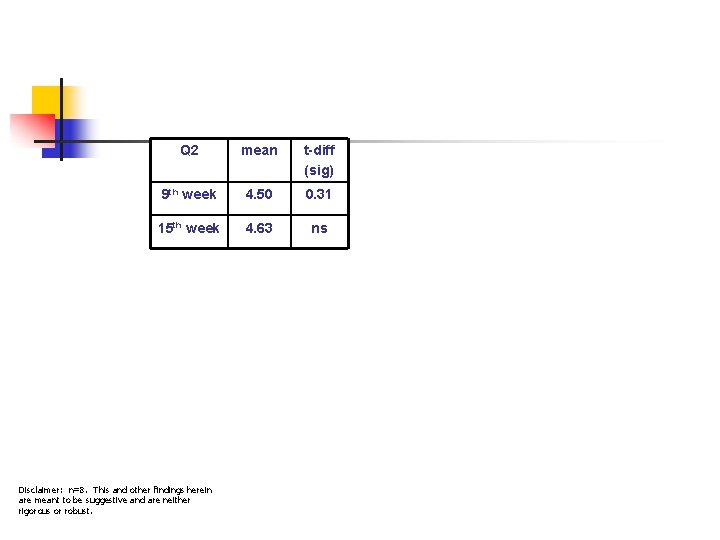
Q 2 mean t-diff (sig) 9 th week 4. 50 0. 31 15 th week 4. 63 ns Disclaimer: n=8. This and other findings herein are meant to be suggestive and are neither rigorous or robust.
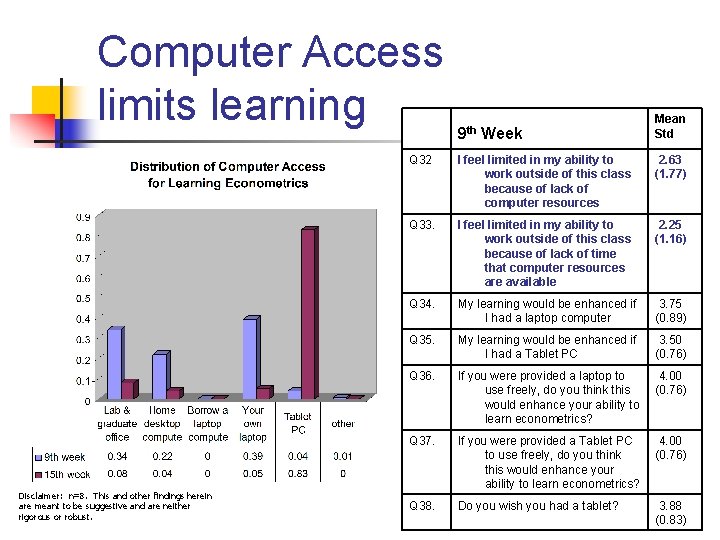
Computer Access limits learning Disclaimer: n=8. This and other findings herein are meant to be suggestive and are neither rigorous or robust. 9 th Week Mean Std Q 32 I feel limited in my ability to work outside of this class because of lack of computer resources 2. 63 (1. 77) Q 33. I feel limited in my ability to work outside of this class because of lack of time that computer resources are available 2. 25 (1. 16) Q 34. My learning would be enhanced if I had a laptop computer 3. 75 (0. 89) Q 35. My learning would be enhanced if I had a Tablet PC 3. 50 (0. 76) Q 36. If you were provided a laptop to use freely, do you think this would enhance your ability to learn econometrics? 4. 00 (0. 76) Q 37. If you were provided a Tablet PC to use freely, do you think this would enhance your ability to learn econometrics? 4. 00 (0. 76) Q 38. Do you wish you had a tablet? 3. 88 (0. 83)
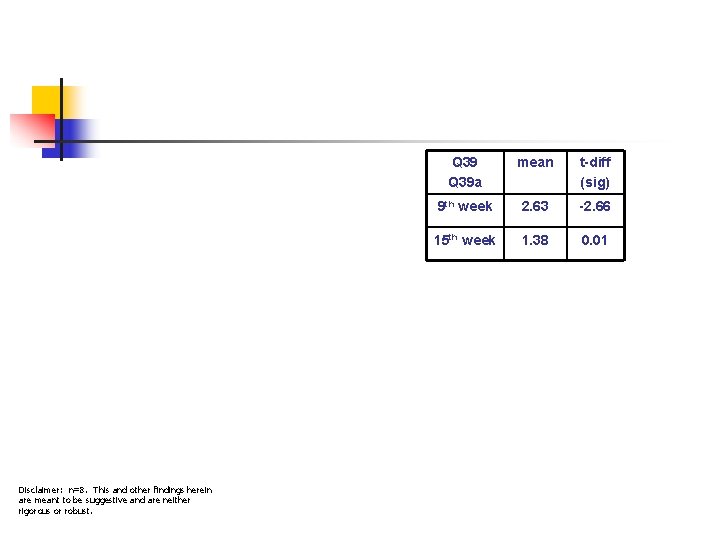
Disclaimer: n=8. This and other findings herein are meant to be suggestive and are neither rigorous or robust. Q 39 a mean t-diff (sig) 9 th week 2. 63 -2. 66 15 th week 1. 38 0. 01
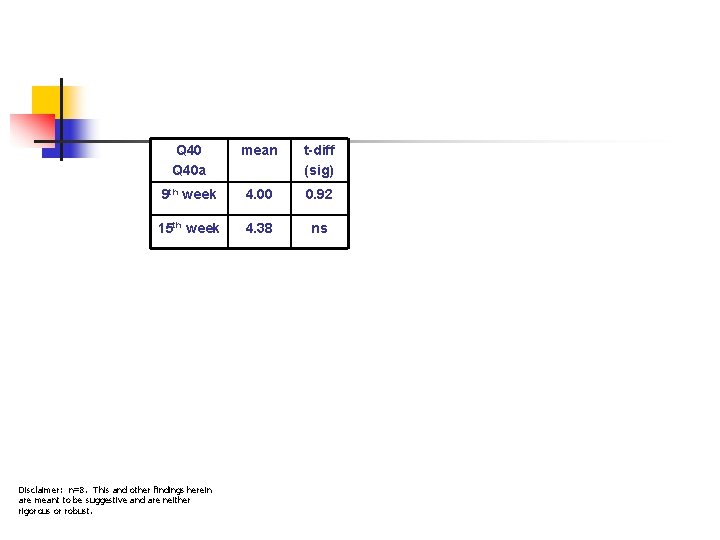
Q 40 a mean t-diff (sig) 9 th week 4. 00 0. 92 15 th week 4. 38 ns Disclaimer: n=8. This and other findings herein are meant to be suggestive and are neither rigorous or robust.
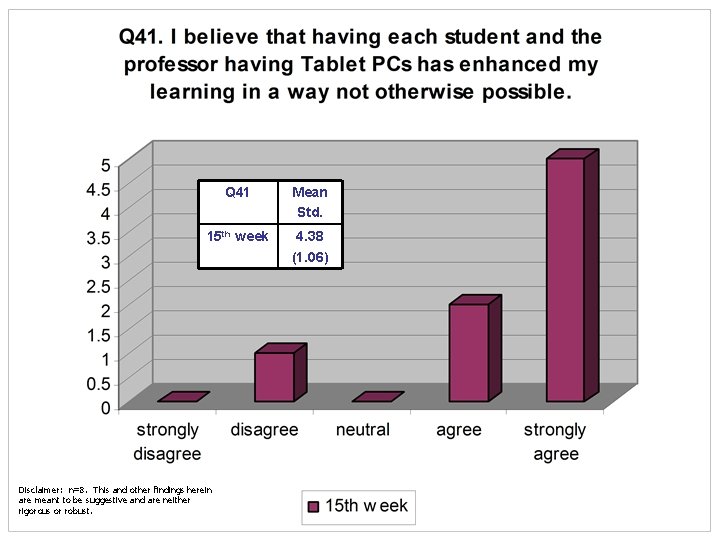
Q 41 Mean Std. 15 th week 4. 38 (1. 06) Disclaimer: n=8. This and other findings herein are meant to be suggestive and are neither rigorous or robust.
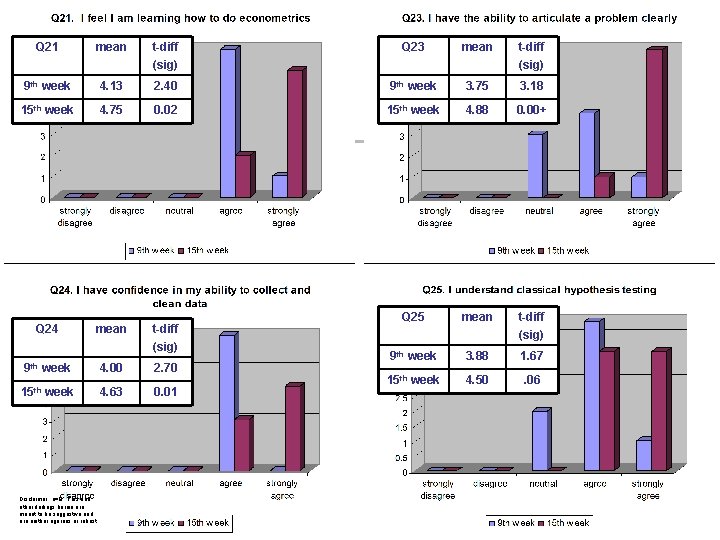
Q 21 mean t-diff (sig) Q 23 mean t-diff (sig) 9 th week 4. 13 2. 40 9 th week 3. 75 3. 18 15 th week 4. 75 0. 02 15 th week 4. 88 0. 00+ Q 24 mean t-diff (sig) Q 25 mean t-diff (sig) 9 th week 3. 88 1. 67 15 th week 4. 50 . 06 9 th week 4. 00 2. 70 15 th week 4. 63 0. 01 Disclaimer: n=8. This and other findings herein are meant to be suggestive and are neither rigorous or robust.
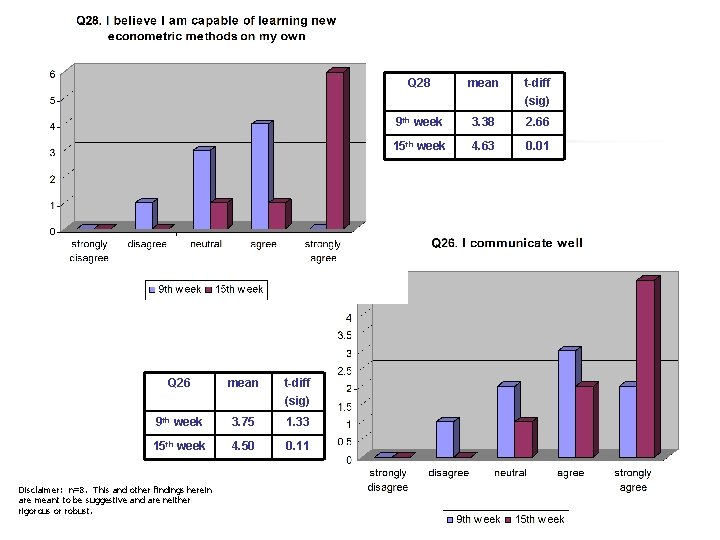
Q 26 mean t-diff (sig) 9 th week 3. 75 1. 33 15 th week 4. 50 0. 11 Disclaimer: n=8. This and other findings herein are meant to be suggestive and are neither rigorous or robust. Q 28 mean t-diff (sig) 9 th week 3. 38 2. 66 15 th week 4. 63 0. 01
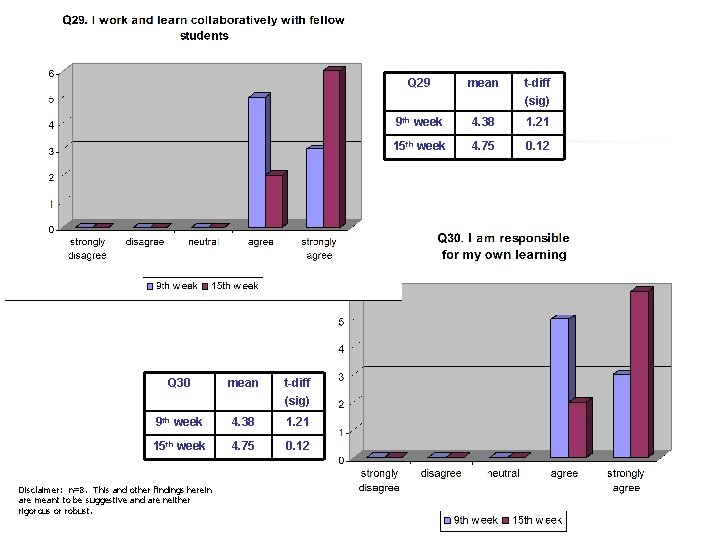
Q 30 mean t-diff (sig) 9 th week 4. 38 1. 21 15 th week 4. 75 0. 12 Disclaimer: n=8. This and other findings herein are meant to be suggestive and are neither rigorous or robust. Q 29 mean t-diff (sig) 9 th week 4. 38 1. 21 15 th week 4. 75 0. 12
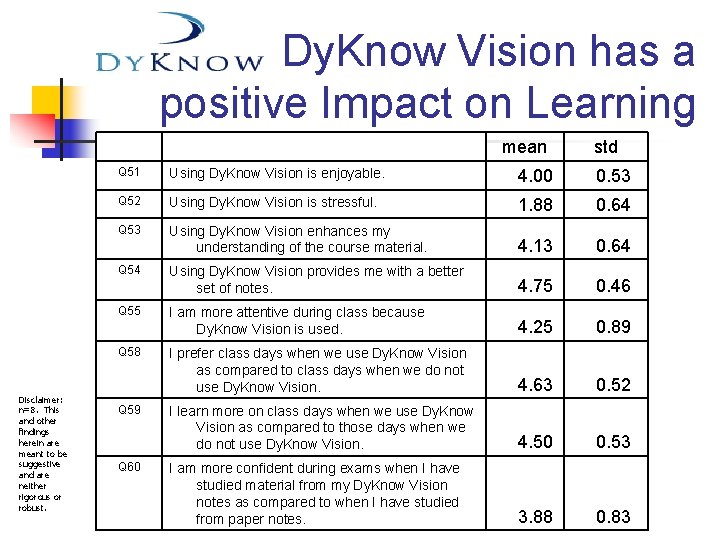
Dy. Know Vision has a positive Impact on Learning mean Disclaimer: n=8. This and other findings herein are meant to be suggestive and are neither rigorous or robust. std Q 51 Using Dy. Know Vision is enjoyable. 4. 00 0. 53 Q 52 Using Dy. Know Vision is stressful. 1. 88 0. 64 Q 53 Using Dy. Know Vision enhances my understanding of the course material. 4. 13 0. 64 Q 54 Using Dy. Know Vision provides me with a better set of notes. 4. 75 0. 46 Q 55 I am more attentive during class because Dy. Know Vision is used. 4. 25 0. 89 Q 58 I prefer class days when we use Dy. Know Vision as compared to class days when we do not use Dy. Know Vision. 4. 63 0. 52 I learn more on class days when we use Dy. Know Vision as compared to those days when we do not use Dy. Know Vision. 4. 50 0. 53 I am more confident during exams when I have studied material from my Dy. Know Vision notes as compared to when I have studied from paper notes. 3. 88 0. 83 Q 59 Q 60
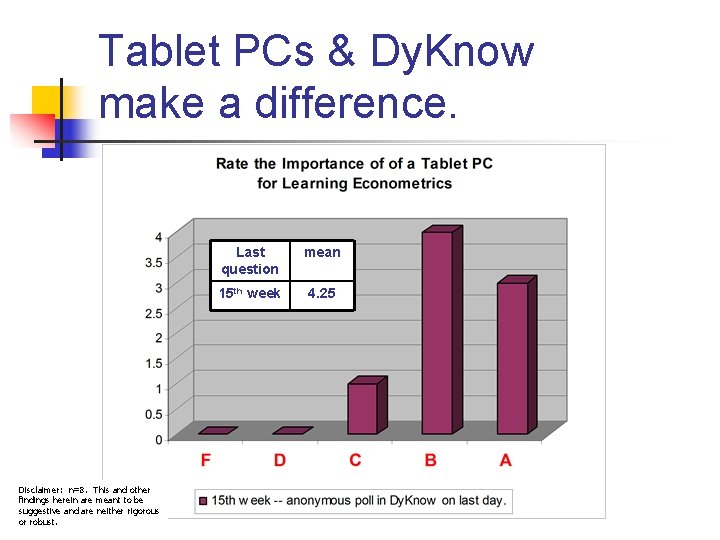
Tablet PCs & Dy. Know make a difference. Disclaimer: n=8. This and other findings herein are meant to be suggestive and are neither rigorous or robust. Last question mean 15 th week 4. 25
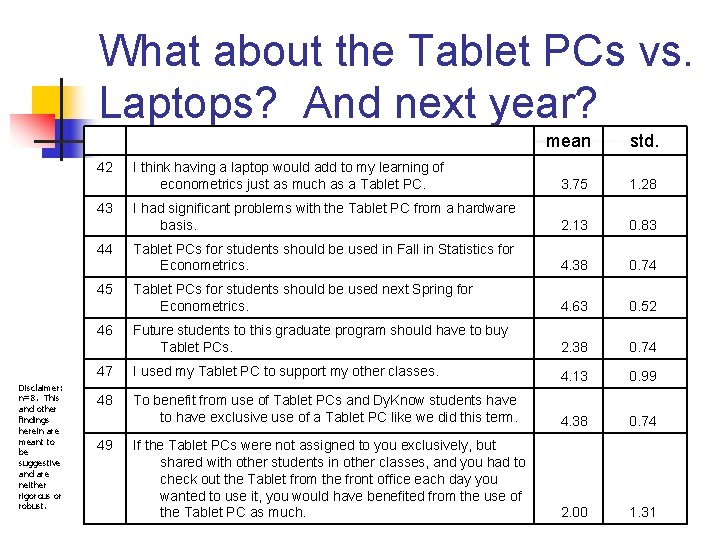
What about the Tablet PCs vs. Laptops? And next year? mean std. I think having a laptop would add to my learning of econometrics just as much as a Tablet PC. 3. 75 1. 28 I had significant problems with the Tablet PC from a hardware basis. 2. 13 0. 83 Tablet PCs for students should be used in Fall in Statistics for Econometrics. 4. 38 0. 74 Tablet PCs for students should be used next Spring for Econometrics. 4. 63 0. 52 Future students to this graduate program should have to buy Tablet PCs. 2. 38 0. 74 47 I used my Tablet PC to support my other classes. 4. 13 0. 99 48 To benefit from use of Tablet PCs and Dy. Know students have to have exclusive use of a Tablet PC like we did this term. 4. 38 0. 74 If the Tablet PCs were not assigned to you exclusively, but shared with other students in other classes, and you had to check out the Tablet from the front office each day you wanted to use it, you would have benefited from the use of the Tablet PC as much. 2. 00 1. 31 42 43 44 45 46 Disclaimer: n=8. This and other findings herein are meant to be suggestive and are neither rigorous or robust. 49
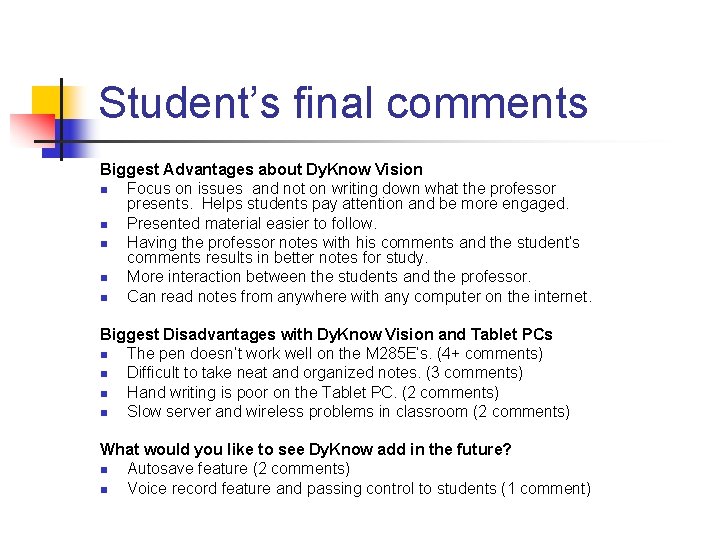
Student’s final comments Biggest Advantages about Dy. Know Vision n Focus on issues and not on writing down what the professor presents. Helps students pay attention and be more engaged. n Presented material easier to follow. n Having the professor notes with his comments and the student’s comments results in better notes for study. n More interaction between the students and the professor. n Can read notes from anywhere with any computer on the internet. Biggest Disadvantages with Dy. Know Vision and Tablet PCs n The pen doesn’t work well on the M 285 E’s. (4+ comments) n Difficult to take neat and organized notes. (3 comments) n Hand writing is poor on the Tablet PC. (2 comments) n Slow server and wireless problems in classroom (2 comments) What would you like to see Dy. Know add in the future? n Autosave feature (2 comments) n Voice record feature and passing control to students (1 comment)
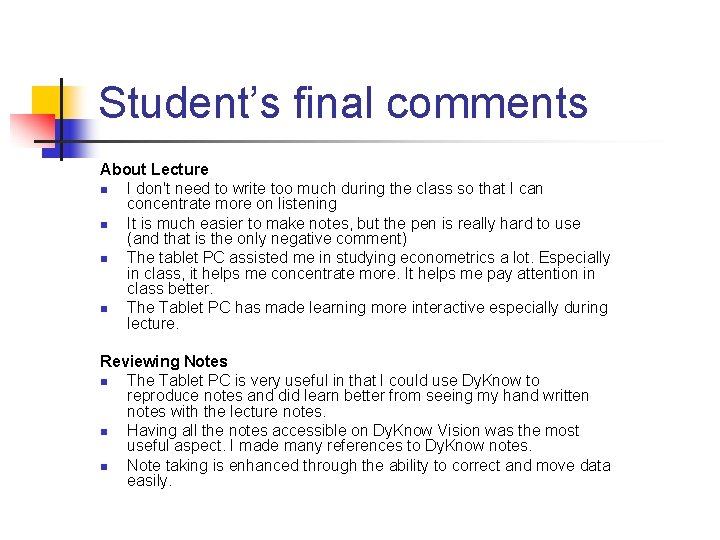
Student’s final comments About Lecture n I don't need to write too much during the class so that I can concentrate more on listening n It is much easier to make notes, but the pen is really hard to use (and that is the only negative comment) n The tablet PC assisted me in studying econometrics a lot. Especially in class, it helps me concentrate more. It helps me pay attention in class better. n The Tablet PC has made learning more interactive especially during lecture. Reviewing Notes n The Tablet PC is very useful in that I could use Dy. Know to reproduce notes and did learn better from seeing my hand written notes with the lecture notes. n Having all the notes accessible on Dy. Know Vision was the most useful aspect. I made many references to Dy. Know notes. n Note taking is enhanced through the ability to correct and move data easily.
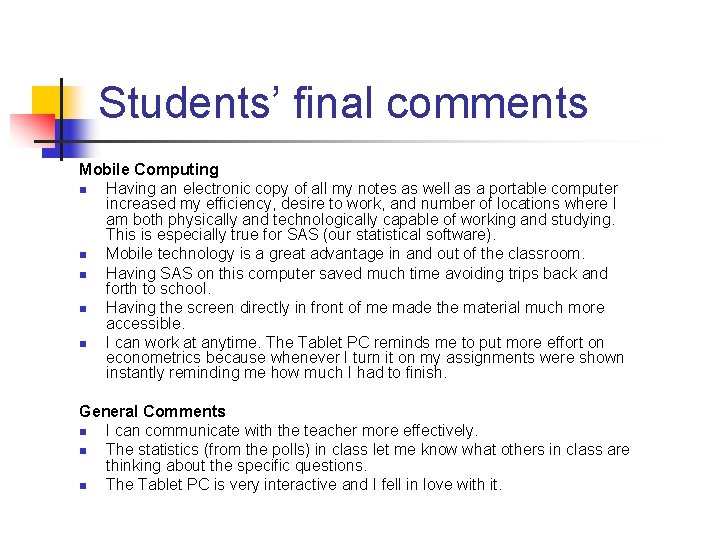
Students’ final comments Mobile Computing n Having an electronic copy of all my notes as well as a portable computer increased my efficiency, desire to work, and number of locations where I am both physically and technologically capable of working and studying. This is especially true for SAS (our statistical software). n Mobile technology is a great advantage in and out of the classroom. n Having SAS on this computer saved much time avoiding trips back and forth to school. n Having the screen directly in front of me made the material much more accessible. n I can work at anytime. The Tablet PC reminds me to put more effort on econometrics because whenever I turn it on my assignments were shown instantly reminding me how much I had to finish. General Comments n I can communicate with the teacher more effectively. n The statistics (from the polls) in class let me know what others in class are thinking about the specific questions. n The Tablet PC is very interactive and I fell in love with it.
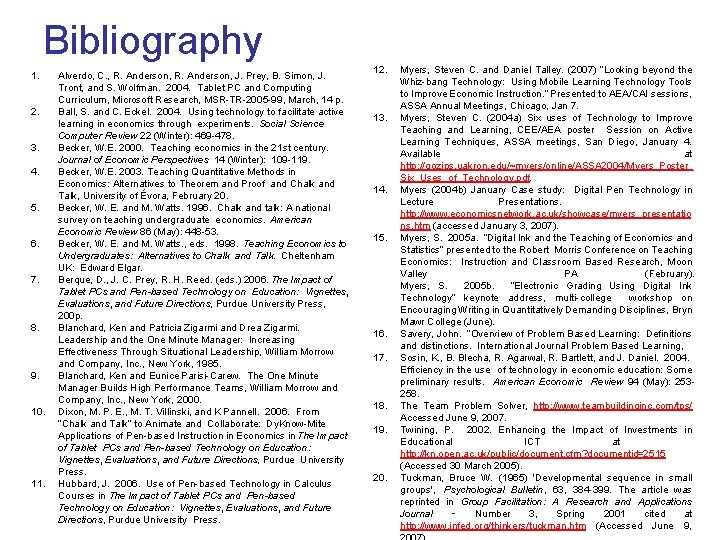
Bibliography 1. 2. 3. 4. 5. 6. 7. 8. 9. 10. 11. Alverdo, C. , R. Anderson, J. Prey, B. Simon, J. Tront, and S. Wolfman. 2004. Tablet PC and Computing Curriculum, Microsoft Research, MSR-TR-2005 -99, March, 14 p. Ball, S. and C. Eckel. 2004. Using technology to facilitate active learning in economics through experiments. Social Science Computer Review 22 (Winter): 469 -478. Becker, W. E. 2000. Teaching economics in the 21 st century. Journal of Economic Perspectives 14 (Winter): 109 -119. Becker, W. E. 2003. Teaching Quantitative Methods in Economics: Alternatives to Theorem and Proof and Chalk and Talk, University of Évora, February 20. Becker, W. E. and M. Watts. 1996. Chalk and talk: A national survey on teaching undergraduate economics. American Economic Review 86 (May): 448 -53. Becker, W. E. and M. Watts. , eds. 1998. Teaching Economics to Undergraduates: Alternatives to Chalk and Talk. Cheltenham UK: Edward Elgar. Berque, D. , J. C. Prey, R. H. Reed. (eds. ) 2006. The Impact of Tablet PCs and Pen-based Technology on Education: Vignettes, Evaluations, and Future Directions, Purdue University Press, 200 p. Blanchard, Ken and Patricia Zigarmi and Drea Zigarmi. Leadership and the One Minute Manager: Increasing Effectiveness Through Situational Leadership, William Morrow and Company, Inc. , New York, 1985. Blanchard, Ken and Eunice Parisi-Carew. The One Minute Manager Builds High Performance Teams, William Morrow and Company, Inc. , New York, 2000. Dixon, M. P. E. , M. T. Villinski, and K Pannell. 2006. From “Chalk and Talk” to Animate and Collaborate: Dy. Know-Mite Applications of Pen-based Instruction in Economics in The Impact of Tablet PCs and Pen-based Technology on Education: Vignettes, Evaluations, and Future Directions, Purdue University Press. Hubbard, J. 2006. Use of Pen-based Technology in Calculus Courses in The Impact of Tablet PCs and Pen-based Technology on Education: Vignettes, Evaluations, and Future Directions, Purdue University Press. 12. 13. 14. 15. 16. 17. 18. 19. 20. Myers, Steven C. and Daniel Talley. (2007) “Looking beyond the Whiz-bang Technology: Using Mobile Learning Technology Tools to Improve Economic Instruction. ” Presented to AEA/CAI sessions, ASSA Annual Meetings, Chicago, Jan 7. Myers, Steven C. (2004 a) Six uses of Technology to Improve Teaching and Learning, CEE/AEA poster Session on Active Learning Techniques, ASSA meetings, San Diego, January 4. Available at http: //gozips. uakron. edu/~myers/online/ASSA 2004/Myers_Poster_ Six_Uses_of_Technology. pdf. Myers (2004 b) January Case study: Digital Pen Technology in Lecture Presentations. http: //www. economicsnetwork. ac. uk/showcase/myers_presentatio ns. htm (accessed January 3, 2007). Myers, S. 2005 a. “Digital Ink and the Teaching of Economics and Statistics” presented to the Robert Morris Conference on Teaching Economics: Instruction and Classroom Based Research, Moon Valley PA (February). Myers, S. 2005 b. “Electronic Grading Using Digital Ink Technology” keynote address, multi-college workshop on Encouraging Writing in Quantitatively Demanding Disciplines, Bryn Mawr College (June). Savery, John. “Overview of Problem Based Learning: Definitions and distinctions. International Journal Problem Based Learning, Sosin, K. , B. Blecha, R. Agarwal, R. Bartlett, and J. Daniel. 2004. Efficiency in the use of technology in economic education: Some preliminary results. American Economic Review 94 (May): 253258. The Team Problem Solver, http: //www. teambuildinginc. com/tps/ Accessed June 9, 2007. Twining, P. 2002. Enhancing the Impact of Investments in Educational ICT at http: //kn. open. ac. uk/public/document. cfm? documentid=2515 (Accessed 30 March 2005). Tuckman, Bruce W. (1965) 'Developmental sequence in small groups', Psychological Bulletin, 63, 384 -399. The article was reprinted in Group Facilitation: A Research and Applications Journal ‑ Number 3, Spring 2001 cited at http: //www. infed. org/thinkers/tuckman. htm (Accessed June 9,
- Slides: 29