
Learning Dispositions and Modalities WHATS YOUR LEARNING STYLE
- Slides: 26
Learning Dispositions and Modalities WHAT’S YOUR LEARNING STYLE
Results The results give ideas for activities and materials that can make it easier for you to learn, do homework, study for tests, and find out what you love to do.
What are Dispositions basically determine the ways people work, communicate, and learn. The Learning Style Profile identifies five dispositions: Performing, Producing, Inventing, Relating/Inspiring, and Thinking/Creating. A person’s dispositions affects behavior as well as learning.
Primary and Secondary Dispositions Each of us has attributes from all five of the dispositions identified in the Profile; however, two, or sometime, three dispositions usually dominate. For the most part, primary and secondary dispositions keep their dominant positions over time. If the profile assessment was filled out according to your own “voice” and not based on what you thought the answers “should” be.
“When you learn how to learn in your preferred style – the way that best suits your brain – it’s like writing with your preferred hand. The result is much better, easier, and quicker. ” �Colin Rose
The Performing Disposition Topics Objective Best Learning/Working Situations Needs Acknowledgement For. . . Appropriate Rewards Contributions
Areas For Growth Keeping Schedules Planning Ahead Keeping Things in Order Reserving Time for Quiet Thought Problem Solving (It takes too long) Following Through on Commitments Do your recognize any of these items that should be listed on your “Plan Form. ”
Study/Homework Helps You will find activities that allow you to change things, compose, construct, design, formulate, generate, originate, pretend, reconstruct, reorganize, revise, suggest, and visualize to be to your liking. Take breaks every 15 – 20 minutes when doing paper-pencil activities Incorporate movement into study techniques whenever possible (bouncing a ball, shooting a basket while reciting facts for memorization) Hopping, jumping, skipping, running or dancing are also great.
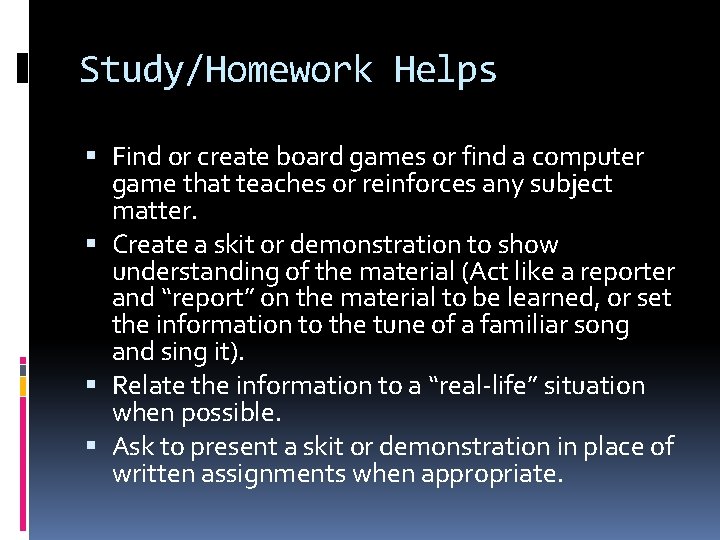
Study/Homework Helps Find or create board games or find a computer game that teaches or reinforces any subject matter. Create a skit or demonstration to show understanding of the material (Act like a reporter and “report” on the material to be learned, or set the information to the tune of a familiar song and sing it). Relate the information to a “real-life” situation when possible. Ask to present a skit or demonstration in place of written assignments when appropriate.
The Producing Disposition Topics Objective Best Learning/Working Situations Needs Acknowledgement For. . . Appropriate Rewards Contributions
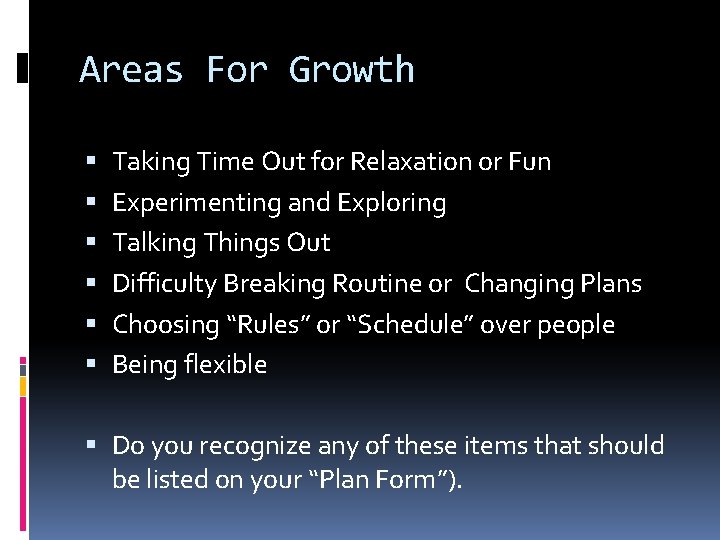
Areas For Growth Taking Time Out for Relaxation or Fun Experimenting and Exploring Talking Things Out Difficulty Breaking Routine or Changing Plans Choosing “Rules” or “Schedule” over people Being flexible Do you recognize any of these items that should be listed on your “Plan Form”).
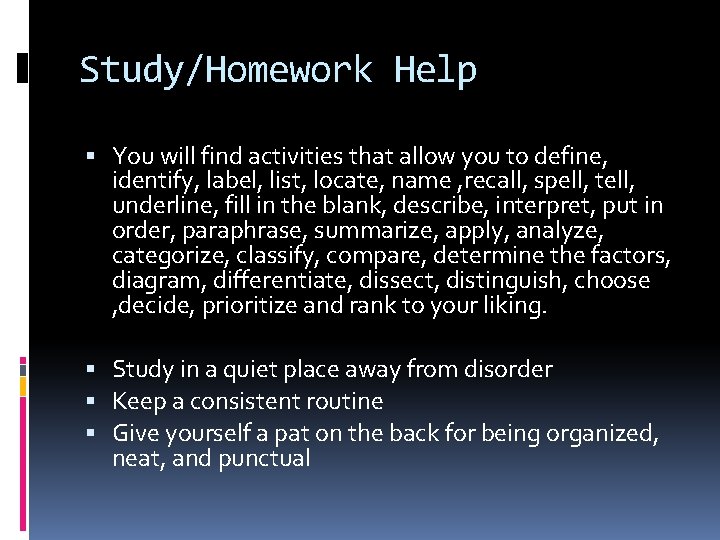
Study/Homework Help You will find activities that allow you to define, identify, label, list, locate, name , recall, spell, tell, underline, fill in the blank, describe, interpret, put in order, paraphrase, summarize, apply, analyze, categorize, classify, compare, determine the factors, diagram, differentiate, dissect, distinguish, choose , decide, prioritize and rank to your liking. Study in a quiet place away from disorder Keep a consistent routine Give yourself a pat on the back for being organized, neat, and punctual
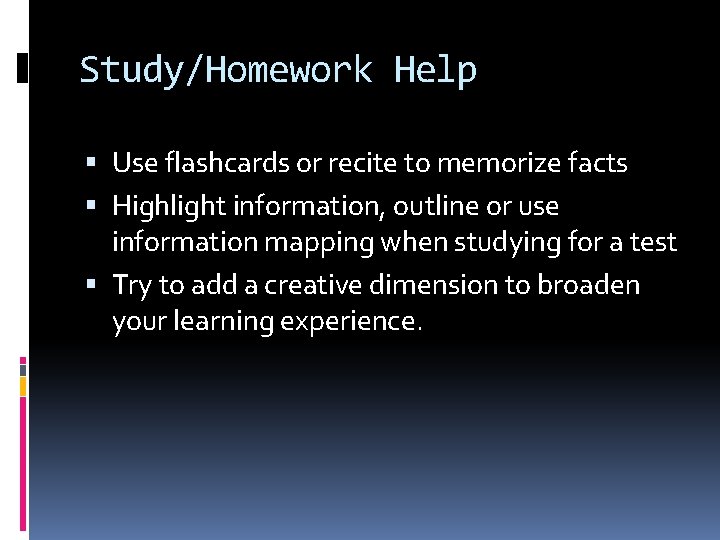
Study/Homework Help Use flashcards or recite to memorize facts Highlight information, outline or use information mapping when studying for a test Try to add a creative dimension to broaden your learning experience.
The Inventing Disposition Topics Objective Best Learning/Working Situations Needs Acknowledgement For. . . Appropriate Rewards Contributions
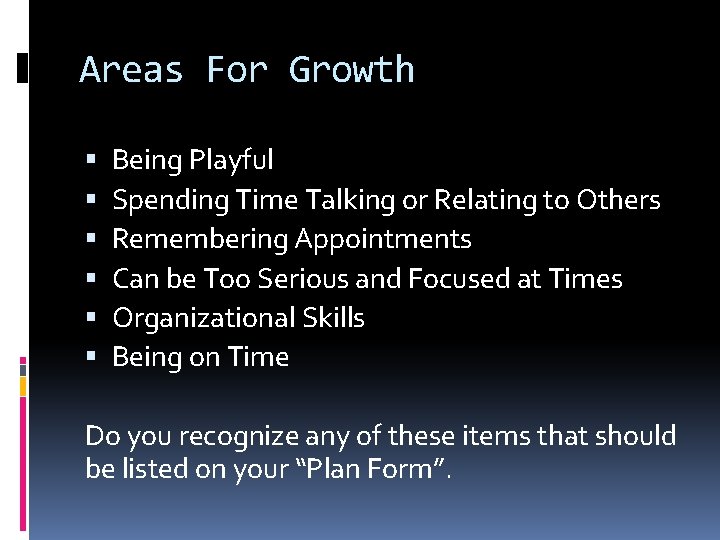
Areas For Growth Being Playful Spending Time Talking or Relating to Others Remembering Appointments Can be Too Serious and Focused at Times Organizational Skills Being on Time Do you recognize any of these items that should be listed on your “Plan Form”.
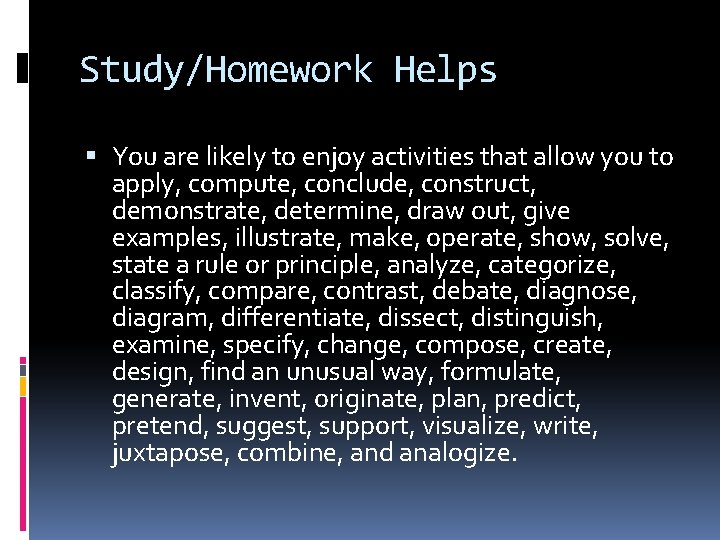
Study/Homework Helps You are likely to enjoy activities that allow you to apply, compute, conclude, construct, demonstrate, determine, draw out, give examples, illustrate, make, operate, show, solve, state a rule or principle, analyze, categorize, classify, compare, contrast, debate, diagnose, diagram, differentiate, dissect, distinguish, examine, specify, change, compose, create, design, find an unusual way, formulate, generate, invent, originate, plan, predict, pretend, suggest, support, visualize, write, juxtapose, combine, and analogize.
Study/Homework Helps Debate on the subject being taught Techniques that involve drawing or constructing a model (Could be as simple as information mapping) Find computer programs that teach or reinforce a subject Brainstorming sessions that result in “collecting” or “classifying” the information Make hands-on models or visual representations whenever possible Ask to be allowed to present a project in place of written reports when appropriate.
The Relating/Inspiring Disposition Topics Objective Best Learning/Working Situations Needs Acknowledgement For. . . Appropriate Rewards Contributions
Areas For Growth Working Independently Relaxing Quietly Finding Relevance in Subjects with no “Human” Connection Getting Sidetracked by People Who Need Their Help and Disappointing Those Who Are Counting On Them Being Late For Appointment Do you recognize any of these items that should be listed on your “Plan Form”.
Study/Homework Helps You will enjoy many kinds of activities that can be done with others. In addition activities that give examples, compare, debate, diagnose, differentiate, distinguish, suggest, support, defend, justify, select, give opinions, reorganize, or visualize will likely be enjoyable. Discussing and talking through a lesson can be helpful
Study/Homework Helps Study with a partner Pretend you are involved with the subject being studied when applicable Give oral presentations to an imaginary audience Relate lessons to social events
The Thinking/Creating Disposition Topics Objective Best Learning/Working Situations Needs Acknowledgement For. . . Appropriate Rewards Contributions
Areas For Growth Keeping Schedules Interacting in Groups Completing Projects Keeping Appointments Daydreaming Moody or Inconsiderate of Others’ Plans and Feelings
Study/Homework Helps You are likely to enjoy activities that require you to compose, construct, design, find and unusual way, formulate, generate, invent, originate, visualize, write creatively, imagine, juxtapose, combine, analogize, diverge, create Draw and doodle during study times Experiment with different types of background music when studying – Baroque is especially good for helping some students focus
Study/Homework Helps Schedule time and space for quiet, alone time Draw pictures or write a poem to help understand a concept or summarize a lesson Write a song or set the information to a familiar melody Use Information Mapping with pictures when studying Ask to present posters, collages, poems, or other artistic presentations in place of written reports when applicable.
Important To Remember Knowing your Learning Disposition can be empowering when making the best decisions for your learning and when asking for help/accommodations It’s important to remember we live and learn with people who have needs just like we do, and there needs are equally important. We should do our best to respect others needs and do our best to accommodate them too. Finally, not all situations will lend themselves to our particular disposition, and it is our responsibility to independently do our best to either make modifications or to commit to trying to learn in spite of temporatily being out of our comfort zone.