
Learning Disability Awareness in Acute Hospital Care By
Learning Disability Awareness in Acute Hospital Care By Nathan Samuels Learning Disability & Mental Health Lead Nurse
What is a learning disability? • Definition: Valuing People: a new strategy for learning disability for the 21 st century, the government White Paper for England about health and social care support for people with a learning disability (2001). It explains that a learning disability includes the presence of: • a significantly reduced ability to understand new or complex information or to learn new skills (impaired intelligence) • a reduced ability to cope independently (impaired social functioning) • an impairment that started before adulthood, with a lasting effect on development
In their own words… • https: //youtu. be/tfk. VA 2 BKIy. Y
Why is this relevant to ROH? • Specialising in Orthopaedic Surgery, ROH has a very high turn over of patients who have a range of • Learning Disabilities • Physical Disabilities • Profound and Multiple Learning Disabilities • In addition to this, as of February 2020 21% of the ROH workforce are registered as having a Learning Disability or Unspecified Learning Disability (including bank staff)
Why is this relevant to ROH? • According to the most recent Birmingham City Council Census in 2011, Birmingham has a population of over 1. 1 million people • Of those, 2. 3 percent (23, 800) are registered as having a learning disability • Approximately 1. 5 million people in the UK have a learning disability. This includes 905, 000 adults aged 18+ • (Source: People with Learning Disabilities in England 2011)
Why is this relevant to ROH continued? • This figure is set to increase, largely due to better neonatal care for premature babies, and current trends which have seen maternal age rise, giving an increase in the incidence of maternal age related chromosomal disorders. • People with learning disabilities are living longer than they used to.
Why is this relevant to ROH continued? • There has been a great deal of evidence to support the fact that people who have a learning disability do not receive equal healthcare treatment or a good service. • There are significant unmet health needs which often go unrecognised, and this has an impact upon the quality of life and the life expectancy of people with a learning disability. • It is still estimated that they are likely to die 20 years before the general population, and they are 58 times more likely to die before the age of 50 in comparison to the general population (Confidential enquiry into the premature deaths of people with a learning disability 2013).
Health Facts in Learning Disabilities • This is partly due to conditions associated with Learning Disability which raise the risk of premature death. • Almost half of all people with Down’s syndrome have congenital heart problems, a much higher rate than the general population • Research also indicates people with Learning Disabilities have a higher risk of developing Alzheimer’s disease, gastro intestinal disorders and cancer.
Health Facts in Learning Disabilities continued… • Approximately a third of all people with a learning disability have epilepsy (at least 20 times higher than the general population). • People with LD are more likely to have epilepsy that is difficult to control. • The risks of sudden unexpected death in epilepsy (SUDEP) are highest in children with a learning disability (Source: Healthcare for All 2008)
Key Reports • A range of findings from various enquires and reports have all identified significant failings by NHS and Social Care agencies in meeting the health needs of people with learning disabilities • A consistent theme amongst these reports are premature deaths and deaths which are somewhat avoidable.
Key Reports continued… • • • Death by Indifference report (Mencap, 2007) updated 2012 Joint Ombudsman report (Six Lives, 2009) updated 2013 Winterbourne View Review Concordat (2012) Confidential Inquiry into the premature deaths of people with a learning disability (CIPOLD) (Norah Fry Research Centre, 2013) Learning Disability Mortality Review Programme (Le. De. R) 2015 STOMP – Stopping over medication of people with a Learning Disability, Autism or both (NHS England, 2016) Oliver Mc. Gowan Review (NHS England, 2019) The NHS Long Term Plan 2019 Learning Disability Improvement Standards Review (NHSE, NHSi & NHS Benchmarking Network 2019)
Communication • Working with someone with a learning disability may challenge your idea of what communication is, and how you make yourself understood.
Imagine not being able to read this, nor tell anyone about it not being able to find the words you wanted to say opening your mouth and no sound coming out words coming out jumbled up not getting the sounds right words getting stuck, someone jumping in, saying words for you • people assuming what you want, without checking with you • not hearing the questions being asked of you • • •
Imaging not being able to… • not being able to see, or not being able to understand, the signs and symbols around you • not understanding the words, phrases or expressions • not being able to write down your ideas • being unable to join a conversation which is about you • People ignoring what you are trying to say, feeling embarrassed and moving away from you • People not waiting long enough for you to respond in some way, assuming you have nothing to say and moving away
Communication continued… • To be a successful communicator with people with a learning disability you need to be prepared to • - use all your communication tools • - follow the lead of the person you’re communicating with • - Go at that particular patient’s own pace
Communication continued… • Communication – Always ensure you individually tailor communication to the needs of the patient you are working with. • Speak clearly and concisely and only use short sentences. • Support the patient to express their wants, needs, concerns, pain or discomfort • Use communication aids or visual supports when necessary
Challenging Behaviour • Some people with Learning Disabilities and Autism can display challenging behaviour. It includes what would normally be considered physically aggressive behaviour, but can also include other behaviours that are having a negative impact on the person or their family.
Challenging Behaviour continued… • Examples of challenging behaviours can include: • - Self Injuring Behaviour • - Physically aggressive behaviour, including biting, spitting, hitting out, hair pulling, scratching • - PICA (eating or mouthing non-edible items) • - Smearing • - Screaming • - Verbal Aggression
Challenging Behaviour continued… • Challenging Behaviour has a function, and there could be a number of reasons for it. These may include: • - feeling unwell, tired or hungry • - difficulty in processing information • - unstructured time • - over-sensitivity or under-sensitivity to sensory stimuli • - a change in routine • - transition between activities • Not being able to communicate these difficulties can lead to anxiety, anger and frustration, and then ultimately to an outburst of challenging behaviour.
Managing Challenging Behaviours • Support – Re-assure the patient and seek to support them through their distress as opposed to punishing them for the behaviour • Consistency – Always remain consistent in your approach, and ask others around you also working with the patient to apply the same approach
Managing Challenging Behaviours continued… • Rewards – Always offer praise following a positive behaviour to help re-enforce to the patient that their behaviour is acceptable • Re-direct challenging behaviours – Challenging Behaviour can often be diffused by an activity that enables the patient to release any built anger or excessive energy. • And remember, Always try to find out why!!!
Reasonable Adjustments • Under the Equality Act 2010 and Accessible Information Specification (2016), all healthcare providers and organisations are required by law to make adaptations to their approaches and provision to demonstrate that the services they provide are as accessible to those with learning disabilities and additional communication needs as they are for the rest of the general population. • People with Learning Disabilities can sometimes need particular adjustments or more personally tailored support to help make health care services easier for them to access and more of a positive experience when they do. • The above documents place a legal duty on all service providers to take steps to make “reasonable adjustments” in order to avoid putting a disabled person at a substantial disadvantage when compared to a person who is not disabled.
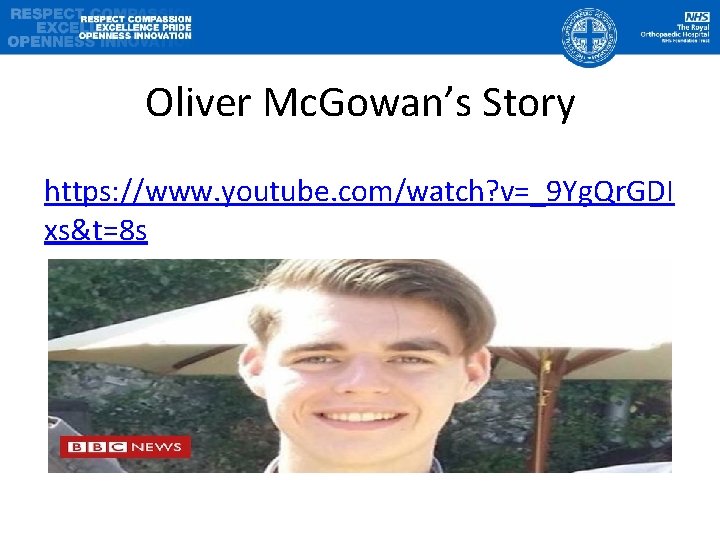
Oliver Mc. Gowan’s Story https: //www. youtube. com/watch? v=_9 Yg. Qr. GDI xs&t=8 s
Reasonable Adjustments at ROH • If the patient is coming for a planned stay, would they benefit from? ? ? • - Being first on theatre list • - One/ a series of visits to hospital/ ward prior to admission • - To be admitted night before procedure to relieve anxiety • - A side room or cubical
• • Reasonable Adjustments at ROH continued… - a corner bed within a bay - hoist - help with washing & personal care - help eating and drinking - support for carer - communication aids/ visual support - hospital passport
Reasonable adjustments at ROH continued… Outpatient considerations - First or last appointments - Would a volunteer be helpful? - A quiet space before/ after appointments - Support during appointment with Clinician - Will they require hoist/ bed or any personal care • - How is the patient getting to/ from the hospital? • • •
Our Learning Disability Strategy • Patients with learning disabilities are entitled to receive the same high standards of care the general population would expect to receive when accessing services at ROH. • All care given should be flexible and tailored to the specific needs of the patient with a learning disability (Michael, 2008).
Our strategy continued… • The Trust has adopted the 4 key principles of the key government Learning Disability white paper Valuing People: a new strategy for learning disability for the 21 st century, (Department of Health, 2001).
Our Strategy • Choice • All patients can expect communication in a way which meets their own individual communication needs • All staff will communicate in a way which enables them to make informed choices about their care and treatment • Independence • All patients can expect accessible information regarding all aspects of their care • All staff will promote patient independence in all aspects of decision making
Our strategy • Rights • All patients can expect the right to have their wishes respected in relation to their care • All staff will work to uphold the key principles of the mental capacity act and ensure equal treatment for patients with a learning disability • Inclusion • Patients with a learning disability can expect accessible information across all wards and departments • Staff will ensure all patients, their relatives and carers views are included in decision making process
Moving forwards… • • • ROH Learning Disability Strategy officially launched in March 2018 Trust has invested in full time Learning Disability Practitioner Mandatory Learning Disability awareness training for all ROH staff Pre-admission support now available for people with LD LD patient notification system now live for all wards and departments to complete on first contact with patient with LD (available via Learning Disability page on Intranet). Reasonable adjustments offered to people with LD and more complex needs and additional support during stay where required Hospital Passports – including individualised care plan to be offered by ROH staff at every initial contact (available via Learning Disability page on Intranet) Communication Toolkits for people with LD available on all inpatient wards and Outpatient department ROH website has new stand alone Learning Disability Internet site for patients with a range of user friendly information and resources
Contact • Trust Learning Disability & Mental Health Liaison Lead • ext 55822 • bleep 2688 • mobile: 07970 339 544 Or alternatively, contact the Trust Safeguarding team
This is a Reasonable Adjustment • https: //www. youtube. com/watch? v=DMV 06 K 1 oan. A&t=22 s
- Slides: 33