
Learning Disabilities By Nicole Day What is a
Learning Disabilities By: Nicole Day
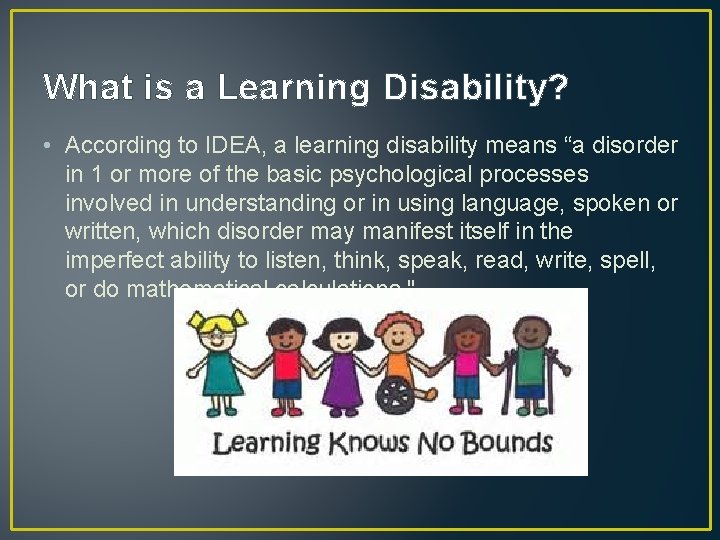
What is a Learning Disability? • According to IDEA, a learning disability means “a disorder in 1 or more of the basic psychological processes involved in understanding or in using language, spoken or written, which disorder may manifest itself in the imperfect ability to listen, think, speak, read, write, spell, or do mathematical calculations. "
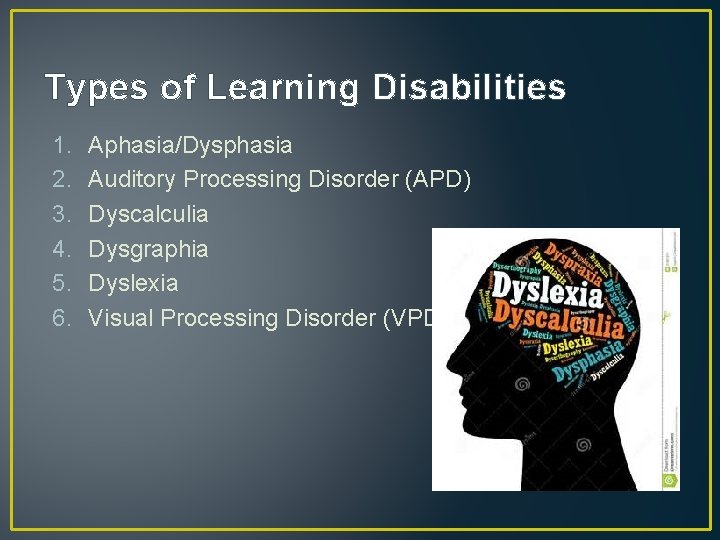
Types of Learning Disabilities 1. 2. 3. 4. 5. 6. Aphasia/Dysphasia Auditory Processing Disorder (APD) Dyscalculia Dysgraphia Dyslexia Visual Processing Disorder (VPD)
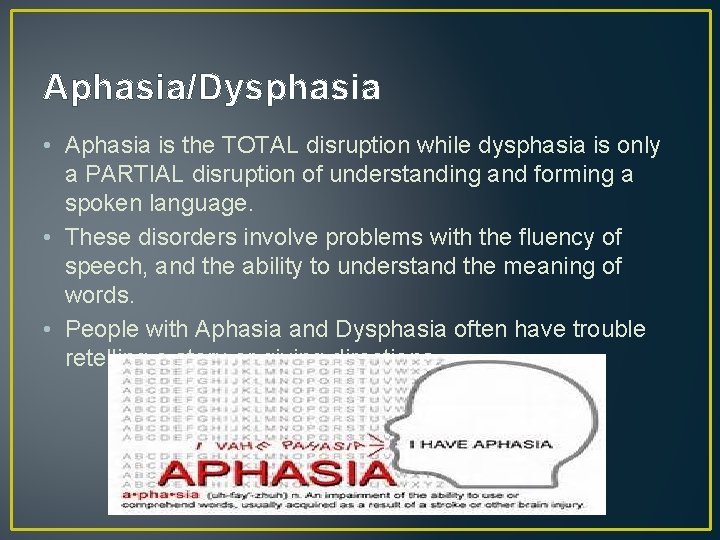
Aphasia/Dysphasia • Aphasia is the TOTAL disruption while dysphasia is only a PARTIAL disruption of understanding and forming a spoken language. • These disorders involve problems with the fluency of speech, and the ability to understand the meaning of words. • People with Aphasia and Dysphasia often have trouble retelling a story or giving directions.
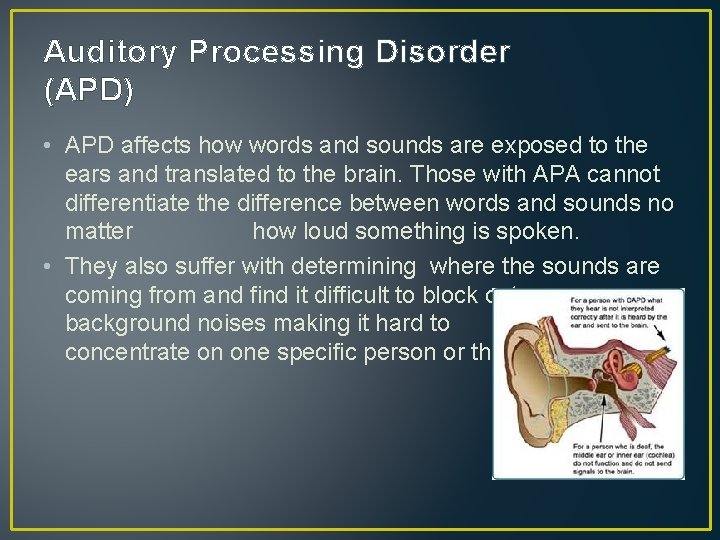
Auditory Processing Disorder (APD) • APD affects how words and sounds are exposed to the ears and translated to the brain. Those with APA cannot differentiate the difference between words and sounds no matter how loud something is spoken. • They also suffer with determining where the sounds are coming from and find it difficult to block out background noises making it hard to concentrate on one specific person or thing.
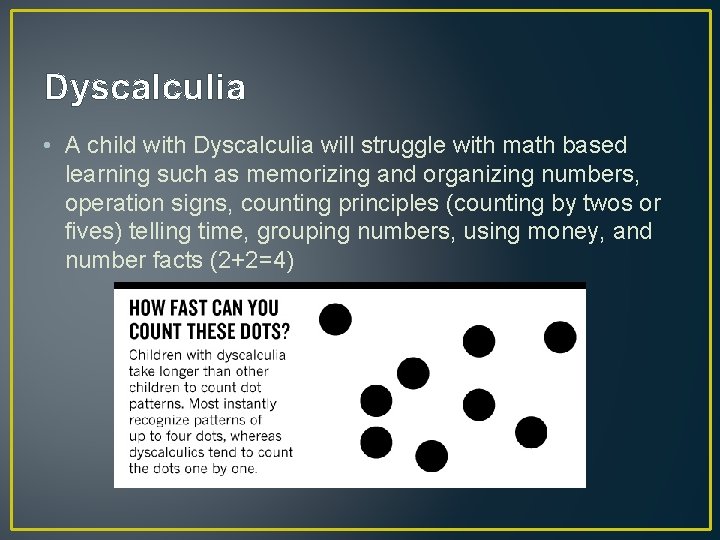
Dyscalculia • A child with Dyscalculia will struggle with math based learning such as memorizing and organizing numbers, operation signs, counting principles (counting by twos or fives) telling time, grouping numbers, using money, and number facts (2+2=4)
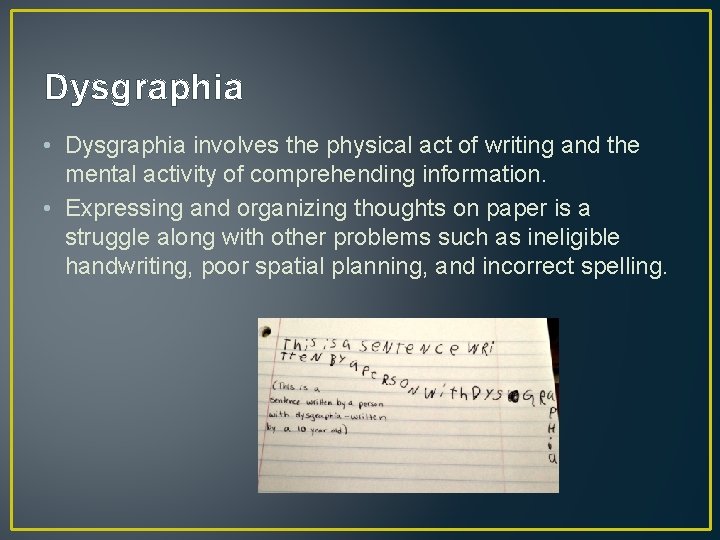
Dysgraphia • Dysgraphia involves the physical act of writing and the mental activity of comprehending information. • Expressing and organizing thoughts on paper is a struggle along with other problems such as ineligible handwriting, poor spatial planning, and incorrect spelling.
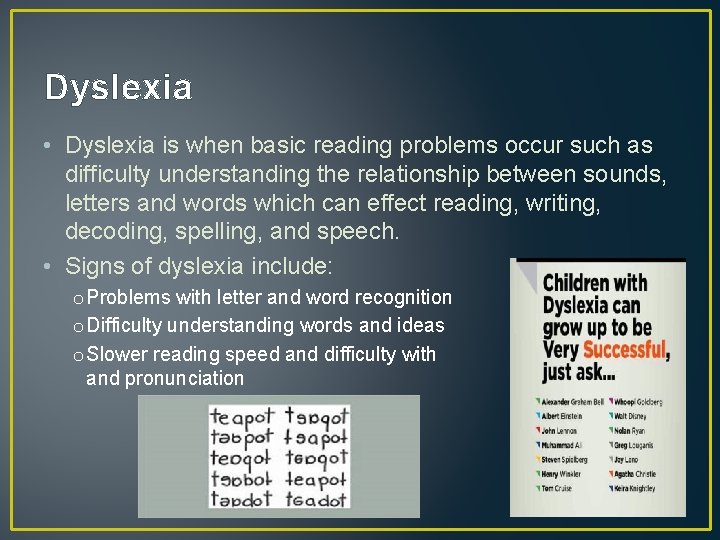
Dyslexia • Dyslexia is when basic reading problems occur such as difficulty understanding the relationship between sounds, letters and words which can effect reading, writing, decoding, spelling, and speech. • Signs of dyslexia include: o Problems with letter and word recognition o Difficulty understanding words and ideas o Slower reading speed and difficulty with and pronunciation fluency

Visual Processing Disorder (VPD) • VPD affects the way a person understands and interprets the information he or she is seeing. • People with VPD often struggle with drawing or copying something, hand-eye coordination, confusing shapes and letters, and frequently losing place while reading.
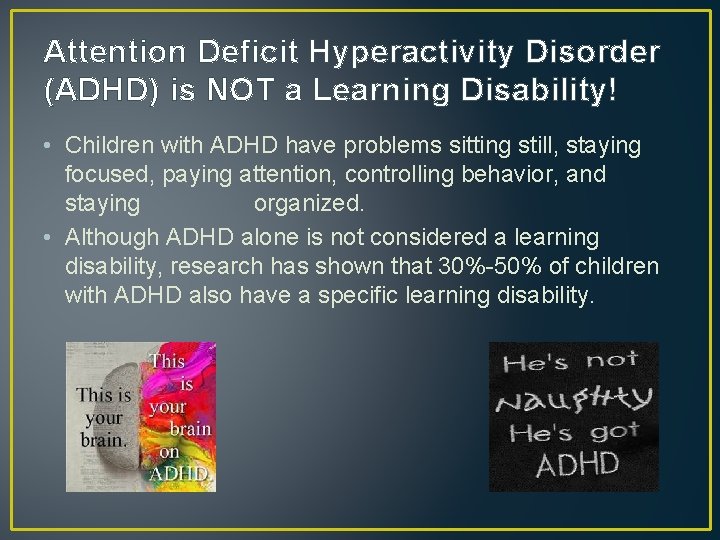
Attention Deficit Hyperactivity Disorder (ADHD) is NOT a Learning Disability! • Children with ADHD have problems sitting still, staying focused, paying attention, controlling behavior, and staying organized. • Although ADHD alone is not considered a learning disability, research has shown that 30%-50% of children with ADHD also have a specific learning disability.
Be Prepared • 91% of people are aware of what dyslexia is, however, 2/3 of people do not know what dysgraphia, dyscalculia, and dyspraxia are…know what to look for in your classroom! • Nearly a quarter of children are diagnosed in kindergarten and over a half are diagnosed in grades first-fourth. • 5% of our nation’s students have a learning disability. • There are 2. 4 million students in American public schools with a learning disability. • You WILL have a student with a learning disability at some point
How do I know if my Student has a Learning Disability? • Preschool: 1. Problem pronouncing words 2. Problem finding the right words 3. Difficulty rhyming 4. Trouble learning the alphabet, numbers, colors, shapes, and days of the week 5. Difficulty following directions or learning routines 6. Difficulty controlling colors and scissors or coloring within the lines 7. Troubles with buttons, zippers, or learning to tie shoes
How do I know if my Student has a Learning Disability? • Ages 5 -9 1. Trouble learning the connection between letters and sounds 2. Unable to blend sounds to make words 3. Confuses basic words when reading 4. Consistently misspells words and makes frequent reading errors 5. Trouble learning basic math concepts 6. Slow to learn new skills
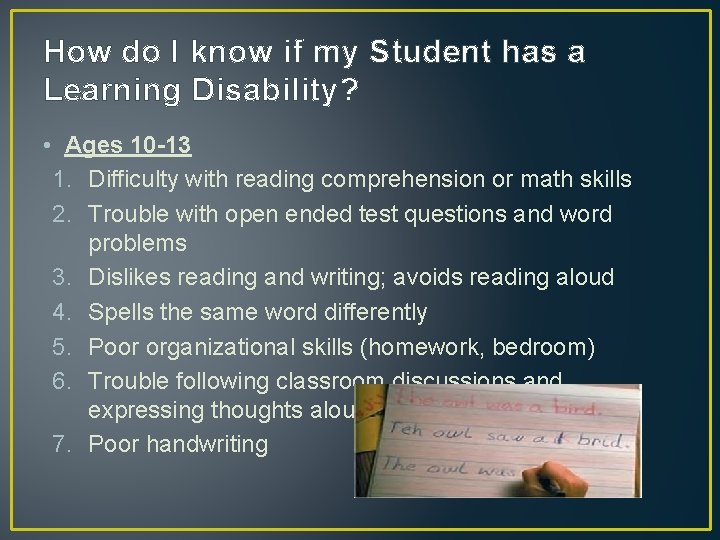
How do I know if my Student has a Learning Disability? • Ages 10 -13 1. Difficulty with reading comprehension or math skills 2. Trouble with open ended test questions and word problems 3. Dislikes reading and writing; avoids reading aloud 4. Spells the same word differently 5. Poor organizational skills (homework, bedroom) 6. Trouble following classroom discussions and expressing thoughts aloud 7. Poor handwriting
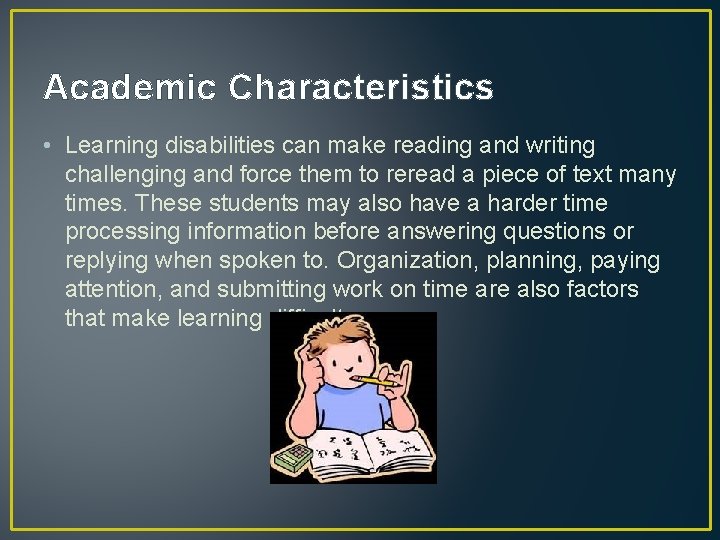
Academic Characteristics • Learning disabilities can make reading and writing challenging and force them to reread a piece of text many times. These students may also have a harder time processing information before answering questions or replying when spoken to. Organization, planning, paying attention, and submitting work on time are also factors that make learning difficult.
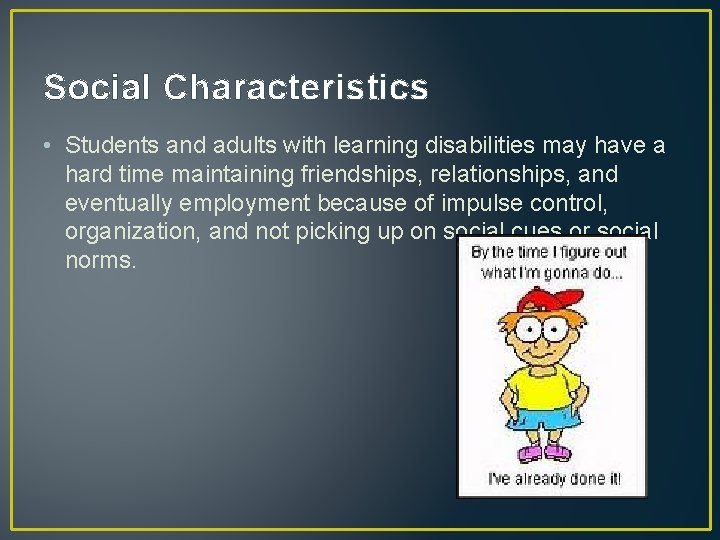
Social Characteristics • Students and adults with learning disabilities may have a hard time maintaining friendships, relationships, and eventually employment because of impulse control, organization, and not picking up on social cues or social norms.

Behavioral Characteristics • Depending on the child’s learning disability, emotional instability may affect their everyday interactions with other students, teachers, and parents. Not wanting to go to school, avoiding doing homework, avoiding communication, saying the work is too difficult, and making comments such as “I’m stupid, I give up” are all behavioral characteristics of someone with a learning disability.
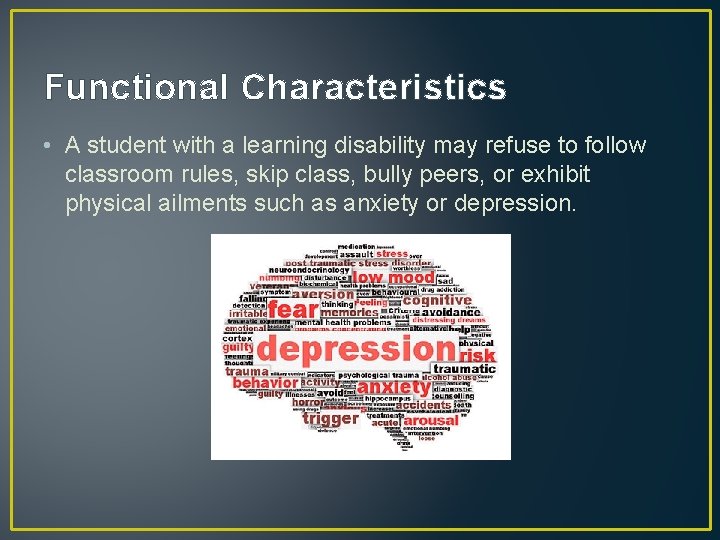
Functional Characteristics • A student with a learning disability may refuse to follow classroom rules, skip class, bully peers, or exhibit physical ailments such as anxiety or depression.
Finding “Ability” in “Disability” • The ability to solve problems with navigation or visualizing spaces and objects. This can be useful to engineers and filmmakers • Ability to connect seemingly-disconnected ideas. Paul Orfalea said that his “learning style helped him see the big picture and not worry about tiny details. ” • Contain a great memory for personal experiences. This can be helpful for writers. • Ability to reason in novel situations. Albert Einstein demonstrates this through the scientific field.
“If I don’t learn the way you teach, then teach the way I learn!” • Give direct instructions using a multi-sensory approach by using diagrams, charts, pictures, music, hands-on experiments, etc. • Engage the student in open-ended questions such as “How are you doing? What can we do to improve? ” • Break the learning down into smaller steps • Give lots of feedback and many opportunities for the student to practice what they are learning
Classroom Strategies for Success • Common Accommodations: o Read aloud what you have written on the board and use more than one way to demonstrate what you are teaching o Announce upcoming tests and homework dates early so the students have enough time to prepare o Suggest campus resources such as computer labs, tutoring, library resources, counselors, etc. o When showing videos, ensure that the captions are on o Provide study guides and/or review sheets o Provide printed material or electronic files early to give the students time to read it, and avoid last minute readings
Continued Strategies for Success • Classroom and assignments: o Help the student with taking notes or find a peer note-taker o Allow the student to record lectures o Allow the student additional time to complete in-class assignments o Provide assistance with anything they may need help on, especially proof-reading written assignments • Tests: o Extended test time- one half to double the time o Provide assistance of a reader or word processor o Provide the option of an oral exam o Allow the use of scratch paper o Take the test in a separate room free of distractions
Communication with the Parents • Initiation • Weekly or monthly folders of student’s work sent home for parent review, comments, and concerns • Parent conferences • Consistency and frequency • Follow up’s • Clarity and usefulness
You are not alone • Internet Resources: o The Learning Disabilities Association of America website contains useful information for parents and professionals http: //www. ldanatl. org o The website for the National center for Learning Disabilities contains useful resources http: //www. ncld. org o The Division for Learning Disabilities of the Council for Exceptional Children website contains research based teaching methods practices www. Teaching. LD. org
You are not alone • Books: o Strategy Instruction for Students with Learning Disabilities by Robert Reid o The Complete Learning Disabilities Handbook: Ready to use Strategies and Activities for Teachers with Students Learning Disabilities by Joan M. Harwell o Teaching Mathematics to Students with Learning Disabilities by Nancy S. Bley o Differentiating Instruction for Students with Learning Disabilities by William N. Bender

A Student’s View • https: //www. youtube. com/watch? v=3 e. Jw. U 7 Gpq. Xs

Work Cited • Academic Accommodations for Students with Learning Disabilities. (n. d). Retrieved January 26, 2016, from http: //www. washington. edu/doit/academicaccommodations-students-learning-disabilities • Cortiella, C. , & Horowitz, S. (2014). The State of Learning Disabilities. National Center for Learning Disabilities, (3), 3 -12. Retrieved from http: //www. ncld. org/wpcontent/uploads/2014/11/2014 -State-of-LD. pdf • Csillag, J. (December 19, 2014). Strengths of People with Learning Disabilities. N/A, 1 -4. Retrieved from https: //www. noodle. com/articles/strengths-of-peoplewith-learning-disabilities • Successful Strategies for Teaching Students with Learning Disabilities. (n. d. ). Retrieved January 26, 2016, from http: //ldaamerica. org/successful-strategies-forteaching-students-with-learning-disabilities/ • Support and Resources for Educators. (n. d. ). Retrieved January 26, 2016, from http: //ldaamerica. org/educators/
- Slides: 27