
Learning Difficulties in School Children Orientation Session for
- Slides: 40
Learning Difficulties in School Children Orientation Session for Teachers November 2015 Dr. Shekhar Seshadri Dept. of Child & Adolescent Psychiatry NIMHANS, Bangalore
Our Framework for Understanding Learning Difficulties in School Children • Understanding Child Development • Developmental Disabilities – Introduction to Disability – Assessing children for developmental delays and disabilities • Specific Learning Disabilities – Introduction to Specific Learning Disabilities – Assessing children with Specific Learning Disabilities • Understanding Attention Deficit Hyperactivity Disorder (ADHD) and its Impact on Learning • Let’s Practice…Case Study & Discussion
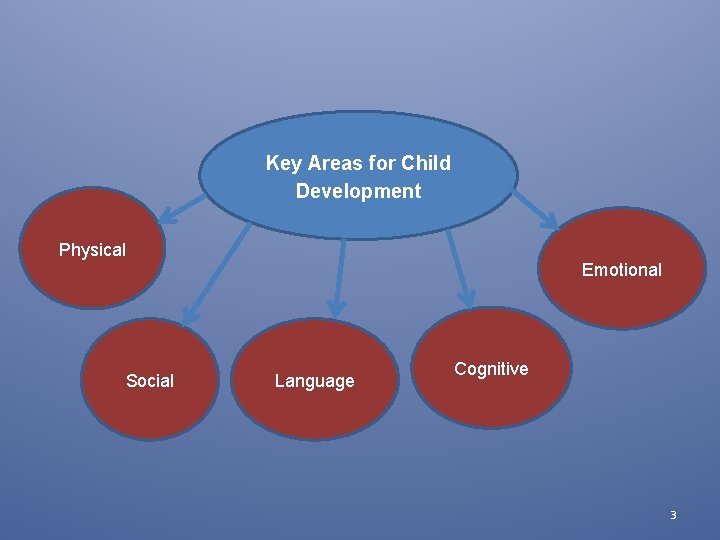
Key Areas for Child Development Physical Emotional Social Language Cognitive 3
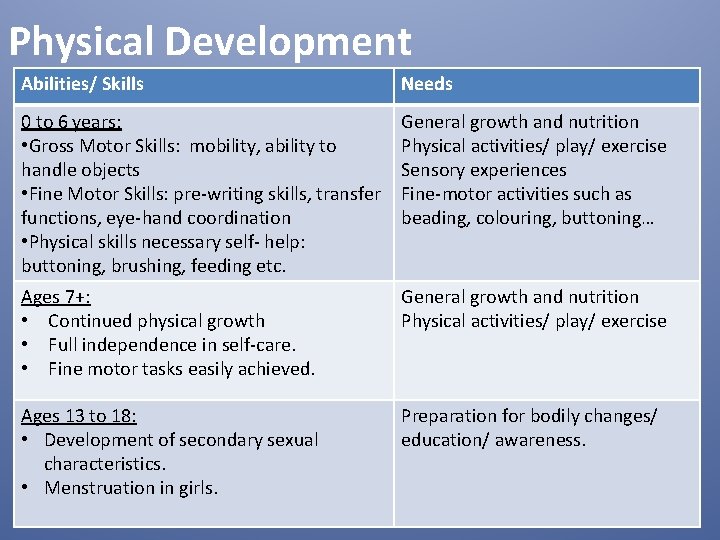
Physical Development Abilities/ Skills Needs 0 to 6 years: • Gross Motor Skills: mobility, ability to handle objects • Fine Motor Skills: pre-writing skills, transfer functions, eye-hand coordination • Physical skills necessary self- help: buttoning, brushing, feeding etc. General growth and nutrition Physical activities/ play/ exercise Sensory experiences Fine-motor activities such as beading, colouring, buttoning… Ages 7+: • Continued physical growth • Full independence in self-care. • Fine motor tasks easily achieved. General growth and nutrition Physical activities/ play/ exercise Ages 13 to 18: • Development of secondary sexual characteristics. • Menstruation in girls. Preparation for bodily changes/ education/ awareness.
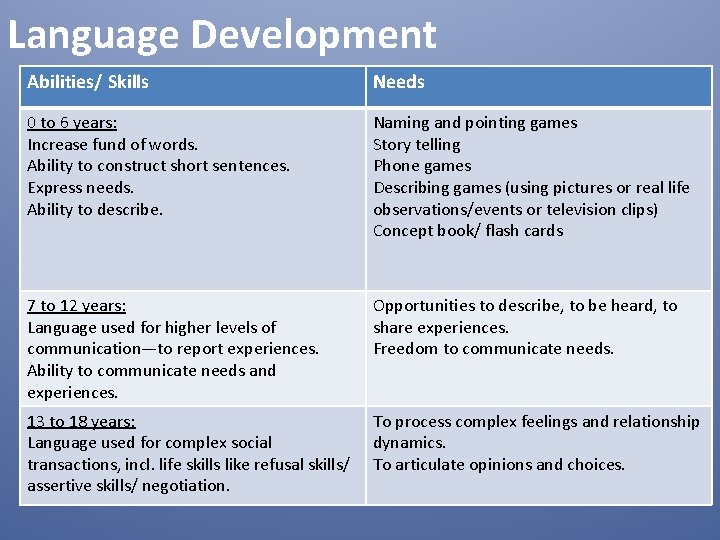
Language Development Abilities/ Skills Needs 0 to 6 years: Increase fund of words. Ability to construct short sentences. Express needs. Ability to describe. Naming and pointing games Story telling Phone games Describing games (using pictures or real life observations/events or television clips) Concept book/ flash cards 7 to 12 years: Language used for higher levels of communication—to report experiences. Ability to communicate needs and experiences. Opportunities to describe, to be heard, to share experiences. Freedom to communicate needs. 13 to 18 years: Language used for complex social transactions, incl. life skills like refusal skills/ assertive skills/ negotiation. To process complex feelings and relationship dynamics. To articulate opinions and choices.
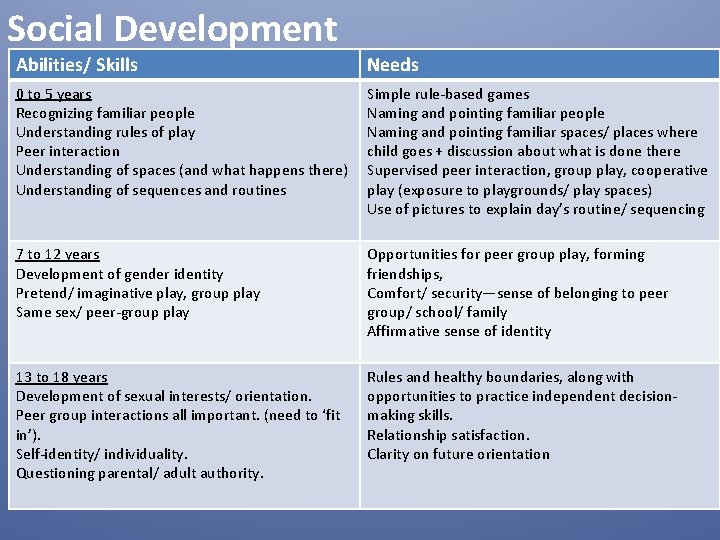
Social Development Abilities/ Skills Needs 0 to 5 years Recognizing familiar people Understanding rules of play Peer interaction Understanding of spaces (and what happens there) Understanding of sequences and routines Simple rule-based games Naming and pointing familiar people Naming and pointing familiar spaces/ places where child goes + discussion about what is done there Supervised peer interaction, group play, cooperative play (exposure to playgrounds/ play spaces) Use of pictures to explain day’s routine/ sequencing 7 to 12 years Development of gender identity Pretend/ imaginative play, group play Same sex/ peer-group play Opportunities for peer group play, forming friendships, Comfort/ security—sense of belonging to peer group/ school/ family Affirmative sense of identity 13 to 18 years Development of sexual interests/ orientation. Peer group interactions all important. (need to ‘fit in’). Self-identity/ individuality. Questioning parental/ adult authority. Rules and healthy boundaries, along with opportunities to practice independent decisionmaking skills. Relationship satisfaction. Clarity on future orientation
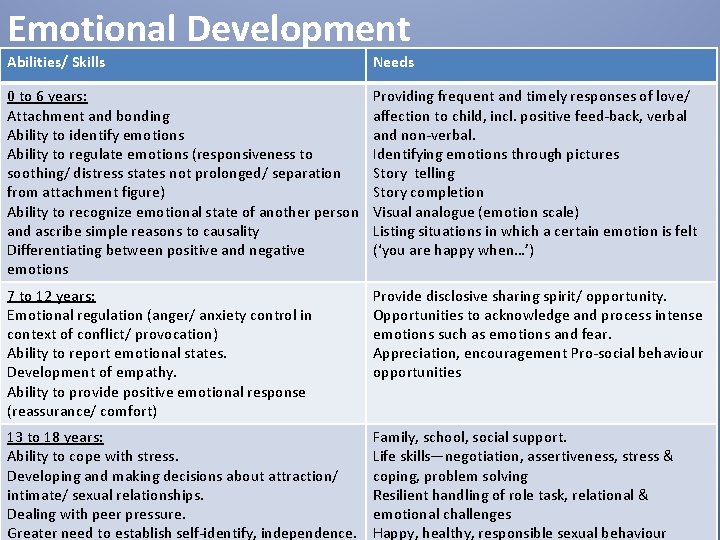
Emotional Development Abilities/ Skills Needs 0 to 6 years: Attachment and bonding Ability to identify emotions Ability to regulate emotions (responsiveness to soothing/ distress states not prolonged/ separation from attachment figure) Ability to recognize emotional state of another person and ascribe simple reasons to causality Differentiating between positive and negative emotions Providing frequent and timely responses of love/ affection to child, incl. positive feed-back, verbal and non-verbal. Identifying emotions through pictures Story telling Story completion Visual analogue (emotion scale) Listing situations in which a certain emotion is felt (‘you are happy when…’) 7 to 12 years: Emotional regulation (anger/ anxiety control in context of conflict/ provocation) Ability to report emotional states. Development of empathy. Ability to provide positive emotional response (reassurance/ comfort) Provide disclosive sharing spirit/ opportunity. Opportunities to acknowledge and process intense emotions such as emotions and fear. Appreciation, encouragement Pro-social behaviour opportunities 13 to 18 years: Ability to cope with stress. Developing and making decisions about attraction/ intimate/ sexual relationships. Dealing with peer pressure. Greater need to establish self-identify, independence. Family, school, social support. Life skills—negotiation, assertiveness, stress & coping, problem solving Resilient handling of role task, relational & emotional challenges Happy, healthy, responsible sexual behaviour
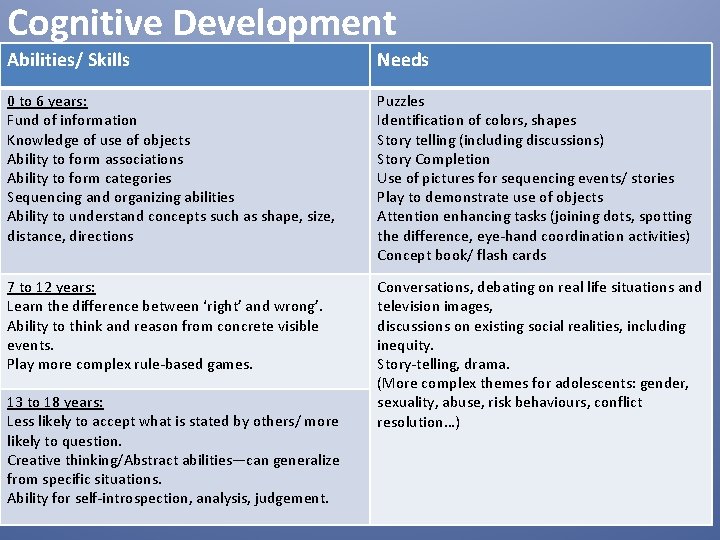
Cognitive Development Abilities/ Skills Needs 0 to 6 years: Fund of information Knowledge of use of objects Ability to form associations Ability to form categories Sequencing and organizing abilities Ability to understand concepts such as shape, size, distance, directions Puzzles Identification of colors, shapes Story telling (including discussions) Story Completion Use of pictures for sequencing events/ stories Play to demonstrate use of objects Attention enhancing tasks (joining dots, spotting the difference, eye-hand coordination activities) Concept book/ flash cards 7 to 12 years: Learn the difference between ‘right’ and wrong’. Ability to think and reason from concrete visible events. Play more complex rule-based games. Conversations, debating on real life situations and television images, discussions on existing social realities, including inequity. Story-telling, drama. (More complex themes for adolescents: gender, sexuality, abuse, risk behaviours, conflict resolution…) 13 to 18 years: Less likely to accept what is stated by others/ more likely to question. Creative thinking/Abstract abilities—can generalize from specific situations. Ability for self-introspection, analysis, judgement.
Understanding Disability… https: //youtu. be/4 W 6 yr. Fge. Ot. A
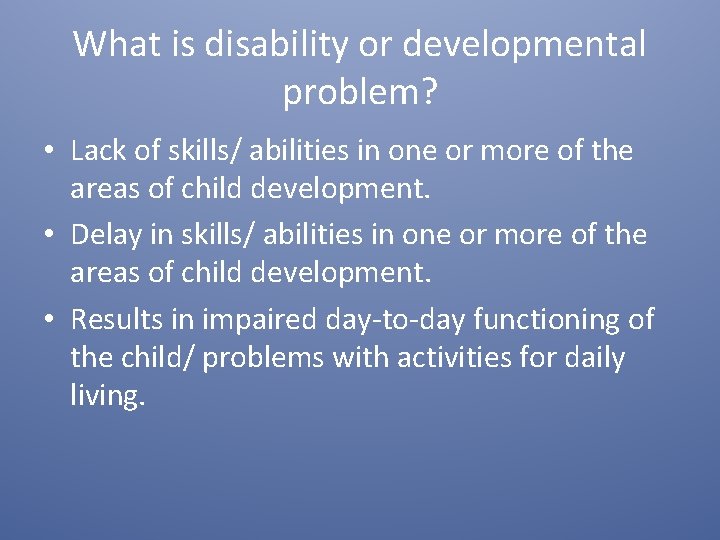
What is disability or developmental problem? • Lack of skills/ abilities in one or more of the areas of child development. • Delay in skills/ abilities in one or more of the areas of child development. • Results in impaired day-to-day functioning of the child/ problems with activities for daily living.
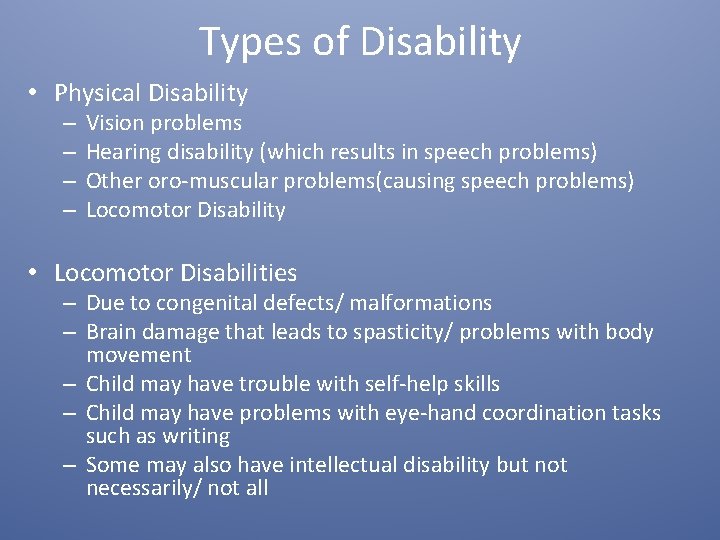
Types of Disability • Physical Disability – – Vision problems Hearing disability (which results in speech problems) Other oro-muscular problems(causing speech problems) Locomotor Disability • Locomotor Disabilities – Due to congenital defects/ malformations – Brain damage that leads to spasticity/ problems with body movement – Child may have trouble with self-help skills – Child may have problems with eye-hand coordination tasks such as writing – Some may also have intellectual disability but not necessarily/ not all
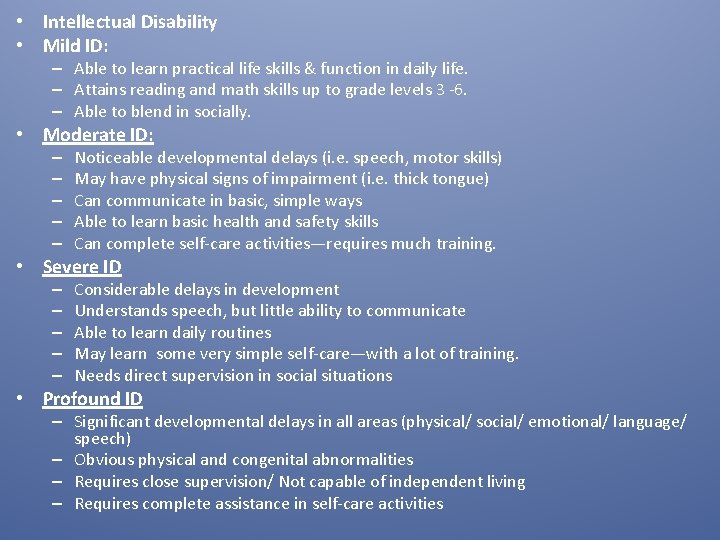
• Intellectual Disability • Mild ID: – Able to learn practical life skills & function in daily life. – Attains reading and math skills up to grade levels 3 -6. – Able to blend in socially. • Moderate ID: – – – Noticeable developmental delays (i. e. speech, motor skills) May have physical signs of impairment (i. e. thick tongue) Can communicate in basic, simple ways Able to learn basic health and safety skills Can complete self-care activities—requires much training. • Severe ID – – – Considerable delays in development Understands speech, but little ability to communicate Able to learn daily routines May learn some very simple self-care—with a lot of training. Needs direct supervision in social situations • Profound ID – Significant developmental delays in all areas (physical/ social/ emotional/ language/ speech) – Obvious physical and congenital abnormalities – Requires close supervision/ Not capable of independent living – Requires complete assistance in self-care activities
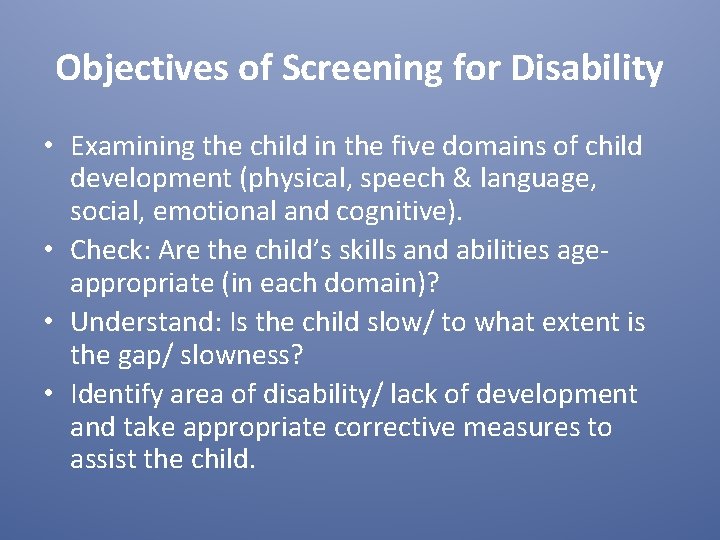
Objectives of Screening for Disability • Examining the child in the five domains of child development (physical, speech & language, social, emotional and cognitive). • Check: Are the child’s skills and abilities ageappropriate (in each domain)? • Understand: Is the child slow/ to what extent is the gap/ slowness? • Identify area of disability/ lack of development and take appropriate corrective measures to assist the child.
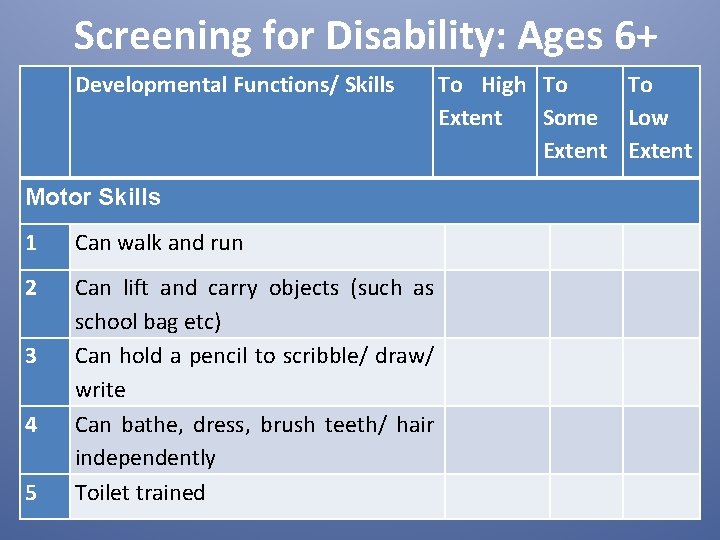
Screening for Disability: Ages 6+ Developmental Functions/ Skills To High To To Extent Some Low Extent Motor Skills 1 Can walk and run 2 Can lift and carry objects (such as school bag etc) Can hold a pencil to scribble/ draw/ write Can bathe, dress, brush teeth/ hair independently Toilet trained 3 4 5
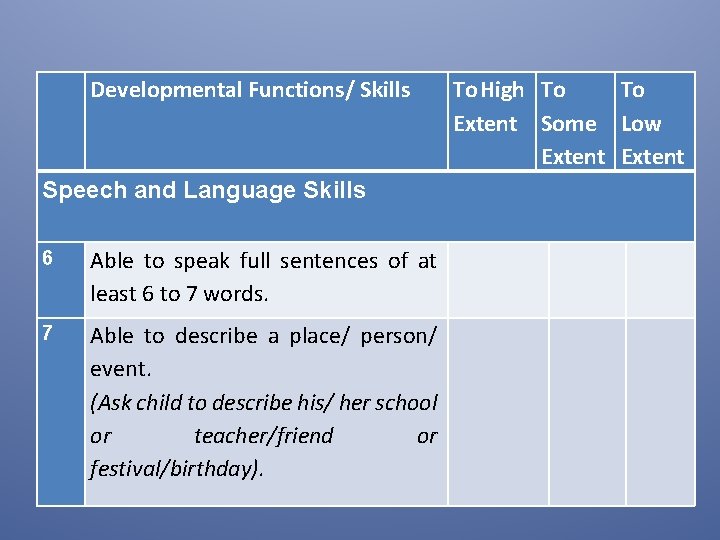
Developmental Functions/ Skills To High To To Extent Some Low Extent Speech and Language Skills 6 Able to speak full sentences of at least 6 to 7 words. 7 Able to describe a place/ person/ event. (Ask child to describe his/ her school or teacher/friend or festival/birthday).
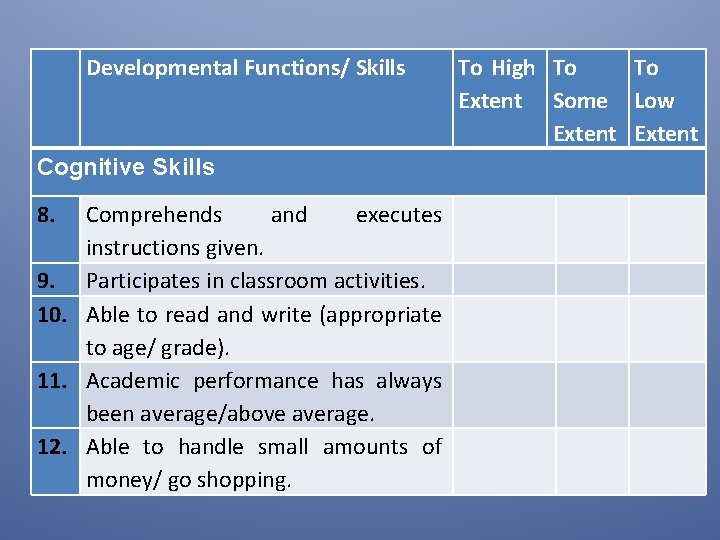
Developmental Functions/ Skills To High To To Extent Some Low Extent Cognitive Skills 8. Comprehends and executes instructions given. 9. Participates in classroom activities. 10. Able to read and write (appropriate to age/ grade). 11. Academic performance has always been average/above average. 12. Able to handle small amounts of money/ go shopping.
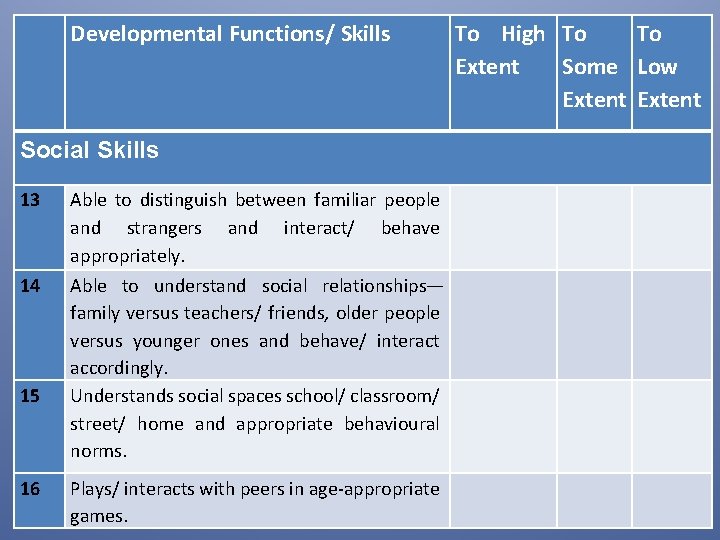
Developmental Functions/ Skills To High To To Extent Some Low Extent Social Skills 13 14 15 16 Able to distinguish between familiar people and strangers and interact/ behave appropriately. Able to understand social relationships— family versus teachers/ friends, older people versus younger ones and behave/ interact accordingly. Understands social spaces school/ classroom/ street/ home and appropriate behavioural norms. Plays/ interacts with peers in age-appropriate games.
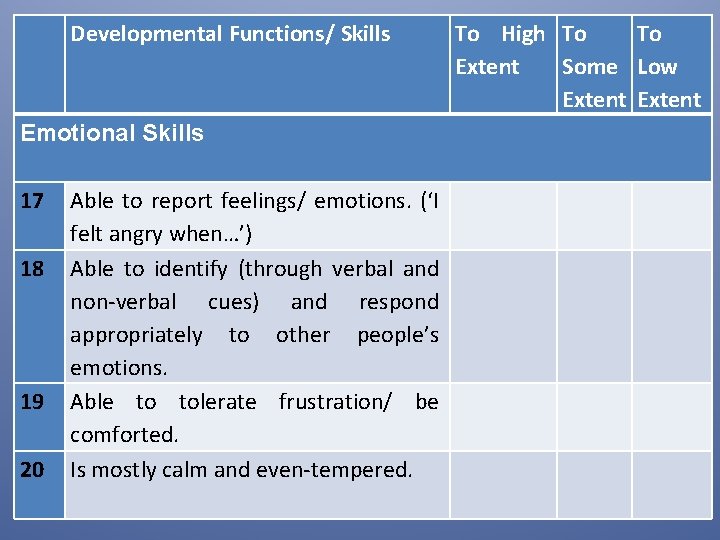
Developmental Functions/ Skills To High To To Extent Some Low Extent Emotional Skills 17 18 19 20 Able to report feelings/ emotions. (‘I felt angry when…’) Able to identify (through verbal and non-verbal cues) and respond appropriately to other people’s emotions. Able to tolerate frustration/ be comforted. Is mostly calm and even-tempered.
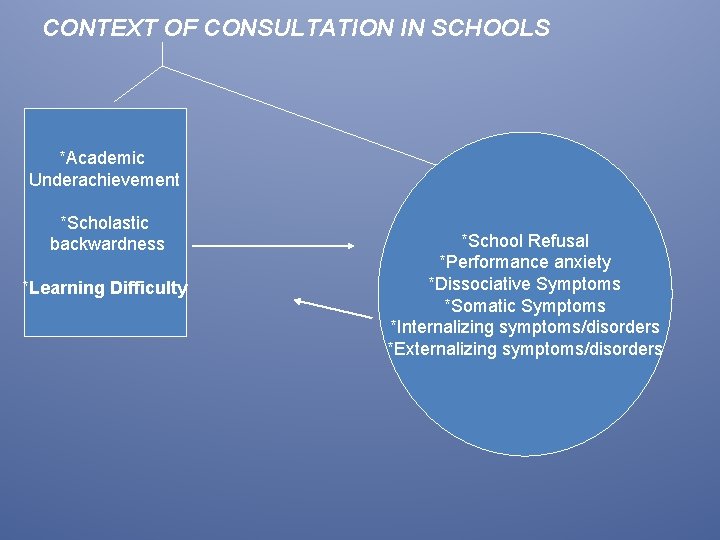
CONTEXT OF CONSULTATION IN SCHOOLS *Academic Underachievement *Scholastic backwardness *Learning Difficulty *School Refusal *Performance anxiety *Dissociative Symptoms *Somatic Symptoms *Internalizing symptoms/disorders *Externalizing symptoms/disorders
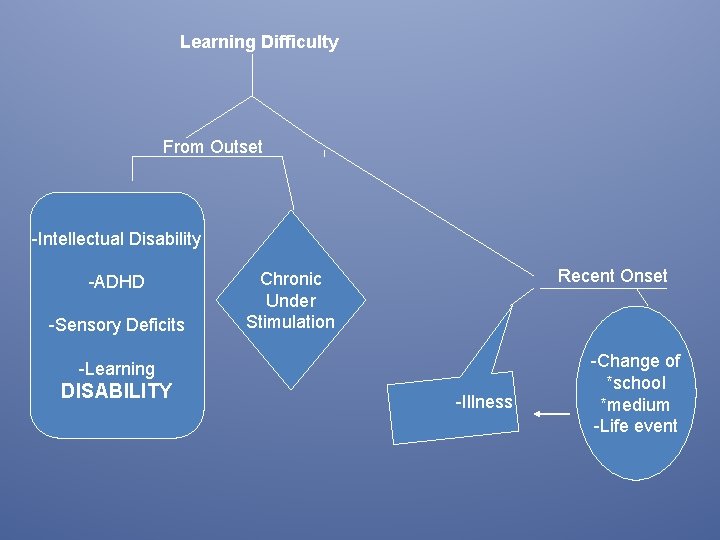
Learning Difficulty From Outset -Intellectual Disability -ADHD -Sensory Deficits Recent Onset Chronic Under Stimulation -Learning DISABILITY -Illness -Change of *school *medium -Life event
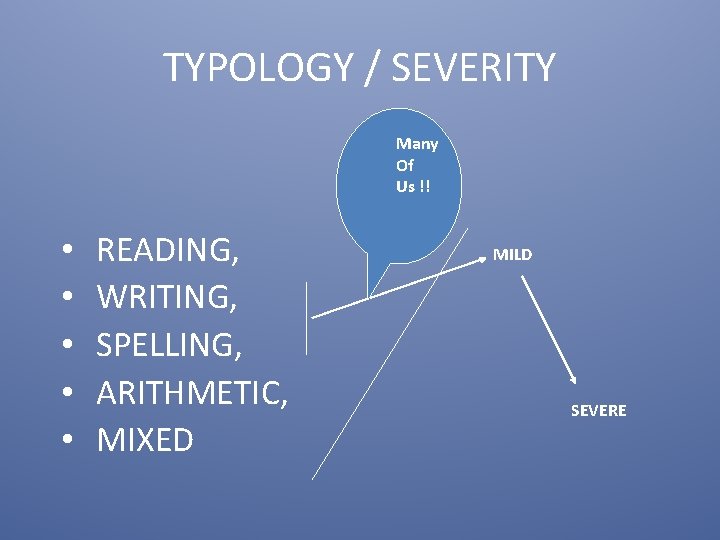
TYPOLOGY / SEVERITY Many Of Us !! • • • READING, WRITING, SPELLING, ARITHMETIC, MIXED MILD SEVERE
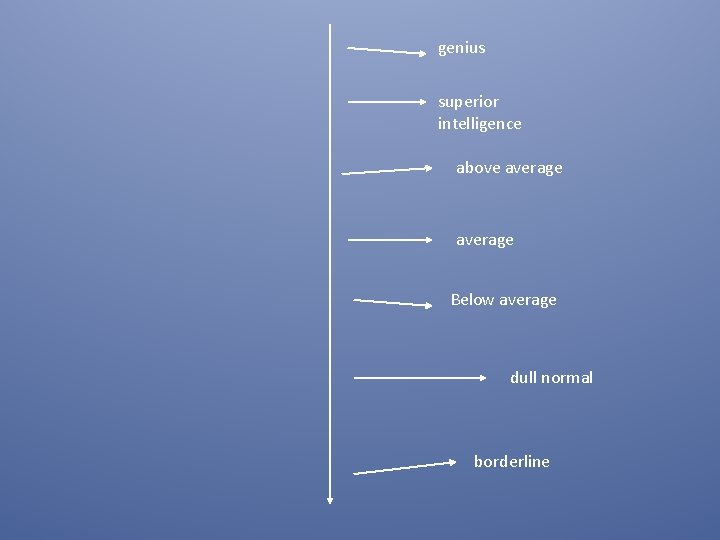
genius superior intelligence above average Below average dull normal borderline
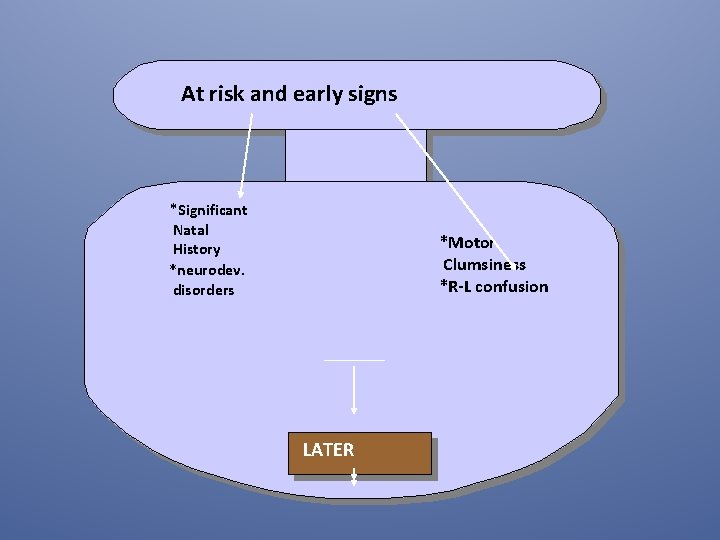
At risk and early signs *Significant Natal History *neurodev. disorders *Motor Clumsiness *R-L confusion LATER
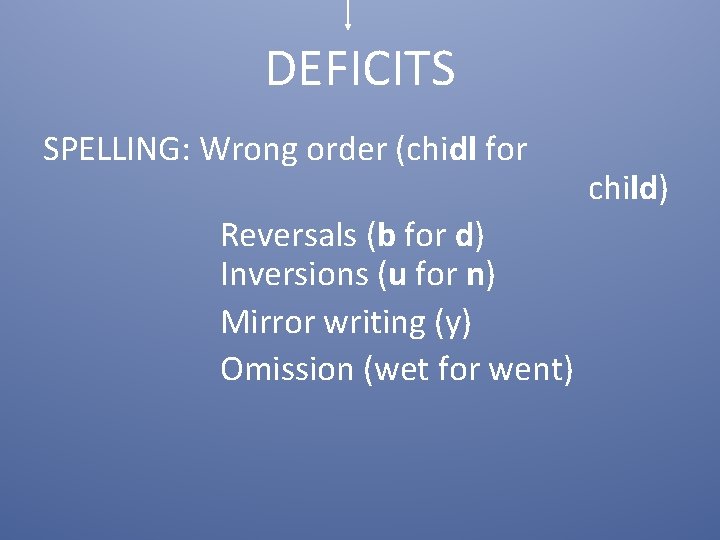
DEFICITS SPELLING: Wrong order (chidl for child) Reversals (b for d) Inversions (u for n) Mirror writing (y) Omission (wet for went)
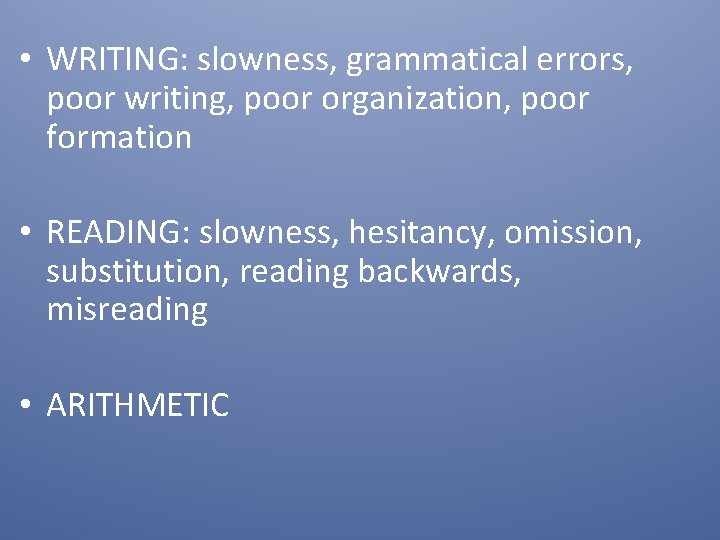
• WRITING: slowness, grammatical errors, poor writing, poor organization, poor formation • READING: slowness, hesitancy, omission, substitution, reading backwards, misreading • ARITHMETIC
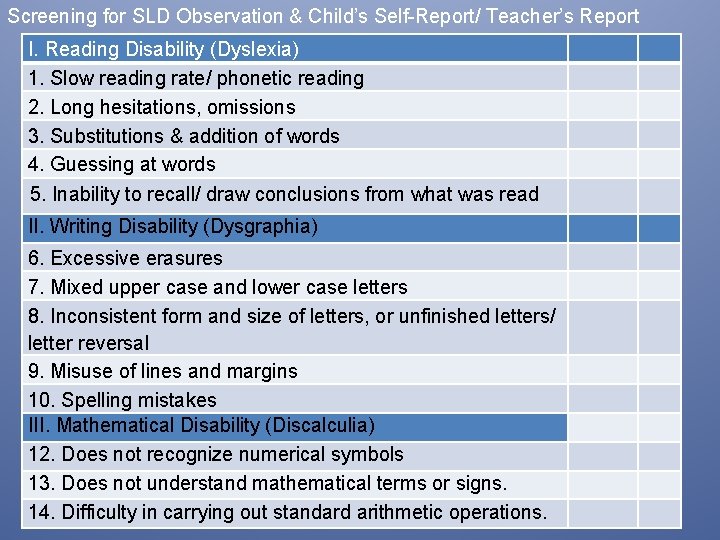
Screening for SLD Observation & Child’s Self-Report/ Teacher’s Report I. Reading Disability (Dyslexia) 1. Slow reading rate/ phonetic reading 2. Long hesitations, omissions 3. Substitutions & addition of words 4. Guessing at words 5. Inability to recall/ draw conclusions from what was read II. Writing Disability (Dysgraphia) 6. Excessive erasures 7. Mixed upper case and lower case letters 8. Inconsistent form and size of letters, or unfinished letters/ letter reversal 9. Misuse of lines and margins 10. Spelling mistakes III. Mathematical Disability (Discalculia) 12. Does not recognize numerical symbols 13. Does not understand mathematical terms or signs. 14. Difficulty in carrying out standard arithmetic operations.
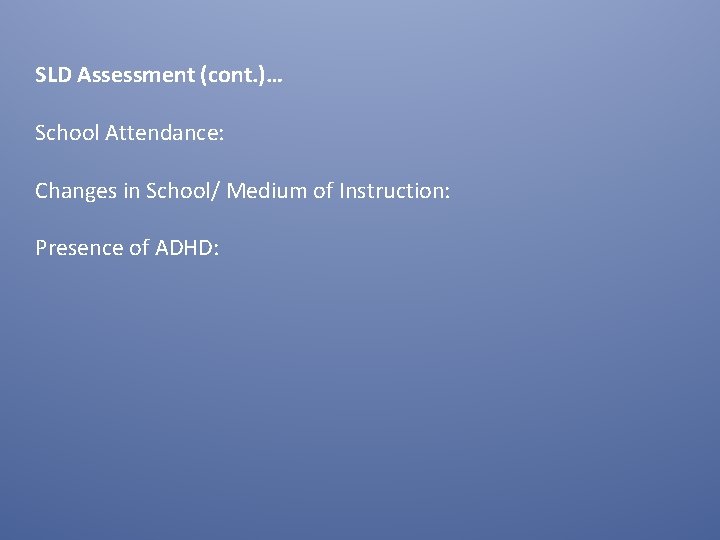
SLD Assessment (cont. )… School Attendance: Changes in School/ Medium of Instruction: Presence of ADHD:
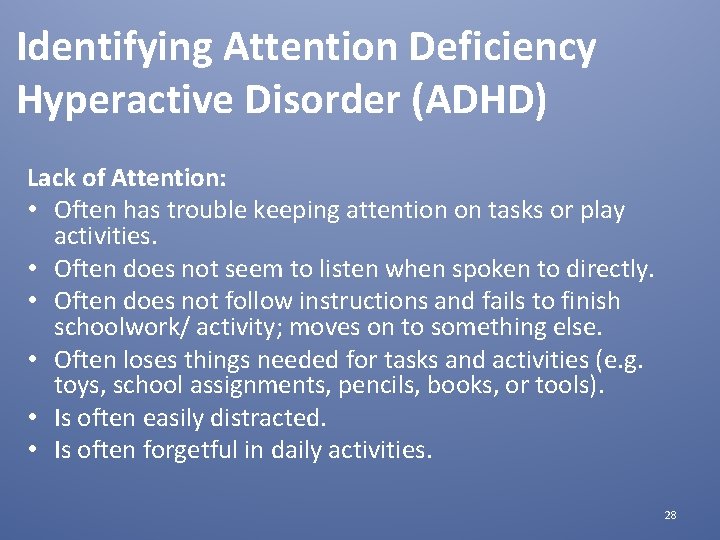
Identifying Attention Deficiency Hyperactive Disorder (ADHD) Lack of Attention: • Often has trouble keeping attention on tasks or play activities. • Often does not seem to listen when spoken to directly. • Often does not follow instructions and fails to finish schoolwork/ activity; moves on to something else. • Often loses things needed for tasks and activities (e. g. toys, school assignments, pencils, books, or tools). • Is often easily distracted. • Is often forgetful in daily activities. 28
Hyperactivity: • Often restless/fidgets with hands or feet or squirms in seat. • Often gets up from seat when remaining in seat is expected. • Excessive running/ climbing (more than other kids). • Often has trouble playing rule-based games or enjoying leisure activities quietly. • Is often "on the go" or often acts as if "driven by a motor. " Impulsivity: • Often has trouble waiting one's turn. • Often interrupts or intrudes on others. (pushing/poking/hitting…). • Impaired social judgement/ hasty decisions without due thought (older children). 29
Distinguishing between Mild Global Intellectual Disability and Specific Learning Disability • Child cannot read and write and also finds it difficult to comprehend/ communicate and has difficulty performing other developmental tasks. Child also has limited social intelligence. versus • Child cannot read and write but comprehends instructions, communicates well verbally and performs all other developmental tasks/ activities. Child has normal social intelligence.
Ask the teacher: • Other than reading and writing, are the child’s behaviours and abilities like that of other children her age? • Does the child seem slower to respond/ more dull than other children in all school/ class activities? • Are the child’s oral skills much higher than her reading/written skills? Ask the child some questions to test her general intelligence: • What was the last film you saw? Tell me what the story was. • What is your best subject? What was the last lesson about? • For what kind of illnesses do people go to hospitals? • What kind of work does your father/ mother do? (Details? )
How to Tell When Learning Problems are due to Emotional Issues • When the learning problems are of recent onset. • When the school system is aware an event has occurred in the child’s life (life change/ trauma). • There is disclosure of emotional issues. • There are behavioral indicators such as withdrawal, weepiness, anxiety. • In a better state of well-being, the child is able to perform well (variability in performance).
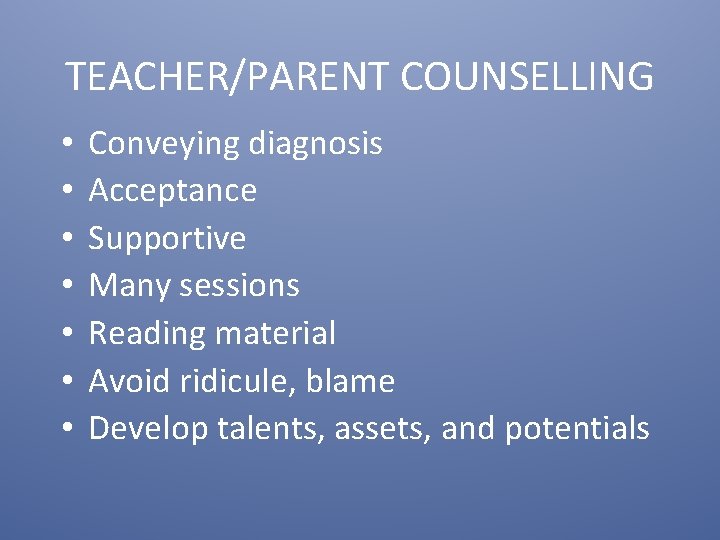
TEACHER/PARENT COUNSELLING • • Conveying diagnosis Acceptance Supportive Many sessions Reading material Avoid ridicule, blame Develop talents, assets, and potentials
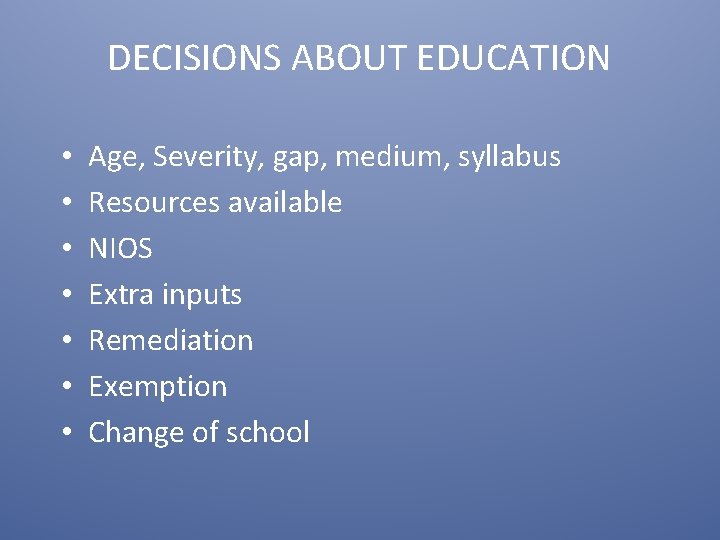
DECISIONS ABOUT EDUCATION • • Age, Severity, gap, medium, syllabus Resources available NIOS Extra inputs Remediation Exemption Change of school
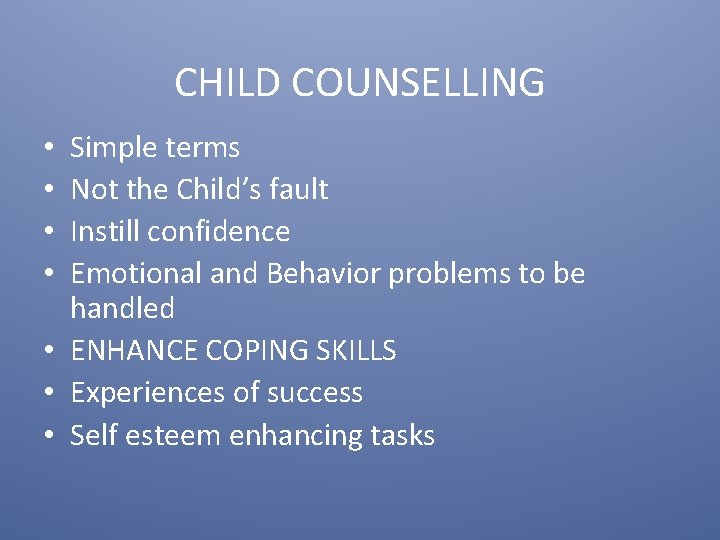
CHILD COUNSELLING Simple terms Not the Child’s fault Instill confidence Emotional and Behavior problems to be handled • ENHANCE COPING SKILLS • Experiences of success • Self esteem enhancing tasks • •
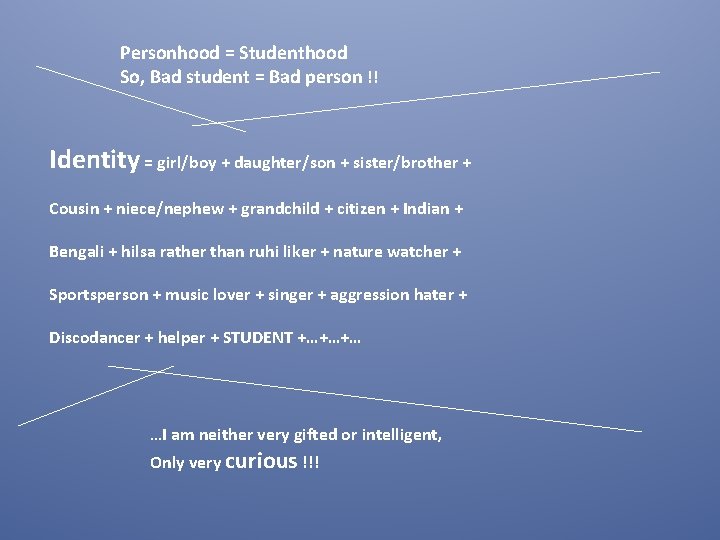
Personhood = Studenthood So, Bad student = Bad person !! Identity = girl/boy + daughter/son + sister/brother + Cousin + niece/nephew + grandchild + citizen + Indian + Bengali + hilsa rather than ruhi liker + nature watcher + Sportsperson + music lover + singer + aggression hater + Discodancer + helper + STUDENT +…+…+… …I am neither very gifted or intelligent, Only very curious !!!
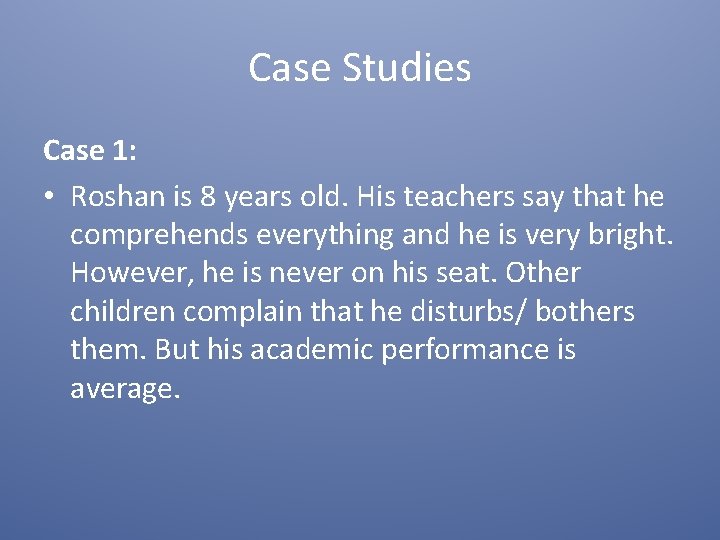
Case Studies Case 1: • Roshan is 8 years old. His teachers say that he comprehends everything and he is very bright. However, he is never on his seat. Other children complain that he disturbs/ bothers them. But his academic performance is average.
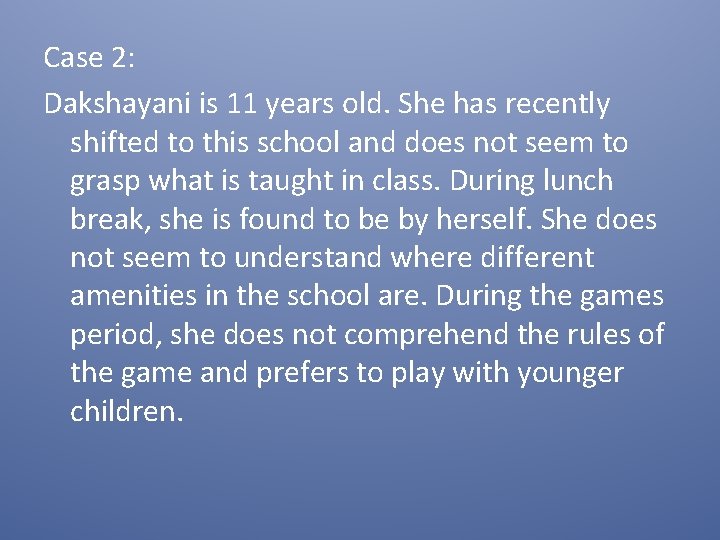
Case 2: Dakshayani is 11 years old. She has recently shifted to this school and does not seem to grasp what is taught in class. During lunch break, she is found to be by herself. She does not seem to understand where different amenities in the school are. During the games period, she does not comprehend the rules of the game and prefers to play with younger children.
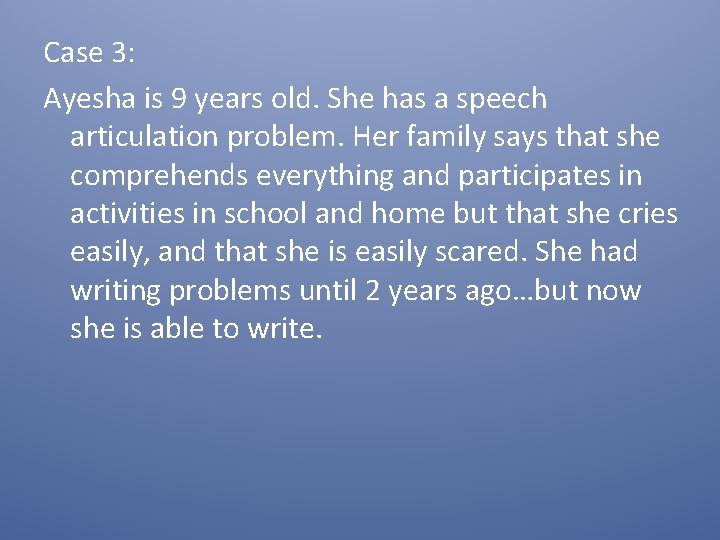
Case 3: Ayesha is 9 years old. She has a speech articulation problem. Her family says that she comprehends everything and participates in activities in school and home but that she cries easily, and that she is easily scared. She had writing problems until 2 years ago…but now she is able to write.
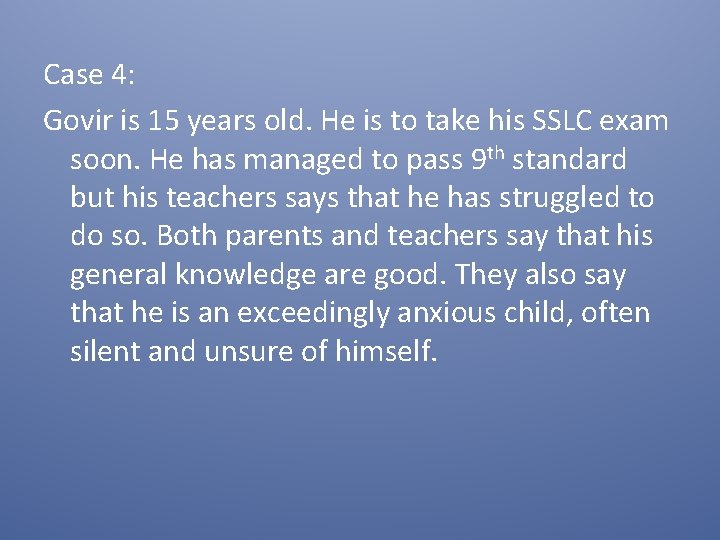
Case 4: Govir is 15 years old. He is to take his SSLC exam soon. He has managed to pass 9 th standard but his teachers says that he has struggled to do so. Both parents and teachers say that his general knowledge are good. They also say that he is an exceedingly anxious child, often silent and unsure of himself.