
Learning Define Learning o Learning is a relatively

- Slides: 60
Learning
Define Learning o. Learning is a relatively permanent change in behavior as a result of experience.
Define Learning o John Locke, David Hume, Aristotle: We learn by association. Our minds naturally connect events that occur in a sequence. n IE. If, after seeing and smelling freshly baked bread, you eat some and find it satisfying, then the next time you see and smell fresh bread, your experience will lead you to expect that eating some will be satisfying again.
Define Conditioning o. Conditioning is the process of learning associations.
Classical Conditioning n In classical conditioning, we learn to associate two stimuli and anticipate events. o For example, we learn that a flash of lightening signals an impending crack of thunder, as so we start to brace ourselves when lightening flashes nearby.
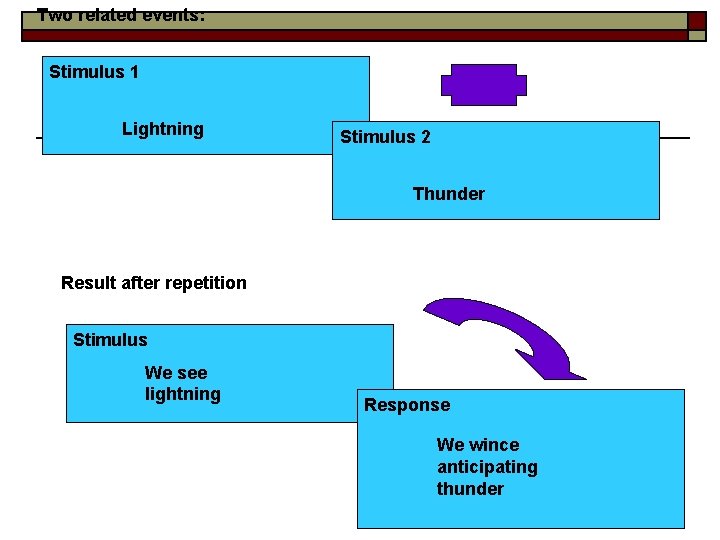
Two related events: Stimulus 1 Lightning Stimulus 2 Thunder Result after repetition Stimulus We see lightning Response We wince anticipating thunder
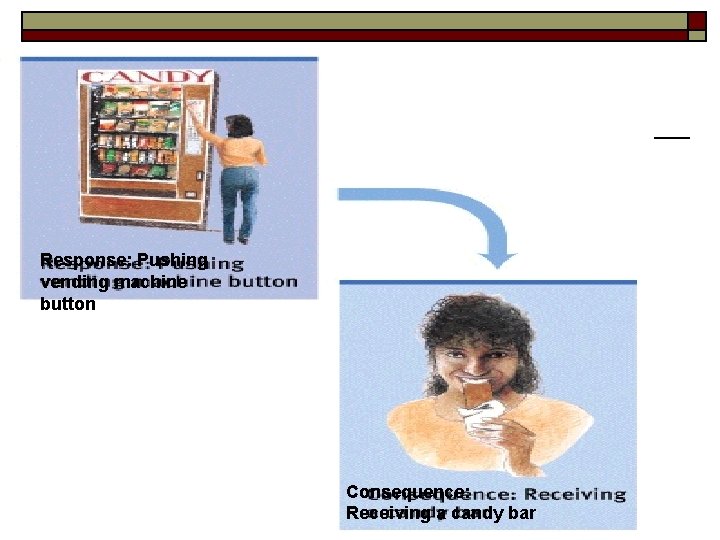
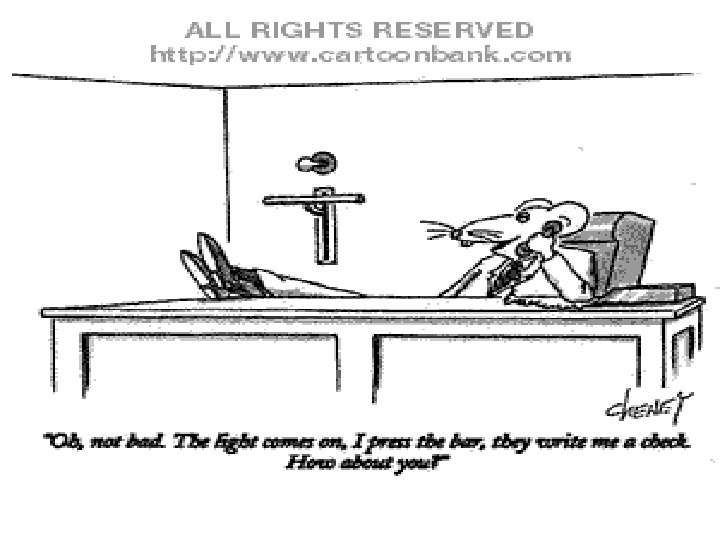
Operant Conditioning n In operant conditioning, we learn to associate a response and its consequence, and we repeat acts followed by rewards, and avoid acts followed by punishment. o For example, we learn that pushing a vending machine button relates to the delivery of a candy bar.
Response: Pushing vending machine button Consequence: Receiving a candy bar
Social/Vicarious/Observational Learning o In social learning, we learn from other’s experiences and examples. n For example, chimpanzees sometimes learn behaviors merely by observing others perform them. If one animal watches another learn to solve a puzzle that gains a food reward, the observing animal may perform the trick as well, and even more quickly.
Classical Conditioning o Ivan Pavlov - Russian; Medical doctor who spent two decades studying the digestive system. Nobel Prize in 1904. Studied learning for the next three decades, by “accident”. n After studying salivary secretion in dogs, he knew that when he put food in a dog’s mouth the animal would invariably salivate. He also began to notice that when he worked with the same dog repeatedly, the dog began salivating to stimuli associated with food – the sight of food, the food dish, the mere presence of the person bringing the food, even the sound of oncoming footsteps in anticipation of the food
Classical Conditioning o o Pavlov’s Experiment: Through experimentation, Pavlov asked: If a neutral stimulus (something the dog could see or hear) regularly signaled the arrival of food, would the dog associate the two stimuli (the food and the neutral stimuli)? If so, would the dog begin to salivate to the neutral stimulus in anticipation of the food?
Classical Conditioning o. Unconditioned n. A Stimulus stimulus that naturally and automatically triggers a response
Classical Conditioning o Unconditioned n The Response unlearned, naturally occurring response to the unconditioned stimulus
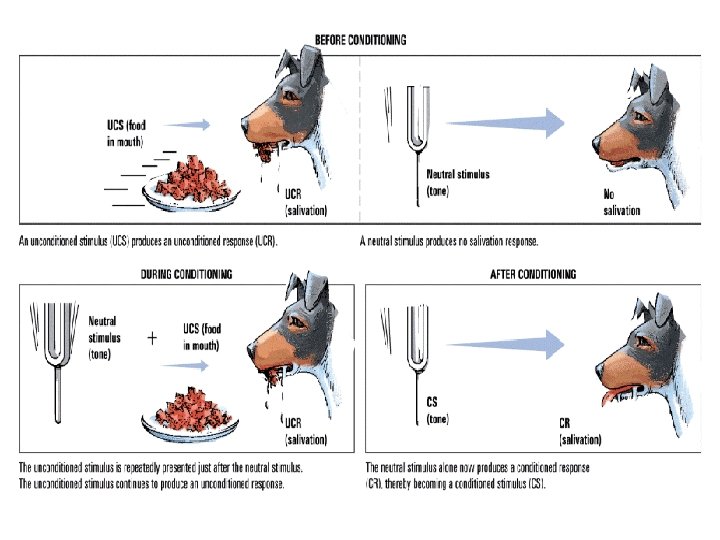
Classical Conditioning o. For example: n For Pavlov, the UCS was food and the UCR was the dog’s salivation
Classical Conditioning Pavlov’s Experiment (continued): o Just before placing food in the dog’s mouth to produce salivation, Pavlov sounded a tone. After several pairings of tone and food, the dog began to salivate to the tone alone, in anticipation of the food. o
Classical Conditioning o Conditioned Stimulus n An originally irrelevant stimulus that, after association with and unconditioned stimulus, comes to trigger a conditioned response
Classical Conditioning o Conditioned Response n The learned response to a previously neutral conditioned stimulus
Classical Conditioning o For example: n For Pavlov, the previously neutral stimulus was the tone. During conditioning, the tone was paired with the food (UCS). After conditioning, the tone, when presented alone, produced salivation in the dog. The tone is now considered the CS, and the dog’s salivation to the tone alone is now considered the CR.
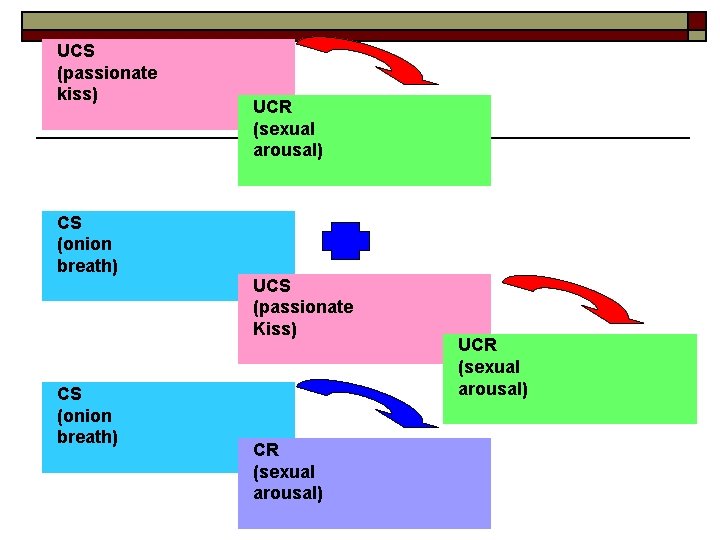
UCS (passionate kiss) CS (onion breath) UCR (sexual arousal) UCS (passionate Kiss) CR (sexual arousal) UCR (sexual arousal)
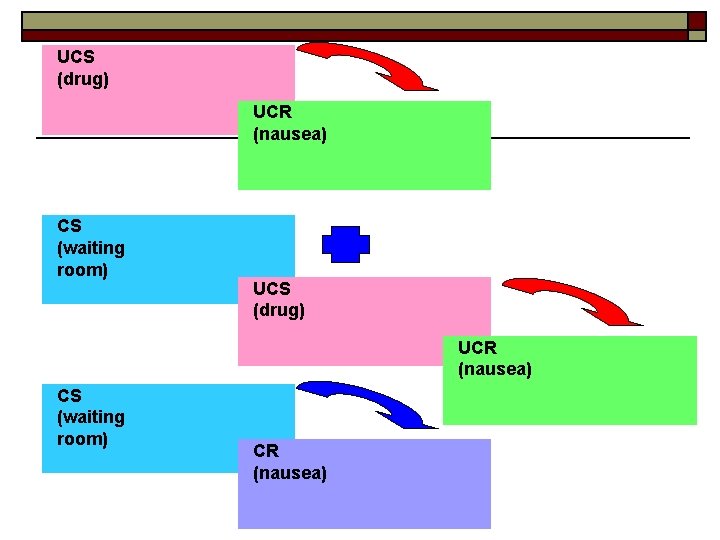
UCS (drug) UCR (nausea) CS (waiting room) CR (nausea)
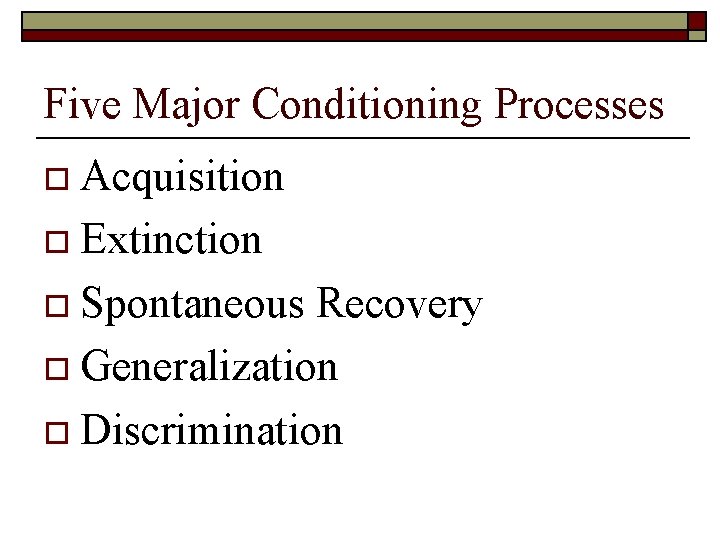
Five Major Conditioning Processes o Acquisition o Extinction o Spontaneous Recovery o Generalization o Discrimination
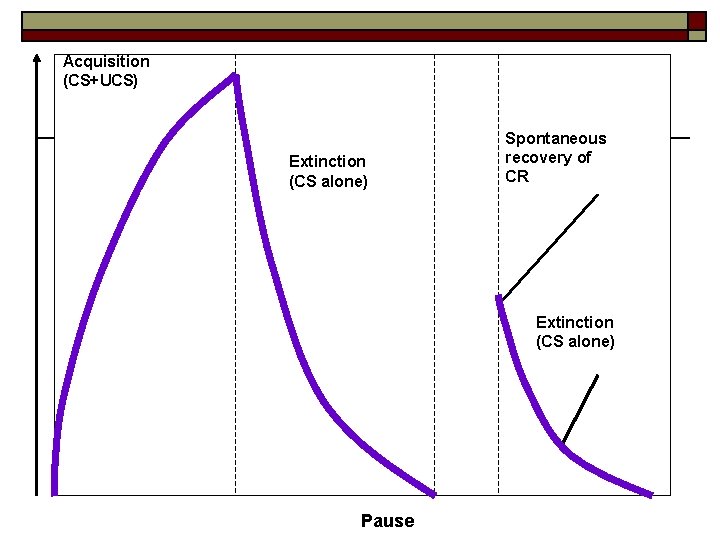
Acquisition The initial stage in classical conditioning o The phase associating a neutral stimulus with an unconditioned stimulus so that the neutral stimulus comes to elicit a conditioned response o
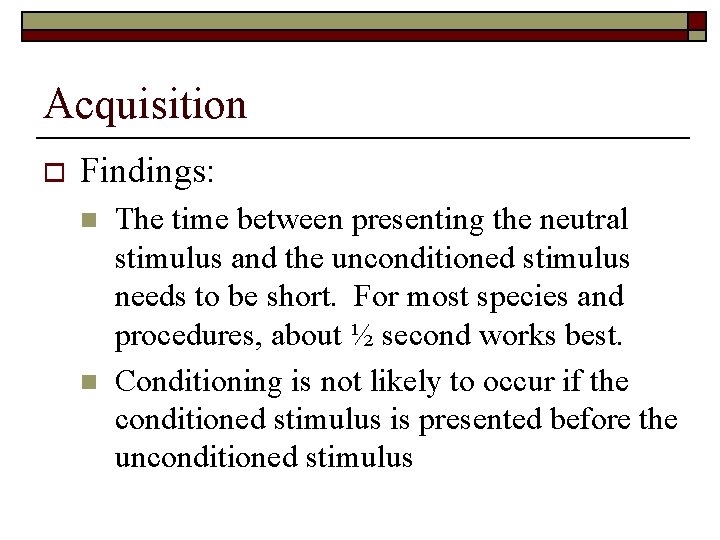
Acquisition o Findings: n n The time between presenting the neutral stimulus and the unconditioned stimulus needs to be short. For most species and procedures, about ½ second works best. Conditioning is not likely to occur if the conditioned stimulus is presented before the unconditioned stimulus
Extinction and Spontaneous Recovery o After conditioning, what happens if the conditioned stimulus occurs repeatedly without the unconditioned stimulus…. . will it continue to elicit the conditioned response? n Extinction – the diminishing of a conditioned response when an unconditioned stimulus no longer follows a conditioned stimulus
Extinction and Spontaneous Recovery The reappearance, after a rest period, of an extinguished conditioned response. o The conditioned response continues to get weaker after less pairings of the CS and the UCS, and after more and more rest periods o
Acquisition (CS+UCS) Extinction (CS alone) Spontaneous recovery of CR Extinction (CS alone) Pause
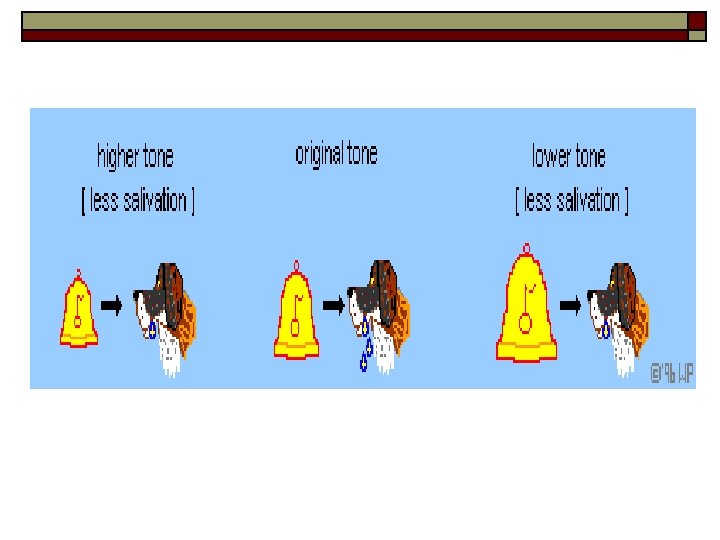
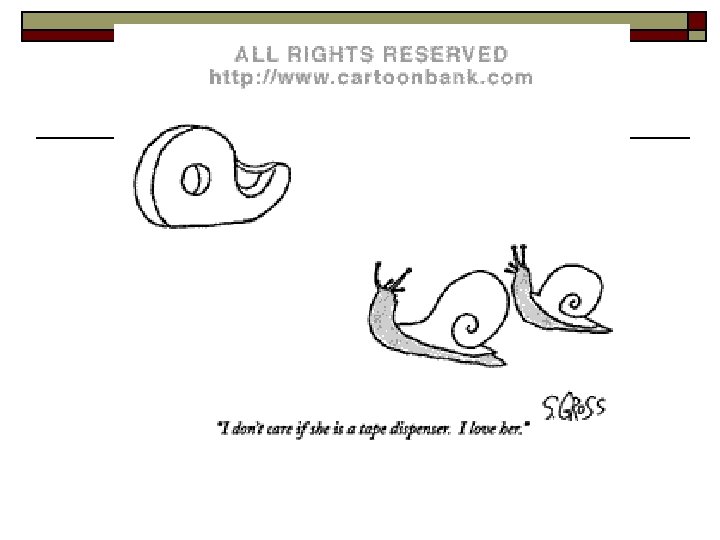
Generalization o The tendency, once a response has been conditioned, for stimuli similar to the conditioned stimulus to elicit similar responses n IE. A child bitten by a dog may fear all dogs. Children who fear moving cars in the street also fear trucks and motorcycles. After 9/11, many people responded anxiously when planes flew near by.
Discrimination o The learned ability to distinguish between a conditioned stimulus and other stimuli that do not signal an unconditioned stimulus n IE. A child bitten by a dog now fears all dogs. The same child learns, over time, that only certain types dogs should be feared (pit bull? ), and others generally shouldn’t (golden retriever? ).
Classical Conditioning – Extra o Little Albert Experiment – Fear Conditioning n An 11 -month infant named Albert feared loud noises, but not white rats. In the experiment, when Albert was presented with a white rat and reached out to touch it, a hammer was struck on a steel beam behind his head. After seven repetitions of seeing the rat and then hearing the frightening noise, Albert burst into tears at the mere sight of the rat.
Classical Conditioning - Extra o Five days after the testing, Albert showed generalization of his conditioned response by reacting with fear to a rabbit, a dog, and a sealskin coat.
Operant Conditioning o Type of learning in which behavior is strengthened if followed by a reinforcer, or diminished if followed by a punisher
Operant Conditioning o B. F. Skinner’s Experiments: n n Based on Edward Thorndike’s LAW OF EFFECT – states that rewarded behavior is likely to recur Experiments conducted with animals in an operant chamber (Skinner Box) – a soundproof box, with a bar or key that an animal presses or pecks to release a reward of food or water
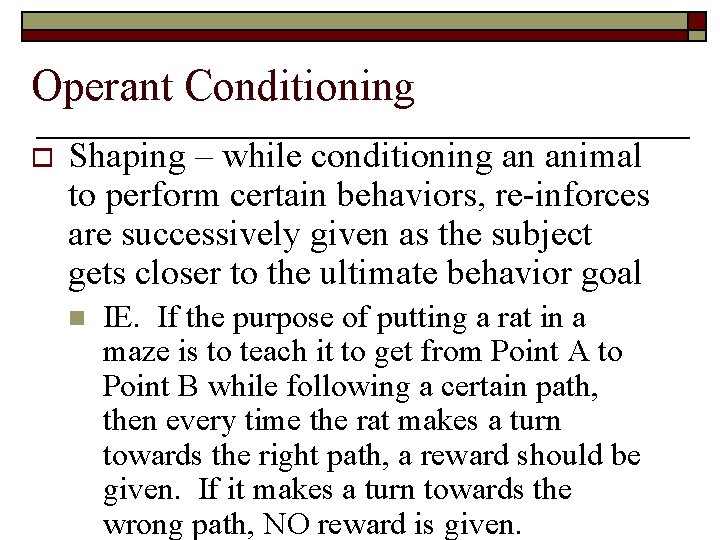
Operant Conditioning o Shaping – while conditioning an animal to perform certain behaviors, re-inforces are successively given as the subject gets closer to the ultimate behavior goal n IE. If the purpose of putting a rat in a maze is to teach it to get from Point A to Point B while following a certain path, then every time the rat makes a turn towards the right path, a reward should be given. If it makes a turn towards the wrong path, NO reward is given.
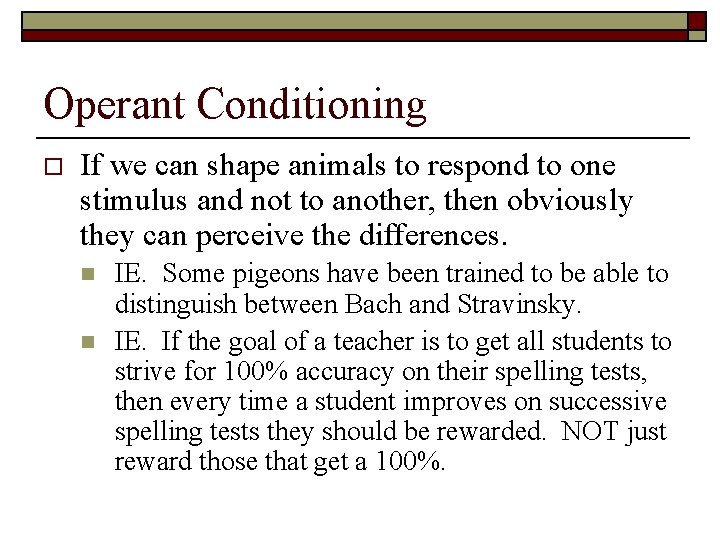
Operant Conditioning o If we can shape animals to respond to one stimulus and not to another, then obviously they can perceive the differences. n n IE. Some pigeons have been trained to be able to distinguish between Bach and Stravinsky. IE. If the goal of a teacher is to get all students to strive for 100% accuracy on their spelling tests, then every time a student improves on successive spelling tests they should be rewarded. NOT just reward those that get a 100%.
Operant Conditioning o Reinforcement – any event that increases the frequency of a preceding response, or strengthens the behavior that it follows n IE. Being able to borrow the car after the dishes are done. A snack break after one-hour of study time.
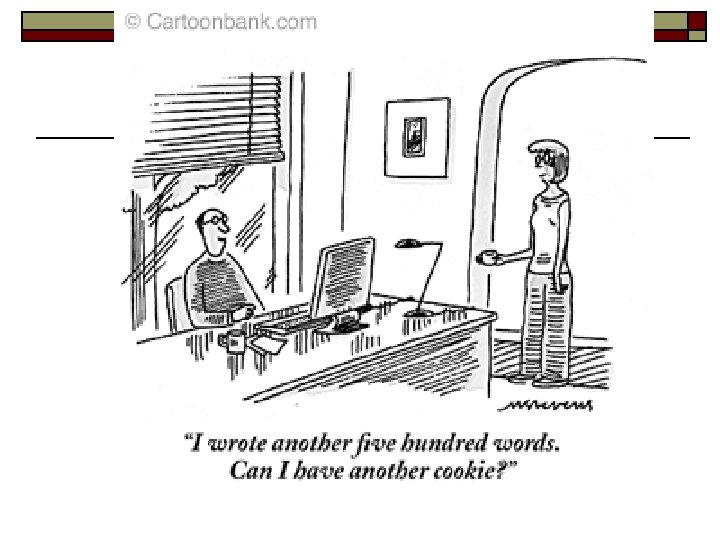
Operant Conditioning o Positive Reinforcement – strengthens a response by presenting a typically pleasurable stimulus after a response. n IE. Food for a hungry animal. Attention, approval, money for people.
Operant Conditioning o Negative Reinforcement – strengthens a response by reducing or removing an aversive stimulus n IE. Taking aspirin to relieve a headache will increase the behavior of taking aspirin because it reduces or eliminates the pain. Smoking a cigarette to relieve stress will increase the behavior of smoking because it reduces or eliminates anxiety and pressure.
Operant Conditioning o Positive ADDS a desirable stimulus, like getting a hug or watching TV. o Negative REMOVES an aversive stimulus, like fastening a seatbelt to stop the annoying beeping
Operant Conditioning o Primary Reinforcers – an innately reinforcing stimulus, such as one that satisfies a biological need n IE. Primary reinforces may be food, water, adequate warmth, or sexual contact
o Conditioned Reinforcers – a stimulus that is learned, and/or is associated with a primary reinforcer n Secondary reinforces may be money, praise, good grades, a pleasant tone of voice.
Operant Conditioning o Immediate and Delayed Reinforcers – How quickly does a reinforcement needed to be given after a desired behavior has been exhibited in order for the behavior to be conditioned? How often does the reinforcement need to be given to condition proper behavior?
Operant Conditioning o Continuous Reinforcement – Reinforcing the desired response immediately, every time it occurs. Learning occurs quickly, but as soon as reinforcement ends, extinction occurs very quickly also. n You go to the same soda machine every day, put your money into it, and it delivers a soda. On Friday, you put your money into it and it doesn’t work. Same thing Saturday. You stop using the machine, though a week later you may try again.
Operant Conditioning o Partial (Intermittent) Reinforcement – Reinforcing a response only part of the time. This results in slower acquisition of a response, but much greater resistance to extinction also. n IE. Slot machines. You may win only once in long while, but you’ll keep playing because the reinforcement is worth it, and the habit may last a long time.
Operant Conditioning o Partial (Intermittent) Reinforcement Schedules: n Fixed-Ratio = a schedule of reinforcement that reinforces only after a specified number of responses. o IE. Every 10 th sale gets a prize.
Operant Conditioning o Partial (Intermittent) Reinforcement Schedules: n Variable-Ratio Schedule = a schedule of reinforcement that reinforces a response after an unpredictable number of responses o IE. Slot machines, fishing.
Operant Conditioning o Partial (Intermittent) Reinforcement Schedules: n Fixed-interval schedules = a schedule of reinforcement that reinforces a response only after a specified time has elapsed o IE. At the end of every 30 minutes a new batch of cookies will be baked.
Operant Conditioning o Partial (Intermittent) Reinforcement Schedules: n Variable-Interval Schedules = a schedule of reinforcement that reinforces a response at unpredictable time intervals o IE. “You’ve Got Mail”…you don’t know when you will get an email, but you are always checking for it.
Operant Conditioning o Punishment – An event that decreases the behavior that it follows n May be done by administering an undesirable consequence, or by withdrawing a desirable consequence o IE. Shock treatment and spanking are added, undesirable consequences, while taking away phone or car privileges withdraws desirable consequences.
Operant Conditioning o Issues/Questions regarding punishments n n n Physical punishments are not forgotten, just suppressed Physical punishments may increase aggressiveness by demonstrating that aggression is a way to cope with problems Punishments may create fear
Operant Conditioning n n If punishment isn’t delivered swiftly, or proportionally with regards to the crime, those punished may be confused, depressed, or helpless Punishments still do not teach the proper behavior – it only suppresses unwanted behaviors
Operant Conditioning o Observational Learning is learning by watching and imitating others o The process of observing and imitating a specific behavior is called Modeling