
Learning Classical Conditioning This is passive learning automaticlearner


- Slides: 31
Learning
Classical Conditioning • This is passive learning (automatic…learner does NOT have to think). • First thing you need is a unconditional relationship. • Unconditional Stimulus (UCS)- something that elicits a natural, reflexive response. • Unconditional Response (UCR)- response to the UCS.
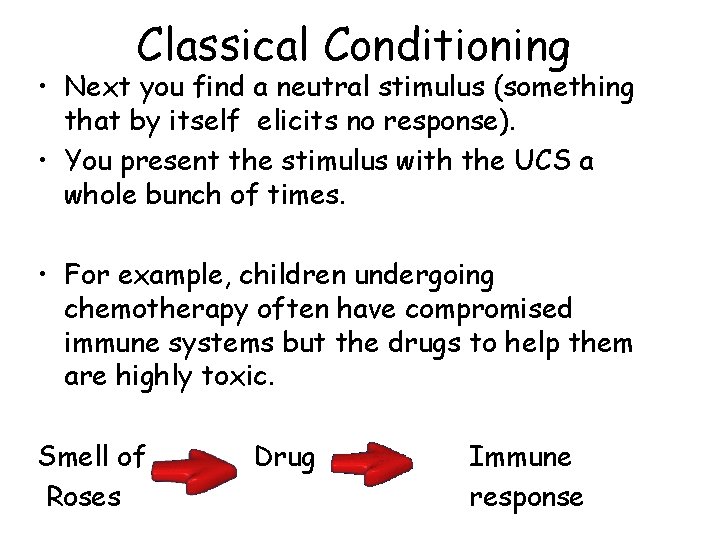
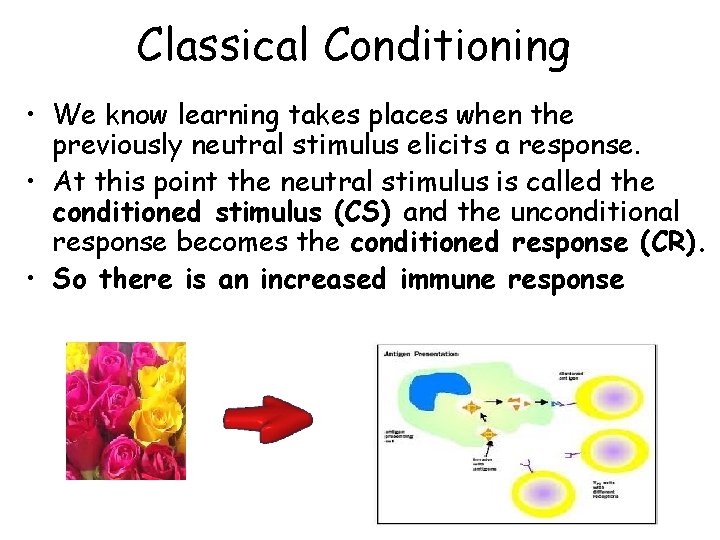
Classical Conditioning • Next you find a neutral stimulus (something that by itself elicits no response). • You present the stimulus with the UCS a whole bunch of times. • For example, children undergoing chemotherapy often have compromised immune systems but the drugs to help them are highly toxic. Smell of Roses Drug Immune response
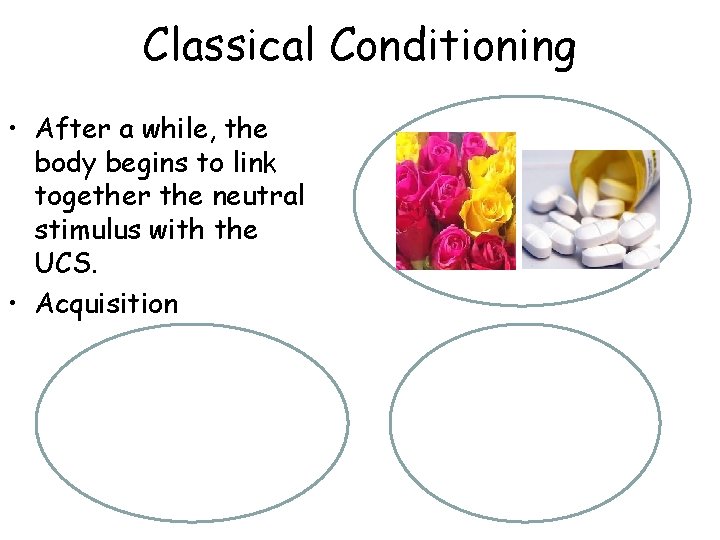
Classical Conditioning • After a while, the body begins to link together the neutral stimulus with the UCS. • Acquisition
Classical Conditioning • We know learning takes places when the previously neutral stimulus elicits a response. • At this point the neutral stimulus is called the conditioned stimulus (CS) and the unconditional response becomes the conditioned response (CR). • So there is an increased immune response
Classical Conditioning • TRICKY FACT: We know learning exists because the CS is linked to the UCS. • This is called ACQUISITION. • http: //www. youtube. com/watch? v=Wf. Zf. MIHw. Sk. U
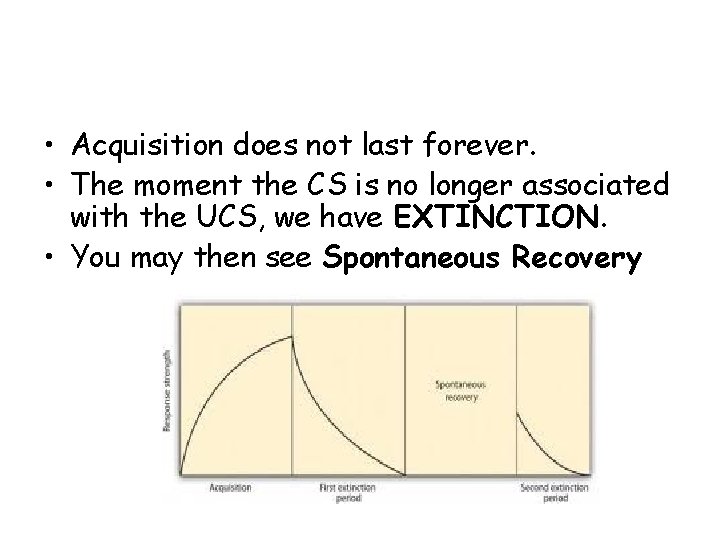
• Acquisition does not last forever. • The moment the CS is no longer associated with the UCS, we have EXTINCTION. • You may then see Spontaneous Recovery
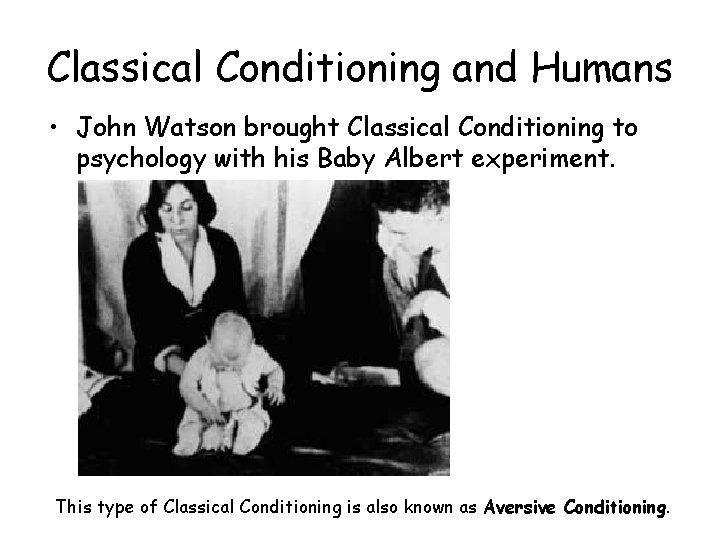
Classical Conditioning and Humans • John Watson brought Classical Conditioning to psychology with his Baby Albert experiment. This type of Classical Conditioning is also known as Aversive Conditioning.
Preparedness and Contrapreparedness • Seligman- We are prepared to fear certain things. All common objects of phobias (heights, snakes, the dark ertc…) are “related to the survival of the species through the long course of evolution. ” • Thus, we generally do not develop phobias of flowers and hammers and electric outlets. Despite the fact that an electric outlet poses a greater threat to you than does a garter snake.
Learned Taste Aversions • When it comes to food being paired with sickness, the conditioning is incredible strong. • Even when food and sickness are hours apart. • Food must be salient (noticeable. )
Mary Cover Jones and Wolpe • Since phobias can be acquired can’t we condition people not to be afraid? • Jones- conditioned children to not be afraid of rats with candy • Candy (US) leads to pleasure (UR) • Pairing candy (US) with rats (CS) eventually brings about pleasure (CR) • Wolpe- Desensitization therapy • Step 1 - Deep muscle relaxation • Step 2 - create an anxiety hierarchy • Step 3 - Progress up the anxiety hierarchy by degrees until you no longer feel anxiety
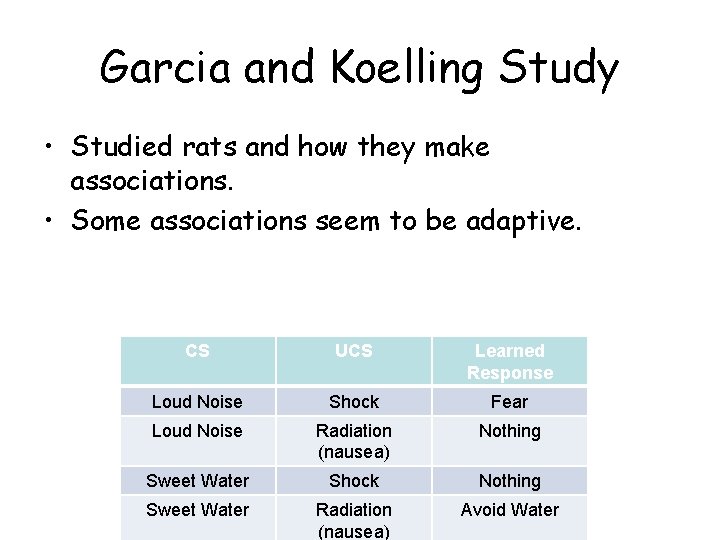
Garcia and Koelling Study • Studied rats and how they make associations. • Some associations seem to be adaptive. CS UCS Learned Response Loud Noise Shock Fear Loud Noise Radiation (nausea) Nothing Sweet Water Shock Nothing Sweet Water Radiation (nausea) Avoid Water
Operant Conditioning • Learner is not passive • This is voluntary learning • Thorndike’s Law of Effect
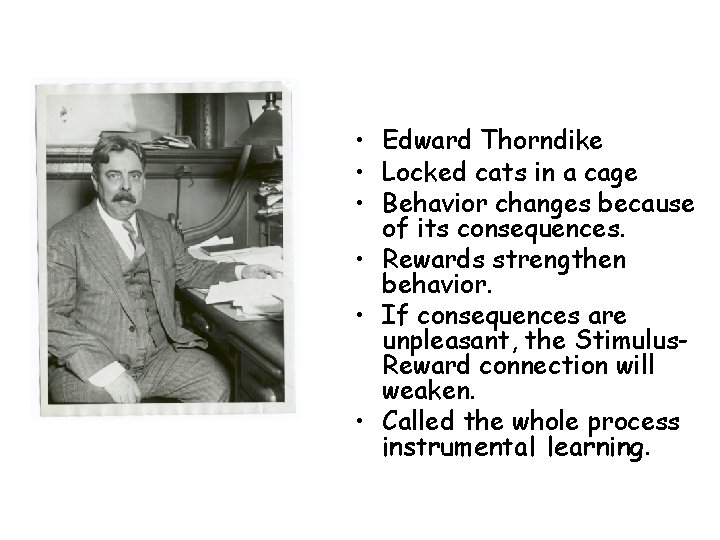
• Edward Thorndike • Locked cats in a cage • Behavior changes because of its consequences. • Rewards strengthen behavior. • If consequences are unpleasant, the Stimulus. Reward connection will weaken. • Called the whole process instrumental learning.
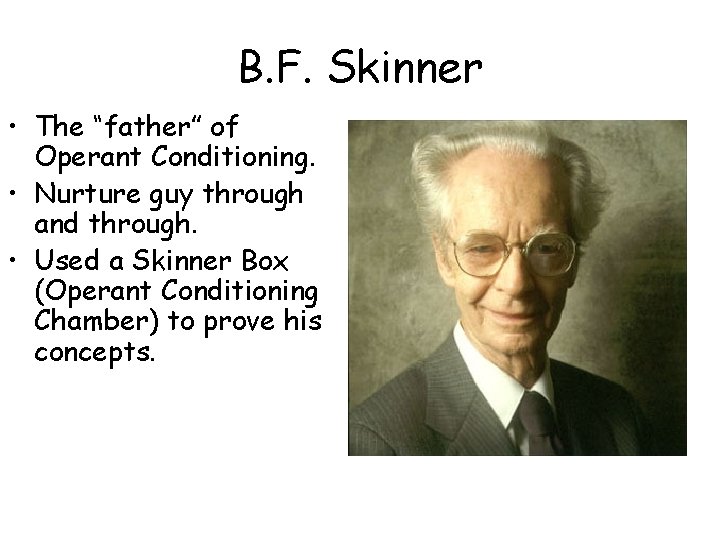
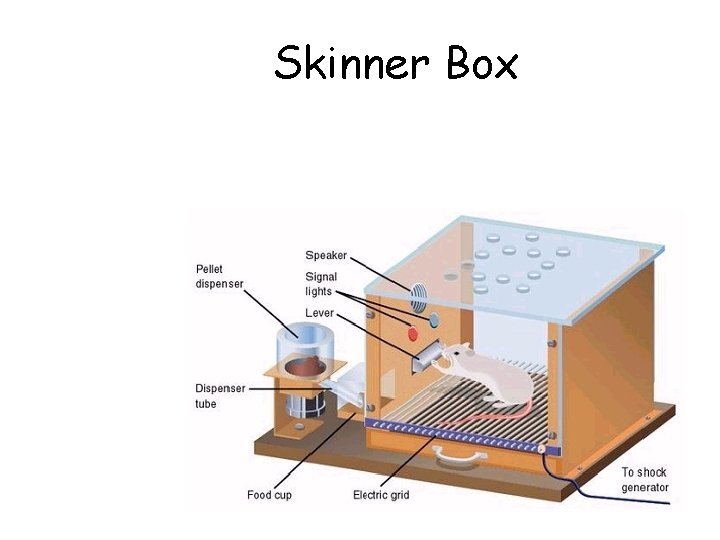
B. F. Skinner • The “father” of Operant Conditioning. • Nurture guy through and through. • Used a Skinner Box (Operant Conditioning Chamber) to prove his concepts.
Skinner Box
Reinforces • A reinforcer is anything the INCREASES a behavior. Positive Reinforcement: • The addition of something pleasant. Negative Reinforcement: • The removal of something unpleasant. • Two types of NR: • 1) Escape Learning • 2) Avoidance Learning (Getting kicked out of class versus cutting class)
Punishment Meant to decrease a behavior. Positive Punishment • Addition of something unpleasant. Negative Punishment (Omission Training) • Removal of something pleasant. There are 3 rules to punishment: 1) It must be swift 2) It must be fair 3) It must be consistent This is VERY difficult to do!!!!!
• Avoidance Training • Usually done with animals, there is typically a warning device of some sort (light or noise) that precedes a painful or scary experience. The animal then learns to do a particular task after the warning to avoid the pain/scare. • How about Humans?
Superstitious behavior • • • Do you have any superstitions? Why do we have superstitions? Post Hoc Ergo Propter Hoc “After this, therefore because of this” “I wore my Yankee boxers to the game and Sabathia threw a no-hitter so now I wear them to every game. ”
Learned helplessness • • • Seligman- dogs on the treadmill. Why so significant? Poverty Abuse Drugs
Generalization and Discrimination Generalization • Something is so similar to the CS that you get a CR. • For example, if you are conditioned to flinch at the sound of a door slam, you would flinch at the sound of a book falling, or a car door. Discrimination • Something so different to the CS so you do not get a CR. • However, you would not flinch at the sound of loud music or loud cheering at a game.
First-Order and Second-Order Conditioning First Order Conditioning. • Bell + meat = salivation. • Bell = Salivation. Second Order Conditioning (After first order conditioning has occurred) • Light + Bell = Salivation. • Light = Salivation.
Contingencies- Timing Matters • Delayed Conditioning: present CS, while CS is still there, present UCS. • Trace Conditioning: present CS, short break, then present UCS. • Simultaneous Conditioning: CS and UCS are presented at the same time. • Backward Conditioning: UCS is presented, then CS is presented.
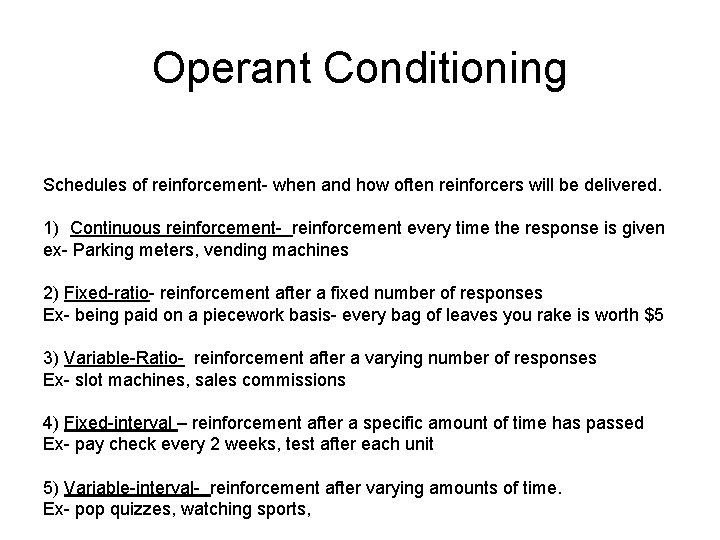
Operant Conditioning Schedules of reinforcement- when and how often reinforcers will be delivered. 1) Continuous reinforcement- reinforcement every time the response is given ex- Parking meters, vending machines 2) Fixed-ratio- reinforcement after a fixed number of responses Ex- being paid on a piecework basis- every bag of leaves you rake is worth $5 3) Variable-Ratio- reinforcement after a varying number of responses Ex- slot machines, sales commissions 4) Fixed-interval – reinforcement after a specific amount of time has passed Ex- pay check every 2 weeks, test after each unit 5) Variable-interval- reinforcement after varying amounts of time. Ex- pop quizzes, watching sports,
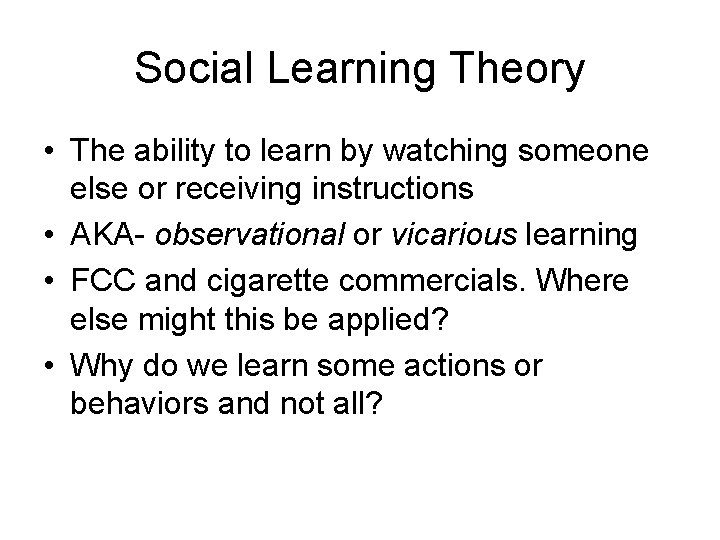
Social Learning Theory • The ability to learn by watching someone else or receiving instructions • AKA- observational or vicarious learning • FCC and cigarette commercials. Where else might this be applied? • Why do we learn some actions or behaviors and not all?
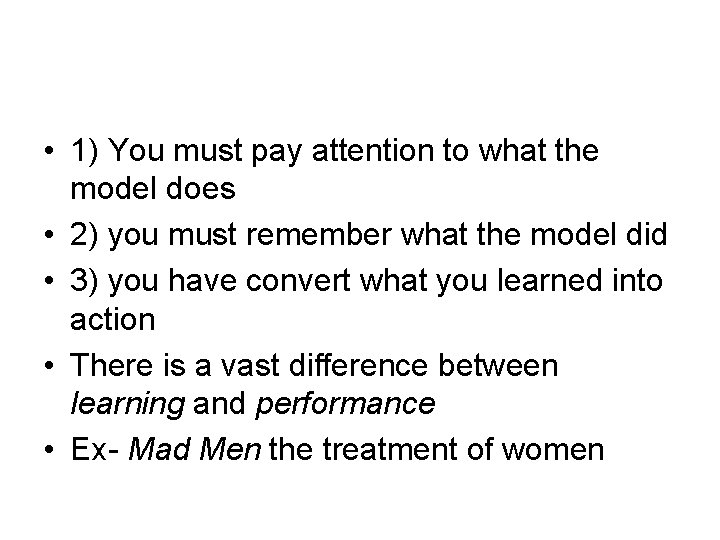
• 1) You must pay attention to what the model does • 2) you must remember what the model did • 3) you have convert what you learned into action • There is a vast difference between learning and performance • Ex- Mad Men the treatment of women
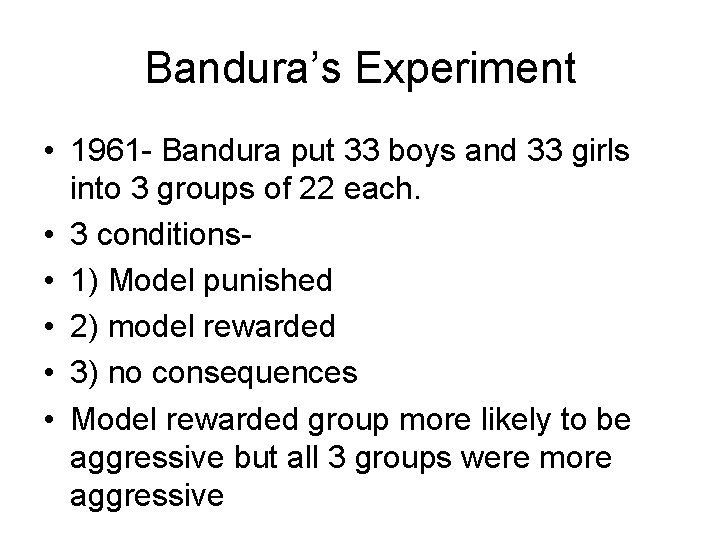
Bandura’s Experiment • 1961 - Bandura put 33 boys and 33 girls into 3 groups of 22 each. • 3 conditions • 1) Model punished • 2) model rewarded • 3) no consequences • Model rewarded group more likely to be aggressive but all 3 groups were more aggressive
Footage • http: //www. youtube. com/watch? v=Pr 0 OTC Vt. Hb. U