
learning Chapter 7 Basic Learning Concepts What is
learning Chapter 7
Basic Learning Concepts • What is learning? • Process of acquiring through experience new information or behaviors • How do we learn? • Through association: Certain events occur together (Classical conditioning); Stimuli that are not control are associated and response is automatic (respondent behavior) • Through consequences: Association between a response and consequences is learned (Operant conditioning) • Through acquisition of mental information that guides behavior: Cognitive learning
Classical Conditioning • Watson • Influenced by Pavlov • Theoretical goal of science of psychology is prediction and control of behavior • Behaviorism • Psychology (1) should be an objective science that (2) studies behavior without reference to mental processes. • Most research psychologists today agree with (1) but not with (2).
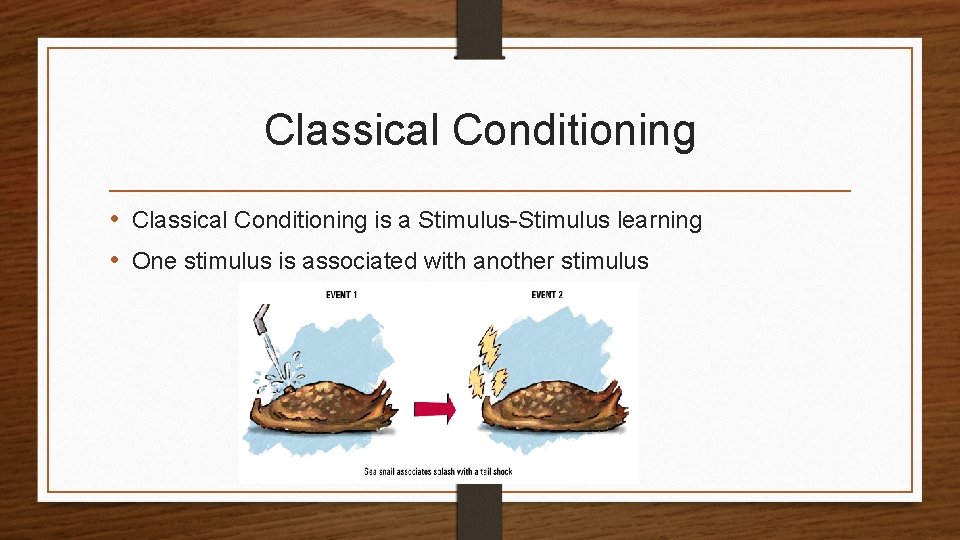
Classical Conditioning • Classical Conditioning is a Stimulus-Stimulus learning • One stimulus is associated with another stimulus
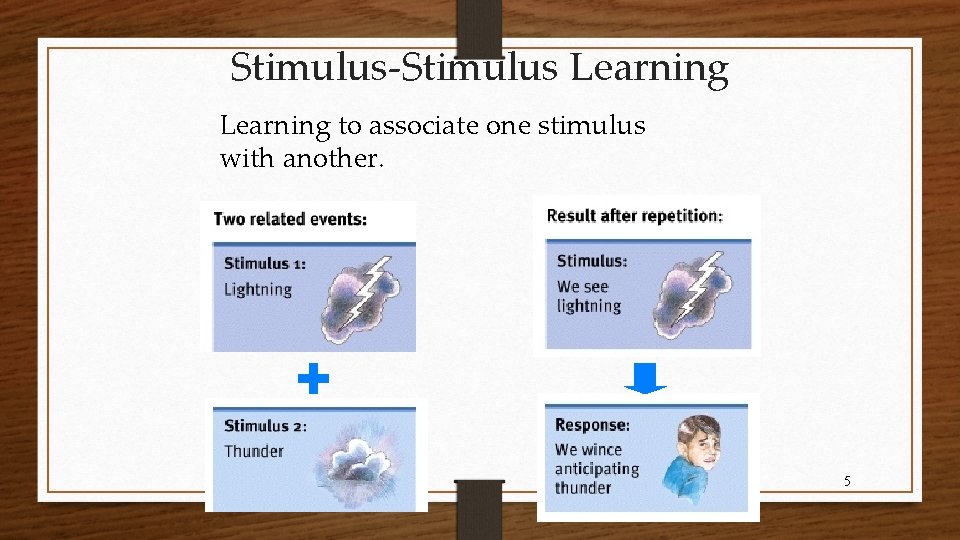
Stimulus-Stimulus Learning to associate one stimulus with another. 5
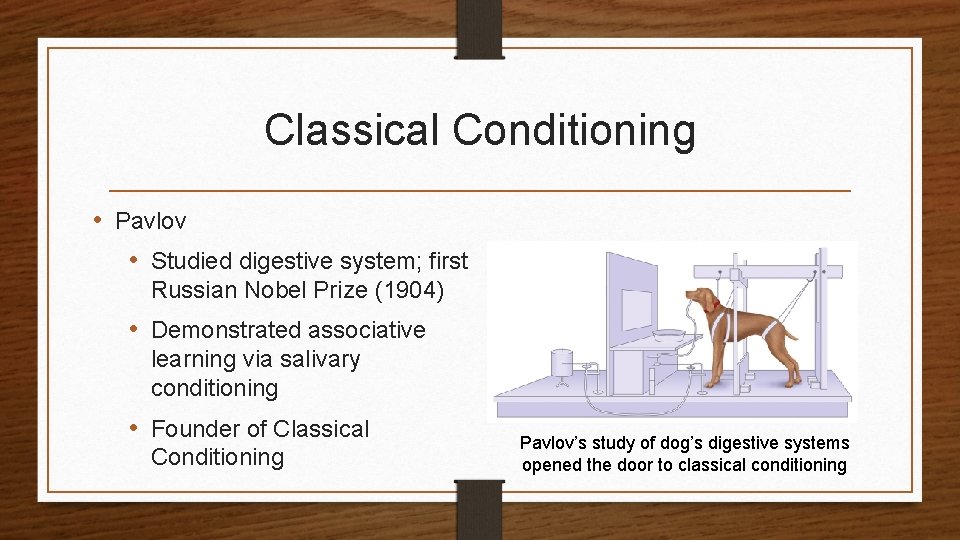
Classical Conditioning • Pavlov • Studied digestive system; first Russian Nobel Prize (1904) • Demonstrated associative learning via salivary conditioning • Founder of Classical Conditioning Pavlov’s study of dog’s digestive systems opened the door to classical conditioning
Classical Conditioning • Classical conditioning: Type of learning in which one learns to link two or more stimuli and anticipate events • Neutral stimulus (NS): In classical conditioning, a stimulus that elicits no response before conditioning • Unconditioned stimulus (US): in classical conditioning, a stimulus that unconditionally—naturally and automatically—triggers an unconditioned response (UR) • Unconditioned response (UR): In classical conditioning, an unlearned, naturally occurring response (such as salivation) to an unconditioned stimulus (US) (such as food in the mouth)
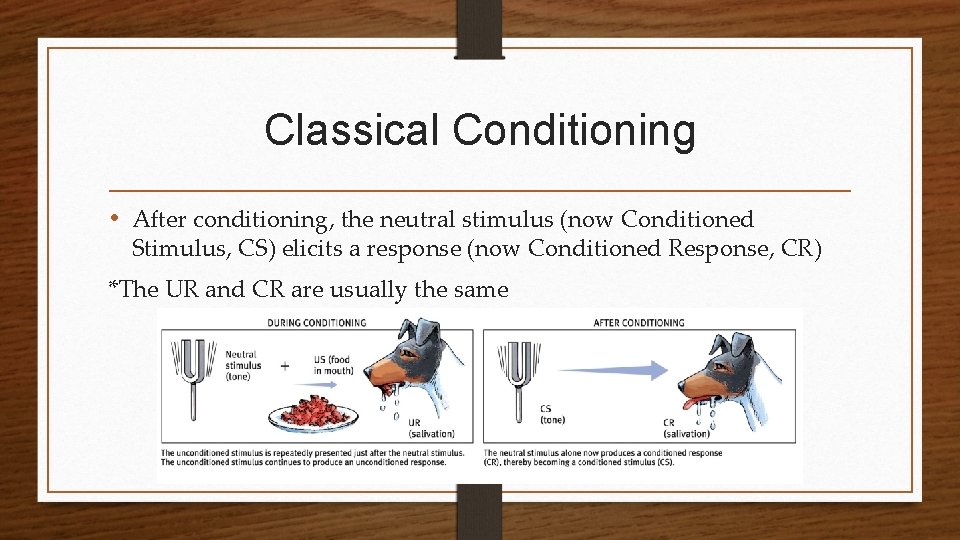
Classical Conditioning • After conditioning, the neutral stimulus (now Conditioned Stimulus, CS) elicits a response (now Conditioned Response, CR) *The UR and CR are usually the same

Classical Conditioning
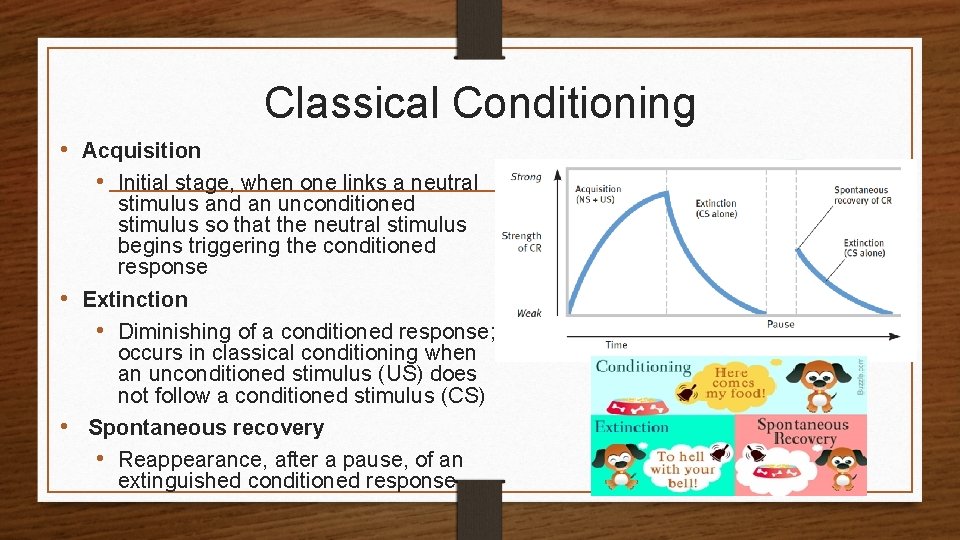
Classical Conditioning • Acquisition • Initial stage, when one links a neutral stimulus and an unconditioned stimulus so that the neutral stimulus begins triggering the conditioned response • Extinction • Diminishing of a conditioned response; occurs in classical conditioning when an unconditioned stimulus (US) does not follow a conditioned stimulus (CS) • Spontaneous recovery • Reappearance, after a pause, of an extinguished conditioned response
Classical Conditioning
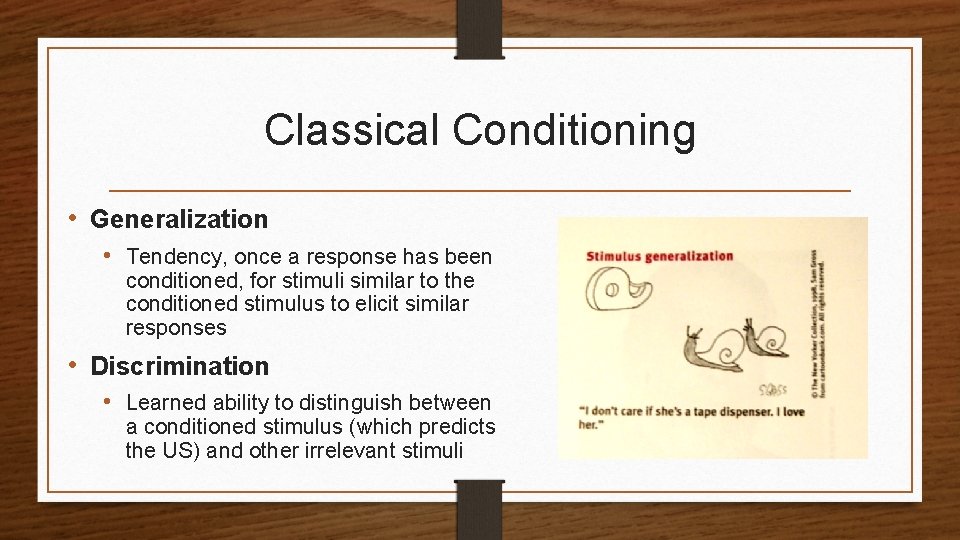
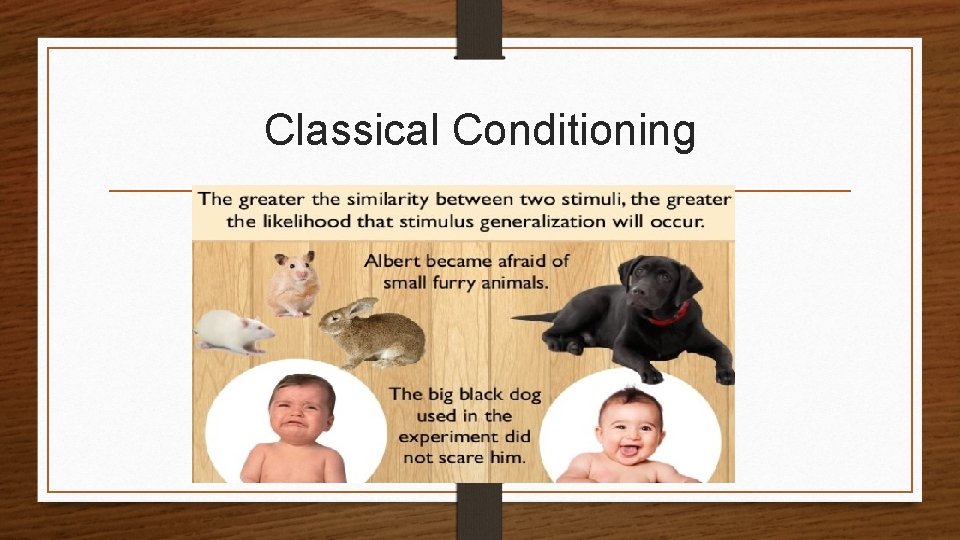
Classical Conditioning • Generalization • Tendency, once a response has been conditioned, for stimuli similar to the conditioned stimulus to elicit similar responses • Discrimination • Learned ability to distinguish between a conditioned stimulus (which predicts the US) and other irrelevant stimuli
Classical Conditioning
Classical Conditioning • Pavlov and Watson considered consciousness, or mind, unfit for the scientific study of psychology. However, they underestimated the importance of cognitive processes and biological constraints. • Early behaviorists believed that learned behaviors of various animals could be reduced to mindless mechanisms. • However, later behaviorists suggested that animals learn the predictability of a stimulus, meaning they learn expectancy or awareness of a stimulus (Rescorla, 1988).
Classical Conditioning • Pavlov and Watson believed that laws of learning were similar for all animals. Therefore, a pigeon and a person do not differ in their learning. • However, behaviorists later suggested that learning is constrained by an animal’s biology.
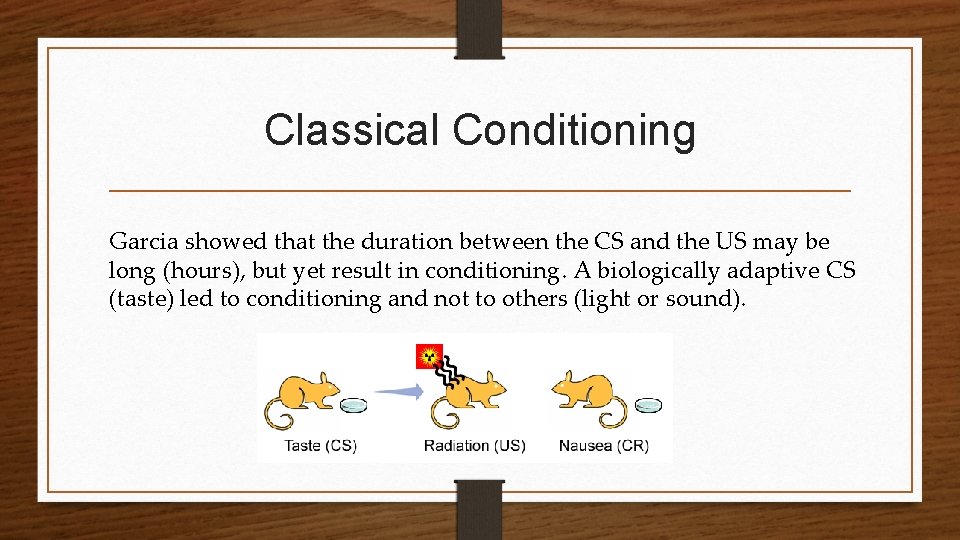
Classical Conditioning Garcia showed that the duration between the CS and the US may be long (hours), but yet result in conditioning. A biologically adaptive CS (taste) led to conditioning and not to others (light or sound).
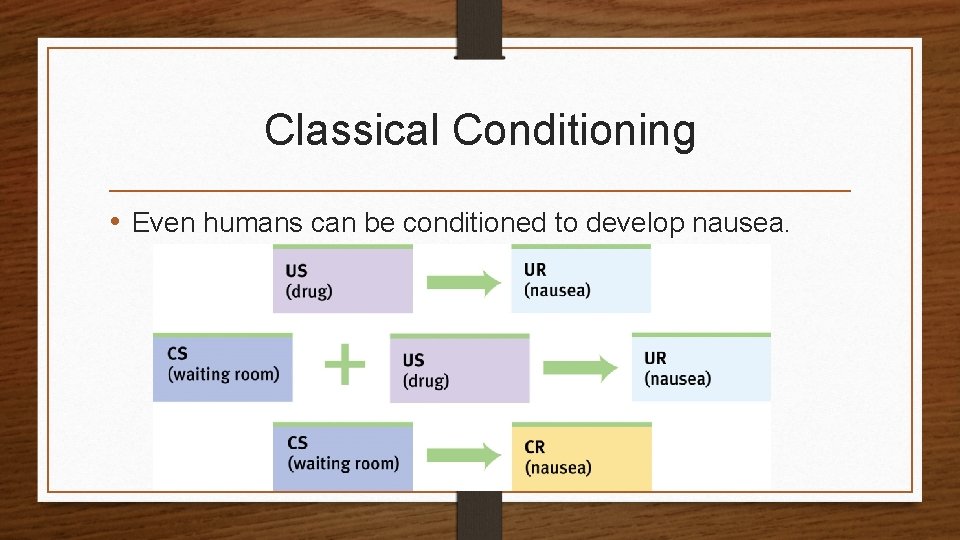
Classical Conditioning • Even humans can be conditioned to develop nausea.
Applications of Classical Conditioning Pavlov’s Legacy • Consensus among psychologists that classical conditioning is basic learning form • Many other responses to many other stimuli can be classically conditioned in many other organisms. • Pavlov demonstrated how a learning process can be studied objectively. • Classical conditioning is a basic form of learning that applies to all species.
Applications of Classical Conditioning • Pavlov’s principles are used to influence human health and wellbeing • Areas of consciousness, motivation, emotion, health, psychological disorders, therapy • Addicts counseled to avoid stimuli that may trigger cravings • Pairing particular taste with drug that influences immune responses may eventually lead to response from taste alone.
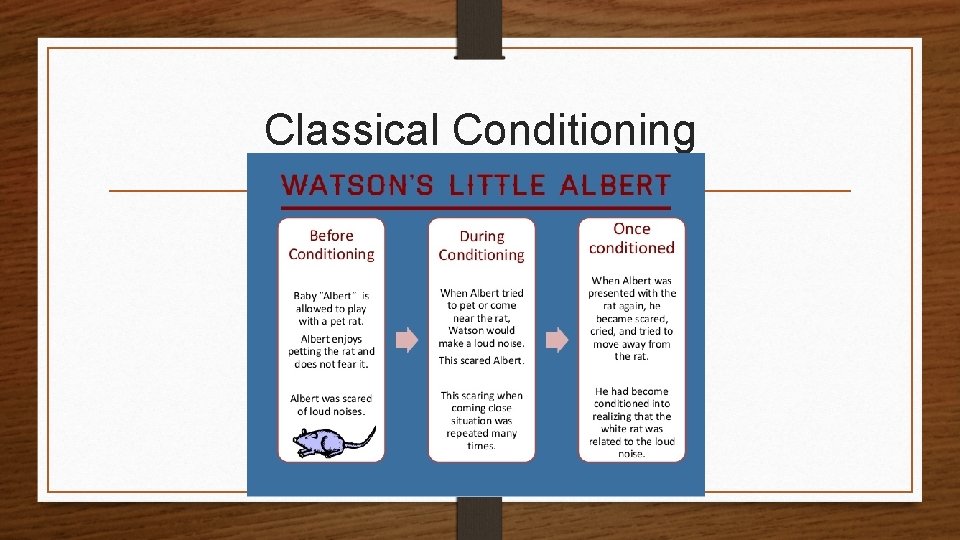
Applications of Classical Conditioning • Pavlov’s work also provided a basis for Watson’s ideas that human emotions and behaviors, though biologically influenced, are mainly conditioned responses. • Watson applied classical conditioning principles in his studies of “Little Albert” to demonstrate how specific fears might be conditioned. Used in advertising • When you hear “$5 footlong” you automatically think of what food chain?
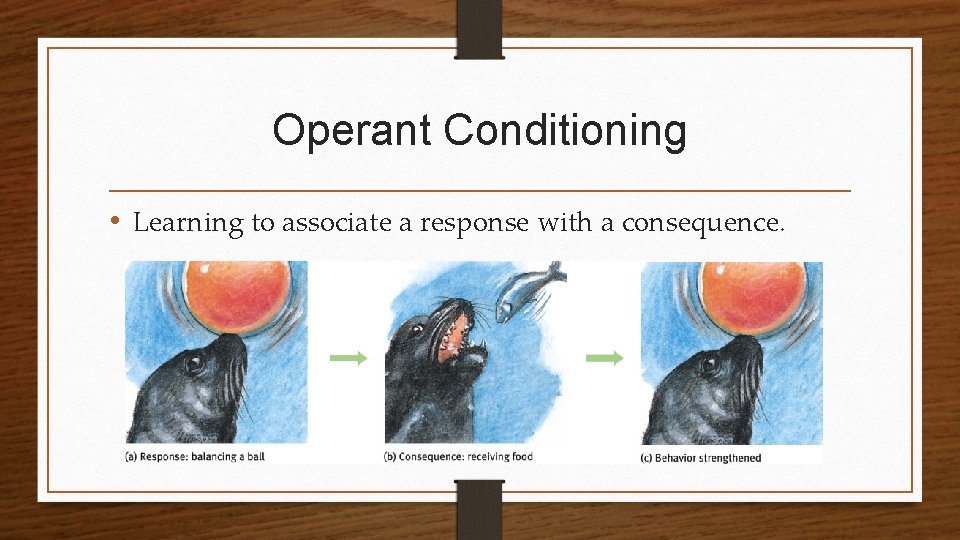
Operant Conditioning • Learning to associate a response with a consequence.
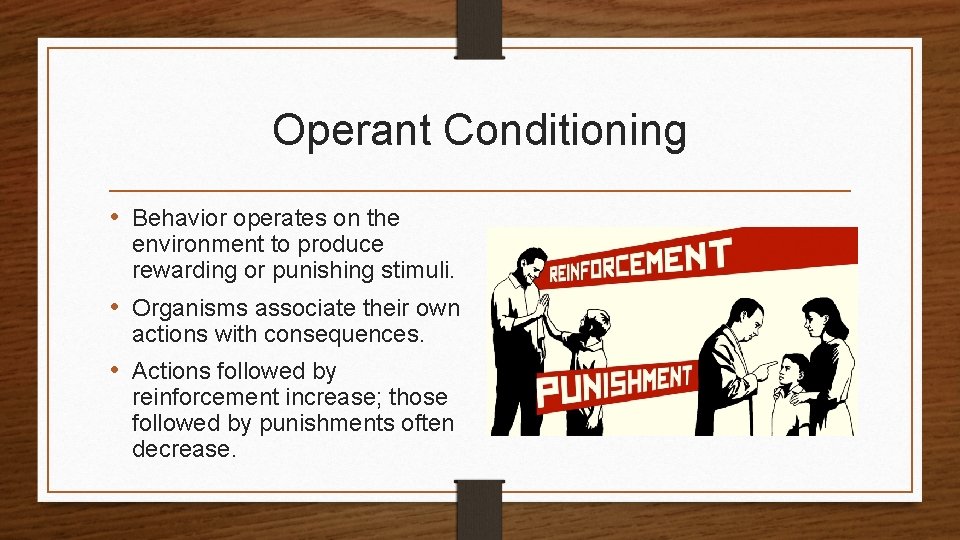
Operant Conditioning • Behavior operates on the environment to produce rewarding or punishing stimuli. • Organisms associate their own actions with consequences. • Actions followed by reinforcement increase; those followed by punishments often decrease.
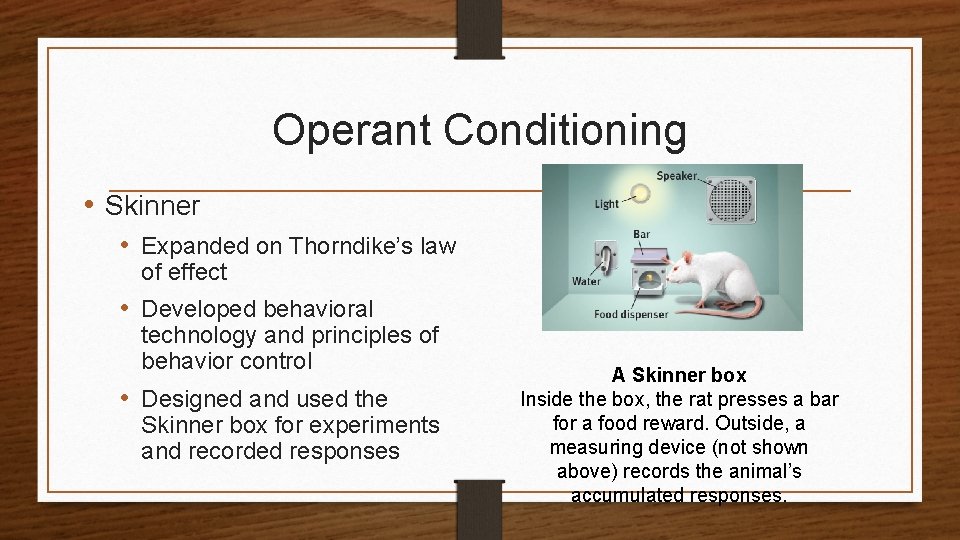
Operant Conditioning • Skinner • Expanded on Thorndike’s law of effect • Developed behavioral technology and principles of behavior control • Designed and used the Skinner box for experiments and recorded responses A Skinner box Inside the box, the rat presses a bar for a food reward. Outside, a measuring device (not shown above) records the animal’s accumulated responses.
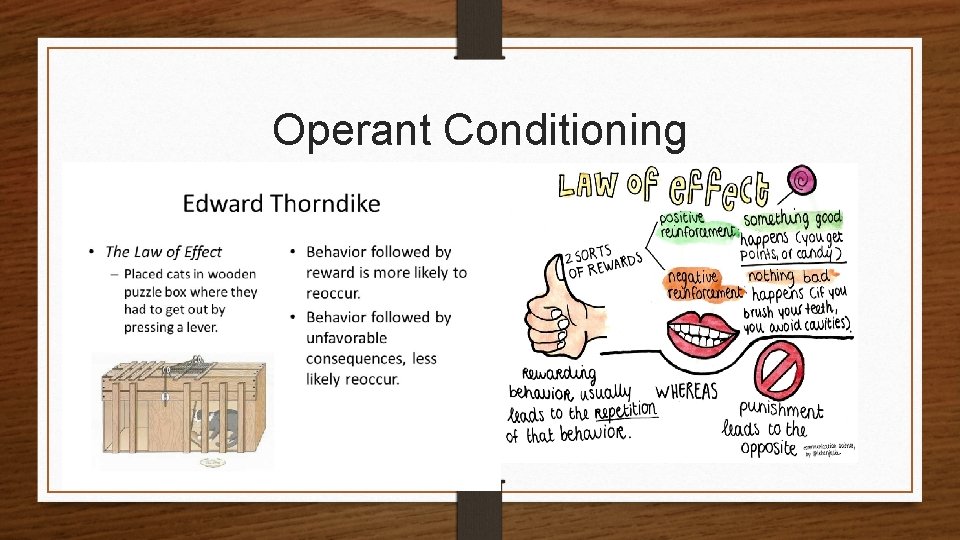
Operant Conditioning
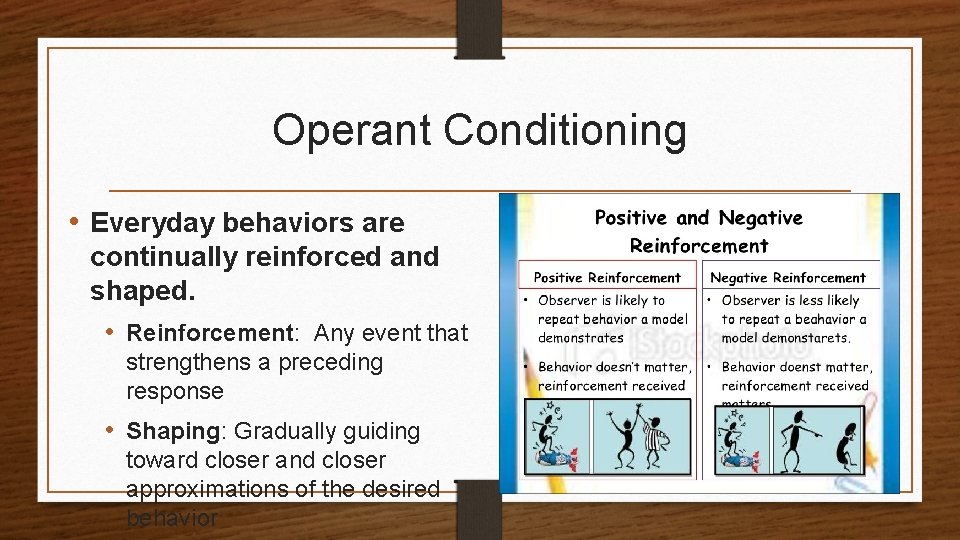
Operant Conditioning • Everyday behaviors are continually reinforced and shaped. • Reinforcement: Any event that strengthens a preceding response • Shaping: Gradually guiding toward closer and closer approximations of the desired behavior
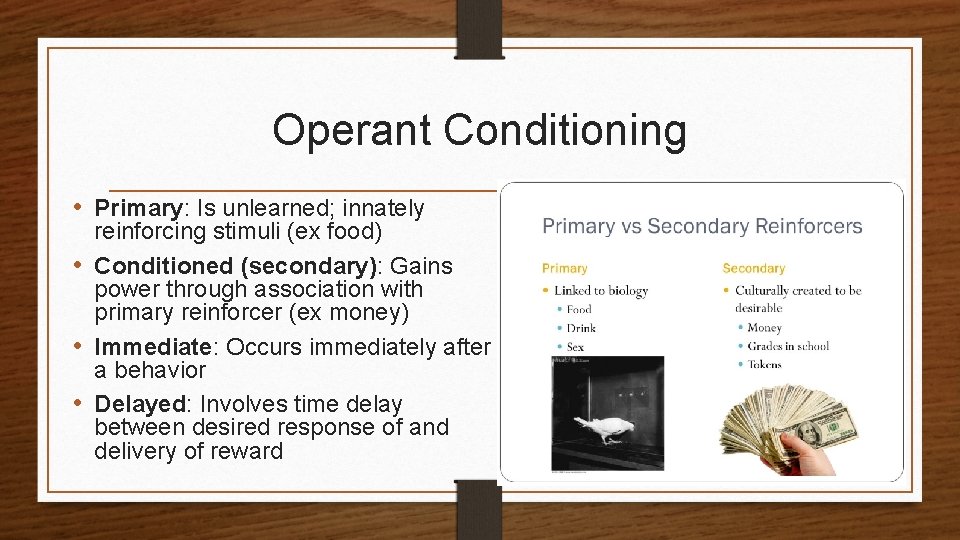
Operant Conditioning • Primary: Is unlearned; innately reinforcing stimuli (ex food) • Conditioned (secondary): Gains power through association with primary reinforcer (ex money) • Immediate: Occurs immediately after a behavior • Delayed: Involves time delay between desired response of and delivery of reward
Operant Conditioning • Reinforcement schedule • Includes pattern that defines how often a desired response will be reinforced • Continuous reinforcement schedule • Involves reinforcing the desired response every time it occurs • Partial (intermittent) reinforcement • Includes schedule reinforcing a response only part of the time; results in slower acquisition of a response but much greater resistance to extinction than does continuous reinforcement
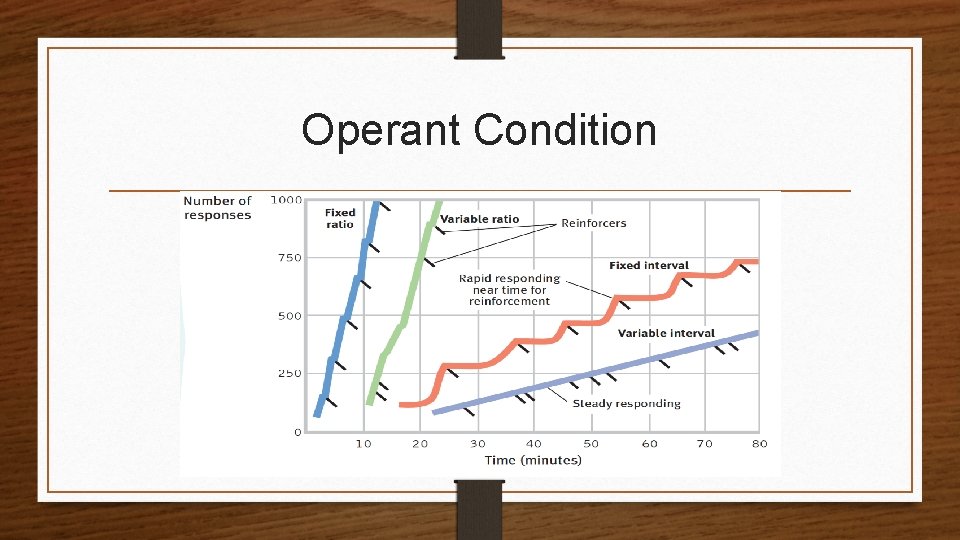
Operant Condition
Operant Conditioning • Fixed- ratio schedule: In operant conditioning, a reinforcement schedule that reinforces a response only after a specified number of responses. (Ex: getting paid for every 10 shoes made) • Variable-ratio: Schedule in operant conditioning, a reinforcement schedule that reinforces a response after an unpredictable number of responses. (Ex: gambling & fishing)
Operant Conditioning • Fixed-interval schedule: In operant conditioning, a reinforcement schedule that reinforces a response only after a specified time has elapsed. (only studying when you know there is a test/quiz or paid every two weeks) • Variable-interval schedule: In operant conditioning, a reinforcement schedule that reinforces a response at unpredictable time intervals. (pop quizzes or getting flowers from you S/O for no reason)
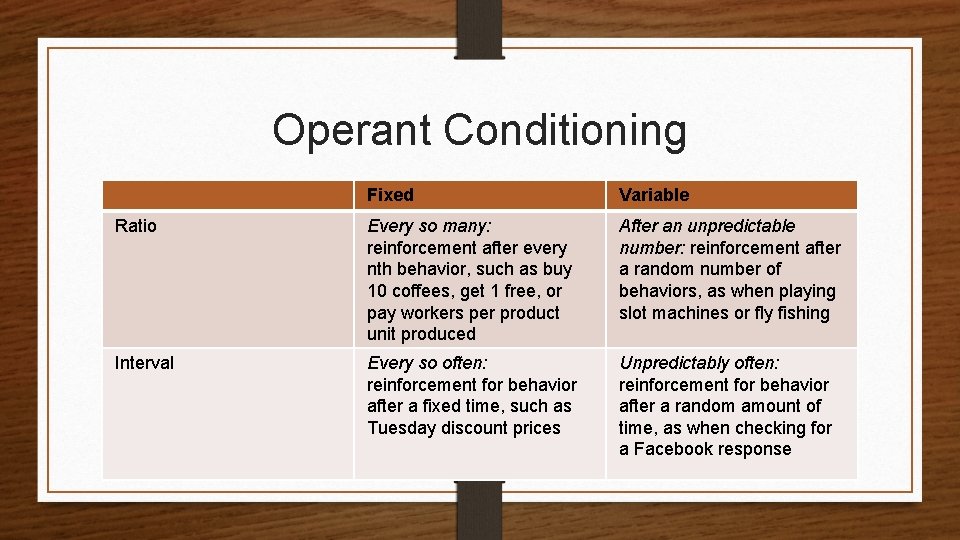
Operant Conditioning Fixed Variable Ratio Every so many: reinforcement after every nth behavior, such as buy 10 coffees, get 1 free, or pay workers per product unit produced After an unpredictable number: reinforcement after a random number of behaviors, as when playing slot machines or fly fishing Interval Every so often: reinforcement for behavior after a fixed time, such as Tuesday discount prices Unpredictably often: reinforcement for behavior after a random amount of time, as when checking for a Facebook response
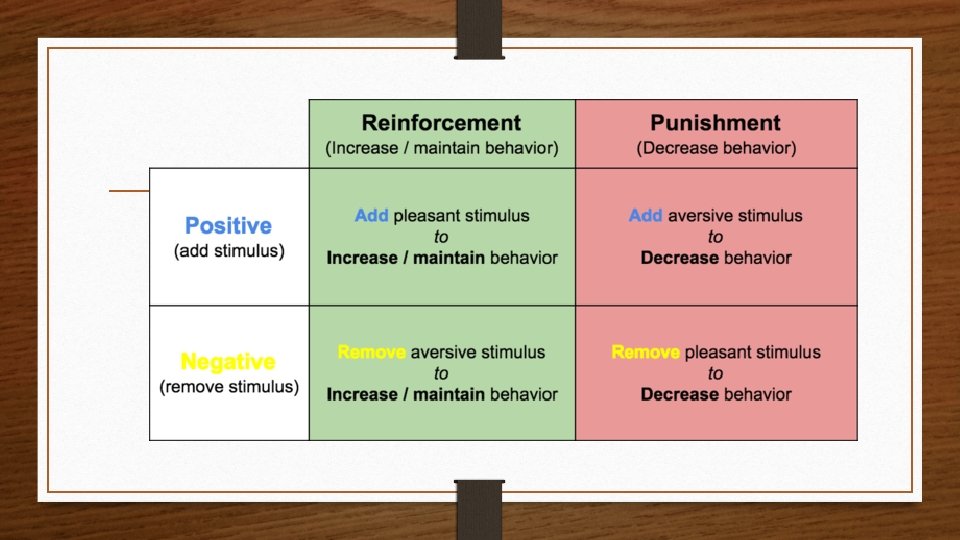
Operant Conditioning • Punishment administers an undesirable consequence or withdraws something desirable in an attempt to decrease the frequency of a behavior (a child’s disobedience). • Positive punishment • Presenting a negative consequence after an undesired behavior is exhibited, making the behavior less likely to happen in the future • Negative punishment • Removing a desired stimulus after particular undesired behavior is exhibited, resulting in reducing behavior in future
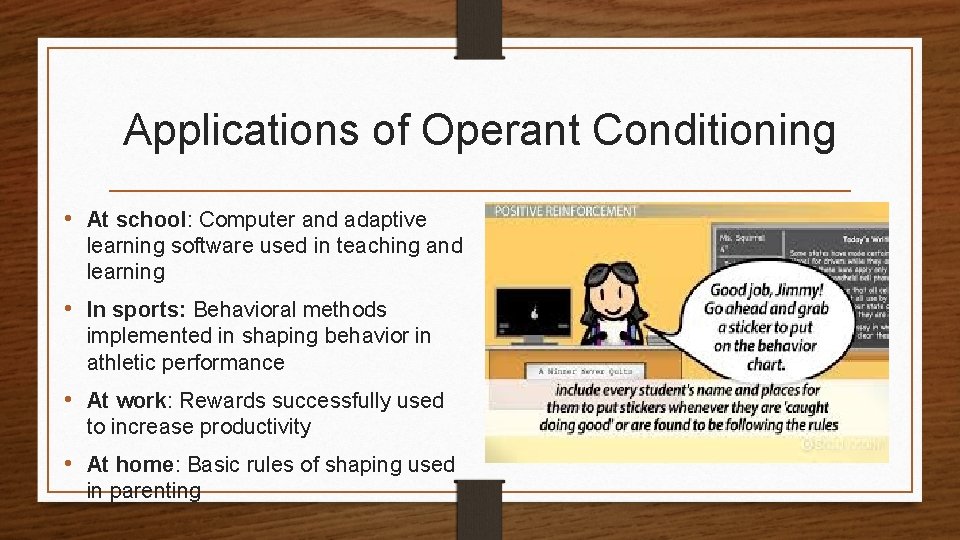
Applications of Operant Conditioning • At school: Computer and adaptive learning software used in teaching and learning • In sports: Behavioral methods implemented in shaping behavior in athletic performance • At work: Rewards successfully used to increase productivity • At home: Basic rules of shaping used in parenting
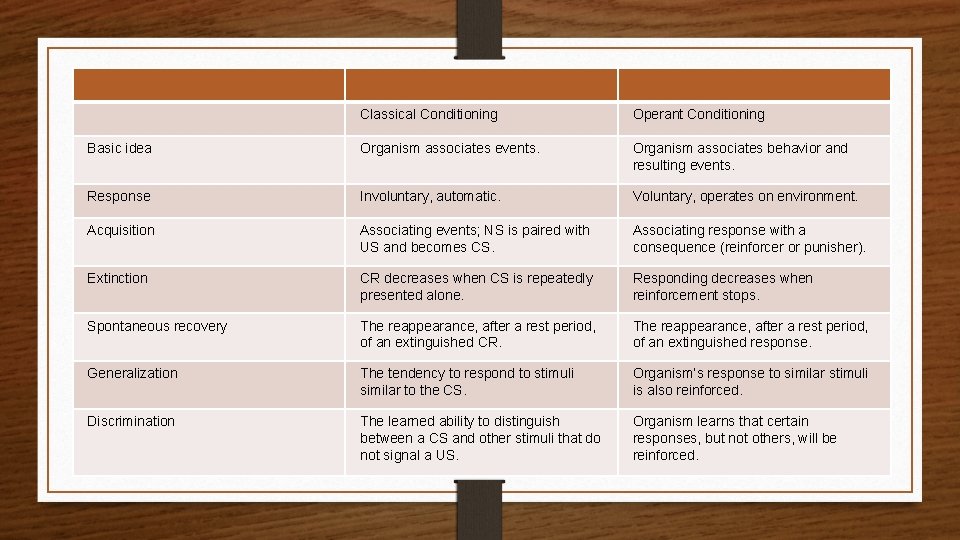
Classical Conditioning Operant Conditioning Basic idea Organism associates events. Organism associates behavior and resulting events. Response Involuntary, automatic. Voluntary, operates on environment. Acquisition Associating events; NS is paired with US and becomes CS. Associating response with a consequence (reinforcer or punisher). Extinction CR decreases when CS is repeatedly presented alone. Responding decreases when reinforcement stops. Spontaneous recovery The reappearance, after a rest period, of an extinguished CR. The reappearance, after a rest period, of an extinguished response. Generalization The tendency to respond to stimuli similar to the CS. Organism’s response to similar stimuli is also reinforced. Discrimination The learned ability to distinguish between a CS and other stimuli that do not signal a US. Organism learns that certain responses, but not others, will be reinforced.
Biological Constraints on Conditioning • Limits on classical conditioning • Garcia and Koelling’s taste-aversion research • Animals and humans seem biologically prepared to learn some associations rather than others • Conditioning is stronger when the CS is ecologically relevant • Genetic predisposition to associate CS with a US that follows predictably and immediately is adaptive
Biological Constraints on Conditioning • Limits on operant conditioning • Nature limits species’ capacity for operant conditioning • Biological constraints predispose organisms to learn associations that are naturally adaptive • Instinctive drift occurs as animals revert to biologically predisposed patterns
Cognition Processes and Classical Conditioning • Mental information that guides behavior is acquired through cognitive learning. • Animal learning of predictability of event (Rescorla and Wagner, 1972) • British children conditioning of ice-cream associated characters (Field, 2006) • Adult gut-level liking for characters associated with positive stimuli (Olson and Fazio, 2001) • Stronger likes and dislikes when notice and awareness of associations learned (Shanks, 2010)
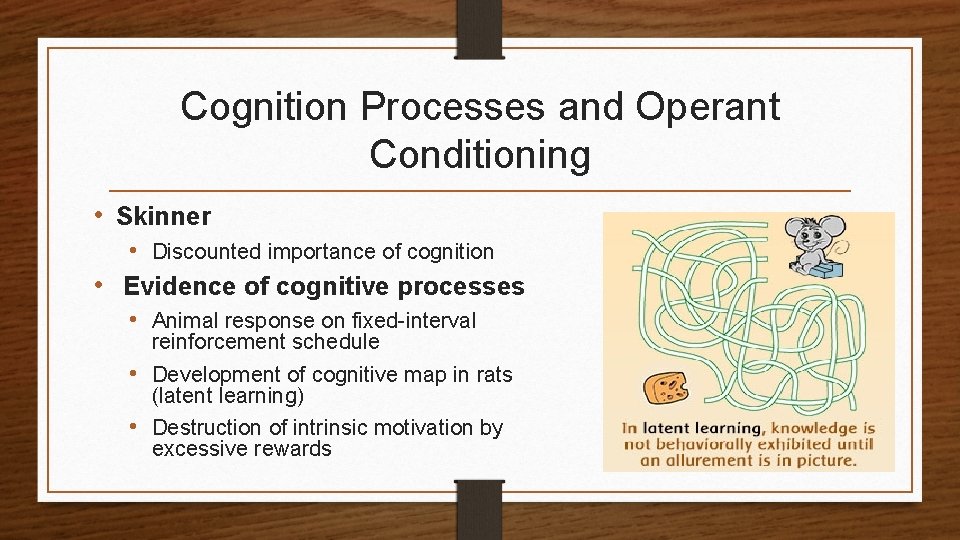
Cognition Processes and Operant Conditioning • Skinner • Discounted importance of cognition • Evidence of cognitive processes • Animal response on fixed-interval reinforcement schedule • Development of cognitive map in rats (latent learning) • Destruction of intrinsic motivation by excessive rewards
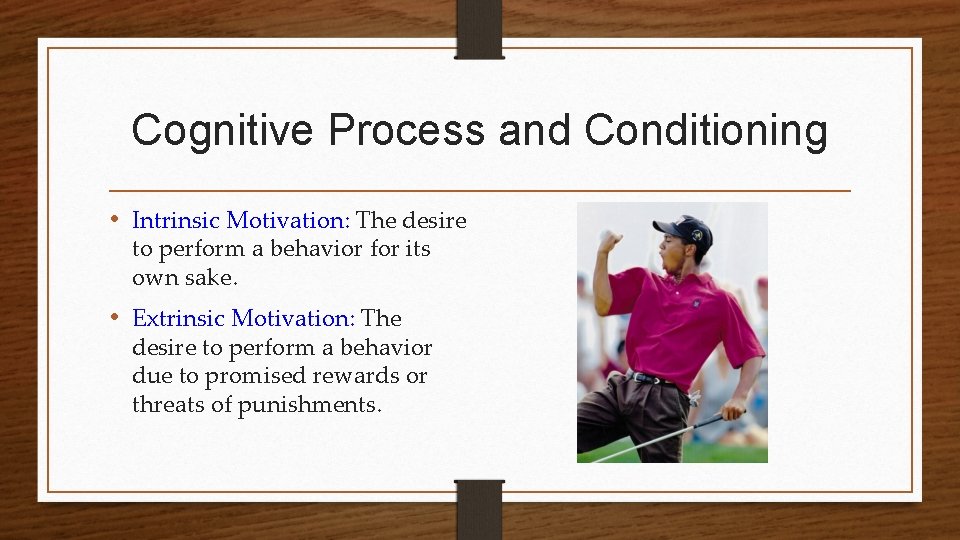
Cognitive Process and Conditioning • Intrinsic Motivation: The desire to perform a behavior for its own sake. • Extrinsic Motivation: The desire to perform a behavior due to promised rewards or threats of punishments.
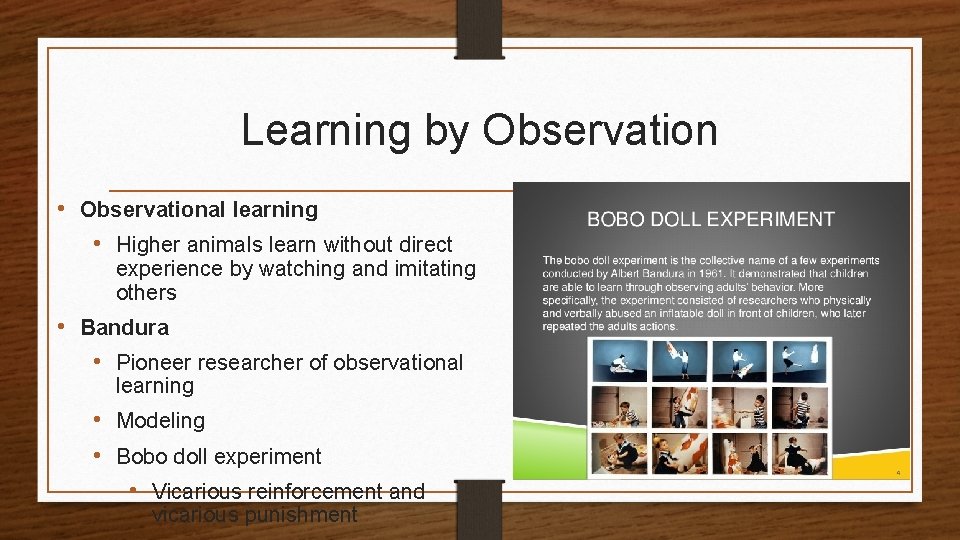
Learning by Observation • Observational learning • Higher animals learn without direct experience by watching and imitating others • Bandura • Pioneer researcher of observational learning • Modeling • Bobo doll experiment • Vicarious reinforcement and vicarious punishment
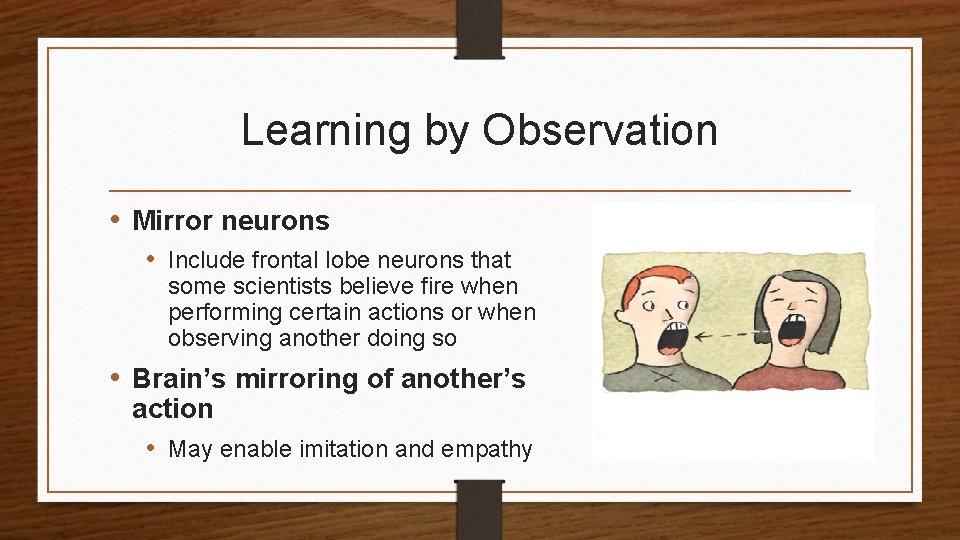
Learning by Observation • Mirror neurons • Include frontal lobe neurons that some scientists believe fire when performing certain actions or when observing another doing so • Brain’s mirroring of another’s action • May enable imitation and empathy
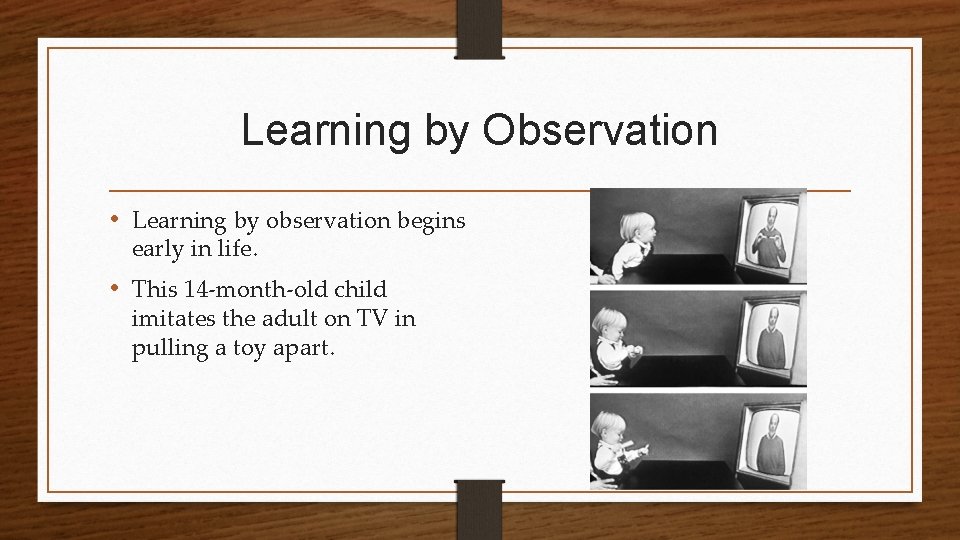
Learning by Observation • Learning by observation begins early in life. • This 14 -month-old child imitates the adult on TV in pulling a toy apart.
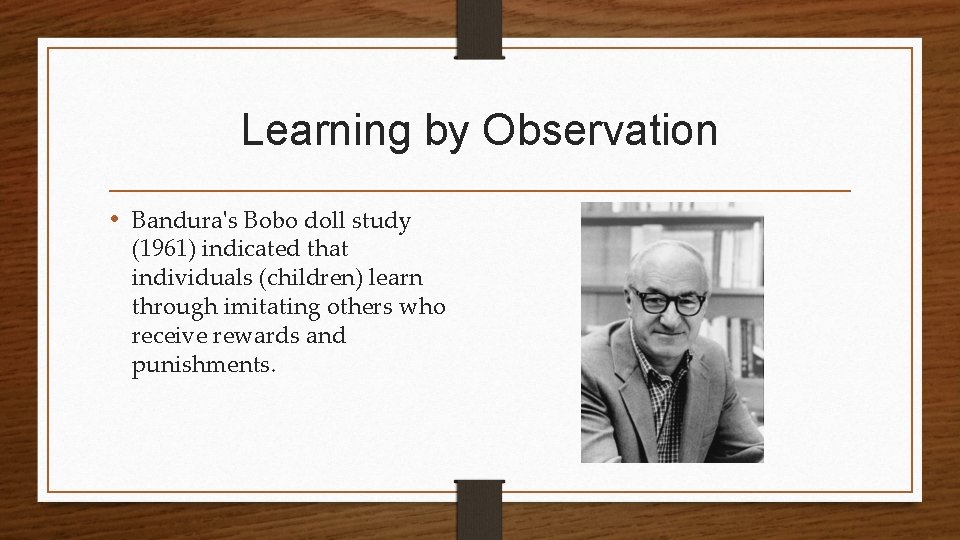
Learning by Observation • Bandura's Bobo doll study (1961) indicated that individuals (children) learn through imitating others who receive rewards and punishments.
Applications of Observational Learning • Prosocial Learning Effects • Behavior modeling enhances learning of communication, sales, and customer service skills in new employees • Modeling nonviolent behavior prompts similar behavior in others • Across seven countries, viewing prosocial media increased later helping behavior • Socially responsive toddlers tend to have strong internalized conscience as preschoolers
Applications of Observational Learning • Antisocial effects • Abusive parents may have aggressive children • Watching TV and videos may teach children • Bullying is effective tool for controlling others • Free and easy sex has little later consequences • Men should be tough; women should be gentle • Violence-viewing effect
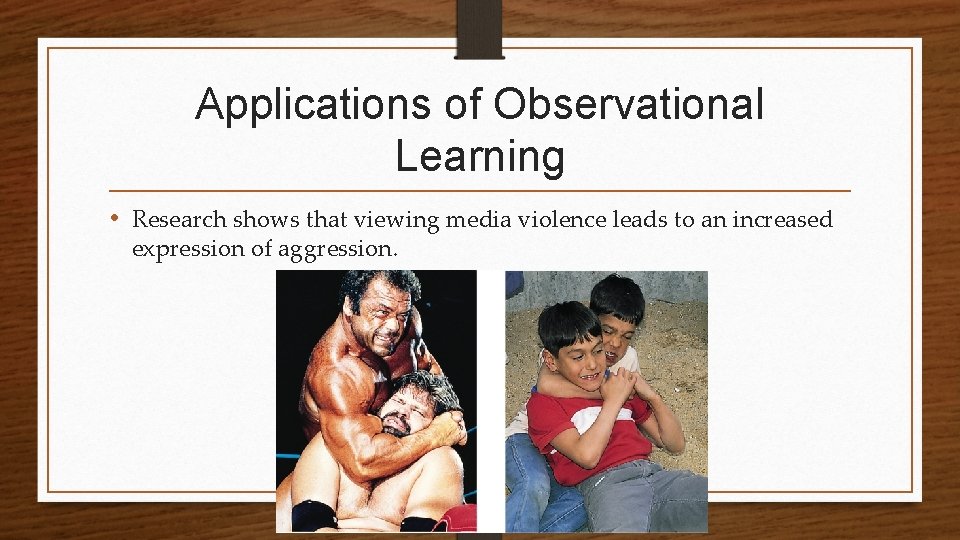
Applications of Observational Learning • Research shows that viewing media violence leads to an increased expression of aggression.
- Slides: 47