
Learning causal theories Josh Tenenbaum MIT Department of
Learning causal theories Josh Tenenbaum MIT Department of Brain and Cognitive Sciences Computer Science and AI Lab (CSAIL)
Collaborators Charles Kemp Noah Goodman Tom Griffiths Vikash Mansinghka
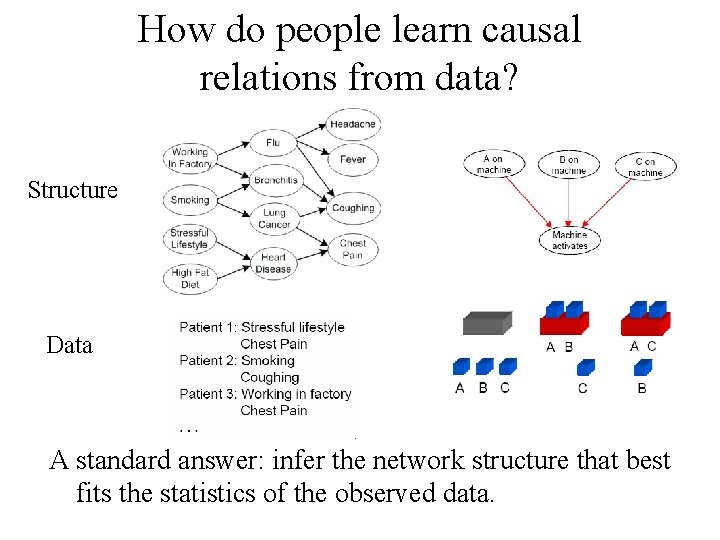
How do people learn causal relations from data? Structure Data A standard answer: infer the network structure that best fits the statistics of the observed data.
What’s missing from this account? The background knowledge that makes causal learning possible. • Causal schemata: domain-specific theories that constrain “natural” causal hypotheses – Abstract classes of variables and mechanisms – Causal laws defined over these classes • Causal variables: substrate of causal hypotheses – Which variables are relevant – How variables ground out in perceptual and motor experience The puzzle: This background knowledge must itself be learned, and learned together with specific causal relations. How? A possible answer: hierarchical Bayesian models
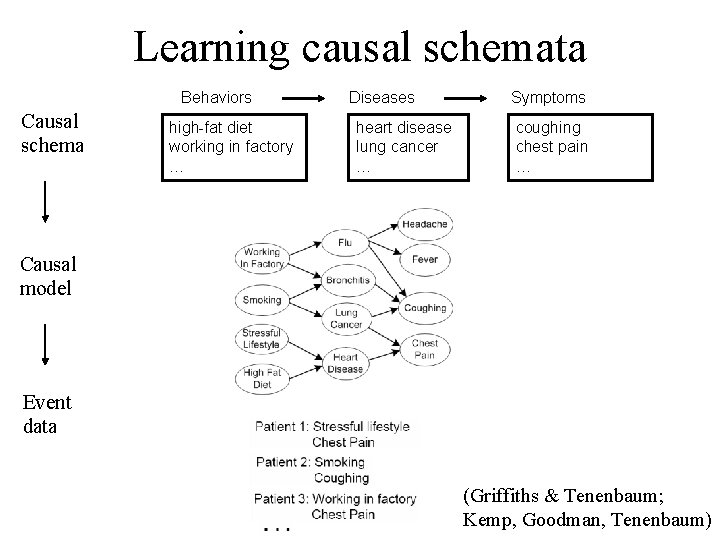
Learning causal schemata Behaviors Causal schema high-fat diet working in factory … Diseases heart disease lung cancer … Symptoms coughing chest pain … Causal model Event data (Griffiths & Tenenbaum; Kemp, Goodman, Tenenbaum)
TO ADD • # of Bayes nets on 12 variables: 521939651343829405020504063 • # of Bayes nets on 12 variables that fit this schema: 131072 • Maybe put the bayes net learning slide next.
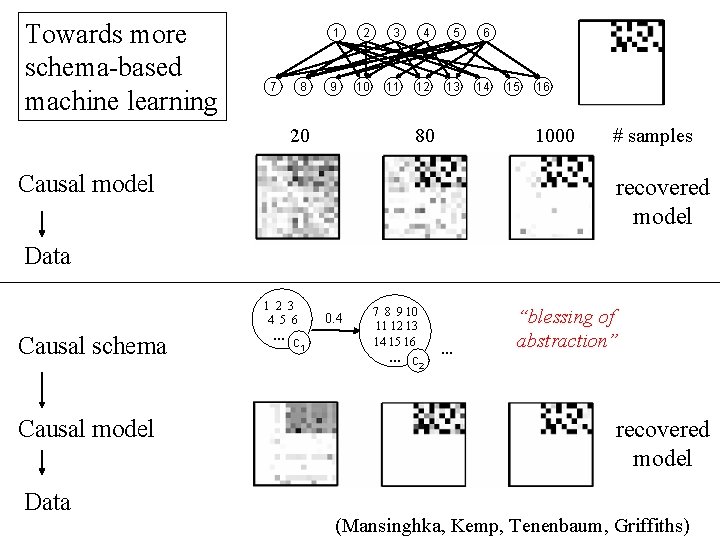
Towards more schema-based machine learning 7 8 1 2 3 4 5 6 9 10 11 12 13 14 20 80 15 16 1000 Causal model # samples recovered model Data Causal schema 1 2 3 4 5 6 … c 1 0. 4 7 8 9 10 11 12 13 14 15 16 … c … “blessing of abstraction” 2 Causal model Data recovered model (Mansinghka, Kemp, Tenenbaum, Griffiths)
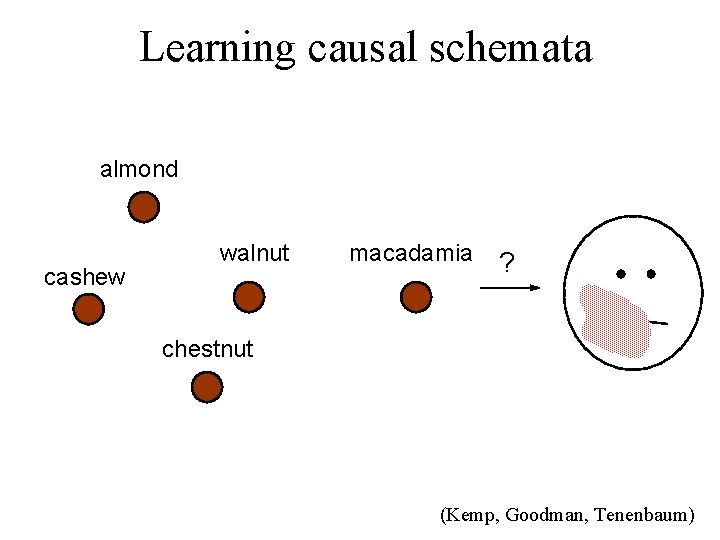
Learning causal schemata almond cashew walnut macadamia ? chestnut (Kemp, Goodman, Tenenbaum)
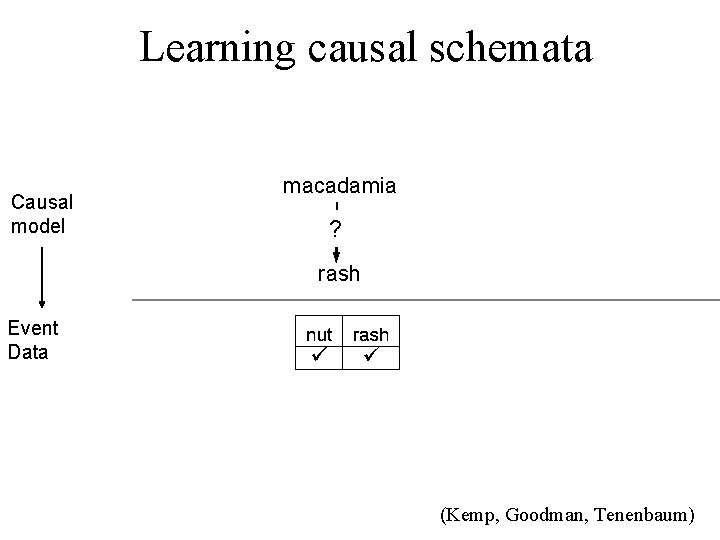
Learning causal schemata Causal model macadamia ? rash Event Data (Kemp, Goodman, Tenenbaum)
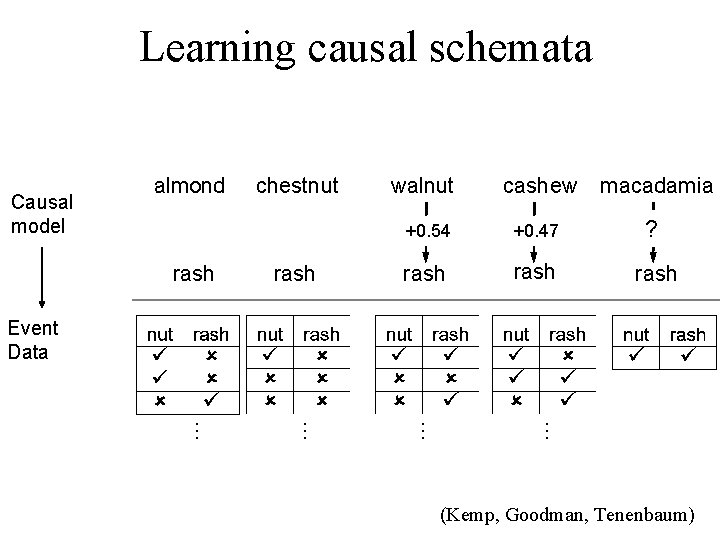
Learning causal schemata Causal model almond rash chestnut rash walnut cashew macadamia +0. 54 +0. 47 ? rash Event Data … … (Kemp, Goodman, Tenenbaum)
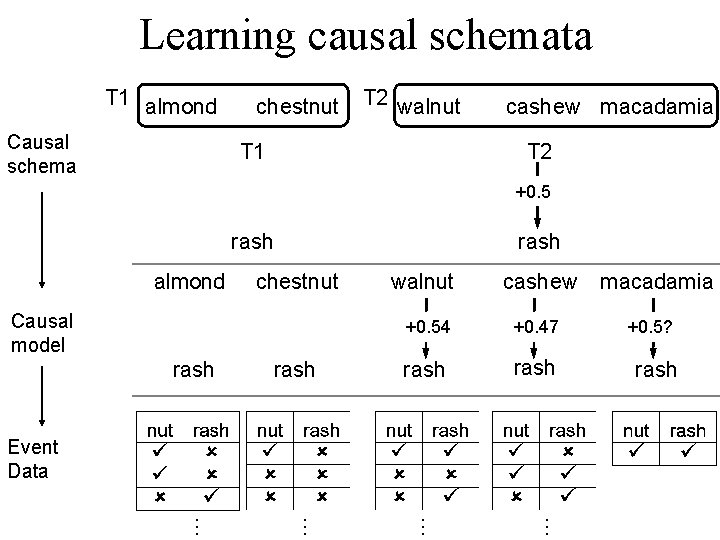
Learning causal schemata T 1 almond Causal schema chestnut T 2 walnut T 1 cashew macadamia T 2 +0. 5 rash almond rash chestnut Causal model rash walnut cashew macadamia +0. 54 +0. 47 +0. 5? rash Event Data … …
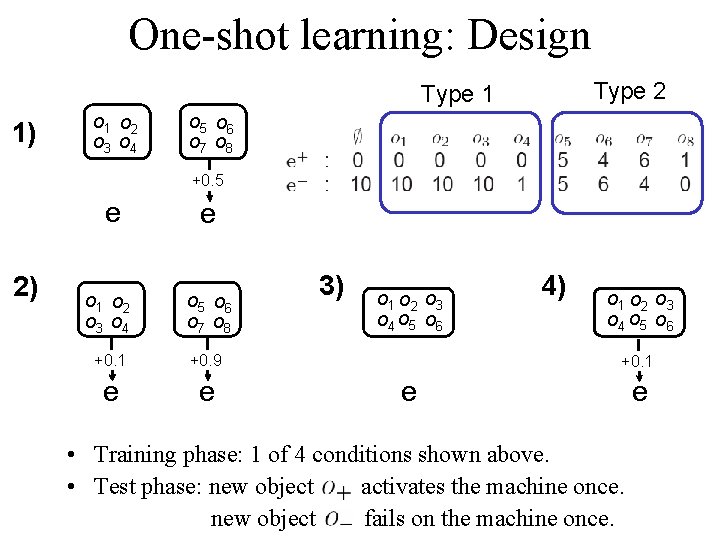
One-shot learning: Design Type 2 Type 1 1) o 1 o 2 o 3 o 4 o 5 o 6 o 7 o 8 +0. 5 2) e e o 1 o 2 o 3 o 4 o 5 o 6 o 7 o 8 +0. 1 +0. 9 e e 3) o 1 o 2 o 3 o 4 o 5 o 6 4) o 1 o 2 o 3 o 4 o 5 o 6 +0. 1 e • Training phase: 1 of 4 conditions shown above. • Test phase: new object activates the machine once. new object fails on the machine once. e
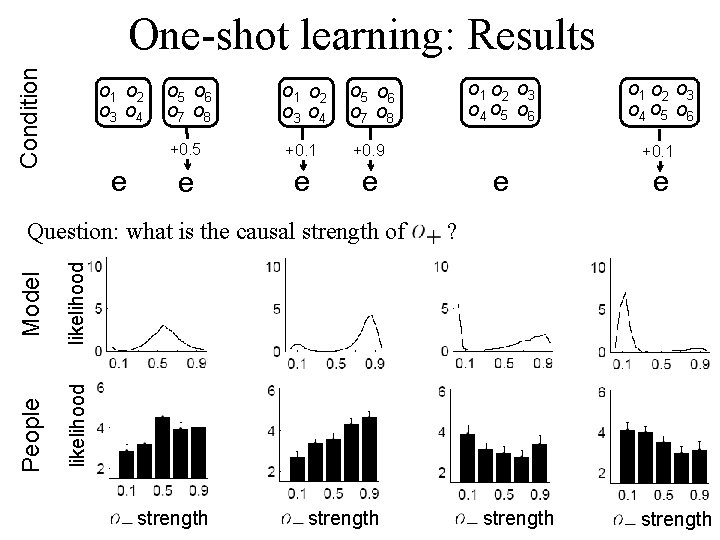
Condition One-shot learning: Results o 1 o 2 o 3 o 4 e o 5 o 6 o 7 o 8 o 1 o 2 o 3 o 4 o 5 o 6 o 7 o 8 +0. 5 +0. 1 +0. 9 e e e Model likelihood People likelihood Question: what is the causal strength of strength o 1 o 2 o 3 o 4 o 5 o 6 +0. 1 e e ? strength
What’s missing from this account? • Causal schemas: domain-specific theories that constrain “natural” causal hypotheses – Abstract classes of variables and mechanisms – Causal laws defined over these classes • Causal variables: constituents of causal hypotheses – Which variables are relevant – How variables ground out in perceptual and motor experience A possible answer: hierarchical Bayesian models (Kemp, Goodman, Griffiths, Tenenbaum).
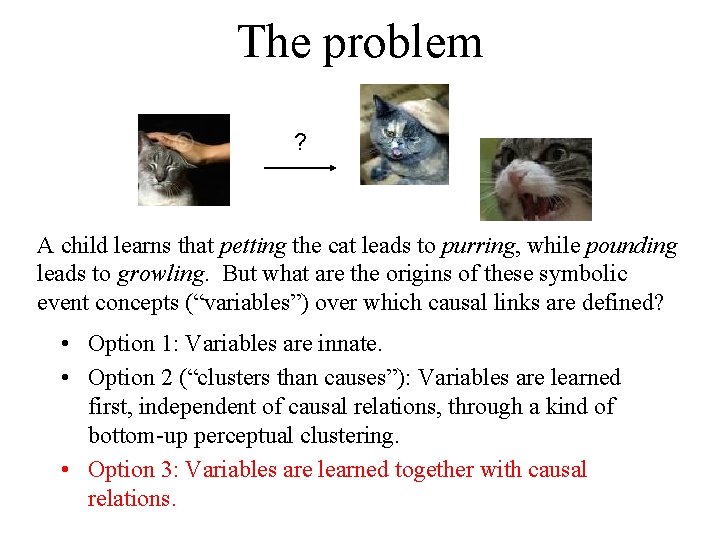
The problem ? A child learns that petting the cat leads to purring, while pounding leads to growling. But what are the origins of these symbolic event concepts (“variables”) over which causal links are defined? • Option 1: Variables are innate. • Option 2 (“clusters than causes”): Variables are learned first, independent of causal relations, through a kind of bottom-up perceptual clustering. • Option 3: Variables are learned together with causal relations.
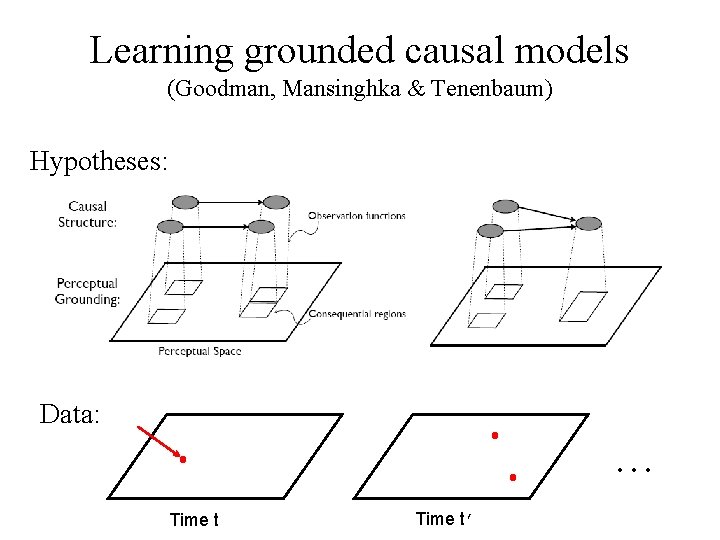
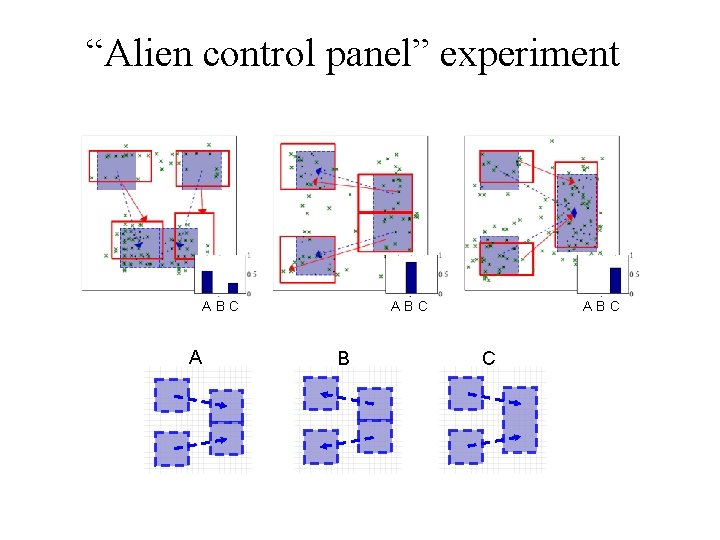
Learning grounded causal models (Goodman, Mansinghka & Tenenbaum) Hypotheses: Data: … Time t’
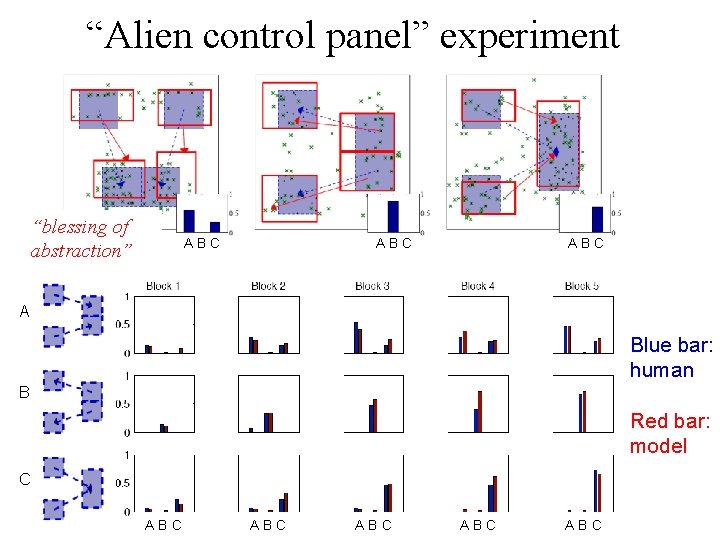
“Alien control panel” experiment “blessing of abstraction” ABC ABC A Blue bar: human B Red bar: model C ABC ABC ABC
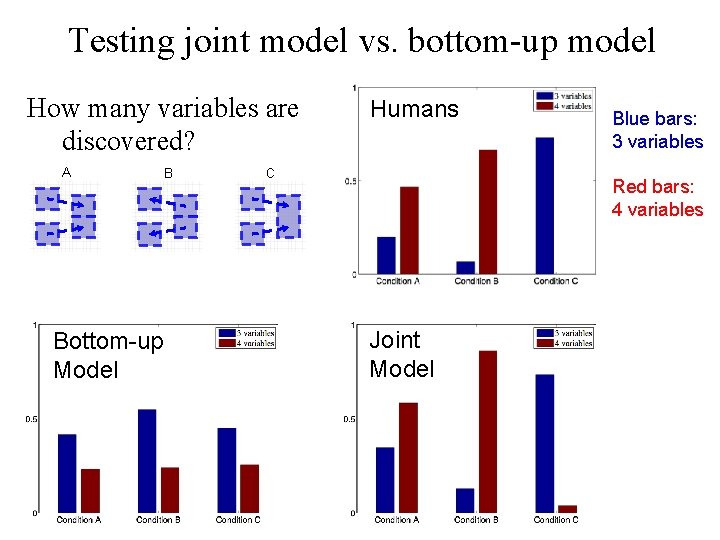
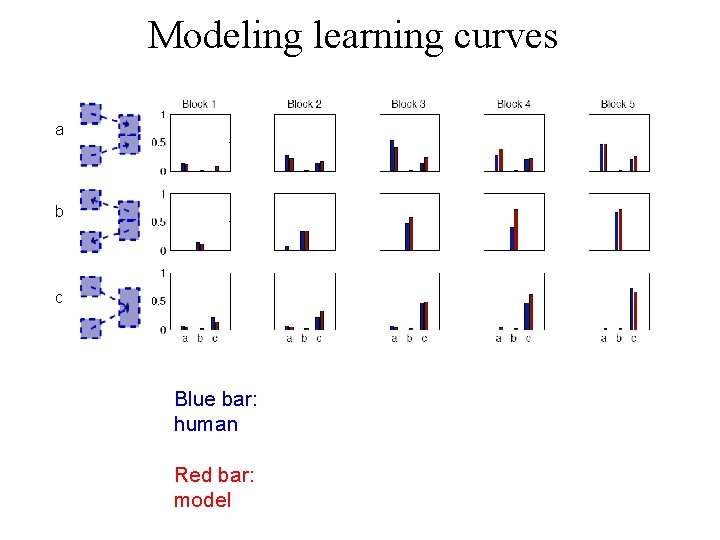
Testing joint model vs. bottom-up model How many variables are discovered? A B Bottom-up Model Humans C Blue bars: 3 variables Red bars: 4 variables Joint Model
Conclusions • Hierarchical Bayesian models (HBMs) explain how the background knowledge that supports causal learning may itself be learned from data through rational inferential means. – Domain-specific schemas constraining candidate causal networks – Causal variables grounded in sensorimotor experience • These issues are more general than just causal learning, relevant to learning associations, symbolic rules, … • Contrast with traditional approaches to knowledge acquisition: – Classical empiricism: variables are innate, schemata learned slowly by accretion and superposition. – Classical nativism: variables are innate, schemata are innate. – Hierarchical Bayes: variables and schemata could be learned; abstract knowledge may be learned from surprisingly little data. • Ongoing and future work: Applying HBMs to many different aspects of cognitive development – categories and properties, word learning, syntax in language, social relations, theory of mind, …

“Alien control panel” experiment ABC A ABC B ABC C
Modeling learning curves a b c Blue bar: human Red bar: model
- Slides: 23