
Learning by analogy Prof Gheorghe Tecuci Learning Agents

Learning by analogy Prof. Gheorghe Tecuci Learning Agents Laboratory Computer Science Department George Mason University 2002, G. Tecuci, Learning Agents Laboratory 1
Overview Learning by analogy: definition Design issues The structure mapping theory Determinations Problem solving by analogy Exercises Recommended reading 2002, G. Tecuci, Learning Agents Laboratory 2
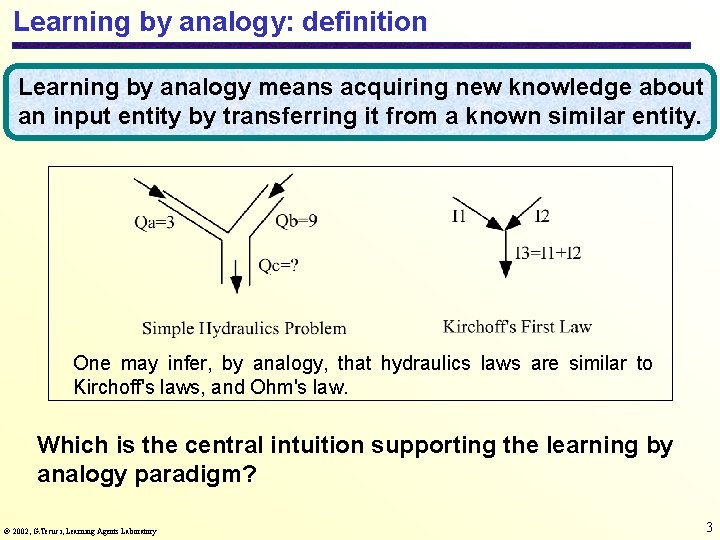
Learning by analogy: definition Learning by analogy means acquiring new knowledge about an input entity by transferring it from a known similar entity. One may infer, by analogy, that hydraulics laws are similar to Kirchoff's laws, and Ohm's law. Which is the central intuition supporting the learning by analogy paradigm? 2002, G. Tecuci, Learning Agents Laboratory 3
Discussion Central intuition supporting learning by analogy: If two entities are similar in some respects then they could be similar in other respects as well. Examples of analogies: Pressure Drop is like Voltage Drop A variable in a programming language is like a box. Provide other examples of analogies. 2002, G. Tecuci, Learning Agents Laboratory 4
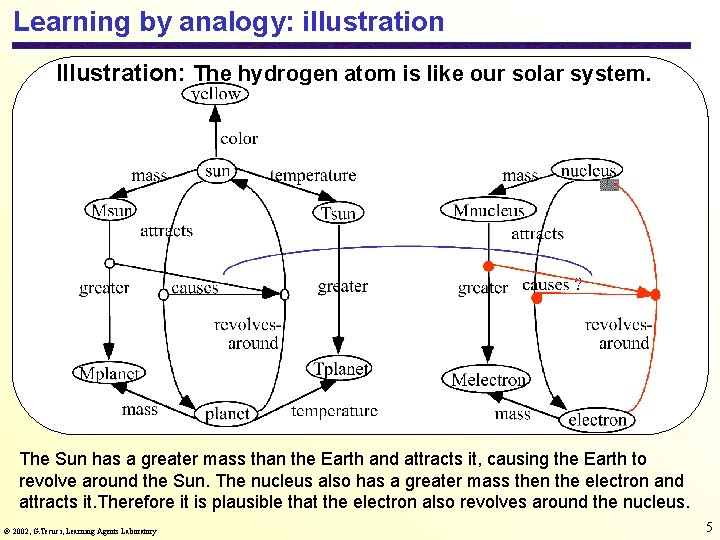
Learning by analogy: illustration Illustration: The hydrogen atom is like our solar system. The Sun has a greater mass than the Earth and attracts it, causing the Earth to revolve around the Sun. The nucleus also has a greater mass then the electron and attracts it. Therefore it is plausible that the electron also revolves around the nucleus. 2002, G. Tecuci, Learning Agents Laboratory 5
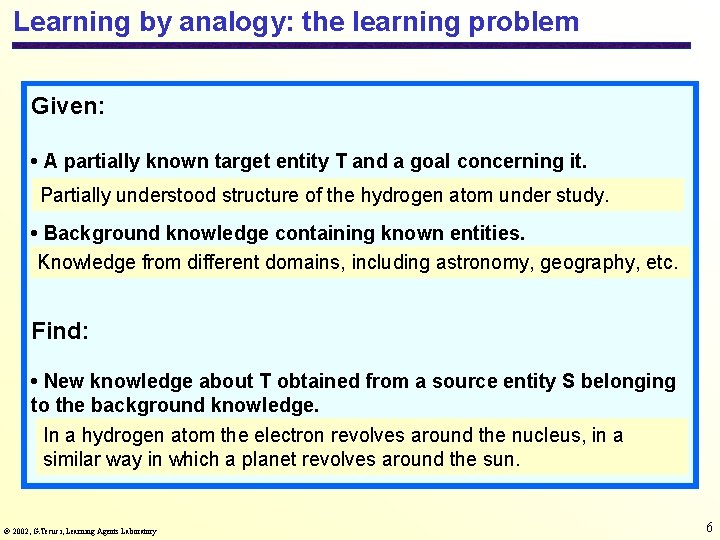
Learning by analogy: the learning problem Given: • A partially known target entity T and a goal concerning it. Partially understood structure of the hydrogen atom under study. • Background knowledge containing known entities. Knowledge from different domains, including astronomy, geography, etc. Find: • New knowledge about T obtained from a source entity S belonging to the background knowledge. In a hydrogen atom the electron revolves around the nucleus, in a similar way in which a planet revolves around the sun. 2002, G. Tecuci, Learning Agents Laboratory 6
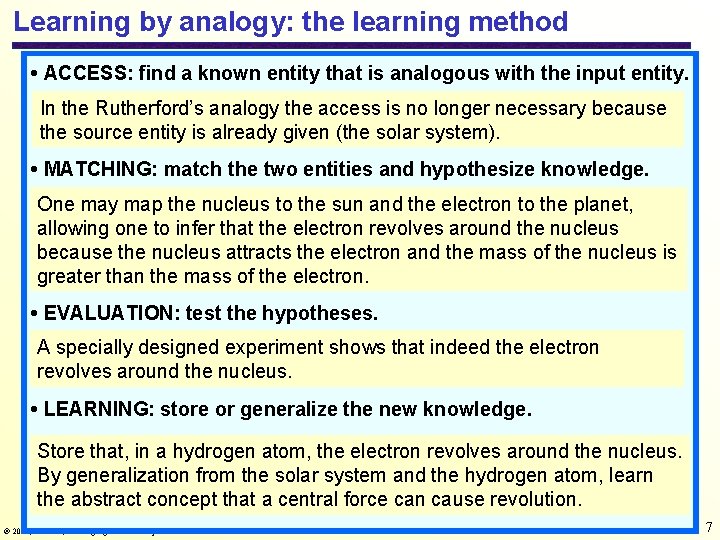
Learning by analogy: the learning method • ACCESS: find a known entity that is analogous with the input entity. In the Rutherford’s analogy the access is no longer necessary because the source entity is already given (the solar system). • MATCHING: match the two entities and hypothesize knowledge. One may map the nucleus to the sun and the electron to the planet, allowing one to infer that the electron revolves around the nucleus because the nucleus attracts the electron and the mass of the nucleus is greater than the mass of the electron. • EVALUATION: test the hypotheses. A specially designed experiment shows that indeed the electron revolves around the nucleus. • LEARNING: store or generalize the new knowledge. Store that, in a hydrogen atom, the electron revolves around the nucleus. By generalization from the solar system and the hydrogen atom, learn the abstract concept that a central force can cause revolution. 2002, G. Tecuci, Learning Agents Laboratory 7
Discussion How does analogy help? Why not just study the structure of the hydrogen atom to discover that new knowledge? We anyway need to perform an experiment to test that the electron revolves around the hydrogen atom. 2002, G. Tecuci, Learning Agents Laboratory 8
Overview Learning by analogy: definition Design issues The structure mapping theory Determinations Problem solving by analogy Exercises Recommended reading 2002, G. Tecuci, Learning Agents Laboratory 9
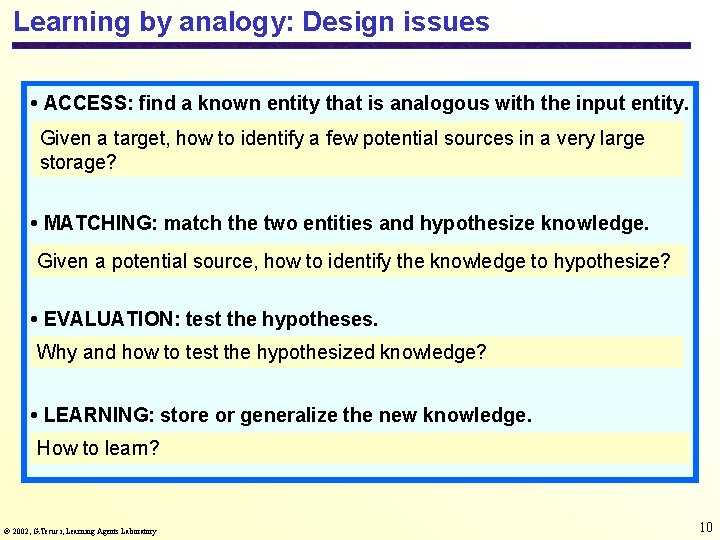
Learning by analogy: Design issues • ACCESS: find a known entity that is analogous with the input entity. Given a target, how to identify a few potential sources in a very large storage? • MATCHING: match the two entities and hypothesize knowledge. Given a potential source, how to identify the knowledge to hypothesize? • EVALUATION: test the hypotheses. Why and how to test the hypothesized knowledge? • LEARNING: store or generalize the new knowledge. How to learn? 2002, G. Tecuci, Learning Agents Laboratory 10
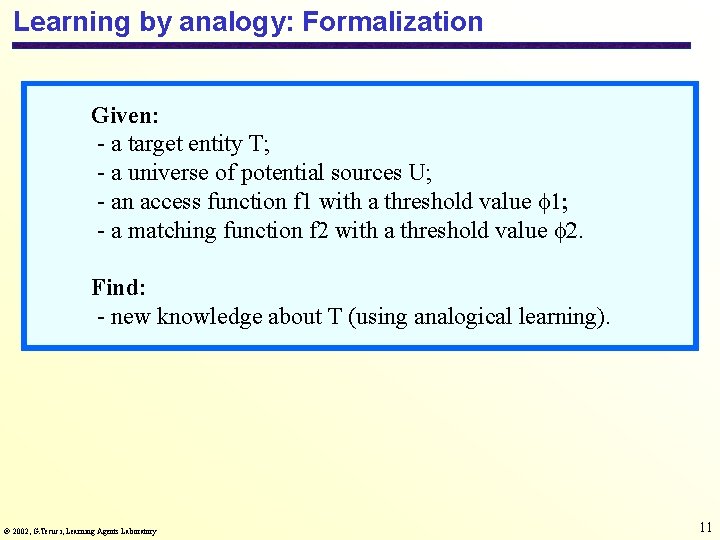
Learning by analogy: Formalization Given: - a target entity T; - a universe of potential sources U; - an access function f 1 with a threshold value f 1; - a matching function f 2 with a threshold value f 2. Find: - new knowledge about T (using analogical learning). 2002, G. Tecuci, Learning Agents Laboratory 11
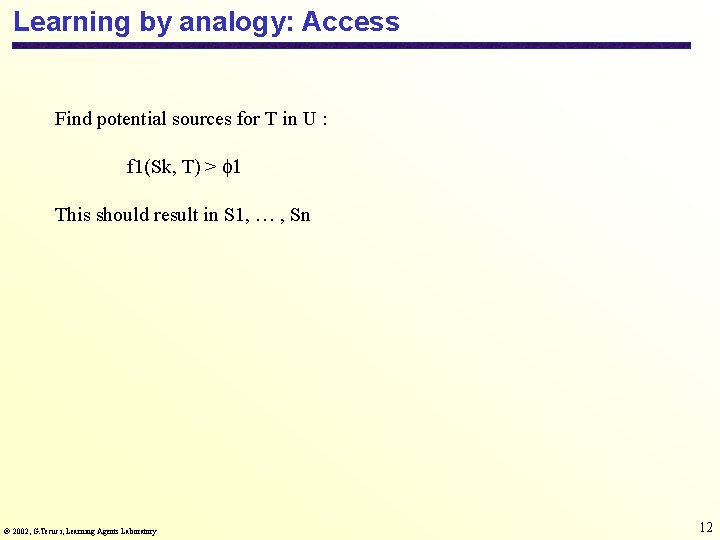
Learning by analogy: Access Find potential sources for T in U : f 1(Sk, T) > f 1 This should result in S 1, … , Sn 2002, G. Tecuci, Learning Agents Laboratory 12

Learning by analogy: Matching Find the best match between one of S 1, …, Sn and T. Let: Sk = A & B & C, T = A' & D where f 2(Sk, T) > f 2 gives the best match. A and A' are the parts of Sk and T that make them analogous: f 2(Sk, T) = f 2(A, A') B, C and D are the other parts of Sk and T. As a side effect of partially matching Sk with T (or totally matching A with A'), one obtains a correspondence (substitution) list s = ( o 1 ¬ o 1', . . . , on ¬ on') where oi is an element of A and oi' is the corresponding element from A'. By applying the substitution s to Sk one obtains: s(Sk) = s(A) & s(B) & s(C) = A' & B' & C'. By analogy with Sk one concludes that T might also have the features B' & C'. 2002, G. Tecuci, Learning Agents Laboratory 13
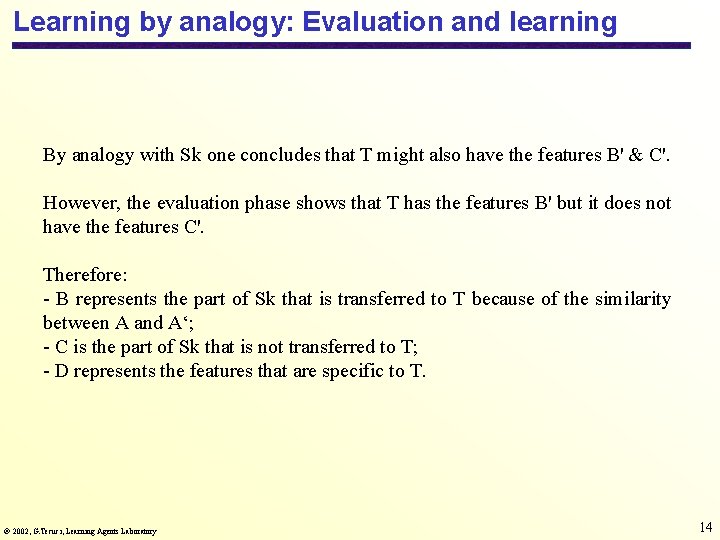
Learning by analogy: Evaluation and learning By analogy with Sk one concludes that T might also have the features B' & C'. However, the evaluation phase shows that T has the features B' but it does not have the features C'. Therefore: - B represents the part of Sk that is transferred to T because of the similarity between A and A‘; - C is the part of Sk that is not transferred to T; - D represents the features that are specific to T. 2002, G. Tecuci, Learning Agents Laboratory 14
Case study discussion: Rutherford’s analogy "The hydrogen atom is like our solar system". In this case, the fact that S and T are analogous is already known. Therefore, the access part is solved and the only purpose of the matching function remains that of identifying the correct correspondence between the elements of the solar system and those of the hydrogen atom. This is an example of a special (simpler form of analogy): “A T is like an S. ” This is useful mostly in teaching based on analogy. 2002, G. Tecuci, Learning Agents Laboratory 15
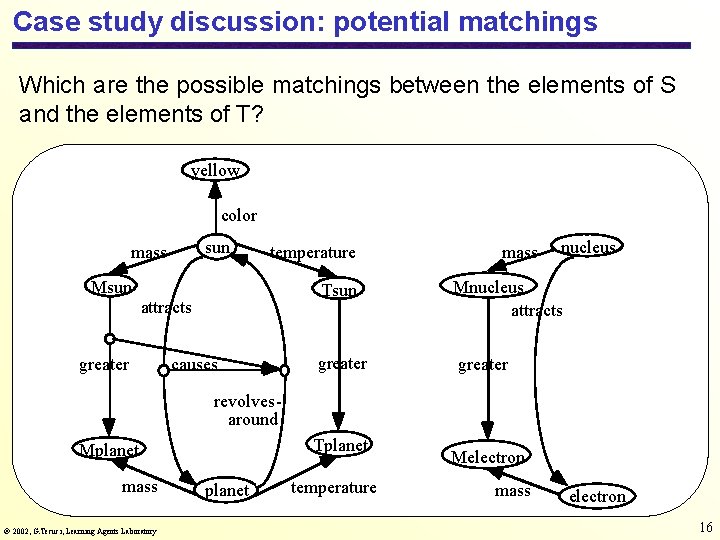
Case study discussion: potential matchings Which are the possible matchings between the elements of S and the elements of T? yellow color sun mass Msun temperature attracts greater causes mass nucleus Tsun Mnucleus attracts greater revolvesaround Tplanet Mplanet mass 2002, G. Tecuci, Learning Agents Laboratory planet temperature Melectron mass electron 16
Case study discussion: potential matchings There are several possible matchings between the elements of S and the elements of T and one has to select the best one: Matching 1: sun « nucleus, planet « electron, Msun « Mnucleus, Mplanet « Melectron, which is supported by the following correspondences mass(sun, Msun) « mass(nucleus, Mnucleus) mass(planet , Mplanet ) « mass(electron, Melectron) greater(Msun, Mplanet) « greater(Mnucleus, Melectron), attracts(sun, planet) « attracts(nucleus, electron) Matching 2: sun « nucleus, planet « electron, Tsun « Mnucleus, Tplanet « Melectron, that is supported by the following correspondences greater(Tsun, Tplanet) « greater(Mnucleus, Melectron), attracts(sun, planet) « attracts(nucleus, electron) Matching 3: sun « electron, planet « nucleus, Msun « Melectron, Mplanet « Mnucleus 2002, G. Tecuci, Learning Agents Laboratory 17
Similarity estimation issues and sample solutions 1. How to search the space of all possible matchings ? Exhaustive search. Other solutions? 2. How to measure the similarity of two elements ? Two elements are similar if they represent the same concept or are subconcepts of the same concepts. In such a case their similarity may be considered 1 (on a 0 -1 scale). Other solutions? 3. How to combine the estimated similarities of the parts in order to obtain the similarity between S and T ? The similarity of two entities is the sum of the similarity of their elements. Other solutions? 4. How to define the similarity threshold ? Similarity threshold defined by the designer (a hard critical issue). Other solutions? 2002, G. Tecuci, Learning Agents Laboratory 18
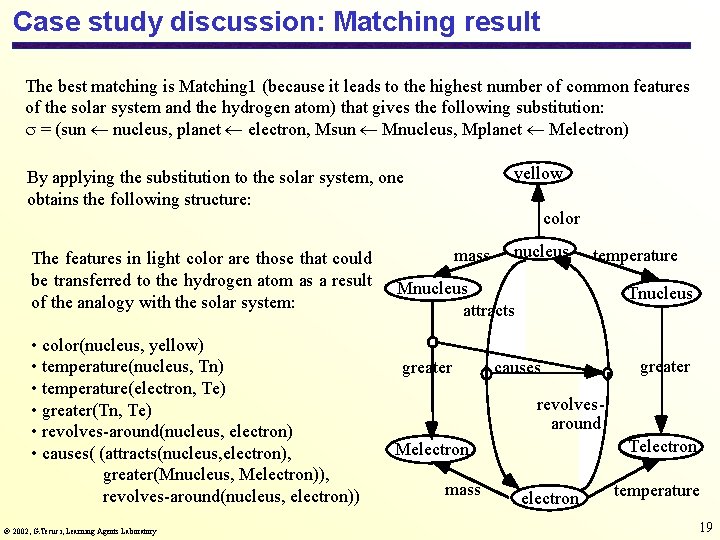
Case study discussion: Matching result The best matching is Matching 1 (because it leads to the highest number of common features of the solar system and the hydrogen atom) that gives the following substitution: s = (sun ¬ nucleus, planet ¬ electron, Msun ¬ Mnucleus, Mplanet ¬ Melectron) yellow By applying the substitution to the solar system, one obtains the following structure: The features in light color are those that could be transferred to the hydrogen atom as a result of the analogy with the solar system: • color(nucleus, yellow) • temperature(nucleus, Tn) • temperature(electron, Te) • greater(Tn, Te) • revolves-around(nucleus, electron) • causes( (attracts(nucleus, electron), greater(Mnucleus, Melectron)), revolves-around(nucleus, electron)) 2002, G. Tecuci, Learning Agents Laboratory color mass nucleus temperature Mnucleus attracts greater Tnucleus Tsun causes greater revolves-around Telectron Tplanet Melectron mass electron temperature 19
Case study discussion: Evaluation The evaluating phase shows that The hydrogen atom has the features: • revolves-around(nucleus, electron) • causes((attracts(nucleus, electron), greater(Mnucleus, Melectron)), revolves-around(nucleus, electron)) The hydrogen atom does not have the features: • color(nucleus, yellow) • temperature(nucleus, Tn) • temperature(electron, En) • greater(Tn, En) Which is, in your opinion, the most critical issue in analogical learning? 2002, G. Tecuci, Learning Agents Laboratory 20
Discussion Which is the most critical issue in analogical learning? What kind of features may be transferred from the source to the target so as to make sound analogical inferences ? 2002, G. Tecuci, Learning Agents Laboratory 21
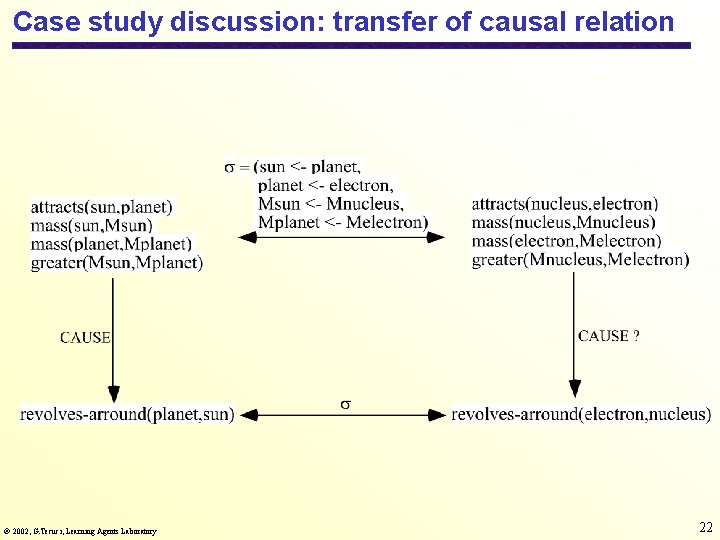
Case study discussion: transfer of causal relation 2002, G. Tecuci, Learning Agents Laboratory 22
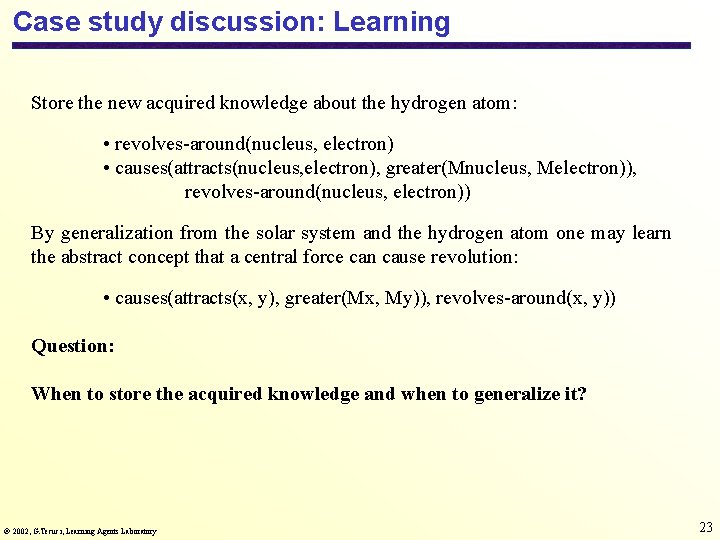
Case study discussion: Learning Store the new acquired knowledge about the hydrogen atom: • revolves-around(nucleus, electron) • causes(attracts(nucleus, electron), greater(Mnucleus, Melectron)), revolves-around(nucleus, electron)) By generalization from the solar system and the hydrogen atom one may learn the abstract concept that a central force can cause revolution: • causes(attracts(x, y), greater(Mx, My)), revolves-around(x, y)) Question: When to store the acquired knowledge and when to generalize it? 2002, G. Tecuci, Learning Agents Laboratory 23
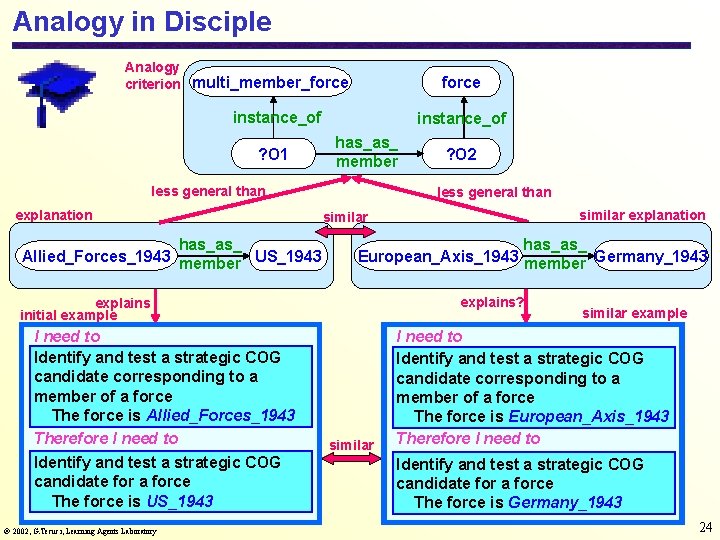
Analogy in Disciple Analogy criterion multi_member_force instance_of ? O 1 instance_of has_as_ member less general than explanation has_as_ Allied_Forces_1943 member US_1943 less general than Identify and test a strategic COG candidate for a force The force is US_1943 2002, G. Tecuci, Learning Agents Laboratory similar explanation similar has_as_ European_Axis_1943 member Germany_1943 explains? explains initial example I need to Identify and test a strategic COG candidate corresponding to a member of a force The force is Allied_Forces_1943 Therefore I need to ? O 2 similar example I need to Identify and test a strategic COG candidate corresponding to a member of a force The force is European_Axis_1943 Therefore I need to Identify and test a strategic COG candidate for a force The force is Germany_1943 24
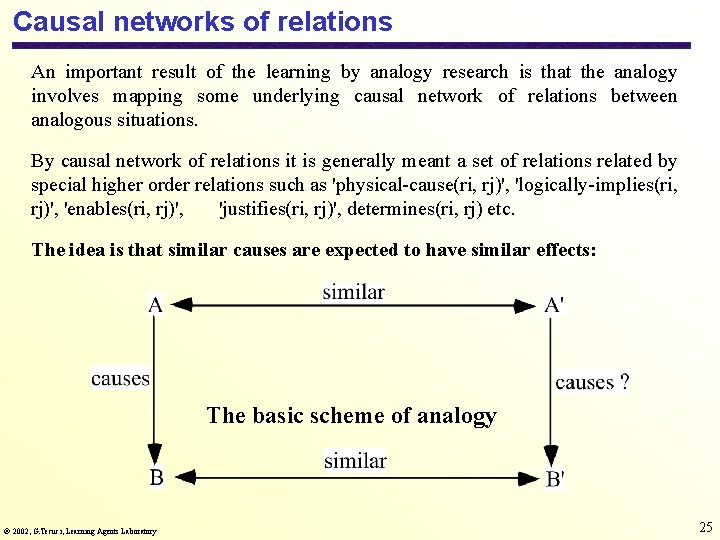
Causal networks of relations An important result of the learning by analogy research is that the analogy involves mapping some underlying causal network of relations between analogous situations. By causal network of relations it is generally meant a set of relations related by special higher order relations such as 'physical-cause(ri, rj)', 'logically-implies(ri, rj)', 'enables(ri, rj)', 'justifies(ri, rj)', determines(ri, rj) etc. The idea is that similar causes are expected to have similar effects: The basic scheme of analogy 2002, G. Tecuci, Learning Agents Laboratory 25
Overview Learning by analogy: definition Design issues The structure mapping theory Determinations Problem solving by analogy Exercises Recommended reading 2002, G. Tecuci, Learning Agents Laboratory 26

Gentner’s structure mapping theory The main claim of this theory is that relations between objects, rather than attributes of objects, are mapped from source to target. Moreover, a relation that belongs to a mappable system of mutually interconnecting relationships is more likely to be imported into the target than isolated relation (the systematicity principle). See: Gentner D. , The mechanisms of analogical reasoning, in J. W. Shavlik, T. G. Dietterich (eds), Readings in Machine Learning, Morgan Kaufmann, 1990. 2002, G. Tecuci, Learning Agents Laboratory 27
Gentner’s structure mapping theory (cont. ) Analogy maps the objects of the source onto the objects of the target: s 1 « t 1, . . . , sn « tn These object correspondences are used to generate the candidate set of inferences in the target domain. Predicates from the source are carried across to the target, using the node substitutions dictated by the object correspondences, according to the following rules: 1. Discard attributes of objects A(si) -/-> A(ti) For instance, the yellow color of the sun is not transferred to the hydrogen nucleus. 2. Try to preserve relations between objects R(si, sj) -? -> R(ti, tj) That is, some relations are transferred to the target, while others are not. 3. The systematicity principle: the relations that are most likely to be transferred are those belonging to systems of interconnected relations R'(R 1(si, sj), R 2(sk, sl)) ® R'(R 1(ti, tj), R 2(tk, tl)) 2002, G. Tecuci, Learning Agents Laboratory 28
Literal similarity, analogy, and abstraction Gentner's theory distinguishes between literal similarity, analogy, and abstraction. One says that a target T is literally similar with a source S if and only if a large number of predicates is mapped from source to target, relative to the number of nonmapped predicates and, also, the mapped predicates include both attributes of objects and relations between objects. For instance, 'kool-aid' is literally similar with 'water' since it has most of the features of 'water' (both attributes of objects and relations between objects). Give other examples of literally similar entities. 2002, G. Tecuci, Learning Agents Laboratory 29
Literal similarity, analogy, and abstraction One says that a target T is analogous with a source S if and only if relations between objects, but few or no attributes of objects, can be mapped from source to target. For instance, 'heat' is analogous to 'water'. One says that a source S is an abstraction of a target T if and only if the source is an abstract relational structure and each predicate (a relation between objects or an attribute of an object) from the abstract source is mapped into a less abstract predicate of the target; there are no nonmapped predicates. For instance, 'through-variable' is an abstraction of 'heat', where by 'throughvariable' we mean something that flows across a difference in potential. Give other examples of abstractions. 2002, G. Tecuci, Learning Agents Laboratory 30
Similarity, analogy, and abstraction: discussion Given that two entities overlap in relations, they are more literally similar to the extent that their object attributes also overlap. Therefore, literal similarity might be seen as a particular case of analogy. Abstraction may also be seen as a special case of analogy in which all the predicates of the source entity are mapped into the target entity. What could we conclude from these observations? 2002, G. Tecuci, Learning Agents Laboratory 31
Similarity, analogy, and abstraction: discussion What could we conclude from these observations? Overlap in relations is necessary for any perception of similarity, analogy or abstraction. The contrast between literal similarity, analogy, and abstraction is a continuum. 2002, G. Tecuci, Learning Agents Laboratory 32
Gentner’s theory: implementation and discussion An implementation of the Structure-Mapping theory is the Structure. Mapping Engine (Falkenhainer, Forbus & Gentner, 1989: The Structure-mapping Engine. Algorithms and Examples, Artificial Intelligence, 41: 1 -63. Also in Readings in Knowledge Acquisition and Learning). Given the descriptions of a source and a target, the Structure-Mapping Engine constructs all syntactically consistent analogical mappings between them. Each mapping consists of pairwise matches between predicates and objects in the source and target, plus a list of predicates which exist in the source but not the target. This list of predicates is the set of candidate inferences sanctioned by the analogy. The Structure-Mapping Engine evaluates syntactically each possible analogy to find the best one. 2002, G. Tecuci, Learning Agents Laboratory 33
Gentner’s theory: implementation and discussion The Structure-Mapping Engine needs to be given the descriptions of a source and a target. This requires the ACCESS problem to be solved first: How do we find potential sources for a target? MAC/FAC (Forbus, Gentner, Law, 1995: “MAC/FAC: A model of similarity-based retrieval, ” Cognitive Science, 19(2): 141 -205) is a system that addresses the access problem. The MAC stage uses a simple, nonstructural matcher to filter our a few promising candidates from a large memory of structured descriptions. The FAC stage evaluates each candidate using SME to provide a structural match. MAC/FAC was scaled-up in the DARPA’s HPKB and RKF programs. What is, however, a problem with Gentner’s theory? 2002, G. Tecuci, Learning Agents Laboratory 34
Gentner’s theory: discussion What is a problem with Gentner’s theory? Gentner’s interpretation rules depend only on the syntactic properties of the knowledge representation, and not on the specific content of the domain. Why is this a problem? Consider these equivalent representations: Book 1 -on-Table On(Book 1, Table) Could you think of a different representation where the following expression is no longer a second order relation? causes((attracts(nucleus, electron), greater(Mnucleus, Melectron)), revolves-around(nucleus, electron)) 2002, G. Tecuci, Learning Agents Laboratory 35
Overview Learning by analogy: definition Design issues The structure mapping theory Determinations Problem solving by analogy Exercises Recommended reading 2002, G. Tecuci, Learning Agents Laboratory 36
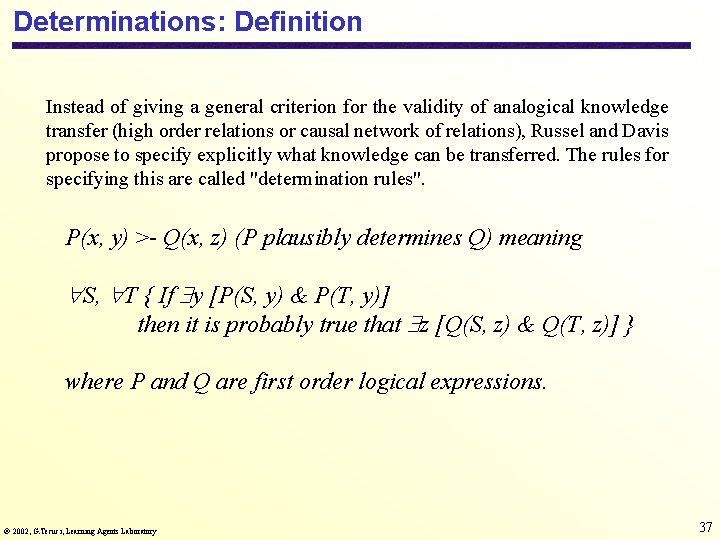
Determinations: Definition Instead of giving a general criterion for the validity of analogical knowledge transfer (high order relations or causal network of relations), Russel and Davis propose to specify explicitly what knowledge can be transferred. The rules for specifying this are called "determination rules". P(x, y) >- Q(x, z) (P plausibly determines Q) meaning "S, "T { If $y [P(S, y) & P(T, y)] then it is probably true that $z [Q(S, z) & Q(T, z)] } where P and Q are first order logical expressions. 2002, G. Tecuci, Learning Agents Laboratory 37
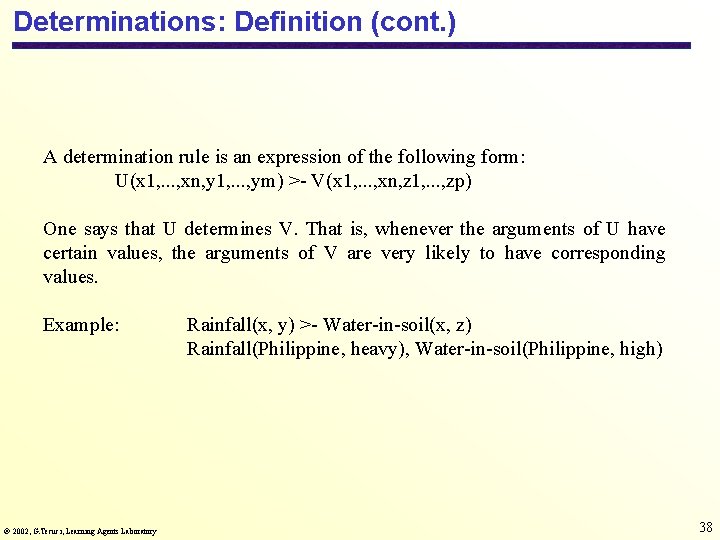
Determinations: Definition (cont. ) A determination rule is an expression of the following form: U(x 1, . . . , xn, y 1, . . . , ym) >- V(x 1, . . . , xn, z 1, . . . , zp) One says that U determines V. That is, whenever the arguments of U have certain values, the arguments of V are very likely to have corresponding values. Example: 2002, G. Tecuci, Learning Agents Laboratory Rainfall(x, y) >- Water-in-soil(x, z) Rainfall(Philippine, heavy), Water-in-soil(Philippine, high) 38
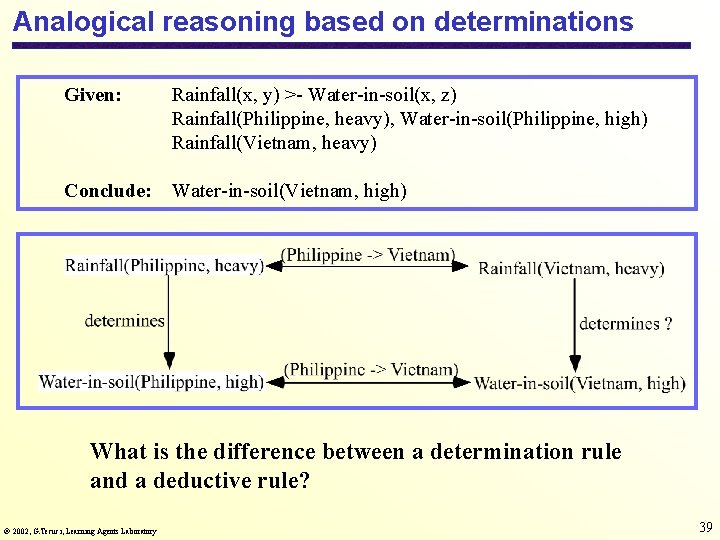
Analogical reasoning based on determinations Given: Rainfall(x, y) >- Water-in-soil(x, z) Rainfall(Philippine, heavy), Water-in-soil(Philippine, high) Rainfall(Vietnam, heavy) Conclude: Water-in-soil(Vietnam, high) What is the difference between a determination rule and a deductive rule? 2002, G. Tecuci, Learning Agents Laboratory 39
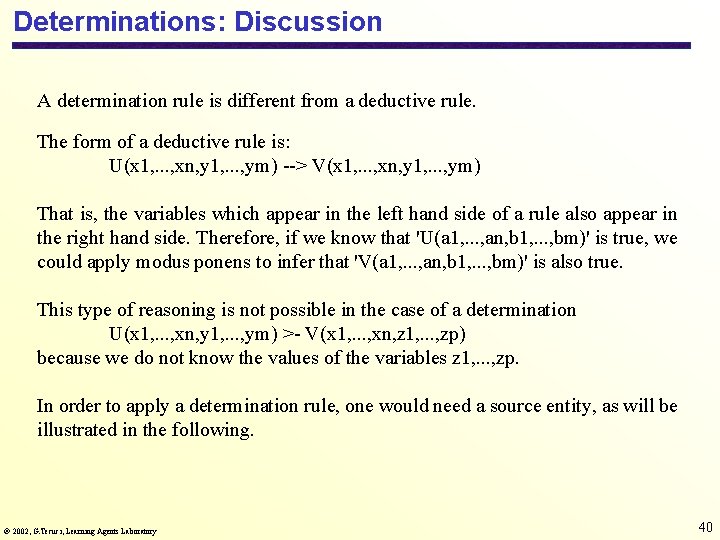
Determinations: Discussion A determination rule is different from a deductive rule. The form of a deductive rule is: U(x 1, . . . , xn, y 1, . . . , ym) --> V(x 1, . . . , xn, y 1, . . . , ym) That is, the variables which appear in the left hand side of a rule also appear in the right hand side. Therefore, if we know that 'U(a 1, . . . , an, b 1, . . . , bm)' is true, we could apply modus ponens to infer that 'V(a 1, . . . , an, b 1, . . . , bm)' is also true. This type of reasoning is not possible in the case of a determination U(x 1, . . . , xn, y 1, . . . , ym) >- V(x 1, . . . , xn, z 1, . . . , zp) because we do not know the values of the variables z 1, . . . , zp. In order to apply a determination rule, one would need a source entity, as will be illustrated in the following. 2002, G. Tecuci, Learning Agents Laboratory 40
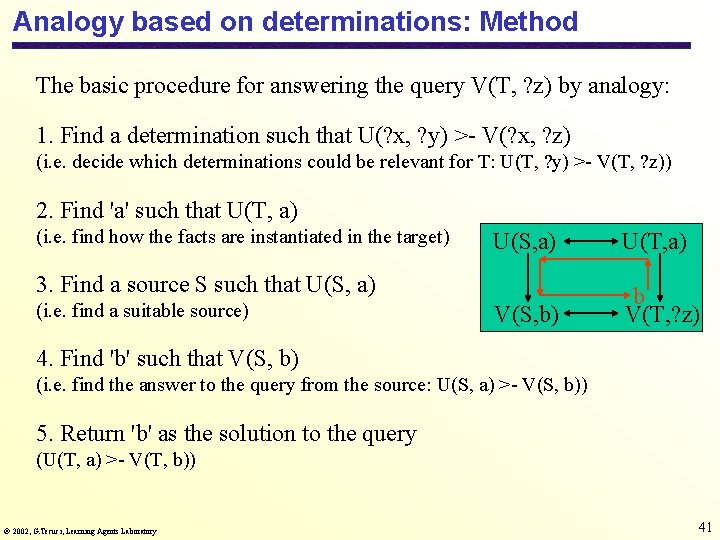
Analogy based on determinations: Method The basic procedure for answering the query V(T, ? z) by analogy: 1. Find a determination such that U(? x, ? y) >- V(? x, ? z) (i. e. decide which determinations could be relevant for T: U(T, ? y) >- V(T, ? z)) 2. Find 'a' such that U(T, a) (i. e. find how the facts are instantiated in the target) U(S, a) U(T, a) V(S, b) b V(T, ? z) 3. Find a source S such that U(S, a) (i. e. find a suitable source) 4. Find 'b' such that V(S, b) (i. e. find the answer to the query from the source: U(S, a) >- V(S, b)) 5. Return 'b' as the solution to the query (U(T, a) >- V(T, b)) 2002, G. Tecuci, Learning Agents Laboratory 41
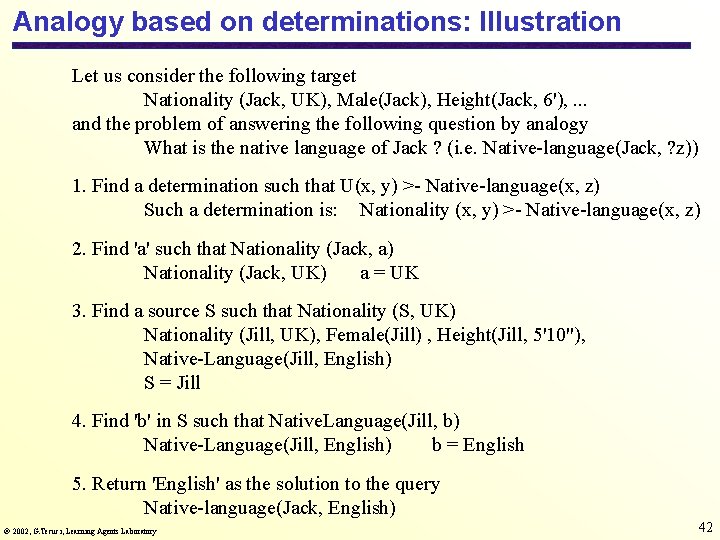
Analogy based on determinations: Illustration Let us consider the following target Nationality (Jack, UK), Male(Jack), Height(Jack, 6'), . . . and the problem of answering the following question by analogy What is the native language of Jack ? (i. e. Native-language(Jack, ? z)) 1. Find a determination such that U(x, y) >- Native-language(x, z) Such a determination is: Nationality (x, y) >- Native-language(x, z) 2. Find 'a' such that Nationality (Jack, a) Nationality (Jack, UK) a = UK 3. Find a source S such that Nationality (S, UK) Nationality (Jill, UK), Female(Jill) , Height(Jill, 5'10"), Native-Language(Jill, English) S = Jill 4. Find 'b' in S such that Native. Language(Jill, b) Native-Language(Jill, English) b = English 5. Return 'English' as the solution to the query Native-language(Jack, English) 2002, G. Tecuci, Learning Agents Laboratory 42
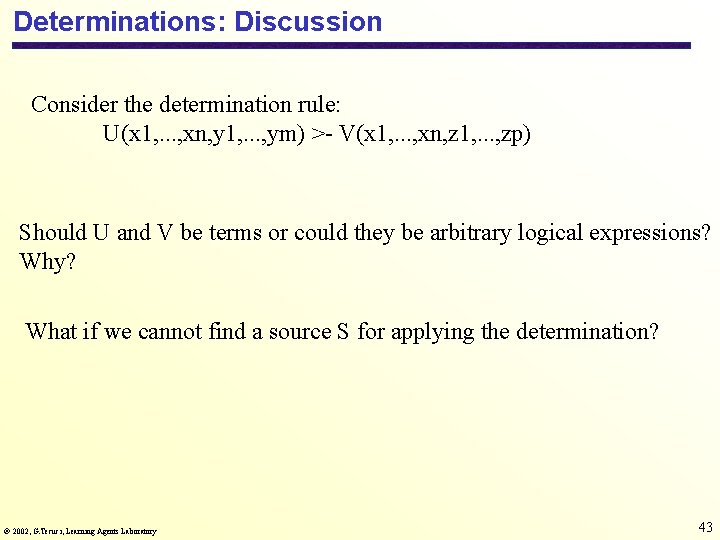
Determinations: Discussion Consider the determination rule: U(x 1, . . . , xn, y 1, . . . , ym) >- V(x 1, . . . , xn, z 1, . . . , zp) Should U and V be terms or could they be arbitrary logical expressions? Why? What if we cannot find a source S for applying the determination? 2002, G. Tecuci, Learning Agents Laboratory 43
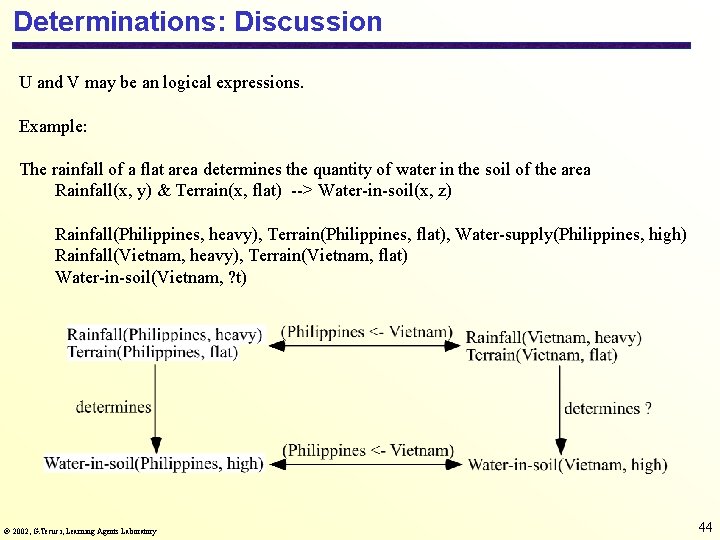
Determinations: Discussion U and V may be an logical expressions. Example: The rainfall of a flat area determines the quantity of water in the soil of the area Rainfall(x, y) & Terrain(x, flat) --> Water-in-soil(x, z) Rainfall(Philippines, heavy), Terrain(Philippines, flat), Water-supply(Philippines, high) Rainfall(Vietnam, heavy), Terrain(Vietnam, flat) Water-in-soil(Vietnam, ? t) 2002, G. Tecuci, Learning Agents Laboratory 44
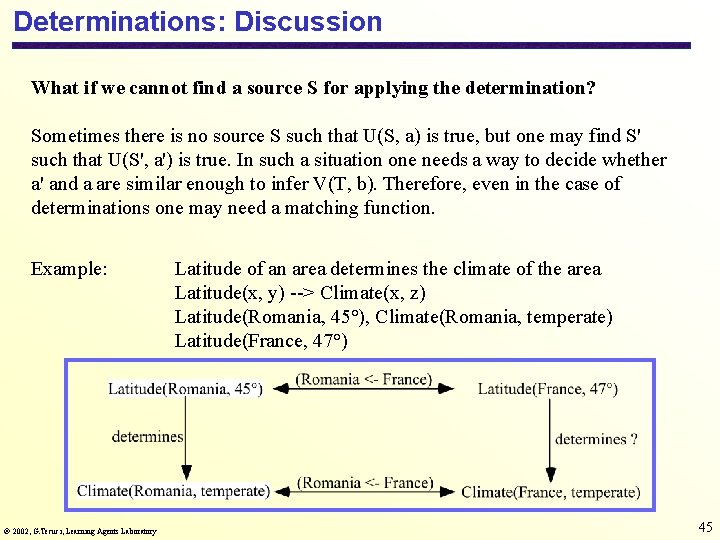
Determinations: Discussion What if we cannot find a source S for applying the determination? Sometimes there is no source S such that U(S, a) is true, but one may find S' such that U(S', a') is true. In such a situation one needs a way to decide whether a' and a are similar enough to infer V(T, b). Therefore, even in the case of determinations one may need a matching function. Example: 2002, G. Tecuci, Learning Agents Laboratory Latitude of an area determines the climate of the area Latitude(x, y) --> Climate(x, z) Latitude(Romania, 45°), Climate(Romania, temperate) Latitude(France, 47°) 45
Overview Learning by analogy: definition Design issues The structure mapping theory Determinations Problem solving by analogy Exercises Recommended reading 2002, G. Tecuci, Learning Agents Laboratory 46
Problem solving by analogy Analogy means deriving new knowledge about an input entity by transferring it from a known similar entity. How could we define problem solving by analogy? 2002, G. Tecuci, Learning Agents Laboratory 47
Problem solving by analogy: definition Problem solving by analogy is the process of transferring knowledge from past problem-solving episodes to new problems that share significant aspects with corresponding past experience and using the transferred knowledge to construct solutions to the new problems. What could be the overall structure of a problem solving by analogy method? 2002, G. Tecuci, Learning Agents Laboratory 48
The problem solving by analogy method Let P be a problem to solve. First, look into the knowledge base for a previous problem solving episode which shares significant aspects with the problem to solve. Next transform the past episode to obtain a solution to the current problem. What questions need to be answered to develop such a method? What it means for problems to share significant aspects? How is the past problem solving episode transformed so as to obtain the solution to the current problem? 2002, G. Tecuci, Learning Agents Laboratory 49
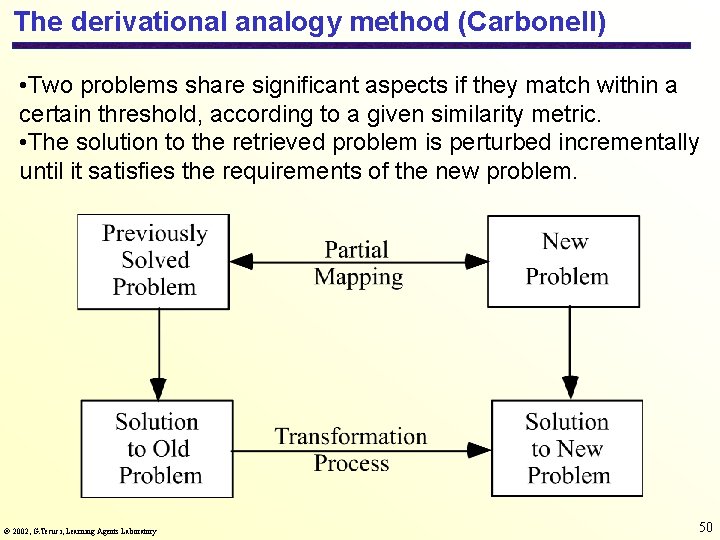
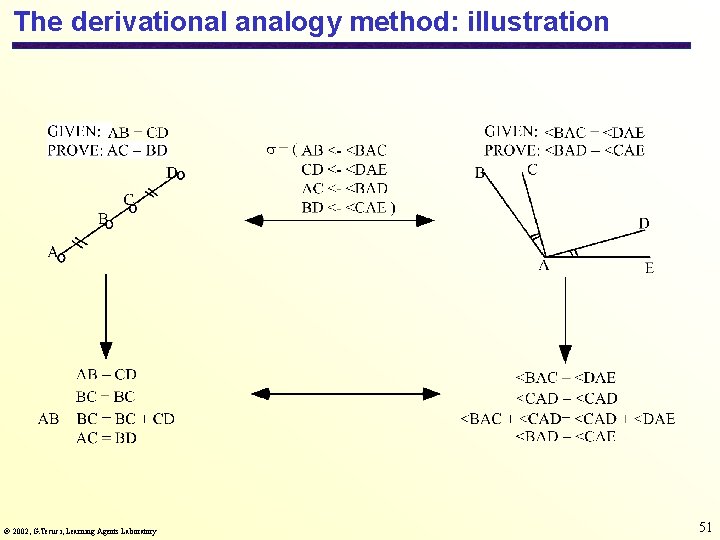
The derivational analogy method (Carbonell) • Two problems share significant aspects if they match within a certain threshold, according to a given similarity metric. • The solution to the retrieved problem is perturbed incrementally until it satisfies the requirements of the new problem. 2002, G. Tecuci, Learning Agents Laboratory 50
The derivational analogy method: illustration 2002, G. Tecuci, Learning Agents Laboratory 51
The derivational analogy method: discussion How does analogy facilitate the problem solving process? How does the derivational analogy method relates to the generally accepted idea that the relations which are usually imported by analogy from a source concept S to the target concept T are those belonging to causal networks? 2002, G. Tecuci, Learning Agents Laboratory 52
The derivational analogy method: discussion How does this method relates to the generally accepted idea that the relations which are usually imported by analogy from a source concept S to the target concept T are those belonging to causal networks? Intuition: The relation between a problem and its solution is a kind of cause-effect relationship. Consider the following problem solving situation: Problem: Find integer solutions of the problem x 3 + y 3 = z 3 Previously solved problem: Find integer solutions of the problem x 2 + y 2 = z 2 Fermat’s last theorem: There is no integer solutions of xn + yn = zn for n>2 What does this example suggests? 2002, G. Tecuci, Learning Agents Laboratory 53
Discussion Except for the trivial problems, a solution does not emerge immediately from the problem formulation, as would be the case in a cause-effect relation. What other relation from the problem solving process might be closer to a cause-effect relation? 2002, G. Tecuci, Learning Agents Laboratory 54
Discussion What other relation from the problem solving process might be closer to a cause-effect relation? The relation between a problem and its derivation trace (i. e. solution process). What is transferred from a past problem solving episode is not a problem solution but the problem solving process itself, what questions have been asked, what factors have been considered, etc. One would try to repeat the same process in the context of the new problem. With this interpretation we retrieve the derivational analogy method: 2002, G. Tecuci, Learning Agents Laboratory 55

The transformational analogy method (Carbonell) Two problems are considered to share significant aspects if their initial analysis yields the same reasoning steps, that is, if the initial segments of their respective derivations start by considering the same issues and making the same decisions; The derivation of the solved problem may therefore be transferred to the new problem by reconsidering the old decisions in the light of the new problem situation, preserving those that apply, and replacing or modifying those whose supports are no longer valid in the new situation. Derivational analogy gives better results than transformational analogy. However, it has the disadvantage to manipulate complex structures representing derivational traces. 2002, G. Tecuci, Learning Agents Laboratory 56
Overview Learning by analogy: definition Design issues The structure mapping theory Determinations Problem solving by analogy Exercises Recommended reading 2002, G. Tecuci, Learning Agents Laboratory 57
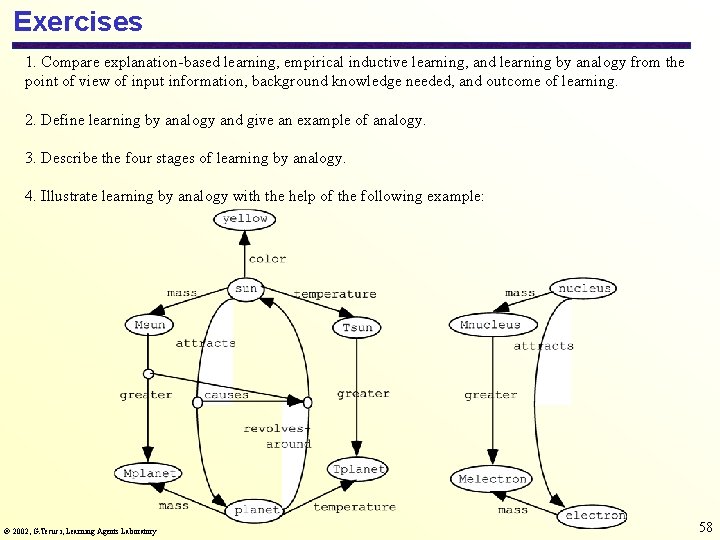
Exercises 1. Compare explanation-based learning, empirical inductive learning, and learning by analogy from the point of view of input information, background knowledge needed, and outcome of learning. 2. Define learning by analogy and give an example of analogy. 3. Describe the four stages of learning by analogy. 4. Illustrate learning by analogy with the help of the following example: 2002, G. Tecuci, Learning Agents Laboratory 58
Exercise Let us consider a learning by analogy system having the following background knowledge: Facts: Economy-type (Germany, highly-industrial), Location(Germany, Europe) Population(Germany, 70), … Economy-type (Vietnam, agricultural), Location(Vietnam, Asia) Population(Vietnam, 70), Economic-state(Vietnam, poor), … Economy-type (Japan, highly-industrial), Location(Japan, Asia), Population(Japan, 100), Economic-state(Japan, excellent), … Determination: Economy-type (x, y) >- Economic-state (x, z) (the economy-type of a country determines the economic state of the country) Write a detailed trace of the reasoning of the system for answering the following question: What is the economic state of Germany ? (i. e. Economic-state (Germany, ? z)) 2002, G. Tecuci, Learning Agents Laboratory 59
Exercises Provide an example of a successful application of the transformational analysis method. Provide an example where the transformational analysis method does not apply, but the derivational analogy method does apply. What is the difference between a determination rule and a deductive rule? Illustrate the difference with an example. 2002, G. Tecuci, Learning Agents Laboratory 60
Recommended reading Gentner D. , Holyoak K. J. , Kokinov B. N. (eds. ), The Analogical Mind: Perspectives from Cognitive Science, The MIT Press, 2001. Carbonell J. G. , Learning by analogy: formulating and generalizing plans from past experience, Machine learning I, 1983. Carbonell J. G. , Derivational analogy: a theory of reconstructive problem solving and expertise acquisition, in Shavlik J. and Dietterich T. (eds), Readings in Machine Learning, Morgan Kaufmann, 1990. Also in Readings in Machine Learning and Knowledge Acquisition. Davies T. R. , Russell S. J. , A logical approach to reasoning by analogy, in Shavlik J. and Dietterich T. (eds), Readings in Machine Learning, Morgan Kaufmann, 1990. Gentner D. , The mechanisms of analogical reasoning, in J. W. Shavlik, T. G. Dietterich (eds), Readings in Machine Learning, Morgan Kaufmann, 1990. Winston P. H. , Learning and reasoning by analogy, Communications of the ACM, 23, pp. 689703, 1980. Forbus K. D. , Exploring Analogy in the Large, in Gentner D. , Holyoak K. J. , Kokinov B. N. (eds. ), The Analogical Mind, 2001 Tecuci, Building Intelligent Agents: An Apprenticeship Multistrategy Learning Theory, Methodology, Tool and Case Studies, Academic Press, 1998, pp: 101 -108. 2002, G. Tecuci, Learning Agents Laboratory 61
- Slides: 61