
Learning Behaviourism Key behaviourist thinkers including Thorndike Pavlov
Learning

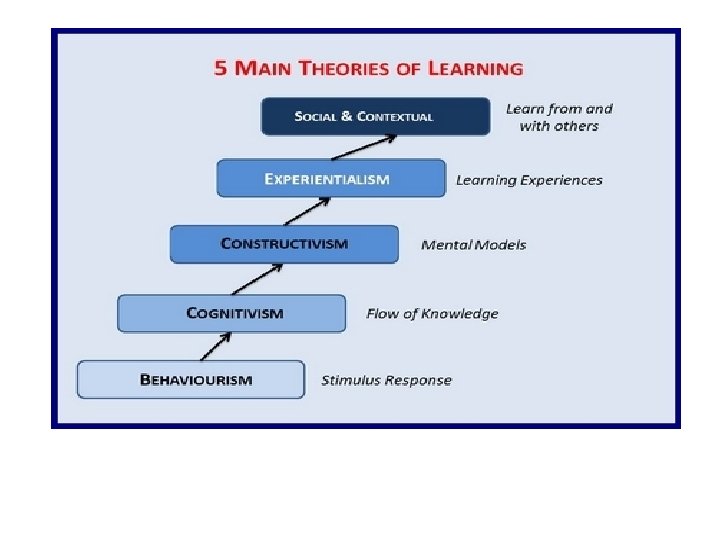
• Behaviourism Key behaviourist thinkers including Thorndike, Pavlov and Skinner have hypothesized that learning is a change in observable behaviour caused by external stimuli in the environment. The key principle of Behaviourism is the reward or punishment of a new behaviour, commonly described as the 'carrot and stick' approach to learning. • Cognitivism replaced Behaviourism as the dominant learning paradigm in the 1960 s and proposes that learning comes from mental activity such as memory, motivation, thinking and reflection. Cognitivism focuses on the transmission of information from someone who knows (such as an 'expert' as opposed to facilitators) to learners who do not know. •
• Constructivism From the constructivist perspective, learning is not a stimulusresponse phenomenon as described by Behaviourism, rather it requires self-regulation and the building of conceptual structures through reflection and abstraction. The learner takes an active role in constructing his own understanding rather than receiving it from someone who knows, learning through observation, processing and interpretation. • Experientialism One of the key theorists of experiential learning is David Kolb who developed his experiential model, as opposed to a purer cognitive which formally recognised that people learn from experience and described learning as following a cycle of experiential stages. •
• Social and Contextual In the Social and Contextual approach, learning does not occur solely within the learner, but in the group and community in which they work. Learning is a shared process which takes place through observing, working together and being part of a larger group, which includes colleagues of varying levels of experience, able to stimulate each other's development
- Slides: 8