
Learning area overview PrepYear 10 Australian Curriculum Mathematics
- Slides: 16
Learning area overview Prep–Year 10 Australian Curriculum: Mathematics
Learning goals This presentation aims to: • build understanding of the Australian Curriculum: Mathematics • provide an overview of the structure of the Mathematics learning area.
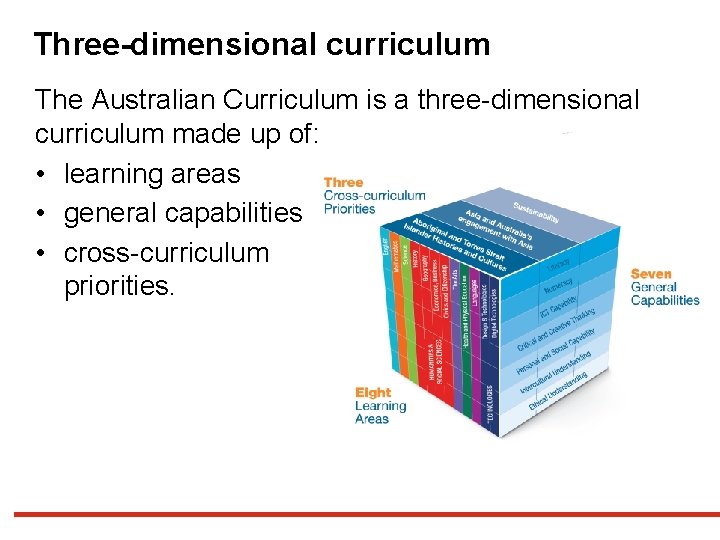
Three-dimensional curriculum The Australian Curriculum is a three-dimensional curriculum made up of: • learning areas • general capabilities • cross-curriculum priorities. English
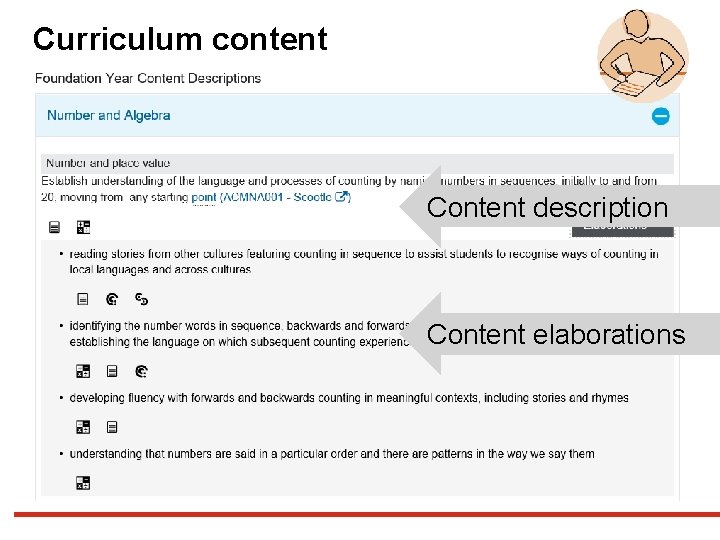
Structure of the Mathematics learning area • • Rationale Aims Key ideas Year-by-year curriculum − Year-level descriptions • Curriculum content − Strands and sub-strands − Content descriptions − Content elaborations • Achievement standards
Rationale Learning area summary In the Mathematics learning area, students develop the numeracy capabilities needed to make informed, efficient decisions in the real world and learn the fundamentals on which further mathematics are built. Video Introduction to Mathematics www. australiancurriculum. edu. au/f-10 curriculum/mathematics/rationale
Aims Learning area summary Learning through Mathematics aims to ensure students: • become confident, creative users of mathematics • develop the ability to pose and solve problems • recognise the connections between the areas of mathematics and other disciplines.
Key ideas Proficiency strands • Understanding • Fluency • Problem-solving • Reasoning The proficiency strands describe the actions that students can engage in when learning and using the content. Video Introduction with Peter Sullivan www. australiancurriculum. edu. au/resources/ mathematics-proficiencies/
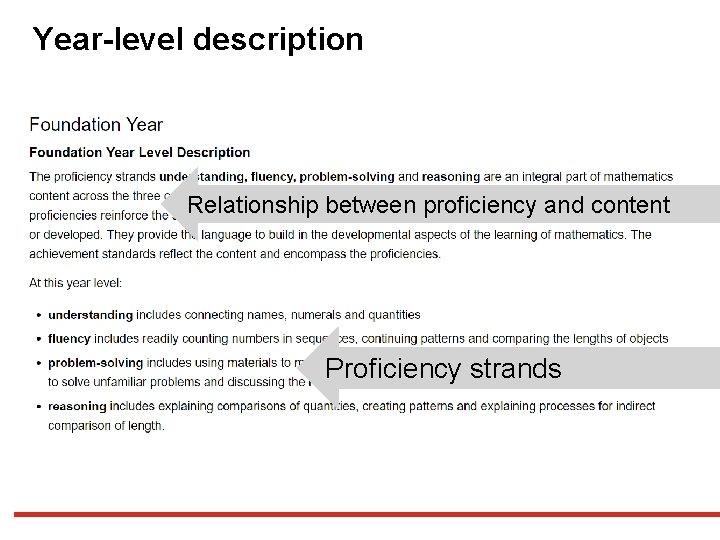
Year-by-year curriculum Each year includes the following structural components: • year-level description • curriculum content • achievement standards. The curriculum is developmentally sequenced across the year levels.
Year-level description Relationship between proficiency and content Proficiency strands
Curriculum content Content description Content elaborations
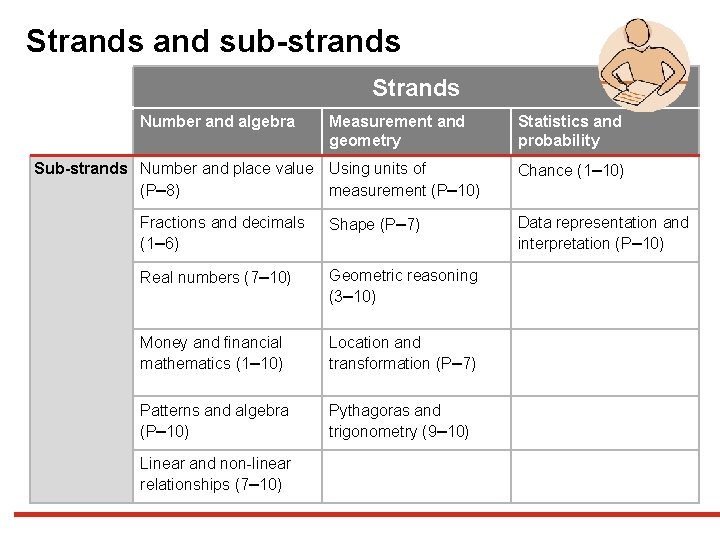
Strands and sub-strands Strands Number and algebra Measurement and geometry Sub-strands Number and place value Using units of (P– 8) measurement (P– 10) Fractions and decimals (1– 6) Shape (P– 7) Real numbers (7– 10) Geometric reasoning (3– 10) Money and financial mathematics (1– 10) Location and transformation (P– 7) Patterns and algebra (P– 10) Pythagoras and trigonometry (9– 10) Linear and non-linear relationships (7– 10) Statistics and probability Chance (1– 10) Data representation and interpretation (P– 10)
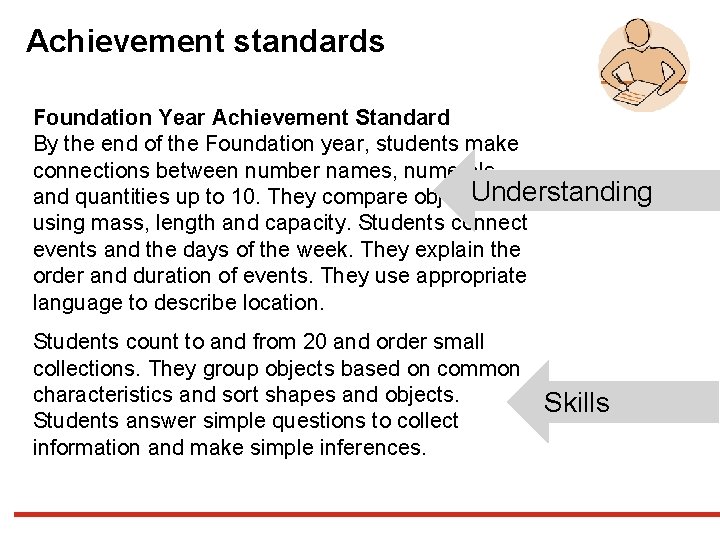
Achievement standards Foundation Year Achievement Standard By the end of the Foundation year, students make connections between number names, numerals Understanding and quantities up to 10. They compare objects using mass, length and capacity. Students connect events and the days of the week. They explain the order and duration of events. They use appropriate language to describe location. Students count to and from 20 and order small collections. They group objects based on common characteristics and sort shapes and objects. Students answer simple questions to collect information and make simple inferences. Skills
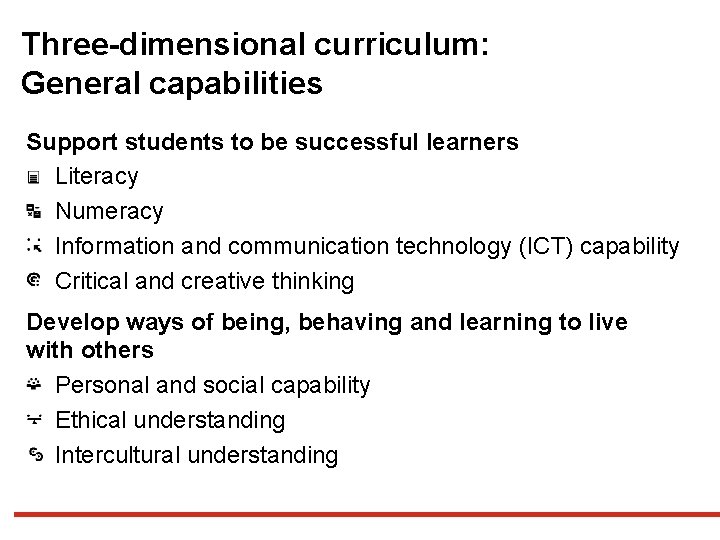
Three-dimensional curriculum: General capabilities Support students to be successful learners Literacy Numeracy Information and communication technology (ICT) capability Critical and creative thinking Develop ways of being, behaving and learning to live with others Personal and social capability Ethical understanding Intercultural understanding
Three-dimensional curriculum: Cross-curriculum priorities Aboriginal and Torres Strait Islander histories and culture Asia and Australia’s engagement with Asia Sustainability
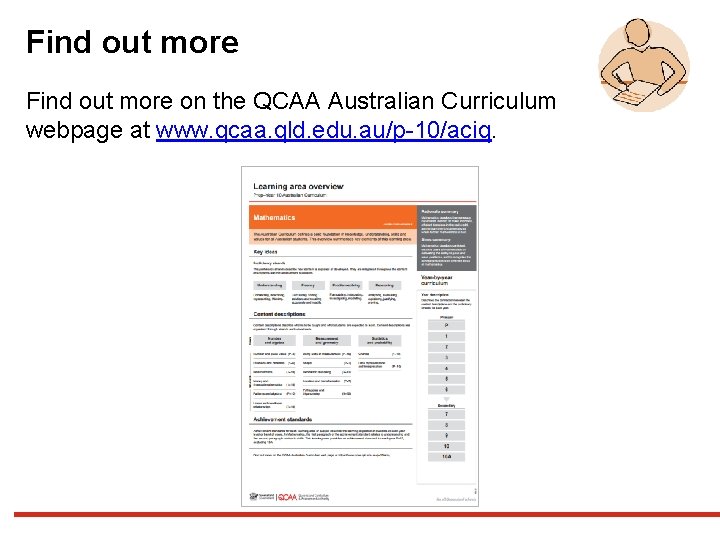
Find out more on the QCAA Australian Curriculum webpage at www. qcaa. qld. edu. au/p-10/aciq.
Copyright information Slides 3 and 8– 14: Images and text © Australian Curriculum, Assessment and Reporting Authority (ACARA) 2009 to present, unless otherwise indicated. This material was downloaded from the ACARA website (www. acara. edu. au) (Website) (accessed Mar 25, 2019) and was not modified. The material is licensed under CC BY 4. 0 (https: //creativecommons. org/licenses/by/4. 0/). ACARA does not endorse any product that uses ACARA material or make any representations as to the quality of such products. Any product that uses material published on this website should not be taken to be affiliated with ACARA or have the sponsorship or approval of ACARA. It is up to each person to make their own assessment of the product.