
Learning and Structural Uncertainty in Relational Probability Models
Learning and Structural Uncertainty in Relational Probability Models Brian Milch MIT 9. 66 November 29, 2007
Outline • Learning relational probability models • Structural uncertainty – Uncertainty about relations – Uncertainty about object existence and identity • Applications of BLOG
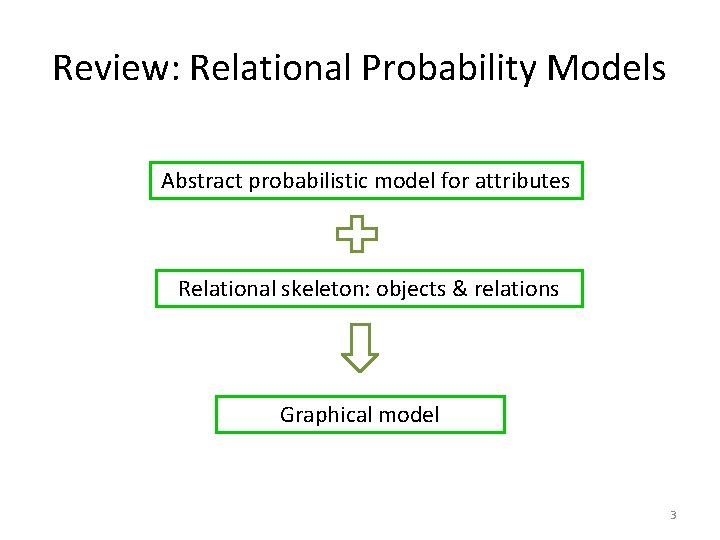
Review: Relational Probability Models Abstract probabilistic model for attributes Relational skeleton: objects & relations Graphical model 3
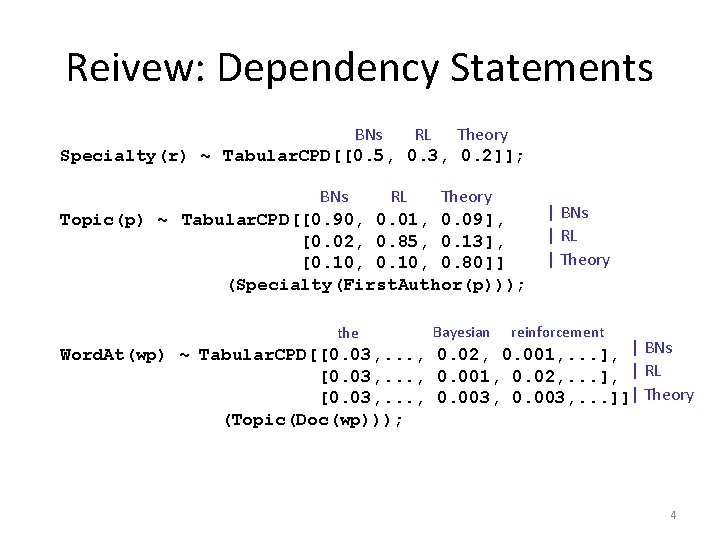
Reivew: Dependency Statements BNs RL Theory Specialty(r) ~ Tabular. CPD[[0. 5, 0. 3, 0. 2]]; BNs RL Theory Topic(p) ~ Tabular. CPD[[0. 90, 0. 01, 0. 09], [0. 02, 0. 85, 0. 13], [0. 10, 0. 80]] (Specialty(First. Author(p))); the Bayesian | BNs | RL | Theory reinforcement Word. At(wp) ~ Tabular. CPD[[0. 03, . . . , 0. 02, 0. 001, . . . ], | BNs [0. 03, . . . , 0. 001, 0. 02, . . . ], | RL [0. 03, . . . , 0. 003, . . . ]]| Theory (Topic(Doc(wp))); 4
Learning • Assume types, functions are given • Straightforward task: given structure, learn parameters – Just like in BNs, but parameters are shared across variables for same function, e. g. , Topic(Smith 98 a), Topic(Jones 00), etc. • Harder: learn abstract dependency structure 5
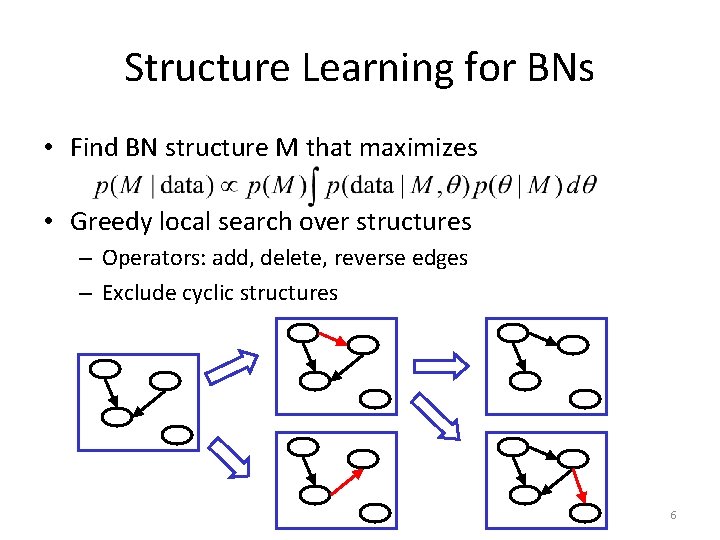
Structure Learning for BNs • Find BN structure M that maximizes • Greedy local search over structures – Operators: add, delete, reverse edges – Exclude cyclic structures 6
Logical Structure Learning • In RPM, want logical specification of each node’s parent set • Deterministic analogue: inductive logic programming (ILP) [Dzeroski & Lavrac 2001; Flach and Lavrac 2002] • Classic work on RPMs by Friedman, Getoor, Koller & Pfeffer [1999] – We’ll call their models FGKP models (they call them “probabilistic relational models” (PRMs)) 7
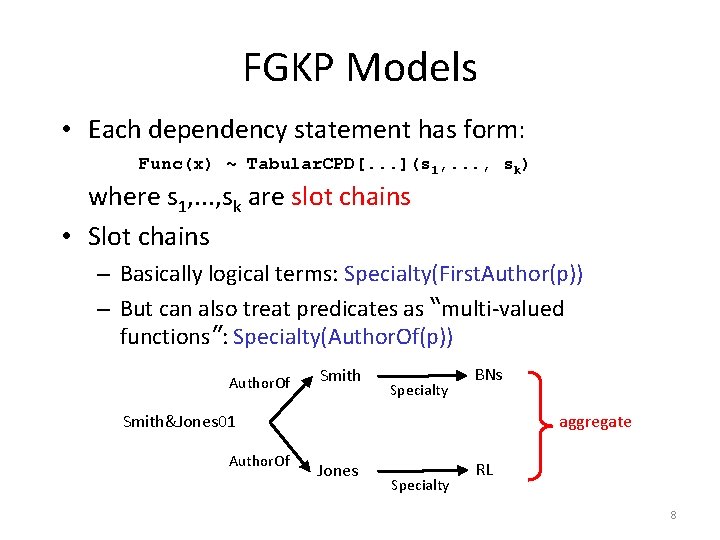
FGKP Models • Each dependency statement has form: Func(x) ~ Tabular. CPD[. . . ](s 1, . . . , sk) where s 1, . . . , sk are slot chains • Slot chains – Basically logical terms: Specialty(First. Author(p)) – But can also treat predicates as “multi-valued functions”: Specialty(Author. Of(p)) Author. Of Smith Specialty BNs Smith&Jones 01 Author. Of aggregate Jones Specialty RL 8
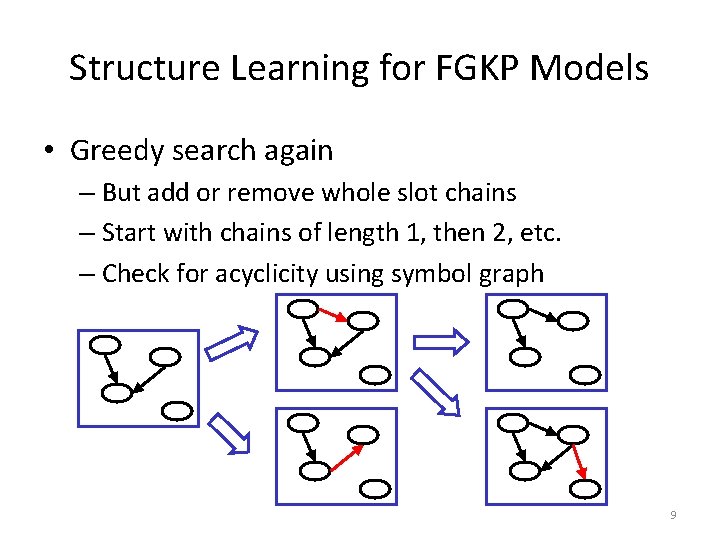
Structure Learning for FGKP Models • Greedy search again – But add or remove whole slot chains – Start with chains of length 1, then 2, etc. – Check for acyclicity using symbol graph 9
Outline • Learning relational probability models • Structural uncertainty – Uncertainty about relations – Uncertainty about object existence and identity • Applications of BLOG
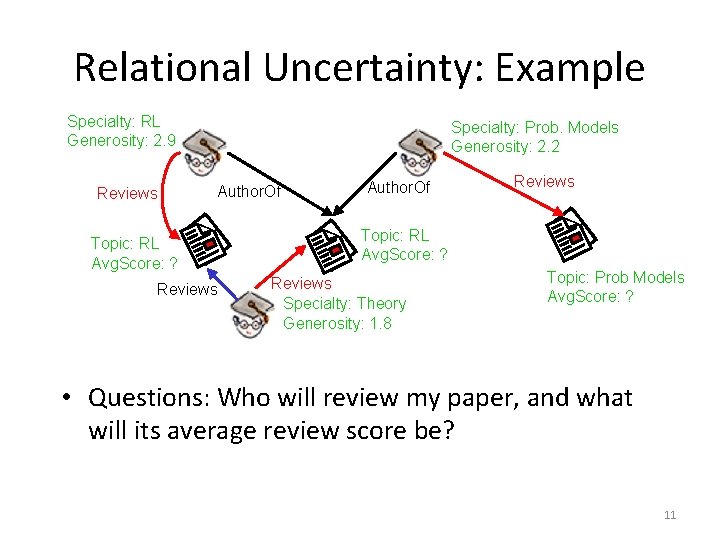
Relational Uncertainty: Example Specialty: RL Generosity: 2. 9 Reviews Specialty: Prob. Models Generosity: 2. 2 Author. Of Topic: RL Avg. Score: ? Reviews Author. Of Reviews Topic: RL Avg. Score: ? Reviews Specialty: Theory Generosity: 1. 8 Topic: Prob Models Avg. Score: ? • Questions: Who will review my paper, and what will its average review score be? 11
Simplest Approach to Relational Uncertainty • Add predicate Reviews(r, p) • Can model this with existing syntax: Reviews(r, p) ~ Review. CPD(Specialty(r), Topic(p)); • Potential drawback: – Reviews(r, p) nodes are independent given specialties and topics – Expected number of reviews per paper grows with number of researchers in skeleton [Getoor et al. , JMLR 2002] 12
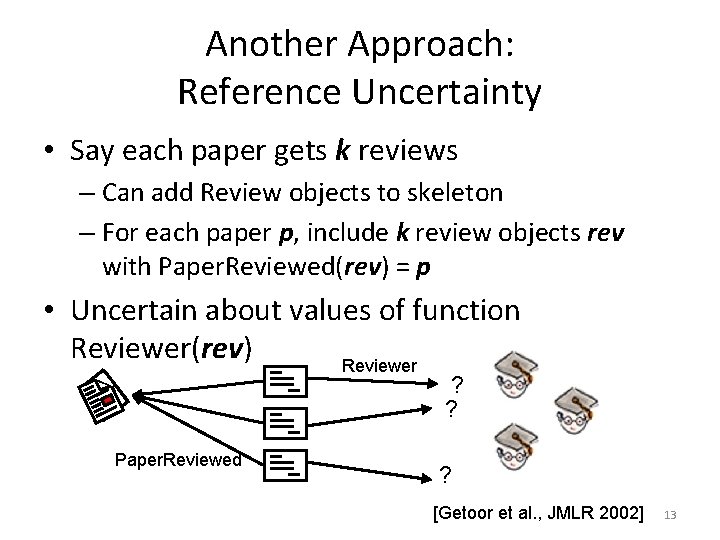
Another Approach: Reference Uncertainty • Say each paper gets k reviews – Can add Review objects to skeleton – For each paper p, include k review objects rev with Paper. Reviewed(rev) = p • Uncertain about values of function Reviewer(rev) Reviewer ? ? Paper. Reviewed ? [Getoor et al. , JMLR 2002] 13
Models for Reviewer(rev) • Explicit distribution over researchers? – No: won’t generalize across skeletons • Selection models: – Uniform sampling from researchers with certain attribute values [Getoor et al. , JMLR 2002] – Weighted sampling, with weights determined by attributes [Pasula et al. , IJCAI 2001] 14
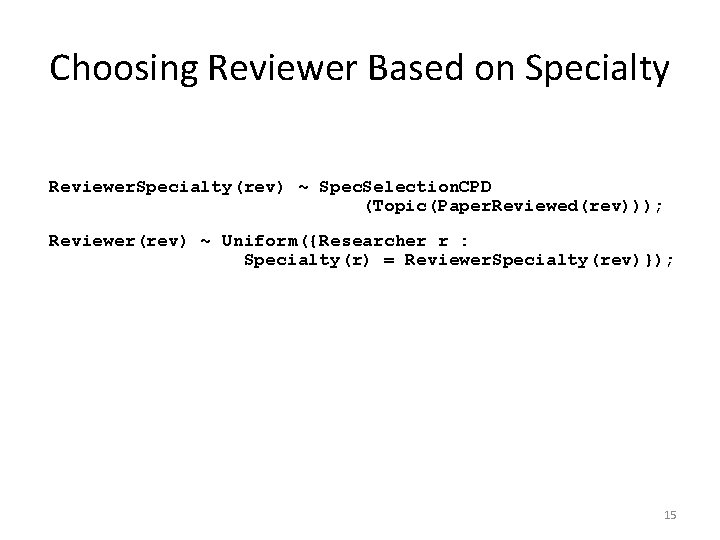
Choosing Reviewer Based on Specialty Reviewer. Specialty(rev) ~ Spec. Selection. CPD (Topic(Paper. Reviewed(rev))); Reviewer(rev) ~ Uniform({Researcher r : Specialty(r) = Reviewer. Specialty(rev)}); 15
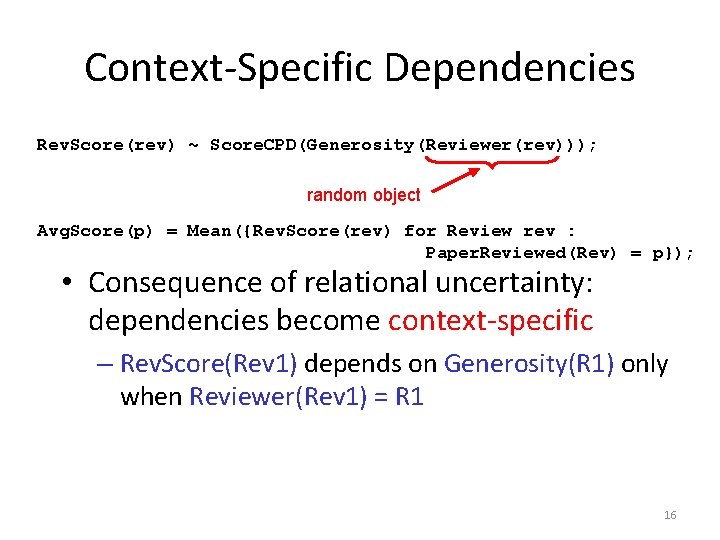
Context-Specific Dependencies Rev. Score(rev) ~ Score. CPD(Generosity(Reviewer(rev))); random object Avg. Score(p) = Mean({Rev. Score(rev) for Review rev : Paper. Reviewed(Rev) = p}); • Consequence of relational uncertainty: dependencies become context-specific – Rev. Score(Rev 1) depends on Generosity(R 1) only when Reviewer(Rev 1) = R 1 16
Semantics: Ground BN • Can still define ground BN • Parents of node X are all basic RVs whose values are potentially relevant in evaluating the right hand side of X’s dependency statement • Example: for Rev. Score(Rev 1)… Rev. Score(rev) ~ Score. CPD(Generosity(Reviewer(rev))); – Reviewer(Rev 1) is always relevant – Generosity(R) might be relevant for any researcher R 17
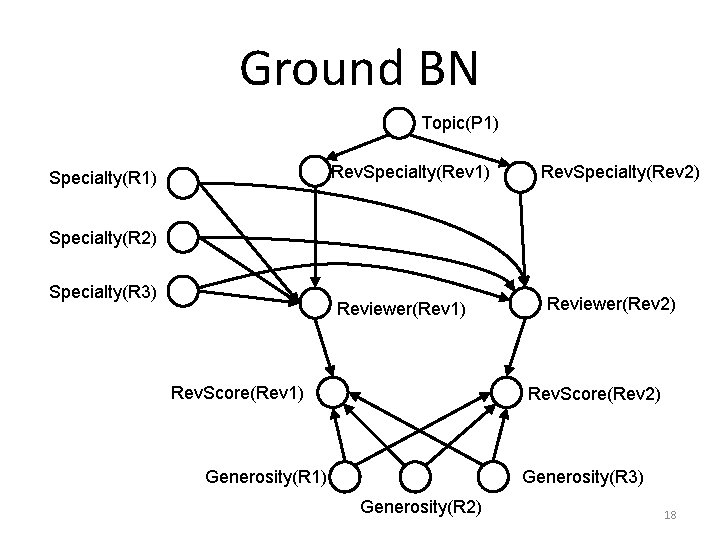
Ground BN Topic(P 1) Rev. Specialty(Rev 1) Specialty(R 1) Rev. Specialty(Rev 2) Specialty(R 3) Reviewer(Rev 1) Rev. Score(Rev 1) Reviewer(Rev 2) Rev. Score(Rev 2) Generosity(R 1) Generosity(R 3) Generosity(R 2) 18
Inference • Can still use ground BN, but it’s often very highly connected • Alternative: MCMC over possible worlds [Pasula & Russell, IJCAI 2001] – In each world, only certain dependencies are active 19
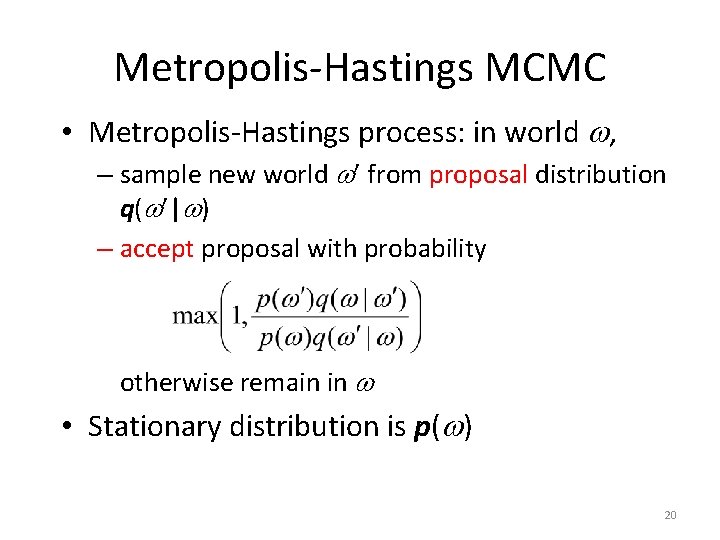
Metropolis-Hastings MCMC • Metropolis-Hastings process: in world , – sample new world from proposal distribution q( | ) – accept proposal with probability otherwise remain in • Stationary distribution is p( ) 20
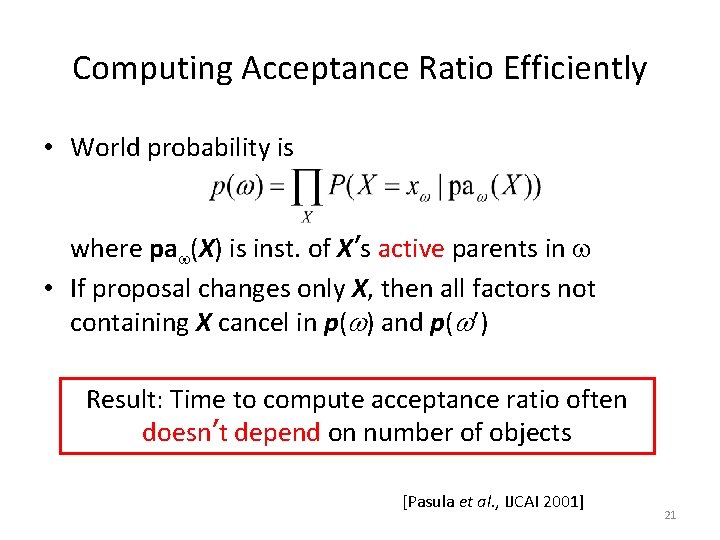
Computing Acceptance Ratio Efficiently • World probability is where pa (X) is inst. of X’s active parents in • If proposal changes only X, then all factors not containing X cancel in p( ) and p( ) Result: Time to compute acceptance ratio often doesn’t depend on number of objects [Pasula et al. , IJCAI 2001] 21
Learning Models for Relations • Binary predicate approach: Reviews(r, p) ~ Review. CPD(Specialty(r), Topic(p)); – Use existing search over slot chains • Selecting based on attributes Reviewer. Specialty(rev) ~ Spec. Selection. CPD (Topic(Paper. Reviewed(rev))); Reviewer(rev) ~ Uniform({Researcher r : Specialty(r) = Reviewer. Specialty(rev)}); – Search over sets of attributes to look at – Search over parent slot chains for choosing attribute values [Getoor et al. , JMLR 2002] 22
Outline • Learning relational probability models • Structural uncertainty – Uncertainty about relations – Uncertainty about object existence and identity • Applications of BLOG
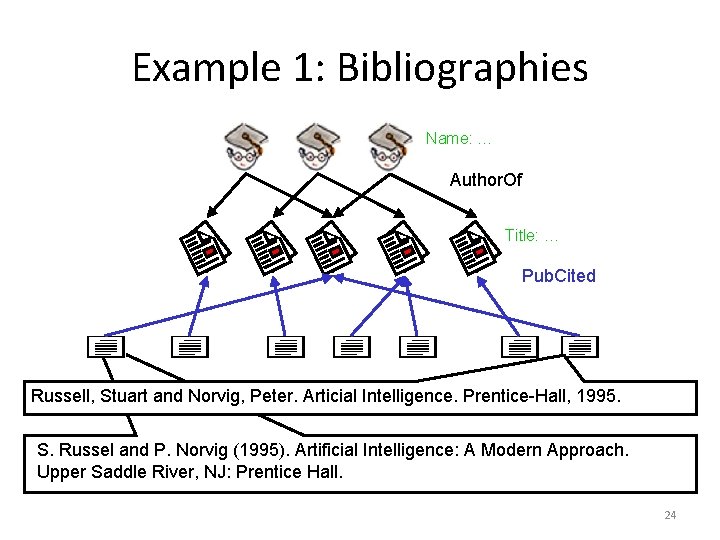
Example 1: Bibliographies Name: … Author. Of Title: … Pub. Cited Russell, Stuart and Norvig, Peter. Articial Intelligence. Prentice-Hall, 1995. S. Russel and P. Norvig (1995). Artificial Intelligence: A Modern Approach. Upper Saddle River, NJ: Prentice Hall. 24

Example 2: Aircraft Tracking Detection Failure 25
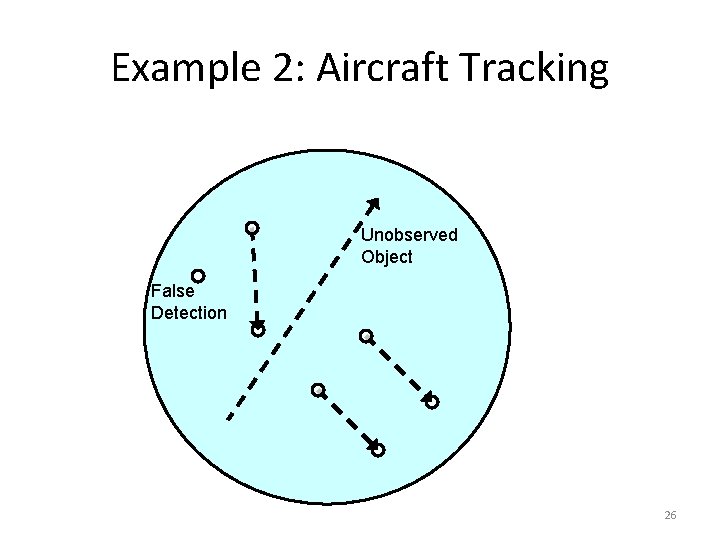
Example 2: Aircraft Tracking Unobserved Object False Detection 26
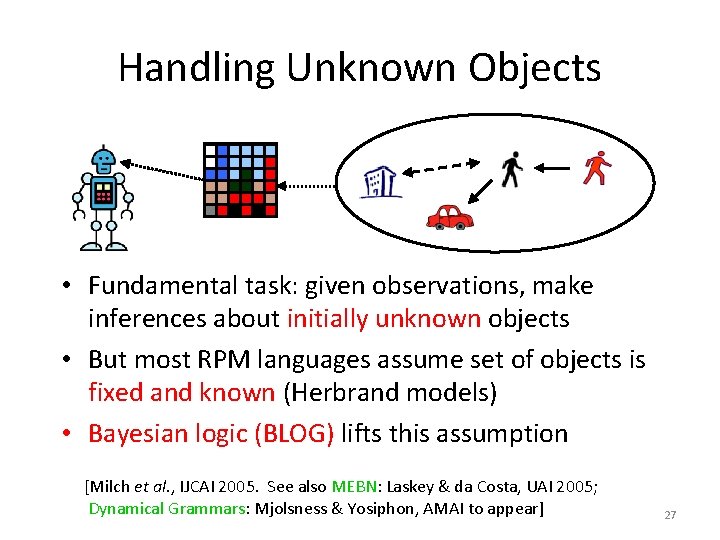
Handling Unknown Objects • Fundamental task: given observations, make inferences about initially unknown objects • But most RPM languages assume set of objects is fixed and known (Herbrand models) • Bayesian logic (BLOG) lifts this assumption [Milch et al. , IJCAI 2005. See also MEBN: Laskey & da Costa, UAI 2005; Dynamical Grammars: Mjolsness & Yosiphon, AMAI to appear] 27
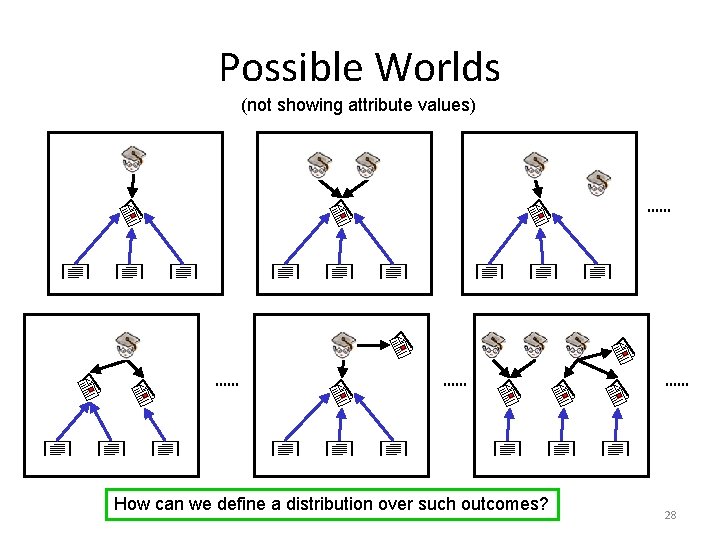
Possible Worlds (not showing attribute values) How can we define a distribution over such outcomes? 28

Generative Process • Imagine process that constructs worlds using two kinds of steps – Add some objects to the world – Set the value of a function on a tuple of arguments 29
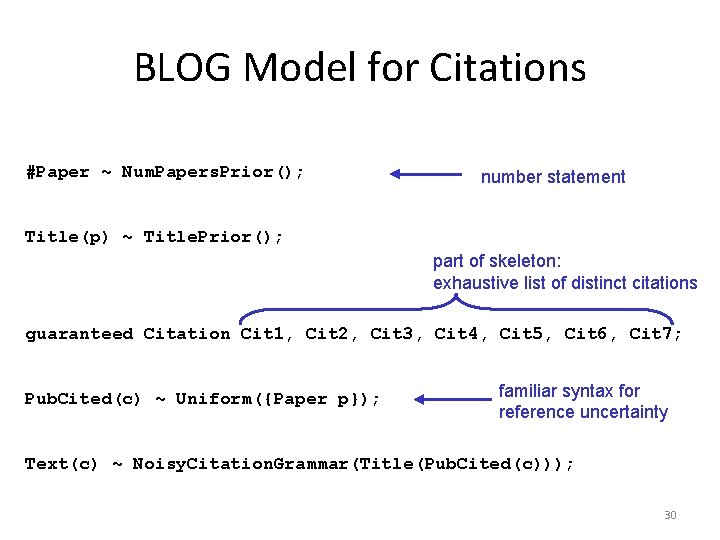
BLOG Model for Citations #Paper ~ Num. Papers. Prior(); number statement Title(p) ~ Title. Prior(); part of skeleton: exhaustive list of distinct citations guaranteed Citation Cit 1, Cit 2, Cit 3, Cit 4, Cit 5, Cit 6, Cit 7; Pub. Cited(c) ~ Uniform({Paper p}); familiar syntax for reference uncertainty Text(c) ~ Noisy. Citation. Grammar(Title(Pub. Cited(c))); 30
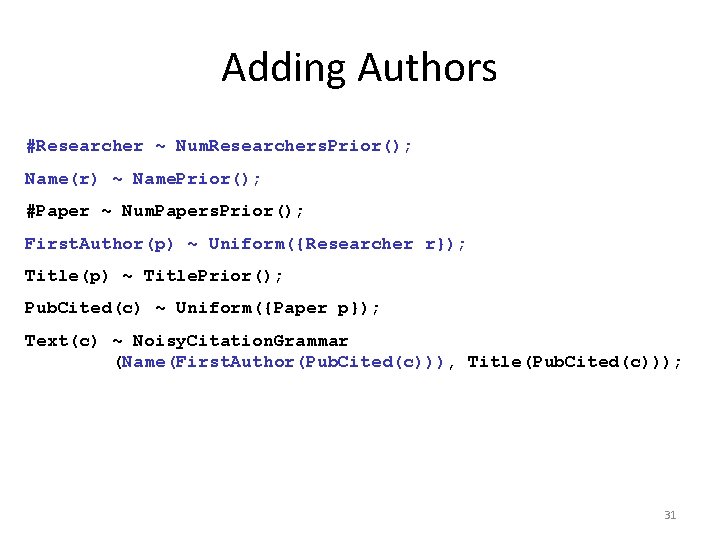
Adding Authors #Researcher ~ Num. Researchers. Prior(); Name(r) ~ Name. Prior(); #Paper ~ Num. Papers. Prior(); First. Author(p) ~ Uniform({Researcher r}); Title(p) ~ Title. Prior(); Pub. Cited(c) ~ Uniform({Paper p}); Text(c) ~ Noisy. Citation. Grammar (Name(First. Author(Pub. Cited(c))), Title(Pub. Cited(c))); 31
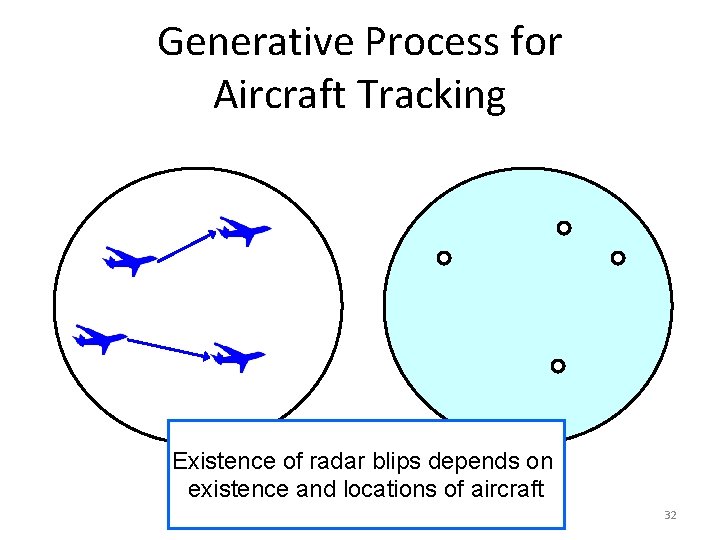
Generative Process for Aircraft Tracking Existence of radar blips depends on Sky Radar existence and locations of aircraft 32
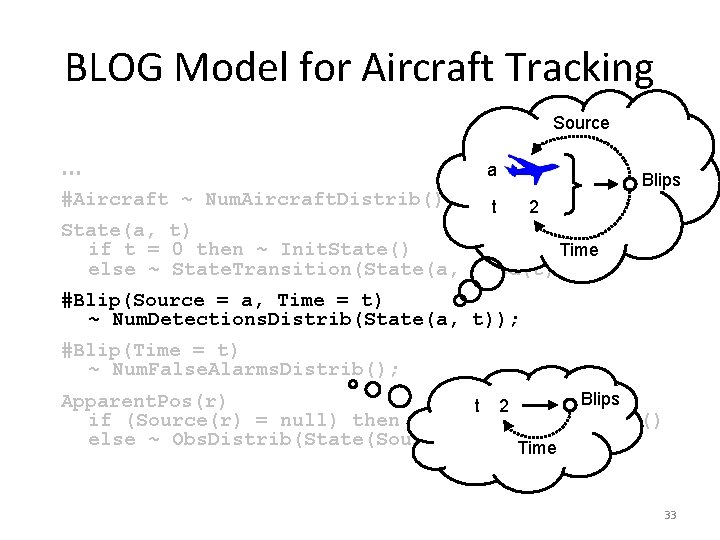
BLOG Model for Aircraft Tracking Source … #Aircraft ~ Num. Aircraft. Distrib(); a t Blips 2 State(a, t) if t = 0 then ~ Init. State() Time else ~ State. Transition(State(a, Pred(t))); #Blip(Source = a, Time = t) ~ Num. Detections. Distrib(State(a, t)); #Blip(Time = t) ~ Num. False. Alarms. Distrib(); Blips Apparent. Pos(r) t 2 if (Source(r) = null) then ~ False. Alarm. Distrib() else ~ Obs. Distrib(State(Source(r), Time(r))); Time 33
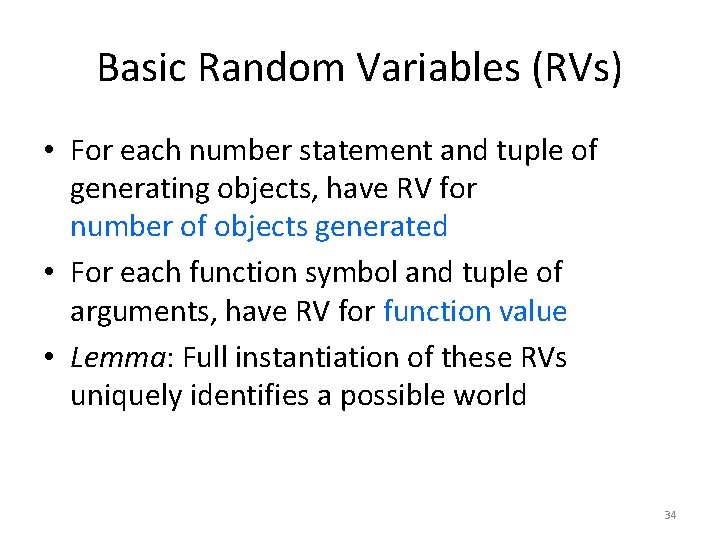
Basic Random Variables (RVs) • For each number statement and tuple of generating objects, have RV for number of objects generated • For each function symbol and tuple of arguments, have RV for function value • Lemma: Full instantiation of these RVs uniquely identifies a possible world 34

Contingent Bayesian Network • Each BLOG model defines contingent Bayesian network (CBN) over basic RVs – Edges active only under certain conditions infinitely many nodes! #Pub Title((Pub, 1)) (Pub, 2) = Pub. Cited(Cit 1) = (Pub, 1) Pub. Cited(Cit 1) Title((Pub, 2)) Pub. Cited(Cit 1) = (Pub, 2) Title((Pub, 3)) … Pub. Cited(Cit 1) = (Pub, 3) Text(Cit 1) [Milch et al. , AI/Stats 2005] 35
Probability Distribution • Through its CBN, BLOG model specifies: – Conditional distributions for basic RVs – Context-specific independence properties e. g. , Text(Cit 1) indep of Title((Pub, 1)) given Pub. Cited(Cit 1) = (Pub, 3) • Theorem: Under certain “context-specific ordering” conditions, every BLOG model fully defines a distribution over possible worlds [Milch et al. , IJCAI 2005] 36
Inference with Unknown Objects • Does infinite set of basic RVs prevent inference? • No: Sampling algorithms only need to instantiate finite set of relevant variables • Generic algorithms: – Rejection sampling [Milch et al. , IJCAI 2005] – Guided likelihood weighting [Milch et al. , AI/Stats 2005] • More practical: MCMC over partial worlds 37
Toward General-Purpose MCMC with Unknown Objects • Successful applications of MCMC with domain-specific proposal distributions: – Citation matching [Pasula et al. , 2003] – Multi-target tracking [Oh et al. , 2004] • But each application requires new code for: – Proposing moves – Representing MCMC states – Computing acceptance probabilities • Goal: – User specifies model and proposal distribution – General-purpose code does the rest
![Proposer for Citations [Pasula et al. , NIPS 2002] • Split-merge moves: – Propose](http://slidetodoc.com/presentation_image_h2/256960886da8ede202245211b8d54e86/image-39.jpg "Proposer for Citations [Pasula et al. , NIPS 2002] • Split-merge moves: – Propose")
Proposer for Citations [Pasula et al. , NIPS 2002] • Split-merge moves: – Propose titles and author names for affected publications based on citation strings • Other moves change total number of publications
MCMC States • Not complete instantiations! – No titles, author names for uncited publications • States are partial instantiations of random variables #Pub = 100, Pub. Cited(Cit 1) = (Pub, 37), Title((Pub, 37)) = “Calculus” – Each state corresponds to an event: set of outcomes satisfying description
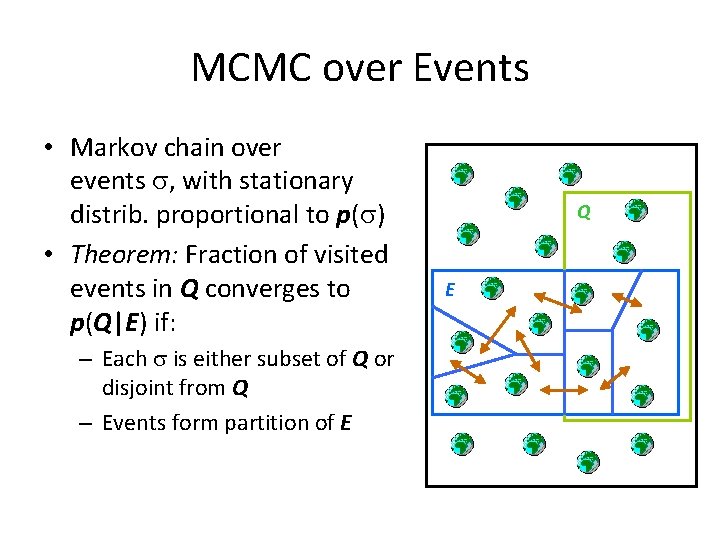
MCMC over Events • Markov chain over events , with stationary distrib. proportional to p( ) • Theorem: Fraction of visited events in Q converges to p(Q|E) if: – Each is either subset of Q or disjoint from Q – Events form partition of E Q E
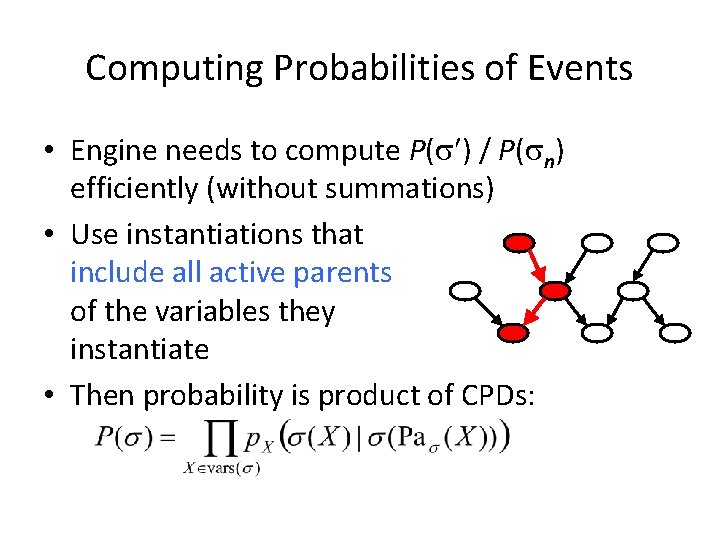
Computing Probabilities of Events • Engine needs to compute P( ) / P( n) efficiently (without summations) • Use instantiations that include all active parents of the variables they instantiate • Then probability is product of CPDs:
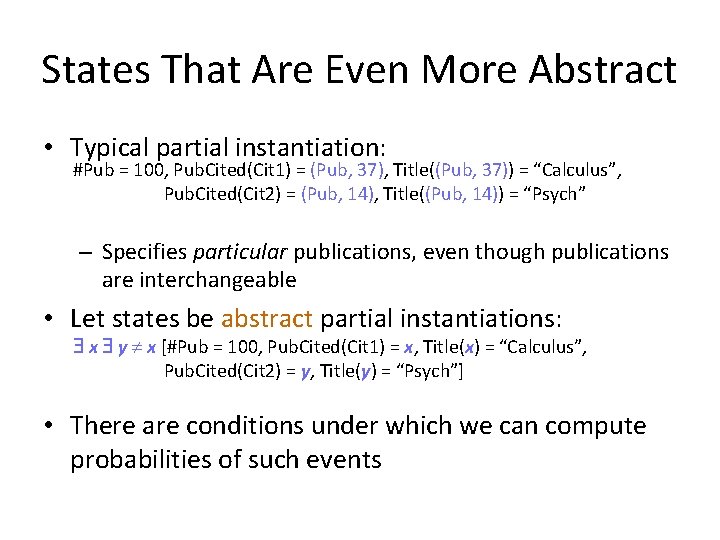
States That Are Even More Abstract • Typical partial instantiation: #Pub = 100, Pub. Cited(Cit 1) = (Pub, 37), Title((Pub, 37)) = “Calculus”, Pub. Cited(Cit 2) = (Pub, 14), Title((Pub, 14)) = “Psych” – Specifies particular publications, even though publications are interchangeable • Let states be abstract partial instantiations: x y x [#Pub = 100, Pub. Cited(Cit 1) = x, Title(x) = “Calculus”, Pub. Cited(Cit 2) = y, Title(y) = “Psych”] • There are conditions under which we can compute probabilities of such events
Outline • Learning relational probability models • Structural uncertainty – Uncertainty about relations – Uncertainty about object existence and identity • Applications of BLOG
Citation Matching • Elaboration of generative model shown earlier • Parameter estimation – Priors for names, titles, citation formats learned offline from labeled data – String corruption parameters learned with Monte Carlo EM • Inference – MCMC with split-merge proposals – Guided by “canopies” of similar citations – Accuracy stabilizes after ~20 minutes [Pasula et al. , NIPS 2002] 45
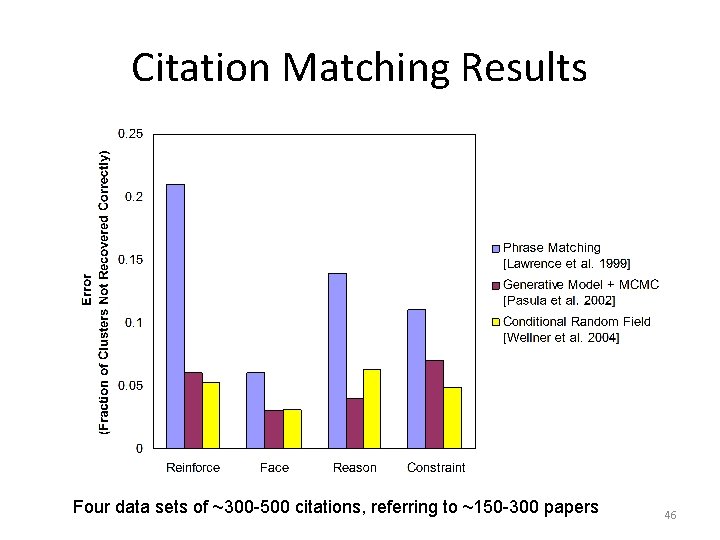
Citation Matching Results Four data sets of ~300 -500 citations, referring to ~150 -300 papers 46
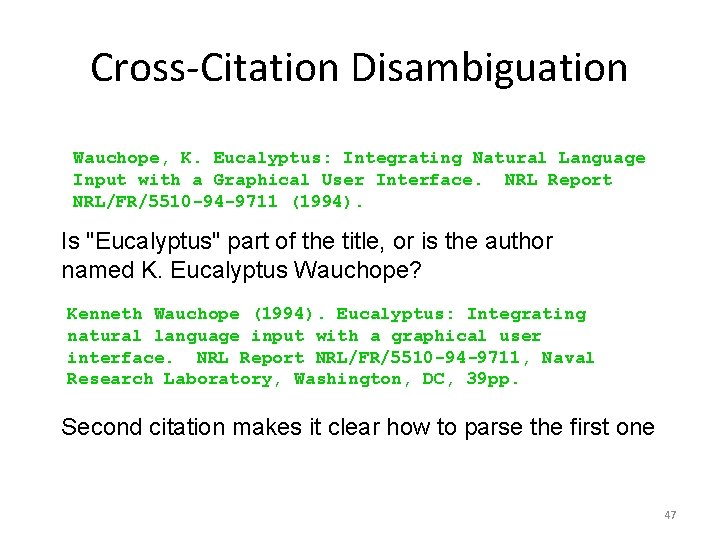
Cross-Citation Disambiguation Wauchope, K. Eucalyptus: Integrating Natural Language Input with a Graphical User Interface. NRL Report NRL/FR/5510 -94 -9711 (1994). Is "Eucalyptus" part of the title, or is the author named K. Eucalyptus Wauchope? Kenneth Wauchope (1994). Eucalyptus: Integrating natural language input with a graphical user interface. NRL Report NRL/FR/5510 -94 -9711, Naval Research Laboratory, Washington, DC, 39 pp. Second citation makes it clear how to parse the first one 47
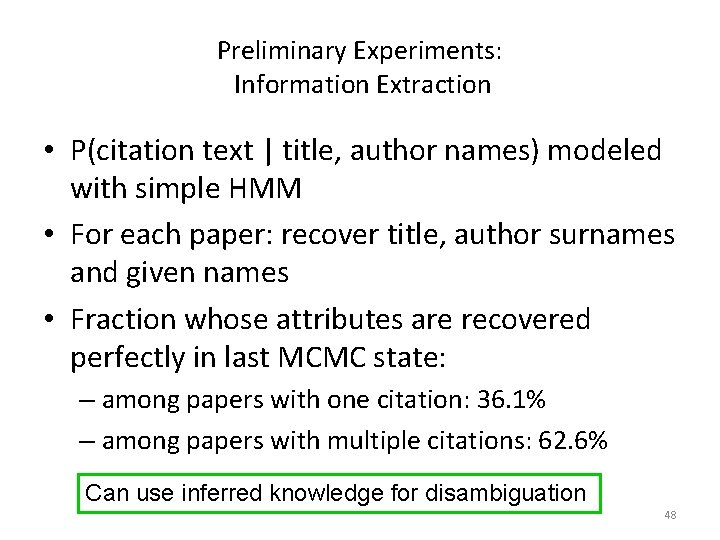
Preliminary Experiments: Information Extraction • P(citation text | title, author names) modeled with simple HMM • For each paper: recover title, author surnames and given names • Fraction whose attributes are recovered perfectly in last MCMC state: – among papers with one citation: 36. 1% – among papers with multiple citations: 62. 6% Can use inferred knowledge for disambiguation 48
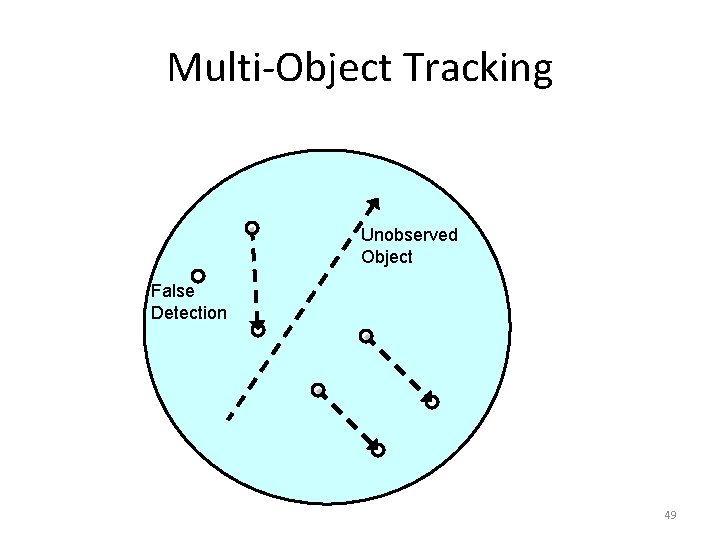
Multi-Object Tracking Unobserved Object False Detection 49
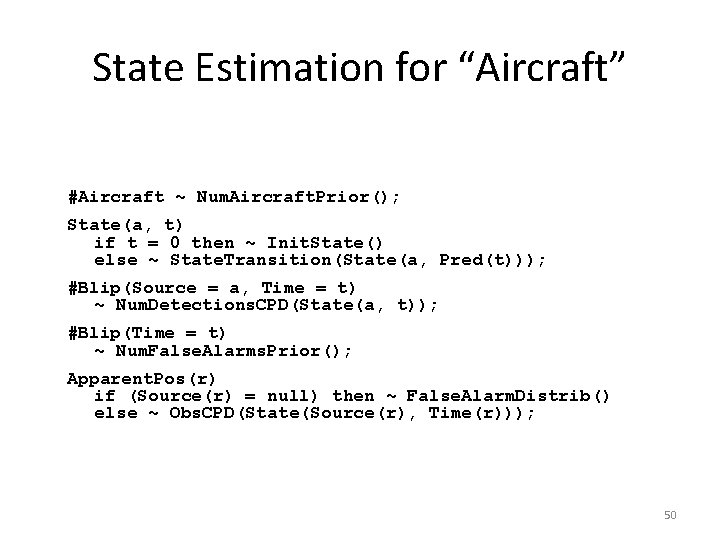
State Estimation for “Aircraft” #Aircraft ~ Num. Aircraft. Prior(); State(a, t) if t = 0 then ~ Init. State() else ~ State. Transition(State(a, Pred(t))); #Blip(Source = a, Time = t) ~ Num. Detections. CPD(State(a, t)); #Blip(Time = t) ~ Num. False. Alarms. Prior(); Apparent. Pos(r) if (Source(r) = null) then ~ False. Alarm. Distrib() else ~ Obs. CPD(State(Source(r), Time(r))); 50
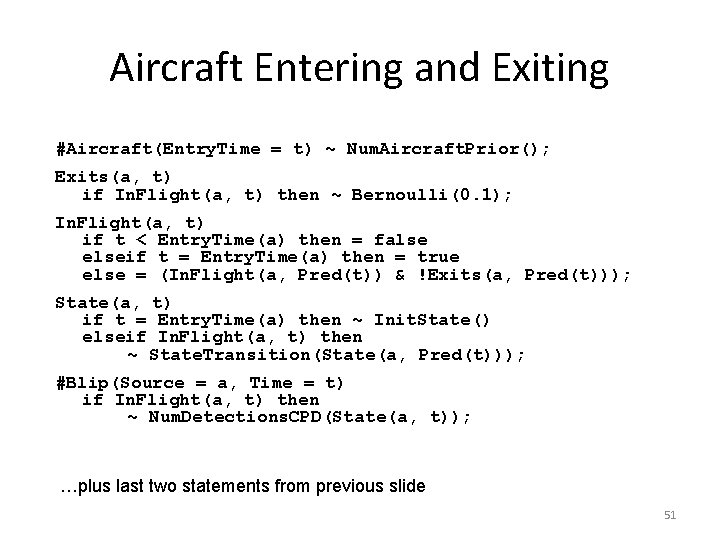
Aircraft Entering and Exiting #Aircraft(Entry. Time = t) ~ Num. Aircraft. Prior(); Exits(a, t) if In. Flight(a, t) then ~ Bernoulli(0. 1); In. Flight(a, t) if t < Entry. Time(a) then = false elseif t = Entry. Time(a) then = true else = (In. Flight(a, Pred(t)) & !Exits(a, Pred(t))); State(a, t) if t = Entry. Time(a) then ~ Init. State() elseif In. Flight(a, t) then ~ State. Transition(State(a, Pred(t))); #Blip(Source = a, Time = t) if In. Flight(a, t) then ~ Num. Detections. CPD(State(a, t)); …plus last two statements from previous slide 51
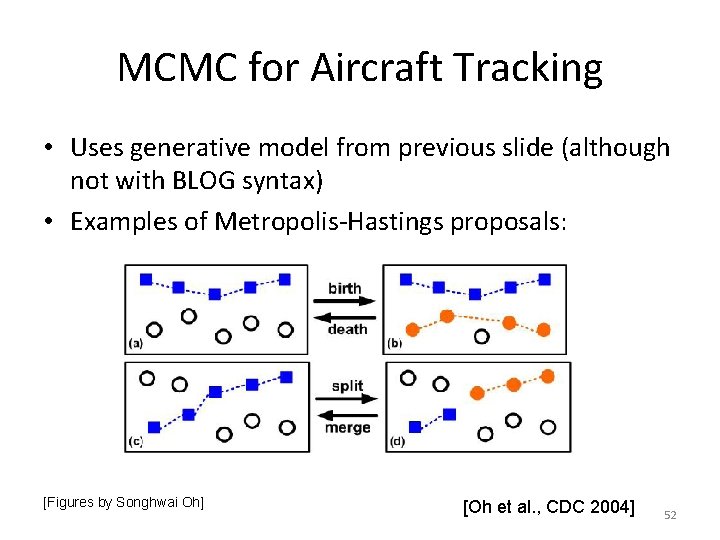
MCMC for Aircraft Tracking • Uses generative model from previous slide (although not with BLOG syntax) • Examples of Metropolis-Hastings proposals: [Figures by Songhwai Oh] [Oh et al. , CDC 2004] 52
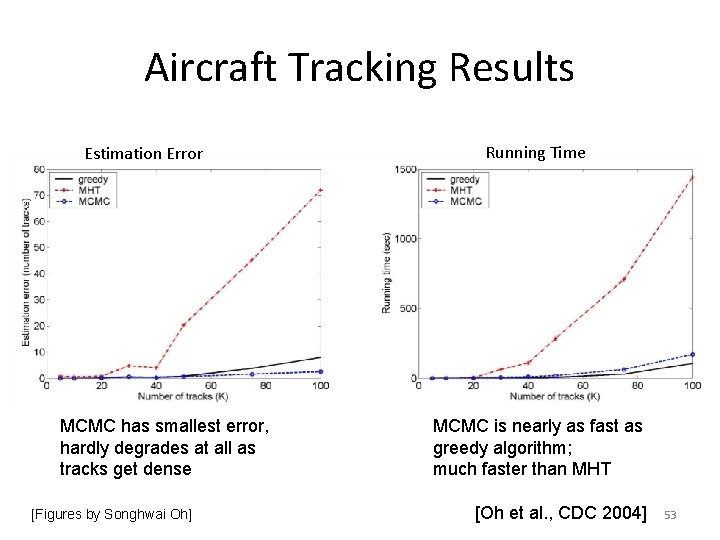
Aircraft Tracking Results Estimation Error MCMC has smallest error, hardly degrades at all as tracks get dense [Figures by Songhwai Oh] Running Time MCMC is nearly as fast as greedy algorithm; much faster than MHT [Oh et al. , CDC 2004] 53
BLOG Software • Bayesian Logic inference engine available: http: //people. csail. mit. edu/milch/blog 54
References • • Friedman, N. , Getoor, L. , Koller, D. , and Pfeffer, A. (1999) “Learning probabilistic relational models”. In Proc. 16 th Int’l Joint Conf. on AI, pages 1300 -1307. Taskar, B. , Segal, E. , and Koller, D. (2001) “Probabilistic classification and clustering in relational data”. In Proc. 17 th Int’l Joint Conf. on AI, pages 870 -878. Getoor, L. , Friedman, N. , Koller, D. , and Taskar, B. (2002) “Learning probabilistic models of link structure”. J. Machine Learning Res. 3: 679 -707. Taskar, B. , Abbeel, P. , and Koller, D. (2002) “Discriminative probabilistic models for relational data”. In Proc. 18 th Conf. on Uncertainty in AI, pages 485 -492. Dzeroski, S. and Lavrac, N. , eds. (2001) Relational Data Mining. Springer. Flach, P. and Lavrac, N. (2002) “Learning in Clausal Logic: A Perspective on Inductive Logic Programming”. In Computational Logic: Logic Programming and Beyond (Essays in Honour of Robert A. Kowalski), Springer Lecture Notes in AI volume 2407, pages 437 -471. Pasula, H. and Russell, S. (2001) “Approximate inference for first-order probabilistic languages”. In Proc. 17 th Int’l Joint Conf. on AI, pages 741 -748. Milch, B. , Marthi, B. , Russell, S. , Sontag, D. , Ong, D. L. , and Kolobov, A. (2005) “BLOG: Probabilistic Models with Unknown Objects”. In Proc. 19 th Int’l Joint Conf. on AI, pages 1352 -1359. 55
References • • • Milch, B. , Marthi, B. , Russell, S. , Sontag, D. , Ong, D. L. , and Kolobov, A. (2005) “BLOG: Probabilistic Models with Unknown Objects”. In Proc. 19 th Int’l Joint Conf. on AI, pages 13521359. Milch, B. , Marthi, B. , Sontag, D. , Russell, S. , Ong, D. L. , and Kolobov, A. (2005) “Approximate inference for infinite contingent Bayesian networks”. In Proc. 10 th Int’l Workshop on AI and Statistics. Milch, B. and Russell, S. (2006) “General-purpose MCMC inference over relational structures”. In Proc. 22 nd Conf. on Uncertainty in AI, pages 349 -358. Pasula, H. , Marthi, B. , Milch, B. , Russell, S. , and Shpitser, I. (2003) “Identity uncertainty and citation matching”. In Advances in Neural Information Processing Systems 15, MIT Press, pages 1401 -1408. Lawrence, S. , Giles, C. L. , and Bollacker, K. D. (1999) “Autonomous citation matching”. In Proc. 3 rd Int’l Conf. on Autonomous Agents, pages 392 -393. Wellner, B. , Mc. Callum, A. , Feng, P. , and Hay, M. (2004) “An integrated, conditional model of information extraction and coreference with application to citation matching”. In Proc. 20 th Conf. on Uncertainty in AI, pages 593 -601. 56
References • • Pasula, H. , Russell, S. J. , Ostland, M. , and Ritov, Y. (1999) “Tracking many objects with many sensors”. In Proc. 16 th Int’l Joint Conf. on AI, pages 1160 -1171. Oh, S. , Russell, S. and Sastry, S. (2004) “Markov chain Monte Carlo data association for general multi-target tracking problems”. In Proc. 43 rd IEEE Conf. on Decision and Control, pages 734 -742. 57
- Slides: 57