
Learning and Skills Research Network Discussion Workshop Using

- Slides: 21
Learning and Skills Research Network Discussion Workshop Using evidence for good in an FE environment ‘Turning a place of learning into a learning workplace’ (IFL In-Tuition Spring 2012) Chris Davies Director of Curriculum Quality and Support South Staffordshire College
Some useful background Shape of presentation • Background to the FE sector post incorporation and the challenge of the new landscape • The relationship between the individual and the organisation (Teacher agency vs social structure) • Positioning yourself and the organisation – The developmental philosophy • Some examples of changes to practice and policy • Some examples of changes to resources
Three areas of influence in my use and development of research within my current role • My own doctoral research into Teacher Identity within FE • Mechanisms to develop teacher interest and motivation in research linked to notions of professionalism • The development and introduction of a new approach to lesson observations and performance reviews
Some context Changes in FE post incorporation Smith (2007) refers to the marketisation of education post incorporation and the change in teacher roles / values, which have impacted directly on teacher agency and professionalism
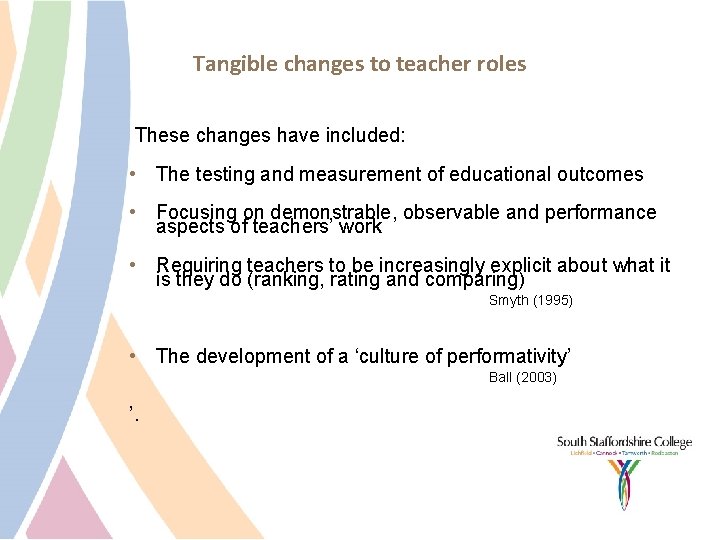
Tangible changes to teacher roles These changes have included: • The testing and measurement of educational outcomes • Focusing on demonstrable, observable and performance aspects of teachers’ work • Requiring teachers to be increasingly explicit about what it is they do (ranking, rating and comparing) Smyth (1995) • The development of a ‘culture of performativity’ Ball (2003) ’.
My positioning Maclure (1993) feels that the teacher-as-person, describes a slant or posture towards research that ‘places the biographical subject and her or his lived experience at the centre of the analytic frame. Teachers personal and professional identities are constantly being reconstructed through the historical, cultural, sociological and psychological influences which all shape the meaning of being a teacher’ (p 311)
Where is the sector 20 years after incorporation? ‘It seems to us likely that these interventions have, in the name of control and accountability, weakened the very characteristics successive governments have wished to nourish: good governance; self-reliance in academic quality assurance and continuous improvement The sector has matured beyond a need for such interventions in our view; they are now widely resented. There is some evidence that this ‘command control’ environment has infiltrated relations between some FE providers and their staff, on whom a good service to customers relies. ’ Lingfield Review 2012
In what ways should the sector change? • Developing a vision for the FE landscape to help shape the sector • Providing FE colleges with greater freedoms and flexibilities in terms of simplified funding • Further developing Teaching, learning and qualifications with a view to simplifying qualifications, further developing teaching qualifications and further developing professionalism • A focus on Deregulation and devolution of centralised controls to further develop the nature of competition and collaboration within the sector. (New Challenges, new chances further education reform plan 2011, p 8)
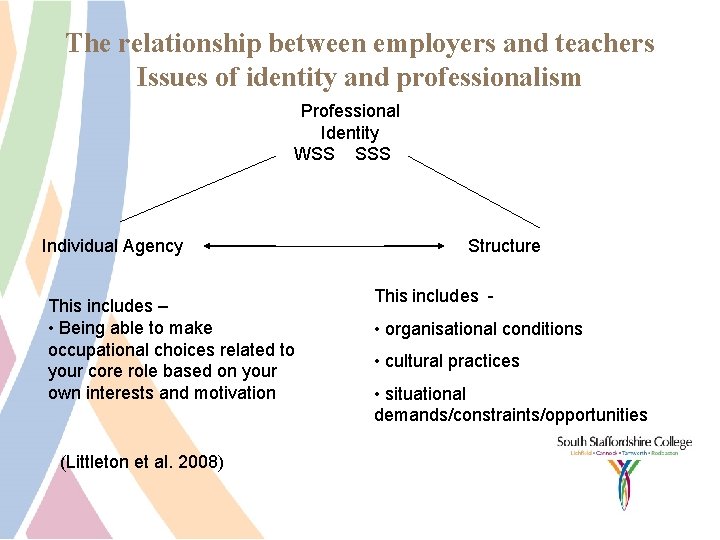
The relationship between employers and teachers Issues of identity and professionalism Professional Identity WSS SSS Individual Agency This includes – • Being able to make occupational choices related to your core role based on your own interests and motivation (Littleton et al. 2008) Structure This includes - • organisational conditions • cultural practices • situational demands/constraints/opportunities
Teacher Identity defined • Individuals’ perceptions of themselves as actors – including a sense of belonging, notions of commitment and values regarding education’ (Bejjard et al. 2004) • It is held to be negotiated in the course of an individuals’ biography • It is based on those elements which give a sense of meaning and commitment to people in their work • It is influenced by future prospects (Littleton et al. 2008)
Professionalism within FE The five inter-related parts of the professional self • Self-image: how teachers describe themselves though their career stories; • Self-esteem: the evolution of self as a teacher, how good or otherwise as defined by self or others; • Job-motivation: what makes teachers choose, remain committed to or leave the job; • Task perception: how teachers define their jobs; • Future perspective: teachers’ expectations for the future development of their jobs Geert Kelchtermans (1993, pp. 449– 450)
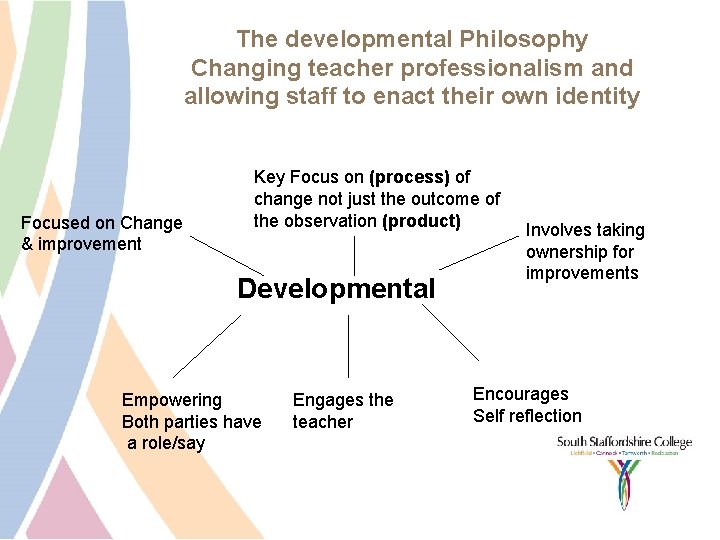
The developmental Philosophy Changing teacher professionalism and allowing staff to enact their own identity Focused on Change & improvement Key Focus on (process) of change not just the outcome of the observation (product) Developmental Empowering Both parties have a role/say Engages the teacher Involves taking ownership for improvements Encourages Self reflection
The concept of the Total Learning College (Outstanding Teaching and Learning Conference October 2012 – Leading learning and letting go 157 publication 2013) We need to consider tangible and intangible aspects of any changes • Identifying key components of the teaching role – re thinking the professional lecturer • Dedicated time for staff development • Professional Development Centres at each campus • Developmental approach to lesson observations • Establishing opportunities for new ways of working and thinking about teaching and learning
What is the focus of the teacher role within your college? Outcomes of professional lecturer project at BMET (reported in IFL research publication Leading Learning and letting go 2013) Over 40% of non teaching time spent undertaking activities not associated with teaching and learning The project identified the need for lecturers to have more time to focus on high value added activities associated with the core role of a teacher. (planning/preparing and delivering learning) As part of this process the project identified a number of non-core activities that could be changed/removed from the lecturer role in order to create the time and space for a greater focus on teaching and learning.
Development of a research culture ‘Teacher as Researcher’ (LSIS Inside Evidence Summer 2012) • Scholarly activity conferences and networking events – Staff and students within and outside the college • Supported experiments – encouraging staff to research specific aspects of their role (experience the benefits of small scale action research into vocational practice) • CPD linked to specific targets (Not just lesson observations – updating vocational knowledge – vocational connectivity – achievement of Director plans) • Technology enabled solutions to T&L issues (Social collaborative learning – The flipped classroom – Targets linked to % of curriculum delivered using technology enabled delivery
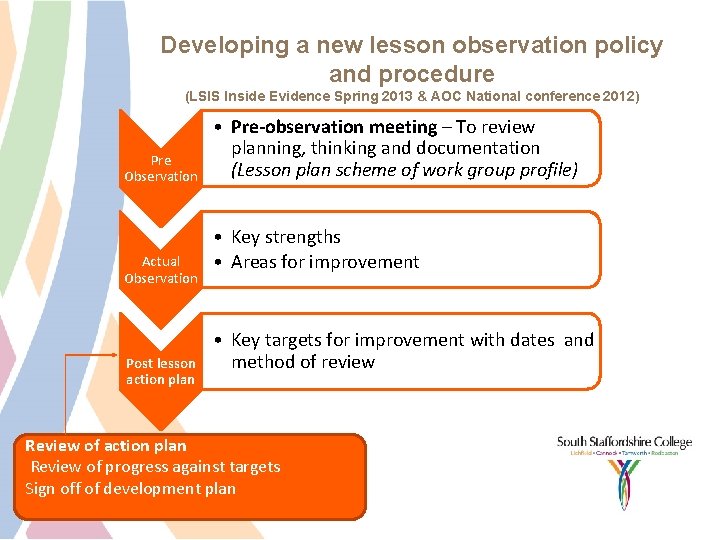
Developing a new lesson observation policy and procedure (LSIS Inside Evidence Spring 2013 & AOC National conference 2012) Pre Observation Actual Observation Post lesson action plan • Pre-observation meeting – To review planning, thinking and documentation (Lesson plan scheme of work group profile) • Key strengths • Areas for improvement • Key targets for improvement with dates and method of review Review of action plan Review of progress against targets Sign off of development plan
Some key questions we considered • Should the observation team be managers or excellent teachers? • Should we let teachers know when they are being observed? • Should they be required to prepare lesson plans for the week or just the observed session? • Is our focus the product or the process?
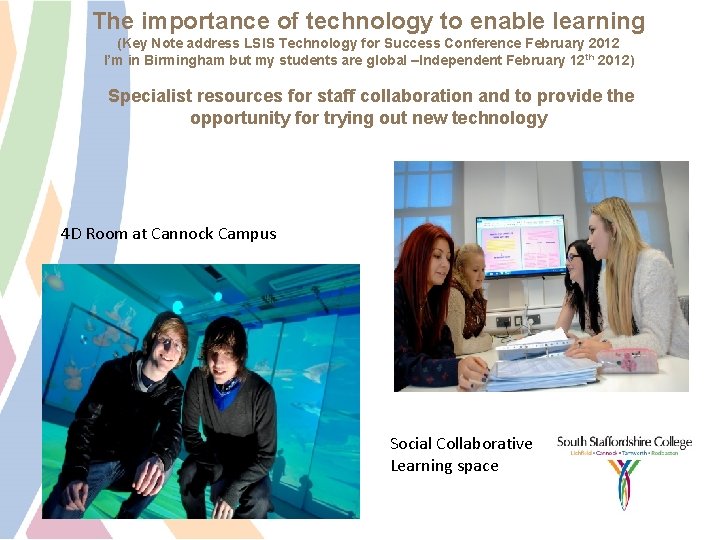
The importance of technology to enable learning (Key Note address LSIS Technology for Success Conference February 2012 I’m in Birmingham but my students are global –Independent February 12 th 2012) Specialist resources for staff collaboration and to provide the opportunity for trying out new technology 4 D Room at Cannock Campus Social Collaborative Learning space
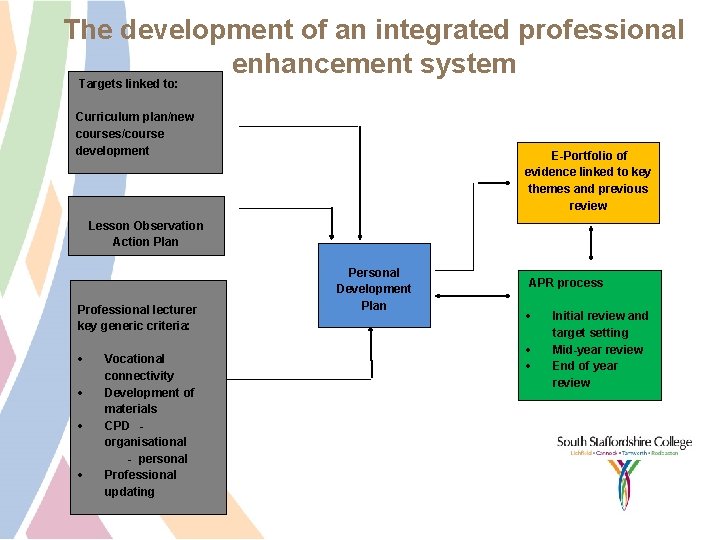
The development of an integrated professional enhancement system Targets linked to: Curriculum plan/new courses/course development E-Portfolio of evidence linked to key themes and previous review Lesson Observation Action Plan Professional lecturer key generic criteria: Vocational connectivity Development of materials CPD organisational - personal Professional updating Personal Development Plan APR process Initial review and target setting Mid-year review End of year review
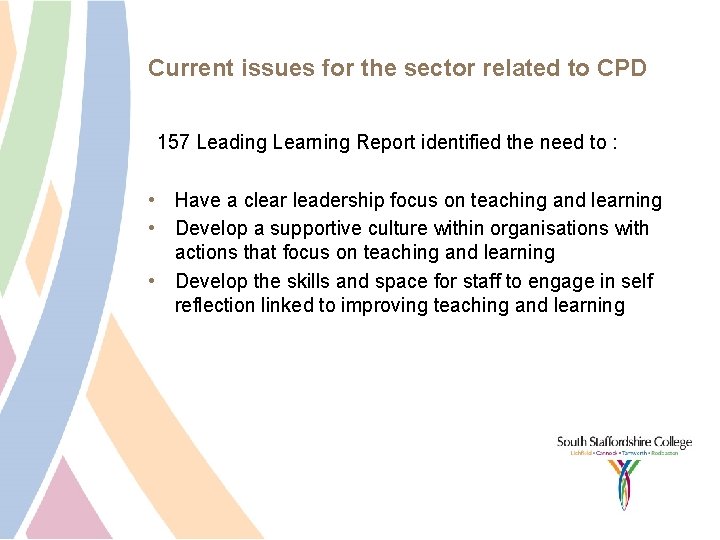
Current issues for the sector related to CPD 157 Leading Learning Report identified the need to : • Have a clear leadership focus on teaching and learning • Develop a supportive culture within organisations with actions that focus on teaching and learning • Develop the skills and space for staff to engage in self reflection linked to improving teaching and learning
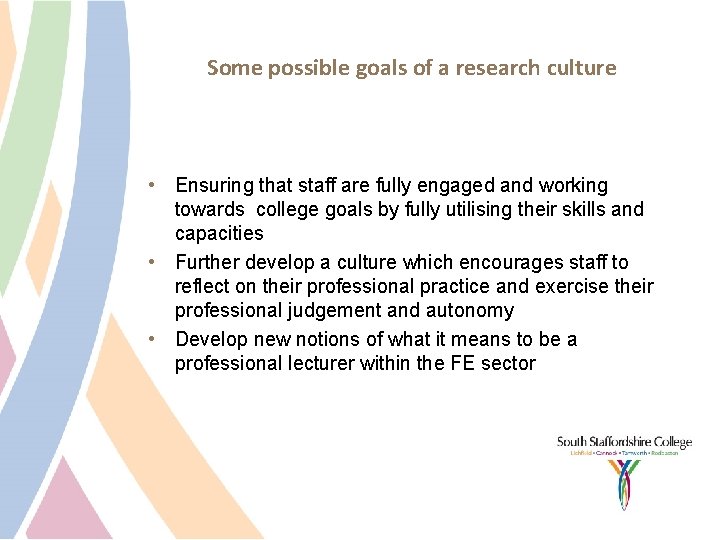
Some possible goals of a research culture • Ensuring that staff are fully engaged and working towards college goals by fully utilising their skills and capacities • Further develop a culture which encourages staff to reflect on their professional practice and exercise their professional judgement and autonomy • Develop new notions of what it means to be a professional lecturer within the FE sector