
Learning and Mathematics Bluebook Anticipatory SetMultiple choice Learning
Learning and Mathematics Bluebook Anticipatory Set-Multiple choice Learning and Writing cont. Learning and Mathematics Discussions–Questioning Strategies For Tuesday: Read Chapter 6, HYLA 1 due

Good Writers Have…. . Knowledge n n n Language Topic Audience
Cognitive Processes in Writing The writing process
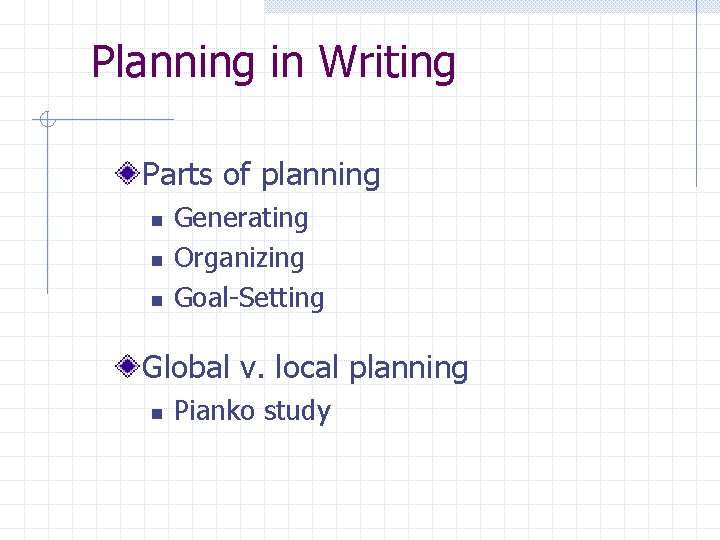
Planning in Writing Parts of planning n n n Generating Organizing Goal-Setting Global v. local planning n Pianko study
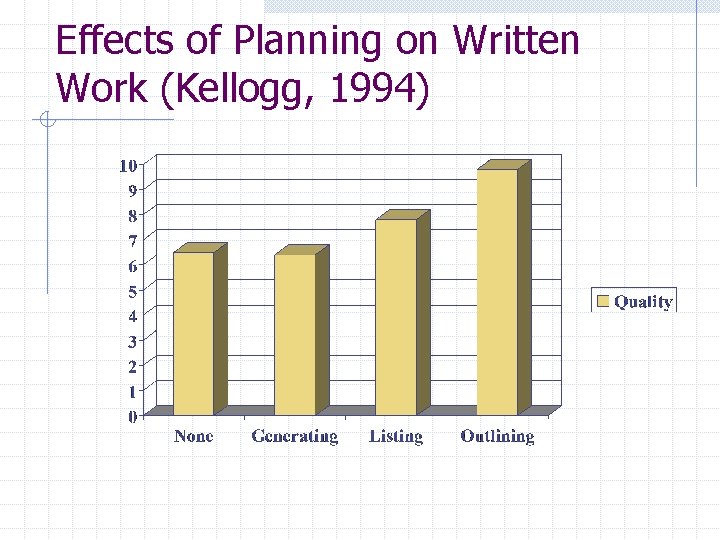
Effects of Planning on Written Work (Kellogg, 1994)
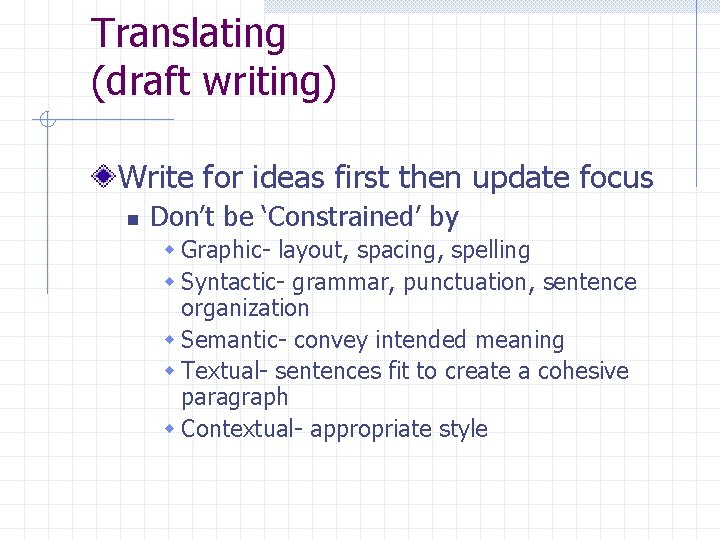
Translating (draft writing) Write for ideas first then update focus n Don’t be ‘Constrained’ by w Graphic- layout, spacing, spelling w Syntactic- grammar, punctuation, sentence organization w Semantic- convey intended meaning w Textual- sentences fit to create a cohesive paragraph w Contextual- appropriate style
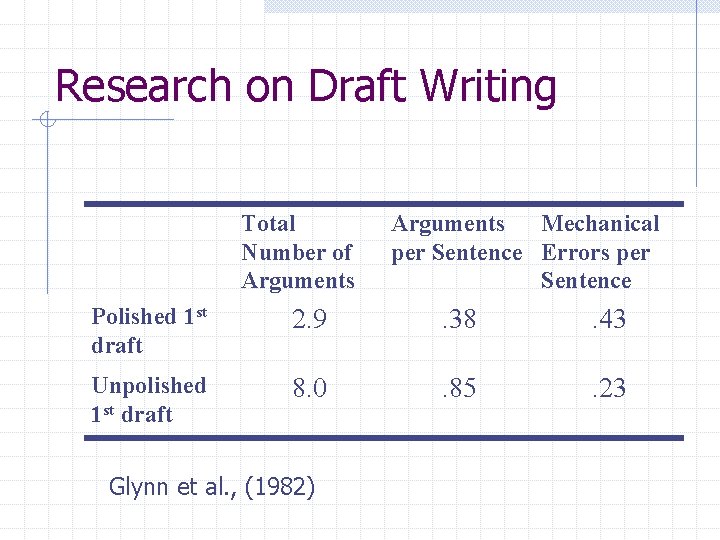
Research on Draft Writing Total Number of Arguments Mechanical per Sentence Errors per Sentence Polished 1 st draft 2. 9 . 38 . 43 Unpolished 1 st draft 8. 0 . 85 . 23 Glynn et al. , (1982)
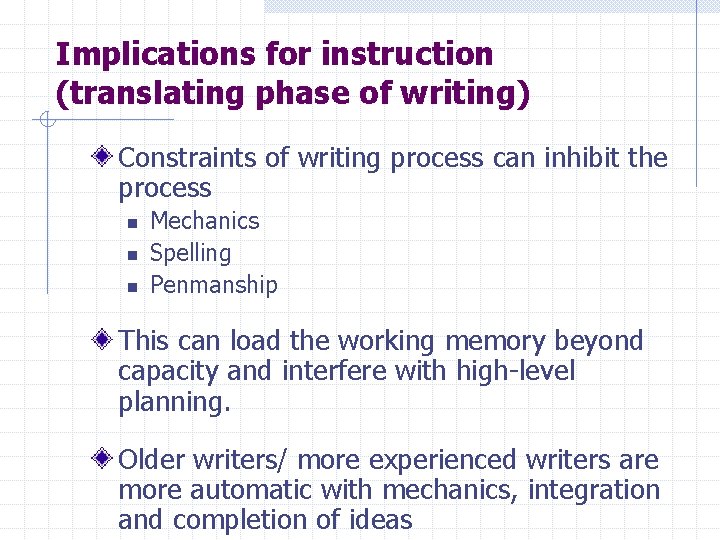
Implications for instruction (translating phase of writing) Constraints of writing process can inhibit the process n n n Mechanics Spelling Penmanship This can load the working memory beyond capacity and interfere with high-level planning. Older writers/ more experienced writers are more automatic with mechanics, integration and completion of ideas
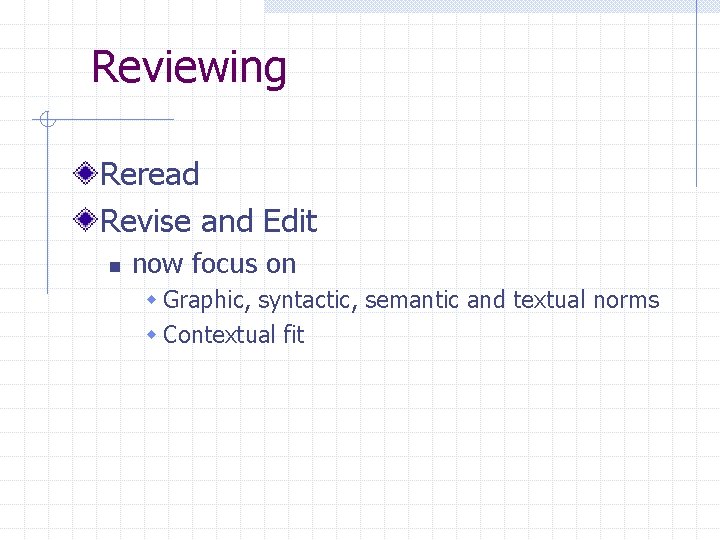
Reviewing Reread Revise and Edit n now focus on w Graphic, syntactic, semantic and textual norms w Contextual fit
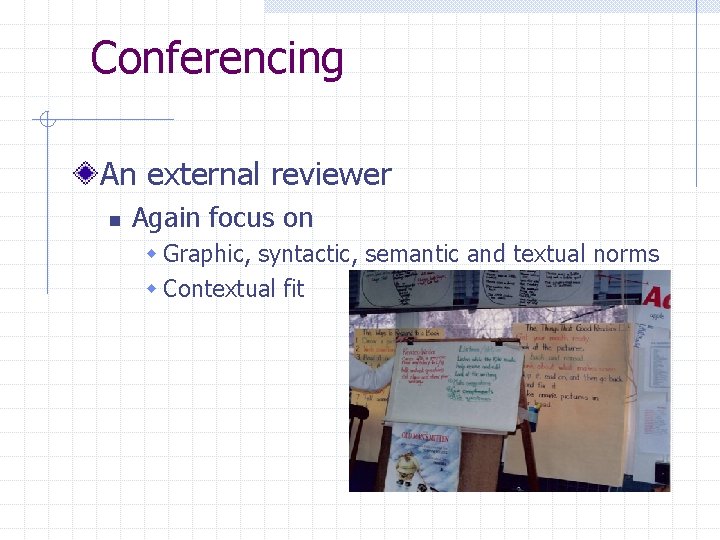
Conferencing An external reviewer n Again focus on w Graphic, syntactic, semantic and textual norms w Contextual fit
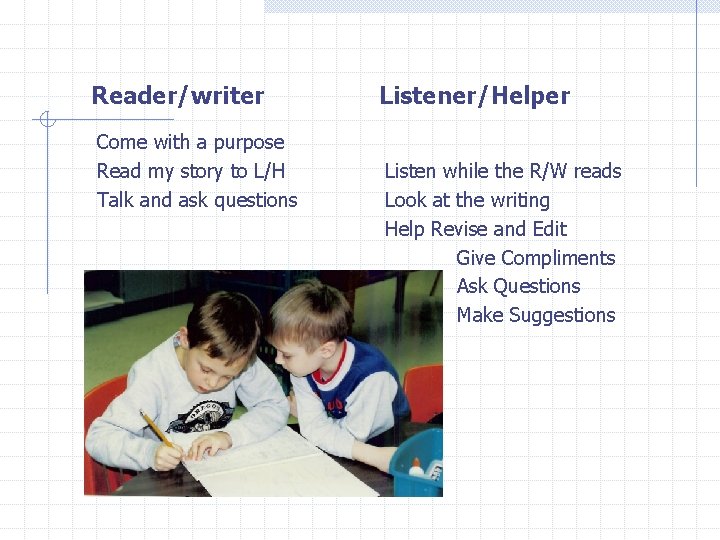
Reader/writer Come with a purpose Read my story to L/H Talk and ask questions Listener/Helper Listen while the R/W reads Look at the writing Help Revise and Edit Give Compliments Ask Questions Make Suggestions
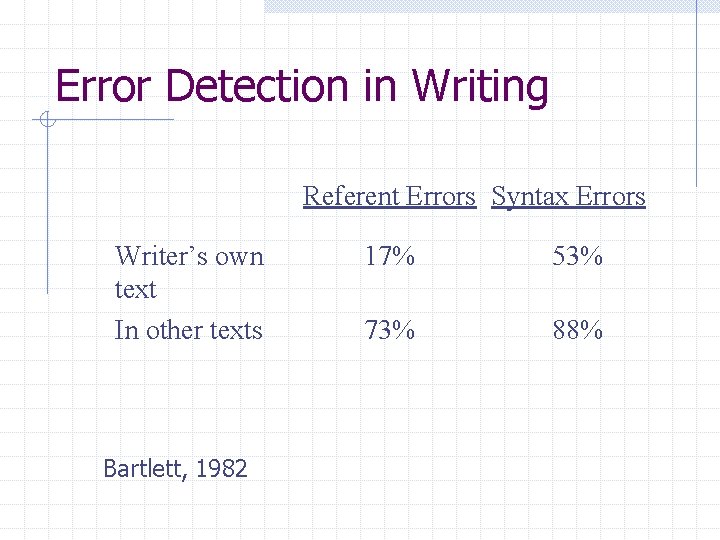
Error Detection in Writing Referent Errors Syntax Errors Writer’s own text In other texts Bartlett, 1982 17% 53% 73% 88%
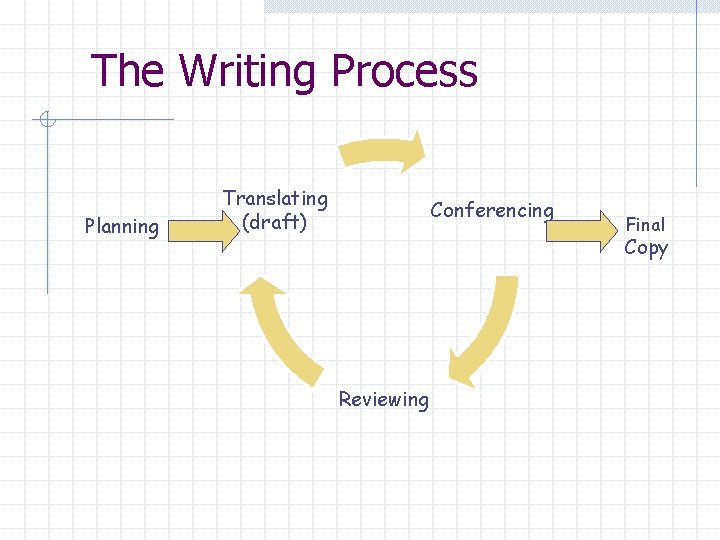
The Writing Process Planning Translating (draft) Conferencing Final Copy Reviewing
Scaffolding Student Writing Building Early Literacy Skills n n The use of mediators Inventive spelling 1. 2. 3. 4. 5. Non-alphabetic markings Initial sounds – semi-phonetic Initial and final sounds - phonetic Medial vowels - transitional Moves toward conventional spelling
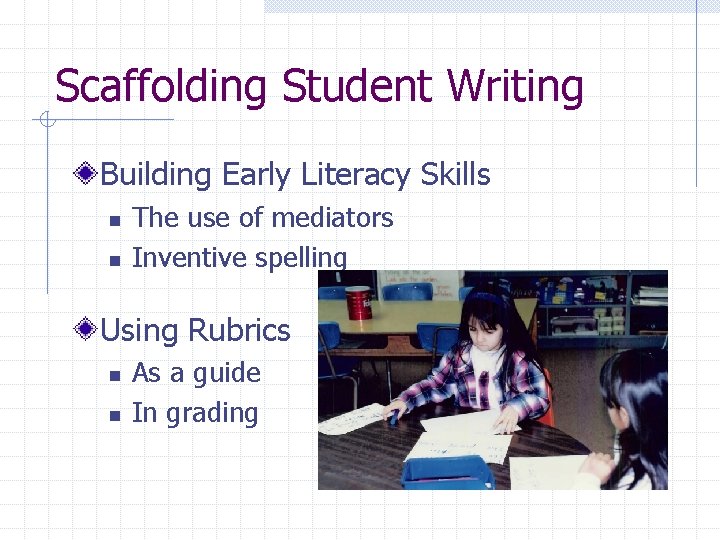
Scaffolding Student Writing Building Early Literacy Skills n n The use of mediators Inventive spelling Using Rubrics n n As a guide In grading
Learning and Mathematics Instructional Approaches Problem Solving in Mathematics Counting Understanding Number Mathematical Equivalence Logical Reasoning
Bottom-up vs. Top-down Processing Bottom-up n start with the most basic units or elements and build up Top-down n proceeds from information already stored in memory (prior knowledge) to decipher new input
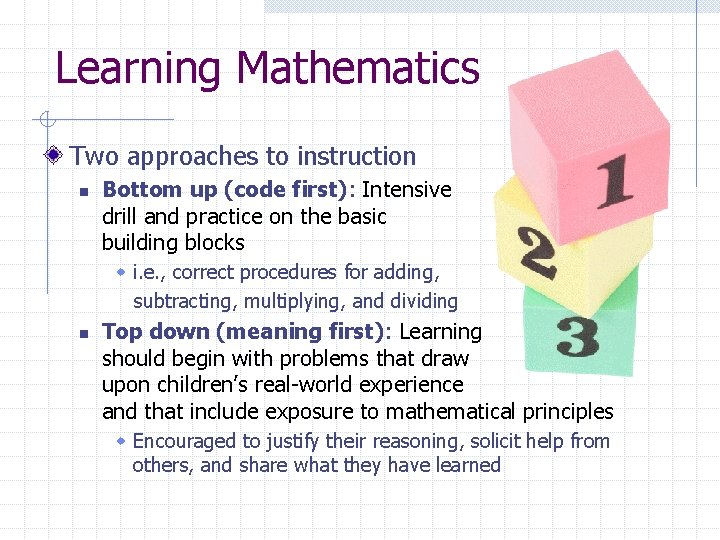
Learning Mathematics Two approaches to instruction n Bottom up (code first): Intensive drill and practice on the basic building blocks w i. e. , correct procedures for adding, subtracting, multiplying, and dividing n Top down (meaning first): Learning should begin with problems that draw upon children’s real-world experience and that include exposure to mathematical principles w Encouraged to justify their reasoning, solicit help from others, and share what they have learned
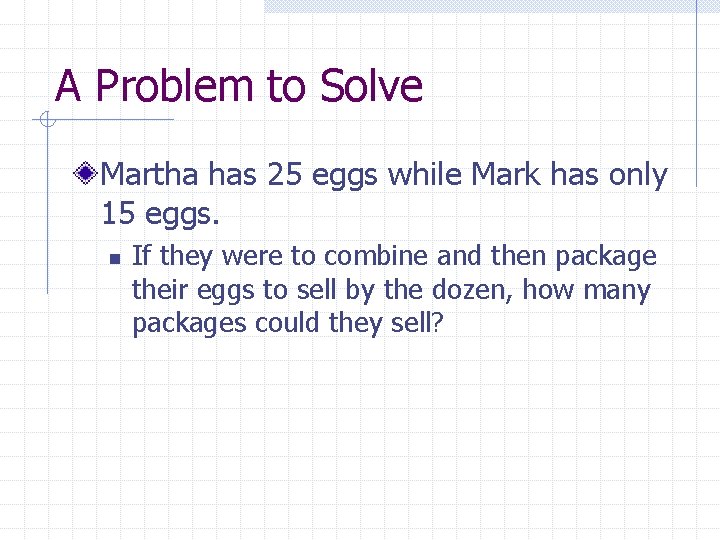
A Problem to Solve Martha has 25 eggs while Mark has only 15 eggs. n If they were to combine and then package their eggs to sell by the dozen, how many packages could they sell?
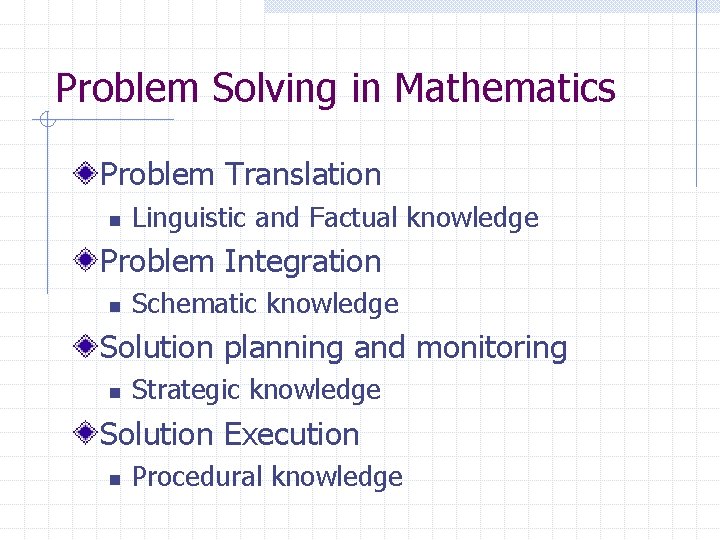
Problem Solving in Mathematics Problem Translation n Linguistic and Factual knowledge Problem Integration n Schematic knowledge Solution planning and monitoring n Strategic knowledge Solution Execution n Procedural knowledge
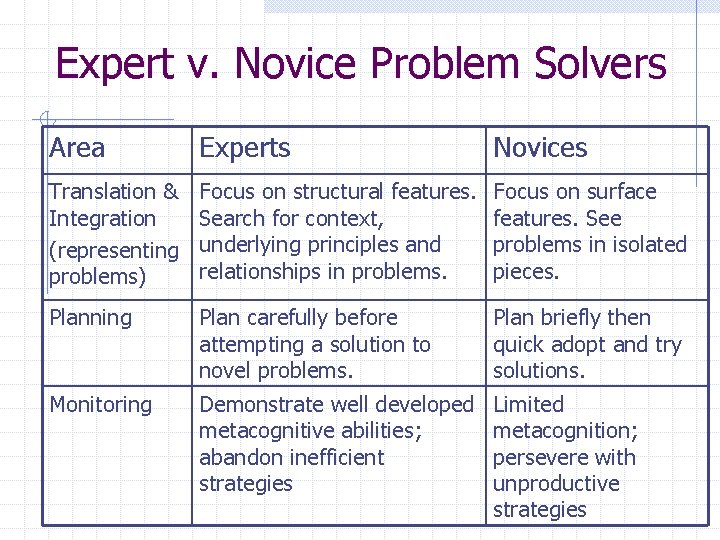
Expert v. Novice Problem Solvers Area Experts Novices Translation & Integration (representing problems) Focus on structural features. Search for context, underlying principles and relationships in problems. Focus on surface features. See problems in isolated pieces. Planning Plan carefully before attempting a solution to novel problems. Plan briefly then quick adopt and try solutions. Monitoring Demonstrate well developed metacognitive abilities; abandon inefficient strategies Limited metacognition; persevere with unproductive strategies
Counting and the Base 10 system Fuson et al (1990) English Asian Languages
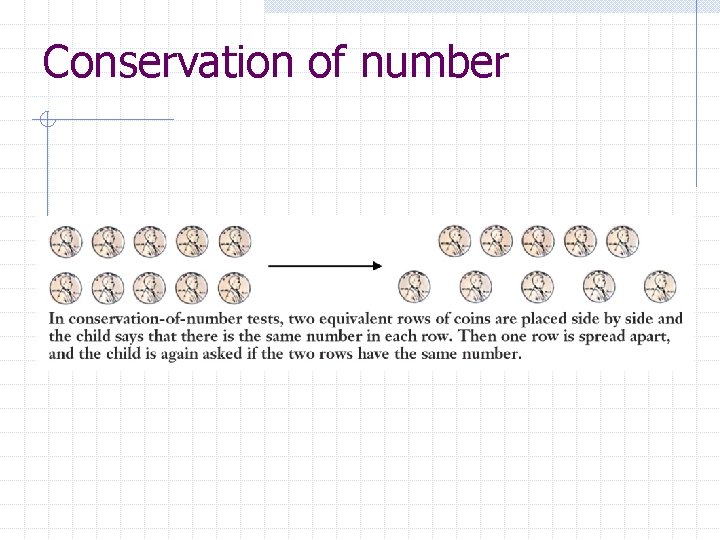
Conservation of number
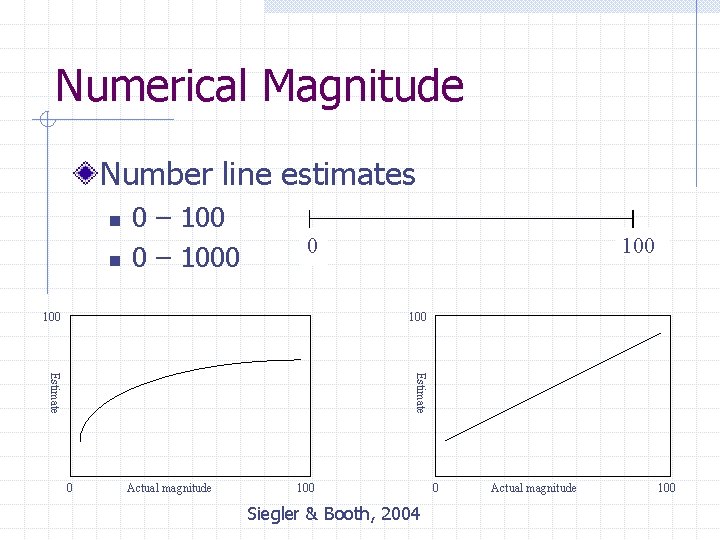
Numerical Magnitude Number line estimates n n 0 – 1000 0 100 100 Estimate 0 Actual magnitude 100 Siegler & Booth, 2004 0 Actual magnitude 100
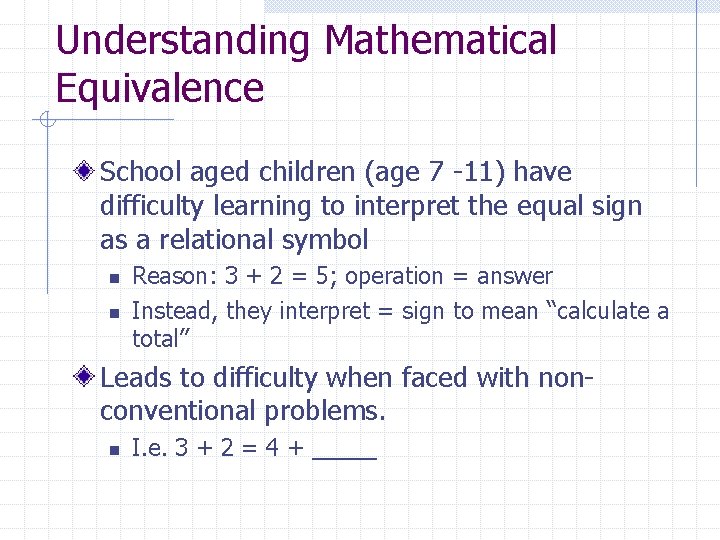
Understanding Mathematical Equivalence School aged children (age 7 -11) have difficulty learning to interpret the equal sign as a relational symbol n n Reason: 3 + 2 = 5; operation = answer Instead, they interpret = sign to mean “calculate a total” Leads to difficulty when faced with nonconventional problems. n I. e. 3 + 2 = 4 + _____
Logical Reasoning Skills Piaget’s Formal Operations Stage Changing Strategies and Rules n Siegler
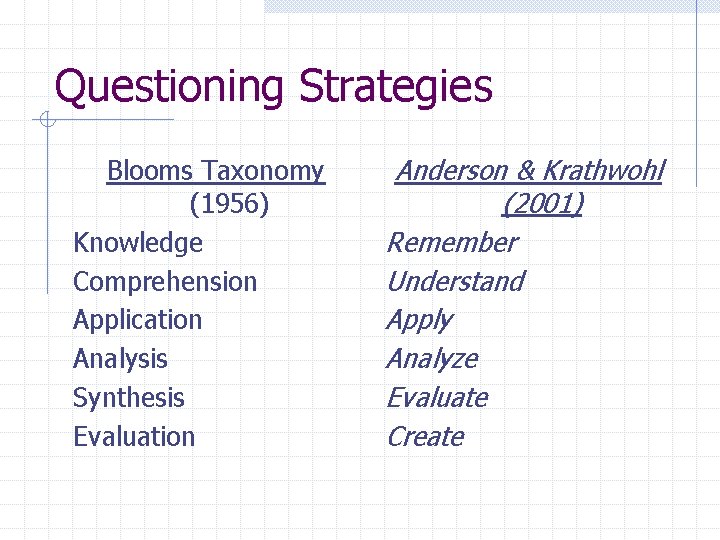
Questioning Strategies Blooms Taxonomy (1956) Knowledge Comprehension Application Analysis Synthesis Evaluation Anderson & Krathwohl (2001) Remember Understand Apply Analyze Evaluate Create
Learning and Mathematics Bluebook Anticipatory Set-Multiple choice Learning and Writing cont. Learning and Mathematics Discussions–Questioning Strategies For Tuesday: Read Chapter 6, HYLA 1 due
“It is better to ask some of the questions than to know all the answers. ” - James Thurber
- Slides: 29