
Learning and development practitioners in industry What are

- Slides: 15
Learning and development practitioners in industry: What are their development needs? Steven Hodge
The project • Funded by the Australian Institute of Training and Development (AITD) • Research to model learning and development (L&D) practitioner needs • Conducted by Steven Hodge (UB), Erica Smith (UB) and Llandis Barratt-Pugh (ECU)
AITD • • • Professional Development activities AITD magazine and monthly newsletter Networking events Database of trainers which can be publicly accessed Access to member-only information, including articles, discussion forum, job listings • Eligibility for national Training Excellence awards • Professional recognition process • Discounts on professional products and services
Challenges of modelling L&D work • • Diversity of L&D work Diversity of organisational settings Diversity of roles Diversity of techniques, knowledge & skills deployed in L&D • Quantity, variable quality and complexity of available knowledge
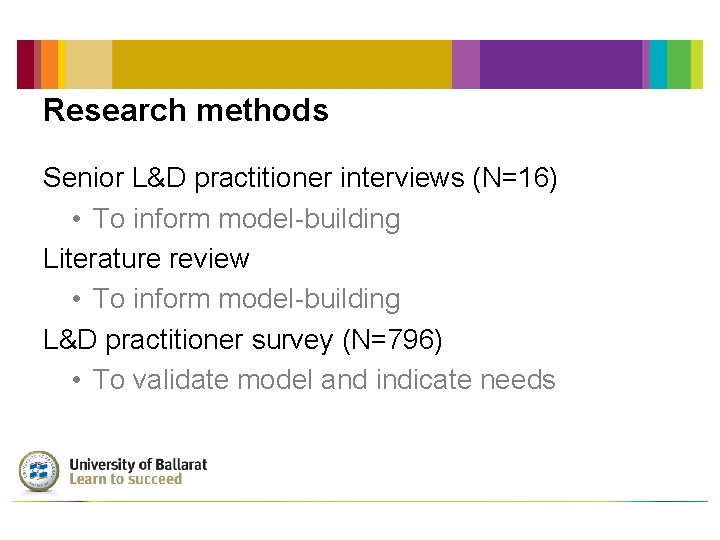
Research methods Senior L&D practitioner interviews (N=16) • To inform model-building Literature review • To inform model-building L&D practitioner survey (N=796) • To validate model and indicate needs
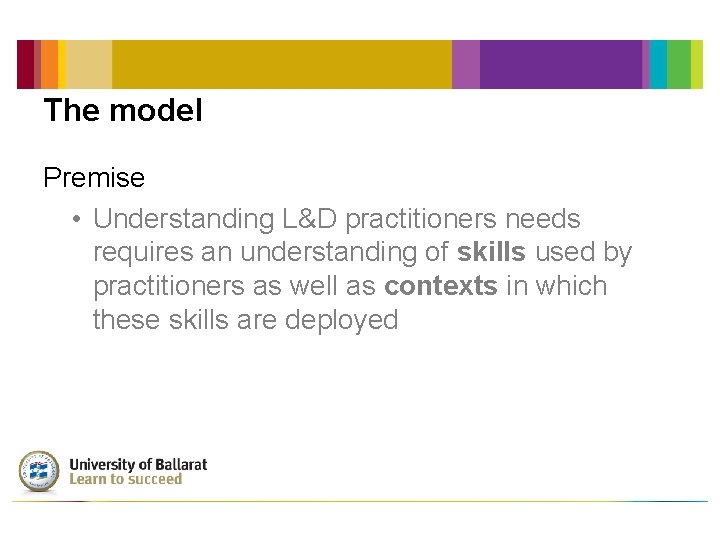
The model Premise • Understanding L&D practitioners needs requires an understanding of skills used by practitioners as well as contexts in which these skills are deployed
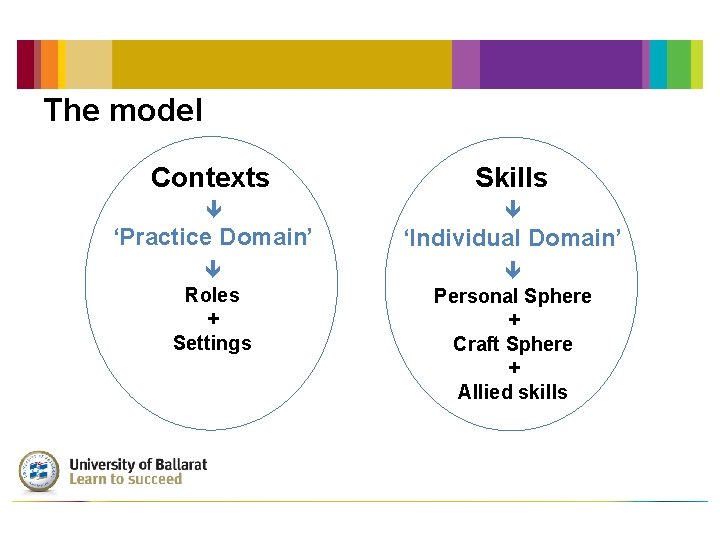
The model Contexts Skills ‘Practice Domain’ ‘Individual Domain’ Roles + Settings Personal Sphere + Craft Sphere + Allied skills
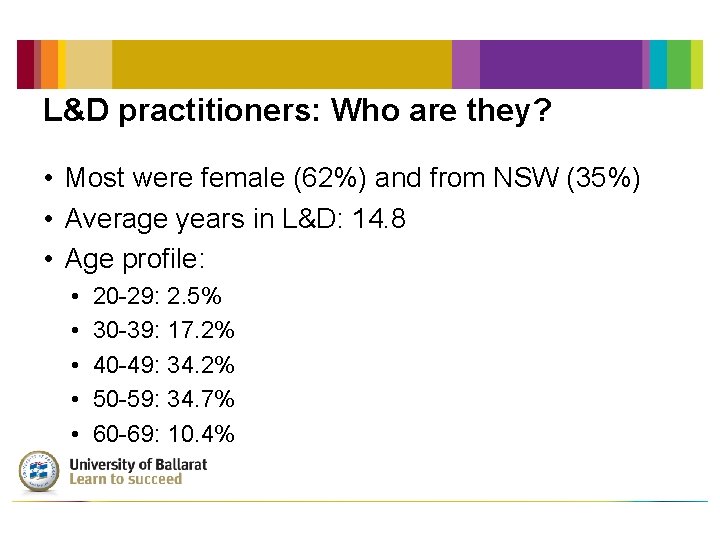
L&D practitioners: Who are they? • Most were female (62%) and from NSW (35%) • Average years in L&D: 14. 8 • Age profile: • • • 20 -29: 2. 5% 30 -39: 17. 2% 40 -49: 34. 2% 50 -59: 34. 7% 60 -69: 10. 4%
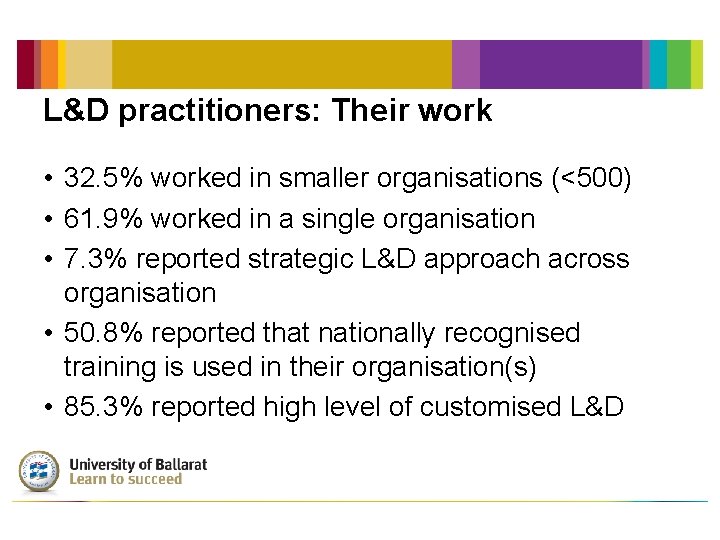
L&D practitioners: Their work • 32. 5% worked in smaller organisations (<500) • 61. 9% worked in a single organisation • 7. 3% reported strategic L&D approach across organisation • 50. 8% reported that nationally recognised training is used in their organisation(s) • 85. 3% reported high level of customised L&D
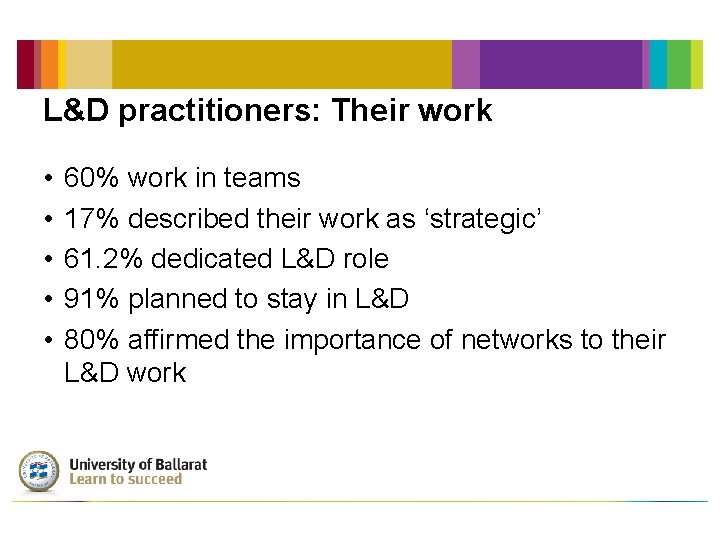
L&D practitioners: Their work • • • 60% work in teams 17% described their work as ‘strategic’ 61. 2% dedicated L&D role 91% planned to stay in L&D 80% affirmed the importance of networks to their L&D work
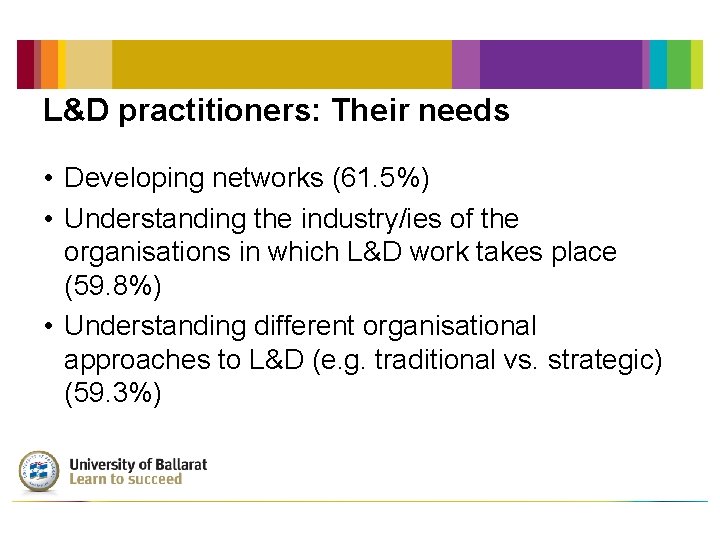
L&D practitioners: Their needs • Developing networks (61. 5%) • Understanding the industry/ies of the organisations in which L&D work takes place (59. 8%) • Understanding different organisational approaches to L&D (e. g. traditional vs. strategic) (59. 3%)
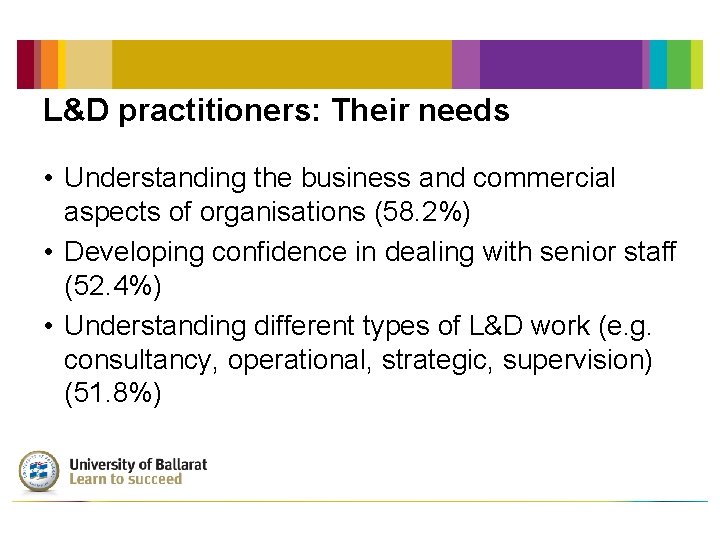
L&D practitioners: Their needs • Understanding the business and commercial aspects of organisations (58. 2%) • Developing confidence in dealing with senior staff (52. 4%) • Understanding different types of L&D work (e. g. consultancy, operational, strategic, supervision) (51. 8%)
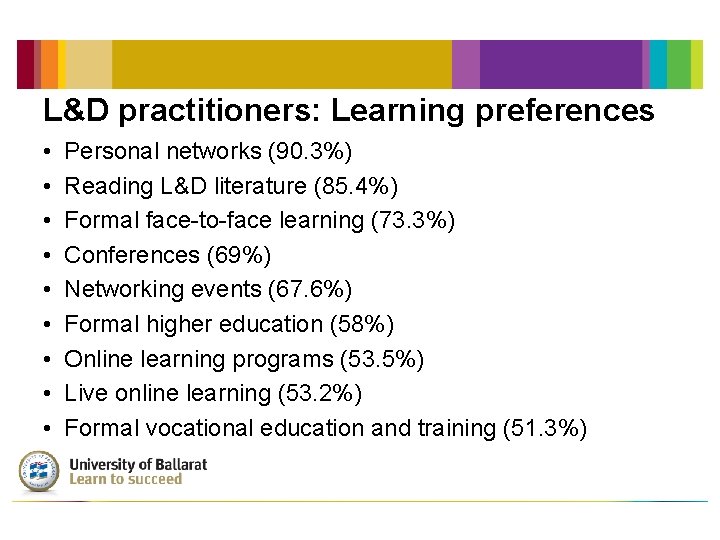
L&D practitioners: Learning preferences • • • Personal networks (90. 3%) Reading L&D literature (85. 4%) Formal face-to-face learning (73. 3%) Conferences (69%) Networking events (67. 6%) Formal higher education (58%) Online learning programs (53. 5%) Live online learning (53. 2%) Formal vocational education and training (51. 3%)
Reflections on modelling L&D work • ‘Archaeological’ aspect of L&D • The place of face-to-face L&D in a high-tech environment • Question of the unity of L&D practice
Questions?