
Learning and Cognition Memory and Learning Human Memory

- Slides: 35
Learning and Cognition Memory and Learning
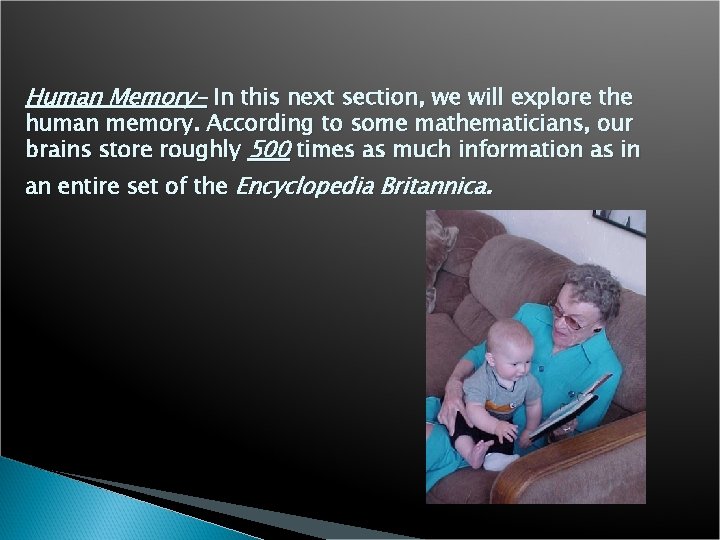
Human Memory- In this next section, we will explore the human memory. According to some mathematicians, our brains store roughly 500 times as much information as in an entire set of the Encyclopedia Britannica.
Three Ways to Memorize Information Memory = the storage and retrieval of what 1. Encoding 2. 3. one has either learned or experienced Storage Retrieval
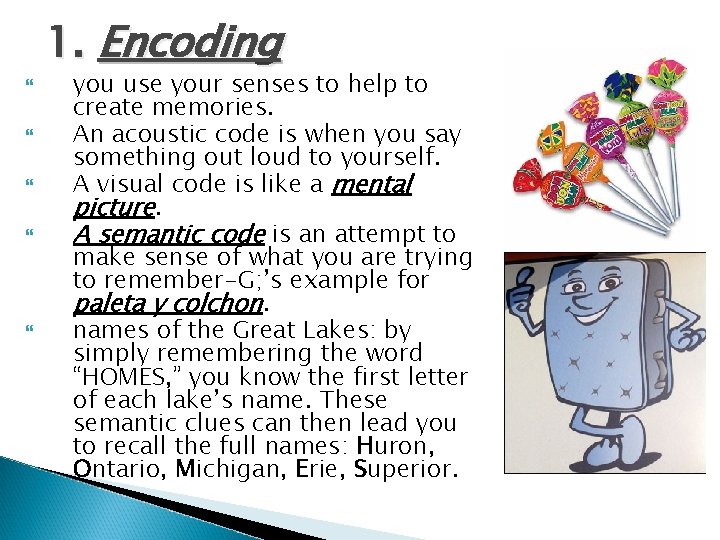
1. Encoding you use your senses to help to create memories. An acoustic code is when you say something out loud to yourself. A visual code is like a mental picture. A semantic code is an attempt to make sense of what you are trying to remember-G; ’s example for paleta y colchon. names of the Great Lakes: by simply remembering the word “HOMES, ” you know the first letter of each lake’s name. These semantic clues can then lead you to recall the full names: Huron, Ontario, Michigan, Erie, Superior.
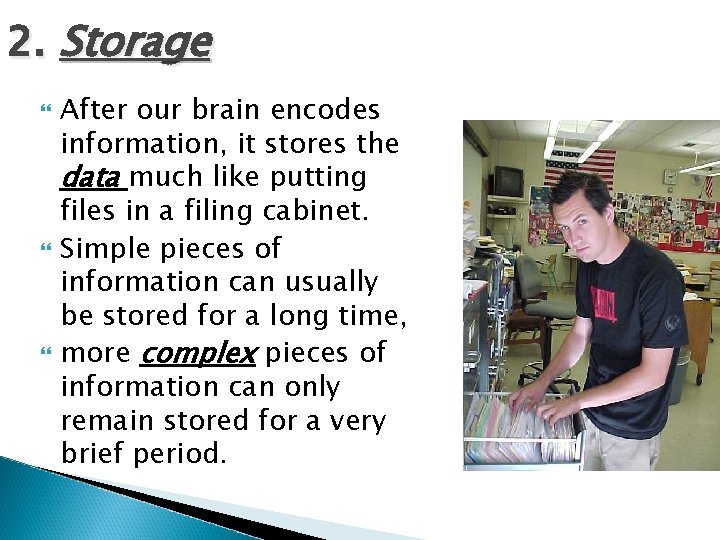
2. Storage After our brain encodes information, it stores the data much like putting files in a filing cabinet. Simple pieces of information can usually be stored for a long time, more complex pieces of information can only remain stored for a very brief period.
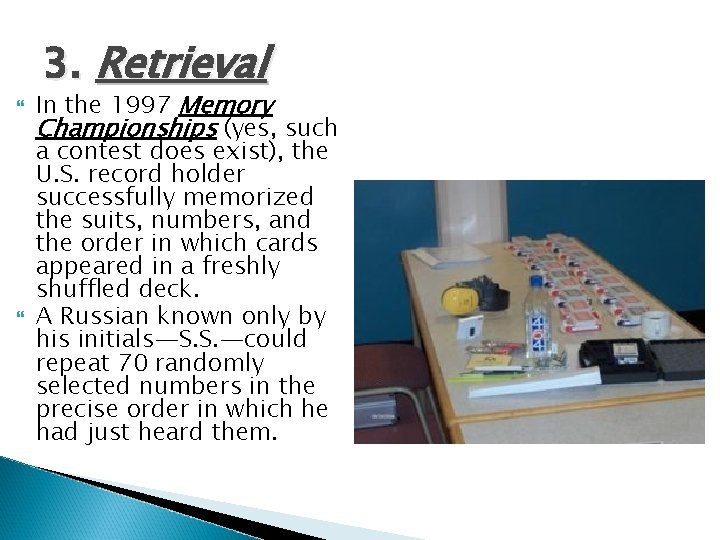
3. Retrieval In the 1997 Memory Championships (yes, such a contest does exist), the U. S. record holder successfully memorized the suits, numbers, and the order in which cards appeared in a freshly shuffled deck. A Russian known only by his initials—S. S. —could repeat 70 randomly selected numbers in the precise order in which he had just heard them.
Memory Stages 1. Sensory 2. Short-term 3. Long-term memory
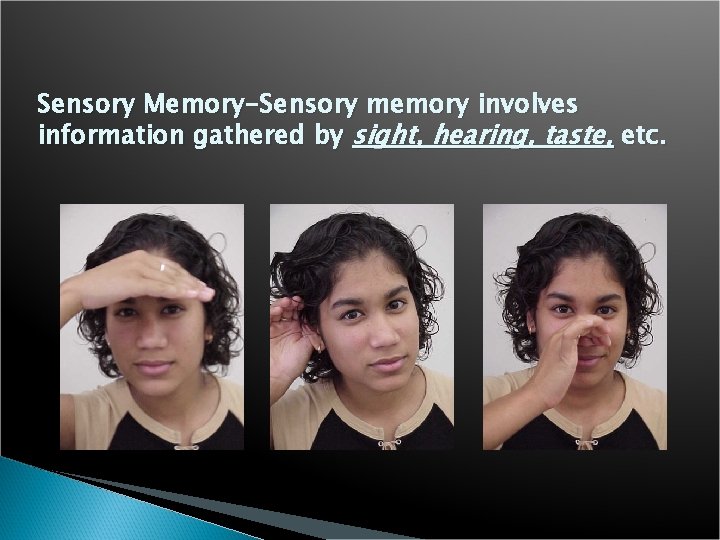
Sensory Memory-Sensory memory involves information gathered by sight, hearing, taste, etc.
Sensory Memory (cont. ) your brain holds this sensory data in storage for only a very short period of time—seconds, perhaps even less. After that period, the information gets replaced by new data. The temporary “storage bin” in our brain is known as the “sensory register. ”
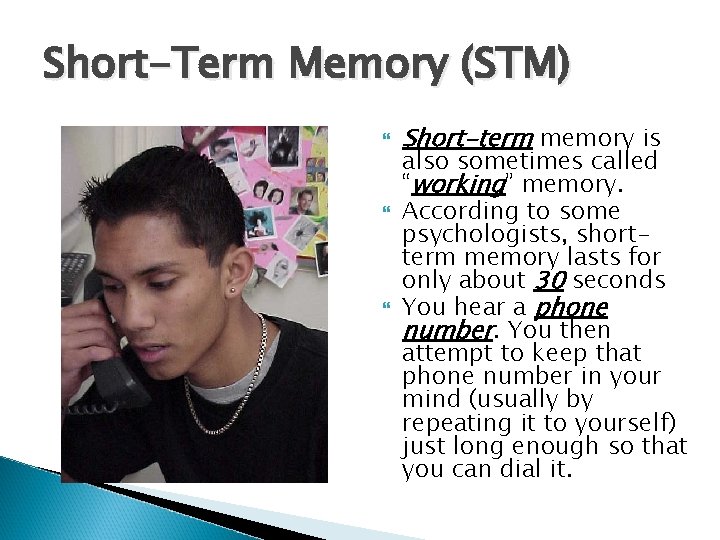
Short-Term Memory (STM) Short-term memory is also sometimes called “working” memory. According to some psychologists, shortterm memory lasts for only about 30 seconds You hear a phone number. You then attempt to keep that phone number in your mind (usually by repeating it to yourself) just long enough so that you can dial it.
Chunking The process of breaking down a large amount of information into smaller chunks Chunking makes recall easier
A Simple Test Row Row 1 2 3 4 5 6 7 2937 78541 821374 3820961 18294624 9284619384 1992199319941995
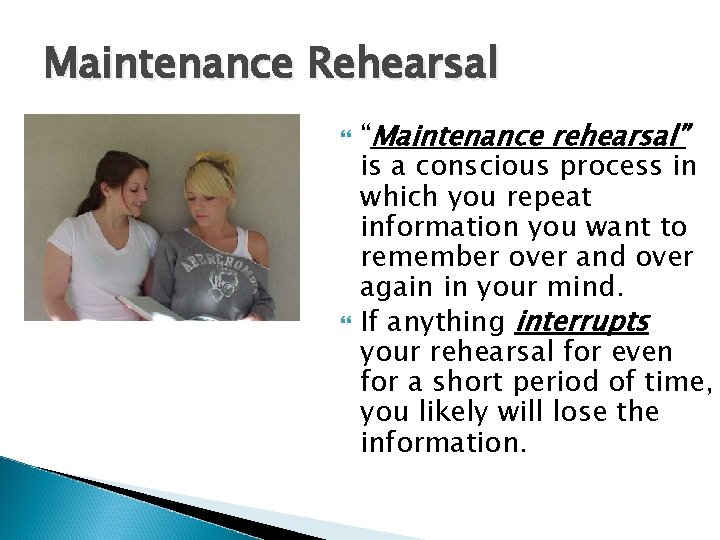
Maintenance Rehearsal “Maintenance rehearsal” is a conscious process in which you repeat information you want to remember over and over again in your mind. If anything interrupts your rehearsal for even for a short period of time, you likely will lose the information.
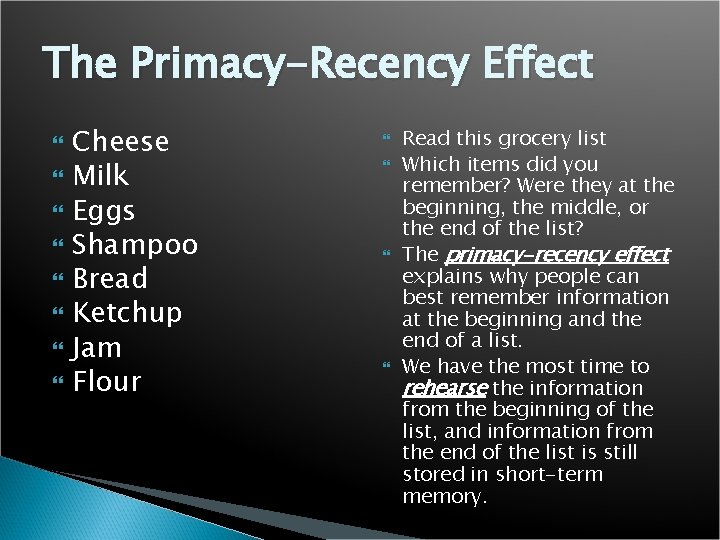
The Primacy-Recency Effect Cheese Milk Eggs Shampoo Bread Ketchup Jam Flour Read this grocery list Which items did you remember? Were they at the beginning, the middle, or the end of the list? The primacy-recency effect explains why people can best remember information at the beginning and the end of a list. We have the most time to rehearse the information from the beginning of the list, and information from the end of the list is still stored in short-term memory.
Long-Term Memory Long-term memory (LTM) allows us to retain information for periods of time well beyond the capacity of short-term memory. Information can remain in long-term memory for days, weeks, or even for the rest of a person’s life. In addition, long-term memory has no limits on its storage capacity. Long-term memory organizes information by categories or features.
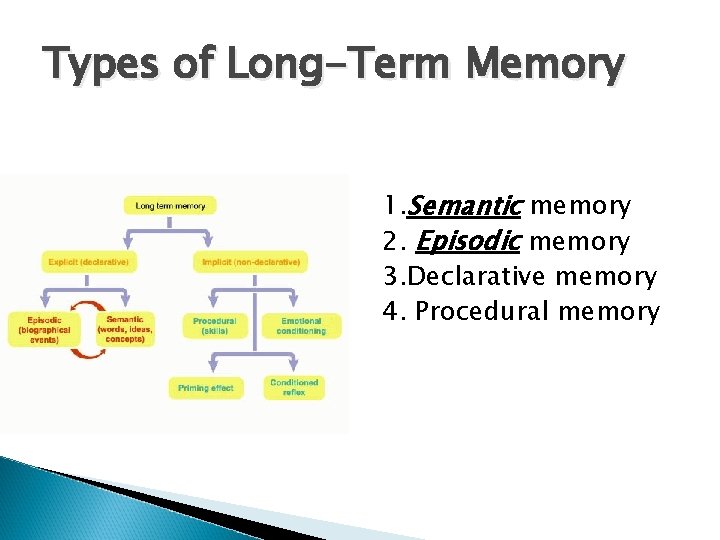
Types of Long-Term Memory 1. Semantic memory 2. Episodic memory 3. Declarative memory 4. Procedural memory
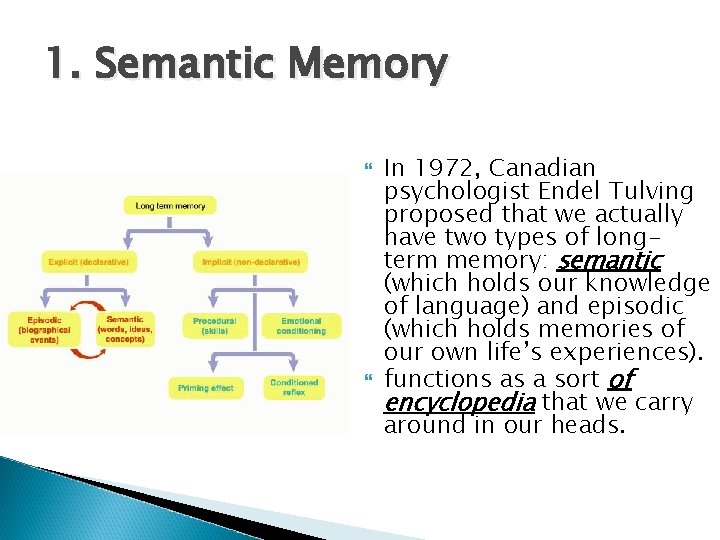
1. Semantic Memory In 1972, Canadian psychologist Endel Tulving proposed that we actually have two types of longterm memory: semantic (which holds our knowledge of language) and episodic (which holds memories of our own life’s experiences). functions as a sort of encyclopedia that we carry around in our heads.
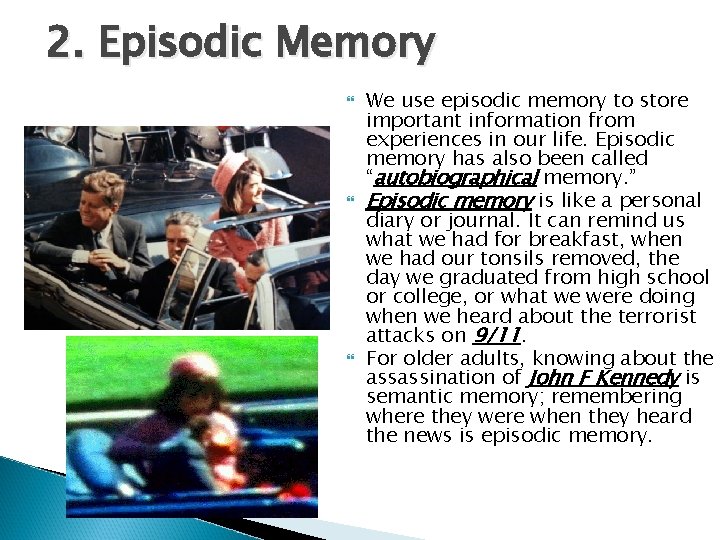
2. Episodic Memory We use episodic memory to store important information from experiences in our life. Episodic memory has also been called “autobiographical memory. ” Episodic memory is like a personal diary or journal. It can remind us what we had for breakfast, when we had our tonsils removed, the day we graduated from high school or college, or what we were doing when we heard about the terrorist attacks on 9/11. For older adults, knowing about the assassination of John F Kennedy is semantic memory; remembering where they were when they heard the news is episodic memory.
3. Declarative Memory “explicit memory. ” It holds facts and personal information that require a conscious effort to bring to mind. For example, we remember “what” street we live on, and we know “that” two plus two equals four.
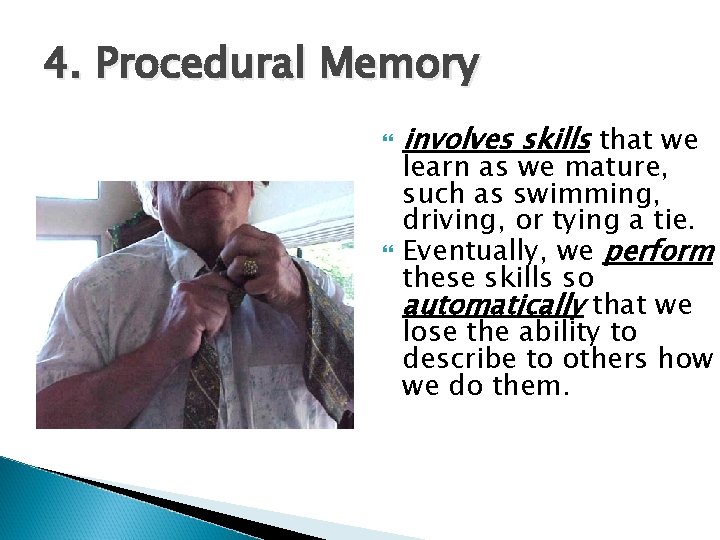
4. Procedural Memory involves skills that we learn as we mature, such as swimming, driving, or tying a tie. Eventually, we perform these skills so automatically that we lose the ability to describe to others how we do them.
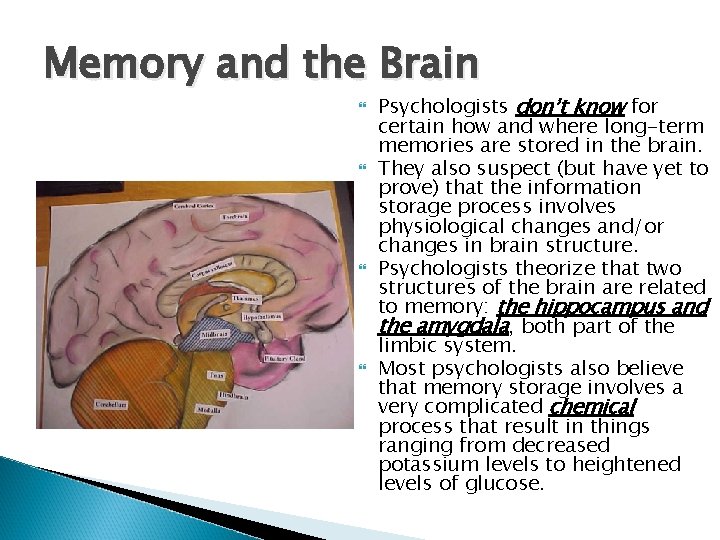
Memory and the Brain Psychologists don’t know for certain how and where long-term memories are stored in the brain. They also suspect (but have yet to prove) that the information storage process involves physiological changes and/or changes in brain structure. Psychologists theorize that two structures of the brain are related to memory: the hippocampus and the amygdala, both part of the limbic system. Most psychologists also believe that memory storage involves a very complicated chemical process that result in things ranging from decreased potassium levels to heightened levels of glucose.
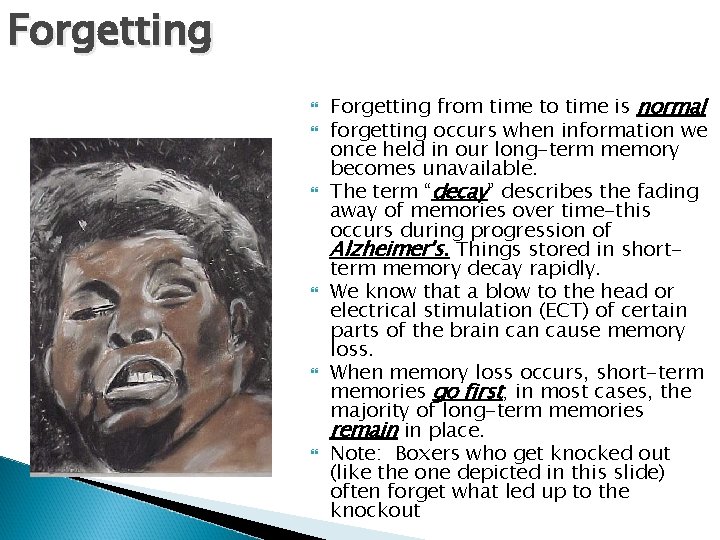
Forgetting Forgetting from time to time is normal forgetting occurs when information we once held in our long-term memory becomes unavailable. The term “decay” describes the fading away of memories over time-this occurs during progression of Alzheimer's. Things stored in shortterm memory decay rapidly. We know that a blow to the head or electrical stimulation (ECT) of certain parts of the brain cause memory loss. When memory loss occurs, short-term memories go first; in most cases, the majority of long-term memories remain in place. Note: Boxers who get knocked out (like the one depicted in this slide) often forget what led up to the knockout
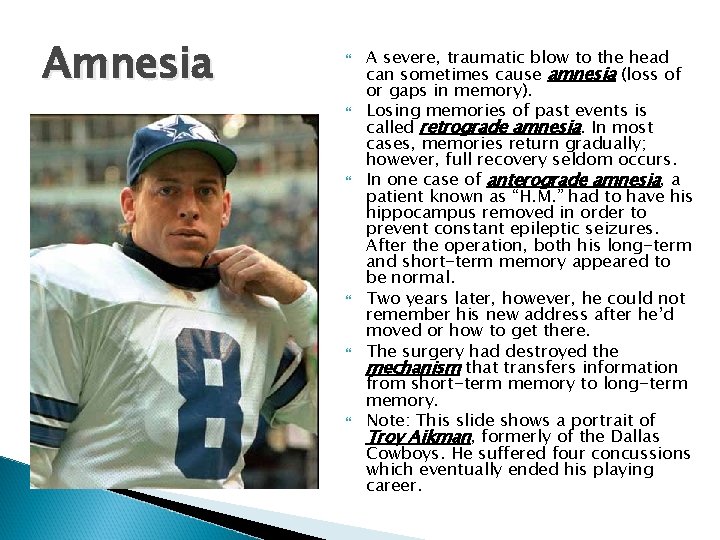
Amnesia A severe, traumatic blow to the head can sometimes cause amnesia (loss of or gaps in memory). Losing memories of past events is called retrograde amnesia. In most cases, memories return gradually; however, full recovery seldom occurs. In one case of anterograde amnesia, a patient known as “H. M. ” had to have his hippocampus removed in order to prevent constant epileptic seizures. After the operation, both his long-term and short-term memory appeared to be normal. Two years later, however, he could not remember his new address after he’d moved or how to get there. The surgery had destroyed the mechanism that transfers information from short-term memory to long-term memory. Note: This slide shows a portrait of Troy Aikman, formerly of the Dallas Cowboys. He suffered four concussions which eventually ended his playing career.
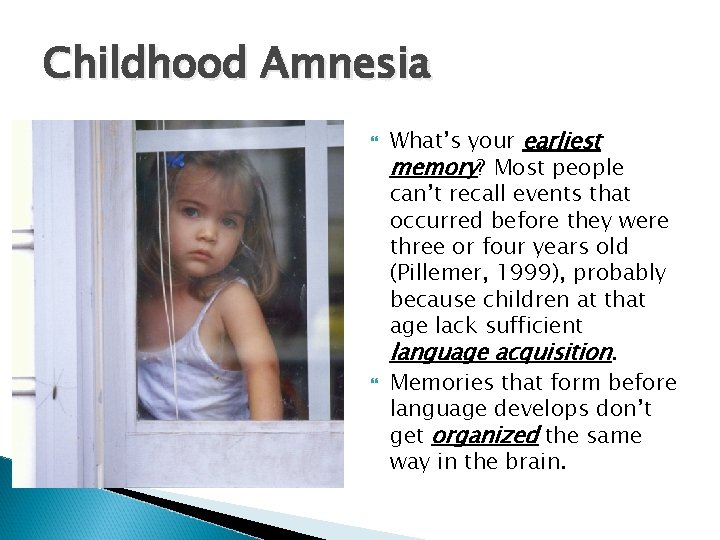
Childhood Amnesia What’s your earliest memory? Most people can’t recall events that occurred before they were three or four years old (Pillemer, 1999), probably because children at that age lack sufficient language acquisition. Memories that form before language develops don’t get organized the same way in the brain.
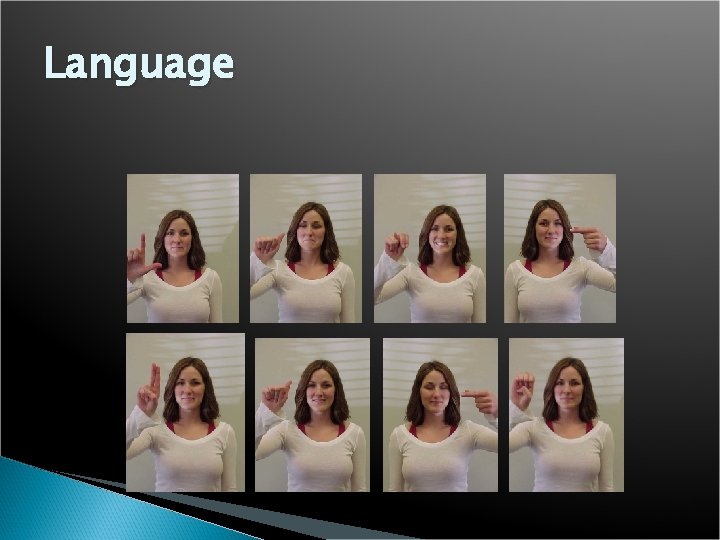
Language
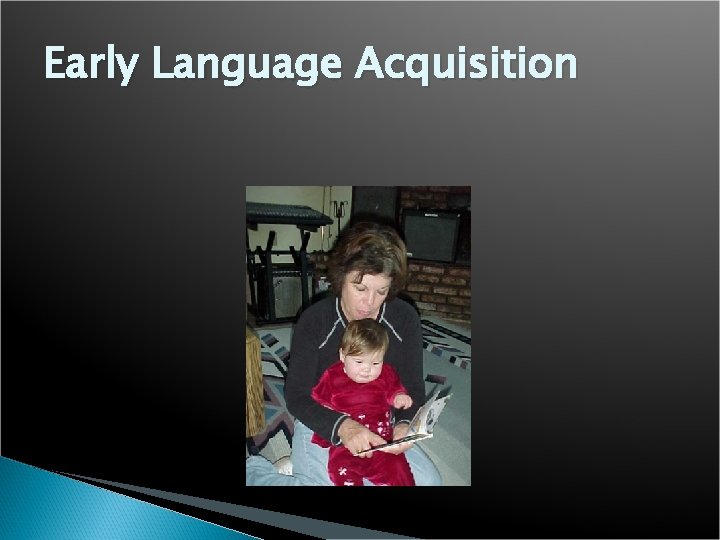
Early Language Acquisition
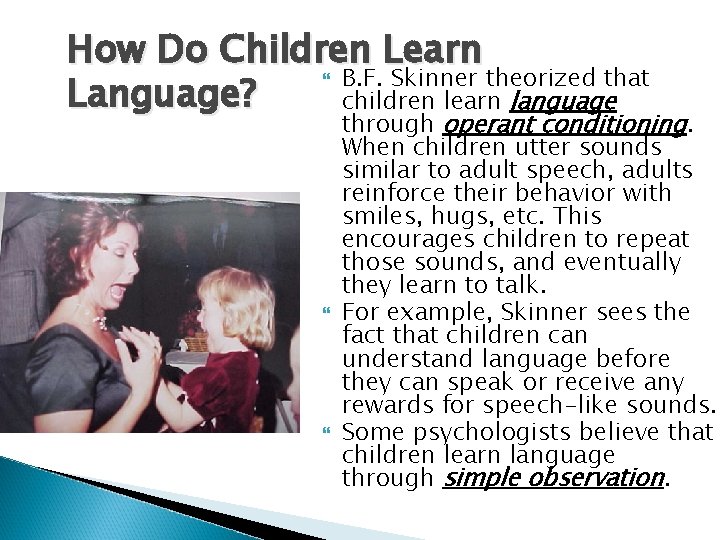
How Do Children Learn B. F. Skinner theorized that Language? children learn language through operant conditioning. When children utter sounds similar to adult speech, adults reinforce their behavior with smiles, hugs, etc. This encourages children to repeat those sounds, and eventually they learn to talk. For example, Skinner sees the fact that children can understand language before they can speak or receive any rewards for speech-like sounds. Some psychologists believe that children learn language through simple observation.
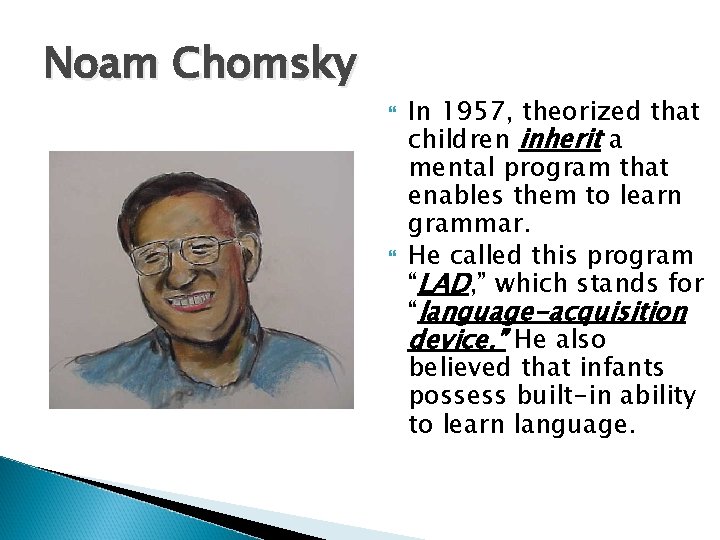
Noam Chomsky In 1957, theorized that children inherit a mental program that enables them to learn grammar. He called this program “LAD, ” which stands for “language-acquisition device. ” He also believed that infants possess built-in ability to learn language.
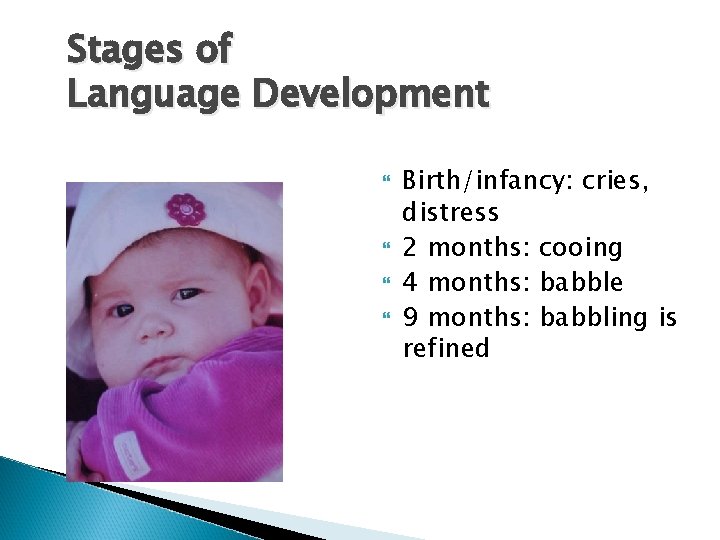
Stages of Language Development Birth/infancy: cries, distress 2 months: cooing 4 months: babble 9 months: babbling is refined
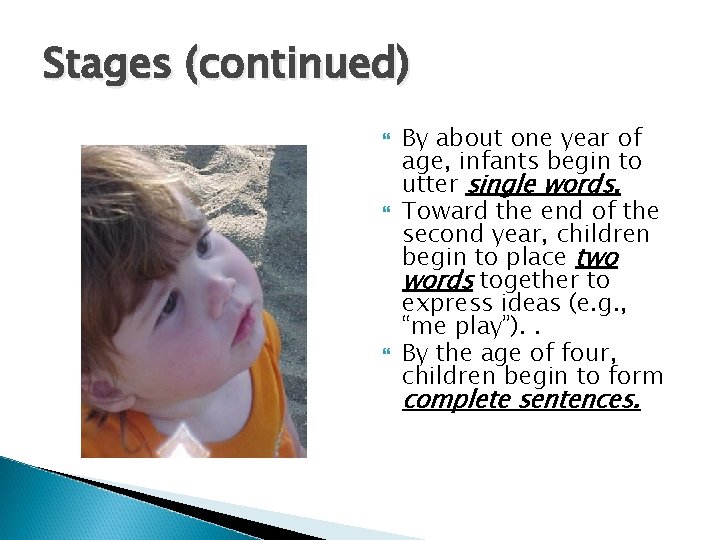
Stages (continued) By about one year of age, infants begin to utter single words. Toward the end of the second year, children begin to place two words together to express ideas (e. g. , “me play”). . By the age of four, children begin to form complete sentences.
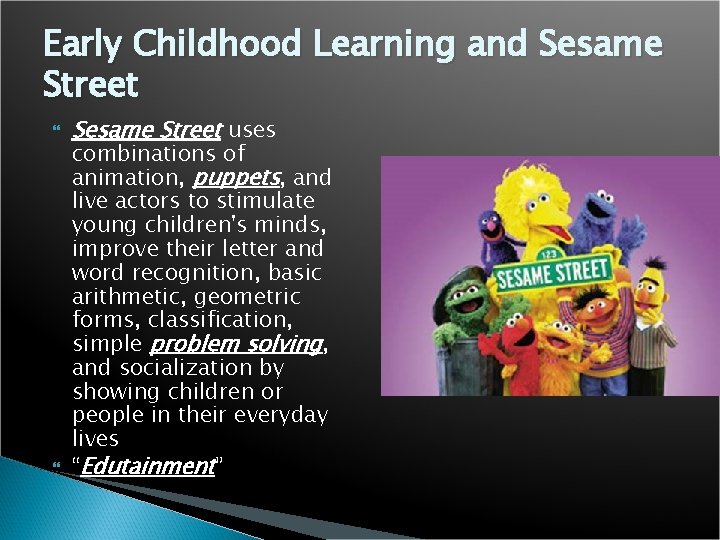
Early Childhood Learning and Sesame Street uses combinations of animation, puppets, and live actors to stimulate young children's minds, improve their letter and word recognition, basic arithmetic, geometric forms, classification, simple problem solving, and socialization by showing children or people in their everyday lives “Edutainment”
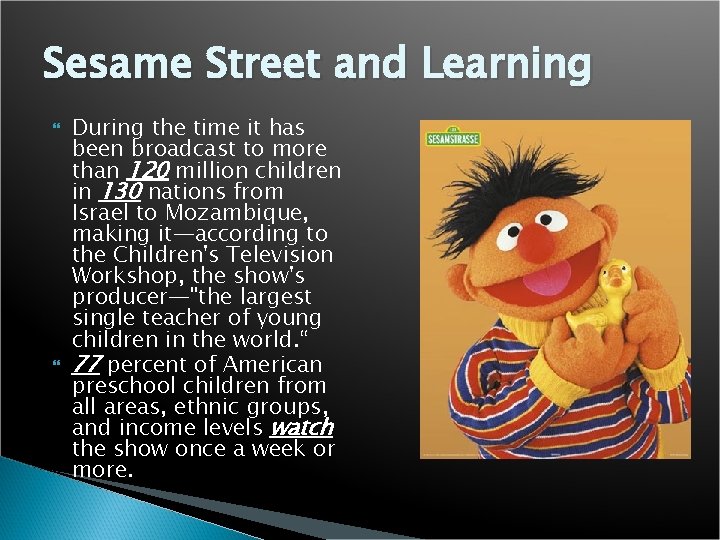
Sesame Street and Learning During the time it has been broadcast to more than 120 million children in 130 nations from Israel to Mozambique, making it—according to the Children's Television Workshop, the show's producer—"the largest single teacher of young children in the world. “ 77 percent of American preschool children from all areas, ethnic groups, and income levels watch the show once a week or more.
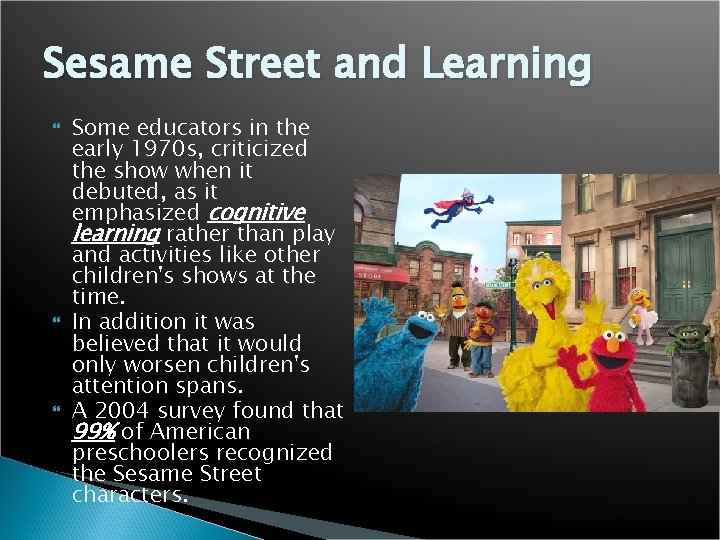
Sesame Street and Learning Some educators in the early 1970 s, criticized the show when it debuted, as it emphasized cognitive learning rather than play and activities like other children's shows at the time. In addition it was believed that it would only worsen children's attention spans. A 2004 survey found that 99% of American preschoolers recognized the Sesame Street characters.
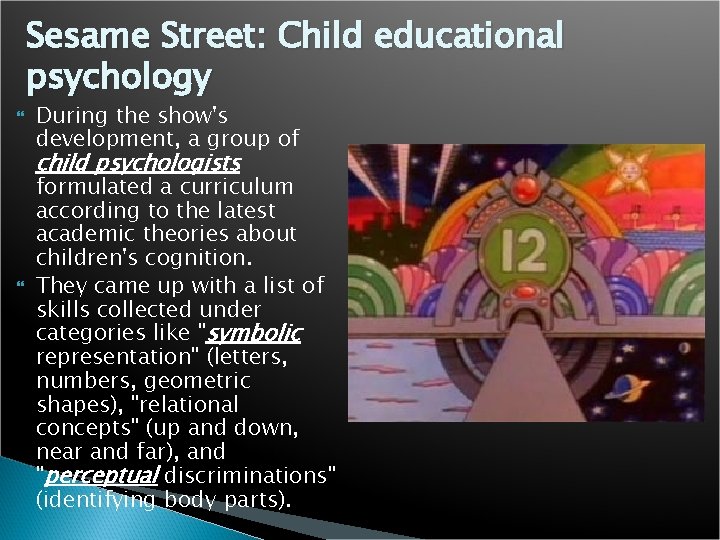
Sesame Street: Child educational psychology During the show's development, a group of child psychologists formulated a curriculum according to the latest academic theories about children's cognition. They came up with a list of skills collected under categories like "symbolic representation" (letters, numbers, geometric shapes), "relational concepts" (up and down, near and far), and "perceptual discriminations" (identifying body parts).
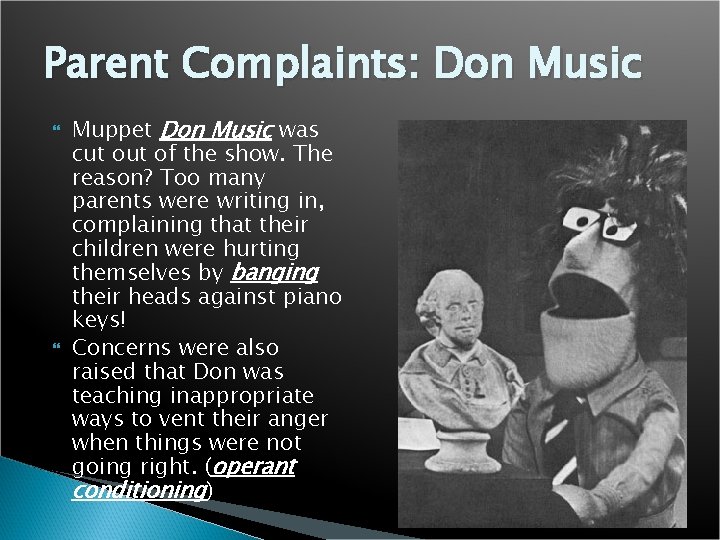
Parent Complaints: Don Music Muppet Don Music was cut of the show. The reason? Too many parents were writing in, complaining that their children were hurting themselves by banging their heads against piano keys! Concerns were also raised that Don was teaching inappropriate ways to vent their anger when things were not going right. (operant conditioning)