
Learning and Behavior Introduction to learning Behavior is
Learning and Behavior
Introduction to learning • Behavior is the response of an organism to stimuli • Behavior is objective (based on facts and observations) and observable, where as what goes on in one’s mind can never really be known or measured. (Behaviorism) • Learning is a relatively permanent change in an organism’s behavior due to experience.
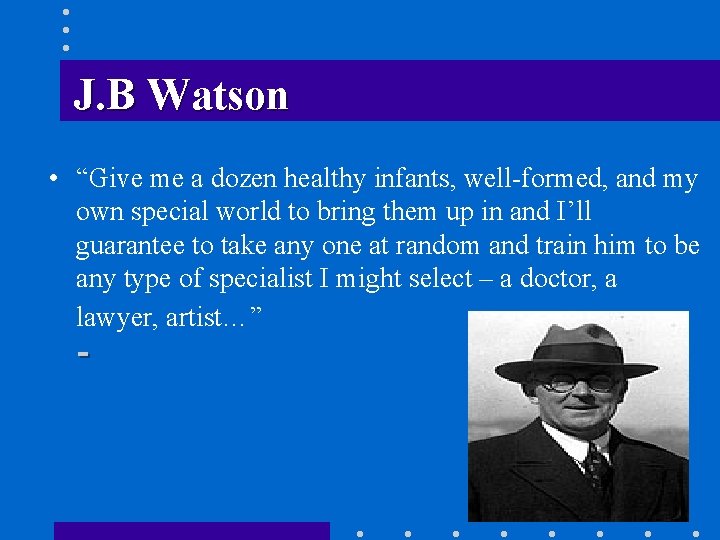
J. B Watson • “Give me a dozen healthy infants, well-formed, and my own special world to bring them up in and I’ll guarantee to take any one at random and train him to be any type of specialist I might select – a doctor, a lawyer, artist…” -
Association in Learning • linking two events or stimuli that occur together in space or time. Early theories of learning were based on principles of association. – Classical Conditioning (Ivan Pavlov) – Operant Conditioning ( B. F. Skinner) – Observational learning (Albert Bandura)
A- Classical Conditioning • Explains some learning of involuntary emotional and physiological responses. – Learning that results from pairing two events in the environment. – Learn to associate a neutral event with another event or stimulus from the environment.
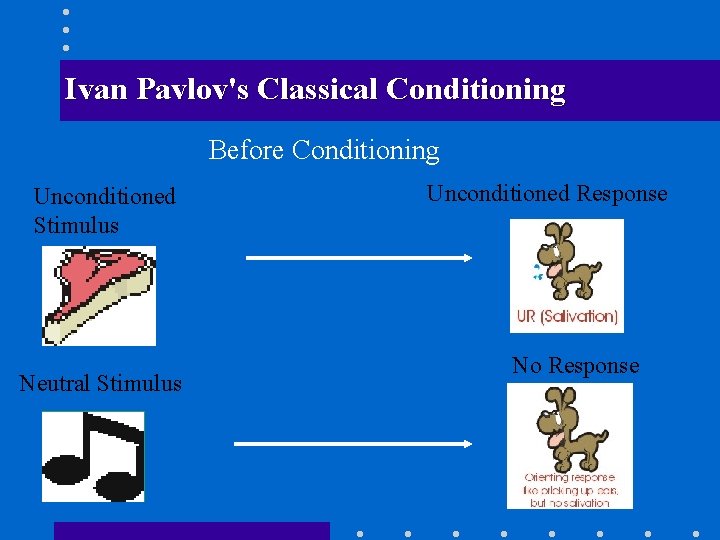
Ivan Pavlov's Classical Conditioning Before Conditioning Unconditioned Stimulus Neutral Stimulus Unconditioned Response No Response
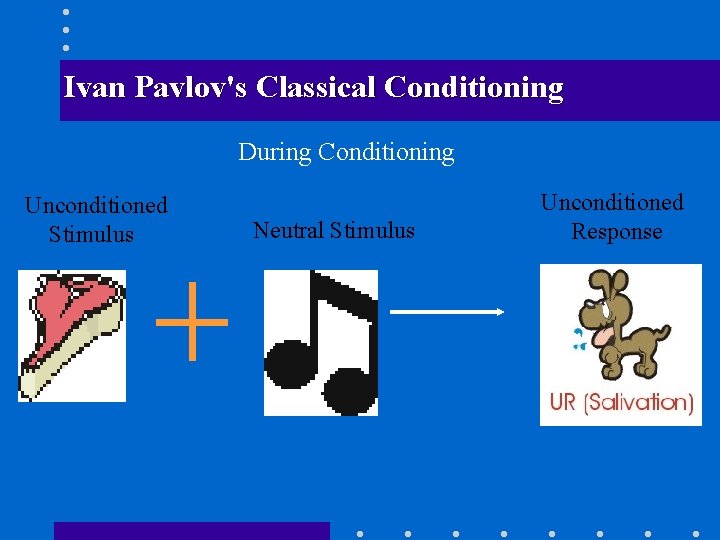
Ivan Pavlov's Classical Conditioning During Conditioning Unconditioned Stimulus Neutral Stimulus Unconditioned Response
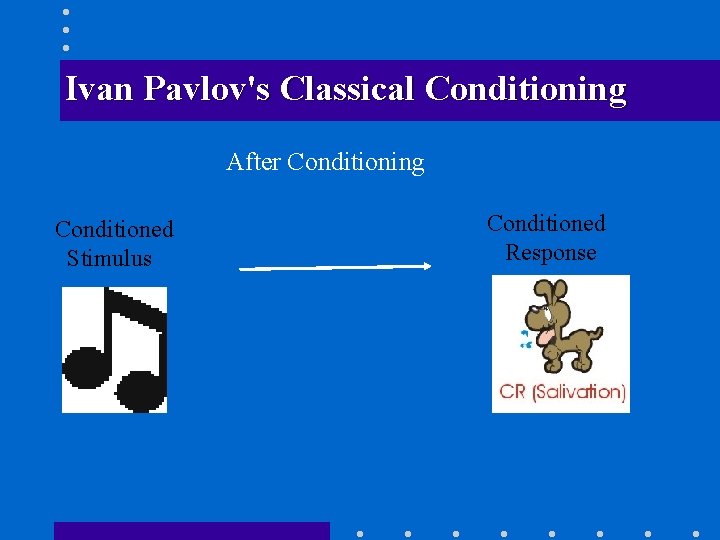
Ivan Pavlov's Classical Conditioning After Conditioning Conditioned Stimulus Conditioned Response
Classical Conditioning • Paired neutral stimulus (tone/bell) with coming of food. – Food – naturally causes salivation – Tone/bell – learned to associate with food – causes salivation. • a. Unconditioned Stimuli and Response – UCS (food) & UCR (salivation) – occurs naturally, automatically, unconditionally. – NOT learned, like reflex
Classical Conditioning • b. Conditioned Stimuli and Response – CS (tone/bell) & CR (salivation) – originally neutral stimulus, that, after being paired with UCS, triggers CR. – learned, NOT automatic. – not naturally occurring.
Conditioning Processes and Principles • a. Acquisition: initial stage of learning. • b. Extinction: diminishing of a CR. – When CS is no longer paired with UCS, eventually, the CS ALONE will not elicit the CR. • c. Spontaneous Recovery: – The reappearance, after a rest period, of an extinguished CR.
Principles continue… • d. Generalization: when a CS is paired with a UCS, stimuli similar to CS can evoke similar responses (like CR). • e. Discrimination: learned ability to distinguish between two stimuli. – How could an animal be trained to discriminate between stimuli?
B- Operant Conditioning • It was introduced by B. F. Skinner • Learning that relies on associating behavior with its results or consequences. • Importance of controlling learning, particularly complex, voluntary, goaldirected behavior. • Skinner believed that behavior is sustained by reinforcements or rewards, not by free will.
Operant Conditioning • Highlights importance of reinforcement & punishment in learning. • With Operant Conditioning the Response comes before the Stimulus (the opposite of CC) R S • i. e. Famous for the skinner box experiment.
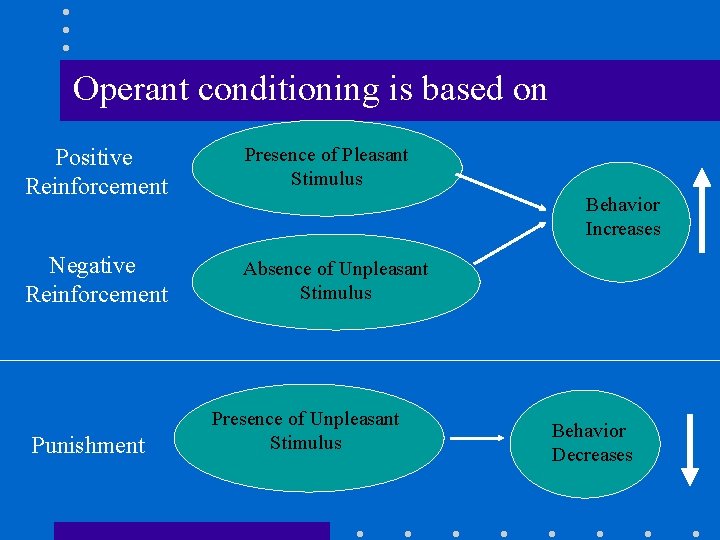
Operant conditioning is based on Positive Reinforcement Presence of Pleasant Stimulus Negative Reinforcement Absence of Unpleasant Stimulus Punishment Behavior Increases Presence of Unpleasant Stimulus Behavior Decreases
Operant conditioning is based on Positive reinforcement: strengthens response by presenting stimulus after response. Negative reinforcement: strengthens response by removing an aversive stimulus after a response. Punishment: An aversive consequence that decreases the frequency of the preceding behavior.
C- Observational Learning • Also called Social Learning Theory • People not only learn through direct experience, but also by observing and imitating others (through modeling). i. e. Influence of TV and media on behavior: APA’s Conclusion: There is a causal link between watching aggressive acts on TV and being aggressive in some children. TV/Media – not the ONLY cause of aggressive behavior.
Four Stages • Attention: Observers cannot learn unless they pay attention to what's happening around them. This process is influenced by characteristics of the model. • Retention/Memory: Observers must not only recognize the observed behavior but also remember it at some later time. • Initiation/Motor: Observers must be physically and/intellectually capable of producing the act. • Motivation: The observer must have motivation to recreate the observed behavior.
- Slides: 18