
Learning Aim F Complete statements of comprehensive income

- Slides: 14
Learning Aim F Complete statements of comprehensive income and financial position and evaluate business performance Introduction to financial statements https: //www. youtube. com/wat ch? v=a. BZvzo. Yeb. A 0 Mr. Barry BTEC National Level 3
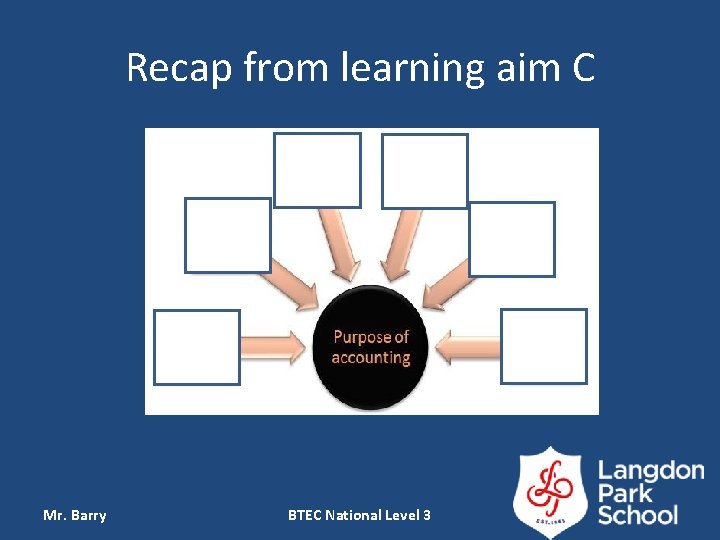
Recap from learning aim C Mr. Barry BTEC National Level 3
Introduction • Here you will look at the financial documents that a business produces at the end of a financial year (or mid -year, called interim accounts) • Two key documents are: Ø Statement of comprehensive income, which calculates whether the firm has made a profit or a loss by deducting all expenses from sales revenue Ø Statement of financial position, which calculates the net worth of a business by balancing what the business owns against what it owes. Mr. Barry BTEC National Level 3
Statement of comprehensive income • Can you remember the key terms we discussed in learning aim c linked to profit? _ _ _ 3 minutes _ _ _ _ _ _ _ _ _ _ _ Mr. Barry End BTEC National Level 3
Purpose and use • A statement of comprehensive income, if produced correctly, will give an accurate calculation showing how much profit or loss the business has made. It records sales, costs and profit over a period of time (normally a year). Mr. Barry BTEC National Level 3
Why is it important for companies to prepare a SOCI? 3 minutes End Mr. Barry BTEC National Level 3
Purposes of Final Accounts Profit & Loss Account (Income Statement) • Owners want to judge performance (profit) • Tax purposes • Measure growth • Judge managements ability to control costs and expenses. Mr. Barry BTEC National Level 3
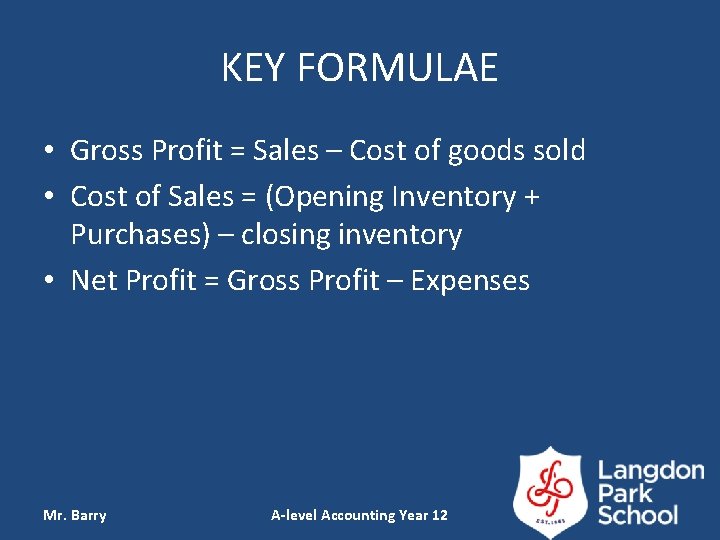
KEY FORMULAE • Gross Profit = Sales – Cost of goods sold • Cost of Sales = (Opening Inventory + Purchases) – closing inventory • Net Profit = Gross Profit – Expenses Mr. Barry A-level Accounting Year 12
1 2 3 4 5 6 Mr. Barry A-level Accounting Year 12
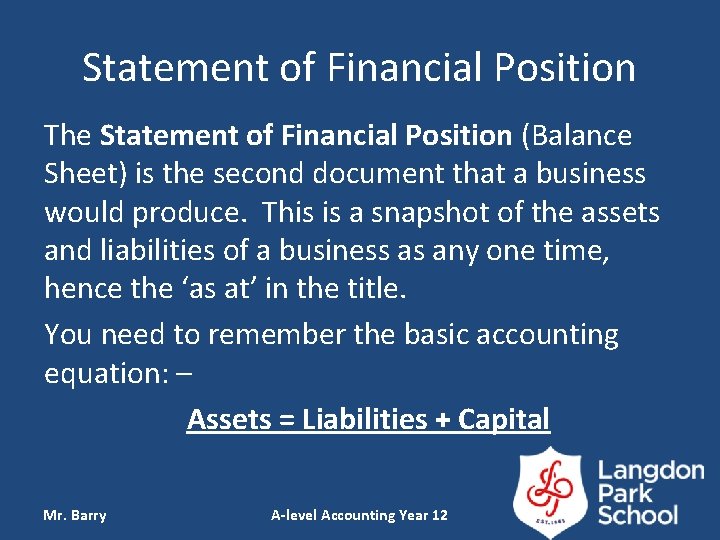
Statement of Financial Position The Statement of Financial Position (Balance Sheet) is the second document that a business would produce. This is a snapshot of the assets and liabilities of a business as any one time, hence the ‘as at’ in the title. You need to remember the basic accounting equation: – Assets = Liabilities + Capital Mr. Barry A-level Accounting Year 12
Why is it important for companies to prepare a SOFP? 3 minutes End Mr. Barry BTEC National Level 3
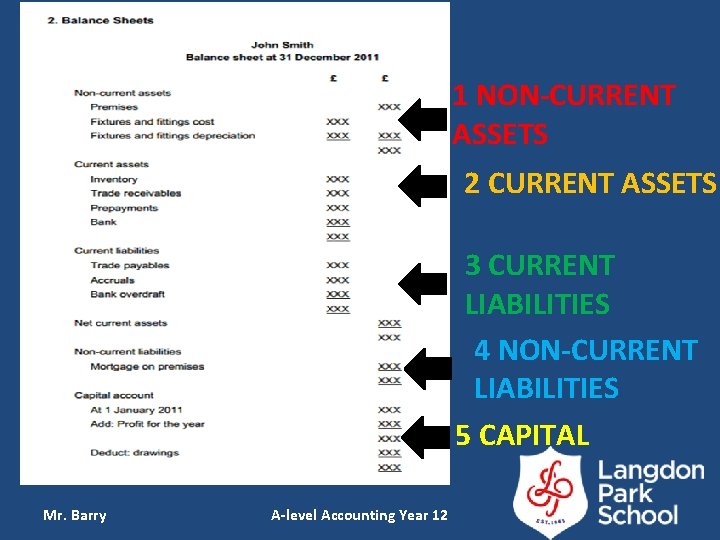
1 NON-CURRENT ASSETS 2 CURRENT ASSETS 3 CURRENT LIABILITIES 4 NON-CURRENT LIABILITIES 5 CAPITAL Mr. Barry A-level Accounting Year 12
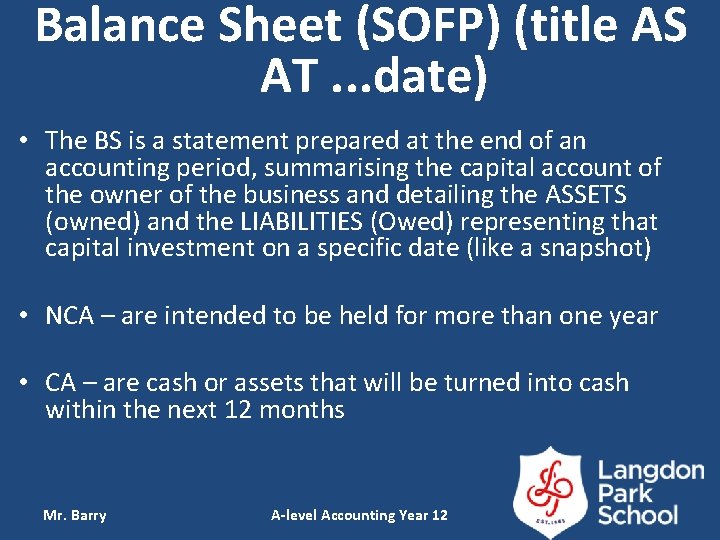
Balance Sheet (SOFP) (title AS AT. . . date) • The BS is a statement prepared at the end of an accounting period, summarising the capital account of the owner of the business and detailing the ASSETS (owned) and the LIABILITIES (Owed) representing that capital investment on a specific date (like a snapshot) • NCA – are intended to be held for more than one year • CA – are cash or assets that will be turned into cash within the next 12 months Mr. Barry A-level Accounting Year 12
Balance Sheet (SOFP) (title AS AT . . . date) • CL – are amounts OWED by the business that have to be repaid in the next 12 months e. g. overdraft, creditors, accruals • NCL – are amounts owed by the Co that are not due to be repaid in the next 12 months e. g. mortgages and loans • Capital Account – is the amount of the investment in the business made by the owner Mr. Barry BTEC National Level 3