
Learning Aim C Investigate the principles behind enabling
Learning Aim C: Investigate the principles behind enabling individuals with care and support needs to overcome challenges ©Outstanding Resources 2017
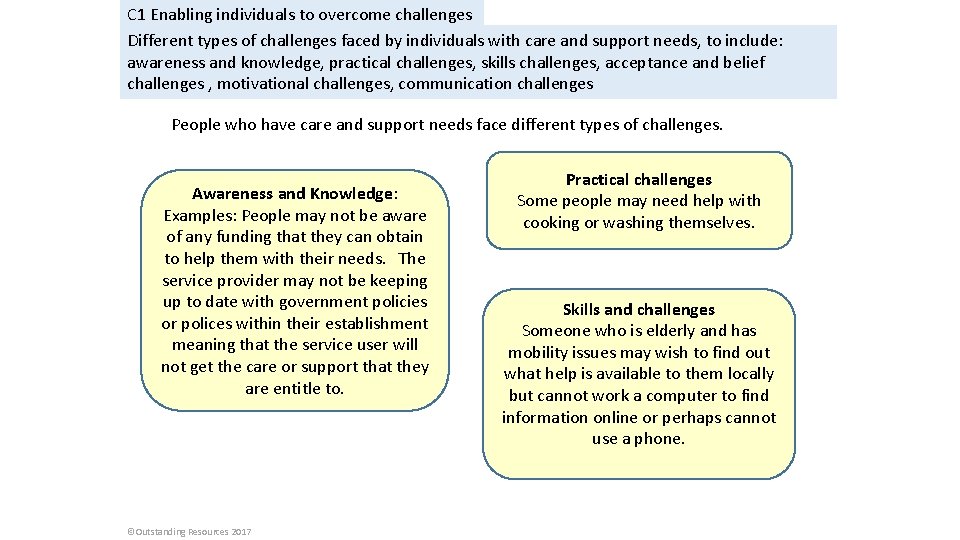
C 1 Enabling individuals to overcome challenges Different types of challenges faced by individuals with care and support needs, to include: awareness and knowledge, practical challenges, skills challenges, acceptance and belief challenges , motivational challenges, communication challenges People who have care and support needs face different types of challenges. Awareness and Knowledge: Examples: People may not be aware of any funding that they can obtain to help them with their needs. The service provider may not be keeping up to date with government policies or polices within their establishment meaning that the service user will not get the care or support that they are entitle to. ©Outstanding Resources 2017 Practical challenges Some people may need help with cooking or washing themselves. Skills and challenges Someone who is elderly and has mobility issues may wish to find out what help is available to them locally but cannot work a computer to find information online or perhaps cannot use a phone.
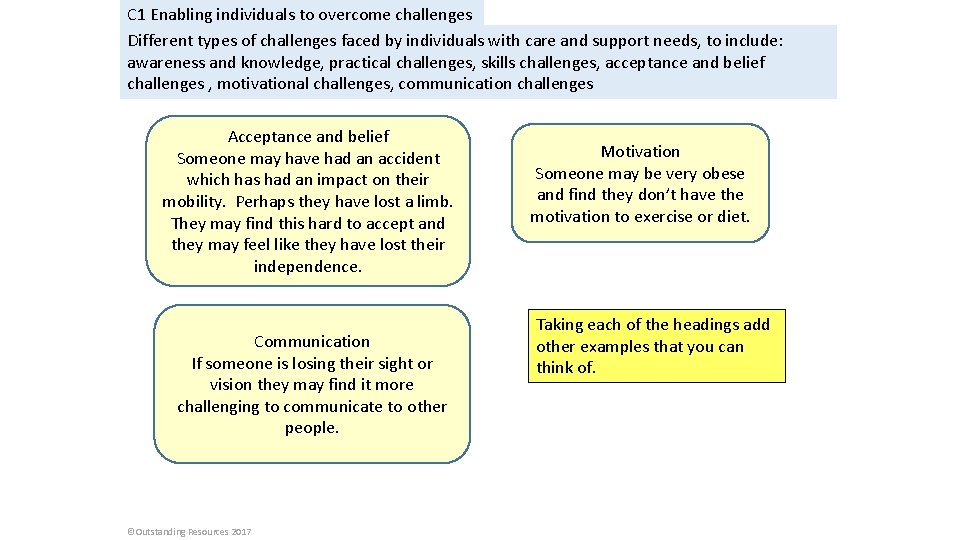
C 1 Enabling individuals to overcome challenges Different types of challenges faced by individuals with care and support needs, to include: awareness and knowledge, practical challenges, skills challenges, acceptance and belief challenges , motivational challenges, communication challenges Acceptance and belief Someone may have had an accident which has had an impact on their mobility. Perhaps they have lost a limb. They may find this hard to accept and they may feel like they have lost their independence. Communication If someone is losing their sight or vision they may find it more challenging to communicate to other people. ©Outstanding Resources 2017 Motivation Someone may be very obese and find they don’t have the motivation to exercise or diet. Taking each of the headings add other examples that you can think of.
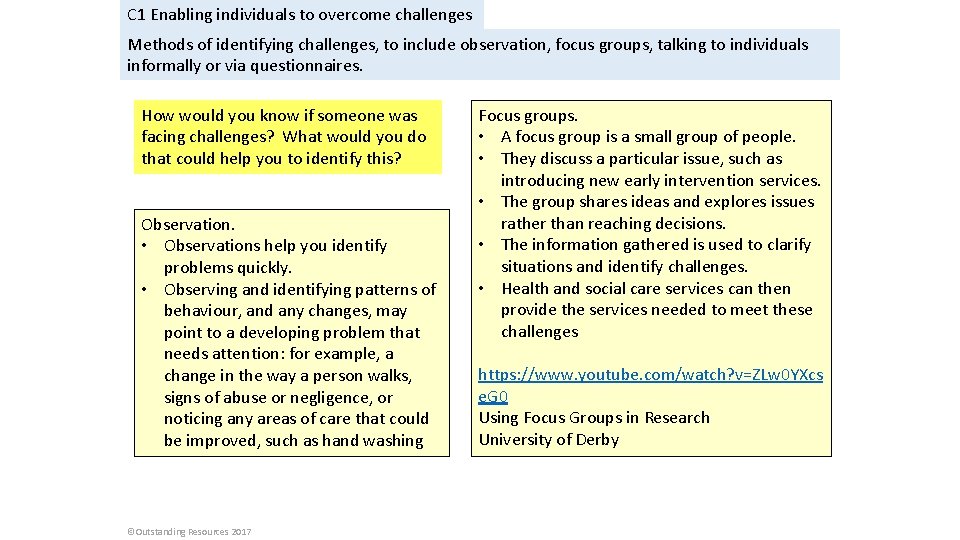
C 1 Enabling individuals to overcome challenges Methods of identifying challenges, to include observation, focus groups, talking to individuals informally or via questionnaires. How would you know if someone was facing challenges? What would you do that could help you to identify this? Observation. • Observations help you identify problems quickly. • Observing and identifying patterns of behaviour, and any changes, may point to a developing problem that needs attention: for example, a change in the way a person walks, signs of abuse or negligence, or noticing any areas of care that could be improved, such as hand washing ©Outstanding Resources 2017 Focus groups. • A focus group is a small group of people. • They discuss a particular issue, such as introducing new early intervention services. • The group shares ideas and explores issues rather than reaching decisions. • The information gathered is used to clarify situations and identify challenges. • Health and social care services can then provide the services needed to meet these challenges https: //www. youtube. com/watch? v=ZLw 0 YXcs e. G 0 Using Focus Groups in Research University of Derby
C 1 Enabling individuals to overcome challenges Methods of identifying challenges, to include observation, focus groups, talking to individuals informally or via questionnaires. Talking to individuals informally. • Having a casual chat with an individual allows for them to feel comfortable and not feel under and pressure. • The individual may give you more information is a relaxed atmosphere. Using questionnaires. • Questionnaires are sets of questions used to collect people’s opinions on certain topics. • A well-designed questionnaire is useful because it can collect a lot of information from a large group of people much more quickly than other methods. • Questionnaires are also relatively inexpensive to administer. • What situations can you think of where you may have been asked to complete a questionnaire? Perhaps at you doctors or dentists. • Why do you think that these can be useful for obtaining information. ? ©Outstanding Resources 2017
C 1 Enabling individuals to overcome challenges Strategies used to overcome challenges, to include educational information materials, training courses, opinion leaders, clinical audits, computer-aided advice systems, patient-mediated strategies. List the forms of educational informational material which are available to individuals. E. g. DVD • • • Leaflets Posters Games Slide presentations Wall displays CD-ROMs Flyers Web-based materials Magazines Newspapers TV Radio ©Outstanding Resources 2017 Can you think of any educational information campaigns that you have seen? These educational information materials inform people about current thinking on how to live healthily and they give advice on how to overcome challenges. They help to raise awareness and knowledge. https: //www. youtube. com/watch? v=Ihu. H e. I 4 H 00 U Government release new hard-hitting antismoking advert https: //www. youtube. com/watch? v= e 27 s 1 j. Oi. H 3 I Change 4 Life Sugar Smart Change 4 life
C 1 Enabling individuals to overcome challenges Strategies used to overcome challenges, to include educational information materials, training courses, opinion leaders, clinical audits, computer-aided advice systems, patient-mediated strategies. Training courses • These are for carers and professionals. • They allow people to understand certain conditions and the needs of the people with those conditions. • They can help carers to learn how to care for a certain individuals needs, such as someone with dementia or autism. • If you care for someone who is unable to move you can learn how to move them without injuring yourself. • Organisations such as local councils and hospitals run these courses, and there also courses available online, covering a wide range of challenges. • Training courses are also used to educate service providers about the latest developments in their area of care ©Outstanding Resources 2017 Opinion leader • Well-known individual or organisation Anyone who has an active voice in a community, who speaks out and is often asked for advice. • Chief executives of bodies such as the NHS, Skills in Care or Care England • They can use their influence to motivate health and social care service providers to achieve the best possible care for service users. • Famous people can influence public opinions and make changes. https: //www. youtube. com/watch? v=go_QOzc 7 9 Uc Teach every child about food | Jamie Oliver Watch the clip. Have a look online and see what other changes have been made due to Jamie's influence.
C 1 Enabling individuals to overcome challenges Strategies used to overcome challenges, to include educational information materials, training courses, opinion leaders, clinical audits, computer-aided advice systems, patient-mediated strategies. Watch the clip below. What is a Clinical audit and can you think of anymore examples? https: //www. youtube. com/watch? v=o. AISf. FPz 29 Q Clinical audit -- why and how? The young dentist Clinical audits • A systematic review of care based on standards of best practice and explicit criteria. • Based on the results, changes are then implemented, wherever necessary. • Check that organisations are acting fairly without discrimination. ©Outstanding Resources 2017 Computer-aided advice systems • Online decision support systems that supply service providers with specific information, such as to pharmacists and doctors when they are prescribing medication. • These systems provide prompts designed to reflect best practice and remind service providers to take or avoid a certain action. Patient-mediated strategies • Provide information via mass-media campaigns to service users and the wider public about the latest evidence-based practice. • These strategies also educate and motivate service providers about changes in practice.
C 1 Enabling individuals to overcome challenges Role of policy frameworks in minimising challenges, including: NHS Patient Experience Framework, in particular understanding of the eight elements that are critical to the service users' experience of NHS services. Health Action Plans and how they are used to minimise challenges. Adult Social Care Outcomes Framework (ASCOF). Common Assessment Framework (CAF) https: //www. gov. uk/government/uploads/system/uploads/attachment_data/file/215159/dh_132788. pdf NHS Patient Experience Framework Read the information in the link. Explain each of the 8 elements. http: //www. jpaget. nhs. uk/media/186362/health_action_plans. pdf NHS Health Action plan Using the information in the link, explain what a Health Action Plan is. And how they are used to minimise challenges. If you need more information just google NHS Health Action Plan and you will see a number of examples. https: //www. gov. uk/government/publications/adult-social-care-outcomes-framework-ascof-2015 -to 2016 Adult Social Care Outcomes Framework How are these used to minimise challenges? http: //www. project 6. org. uk/information-advice/a-guide-to-the-common-assessment-framework-caf/ Common Assessment Framework http: //greatermanchesterscb. proceduresonline. com/pdfs/caf_guidance_practitioners. pdf Working in small groups research and create a presentation, for the rest of the class, on one of the above. Make sure you include a short test on the information you have provided and a handout. ©Outstanding Resources 2017
C 1 Enabling individuals to overcome challenges Impact of not enabling individuals to overcome challenges. If people are not helped in anyway to overcome the challenges and difficulties they face then this could have an impact on their health. Challenges people may face. In pairs pick three from this list: • Awareness and Knowledge • Practical challenges • Skills and challenges • Acceptance and belief • Communication • Motivation Pick one of the policies you have studied and state which challenges the policy may help to overcome. ©Outstanding Resources 2017 Strategies to overcome challenges. Pick one strategy to overcome three challenges you picked. Explain how the strategy might help a person overcome those challenges. • Educational information • Training courses • Opinion leaders • Clinical audits • Computer aided device systems • Patient-mediated strategies
C 2 Promoting personalisation Personalisation – ensuring that every person receiving care and support is able to set their personal goals and has choice and control over the shape of their care and support Methods of recognising preferences, to include care plans, learning plans, behavioural plans, specialist support from health and social care professionals The importance of promoting choice and control and the financial impact of this on care provision. https: //www. youtube. com/watch? v=m. Que-_fq 0 Ag Care and Support Planning and The Care Act helensanderson. HSA https: //www. youtube. com/watch? v=bdtwe-A 2 O 60 Personalisation – making it happen: the social worker’s perspective Social Care Institute for Excellence Make notes on all of the videos and discuss afterwards. https: //www. youtube. com/watch? v=PCb. T 31 L-og. A Personalisation for someone with a physical disability https: //www. england. nhs. uk/wp-content/uploads/2016/04/core-info-care-supportplanning-1. pdf Additional reading! ©Outstanding Resources 2017
C 3 Communication techniques Different approaches for effective communication, to include humanistic, behavioural, cognitive, psychoanalytical and social. There a range of different approaches for effective communication: • Humanistic • Behavioural • Cognitive • Psychoanalytical • Social In small groups pick one of the approaches above. Research the approach and produce a presentation to the rest of the class. Think of one example of a situation in a health and social care setting where a professional could use theory to work with a service user. . ©Outstanding Resources 2017
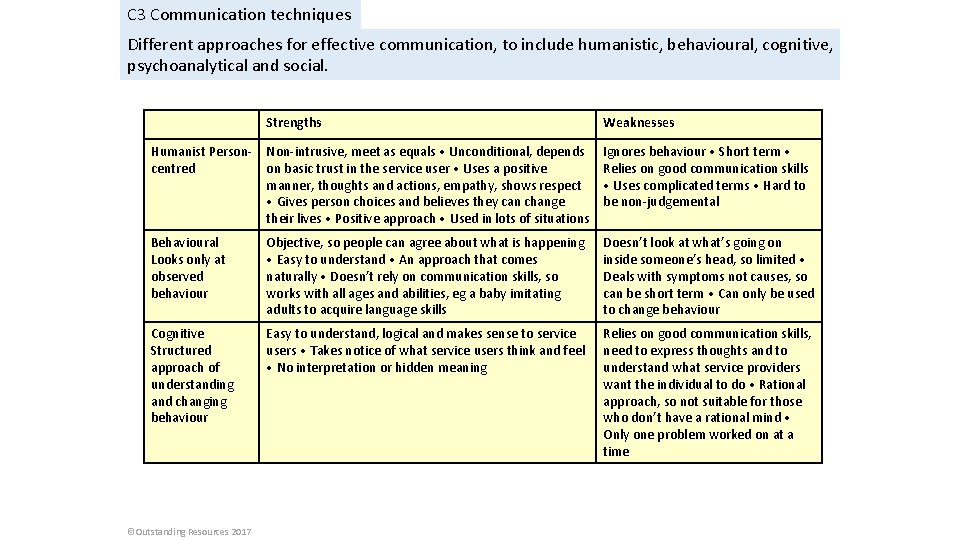
C 3 Communication techniques Different approaches for effective communication, to include humanistic, behavioural, cognitive, psychoanalytical and social. Strengths Weaknesses Humanist Personcentred Non-intrusive, meet as equals • Unconditional, depends on basic trust in the service user • Uses a positive manner, thoughts and actions, empathy, shows respect • Gives person choices and believes they can change their lives • Positive approach • Used in lots of situations Ignores behaviour • Short term • Relies on good communication skills • Uses complicated terms • Hard to be non-judgemental Behavioural Looks only at observed behaviour Objective, so people can agree about what is happening • Easy to understand • An approach that comes naturally • Doesn’t rely on communication skills, so works with all ages and abilities, eg a baby imitating adults to acquire language skills Doesn’t look at what’s going on inside someone’s head, so limited • Deals with symptoms not causes, so can be short term • Can only be used to change behaviour Cognitive Structured approach of understanding and changing behaviour Easy to understand, logical and makes sense to service users • Takes notice of what service users think and feel • No interpretation or hidden meaning Relies on good communication skills, need to express thoughts and to understand what service providers want the individual to do • Rational approach, so not suitable for those who don’t have a rational mind • Only one problem worked on at a time ©Outstanding Resources 2017
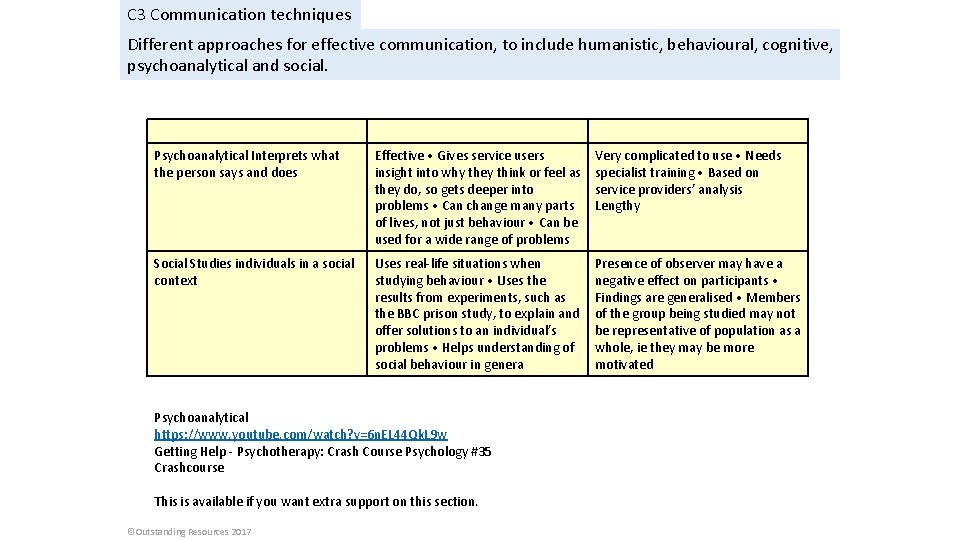
C 3 Communication techniques Different approaches for effective communication, to include humanistic, behavioural, cognitive, psychoanalytical and social. Psychoanalytical Interprets what the person says and does Effective • Gives service users insight into why they think or feel as they do, so gets deeper into problems • Can change many parts of lives, not just behaviour • Can be used for a wide range of problems Very complicated to use • Needs specialist training • Based on service providers’ analysis Lengthy Social Studies individuals in a social context Uses real-life situations when studying behaviour • Uses the results from experiments, such as the BBC prison study, to explain and offer solutions to an individual’s problems • Helps understanding of social behaviour in genera Presence of observer may have a negative effect on participants • Findings are generalised • Members of the group being studied may not be representative of population as a whole, ie they may be more motivated Psychoanalytical https: //www. youtube. com/watch? v=6 n. EL 44 Qk. L 9 w Getting Help - Psychotherapy: Crash Course Psychology #35 Crashcourse This is available if you want extra support on this section. ©Outstanding Resources 2017
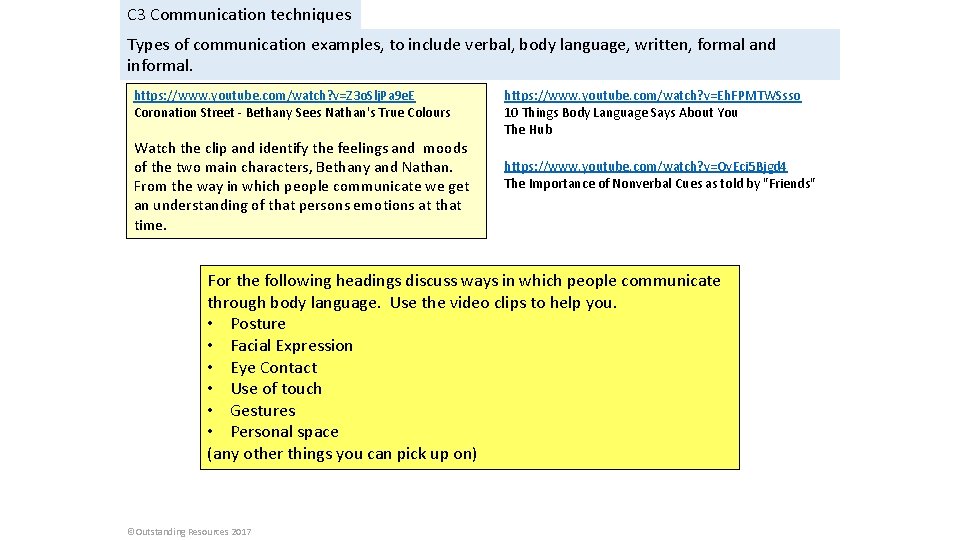
C 3 Communication techniques Types of communication examples, to include verbal, body language, written, formal and informal. https: //www. youtube. com/watch? v=Z 3 o. Slj. Pa 9 e. E Coronation Street - Bethany Sees Nathan's True Colours Watch the clip and identify the feelings and moods of the two main characters, Bethany and Nathan. From the way in which people communicate we get an understanding of that persons emotions at that time. https: //www. youtube. com/watch? v=Eh. FPMTWSsso 10 Things Body Language Says About You The Hub https: //www. youtube. com/watch? v=Ov. Eci 5 Bjgd 4 The Importance of Nonverbal Cues as told by "Friends" For the following headings discuss ways in which people communicate through body language. Use the video clips to help you. • Posture • Facial Expression • Eye Contact • Use of touch • Gestures • Personal space (any other things you can pick up on) ©Outstanding Resources 2017
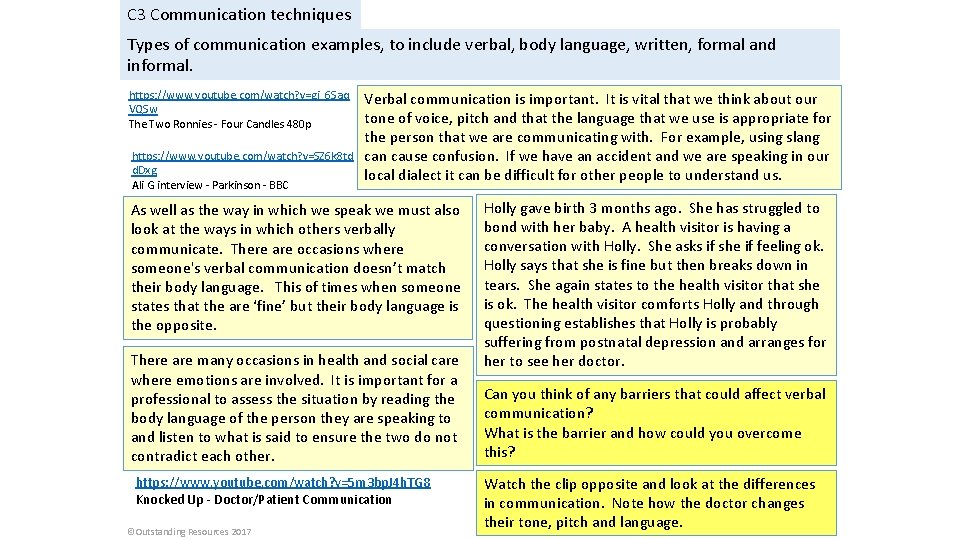
C 3 Communication techniques Types of communication examples, to include verbal, body language, written, formal and informal. https: //www. youtube. com/watch? v=gi_6 Saq VQSw The Two Ronnies - Four Candles 480 p https: //www. youtube. com/watch? v=SZ 6 k 8 td d. Dxg Ali G interview - Parkinson - BBC Verbal communication is important. It is vital that we think about our tone of voice, pitch and that the language that we use is appropriate for the person that we are communicating with. For example, using slang can cause confusion. If we have an accident and we are speaking in our local dialect it can be difficult for other people to understand us. As well as the way in which we speak we must also look at the ways in which others verbally communicate. There are occasions where someone's verbal communication doesn’t match their body language. This of times when someone states that the are ‘fine’ but their body language is the opposite. There are many occasions in health and social care where emotions are involved. It is important for a professional to assess the situation by reading the body language of the person they are speaking to and listen to what is said to ensure the two do not contradict each other. https: //www. youtube. com/watch? v=5 m 3 bp. J 4 h. TG 8 Knocked Up - Doctor/Patient Communication ©Outstanding Resources 2017 Holly gave birth 3 months ago. She has struggled to bond with her baby. A health visitor is having a conversation with Holly. She asks if she if feeling ok. Holly says that she is fine but then breaks down in tears. She again states to the health visitor that she is ok. The health visitor comforts Holly and through questioning establishes that Holly is probably suffering from postnatal depression and arranges for her to see her doctor. Can you think of any barriers that could affect verbal communication? What is the barrier and how could you overcome this? Watch the clip opposite and look at the differences in communication. Note how the doctor changes their tone, pitch and language.
C 3 Communication techniques Types of communication examples, to include verbal, body language, written, formal and informal. • Formal communication Written communication • This can be used to keep records and write reports. • Different types of communication need different styles of writing and different ways of presenting information, but all require literacy skills. • written information must be clear and writing needs to be well structured and legible, with grammar, spelling and punctuation used correctly. • A more formal style of writing and language are needed when recording information about a patient • Written communication could be used by a Doctor who has to write to another consultant about a patient. • When else may written communication be necessary? ©Outstanding Resources 2017 • Think of the way your doctor speaks to you. ‘Good afternoon. How are you feeling today? ’ • This show respect for others. • Formal conversation is often used when a professional person speaks to a service user. • They use clear language to avoid misinterpretation. • Informal communication is the way in which you probably speak to your friends and family. It is much more relaxed. People often use slang and local dialect. ‘Hi, how are you? ’. • Informal communication is warm and friendly. • Think of the Ali G clip you have watched. Parkinson uses a very different style of language compared to Ali G.
C 3 Communication techniques Alternative communications, to include Makaton, British Sign Language (BSL), braille, communication boards and symbol systems. Makaton is a method of communication that uses signs and symbols. Unlike British Sign Language, it uses speech as well as actions and symbols. Makaton uses picture cards, and ties facial expressions to a word to make the word more easily recognised by those with learning difficulties. Watch the clips. How can Makaton be used in the health care and early years professions? https: //www. makaton. org/ For further research and information look at the Makaton website. ©Outstanding Resources 2017 https: //www. youtube. com/watch? v=DPog Foq-l. Ds Who uses Makaton? https: //www. youtube. com/watch? v=7 RA m 9 Os. L 1 g 4 Learn Makaton Signing - Top 10 signs for nurses https: //www. youtube. com/watch? v=6 FHD Qb. MYaa. Q Makaton | How it Assists Development of Communication in the Early years https: //www. youtube. com/watch? v=ro. H 8 p. BC 5 c. M Lucas sign language - Makaton aged 2
C 3 Communication techniques Alternative communications, to include Makaton, British Sign Language (BSL), braille, https: //www. youtube. com/watch? v=UGKDj. MARPg. Y communication boards and symbol systems. British Sign Language (BSL) and the doctor British Sign Language • BSL is a language in its own right. • It was first recognised in the UK in 2003. • BSL uses visual signs instead of sounds. • These are made up of the shapes, positions and movements of the hands, arms or body and facial expressions. • Sign language is commonly used by families and friends of deaf people, as well as by those who are deaf or hard of hearing • The Braille system is a method used by blind people to read and write. • It was devised in 1821 by Louis Braille, a Frenchman. • Braille is a system of raised marks that can be felt with the fingers. • Each Braille character is made up of six dot positions, arranged in a rectangle. • A dot may be raised in any of the six positions to form sixty four possible combinations and these raised dots are read by touch ©Outstanding Resources 2017 https: //www. youtube. com/watch? v=F ha 8 Zsdxup. I Three Year Old Reading to Little Brother Using Sign Language https: //www. youtube. com/ watch? v=9 IQKq. Pa. ICKI The Braille Story https: //www. youtube. com/ watch? v=f. YLdl. O 96 ua. M How Blind People Find Braille Signs

C 3 Communication techniques Alternative communications, to include Makaton, British Sign Language (BSL), braille, https: //www. youtube. com/watch? v=UGKDj. MARPg. Y communication boards and symbol systems. British Sign Language (BSL) and the doctor Pictures can be used to communicate with people who have no ability to speak or use a language • People with autism use picture cards as they tend to learn visually and communicate with images and pictures. • Communication boards are also used with people who have suffered a stroke or other brain injury. (Watch video clip 1 and 2 to see examples of this) • • Makaton and communication boards are examples of systems that use symbols. • Symbol systems are used with children and adults who are either not able to use speech effectively or cannot use speech at all. • These systems enable them to share information with others and to receive messages back, by pointing to the symbol that conveys what they want to communicate. • Some symbols are pictures or photos and others may be tactile – actual objects or parts of objects to touch. • Symbols can be arranged in order to let the person know what will be happening on a particular day. Commercial symbol systems are also available (Watch video 3 and 4 for examples) ©Outstanding Resources 2017 https: //www. youtube. com/watch? v =RO 6 dc 7 QSQb 4 Using Visuals to Teach Autistic Students (VIDEO 1) https: //www. youtube. com/watch? v =kiq. Yapgu 69 g Using an Aided Language Support During Direct Instruction (VIDEO 2) https: //www. youtube. com/watch? v =ICa 2 g_F_c. Ts Tangible Symbols (Chapter 2 of 6) (VIDEO 3) https: //www. youtube. com/watch? v =Vin. L 5 cx. TCDs Using Picture Symbols for Communication (VIDEO 4)
C 3 Communication techniques Alternative communications, to include Makaton, British Sign Language (BSL), braille, https: //www. youtube. com/watch? v=UGKDj. MARPg. Y communication boards and symbol systems. British Sign Language (BSL) and the doctor Choose a task such as making a cup of tea, getting ready for school, going shopping etc. Identify objects of reference or pictures that will assist with communicating. Explain how using this system can promote independence in individuals. ©Outstanding Resources 2017
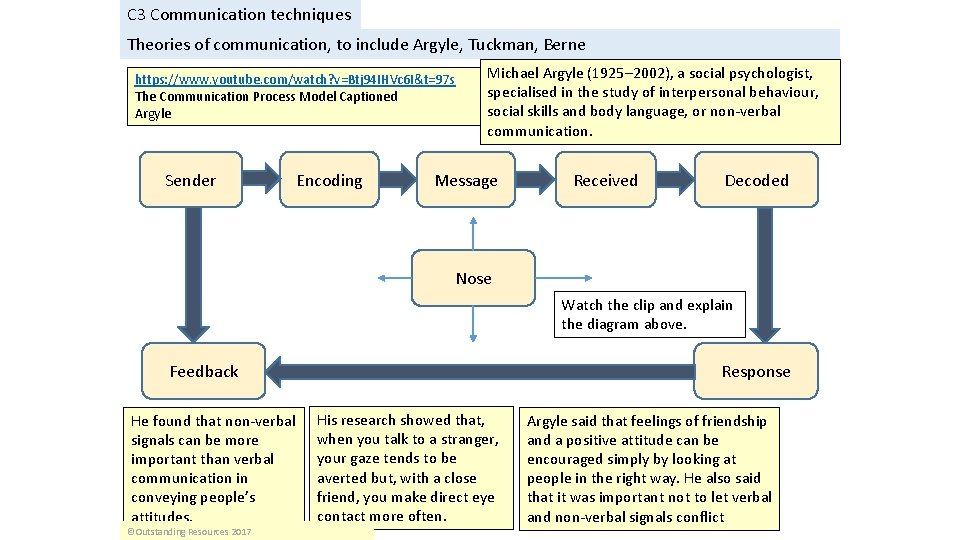
C 3 Communication techniques Theories of communication, to include Argyle, Tuckman, Berne https: //www. youtube. com/watch? v=Btj 94 IHVc 6 I&t=97 s The Communication Process Model Captioned Argyle Sender Encoding Michael Argyle (1925– 2002), a social psychologist, specialised in the study of interpersonal behaviour, social skills and body language, or non-verbal communication. Message Received Decoded Nose Watch the clip and explain the diagram above. Feedback He found that non-verbal signals can be more important than verbal communication in conveying people’s attitudes. ©Outstanding Resources 2017 Response His research showed that, when you talk to a stranger, your gaze tends to be averted but, with a close friend, you make direct eye contact more often. Argyle said that feelings of friendship and a positive attitude can be encouraged simply by looking at people in the right way. He also said that it was important not to let verbal and non-verbal signals conflict
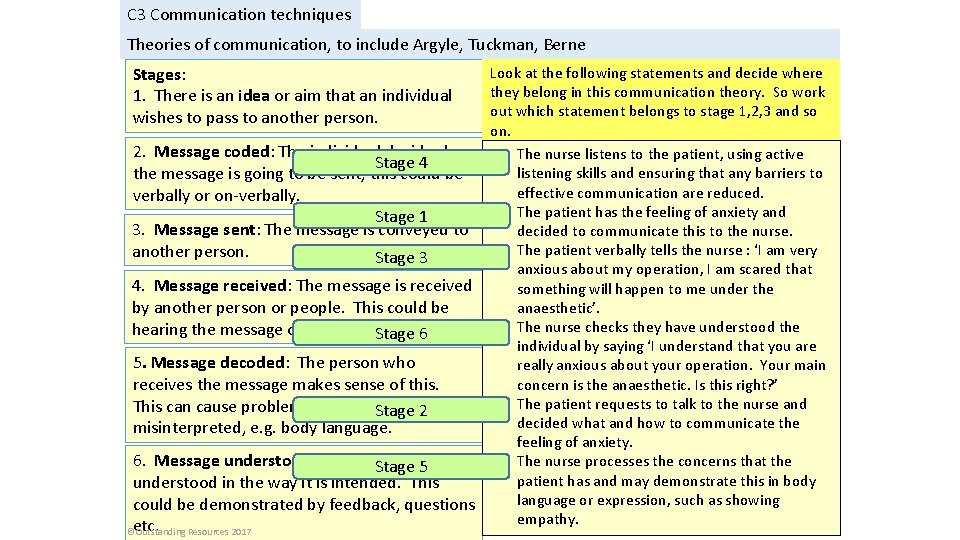
C 3 Communication techniques Theories of communication, to include Argyle, Tuckman, Berne Stages: 1. There is an idea or aim that an individual wishes to pass to another person. Look at the following statements and decide where they belong in this communication theory. So work out which statement belongs to stage 1, 2, 3 and so on. 2. Message coded: The individual decides how 1. The nurse listens to the patient, using active Stage 4 listening skills and ensuring that any barriers to the message is going to be sent, this could be effective communication are reduced. verbally or on-verbally. 2. The patient has the feeling of anxiety and Stage 1 3. Message sent: The message is conveyed to decided to communicate this to the nurse. 3. The patient verbally tells the nurse : ‘I am very another person. Stage 3 anxious about my operation, I am scared that 4. Message received: The message is received something will happen to me under the anaesthetic’. by another person or people. This could be 4. The nurse checks they have understood the hearing the message or reading it. Stage 6 individual by saying ‘I understand that you are 5. Message decoded: The person who really anxious about your operation. Your main concern is the anaesthetic. Is this right? ’ receives the message makes sense of this. 5. The patient requests to talk to the nurse and This can cause problems as it may be Stage 2 decided what and how to communicate the misinterpreted, e. g. body language. feeling of anxiety. 6. Message understood: The message is 6. The nurse processes the concerns that the Stage 5 patient has and may demonstrate this in body understood in the way it is intended. This language or expression, such as showing could be demonstrated by feedback, questions empathy. etc. ©Outstanding Resources 2017
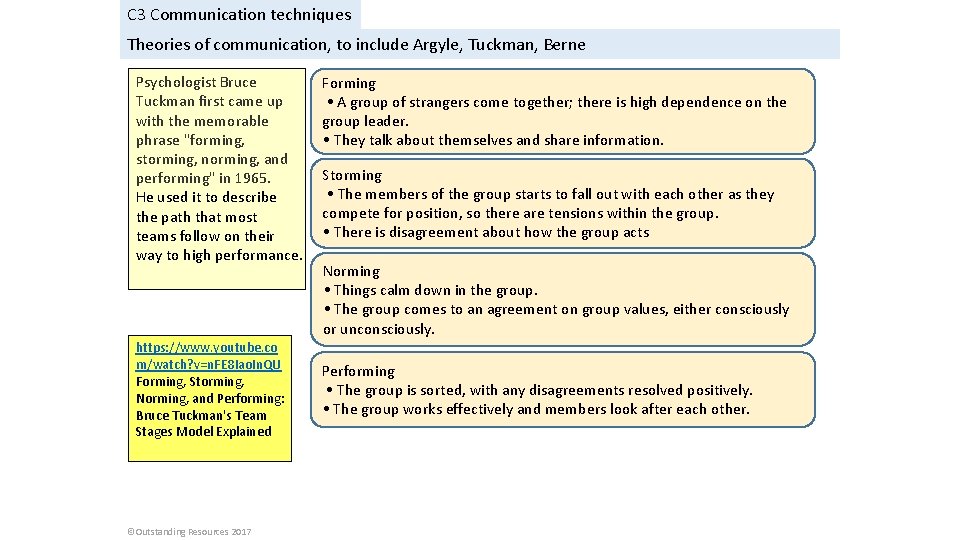
C 3 Communication techniques Theories of communication, to include Argyle, Tuckman, Berne Psychologist Bruce Tuckman first came up with the memorable phrase "forming, storming, norming, and performing" in 1965. He used it to describe the path that most teams follow on their way to high performance. https: //www. youtube. co m/watch? v=n. FE 8 Iao. In. QU Forming, Storming, Norming, and Performing: Bruce Tuckman's Team Stages Model Explained ©Outstanding Resources 2017 Forming • A group of strangers come together; there is high dependence on the group leader. • They talk about themselves and share information. Storming • The members of the group starts to fall out with each other as they compete for position, so there are tensions within the group. • There is disagreement about how the group acts Norming • Things calm down in the group. • The group comes to an agreement on group values, either consciously or unconsciously. Performing • The group is sorted, with any disagreements resolved positively. • The group works effectively and members look after each other.
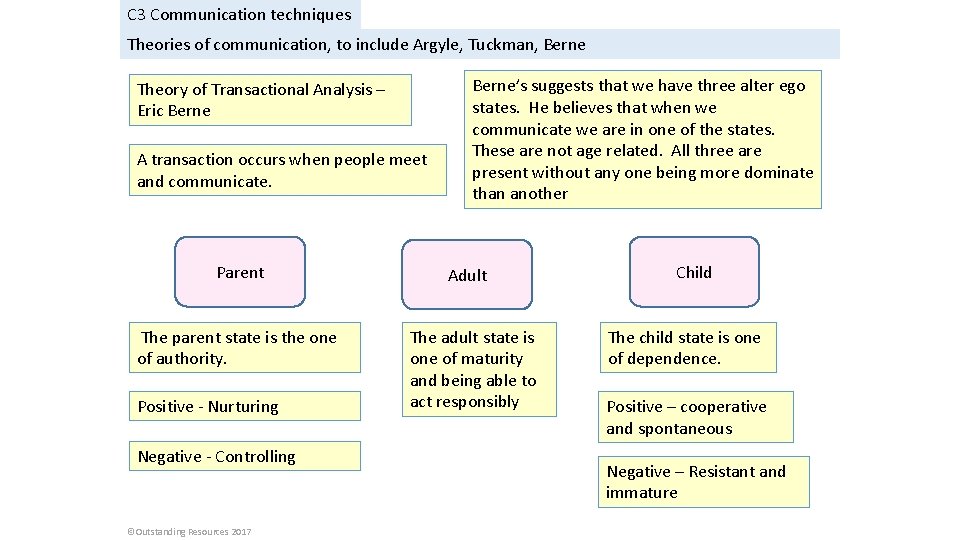
C 3 Communication techniques Theories of communication, to include Argyle, Tuckman, Berne Theory of Transactional Analysis – Eric Berne A transaction occurs when people meet and communicate. Parent The parent state is the one of authority. Positive - Nurturing Negative - Controlling ©Outstanding Resources 2017 Berne’s suggests that we have three alter ego states. He believes that when we communicate we are in one of the states. These are not age related. All three are present without any one being more dominate than another Adult The adult state is one of maturity and being able to act responsibly Child The child state is one of dependence. Positive – cooperative and spontaneous Negative – Resistant and immature
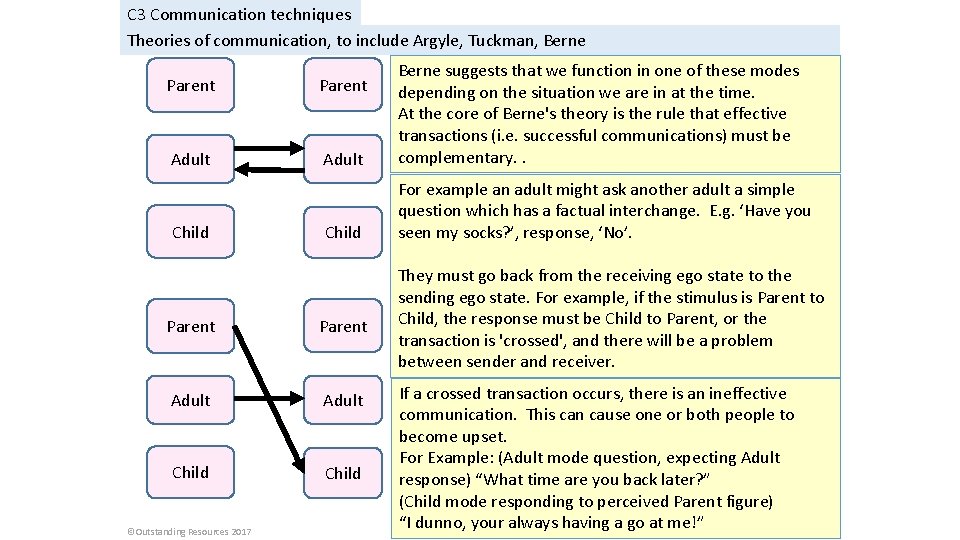
C 3 Communication techniques Theories of communication, to include Argyle, Tuckman, Berne Parent Adult Berne suggests that we function in one of these modes depending on the situation we are in at the time. At the core of Berne's theory is the rule that effective transactions (i. e. successful communications) must be complementary. . Child For example an adult might ask another adult a simple question which has a factual interchange. E. g. ‘Have you seen my socks? ’, response, ‘No’. Child Parent Adult Child ©Outstanding Resources 2017 They must go back from the receiving ego state to the sending ego state. For example, if the stimulus is Parent to Child, the response must be Child to Parent, or the transaction is 'crossed', and there will be a problem between sender and receiver. If a crossed transaction occurs, there is an ineffective communication. This can cause one or both people to become upset. For Example: (Adult mode question, expecting Adult response) “What time are you back later? ” (Child mode responding to perceived Parent figure) “I dunno, your always having a go at me!”
C 3 Communication techniques New technologies and communication techniques Voice output communication aids (VOCA) Turn small movements into written word and then into speech. Watch the two clips below and make notes. Voice activated software can turn spoken and written words into movement, such as instructing the user’s wheelchair to move. https: //www. youtube. com/watch? v=OTm. Pw 4 iy 0 hk Stephen Hawking's Voice and the Machine That Powers It https: //www. youtube. com/watch? v=Xq 1 a. PKSn. Y Speaking for Myself Maggie has Retts syndrome. This is a neurological disorder that affects mainly females. It leads to severe impairments, affecting nearly every aspect of the child's life: their ability to speak, walk, eat, and even breathe easily. Maggie now uses a VOCA to communicate to others. Watch the two clips. How has the VOCA had an impact on her life and that of her family? ©Outstanding Resources 2017 https: //www. youtube. com/watch? v=P 6 ql. Av. FSH 10 How To Talk to A Non-Verbal Kid Magnolias Hope https: //www. youtube. com/watch? v=R_1 U 4 Jma. YB 8 An Actual Conversation With Maggie | Rett Syndrome Magnolias Hope
C 3 Communication techniques New technologies and communication techniques Text relay service is operated by the charity Action on Hearing Loss. This service makes it possible for a person who can’t speak and/or hear to text their message to an operator, who then reads it to a hearing person. The operator types the reply so that the original sender can read it https: //www. youtube. com/watch? v=dk -F 3 uxy 9 RE What is a relay call? Mobile phones can vibrate so that someone know that they have received a message. Hearing aids. are devices with small microphones that pick up and increase the volume of sound. They are battery operated, very small and light and many are hardly noticeable as they are tucked behind the ear. https: //www. youtube. com/watch? v=CJk. H 31 u y 8 xo My deaf child and hearing technology National Deaf Children's Society https: //www. youtube. com/watch? v=PO 05 W q. Hx 8 rk Deaf boy listens to music through his hearing aids How has a hearing aid and technology improved Alex’s quality of life? ©Outstanding Resources 2017
C 3 Communication techniques New technologies and communication techniques A loop system • A hearing loop (sometimes called an audio induction loop) is a special type of sound system for use by people with hearing aids. • It boosts the signal in someone’s hearing aid. • They help those with hearing loss to focus on particular sounds, like a person talking, near the loop’s internal microphone. • In conditions without a hearing loop, all sounds including background noise are amplified making it sometimes difficult to focus on one sound. https: //www. youtube. com/watch? v=hlnx 3 ZI m. Tw 0 How Hearing Loops Work: What is a Hearing Loop and how does it work? OTOj. OY - Your Hearing Loop Experts ©Outstanding Resources 2017 Braille software is used by those who are visually impaired. It creates Braille that is printed out using a special printer. The software comes in a wide range of packages, including those that create mathematical, musical and text Braille, and those that translate different languages https: //www. youtube. com/watch? v=Nxs 369 C 2 Wl. E Unified English Braille - A Beginner's Guide from Dolphin Watch the clip. Look at how this piece of software aids the user. Speech recognition software can be used by the visually impaired, or those with dyslexia, to generate messages without using a computer keyboard. Speech recognition is the ability of a machine or programme to identify words and phrases in spoken language and convert them to a machine-readable format

Learning Aim C P 4 Explain the strategies and communication techniques used with individuals different needs to overcome different challenges. Explain Give reasons for how or why something happens; you need to give examples. What am I being asked to do? ©Outstanding Resources 2017 • What strategies are there? • Explain each one. • What communication techniques are there? • How are they used to help people to communicate? • What type of different needs to people have when it comes to communicating? Give examples • For each example what is used to help/overcome the communication difficulty of the individual?
Learning Aim C P 5 Explain the benefits of promoting personalisation when overcoming challenges faced by individuals with different needs. Explain Give reasons for how or why something happens; you need to give examples. Brainstorm the type of things that could be written about in order to meet this objective. What am I being asked to do? ©Outstanding Resources 2017
Learning Aim C M 4 What am I being asked to do? Assess the strategies and communication techniques used to overcome different challenges faced by individuals with different care and support needs. Assess Consider several options or arguments and weigh them up so as to come to a conclusion about their effectiveness or validity This ties in closely with learning aim C P 4. Explain the strategies and communication techniques used with individuals different needs to overcome different challenges. What is the difference between the two. What extra do you need to include to reach C M 4? ©Outstanding Resources 2017
- Slides: 32