
LEARNING ABOUT ECOSYSTEMS WITH ATP DESERT Prepared by
LEARNING ABOUT ECOSYSTEMS WITH ATP DESERT Prepared by Anahit Gharibyan West Coast Outreach Manager
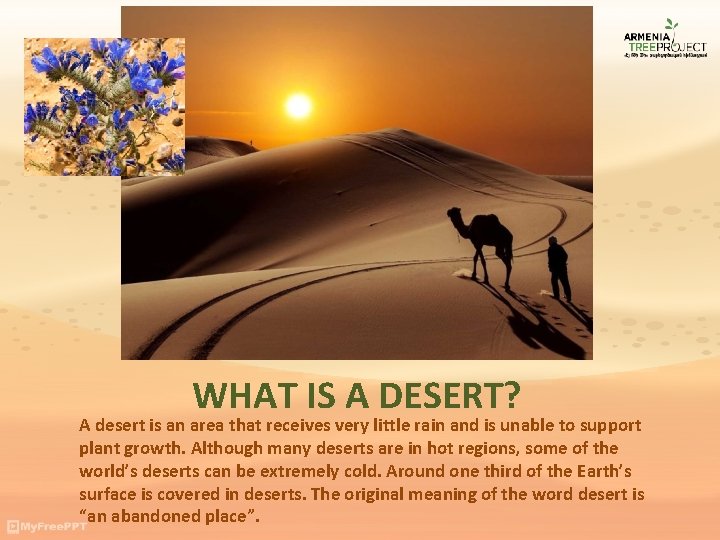
WHAT IS A DESERT? A desert is an area that receives very little rain and is unable to support plant growth. Although many deserts are in hot regions, some of the world’s deserts can be extremely cold. Around one third of the Earth’s surface is covered in deserts. The original meaning of the word desert is “an abandoned place”.
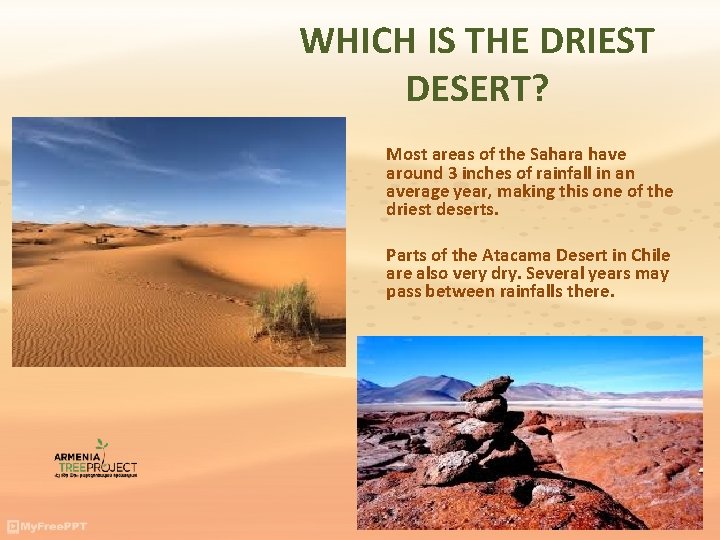
WHICH IS THE DRIEST DESERT? Most areas of the Sahara have around 3 inches of rainfall in an average year, making this one of the driest deserts. Parts of the Atacama Desert in Chile are also very dry. Several years may pass between rainfalls there.
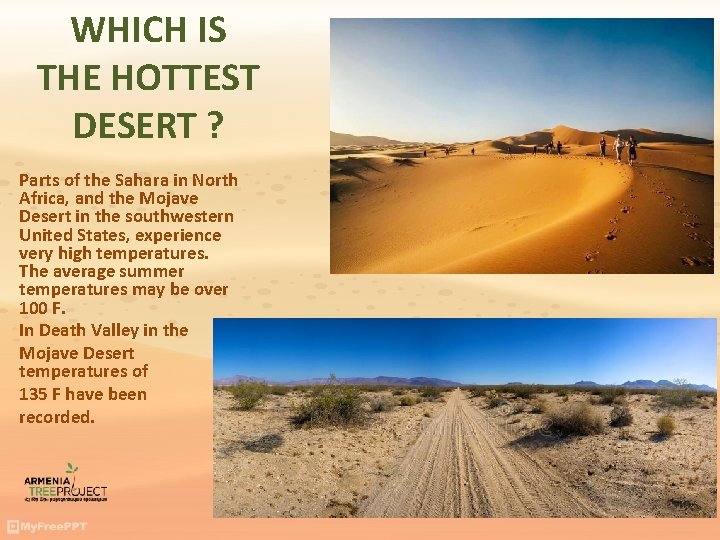
WHICH IS THE HOTTEST DESERT ? Parts of the Sahara in North Africa, and the Mojave Desert in the southwestern United States, experience very high temperatures. The average summer temperatures may be over 100 F. In Death Valley in the Mojave Desert temperatures of 135 F have been recorded.
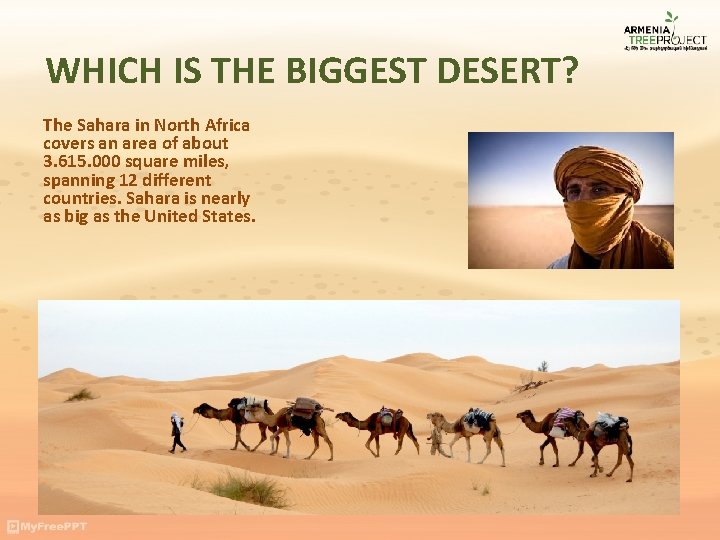
WHICH IS THE BIGGEST DESERT? The Sahara in North Africa covers an area of about 3. 615. 000 square miles, spanning 12 different countries. Sahara is nearly as big as the United States.
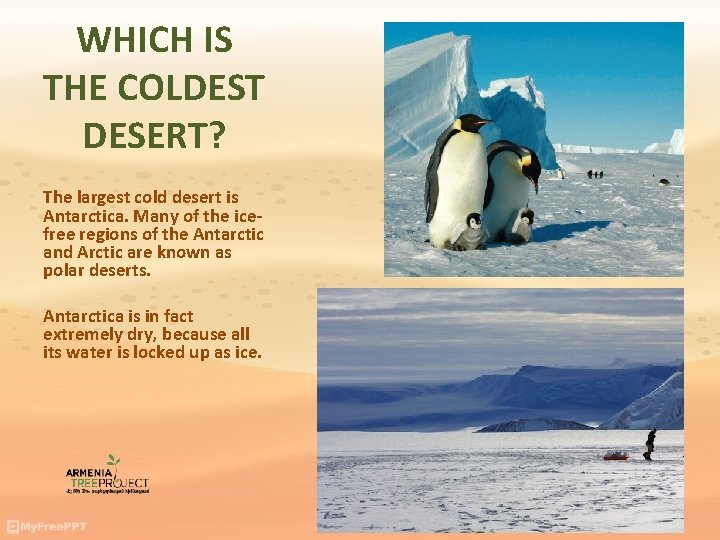
WHICH IS THE COLDEST DESERT? The largest cold desert is Antarctica. Many of the icefree regions of the Antarctic and Arctic are known as polar deserts. Antarctica is in fact extremely dry, because all its water is locked up as ice.
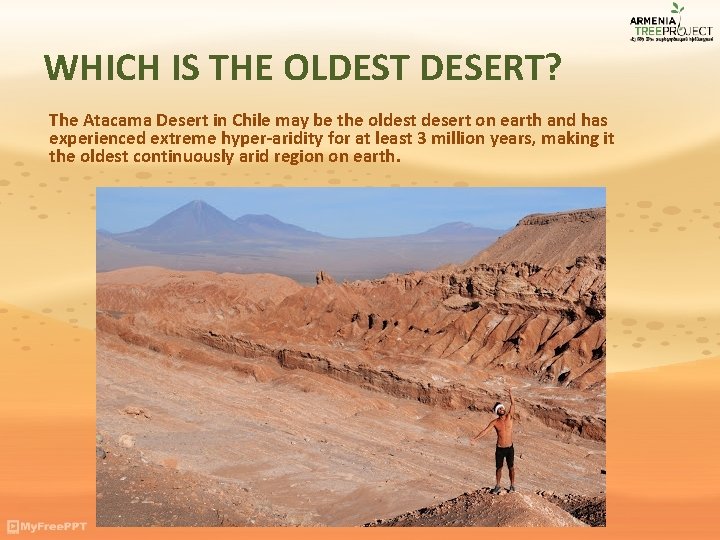
WHICH IS THE OLDEST DESERT? The Atacama Desert in Chile may be the oldest desert on earth and has experienced extreme hyper-aridity for at least 3 million years, making it the oldest continuously arid region on earth.
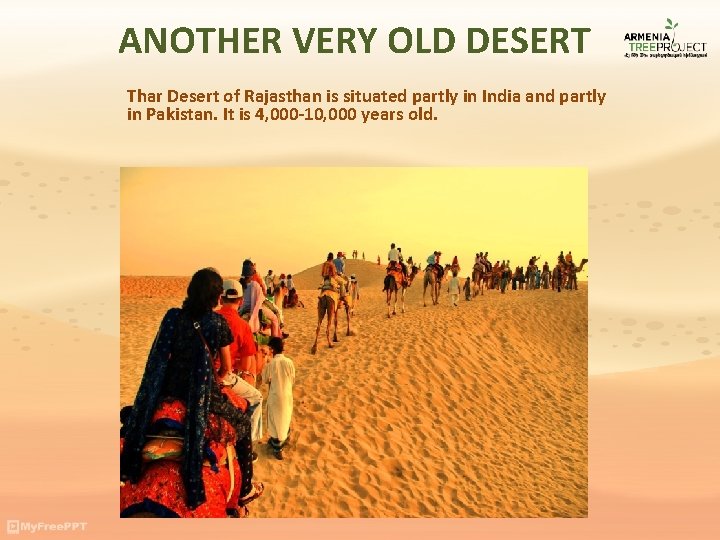
ANOTHER VERY OLD DESERT Thar Desert of Rajasthan is situated partly in India and partly in Pakistan. It is 4, 000 -10, 000 years old.
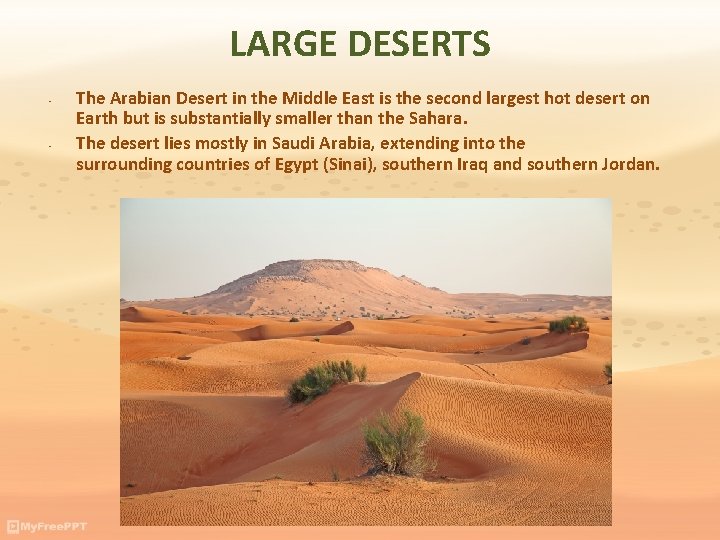
LARGE DESERTS - - The Arabian Desert in the Middle East is the second largest hot desert on Earth but is substantially smaller than the Sahara. The desert lies mostly in Saudi Arabia, extending into the surrounding countries of Egypt (Sinai), southern Iraq and southern Jordan.
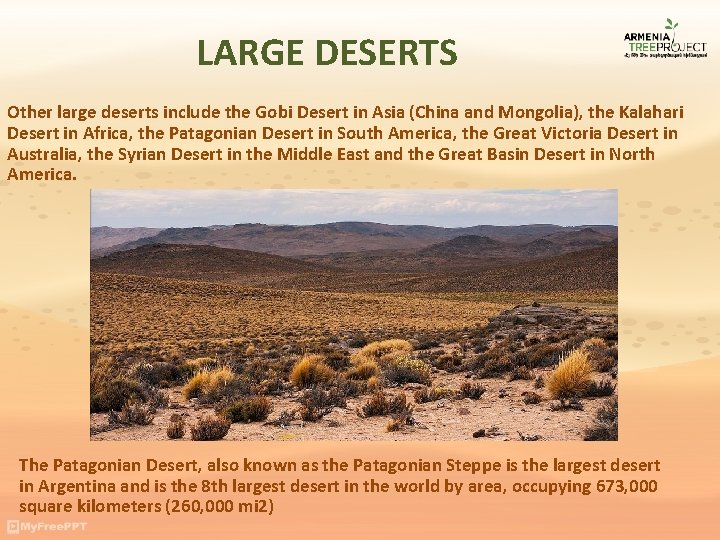
LARGE DESERTS Other large deserts include the Gobi Desert in Asia (China and Mongolia), the Kalahari Desert in Africa, the Patagonian Desert in South America, the Great Victoria Desert in Australia, the Syrian Desert in the Middle East and the Great Basin Desert in North America. The Patagonian Desert, also known as the Patagonian Steppe is the largest desert in Argentina and is the 8 th largest desert in the world by area, occupying 673, 000 square kilometers (260, 000 mi 2)
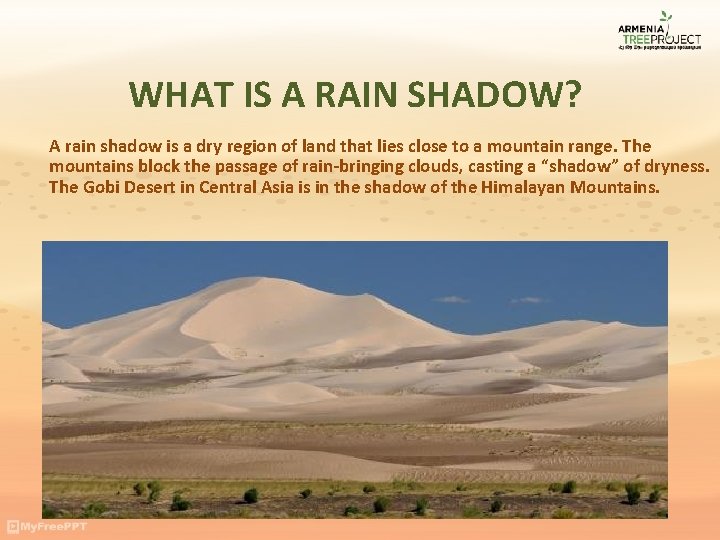
WHAT IS A RAIN SHADOW? A rain shadow is a dry region of land that lies close to a mountain range. The mountains block the passage of rain-bringing clouds, casting a “shadow” of dryness. The Gobi Desert in Central Asia is in the shadow of the Himalayan Mountains.
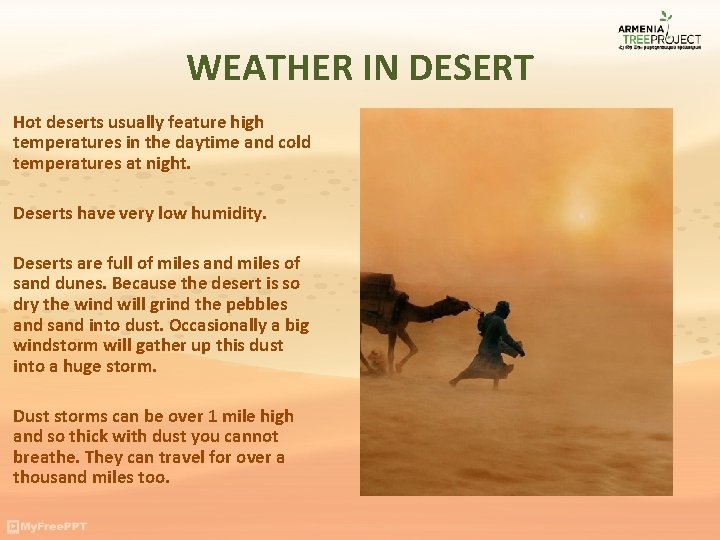
WEATHER IN DESERT Hot deserts usually feature high temperatures in the daytime and cold temperatures at night. Deserts have very low humidity. Deserts are full of miles and miles of sand dunes. Because the desert is so dry the wind will grind the pebbles and sand into dust. Occasionally a big windstorm will gather up this dust into a huge storm. Dust storms can be over 1 mile high and so thick with dust you cannot breathe. They can travel for over a thousand miles too.
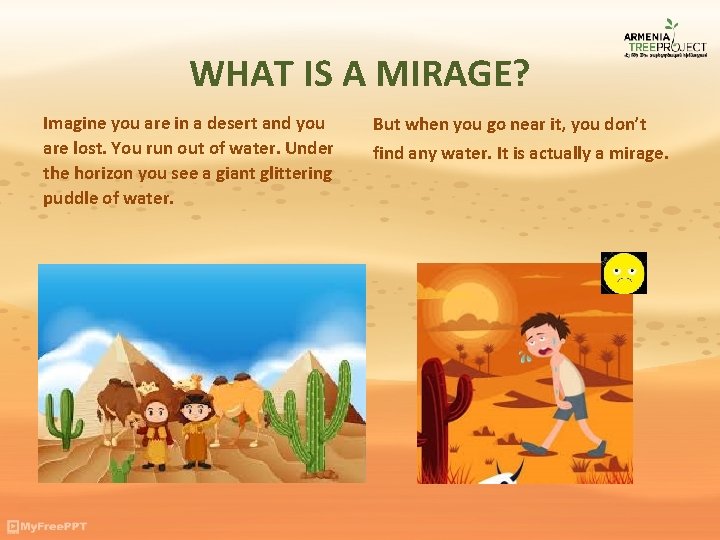
WHAT IS A MIRAGE? Imagine you are in a desert and you are lost. You run out of water. Under the horizon you see a giant glittering puddle of water. But when you go near it, you don’t find any water. It is actually a mirage.
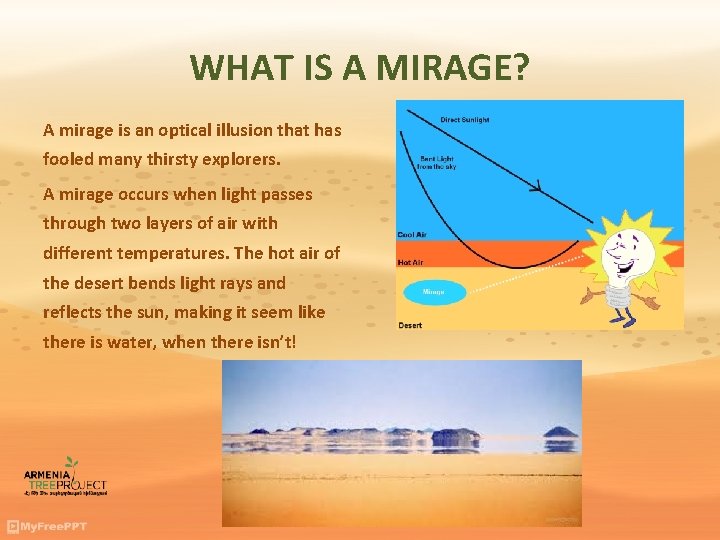
WHAT IS A MIRAGE? A mirage is an optical illusion that has fooled many thirsty explorers. A mirage occurs when light passes through two layers of air with different temperatures. The hot air of the desert bends light rays and reflects the sun, making it seem like there is water, when there isn’t!
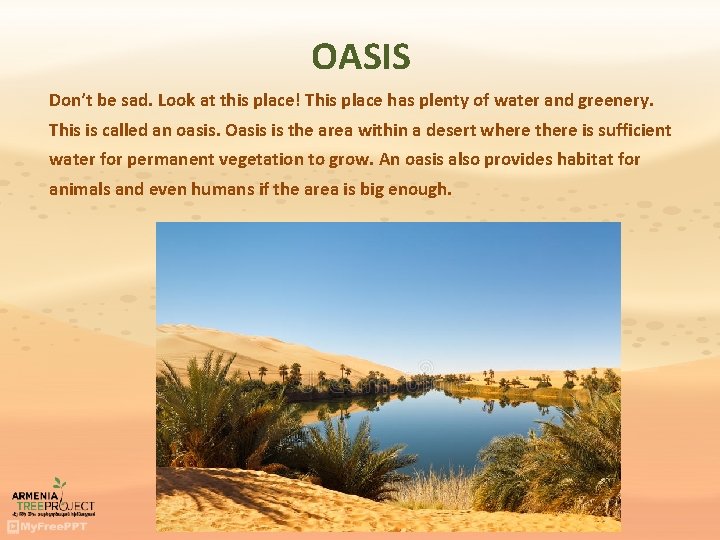
OASIS Don’t be sad. Look at this place! This place has plenty of water and greenery. This is called an oasis. Oasis is the area within a desert where there is sufficient water for permanent vegetation to grow. An oasis also provides habitat for animals and even humans if the area is big enough.
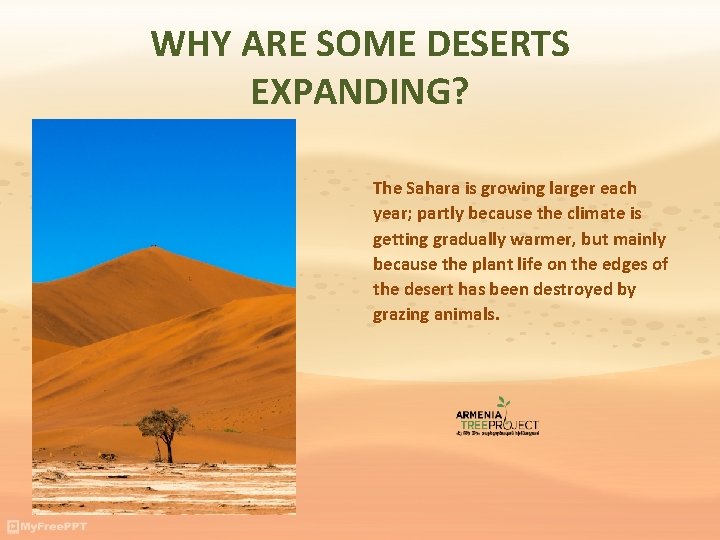
WHY ARE SOME DESERTS EXPANDING? The Sahara is growing larger each year; partly because the climate is getting gradually warmer, but mainly because the plant life on the edges of the desert has been destroyed by grazing animals.
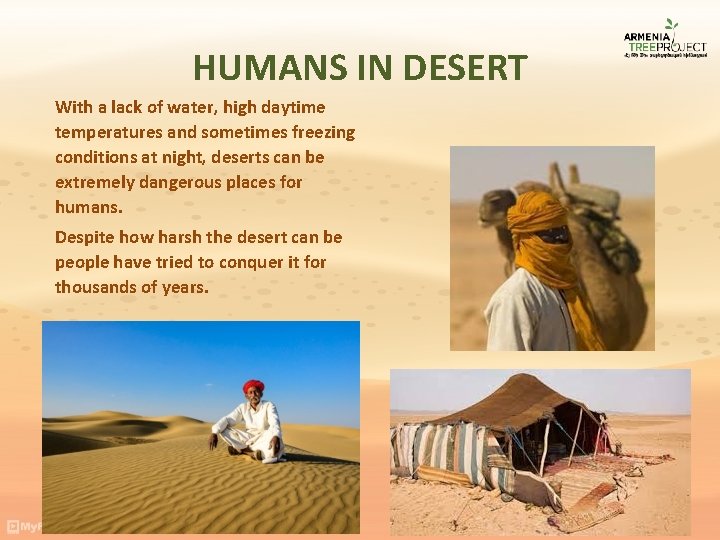
HUMANS IN DESERT With a lack of water, high daytime temperatures and sometimes freezing conditions at night, deserts can be extremely dangerous places for humans. Despite how harsh the desert can be people have tried to conquer it for thousands of years.
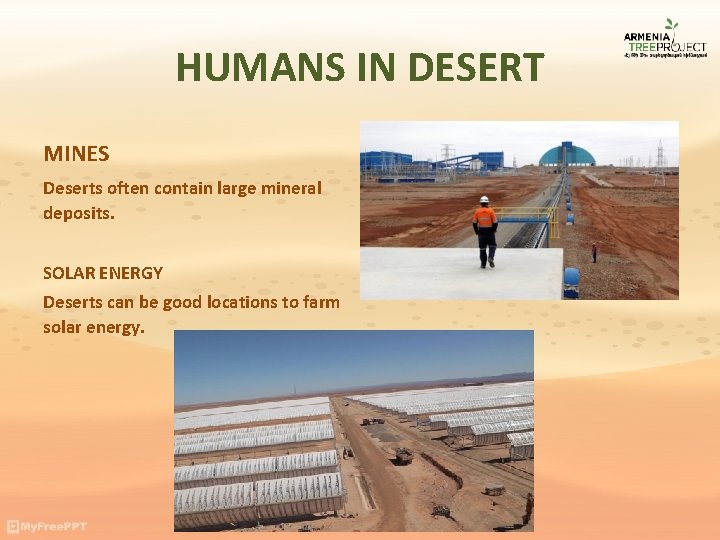
HUMANS IN DESERT MINES Deserts often contain large mineral deposits. SOLAR ENERGY Deserts can be good locations to farm solar energy.
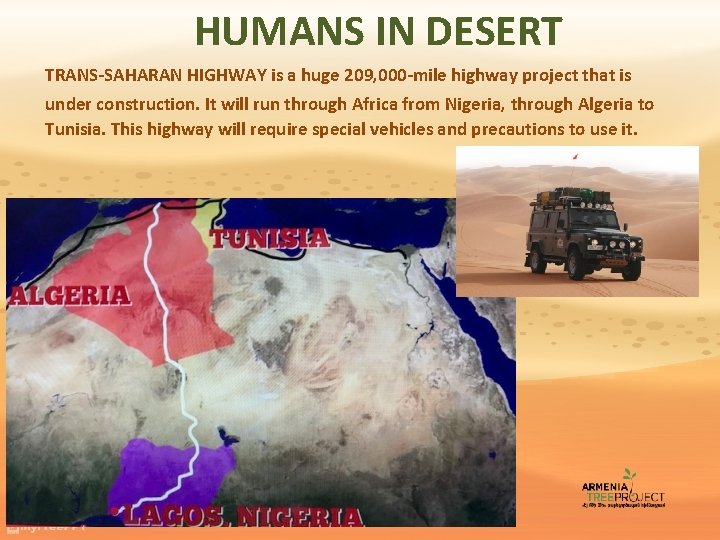
HUMANS IN DESERT TRANS-SAHARAN HIGHWAY is a huge 209, 000 -mile highway project that is under construction. It will run through Africa from Nigeria, through Algeria to Tunisia. This highway will require special vehicles and precautions to use it.
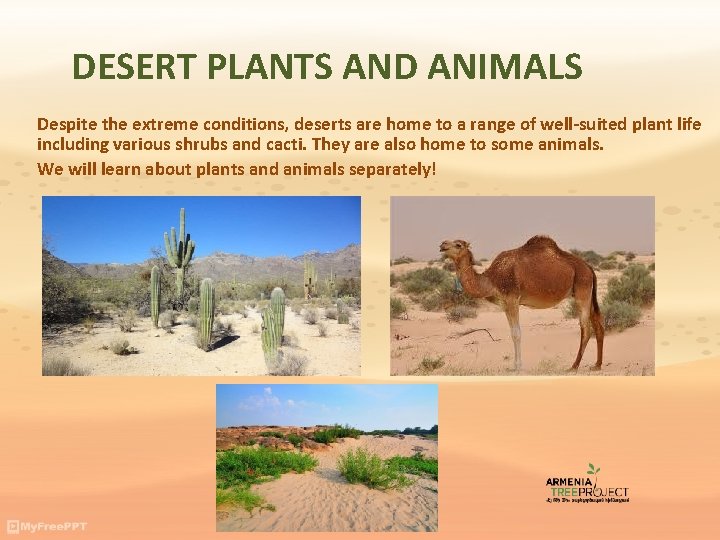
DESERT PLANTS AND ANIMALS Despite the extreme conditions, deserts are home to a range of well-suited plant life including various shrubs and cacti. They are also home to some animals. We will learn about plants and animals separately!
THANK YOU!
- Slides: 21