
LEARNING A relatively permanent change in behavior resulting
LEARNING • A relatively permanent change in behavior resulting from experience • Learning and performance -Performance is an indirect measure of learning but is influenced by other factors such as motivation and fatigue
LEARNING IN ORGANIZATIONS • Formal learning – skill training – orientation – rules and regulations • Informal learning – norms – attitudes – shortcuts in doing your job
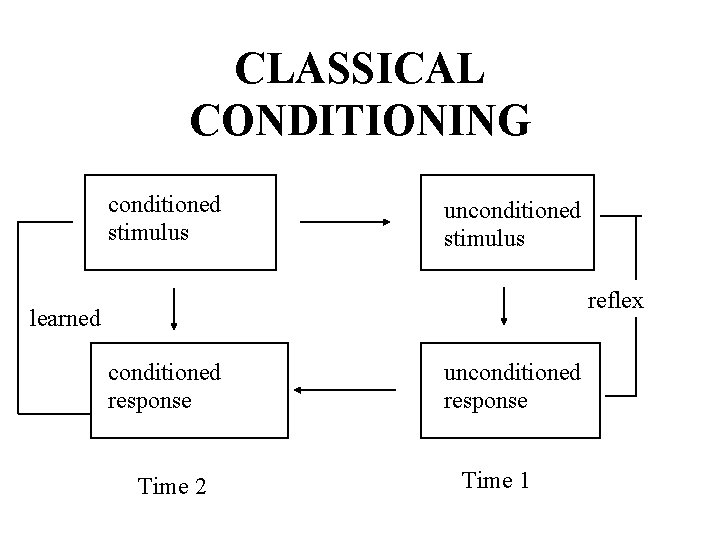
CLASSICAL CONDITIONING conditioned stimulus unconditioned stimulus reflex learned conditioned response Time 2 unconditioned response Time 1
SOME BASICS • Extinction -- eliminating the response • Generalization -- extending the response to similar stimuli • Discrimination -- limiting the response to a specific stimulus • Higher order conditioning -- extending the response to remote conditioned stimuli
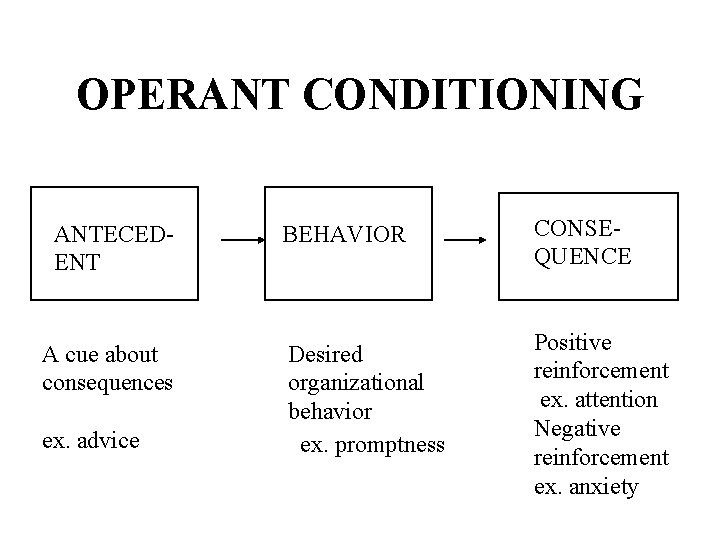
OPERANT CONDITIONING ANTECEDENT A cue about consequences ex. advice BEHAVIOR CONSEQUENCE Desired organizational behavior ex. promptness Positive reinforcement ex. attention Negative reinforcement ex. anxiety
QUALITIES OF REINFORCEMENT • • Immediate Vs. delayed Contrived Vs natural Large Vs small Relative size
REINFORCEMENT SCHEDULES • Interval schedules -- time based – fixed interval: ex. salary – variable interval: ex. spot inspections • Ratio schedules -- performance based – fixed ratio: ex. piece rate – variable ratio: ex. gambling on slot machines
SHAPING • Reinforcement of successive approximations of desired behavior • ex. shaping neatness by rewarding behaviors which gradually move towards keeping a workplace neat
BACKWARDS AND FORWARDS • Summing up: From a look at formal and informal learning to classical conditioning to operant conditioning of desired responses. Focus on qualities of reinforcement • Next time: Continuation of operant conditioning and examination of observational learning
- Slides: 9