
Learning 3 D mesh segmentation and labeling Head
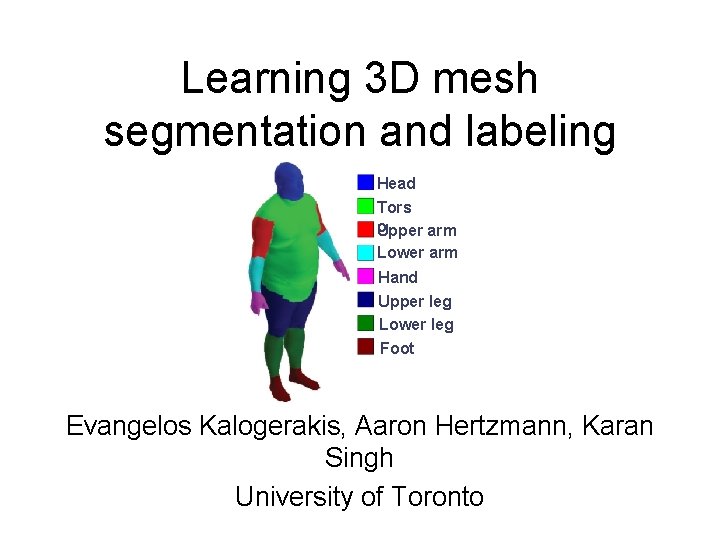
Learning 3 D mesh segmentation and labeling Head Tors o Upper arm Lower arm Hand Upper leg Lower leg Foot Evangelos Kalogerakis, Aaron Hertzmann, Karan Singh University of Toronto
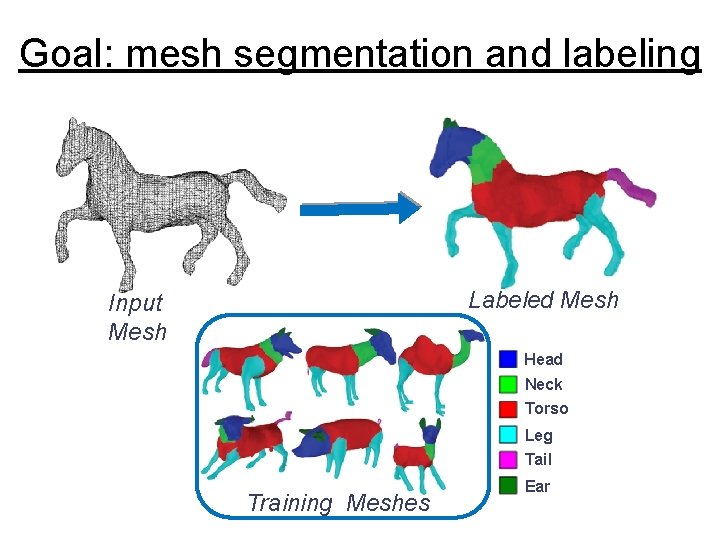
Goal: mesh segmentation and labeling Labeled Mesh Input Mesh Head Neck Torso Leg Tail Training Meshes Ear
Related work: mesh segmentation [Mangan and Whitaker 1999, Shlafman et al. 2002, Katz and Tal 2003, Liu and Zhang 2004, Katz et al. 2005, Simari et al. 2006, Attene et al. 2006, Lin et al. 2007, Kraevoy et al. 2007, Pekelny and Gotsman 2008, Golovinskiy and Funkhouser 2008, Li et al. 2008, Lavoue and Wolf 2008, Huang et al. 2009, Shapira et al. 2010] Surveys: [Attene et al. 2006, Shamir 2008, Chen et al. 2009]
![Related work: mesh segmentation Shape Diameter [Shapira et al. 10] Randomized Cuts [Golovinskiy and](http://slidetodoc.com/presentation_image/08769b3ba4decf3f001146af782912e5/image-4.jpg "Related work: mesh segmentation Shape Diameter [Shapira et al. 10] Randomized Cuts [Golovinskiy and")
Related work: mesh segmentation Shape Diameter [Shapira et al. 10] Randomized Cuts [Golovinskiy and Funkhouser 08] Random Walks [Lai et al. 08] Normalized Cuts [Golovinskiy and Funkhouser 08]
![Is human-level segmentation even possible without higher-level cues? [X. Chen et al. SIGGRAPH 09]](http://slidetodoc.com/presentation_image/08769b3ba4decf3f001146af782912e5/image-5.jpg "Is human-level segmentation even possible without higher-level cues? [X. Chen et al. SIGGRAPH 09]")
Is human-level segmentation even possible without higher-level cues? [X. Chen et al. SIGGRAPH 09]
![Is human-level segmentation even possible without higher-level cues? [X. Chen et al. SIGGRAPH 09]](http://slidetodoc.com/presentation_image/08769b3ba4decf3f001146af782912e5/image-6.jpg "Is human-level segmentation even possible without higher-level cues? [X. Chen et al. SIGGRAPH 09]")
Is human-level segmentation even possible without higher-level cues? [X. Chen et al. SIGGRAPH 09]
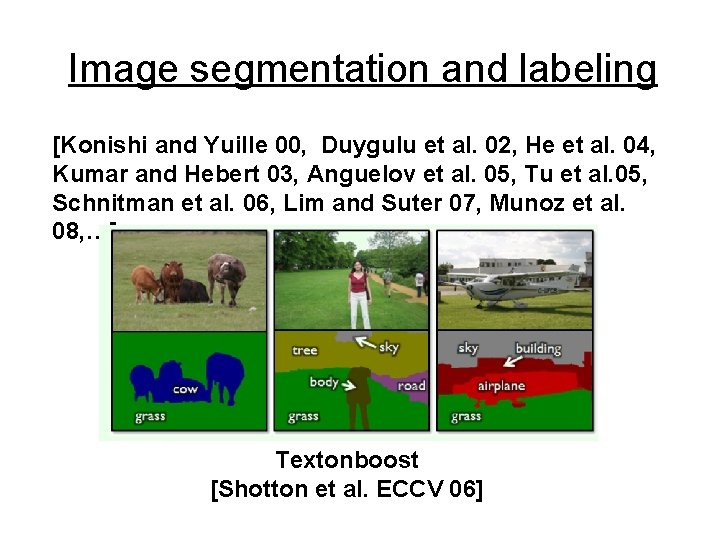
Image segmentation and labeling [Konishi and Yuille 00, Duygulu et al. 02, He et al. 04, Kumar and Hebert 03, Anguelov et al. 05, Tu et al. 05, Schnitman et al. 06, Lim and Suter 07, Munoz et al. 08, …] Textonboost [Shotton et al. ECCV 06]
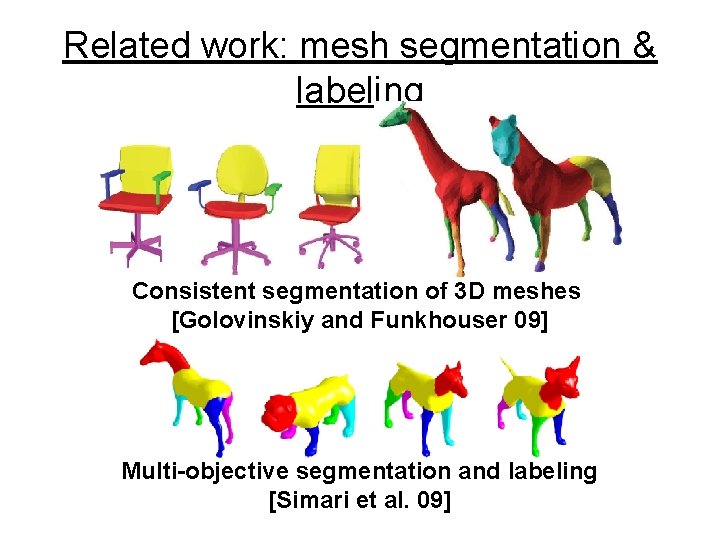
Related work: mesh segmentation & labeling Consistent segmentation of 3 D meshes [Golovinskiy and Funkhouser 09] Multi-objective segmentation and labeling [Simari et al. 09]
Learning mesh segmentation and labeling Learn from examples Significantly better results than state-of-the-art No manual parameter tuning Can learn different styles of segmentation Several applications of part labeling
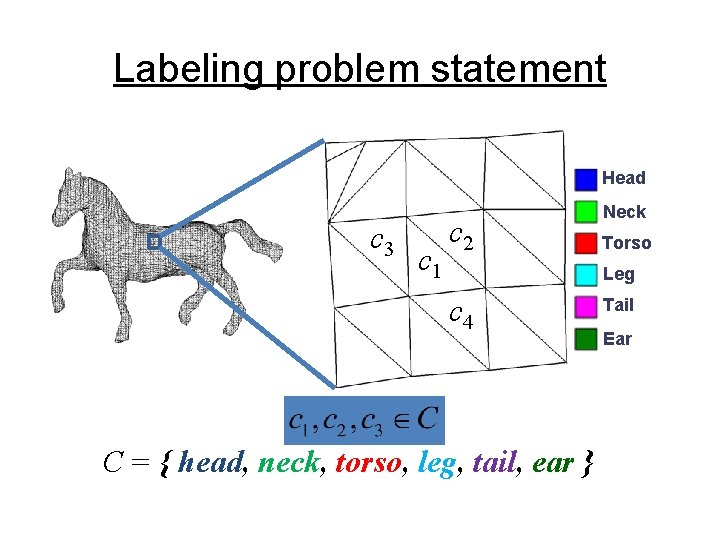
Labeling problem statement Head c 3 c 1 c 2 Neck Torso Leg c 4 C = { head, neck, torso, leg, tail, ear } Tail Ear
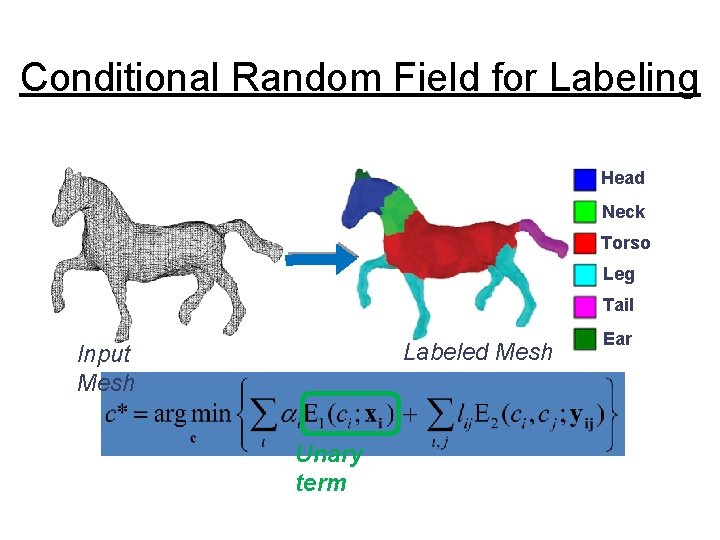
Conditional Random Field for Labeling Head Neck Torso Leg Tail Labeled Mesh Input Mesh Unary term Ear
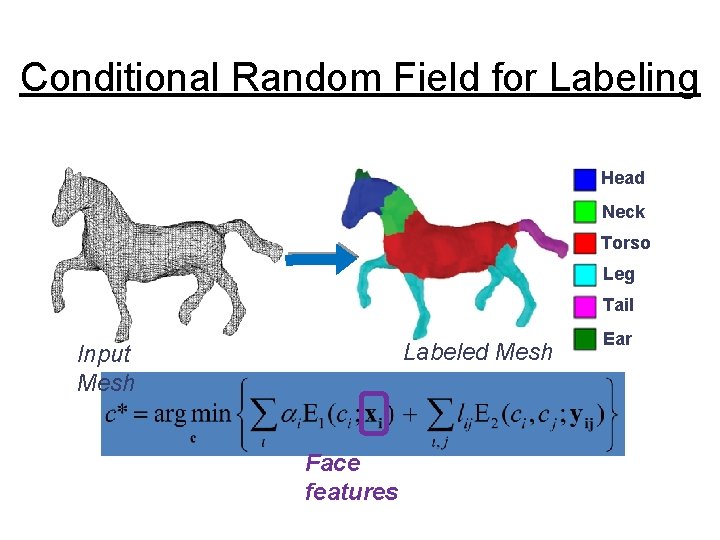
Conditional Random Field for Labeling Head Neck Torso Leg Tail Labeled Mesh Input Mesh Face features Ear
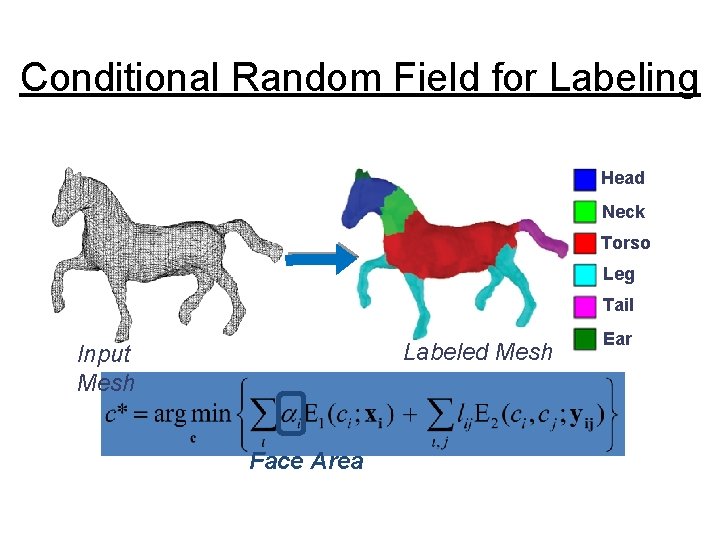
Conditional Random Field for Labeling Head Neck Torso Leg Tail Labeled Mesh Input Mesh Face Area Ear
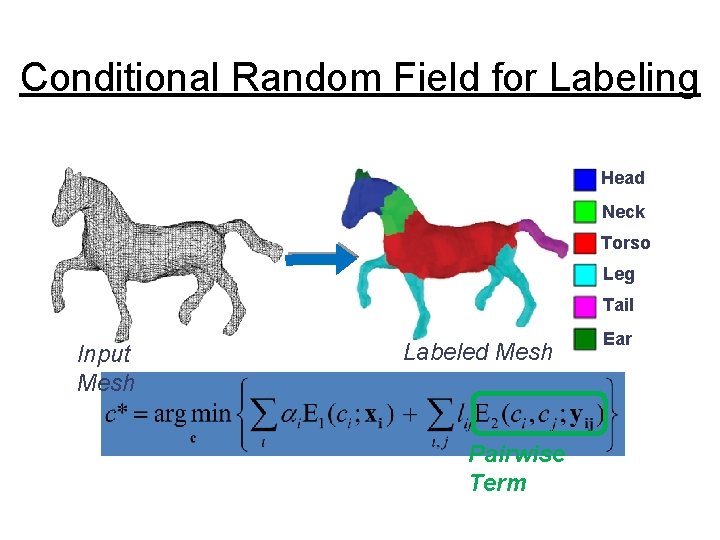
Conditional Random Field for Labeling Head Neck Torso Leg Tail Input Mesh Labeled Mesh Pairwise Term Ear
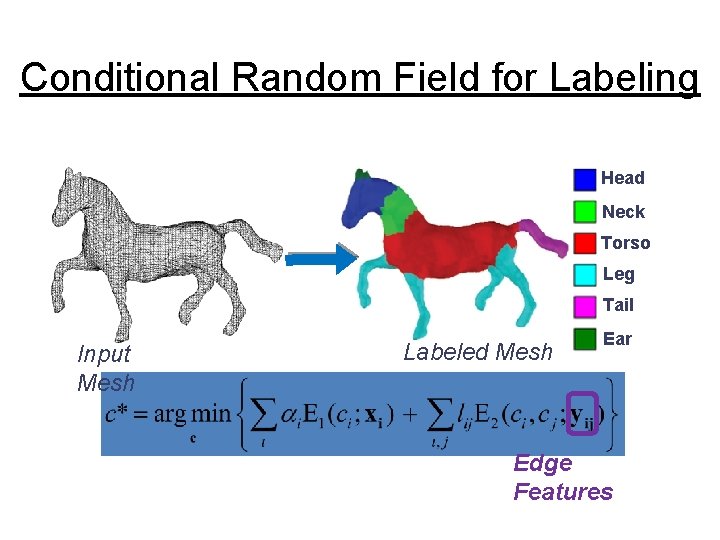
Conditional Random Field for Labeling Head Neck Torso Leg Tail Input Mesh Labeled Mesh Ear Edge Features
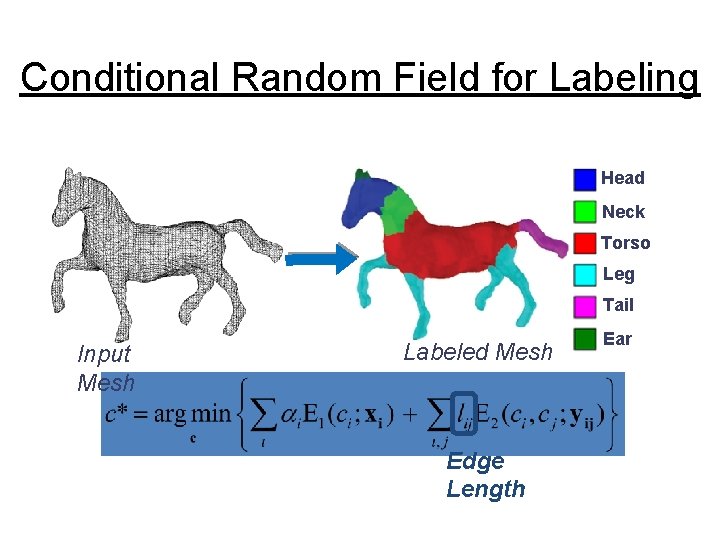
Conditional Random Field for Labeling Head Neck Torso Leg Tail Input Mesh Labeled Mesh Edge Length Ear
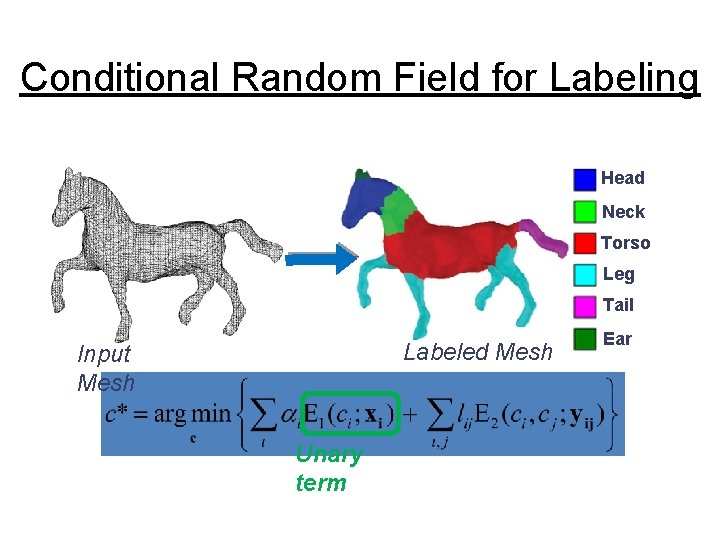
Conditional Random Field for Labeling Head Neck Torso Leg Tail Labeled Mesh Input Mesh Unary term Ear
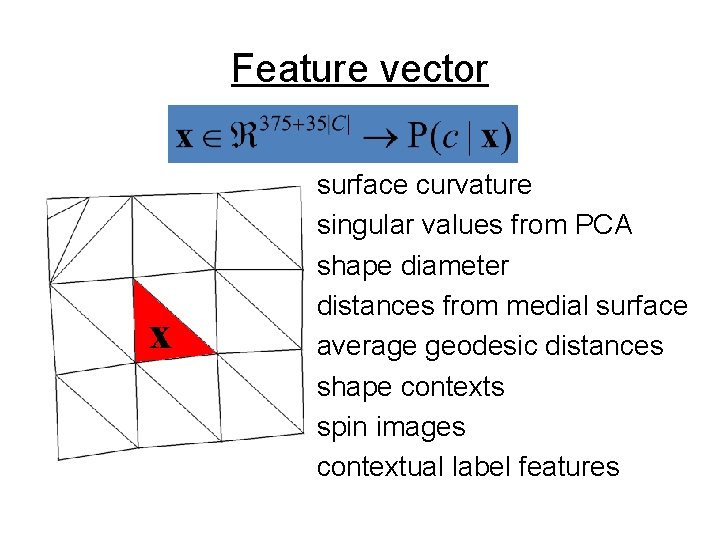
Feature vector x surface curvature singular values from PCA shape diameter distances from medial surface average geodesic distances shape contexts spin images contextual label features
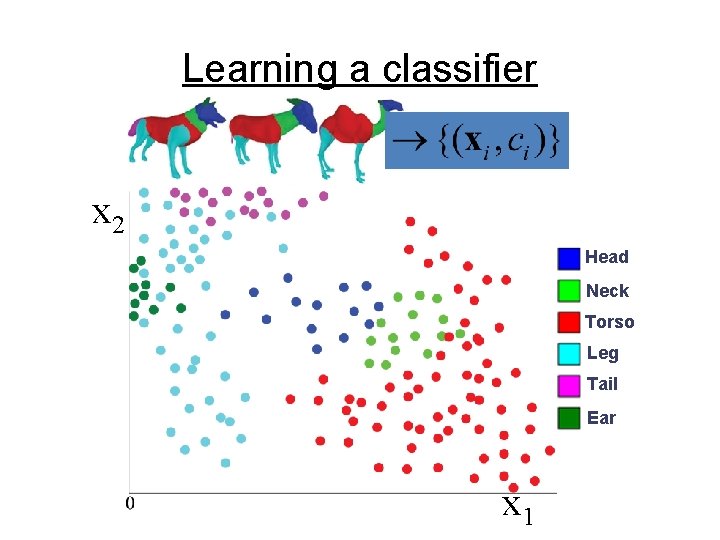
Learning a classifier x 2 Head Neck Torso Leg Tail Ear x 1
![Learning a classifier We use the Jointboost classifier [Torralba et al. 2007] x 2](http://slidetodoc.com/presentation_image/08769b3ba4decf3f001146af782912e5/image-20.jpg "Learning a classifier We use the Jointboost classifier [Torralba et al. 2007] x 2")
Learning a classifier We use the Jointboost classifier [Torralba et al. 2007] x 2 Head ? Neck Torso Leg Tail Ear x 1
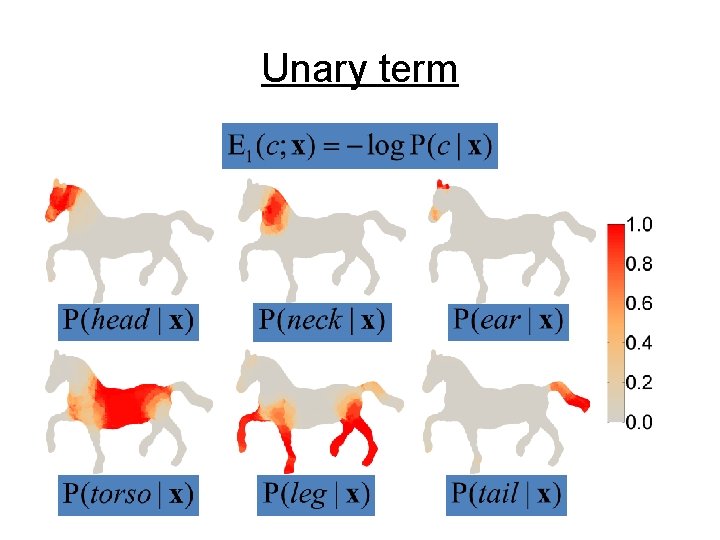
Unary term
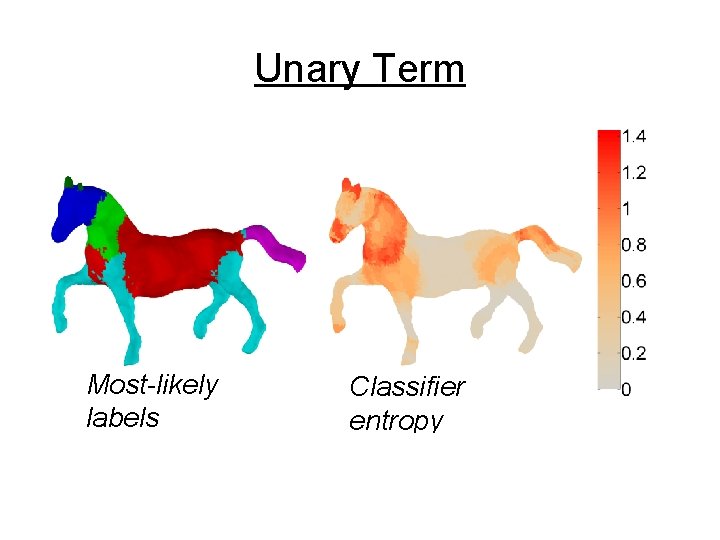
Unary Term Most-likely labels Classifier entropy
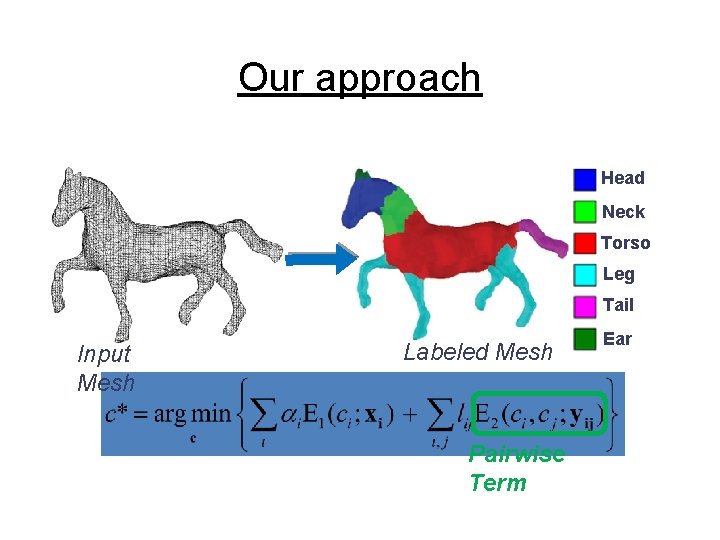
Our approach Head Neck Torso Leg Tail Input Mesh Labeled Mesh Pairwise Term Ear
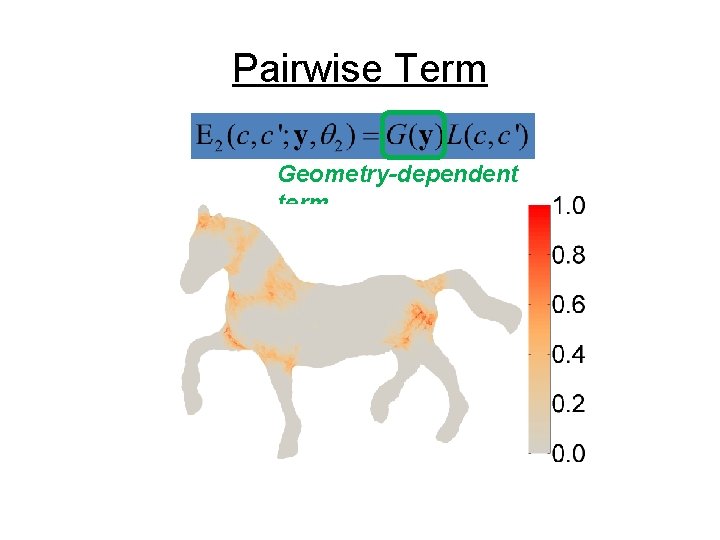
Pairwise Term Geometry-dependent term
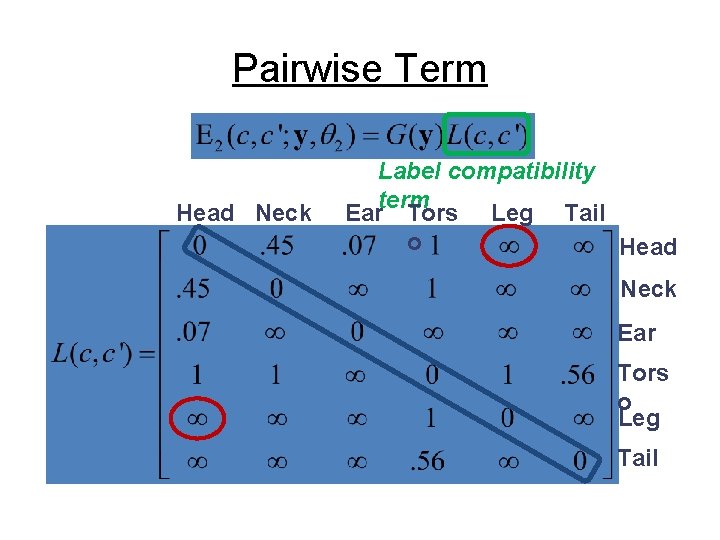
Pairwise Term Head Neck Label compatibility term Ear Tors Leg Tail o Head Neck Ear Tors o Leg Tail
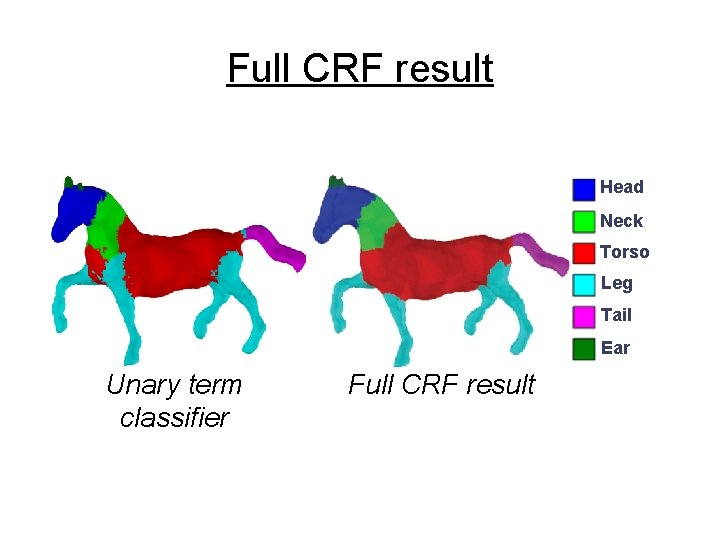
Full CRF result Head Neck Torso Leg Tail Ear Unary term classifier Full CRF result
![Learning Learn unary classifier and G(y) with Joint Boosting [Torralba et al. 2007] Hold-out](http://slidetodoc.com/presentation_image/08769b3ba4decf3f001146af782912e5/image-27.jpg "Learning Learn unary classifier and G(y) with Joint Boosting [Torralba et al. 2007] Hold-out")
Learning Learn unary classifier and G(y) with Joint Boosting [Torralba et al. 2007] Hold-out validation for the rest of parameters
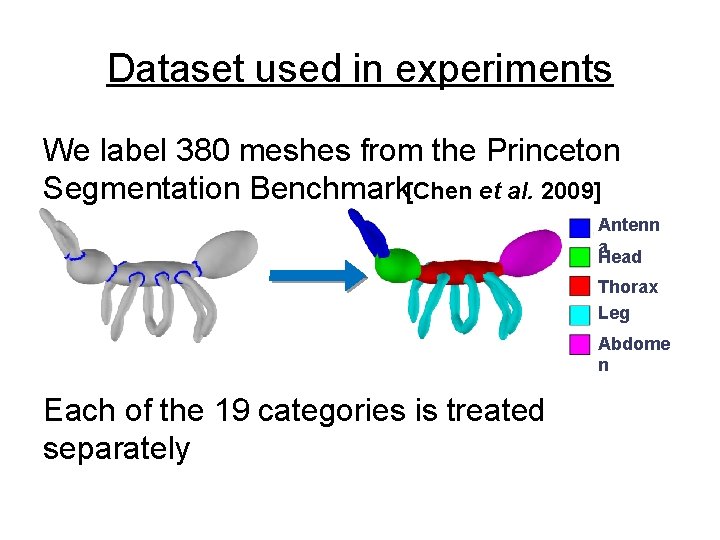
Dataset used in experiments We label 380 meshes from the Princeton Segmentation Benchmark[Chen et al. 2009] Antenn a Head Thorax Leg Abdome n Each of the 19 categories is treated separately
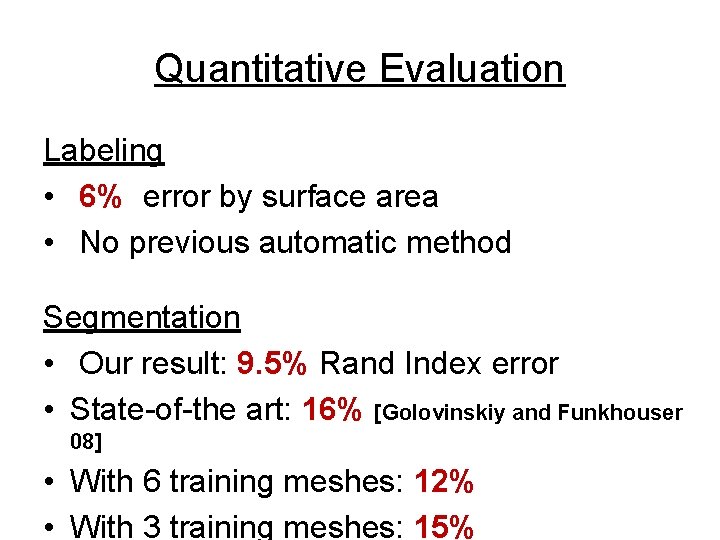
Quantitative Evaluation Labeling • 6% error by surface area • No previous automatic method Segmentation • Our result: 9. 5% Rand Index error • State-of-the art: 16% [Golovinskiy and Funkhouser 08] • With 6 training meshes: 12% • With 3 training meshes: 15%
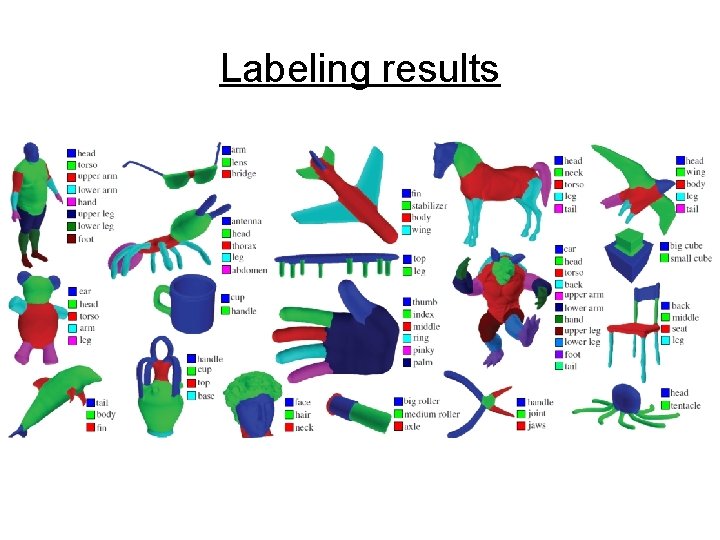
Labeling results
![Segmentation Comparisons Shape Diameter [Shapira et al. 10] Randomized Cuts [Golovinskiy and Funkhouser 08]](http://slidetodoc.com/presentation_image/08769b3ba4decf3f001146af782912e5/image-31.jpg "Segmentation Comparisons Shape Diameter [Shapira et al. 10] Randomized Cuts [Golovinskiy and Funkhouser 08]")
Segmentation Comparisons Shape Diameter [Shapira et al. 10] Randomized Cuts [Golovinskiy and Funkhouser 08] Our approach
![Segmentation Comparisons Shape Diameter [Shapira et al. 10] Randomized Cuts [Golovinskiy and Funkhouser 08]](http://slidetodoc.com/presentation_image/08769b3ba4decf3f001146af782912e5/image-32.jpg "Segmentation Comparisons Shape Diameter [Shapira et al. 10] Randomized Cuts [Golovinskiy and Funkhouser 08]")
Segmentation Comparisons Shape Diameter [Shapira et al. 10] Randomized Cuts [Golovinskiy and Funkhouser 08] Our approach
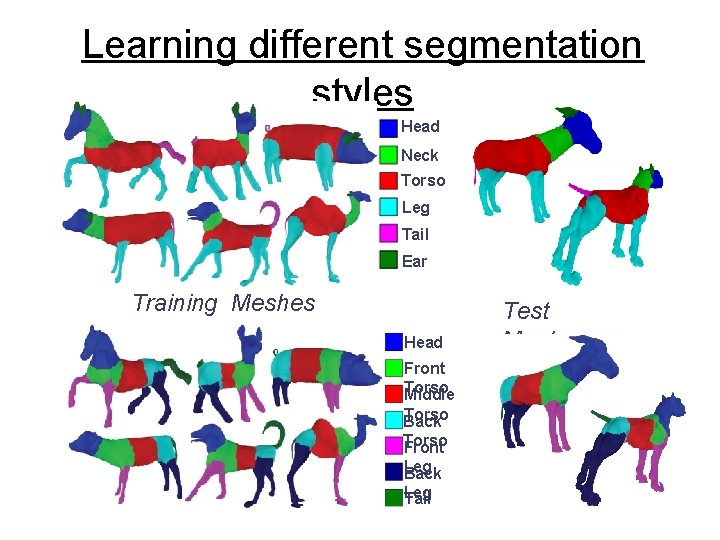
Learning different segmentation styles Head Neck Torso Leg Tail Ear Training Meshes Head Front Torso Middle Torso Back Torso Front Leg Back Leg Tail Test Meshes
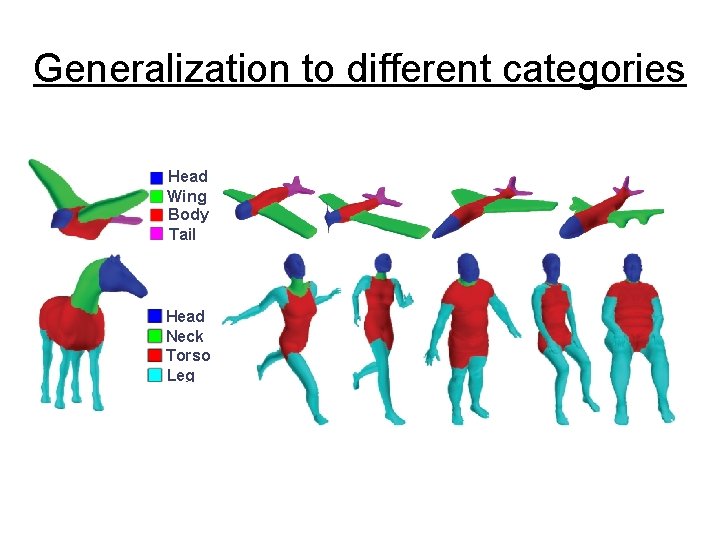
Generalization to different categories Head Wing Body Tail Head Neck Torso Leg
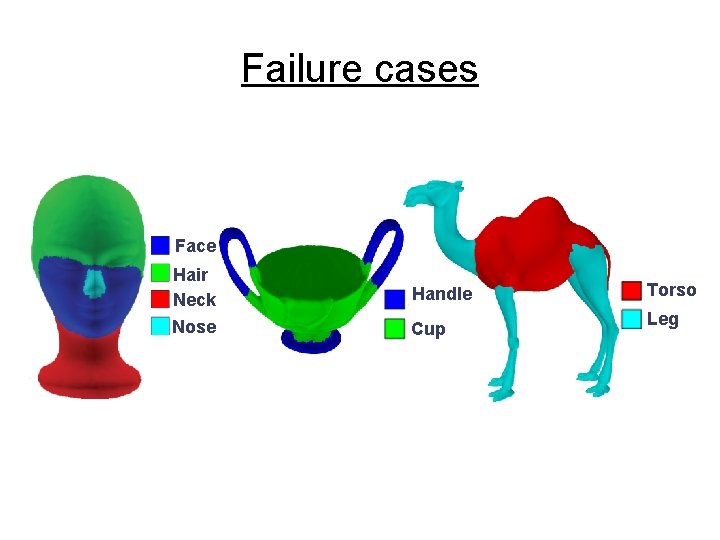
Failure cases Face Hair Neck Handle Nose Cup Torso Leg
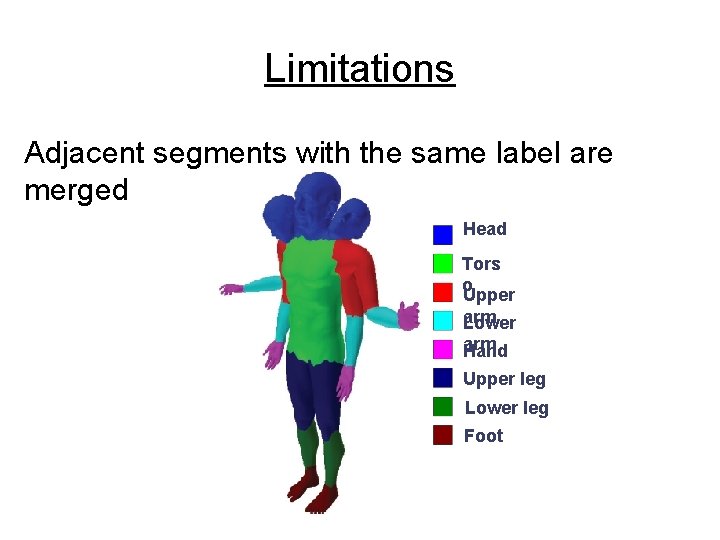
Limitations Adjacent segments with the same label are merged Head Tors o Upper arm Lower arm Hand Upper leg Lower leg Foot
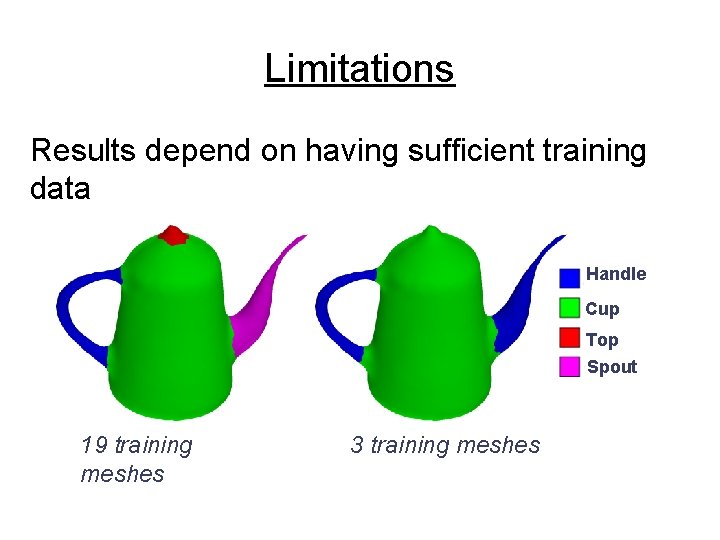
Limitations Results depend on having sufficient training data Handle Cup Top Spout 19 training meshes 3 training meshes
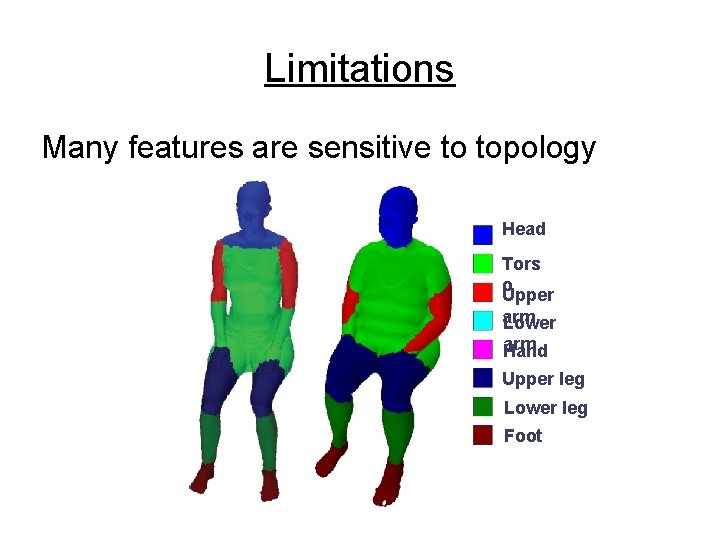
Limitations Many features are sensitive to topology Head Tors o Upper arm Lower arm Hand Upper leg Lower leg Foot
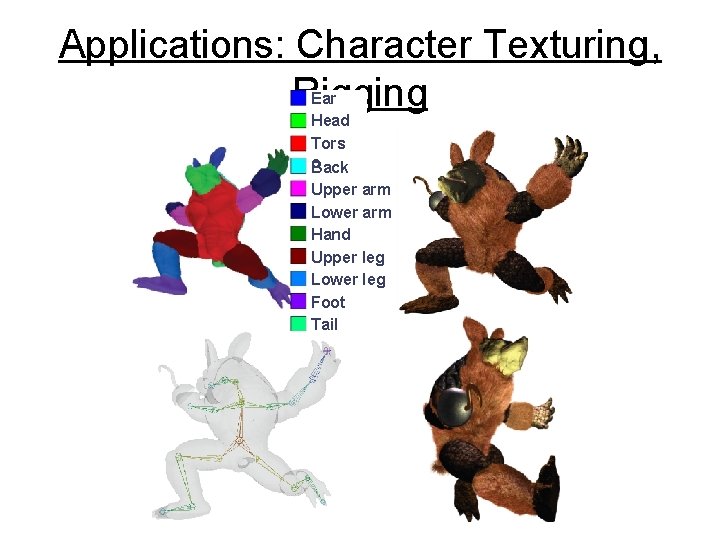
Applications: Character Texturing, Rigging Ear Head Tors o Back Upper arm Lower arm Hand Upper leg Lower leg Foot Tail
Summary • Use prior knowledge for 3 D mesh segmentation and labeling • Based on a Conditional Random Field model • Parameters are learned from examples • Applicable to a broad range of meshes • Significant improvements over the state-of-theart
Thank you! Acknowledgements: Xiaobai Chen, Aleksey Golovinskiy, Thomas Funkhouser, Szymon Rusinkiewicz , Olga Veksler, Daniela Giorgi, AIM@SHAPE, David Fleet, Olga Vesselova, John Hancock Our project web page: http: //www. dgp. toronto. edu/~kalo/papers/Label. Meshes/
- Slides: 41