
Learners with Emotional or Behavioral Disorders Chapter 8
Learners with Emotional or Behavioral Disorders Chapter 8
Topics n n n n n Terminology Definition Classification Prevalence Causes Identification Psychological and Behavioral Characteristics Educational Considerations Early Intervention Transition to Adulthood
Terminology n n n Emotionally Disturbed — used in current federal laws and regulations; “ED” Behaviorally Disordered — used by many professionals and Council for Exceptional Children (CEC); “BD” Emotional or Behavior Disordered — introduced in 1990 by National Mental Health and Special Educational Coalition; gaining in use and acceptance
Definitional problems: n Lack of precise definitions of mental health and normal behavior n n Differences among conceptual models Difficulties in measuring emotion and behavior Relationships between emotional or behavioral disorder and other disabilities Differences in the professionals who diagnose and serve children and youths
Definition Current definitions: n Behavior is extreme n Behavior unacceptable because of social or cultural expectations n Problem is chronic Federal definition: n Excludes social maladjustment which some states interpret as conduct disorder National Mental Health and Special Education definition: n Acknowledges multiple disabilities n Does not have arbitrary exclusions
Classification n n No universally accepted classification system Individualized assessment Two broad dimensions of behavior n Externalizing n Internalizing n Co-morbidity is common Schizophrenia is distinguished from autism or autistic spectrum disorder
Prevalence & Causes Prevalence: n Estimates of 6 to 10 percent of school-age population; boys 5: 1 n About 1 percent identified and receiving special education services; most exhibit externalizing behavior n n n Causes: Biological disorders and diseases n Medical treatment is seldom sufficient Pathological family relationships n Importance of positive approaches to behavior management Undesirable experiences at school n Spiral of negative interactions Negative cultural influences (i. e. increase in poverty)
Identification n n Often easily identified. Difficult to identify if n Child is young; difficult to determine severity of problem. n There is an error in teacher judgment. n The child does not exhibit problems at schools. n Importance of teacher’s informal judgments n Systematic screening procedures needed
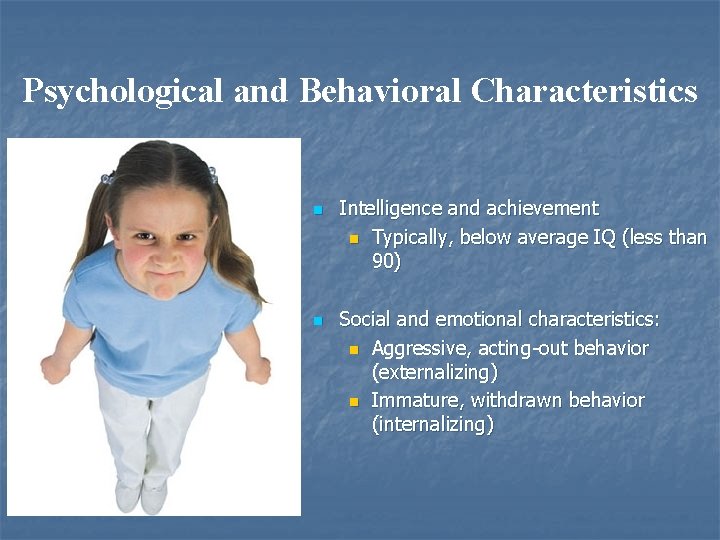
Psychological and Behavioral Characteristics n n Intelligence and achievement n Typically, below average IQ (less than 90) Social and emotional characteristics: n Aggressive, acting-out behavior (externalizing) n Immature, withdrawn behavior (internalizing)
Educational Considerations n n n Two objectives: n Controlling misbehavior n Teaching academic and social skills Balancing behavioral control with academic and social learning Importance of integrated services Service delivery n Trend toward inclusion n Different needs, different placements Instructional considerations n Need for social skills n Needs of juvenile delinquents n Special challenges for teachers Special disciplinary considerations n Functional behavioral assessment and positive behavioral supports
Strategies That Work n Systematic, data-based interventions n Continuous assessment and progress monitoring n Provision for practice of new skills n Treatment matched to the problem; multicomponent treatment n Programming for transfer and maintenance n Commitment to sustained intervention
Early Intervention: n n n Identification is complicated Tasks are simpler, so range of behaviors used for comparisons is restricted; development is rapid and uneven Wide variation in child-rearing practices Hard to distinguish between EBD and other conditions in preschool Prevention problems; programs are costly Need people trained in behavior management
Transition to Adulthood: n Programs range from regular public high school classes to private residential schools n High drop-out rate n Incarcerated youth neglected n Employment difficulty due to social skills n May require intervention throughout life
- Slides: 13