
LearnerCentered Instruction Tier II Professional Development Quality Teaching
- Slides: 33
Learner-Centered Instruction Tier II - Professional Development Quality Teaching & Learning
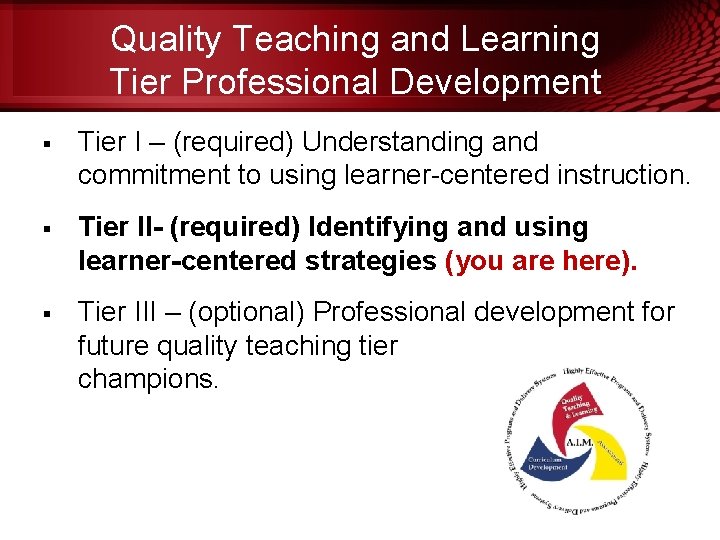
Quality Teaching and Learning Tier Professional Development § Tier I – (required) Understanding and commitment to using learner-centered instruction. § Tier II- (required) Identifying and using learner-centered strategies (you are here). § Tier III – (optional) Professional development for future quality teaching tier champions.
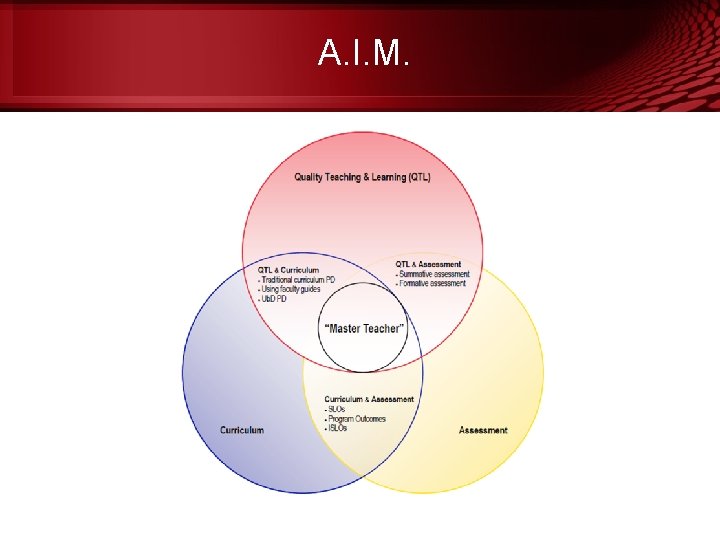
A. I. M.
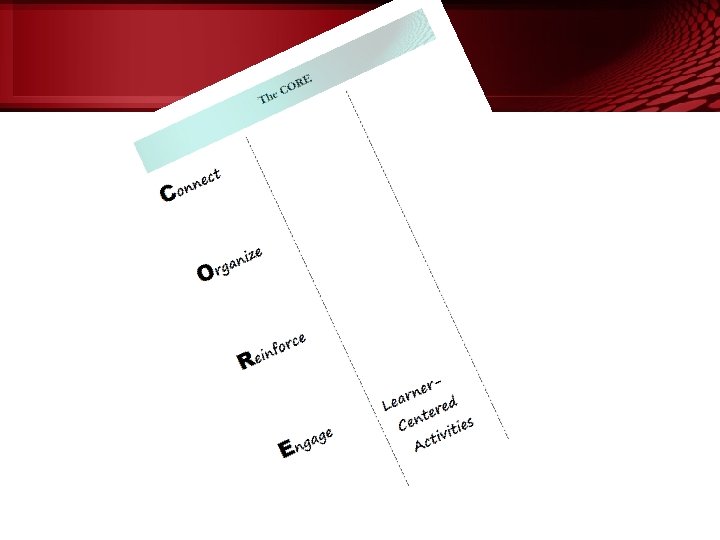
Review From Tier I • Teaching Philosophy • Teacher vs. Learner-centered • TC-LC Continuum • How students learn • C. O. R. E
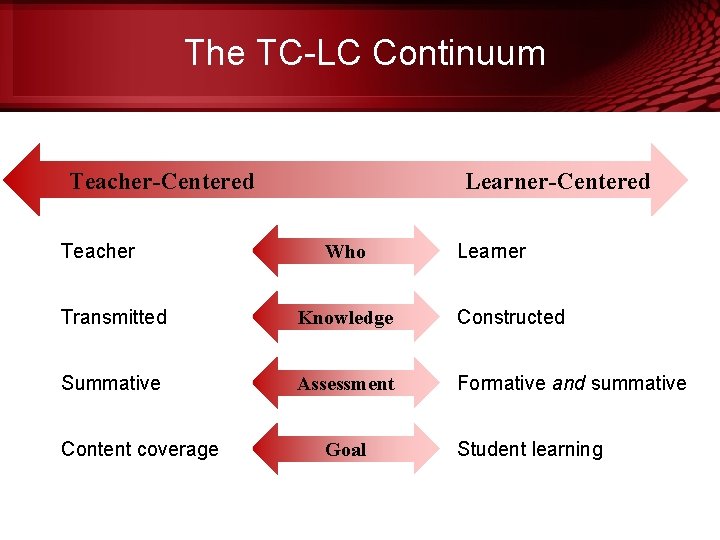
The TC-LC Continuum Teacher-Centered Teacher Learner-Centered Who Learner Transmitted Knowledge Constructed Summative Assessment Formative and summative Content coverage Goal Student learning
“The best teachers are measured by the success of their students. ”
QTL Tier II Objective • Implement appropriate learner-centered instructional strategies based on student learning outcomes (SLOs) and student needs (readiness, scope & sequence of course). • In other words, this tier is about exploring the process of how we make purposeful decisions in the classroom that will foster an engaging and rigorous learning environment.
Learning Logs • Learning Logs can be used for a variety of purposes, primarily for learning documentation, reflection, questions, etc. • Throughout this session you will be asked to use this Learning Log.
Guiding Questions In your Learning Log, respond to the following questions: • How do we know our students readiness for learning? • What role does the scope and sequence have in providing an engaging and rigorous learning experience? • How do I best plan for student learning? *Be prepared to share
Quiz- True/False 1. I always get 100% participation from all of my students in a class session. 2. I am confident that 100% of my students are engaged and challenged from the content and my instruction. 3. I am confident in how I determine my students readiness for learning. 4. I know what strategies facilitate optimal learning and growth and which do not. 5. I always engage my students in meta-cognition.
Guiding Questions • How do we know our students readiness for learning? • What role does the scope and sequence have in providing an engaging and rigorous learning experience? • How do I best plan for student learning?
Participation • What are ways in which you solicit participation from your students? • Ask participants to share their strategy(ies) with a neighbor and then record these on a big chart paper or a white board.
“I’ve learned that people will forget what you said, people will forget what you did, but people will never forget how you made them feel. ” -Maya Angelou
Making Informed Instructional Decisions • Why do we do what we do? • What is the process that we go through in order to make decisions about our instruction? • Respond to these questions in your Learning Log
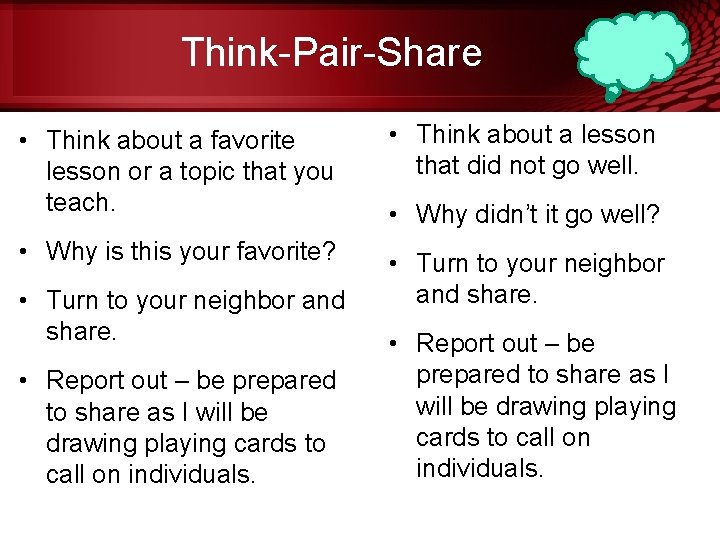
Think-Pair-Share • Think about a favorite lesson or a topic that you teach. • Think about a lesson that did not go well. • Why is this your favorite? • Turn to your neighbor and share. • Report out – be prepared to share as I will be drawing playing cards to call on individuals. • Why didn’t it go well? • Report out – be prepared to share as I will be drawing playing cards to call on individuals.
Evidence for Modifications • How do you know that your lesson has gone well? – What is your evidence? • How do you know that your lesson has not gone well? – What is your evidence?
Meta-cognition • What is meta-cognition? • Who is it for? • Why is it important? • What does this have to do with making instructional decisions in the classroom?
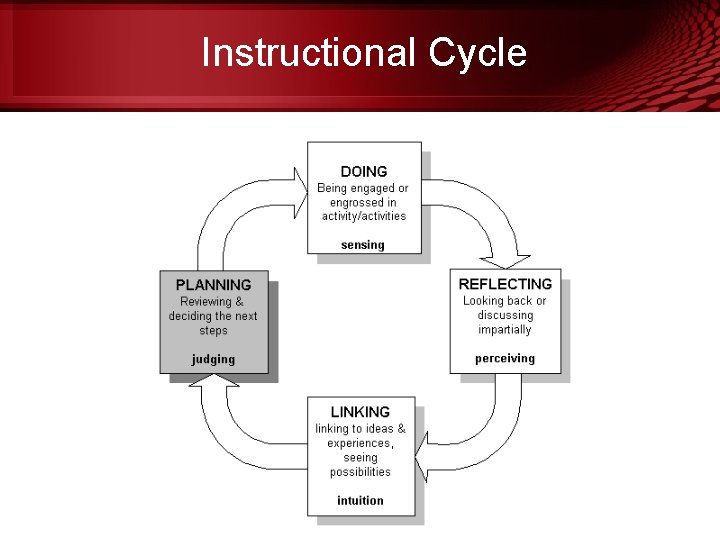
Instructional Cycle
Taking Stock • Take a few minutes to record in your learning log the key learning points that have resonated with you thus far. • Be prepared to share at least one of these points and detail why this learning point seems valuable to you.
“Treat people as if they were what they ought to be and you will help them to become what they are capable of being. ” -Johann W. Von Goethe
Student Readiness To Learn What does student readiness mean? – Cognitive – Affective
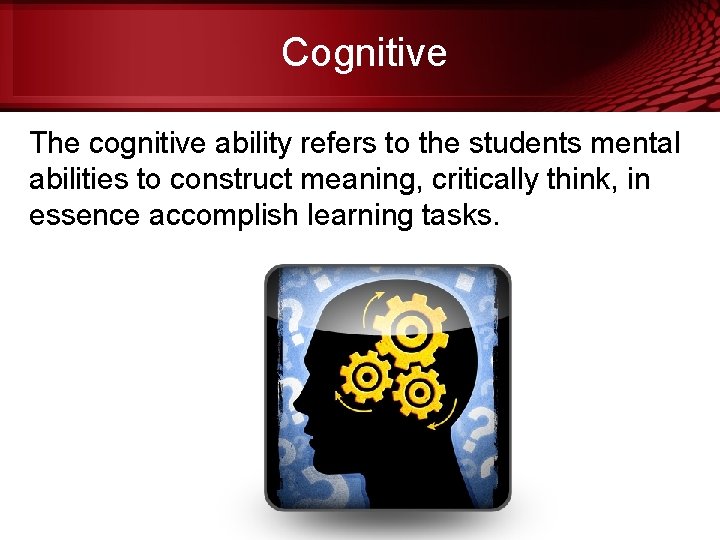
Cognitive The cognitive ability refers to the students mental abilities to construct meaning, critically think, in essence accomplish learning tasks.
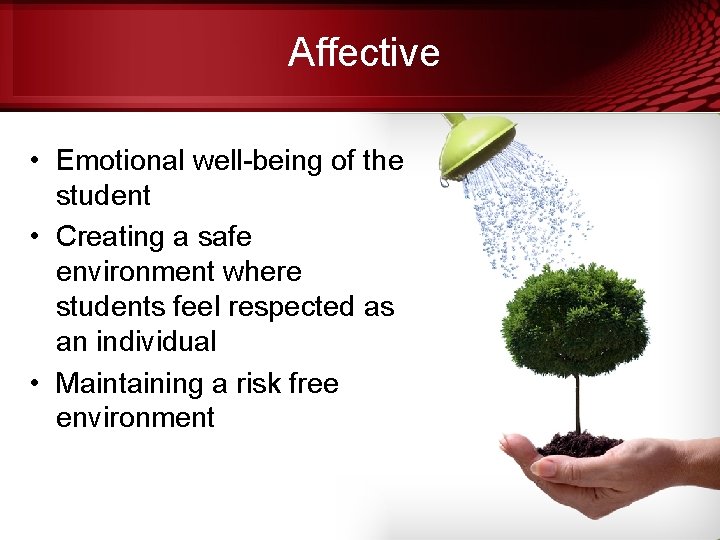
Affective • Emotional well-being of the student • Creating a safe environment where students feel respected as an individual • Maintaining a risk free environment
What is Scope and Sequence? 1. The scope of a course is the base and boundaries of knowledge that will be explored in the course which is defined in part by the SLOs (student learning outcomes). 2. The sequence of a course is the chronological order in which it falls within the context of the program or other related courses i. e. Comp II is taken after Cmp I. 3. Understanding the base knowledge that should be mastered coming into your course and understanding where students need to be in terms of knowledge and skill to be prepared for the course that follows the course you are teaching allows you to gauge an appropriate starting place and also guides you in preparing your students to be successful in your course and in the subsequent course that they will take.
How does scope and sequence impact your instruction? 1. What are the benefits of knowing the scope and sequence of your course(s)? 2. Where do you learn more about the scope and sequence of your course(s)?
“If you dare to teach, then you must dare to learn. ” -Unknown
Learner-Centered Practice 1. Go back in your learning logs and locate your favorite lesson or concept that you recorded. 2. Based on this lesson: – What is the instructional strategy that you used? – When is the strategy best used? – Why is it used? – How are your students engaged? – How are your students accountable for their learning?
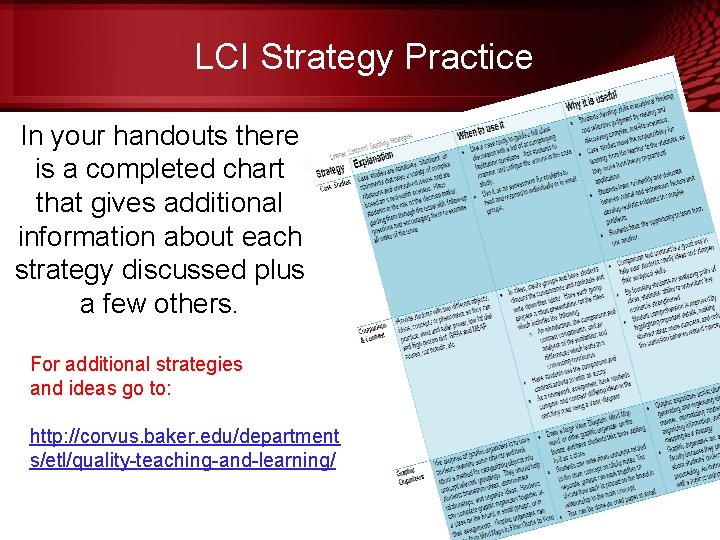
LCI Strategy Practice In your handouts there is a completed chart that gives additional information about each strategy discussed plus a few others. For additional strategies and ideas go to: http: //corvus. baker. edu/department s/etl/quality-teaching-and-learning/
Apply What You Have Learned 1. Record a topic/concept that you teach. Write down several descriptors that would help someone else understand your topic or concept. 2. Throw your topic/concept in a bowl. Mix it up 3. Draw one topic/concept. 4. Partner by playing cards. 5. You and your partner should select one of your topics that you drew. 6. Refer to the LC Teaching Strategies matrix located under the supporting documents tab, choose the best strategy to teach your selected topic. 7. Be prepared to teach it when directed.
Planning Ahead Thinking about your teaching philosophy and your role in curriculum, assessment, and creating an optimal learning environment, create a plan as to how you will implement the ideas and strategies learned in Quality Teaching and Learning Tiers I and II into your own classroom. Give a least one specific example of how you might do this.
References • http: //www. interconnections. co. uk/Market/PCFG/learning. htm