
Learner Objectives Informal Language Basic Interpersonal Communication Skills
Learner Objectives � Informal Language (Basic Interpersonal Communication Skills) vs. Formal Language (Standard English in Academic Setting) � Review SEL’s and EL’s similarities and differences � Instructional Strategies � Monitoring, Evaluation and Accountability

Definition � Informal Language- Language that is spoken with friends and a setting that is not formal such as home. � Formal Language- Language that is spoken in an academic and professional setting such as school, work, or any other establishment.
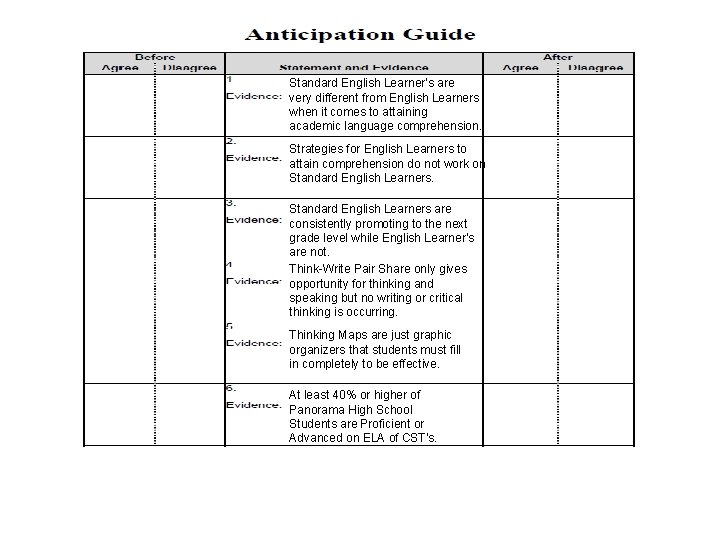
Standard English Learner’s are very different from English Learners when it comes to attaining academic language comprehension. Strategies for English Learners to attain comprehension do not work on Standard English Learners are consistently promoting to the next grade level while English Learner’s are not. Think-Write Pair Share only gives opportunity for thinking and speaking but no writing or critical thinking is occurring. Thinking Maps are just graphic organizers that students must fill in completely to be effective. At least 40% or higher of Panorama High School Students are Proficient or Advanced on ELA of CST’s.
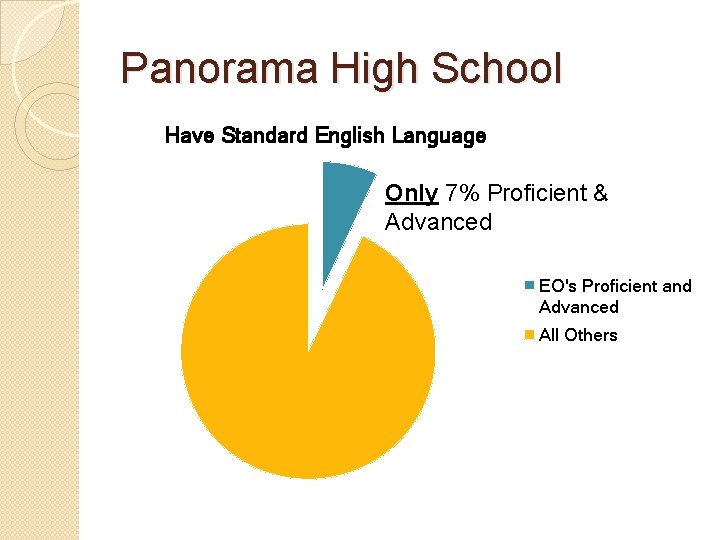
Panorama High School Have Standard English Language Only 7% Proficient & Advanced EO's Proficient and Advanced All Others
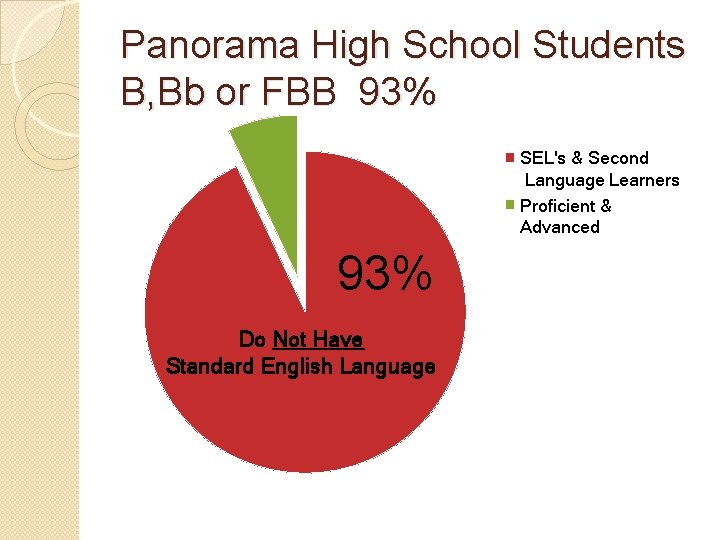
Panorama High School Students B, Bb or FBB 93% SEL's & Second Language Learners Proficient & Advanced 93% Do Not Have Standard English Language
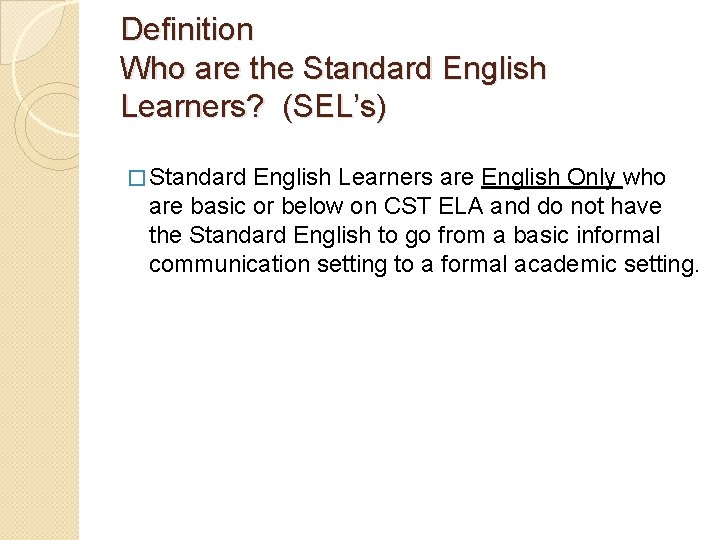
Definition Who are the Standard English Learners? (SEL’s) � Standard English Learners are English Only who are basic or below on CST ELA and do not have the Standard English to go from a basic informal communication setting to a formal academic setting.
Purpose of identifying SEL’s � To know their needs- ◦ To provide appropriate instructional strategies ◦ To provide opportunities for language development.
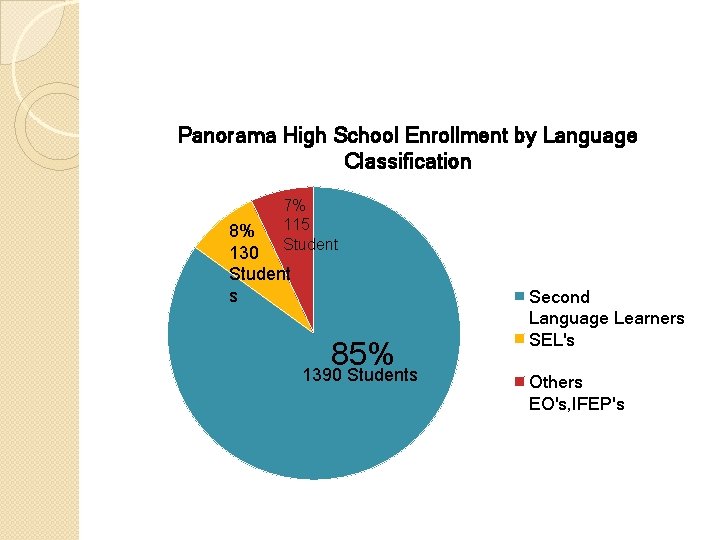
Panorama High School Enrollment by Language Classification 7% 115 Student 8% 130 Student s 85% 1390 Students Second Language Learners SEL's Others EO's, IFEP's
Activity-Think Pair Share 5 min. �Individually analyze the following data. 5 min. �share to your neighbor trends that you see. 5 min. � One person from each group share what they see for one particular grade beginning with the 9 th grade.
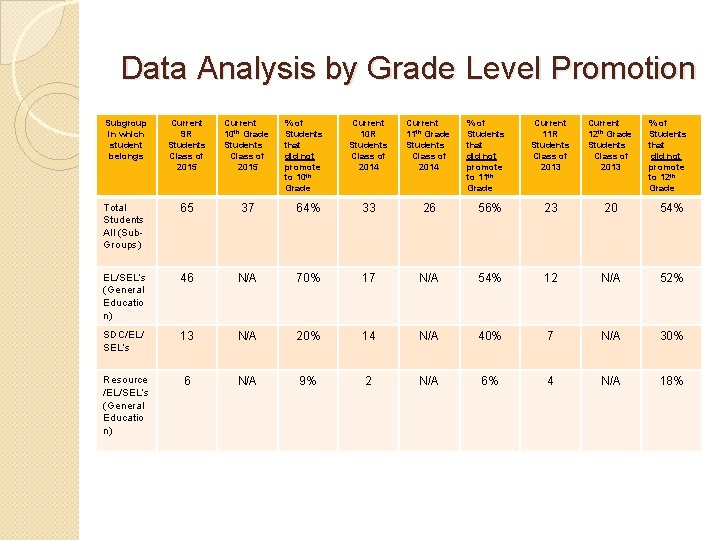
Data Analysis by Grade Level Promotion Subgroup in which student belongs Current 9 R Students Class of 2015 Current 10 th Grade Students Class of 2015 Total Students All (Sub. Groups) 65 37 EL/SEL’s (General Educatio n) 46 SDC/EL/ SEL’s Resource /EL/SEL’s (General Educatio n) % of Students that did not promote to 10 th Grade Current 10 R Students Class of 2014 Current 11 th Grade Students Class of 2014 64% 33 26 N/A 70% 17 13 N/A 20% 6 N/A 9% % of Students that did not promote to 11 th Grade Current 11 R Students Class of 2013 Current 12 th Grade Students Class of 2013 % of Students that did not promote to 12 th Grade 56% 23 20 54% N/A 54% 12 N/A 52% 14 N/A 40% 7 N/A 30% 2 N/A 6% 4 N/A 18%
Share out �Please share out any trends you may have noticed or ask your partner any questions you may have?
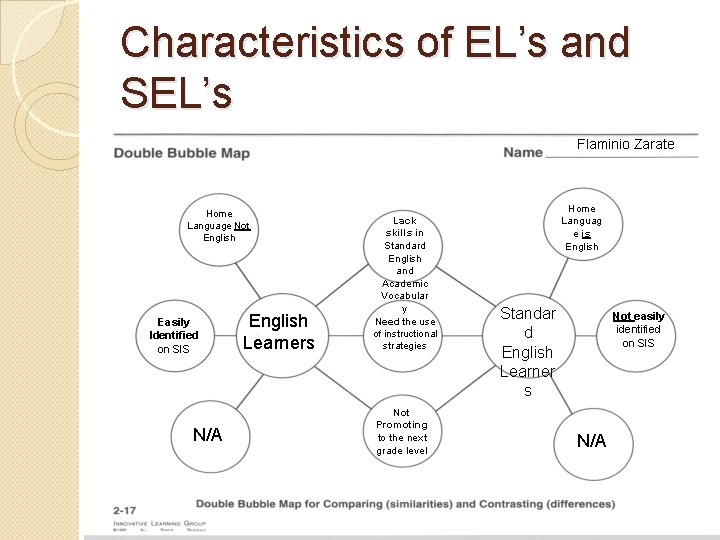
Characteristics of EL’s and SEL’s Flaminio Zarate Home Language Not English Easily Identified on SIS N/A English Learners Lack skills in Standard English and Academic Vocabular y Need the use of instructional strategies Not Promoting to the next grade level Home Languag e is English Standar d English Learner s Not easily identified on SIS N/A
Access to Core Strategies (SDAIE) Several Strategies we will use at Panorama High School: 21 st Century Learner Collaborative Models �Think-Write Pair Share �Anticipation Guides �Thinking Maps
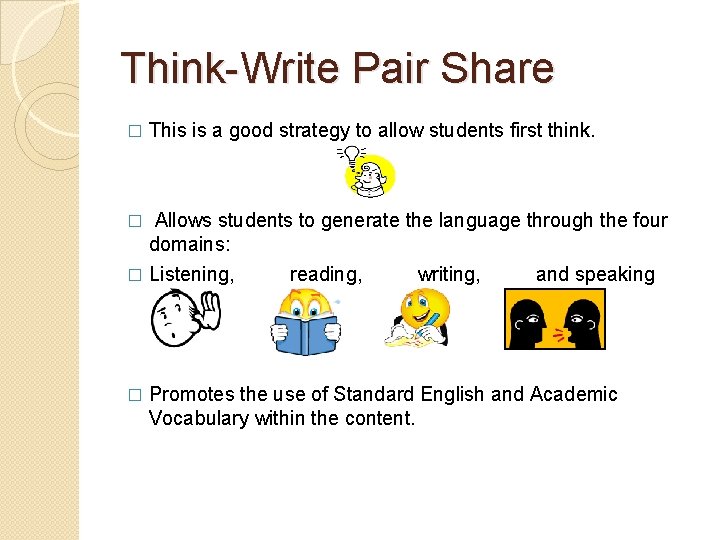
Think-Write Pair Share � This is a good strategy to allow students first think. Allows students to generate the language through the four domains: � Listening, reading, writing, and speaking � � Promotes the use of Standard English and Academic Vocabulary within the content.
Why use Anticipation Guides? � They teach students to make predictions, anticipate the text, and verify their predictions. � They connect new information to prior knowledge and build curiosity about a new topic. � Anticipation guides stimulate students' interest in a topic and set a purpose for reading.
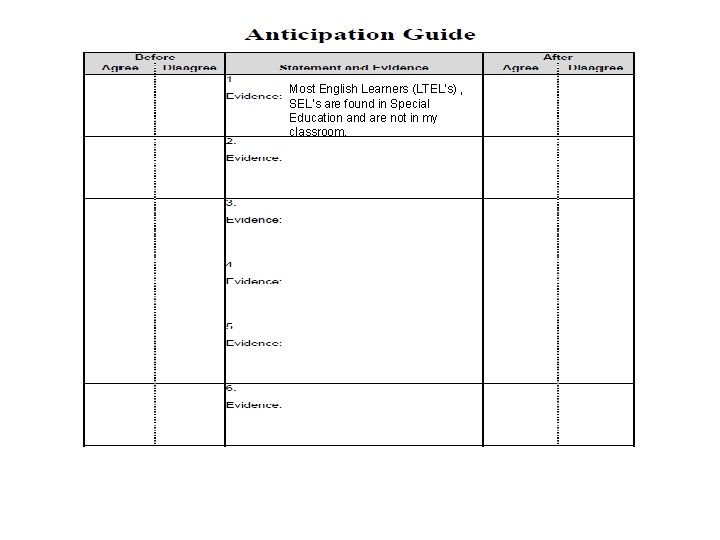
Most English Learners (LTEL’s) , SEL’s are found in Special Education and are not in my classroom.
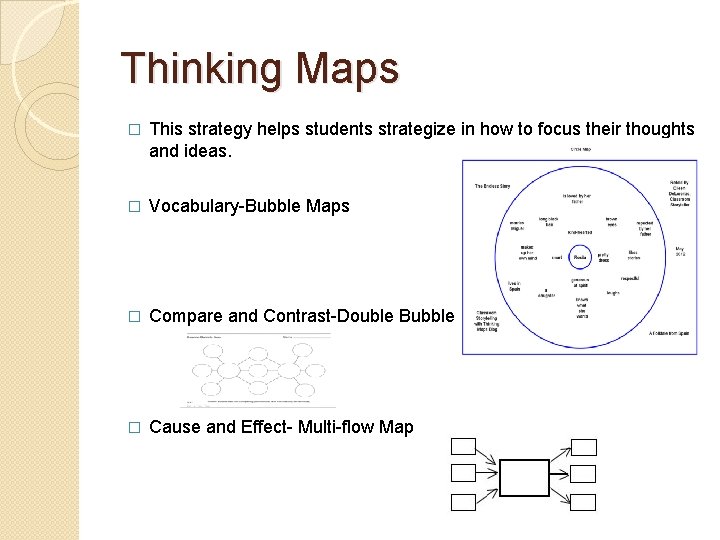
Thinking Maps � This strategy helps students strategize in how to focus their thoughts and ideas. � Vocabulary-Bubble Maps � Compare and Contrast-Double Bubble � Cause and Effect- Multi-flow Map
LAUSD Evaluation and Accountability Goals � Goal 1 -Implement the English Learner Master Plan fully and consistently across the district. � Goal 2 -Ensure steady progress towards and attainment of academic English language development per expected timeframes. � Goal 3 -Ensure steady progress toward and attainment of grade level academic proficiency
Evaluation � (AMAO # 1) Percentage of English Learners progressing at attaining English proficiency. English Learners must move at least one CELDT level each year. � The number of Long Term English Learners that are Reclassified each year so as to reduce the number of LTEL’s in the school.
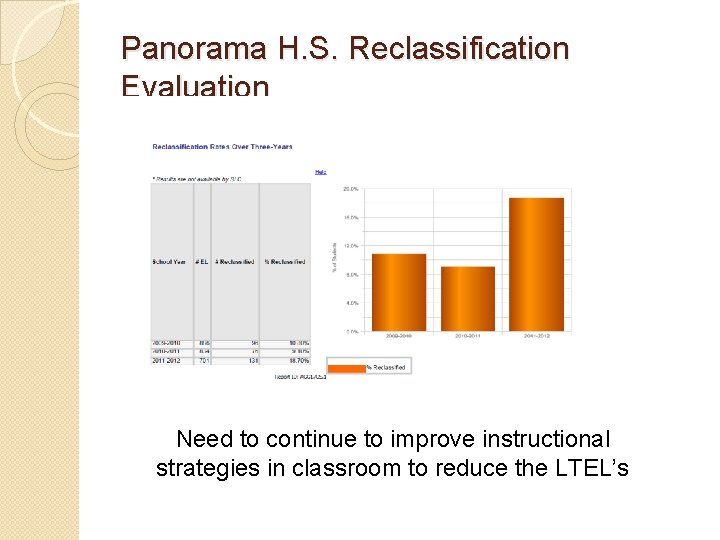
Panorama H. S. Reclassification Evaluation Need to continue to improve instructional strategies in classroom to reduce the LTEL’s
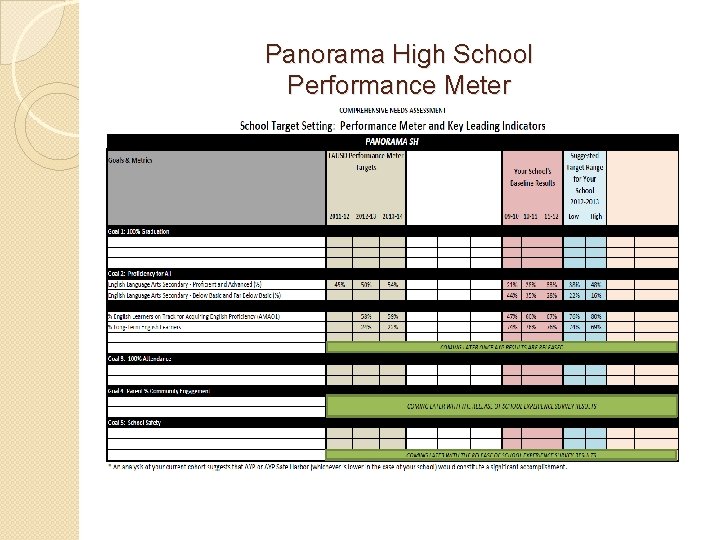
Panorama High School Performance Meter
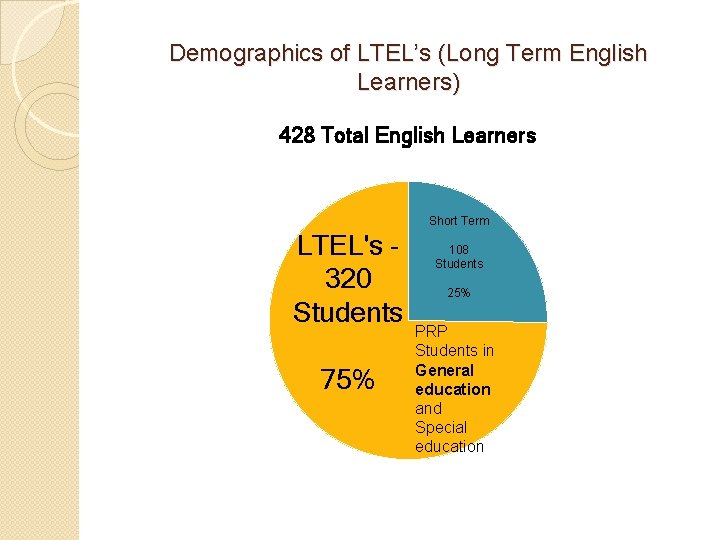
Demographics of LTEL’s (Long Term English Learners) 428 Total English Learners Short Term LTEL's 320 Students 75% 108 Students 25% PRP Students in General education and Special education
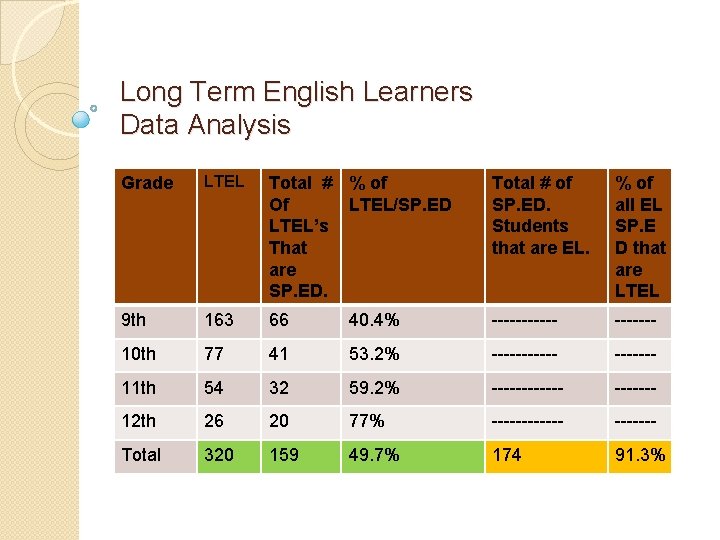
Long Term English Learners Data Analysis Grade LTEL Total # % of Of LTEL/SP. ED LTEL’s That are SP. ED. Total # of SP. ED. Students that are EL. % of all EL SP. E D that are LTEL 9 th 163 66 40. 4% ------- 10 th 77 41 53. 2% ------- 11 th 54 32 59. 2% ------- 12 th 26 20 77% ------- Total 320 159 49. 7% 174 91. 3%
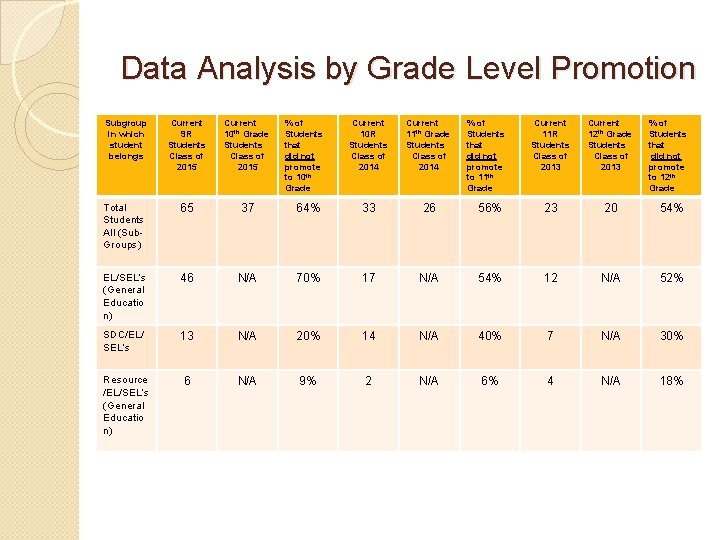
Data Analysis by Grade Level Promotion Subgroup in which student belongs Current 9 R Students Class of 2015 Current 10 th Grade Students Class of 2015 Total Students All (Sub. Groups) 65 37 EL/SEL’s (General Educatio n) 46 SDC/EL/ SEL’s Resource /EL/SEL’s (General Educatio n) % of Students that did not promote to 10 th Grade Current 10 R Students Class of 2014 Current 11 th Grade Students Class of 2014 64% 33 26 N/A 70% 17 13 N/A 20% 6 N/A 9% % of Students that did not promote to 11 th Grade Current 11 R Students Class of 2013 Current 12 th Grade Students Class of 2013 % of Students that did not promote to 12 th Grade 56% 23 20 54% N/A 54% 12 N/A 52% 14 N/A 40% 7 N/A 30% 2 N/A 6% 4 N/A 18%
Reflective Question? 3 min. Discuss at your table. �How will the measurement of these goals: 1. guides staff towards performance, and 2. result in student achievement
EL Module 4 �Please answer the questions on the worksheet to comply with this module as you listen to the video.
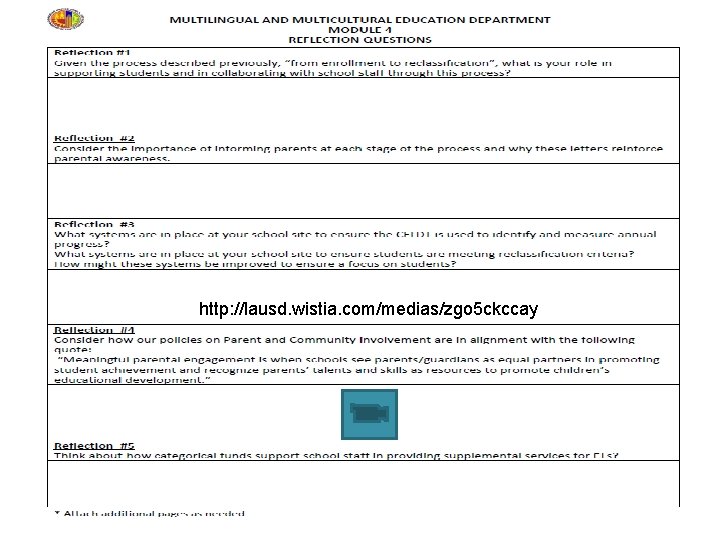
http: //lausd. wistia. com/medias/zgo 5 ckccay
- Slides: 31