
Learner Differences and Learning Needs Cluster 4 Modules


- Slides: 35
Learner Differences and Learning Needs Cluster 4 Modules 10 – 12 Educational Psychology, ALE, 11 th Edition ISBN 0137144547 © 2011 Pearson Education, Inc. All rights reserved.
Focus Questions n n n What are the potential problems raised by categorizing and labeling students? What is your personal concept of intelligence? Should you adapt lessons for students with varying learning styles? What are the implications of the Individuals with Disabilities Education Improvement Act (IDEA) and Section 504 for your teaching? What is Response to Instruction, and how will you use this three-tier process in your class? Educational Psychology, ALE. 11 th Edition Anita Woolfolk ISBN 0135094100 2 © 2011 Pearson Education, Inc. All Rights Reserved.
What Would You Do? n See p. 135 “Teacher’s Casebook” n n How will you design a standards-based curriculum that will allow all of the students to learn to their fullest potential and demonstrate proficiency toward the standards? What can you do to address the specific problems of your students who have been identified with special needs? Educational Psychology, ALE. 11 th Edition Anita Woolfolk ISBN 0135094100 3 © 2011 Pearson Education, Inc. All Rights Reserved.
Intelligence • • Language and Labels Pros of labeling: • • • Offers protection Opens opportunities Cons of labeling: • • Does not provide treatment in all cases Self-fulfilling prophecies Educational Psychology, ALE. 11 th Edition Anita Woolfolk ISBN 0135094100 4 © 2011 Pearson Education, Inc. All Rights Reserved.
Intelligence Disabilities and Handicaps • What are the differences between a disability and a handicap? • • Disability- inability to do something specific Handicap-disadvantage in a certain situation Person-First Language • Why is it important? Educational Psychology, ALE. 11 th Edition Anita Woolfolk ISBN 0135094100 5 © 2011 Pearson Education, Inc. All Rights Reserved.
Intelligence n What Does Intelligence Mean? n Intelligence- One Ability or Many? n n n General Intelligence Fluid Intelligence Crystallized Intelligence Educational Psychology, ALE. 11 th Edition Anita Woolfolk ISBN 0135094100 6 © 2011 Pearson Education, Inc. All Rights Reserved.
Intelligence n n Theory of Multiple Intelligences Howard Gardner (see Table 10. 1, p. 142) n n n n n Linguistic Musical Spatial Logical-mathematical Bodily-kinesthetic Interpersonal Intrapersonal Naturalist (Spiritual) Educational Psychology, ALE. 11 th Edition Anita Woolfolk ISBN 0135094100 7 © 2011 Pearson Education, Inc. All Rights Reserved.
Intelligence n Intelligence as a Process n n What about the importance of life experiences? Sternberg’s Triarchic Theory of Successful Intelligence n n n Analytic Intelligence Creativity Practical Intelligence Educational Psychology, ALE. 11 th Edition Anita Woolfolk ISBN 0135094100 8 © 2011 Pearson Education, Inc. All Rights Reserved.
Intelligence n Measuring Intelligence n n IQ: Intelligence Quotient = Mental Age/Chronological Age x 100 What Does IQ score mean? Educational Psychology, ALE. 11 th Edition Anita Woolfolk ISBN 0135094100 9 © 2011 Pearson Education, Inc. All Rights Reserved.
Intelligence n Group IQ Tests n n n Given to whole classes at once. Much less likely to yield accurate results Why? Individual IQ Tests n n Administered one-on-one by a trained psychologist Stanford Binet Educational Psychology, ALE. 11 th Edition Anita Woolfolk ISBN 0135094100 10 © 2011 Pearson Education, Inc. All Rights Reserved.
Intelligence n The Flynn Effect n n Average IQ scores go up 18% per generation Better nutrition Increasing complexity among society In order to keep average score at 100, test questions must be made harder Educational Psychology, ALE. 11 th Edition Anita Woolfolk ISBN 0135094100 11 © 2011 Pearson Education, Inc. All Rights Reserved.
Intelligence n Sex Differences in Intelligence n n What cautions are necessary in examining the differences between males and female intelligence? Heredity or Environment? Educational Psychology, ALE. 11 th Edition Anita Woolfolk ISBN 0135094100 12 © 2011 Pearson Education, Inc. All Rights Reserved.
Learning and Thinking Styles n n Learning Styles/Preferences Cautions About Learning Styles n n Emphasis on Preferred The Value of Considering Learning Styles n n Develops thoughtful self-monitoring and selfawareness Develops appreciation, acceptance, and accommodation for student differences Educational Psychology, ALE. 11 th Edition Anita Woolfolk ISBN 0135094100 13 © 2011 Pearson Education, Inc. All Rights Reserved.
Learning and Thinking Styles n n Intellectual Styles Zhang and Sternberg n n n Type 1 - Free-flowing, unstructured, openended, complex, unconventional, autonomous Type II- Highly structured, simplistic and straightforward, traditional, values experts Type III- Degree of structure depends, complexity depends, creativity depends, autonomy depends Educational Psychology, ALE. 11 th Edition Anita Woolfolk ISBN 0135094100 14 © 2011 Pearson Education, Inc. All Rights Reserved.
Individual Differences and the Law n IDEA (Individuals with Disabilities Education Improvement Act) n n PL 94 -142 LRE (Least Restrictive Environment) IEP (Individual Education Plan) Section 504 Educational Psychology, ALE. 11 th Edition Anita Woolfolk ISBN 0135094100 15 © 2011 Pearson Education, Inc. All Rights Reserved.
Students with Learning Challenges n n n Neuroscience and Learning Challenges Differences in brain composition and activity Working memory Educational Psychology, ALE. 11 th Edition Anita Woolfolk ISBN 0135094100 16 © 2011 Pearson Education, Inc. All Rights Reserved.
Students with Learning Challenges n Students with Learning Disabilities n Characteristics n n n n Poor coordination Problems paying attention Hyperactivity/impulsivity Organization problems Disordered thinking Memory Speech Social difficulties Educational Psychology, ALE. 11 th Edition Anita Woolfolk ISBN 0135094100 17 © 2011 Pearson Education, Inc. All Rights Reserved.
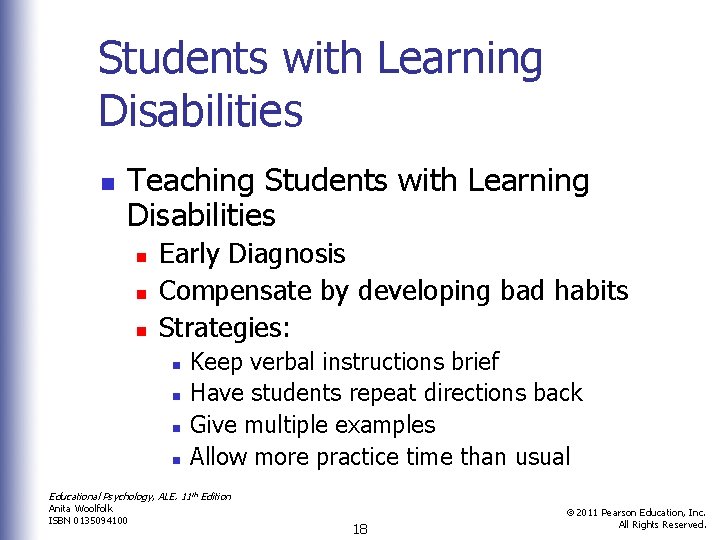
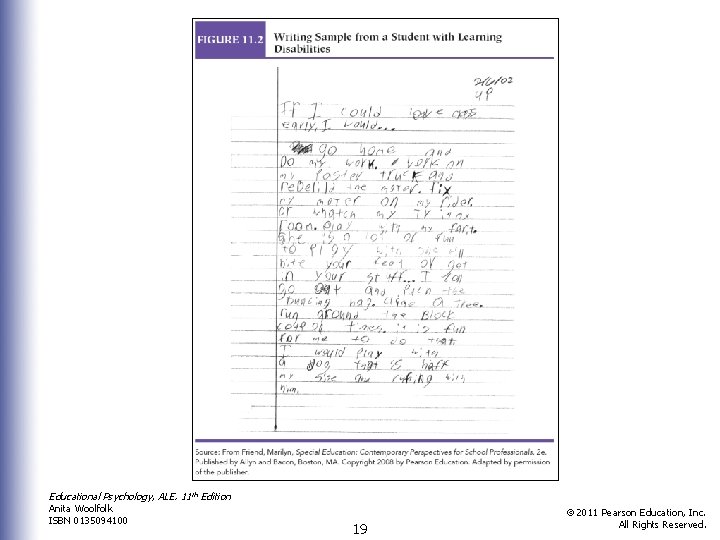
Students with Learning Disabilities n Teaching Students with Learning Disabilities n n n Early Diagnosis Compensate by developing bad habits Strategies: n n Keep verbal instructions brief Have students repeat directions back Give multiple examples Allow more practice time than usual Educational Psychology, ALE. 11 th Edition Anita Woolfolk ISBN 0135094100 18 © 2011 Pearson Education, Inc. All Rights Reserved.
Educational Psychology, ALE. 11 th Edition Anita Woolfolk ISBN 0135094100 19 © 2011 Pearson Education, Inc. All Rights Reserved.
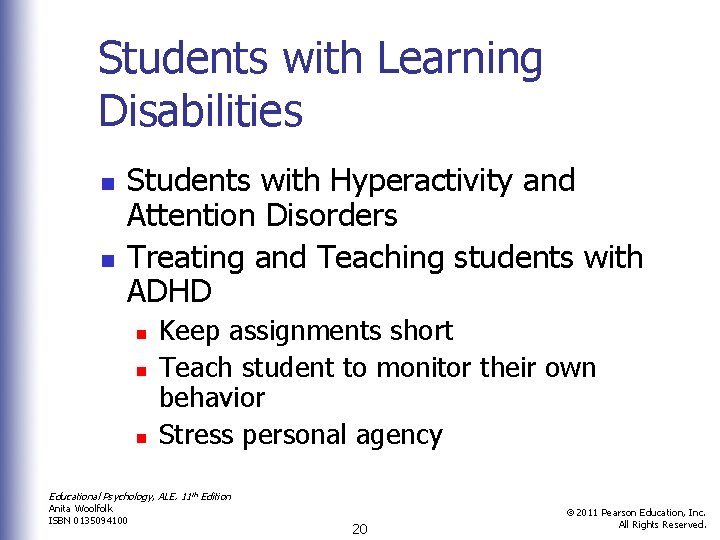
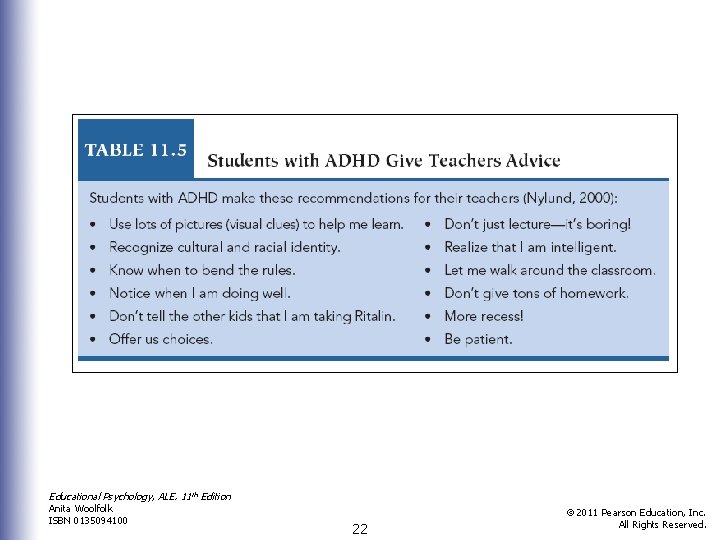
Students with Learning Disabilities n n Students with Hyperactivity and Attention Disorders Treating and Teaching students with ADHD n n n Keep assignments short Teach student to monitor their own behavior Stress personal agency Educational Psychology, ALE. 11 th Edition Anita Woolfolk ISBN 0135094100 20 © 2011 Pearson Education, Inc. All Rights Reserved.
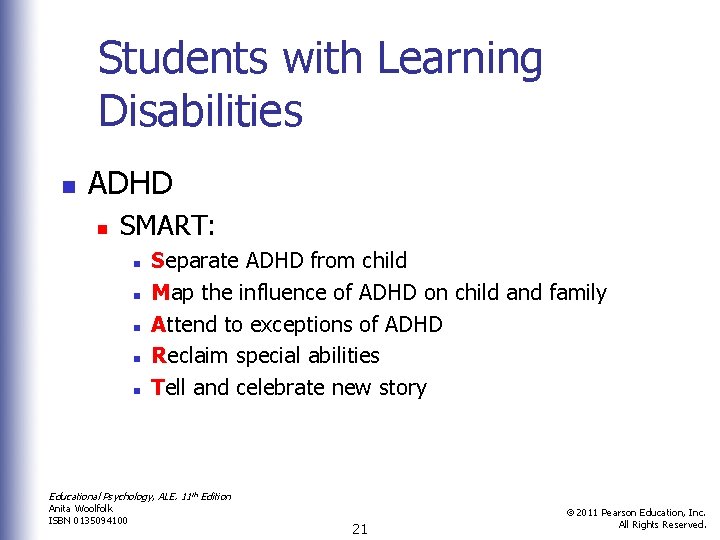
Students with Learning Disabilities n ADHD n SMART: n n n Separate ADHD from child Map the influence of ADHD on child and family Attend to exceptions of ADHD Reclaim special abilities Tell and celebrate new story Educational Psychology, ALE. 11 th Edition Anita Woolfolk ISBN 0135094100 21 © 2011 Pearson Education, Inc. All Rights Reserved.
Educational Psychology, ALE. 11 th Edition Anita Woolfolk ISBN 0135094100 22 © 2011 Pearson Education, Inc. All Rights Reserved.
Students with Language and Communication Disorders n Speech Disorders n n Articulation Disorders Stuttering Voicing Problems Language Disorders n Distinction between language differences and disorders Educational Psychology, ALE. 11 th Edition Anita Woolfolk ISBN 0135094100 23 © 2011 Pearson Education, Inc. All Rights Reserved.
Students with Emotional or Behavioral Difficulties n Strategies for teachers n n n Structure environment Structure schedules Structure activities Structure rules and routines Offer choices Educational Psychology, ALE. 11 th Edition Anita Woolfolk ISBN 0135094100 24 © 2011 Pearson Education, Inc. All Rights Reserved.
Students with Emotional or Behavioral Disorders n Suicide n n Drug abuse n n Four risk factors: depression, substance abuse, history of suicide in family, stress, and family conflict Important to distinguish between abuse and experimentation Prevention Educational Psychology, ALE. 11 th Edition Anita Woolfolk ISBN 0135094100 25 © 2011 Pearson Education, Inc. All Rights Reserved.
Students with Intellectual Disabilities n n n Not to be diagnosed by test scores alone About 1% of population Learning goals likely include living skills Educational Psychology, ALE. 11 th Edition Anita Woolfolk ISBN 0135094100 26 © 2011 Pearson Education, Inc. All Rights Reserved.
Students with Health Impairments n n Cerebral Palsy Seizure Disorders Vision Impairments Other serious health concerns n n n HIV Asthma Diabetes Educational Psychology, ALE. 11 th Edition Anita Woolfolk ISBN 0135094100 27 © 2011 Pearson Education, Inc. All Rights Reserved.
Students Who Are Deaf n n Deaf prefer to be called “deaf” Deaf community has its own culture Deaf community has its own language Goal is to help deaf student become bilingual, bicultural, to function well in both societies Educational Psychology, ALE. 11 th Edition Anita Woolfolk ISBN 0135094100 28 © 2011 Pearson Education, Inc. All Rights Reserved.
Autism Spectrum and Asperger Syndrome n Major area of difficulty is social n n n Avoid eye contact Low or no language skills Sensory stimulation Theory of Mind Interventions Educational Psychology, ALE. 11 th Edition Anita Woolfolk ISBN 0135094100 29 © 2011 Pearson Education, Inc. All Rights Reserved.
Response to Intervention n n RTI Make sure students get appropriate research-based instruction and support as soon as possible Three tiers Early intervention Educational Psychology, ALE. 11 th Edition Anita Woolfolk ISBN 0135094100 30 © 2011 Pearson Education, Inc. All Rights Reserved.
Gifted and Talented n n n Top 1% of population in IQ Larger, stronger, healthier than normal More athletic Walked sooner Better adjusted as adults Lower levels of emotional problems, divorce, drug problems as adults Educational Psychology, ALE. 11 th Edition Anita Woolfolk ISBN 0135094100 31 © 2011 Pearson Education, Inc. All Rights Reserved.
Gifted and Talented n n n Nature/nurture Focused, intense practice At risk for depression, boredom, isolation Educational Psychology, ALE. 11 th Edition Anita Woolfolk ISBN 0135094100 32 © 2011 Pearson Education, Inc. All Rights Reserved.
Identifying and Teaching Gifted Students n n Teachers are not always successful at recognizing gifted students Group and individual IQ tests tend to underestimate abilities Curriculum compacting Emphasis on formal operations, creativity, high-level reading Educational Psychology, ALE. 11 th Edition Anita Woolfolk ISBN 0135094100 33 © 2011 Pearson Education, Inc. All Rights Reserved.
Diversity n n n n Racial and ethnic minorities are overrepresented in special education Young girls reject “gifted” label Gifted and learning disabled Gifted and living in poverty Educational Psychology, ALE. 11 th Edition Anita Woolfolk ISBN 0135094100 34 © 2011 Pearson Education, Inc. All Rights Reserved.
Convergences n n Diversity Testing Educational Psychology, ALE. 11 th Edition Anita Woolfolk ISBN 0135094100 35 © 2011 Pearson Education, Inc. All Rights Reserved.