
Learner demand workplace participation for learning Prof MARK

- Slides: 12
Learner demand workplace participation for learning Prof. MARK STUART
BACKGROUND • Involvement in various projects on workplace learning, mainly from employment relations perspective • Trade Union Learning – current evaluation • Raising the Demand for Learning – 3 year, EU funded action research project, coordinated by the Campaign for Learning – low skill workers • ‘Time to talk training’ – guidance on how to develop an effective dialogue on skills at the workplace, for CBI, TUC, BERR and DIUS.
Rationale for understanding demand for learning • Understand how to raise demand its potential impact seen as important in context of: • Perceived UK skills deficit and basic skills problem • The (policy) turn to the demand side: ‘Raising demand from individuals will put pressure on employers to make use of individual skills and will enlarge the availability of skilled labour’ (PIU, 2001) ‘A dual approach – stimulating independent individual demand for development as well as employer demand – will achieve impact for a demand-led workforce development system’ (Strategy Unit, 2002) • Effective workplace dialogue can contribute to learner demand, opportunities for learning and positive outcomes
Project methods • ‘Raising the demand for learning’ project, 3 years, involved • 8 large public/ private organisations; each employed an ‘action researcher’ – with practical initiatives • Wide stakeholder group • accompanying research programme • 400 qualitative interviews (workers/ managers) • Two employee surveys – second of which undertaken in 2005 generated 1561 responses (18% return) • ‘Time to talk training’ • High level guidance document from social partners • 12 case studies of good practice in different contexts
Individual experiences of learning/ training • Extensive experience of learning (formal and informal) and high demand for more learning • Learning facilitated by – personal want to develop at work; organisational expectations of development; need to gain qualification • Perceived changes in skills – dealing with people; planning; problem solving. • Organisations most likely to provide training on – computers; dealing with people (typically less than 2 days) • Anticipated outcomes of future development more optimistic than past experience (eg. pay, promotion, job choices)
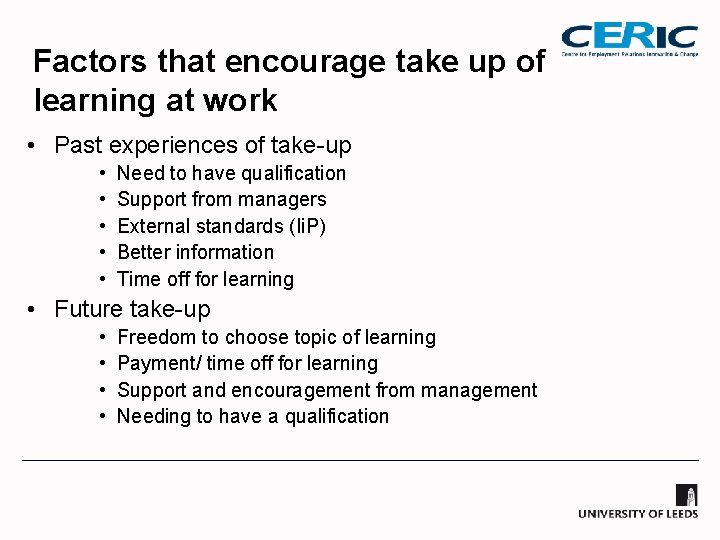
Factors that encourage take up of learning at work • Past experiences of take-up • • • Need to have qualification Support from managers External standards (Ii. P) Better information Time off for learning • Future take-up • • Freedom to choose topic of learning Payment/ time off for learning Support and encouragement from management Needing to have a qualification
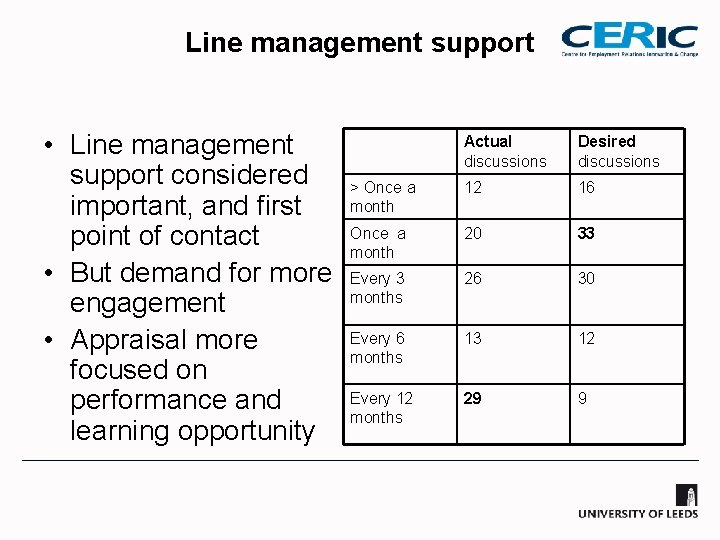
Line management support • Line management support considered important, and first point of contact • But demand for more engagement • Appraisal more focused on performance and learning opportunity Actual discussions Desired discussions > Once a month 12 16 Once a month 20 33 Every 3 months 26 30 Every 6 months 13 12 Every 12 months 29 9
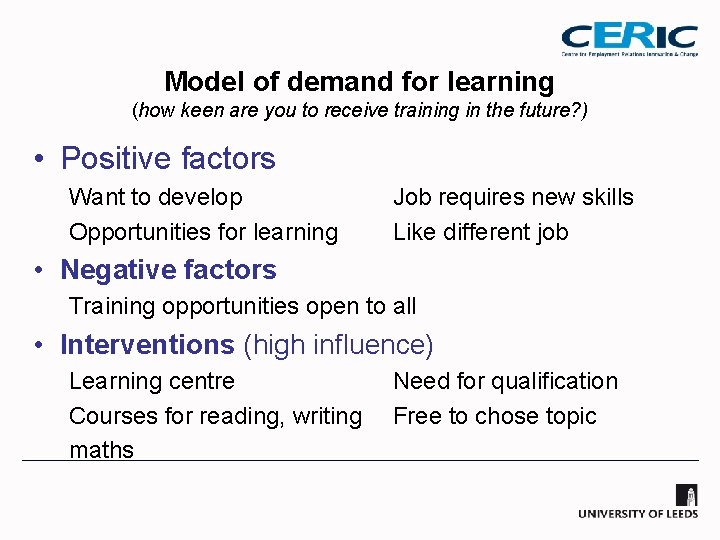
Model of demand for learning (how keen are you to receive training in the future? ) • Positive factors Want to develop Opportunities for learning Job requires new skills Like different job • Negative factors Training opportunities open to all • Interventions (high influence) Learning centre Courses for reading, writing maths Need for qualification Free to chose topic
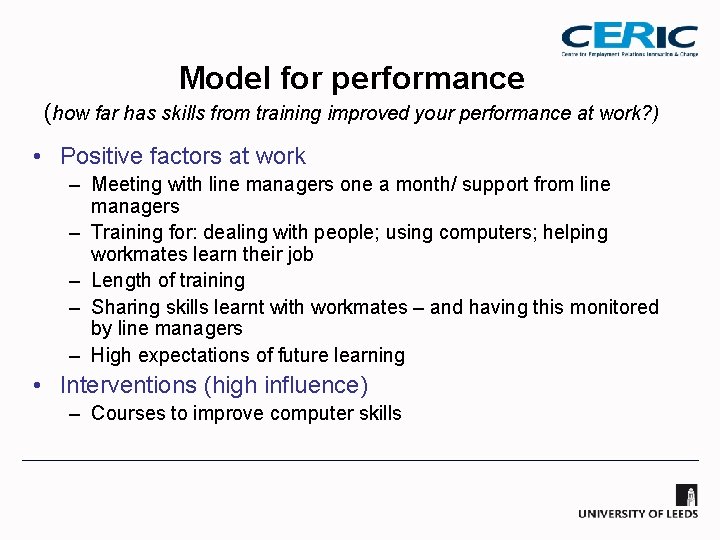
Model for performance (how far has skills from training improved your performance at work? ) • Positive factors at work – Meeting with line managers one a month/ support from line managers – Training for: dealing with people; using computers; helping workmates learn their job – Length of training – Sharing skills learnt with workmates – and having this monitored by line managers – High expectations of future learning • Interventions (high influence) – Courses to improve computer skills
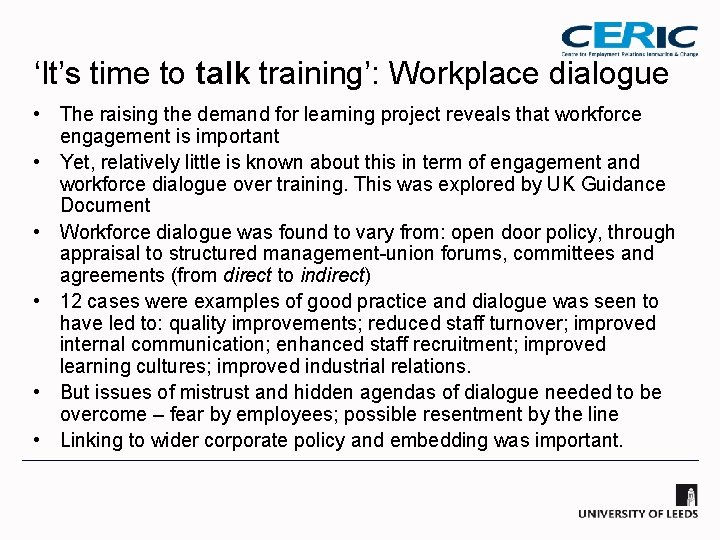
‘It’s time to talk training’: Workplace dialogue • The raising the demand for learning project reveals that workforce engagement is important • Yet, relatively little is known about this in term of engagement and workforce dialogue over training. This was explored by UK Guidance Document • Workforce dialogue was found to vary from: open door policy, through appraisal to structured management-union forums, committees and agreements (from direct to indirect) • 12 cases were examples of good practice and dialogue was seen to have led to: quality improvements; reduced staff turnover; improved internal communication; enhanced staff recruitment; improved learning cultures; improved industrial relations. • But issues of mistrust and hidden agendas of dialogue needed to be overcome – fear by employees; possible resentment by the line • Linking to wider corporate policy and embedding was important.
Top Tips on Dialogue! • • • Need supportive senior management Need all to be onside/committed to principles Must be seen as ‘genuine’ (delivery) Need to take long-term perspective Structures, and embedding, matter… ‘it’s easy to start a dialogue over training, structures are important to maintain dialogue’
Conclusions • High demand for learning • Workforce development influenced naturally by various workplace factors • Much emphasis on ‘transfer’ and skills utilisation • Structures and processes of employee participation and workforce dialogue also important