
Learn the Language of Fashion Intro to Fashion




- Slides: 16
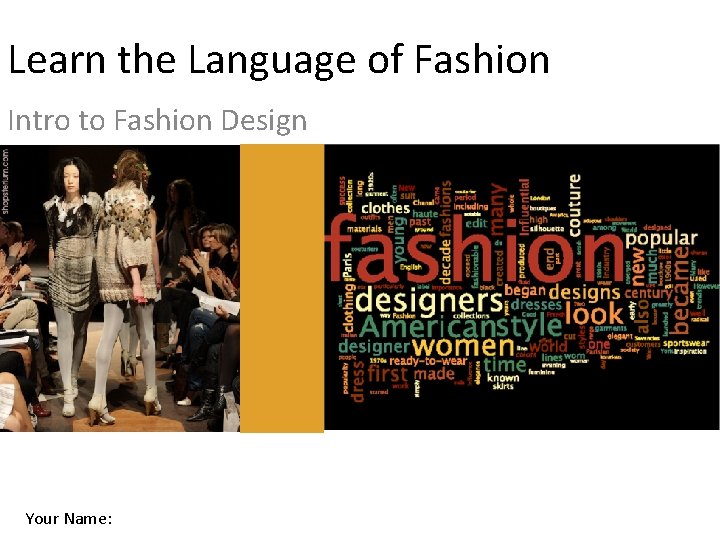
Learn the Language of Fashion Intro to Fashion Design Your Name:
Objective: Learn these terms and be able to use them to describe a garment… • • Silhouette Fit Proportion Line Fabric, Texture Color Detailing
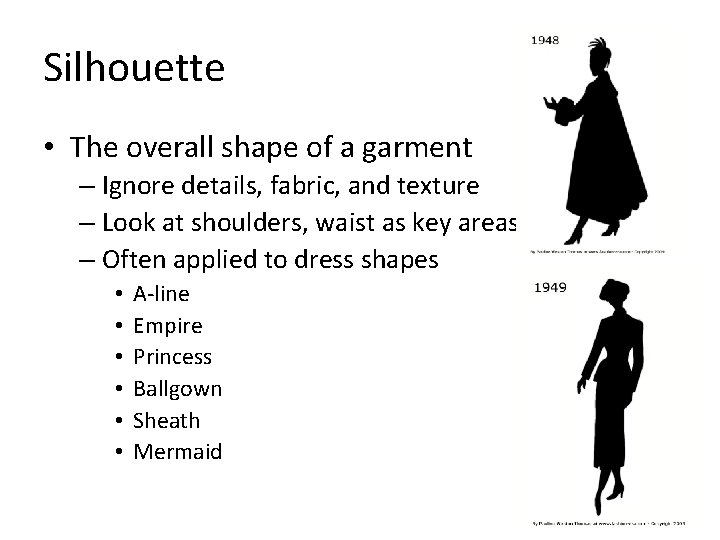
Silhouette • The overall shape of a garment – Ignore details, fabric, and texture – Look at shoulders, waist as key areas – Often applied to dress shapes • • • A-line Empire Princess Ballgown Sheath Mermaid
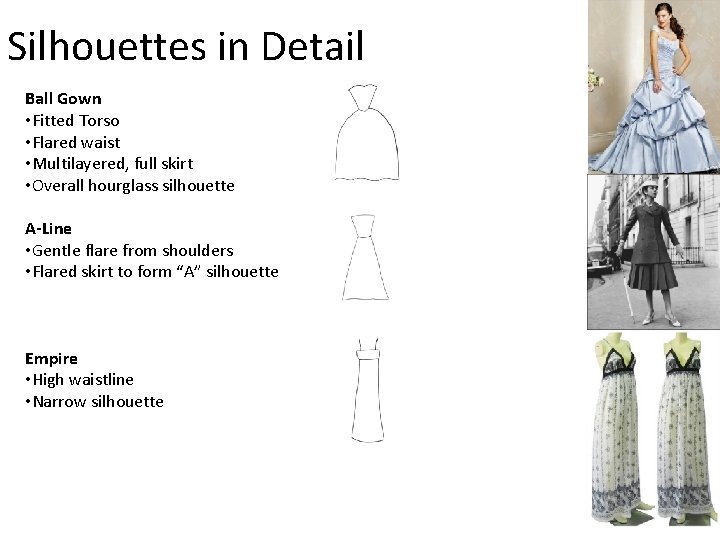
Silhouettes in Detail Ball Gown • Fitted Torso • Flared waist • Multilayered, full skirt • Overall hourglass silhouette A-Line • Gentle flare from shoulders • Flared skirt to form “A” silhouette Empire • High waistline • Narrow silhouette
Silhouettes in Detail Sheath • Follows natural silhouette of the body • Often strapless or backless Fishtail • Follows natural silhouette of the body, but flares at the bottom
Fit • How closely the garment fits the body – Different areas of the garment can have different fit – Look at arms, body, legs
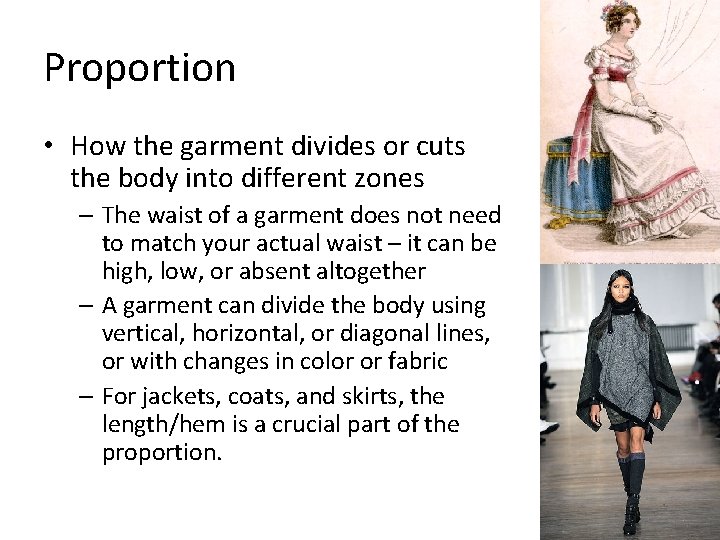
Proportion • How the garment divides or cuts the body into different zones – The waist of a garment does not need to match your actual waist – it can be high, low, or absent altogether – A garment can divide the body using vertical, horizontal, or diagonal lines, or with changes in color or fabric – For jackets, coats, and skirts, the length/hem is a crucial part of the proportion.
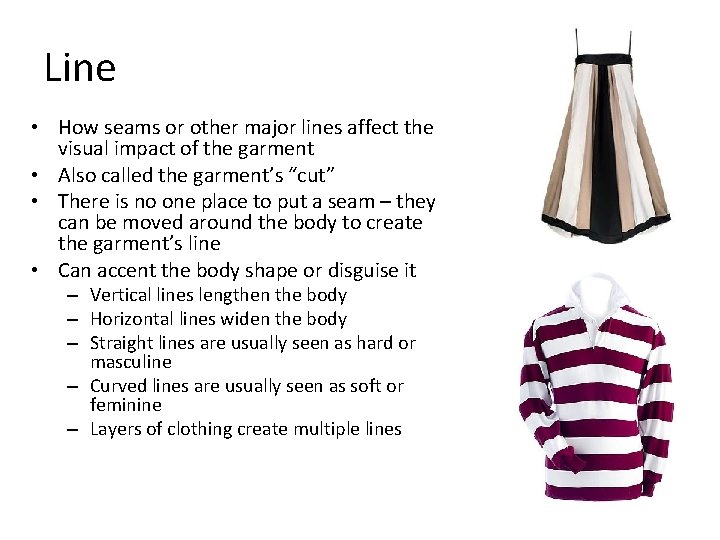
Line • How seams or other major lines affect the visual impact of the garment • Also called the garment’s “cut” • There is no one place to put a seam – they can be moved around the body to create the garment’s line • Can accent the body shape or disguise it – Vertical lines lengthen the body – Horizontal lines widen the body – Straight lines are usually seen as hard or masculine – Curved lines are usually seen as soft or feminine – Layers of clothing create multiple lines
Fabric, Texture • Fabric: the materials used in constructing the garment – Weight (light to heavy) • Affects how the garment drapes the body • Tied to seasons (spring/summer or fall/winter) • Texture (what the fabric feels like) • Somewhat tied to weight – heavy fabrics tend to have heavy textures
Color • Like texture, often influenced by season – Lighter colors for spring/summer – Darker colors for fall/winter • Red and black together is often seen as cliché • Mixing many primary colors can look garish or too “loud” • But there always exceptions
Detailing • All the practical considerations that make the garment wearable AND any applied decorations: – Fasteners (buttons, zippers, snaps, Velcro) – Pockets (position and type) – Topstitching (stitches that are visible in the final garment) – Embellishments (lace, beads, rhinestones, etc. ) • Crucial in men’s formal clothing, because it’s one of the few elements that are not determined by tradition
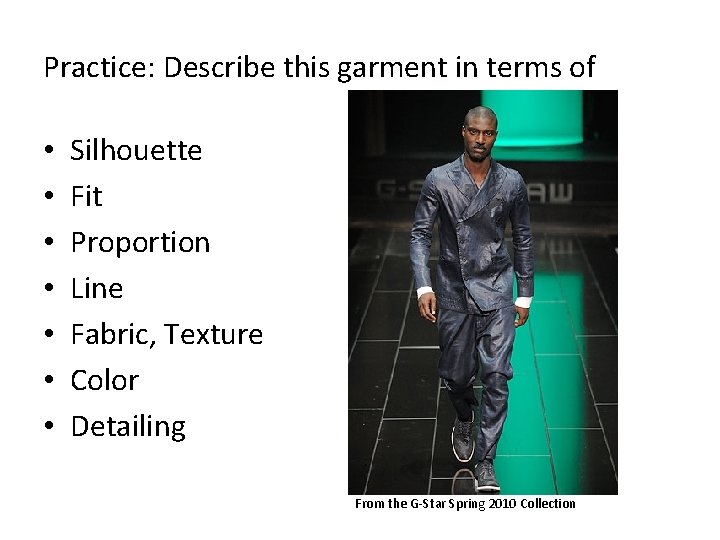
Practice: Describe this garment in terms of • • Silhouette Fit Proportion Line Fabric, Texture Color Detailing From the G-Star Spring 2010 Collection
Sample Answer: “This is a closely fitted men’s suit. The shoulders have a natural silhouette, and the hip-length jacket is tailored to the body. The pants are slightly more roomy, but with tapered cuffs. The charcoal gray fabric is shiny and has a leather-like appearance. The sleeves are accented by white cuffs, and the garment is matched with gray shoes with white soles again providing a visual accent. ” From the G-Star Spring 2010 Collection
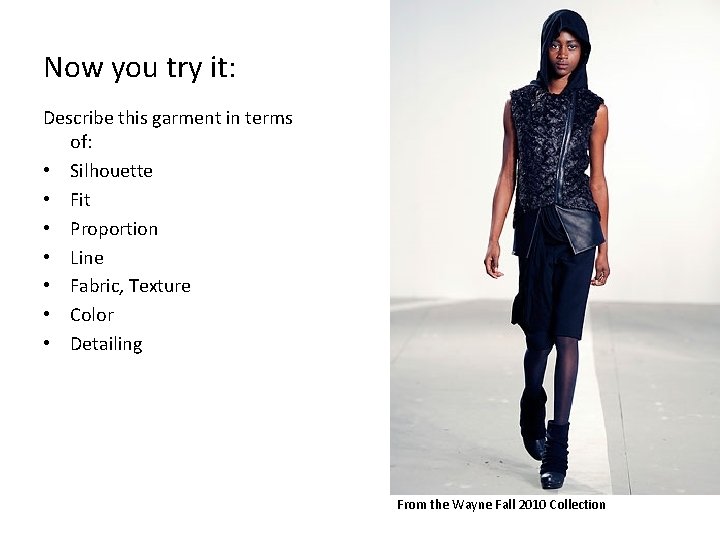
Now you try it: Describe this garment in terms of: • Silhouette • Fit • Proportion • Line • Fabric, Texture • Color • Detailing From the Wayne Fall 2010 Collection
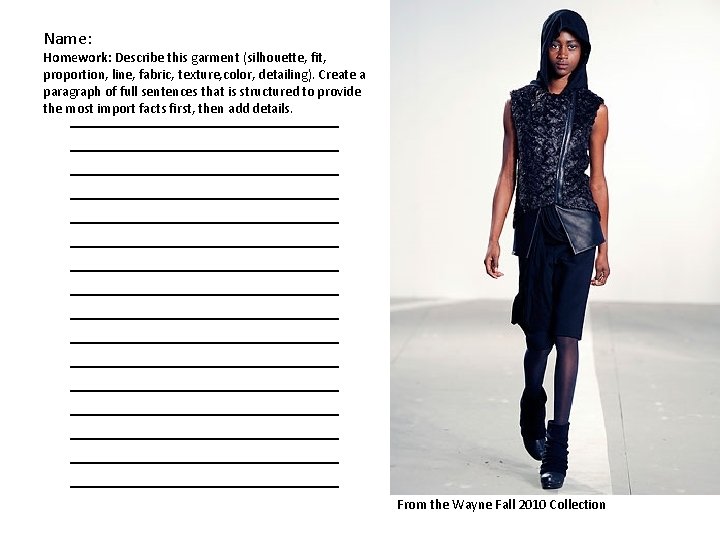
Name: Homework: Describe this garment (silhouette, fit, proportion, line, fabric, texture, color, detailing). Create a paragraph of full sentences that is structured to provide the most import facts first, then add details. ___________________________ ___________________________ ___________________________ ___________________________ From the Wayne Fall 2010 Collection