
LEARN Child Protection Principles Policies a deep dive
- Slides: 24
LEARN Child Protection Principles & Policies a deep dive conversation about building locally appropriate and global standard protections for children, communities and YOU July 14, 2020 Ian Forber-Pratt, MSW ian. forberpratt@CERIkids. org Executive Director Institute for Child Welfare Innovation Director of Global Advocacy Children’s Emergency Relief International (CERI) This Child Protection Policy content has been adapted from a multitude of resources including examples from Keeping Children Safe, Back 2 Back Ministries, Hope and Homes for Children, and the Christian Alliance for Orphans.
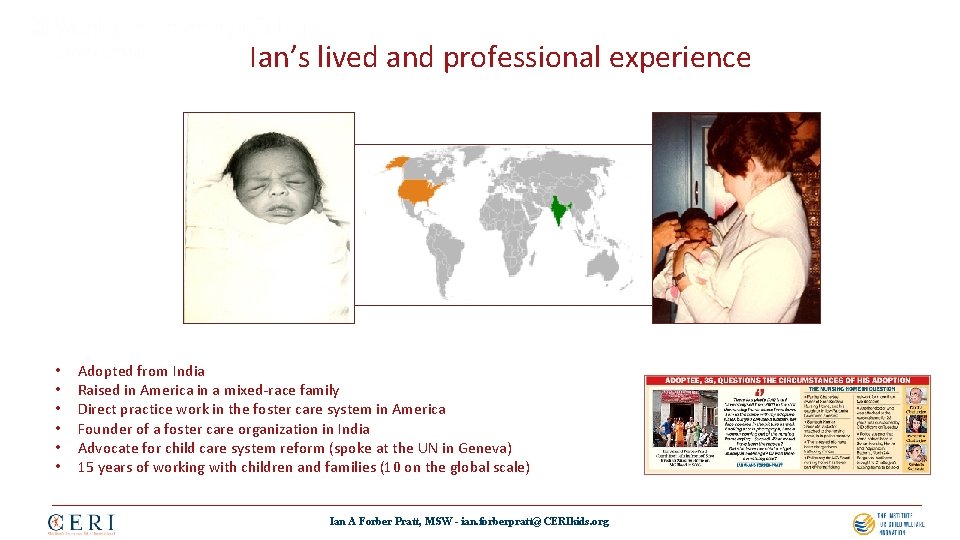
Ian’s lived and professional experience • • • Adopted from India Raised in America in a mixed-race family Direct practice work in the foster care system in America Founder of a foster care organization in India Advocate for child care system reform (spoke at the UN in Geneva) 15 years of working with children and families (10 on the global scale) Ian A Forber Pratt, MSW - ian. forberpratt@CERIkids. org
Note A western sounding person, giving a training on policies developed in the West is respected… BUT NOT REALLY. SO I’m asking you to please make this a valuable use of your time. So I’ll ask you: What works in your context? What does NOT work in context? Are we even approaching this in the right way? Ian A Forber Pratt, MSW - ian. forberpratt@CERIkids. org
Critical Questions Share a situation when the lack of a child protection policy (or an outdated one) harmed you or your organization? (if no examples think of how it COULD harm) List 5 or more Ian A Forber Pratt, MSW - ian. forberpratt@CERIkids. org
Inspirers: Identify the Top 5 Reasons for churches & NGOs to create child protection policies. In other words, WHY should these organizations and ministries begin the process of developing their own policies to apply these principles? Connectors: Identify the Top 8 Stakeholders that must be convinced that they need to create/update their child protection policies. In other words, WHO should we inspire to not only change policies, but to also implement the changed policies. Equippers: Identify the Top 5 Methods to train your network’s churches & NGOs on these principles. In other words, HOW will you share these principles so they are understood and applied appropriately within your contexts? Ian A Forber Pratt, MSW - ian. forberpratt@CERIkids. org
PART I Creating a Child Protection Policy for Foster Care Society in Rajasthan, India - a case study Ian A Forber Pratt, MSW - ian. forberpratt@CERIkids. org
India • • • Foster Care was new No one else had any “live” document “Borrowed” from others but didn’t understand what was legally binding, needed, relevant? Didn’t translate to Hindi. Didn’t spend time sharing with the team properly. Didn’t secure proper buy-in at all levels. Couldn’t find anyone that knew how to do this and that I could afford. Was busy trying to raise money so we used a template. Board didn’t really understand the need. Didn’t look at it for 3 years and then bam, it was required for a big grant. Ian A Forber Pratt, MSW - ian. forberpratt@CERIkids. org
PART II What does it mean to be doing well in child protection? Ian A Forber Pratt, MSW - ian. forberpratt@CERIkids. org
Critical Questions COVID-19, lack of funds, children to serve… why should I take time to do this thoroughly and as per this roadmap? Ian A Forber Pratt, MSW - ian. forberpratt@CERIkids. org
Reflection Questions- how can we make child protection part of our culture? FINANCES: How much of our budget will be allocated for child protection? TRAINING: How will we develop the staff orientation coursework? What pre-existing resources can we draw from? How will we make protecting children part of our staff culture? LEADERSHIP: Who will be our designated Child Protection Officer? How will they be trained? RESPONSE: What would the consequence of breaching the CPP be for staff, board members, volunteers, and organizational leadership? MONITORING: How often will we do self-assessments of our organization? CULTURE: What unique cultural practices might hinder child protection in our program? How do we honor cultural differences while maintaining child protection? Ian A Forber Pratt, MSW - ian. forberpratt@CERIkids. org
Reflection Questions Cont. - how can we make child protection part of our culture? COMMUNICATIONS: How do we prioritize child protection in our communications with stakeholders, especially in regard to images and stories? VOLUNTEERS: How do we emphasize child protection regarding shortterm teams or volunteers? Where might we need to alter our practices for the best interest of children? PARTICIPATION: How can we inform children of their rights in a developmentally appropriate way? How will we educate and equip for safety? LEGAL: If a child is maltreated, how will local law and cultural expectations play a role in the investigation and follow up? PARTNERSHIP: What minimum child protection standards to entities need to meet to partner with us? How can we be part of helping partners improve their child protection policies and practices? BOARD: What role will our board play in empowering child protection in our organization, and in holding leaders accountable for good results? Ian A Forber Pratt, MSW - ian. forberpratt@CERIkids. org
PART III Developing usable/ relevant/ nimble child protection policies The template Ian A Forber Pratt, MSW - ian. forberpratt@CERIkids. org
Critical Questions A small group of you are boughtinto and ready for the new policy. How do you get the rest of the team on board? Do they NEED to be on board? Ian A Forber Pratt, MSW - ian. forberpratt@CERIkids. org
Four key principles of a child protection approach I. Policy: Organization develops a policy that describes how it is committed to preventing, and responding appropriately to, harm to children II. People: Organization places clear responsibilities and expectations on its staff and associates and supports them to act in line with these III. Procedures: Organization creates a child-safe environment by implementing child safeguarding procedures that are applied across the organization. IV. Accountability: Organization monitors and reviews its’ safeguarding measures annually. Ian A Forber Pratt, MSW - ian. forberpratt@CERIkids. org
I. Policy Mission Statement **** Drafting dates Policy drafted by: Policy approved from Board by: Scheduled review date: Policy Version: Overall statement At organization, the children and families served at risk of harm, abuse, or neglect. It is organization’s responsibility to safeguard children by maintaining a policy of reporting and preparing those associated with organization to safely interact with children through its’ policies and procedures. These policies and procedures apply to all staff, volunteers, board of directors, and those associated with organization. **** Terms Child Protection: prevention and response to violence, exploitation, neglect, and abuse of children in all contexts. **** Ian A Forber Pratt, MSW - ian. forberpratt@CERIkids. org
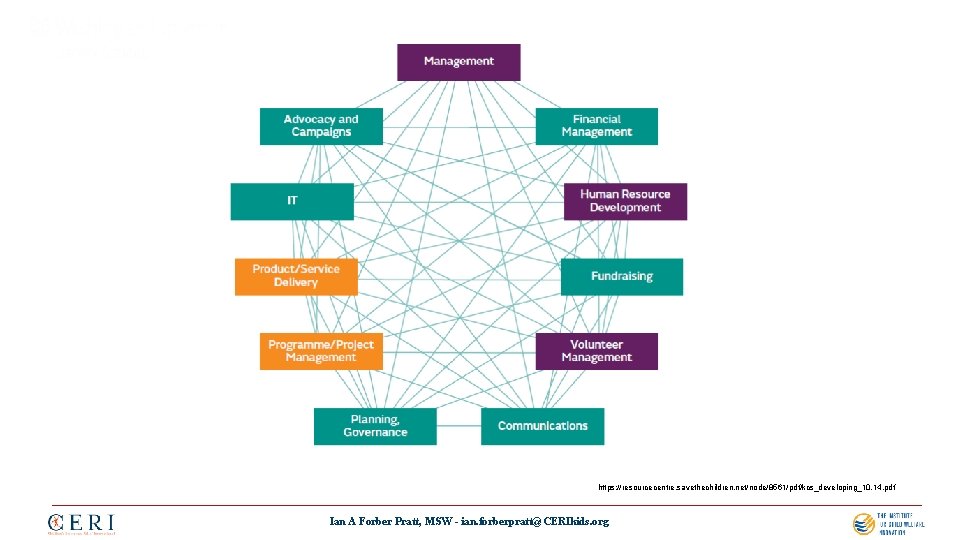
https: //resourcecentre. savethechildren. net/node/8561/pdf/kcs_developing_10. 14. pdf Ian A Forber Pratt, MSW - ian. forberpratt@CERIkids. org
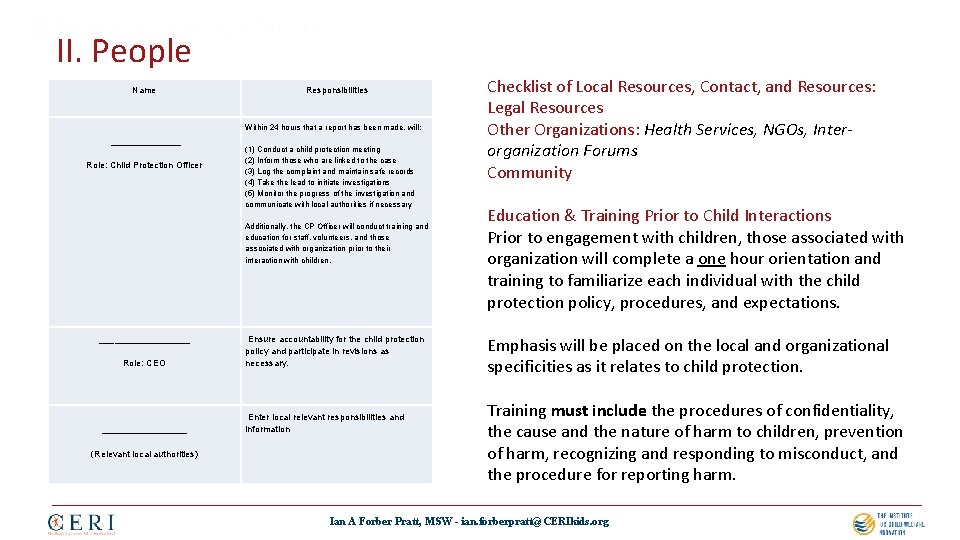
II. People Name Responsibilities Within 24 hours that a report has been made, will: _______ Role: Child Protection Officer (1) Conduct a child protection meeting (2) Inform those who are linked to the case (3) Log the complaint and maintain safe records (4) Take the lead to initiate investigations (5) Monitor the progress of the investigation and communicate with local authorities if necessary Additionally, the CP Officer will conduct training and education for staff, volunteers, and those associated with organization prior to their interaction with children. _________ Role: CEO _________ (Relevant local authorities) Ensure accountability for the child protection policy and participate in revisions as necessary. Enter local relevant responsibilities and information Checklist of Local Resources, Contact, and Resources: Legal Resources Other Organizations: Health Services, NGOs, Interorganization Forums Community Education & Training Prior to Child Interactions Prior to engagement with children, those associated with organization will complete a one hour orientation and training to familiarize each individual with the child protection policy, procedures, and expectations. Emphasis will be placed on the local and organizational specificities as it relates to child protection. Training must include the procedures of confidentiality, the cause and the nature of harm to children, prevention of harm, recognizing and responding to misconduct, and the procedure for reporting harm. Ian A Forber Pratt, MSW - ian. forberpratt@CERIkids. org
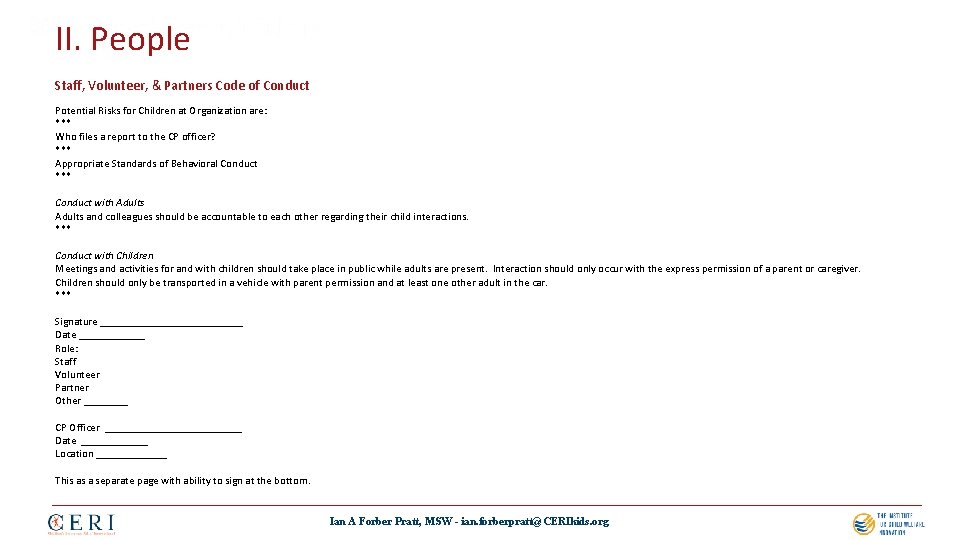
II. People Staff, Volunteer, & Partners Code of Conduct Potential Risks for Children at Organization are: *** Who files a report to the CP officer? *** Appropriate Standards of Behavioral Conduct *** Conduct with Adults and colleagues should be accountable to each other regarding their child interactions. *** Conduct with Children Meetings and activities for and with children should take place in public while adults are present. Interaction should only occur with the express permission of a parent or caregiver. Children should only be transported in a vehicle with parent permission and at least one other adult in the car. *** Signature _____________ Date ______ Role: Staff Volunteer Partner Other ____ CP Officer _____________ Date ______ Location _______ This as a separate page with ability to sign at the bottom. Ian A Forber Pratt, MSW - ian. forberpratt@CERIkids. org
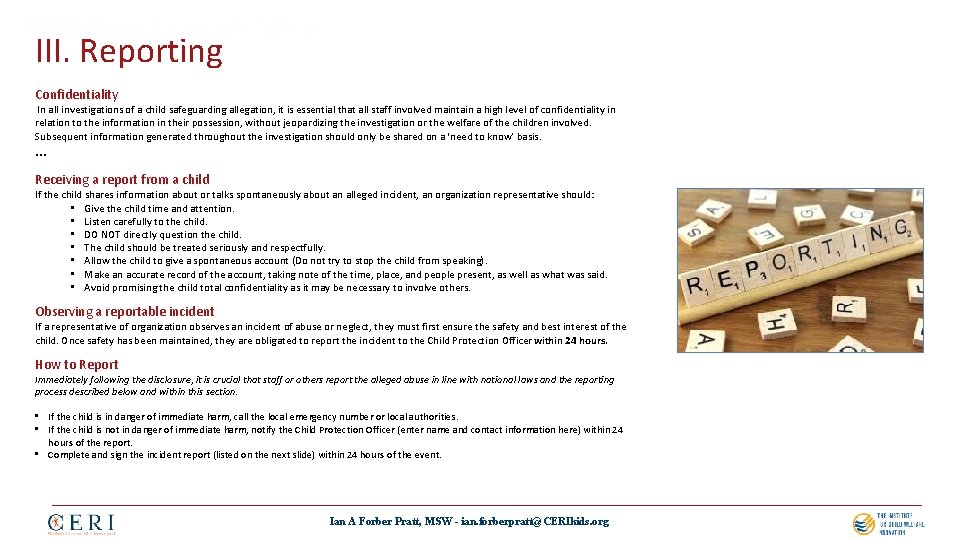
III. Reporting Confidentiality In all investigations of a child safeguarding allegation, it is essential that all staff involved maintain a high level of confidentiality in relation to the information in their possession, without jeopardizing the investigation or the welfare of the children involved. Subsequent information generated throughout the investigation should only be shared on a ‘need to know’ basis. *** Receiving a report from a child If the child shares information about or talks spontaneously about an alleged incident, an organization representative should: • Give the child time and attention. • Listen carefully to the child. • DO NOT directly question the child. • The child should be treated seriously and respectfully. • Allow the child to give a spontaneous account (Do not try to stop the child from speaking). • Make an accurate record of the account, taking note of the time, place, and people present, as well as what was said. • Avoid promising the child total confidentiality as it may be necessary to involve others. Observing a reportable incident If a representative of organization observes an incident of abuse or neglect, they must first ensure the safety and best interest of the child. Once safety has been maintained, they are obligated to report the incident to the Child Protection Officer within 24 hours. How to Report Immediately following the disclosure, it is crucial that staff or others report the alleged abuse in line with national laws and the reporting process described below and within this section. • If the child is in danger of immediate harm, call the local emergency number or local authorities. • If the child is not in danger of immediate harm, notify the Child Protection Officer (enter name and contact information here) within 24 hours of the report. • Complete and sign the incident report (listed on the next slide) within 24 hours of the event. Ian A Forber Pratt, MSW - ian. forberpratt@CERIkids. org
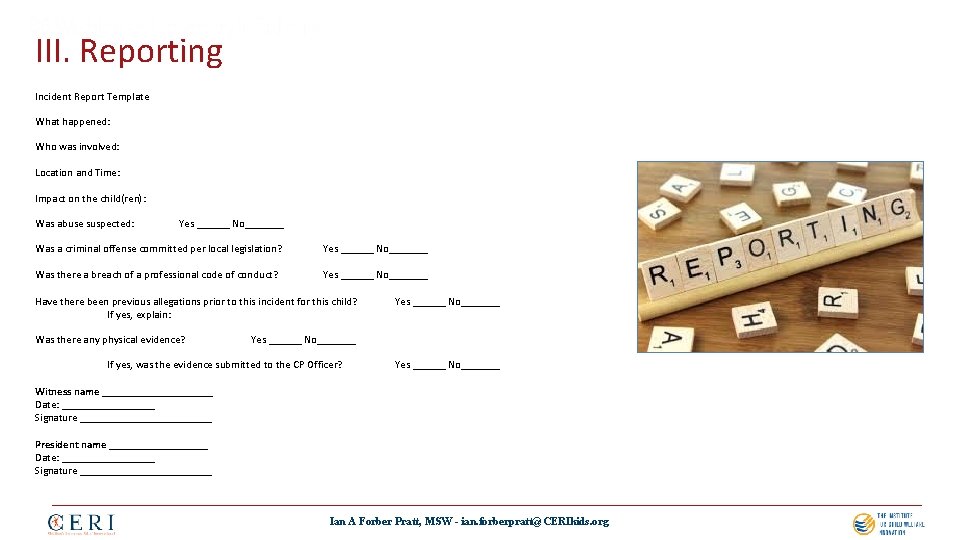
III. Reporting Incident Report Template What happened: Who was involved: Location and Time: Impact on the child(ren): Was abuse suspected: Yes ______ No_______ Was a criminal offense committed per local legislation? Yes ______ No_______ Was there a breach of a professional code of conduct? Yes ______ No_______ Have there been previous allegations prior to this incident for this child? If yes, explain: Was there any physical evidence? Yes ______ No_______ If yes, was the evidence submitted to the CP Officer? Yes ______ No_______ Witness name __________ Date: _________ Signature ____________ President name _________ Date: _________ Signature ____________ Ian A Forber Pratt, MSW - ian. forberpratt@CERIkids. org
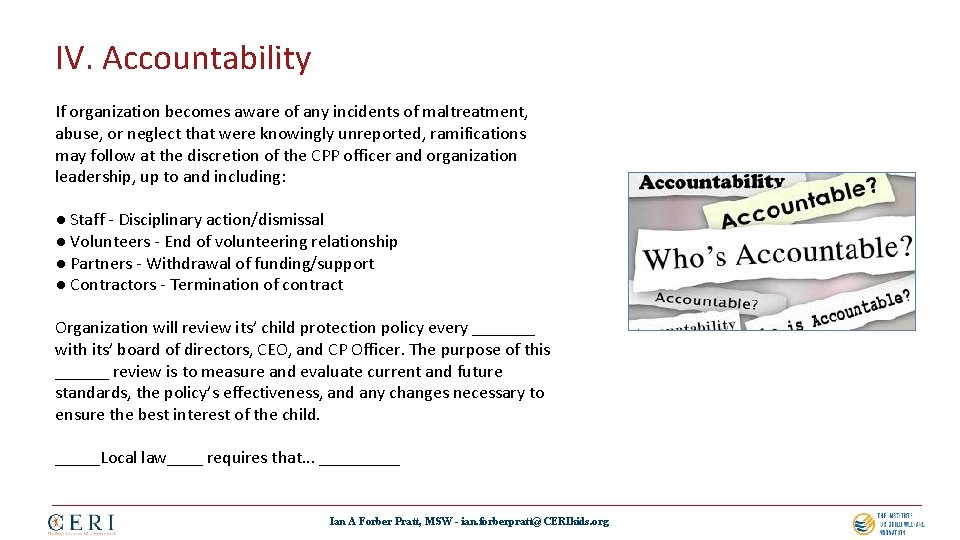
IV. Accountability If organization becomes aware of any incidents of maltreatment, abuse, or neglect that were knowingly unreported, ramifications may follow at the discretion of the CPP officer and organization leadership, up to and including: ● Staff - Disciplinary action/dismissal ● Volunteers - End of volunteering relationship ● Partners - Withdrawal of funding/support ● Contractors - Termination of contract Organization will review its’ child protection policy every _______ with its’ board of directors, CEO, and CP Officer. The purpose of this ______ review is to measure and evaluate current and future standards, the policy’s effectiveness, and any changes necessary to ensure the best interest of the child. _____Local law____ requires that. . . _____ Ian A Forber Pratt, MSW - ian. forberpratt@CERIkids. org
Critical Questions After hearing this chat what do you plan to do in your organisation? What have you thought about differently from this talk? How might you ACT? Ian A Forber Pratt, MSW - ian. forberpratt@CERIkids. org
Tangent Without good people, none of this matters. What are you doing for? • Creative onboarding (show front-end pdf) • Proper, trained, consistent supervision • Intentional innovation not innovation fatigue • Mission adherence • HR clarity • Appreciation mechanisms • ABOVE ALL ELSE - safety Ian A Forber Pratt, MSW - ian. forberpratt@CERIkids. org
Ian A Forber Pratt, MSW - ian. forberpratt@CERIkids. org