
Lean Six Sigma Green Belt Toll Gate Review
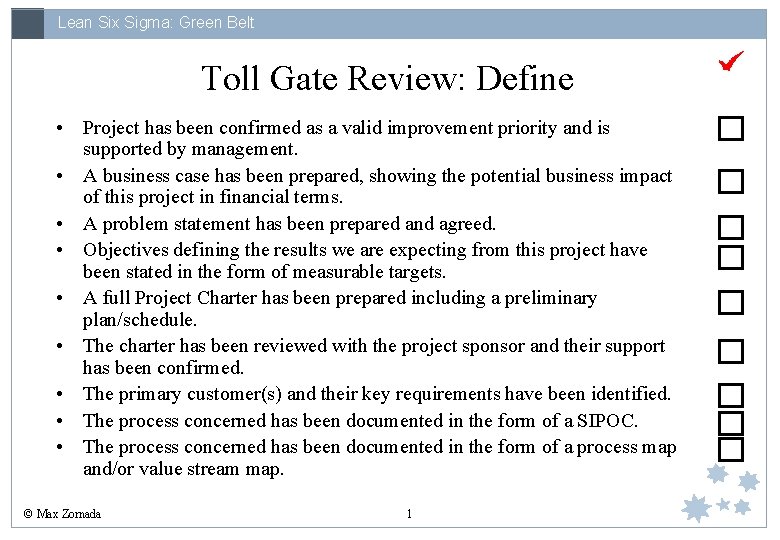
Lean Six Sigma: Green Belt Toll Gate Review: Define • Project has been confirmed as a valid improvement priority and is supported by management. • A business case has been prepared, showing the potential business impact of this project in financial terms. • A problem statement has been prepared and agreed. • Objectives defining the results we are expecting from this project have been stated in the form of measurable targets. • A full Project Charter has been prepared including a preliminary plan/schedule. • The charter has been reviewed with the project sponsor and their support has been confirmed. • The primary customer(s) and their key requirements have been identified. • The process concerned has been documented in the form of a SIPOC. • The process concerned has been documented in the form of a process map and/or value stream map. © Max Zornada 1
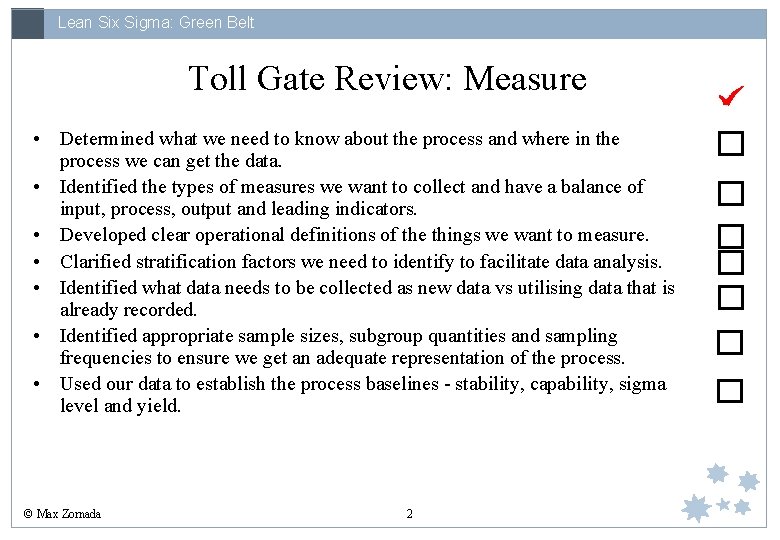
Lean Six Sigma: Green Belt Toll Gate Review: Measure • Determined what we need to know about the process and where in the process we can get the data. • Identified the types of measures we want to collect and have a balance of input, process, output and leading indicators. • Developed clear operational definitions of the things we want to measure. • Clarified stratification factors we need to identify to facilitate data analysis. • Identified what data needs to be collected as new data vs utilising data that is already recorded. • Identified appropriate sample sizes, subgroup quantities and sampling frequencies to ensure we get an adequate representation of the process. • Used our data to establish the process baselines - stability, capability, sigma level and yield. © Max Zornada 2
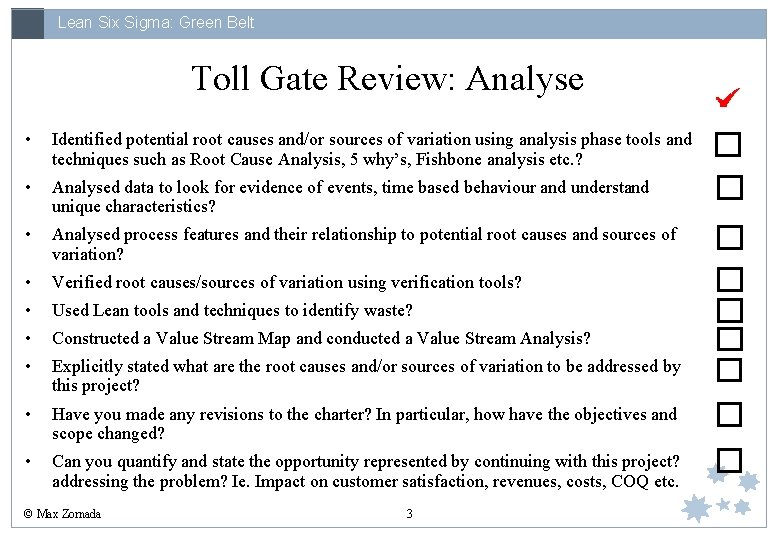
Lean Six Sigma: Green Belt Toll Gate Review: Analyse • Identified potential root causes and/or sources of variation using analysis phase tools and techniques such as Root Cause Analysis, 5 why’s, Fishbone analysis etc. ? • Analysed data to look for evidence of events, time based behaviour and understand unique characteristics? • Analysed process features and their relationship to potential root causes and sources of variation? • Verified root causes/sources of variation using verification tools? • Used Lean tools and techniques to identify waste? • Constructed a Value Stream Map and conducted a Value Stream Analysis? • Explicitly stated what are the root causes and/or sources of variation to be addressed by this project? • Have you made any revisions to the charter? In particular, how have the objectives and scope changed? • Can you quantify and state the opportunity represented by continuing with this project? addressing the problem? Ie. Impact on customer satisfaction, revenues, costs, COQ etc. © Max Zornada 3
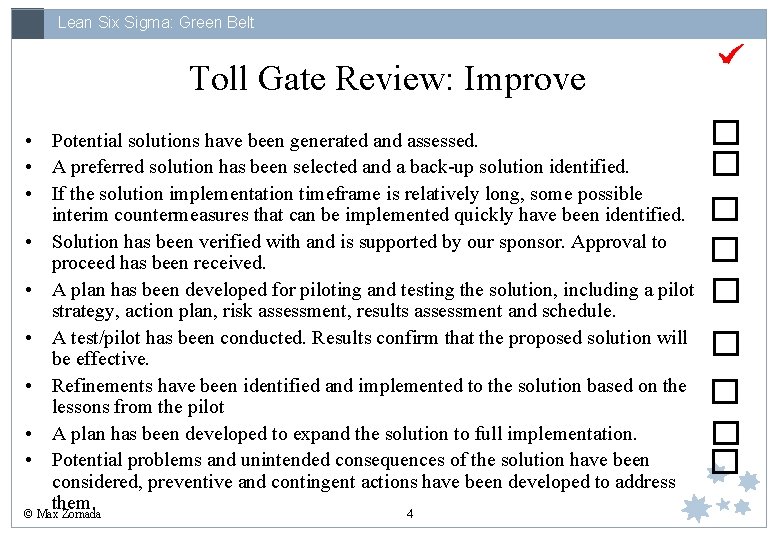
Lean Six Sigma: Green Belt Toll Gate Review: Improve • Potential solutions have been generated and assessed. • A preferred solution has been selected and a back-up solution identified. • If the solution implementation timeframe is relatively long, some possible interim countermeasures that can be implemented quickly have been identified. • Solution has been verified with and is supported by our sponsor. Approval to proceed has been received. • A plan has been developed for piloting and testing the solution, including a pilot strategy, action plan, risk assessment, results assessment and schedule. • A test/pilot has been conducted. Results confirm that the proposed solution will be effective. • Refinements have been identified and implemented to the solution based on the lessons from the pilot • A plan has been developed to expand the solution to full implementation. • Potential problems and unintended consequences of the solution have been considered, preventive and contingent actions have been developed to address them. © Max Zornada 4
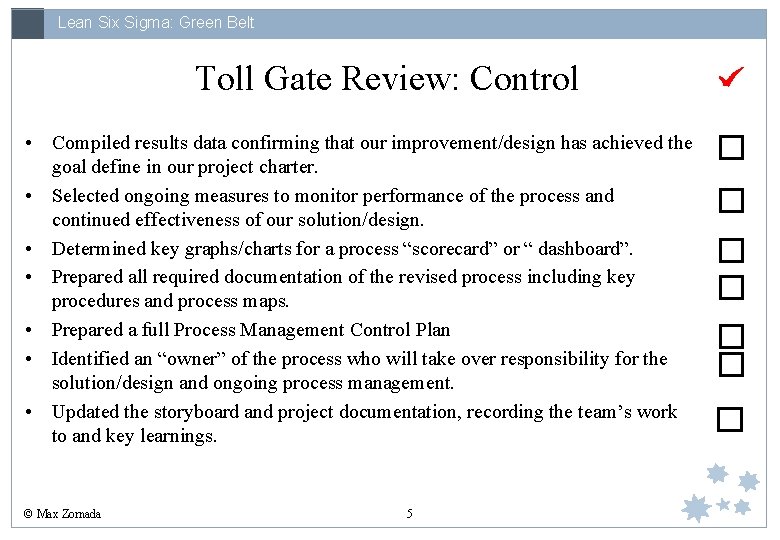
Lean Six Sigma: Green Belt Toll Gate Review: Control • Compiled results data confirming that our improvement/design has achieved the goal define in our project charter. • Selected ongoing measures to monitor performance of the process and continued effectiveness of our solution/design. • Determined key graphs/charts for a process “scorecard” or “ dashboard”. • Prepared all required documentation of the revised process including key procedures and process maps. • Prepared a full Process Management Control Plan • Identified an “owner” of the process who will take over responsibility for the solution/design and ongoing process management. • Updated the storyboard and project documentation, recording the team’s work to and key learnings. © Max Zornada 5
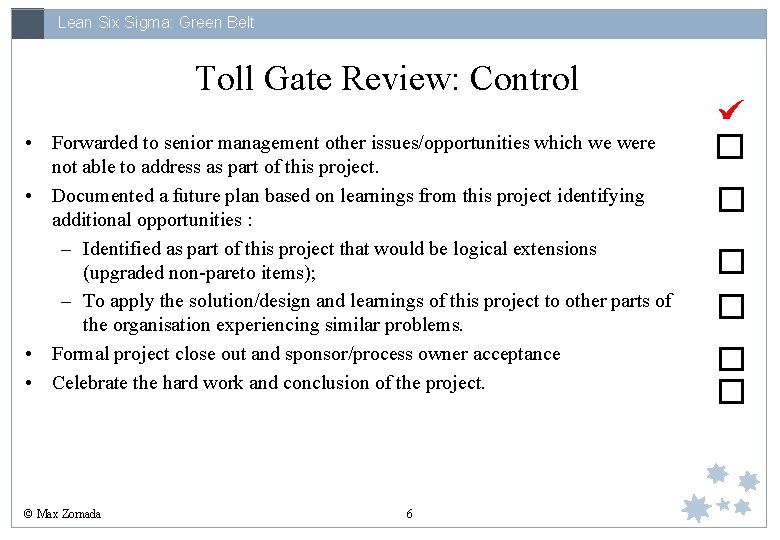
Lean Six Sigma: Green Belt Toll Gate Review: Control • Forwarded to senior management other issues/opportunities which we were not able to address as part of this project. • Documented a future plan based on learnings from this project identifying additional opportunities : – Identified as part of this project that would be logical extensions (upgraded non-pareto items); – To apply the solution/design and learnings of this project to other parts of the organisation experiencing similar problems. • Formal project close out and sponsor/process owner acceptance • Celebrate the hard work and conclusion of the project. © Max Zornada 6
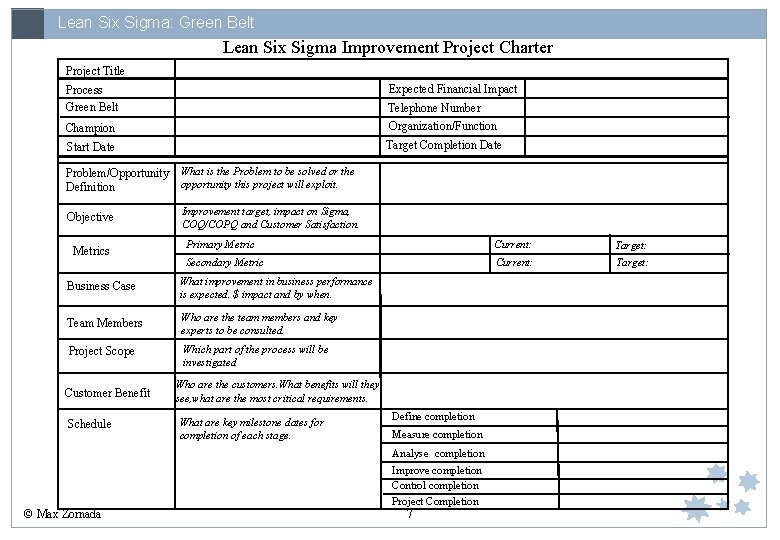
Lean Six Sigma: Green Belt Lean Six Sigma Improvement Project Charter Project Title Expected Financial Impact Process Green Belt Telephone Number Champion Organization/Function Start Date Target Completion Date Problem/Opportunity Definition What is the Problem to be solved or the opportunity this project will exploit. Objective Improvement target, impact on Sigma, COQ/COPQ and Customer Satisfaction. Metrics Primary Metric Current: Target: Secondary Metric Current: Target: Business Case What improvement in business performance is expected. $ impact and by when. Team Members Who are the team members and key experts to be consulted. Project Scope Which part of the process will be investigated Customer Benefit Schedule Who are the customers. What benefits will they see, what are the most critical requirements. What are key milestone dates for completion of each stage. Define completion Measure completion Analyse completion © Max Zornada Improve completion Control completion Project Completion 7
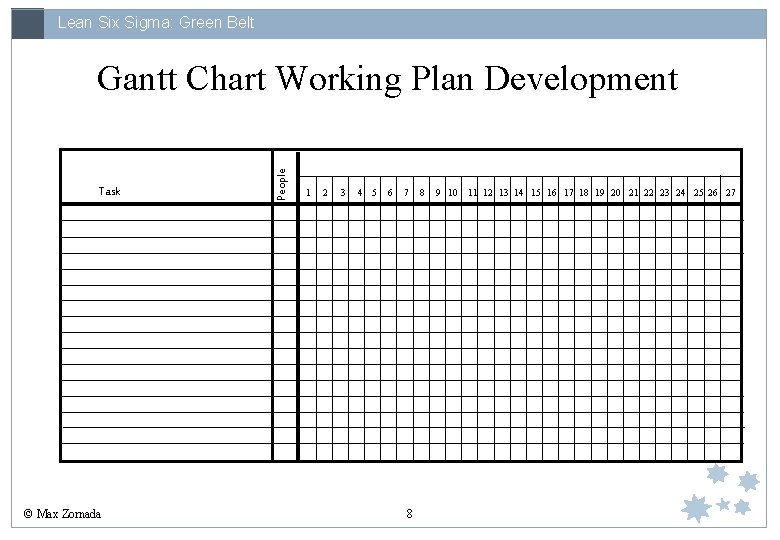
Lean Six Sigma: Green Belt Task © Max Zornada People Gantt Chart Working Plan Development 1 2 3 4 5 6 7 8 8 9 10 11 12 13 14 15 16 17 18 19 20 21 22 23 24 25 26 27
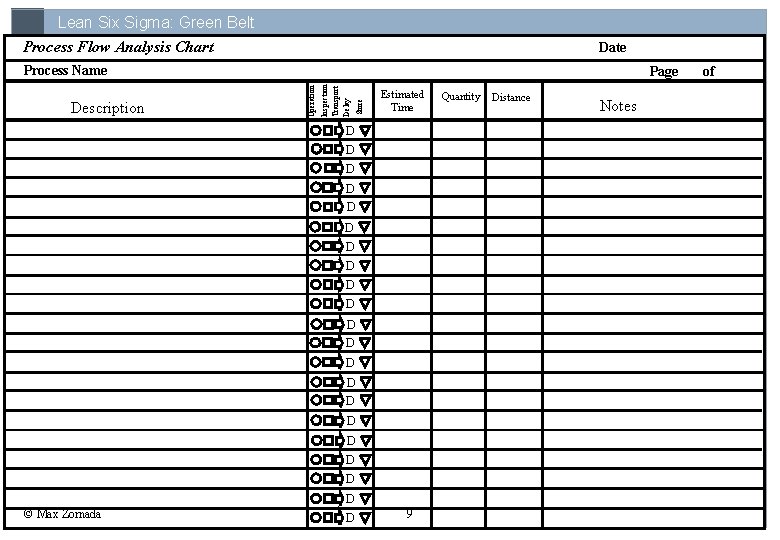
Lean Six Sigma: Green Belt Process Flow Analysis Chart Date Process Name Store Inspection Transport Delay Operation Description Page Estimated Time D D D D D © Max Zornada D D 9 Quantity Distance Notes of
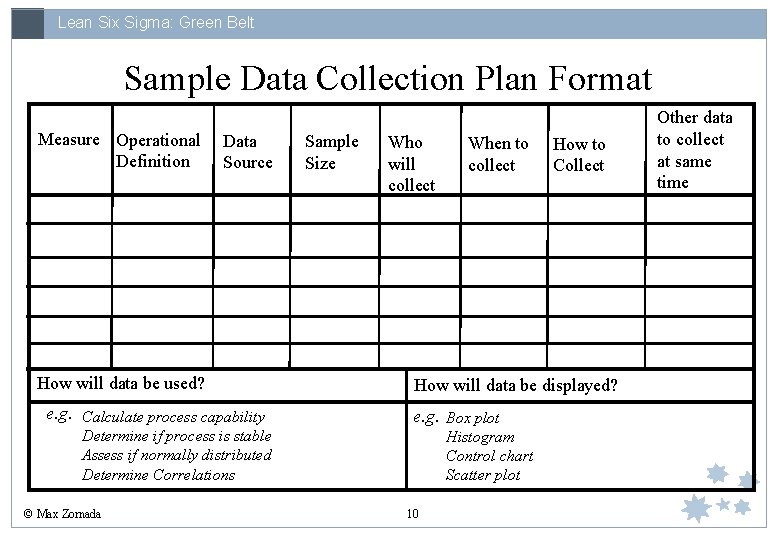
Lean Six Sigma: Green Belt Sample Data Collection Plan Format Measure Operational Definition Data Source How will data be used? e. g. Calculate process capability Sample Size Who will collect How to Collect How will data be displayed? e. g. Box plot Determine if process is stable Assess if normally distributed Determine Correlations © Max Zornada When to collect Histogram Control chart Scatter plot 10 Other data to collect at same time
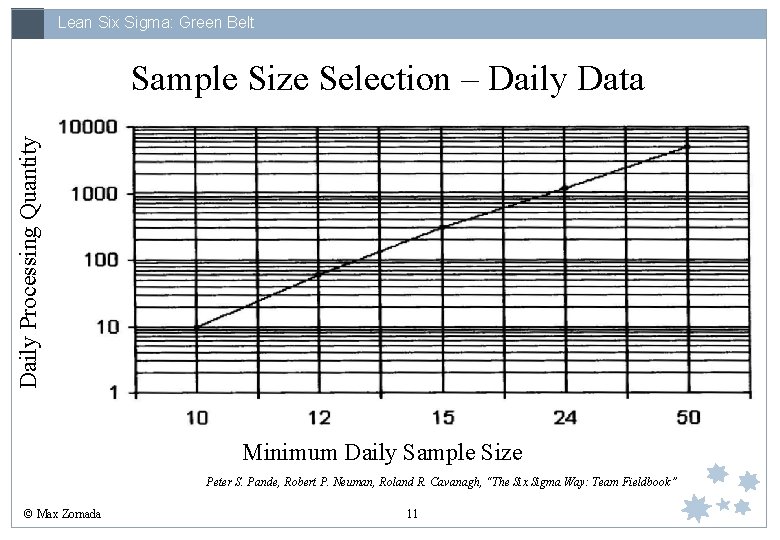
Lean Six Sigma: Green Belt Daily Processing Quantity Sample Size Selection – Daily Data Minimum Daily Sample Size Peter S. Pande, Robert P. Neuman, Roland R. Cavanagh, “The Six Sigma Way: Team Fieldbook” © Max Zornada 11
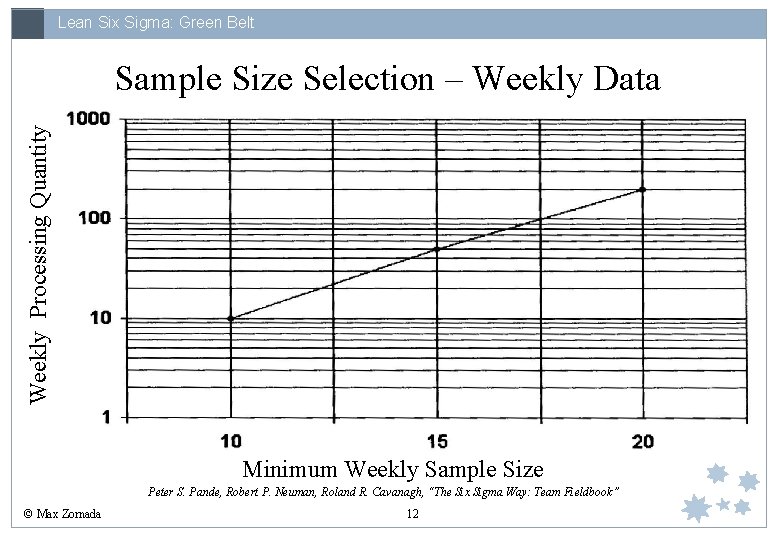
Lean Six Sigma: Green Belt Weekly Processing Quantity Sample Size Selection – Weekly Data Minimum Weekly Sample Size Peter S. Pande, Robert P. Neuman, Roland R. Cavanagh, “The Six Sigma Way: Team Fieldbook” © Max Zornada 12
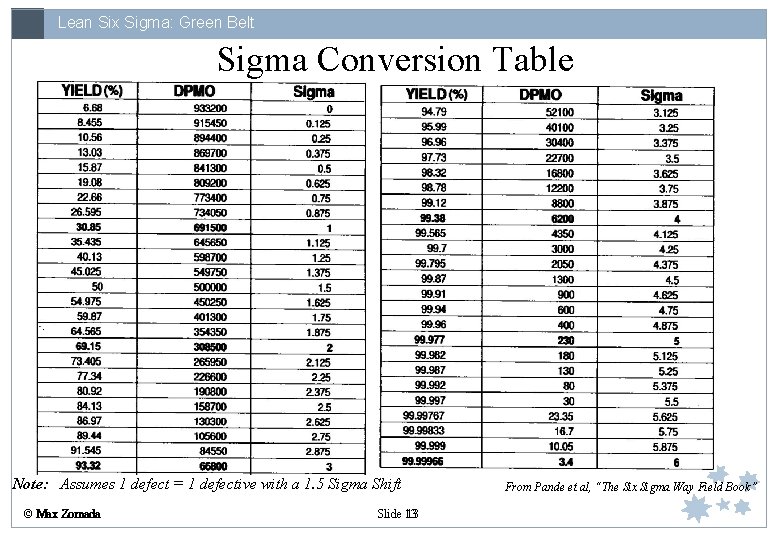
Lean Six Sigma: Green Belt Sigma Conversion Table Note: Assumes 1 defect = 1 defective with a 1. 5 Sigma Shift © Max Zornada 13 Slide 13 From Pande et al, “The Six Sigma Way Field Book”
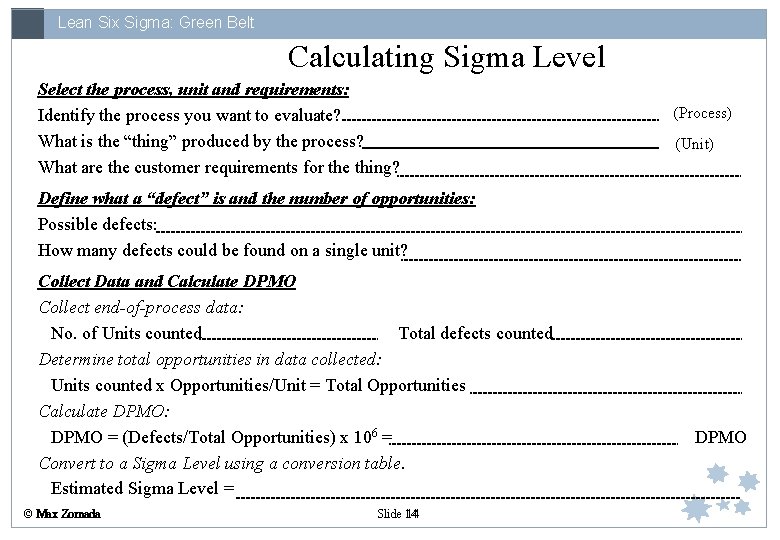
Lean Six Sigma: Green Belt Calculating Sigma Level Select the process, unit and requirements: Identify the process you want to evaluate? What is the “thing” produced by the process? What are the customer requirements for the thing? (Process) (Unit) Define what a “defect” is and the number of opportunities: Possible defects: How many defects could be found on a single unit? Collect Data and Calculate DPMO Collect end-of-process data: No. of Units counted Total defects counted Determine total opportunities in data collected: Units counted x Opportunities/Unit = Total Opportunities Calculate DPMO: DPMO = (Defects/Total Opportunities) x 106 = Convert to a Sigma Level using a conversion table. Estimated Sigma Level = © Max Zornada 14 Slide 14 DPMO
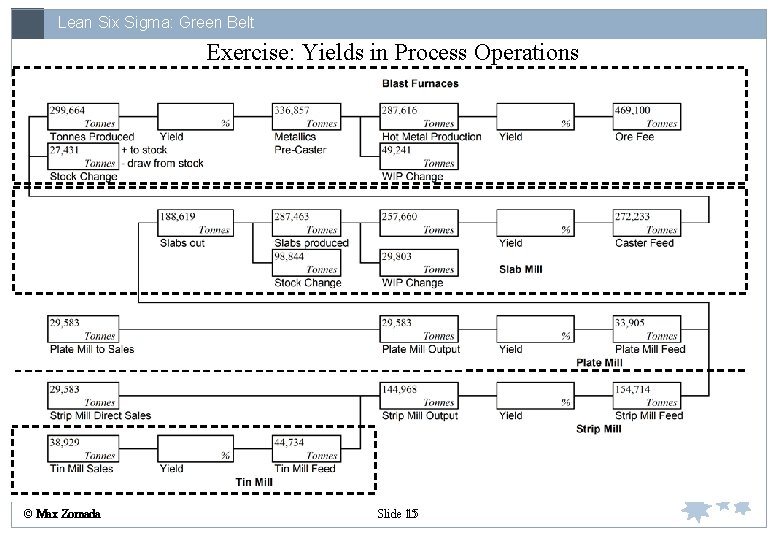
Lean Six Sigma: Green Belt Exercise: Yields in Process Operations © Max Zornada 15 Slide 15
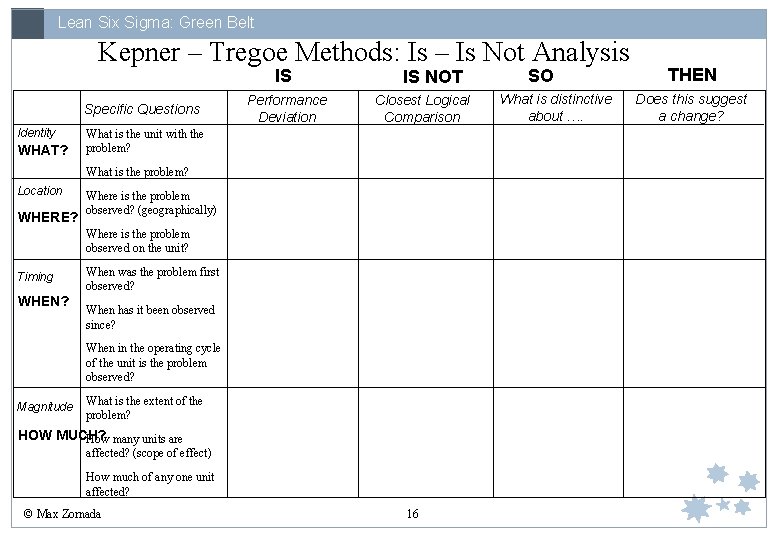
Lean Six Sigma: Green Belt Kepner – Tregoe Methods: Is – Is Not Analysis IS Specific Questions Identity WHAT? Performance Deviation IS NOT Closest Logical Comparison What is the unit with the problem? What is the problem? Location WHERE? Where is the problem observed? (geographically) Where is the problem observed on the unit? Timing WHEN? When was the problem first observed? When has it been observed since? When in the operating cycle of the unit is the problem observed? Magnitude What is the extent of the problem? HOW MUCH? How many units are affected? (scope of effect) How much of any one unit affected? © Max Zornada 16 SO What is distinctive about …. THEN Does this suggest a change?
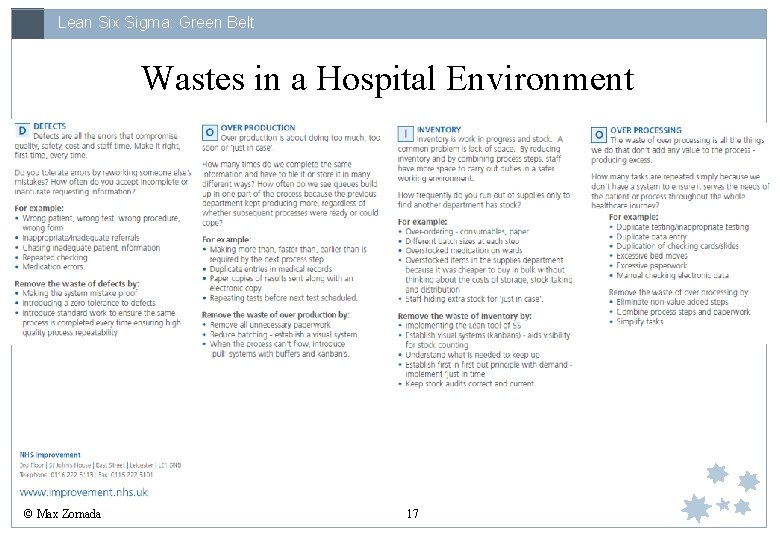
Lean Six Sigma: Green Belt Wastes in a Hospital Environment © Max Zornada 17
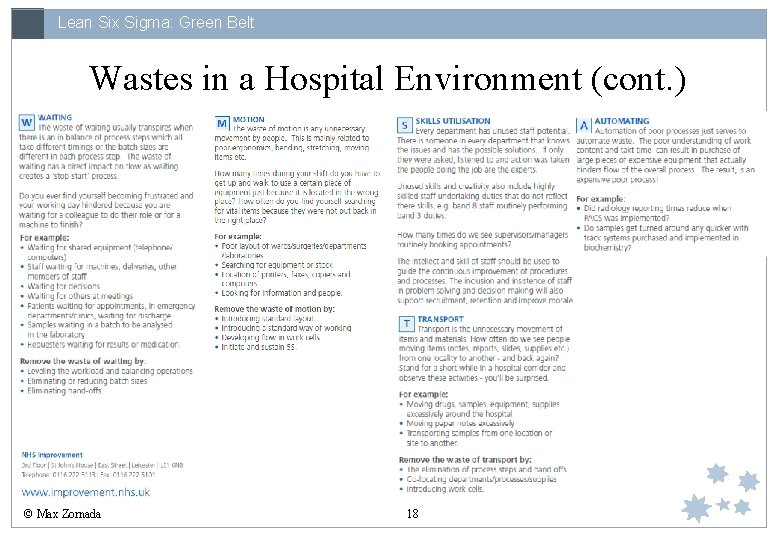
Lean Six Sigma: Green Belt Wastes in a Hospital Environment (cont. ) © Max Zornada 18
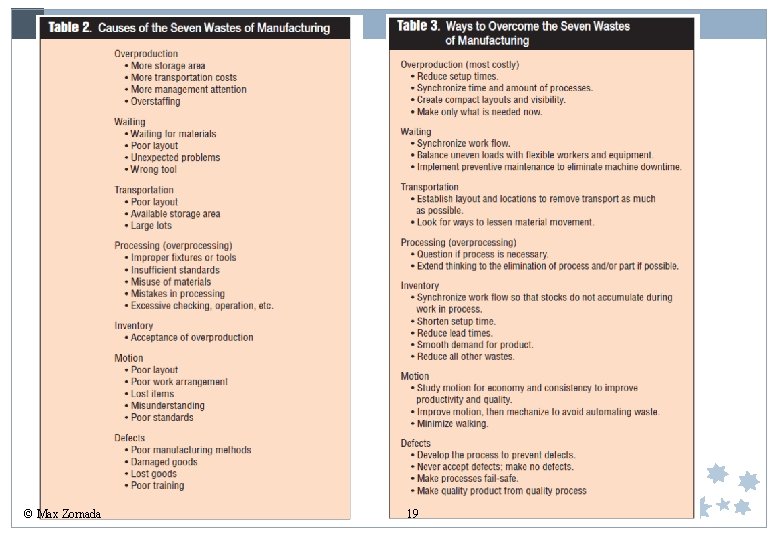
Lean Six Sigma: Green Belt © Max Zornada 19
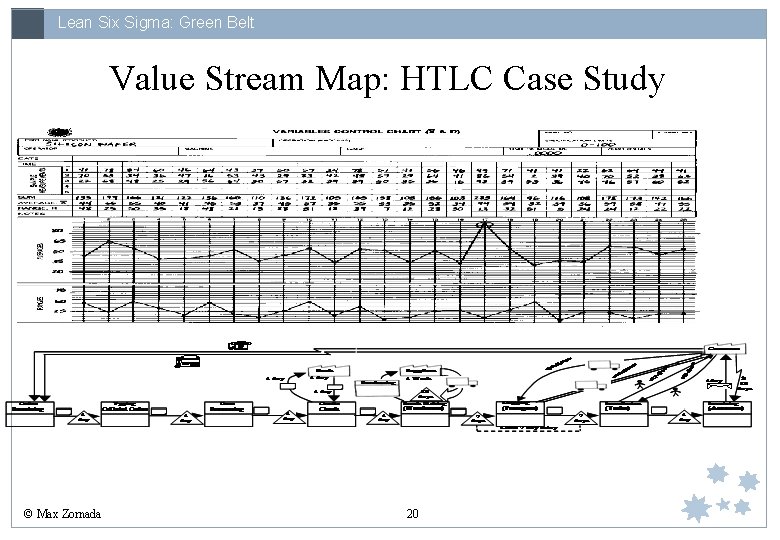
Lean Six Sigma: Green Belt Value Stream Map: HTLC Case Study © Max Zornada 20
Lean Six Sigma: Green Belt © Max Zornada 21
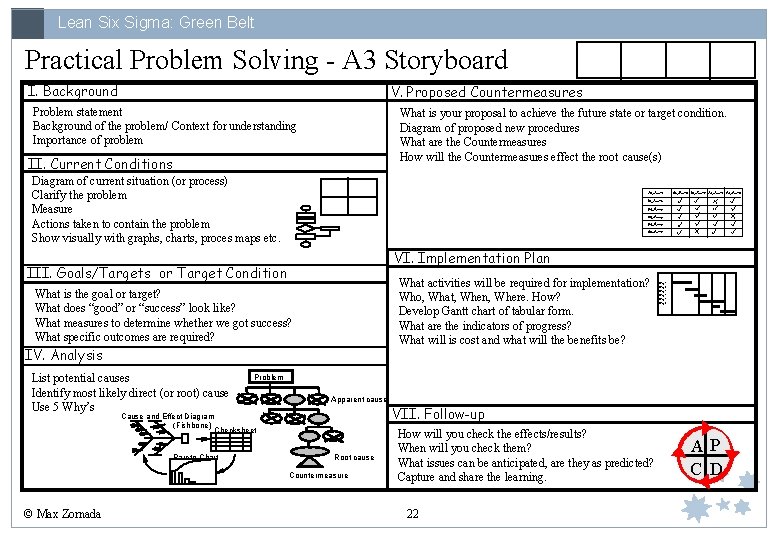
Lean Six Sigma: Green Belt Practical Problem Solving - A 3 Storyboard I. Background V. Proposed Countermeasures Problem statement Background of the problem/ Context for understanding Importance of problem What is your proposal to achieve the future state or target condition. Diagram of proposed new procedures What are the Countermeasures How will the Countermeasures effect the root cause(s) II. Current Conditions Diagram of current situation (or process) Clarify the problem Measure Actions taken to contain the problem Show visually with graphs, charts, proces maps etc. VI. Implementation Plan III. Goals/Targets or Target Condition What activities will be required for implementation? Who, What, When, Where. How? Develop Gantt chart of tabular form. What are the indicators of progress? What will is cost and what will the benefits be? What is the goal or target? What does “good” or “success” look like? What measures to determine whether we got success? What specific outcomes are required? IV. Analysis List potential causes Identify most likely direct (or root) cause Use 5 Why’s Problem Apparent cause Cause and Effect Diagram (Fishbone) Checksheet Pareto Chart Root cause Countermeasure © Max Zornada Step 1 Step 2 Step 3 Step 4 Step 5 Step 6 VII. Follow-up How will you check the effects/results? When will you check them? What issues can be anticipated, are they as predicted? Capture and share the learning. 22 AP C D
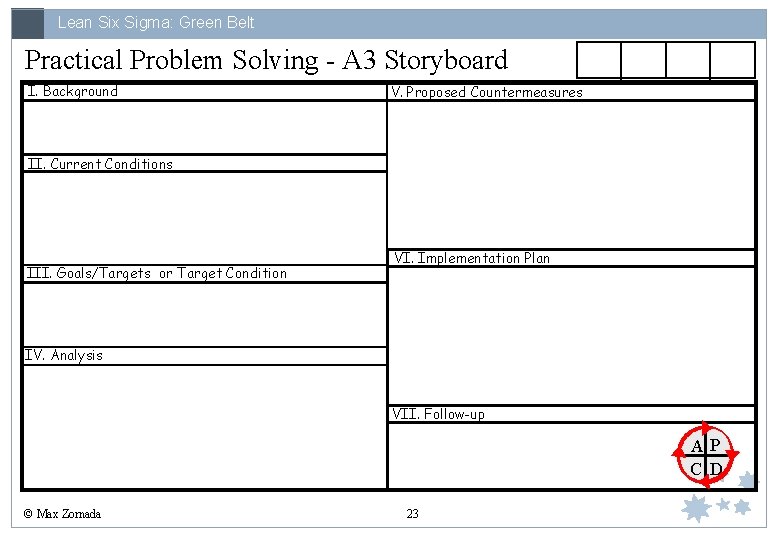
Lean Six Sigma: Green Belt Practical Problem Solving - A 3 Storyboard I. Background V. Proposed Countermeasures II. Current Conditions III. Goals/Targets or Target Condition VI. Implementation Plan IV. Analysis VII. Follow-up AP C D © Max Zornada 23
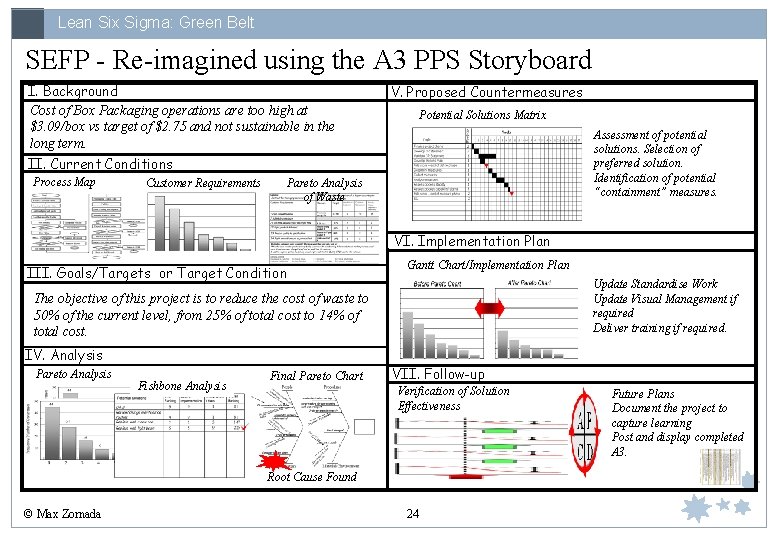
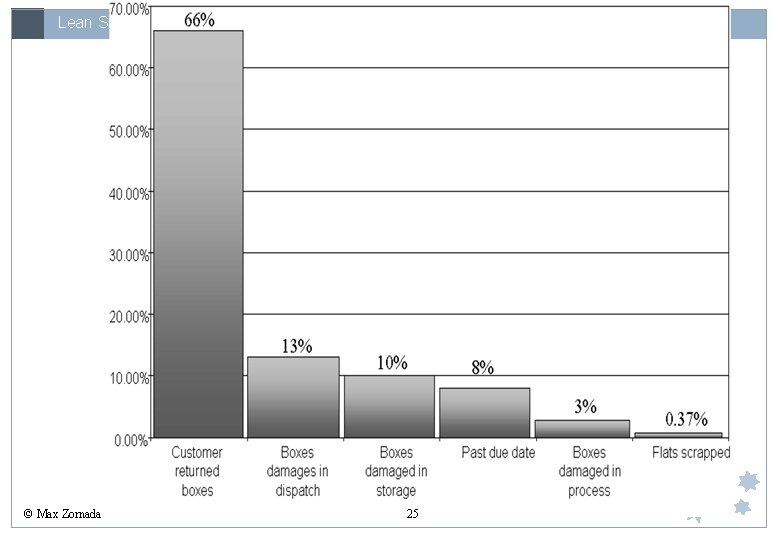
Lean Six Sigma: Green Belt SEFP - Re-imagined using the A 3 PPS Storyboard I. Background Cost of Box Packaging operations are too high at $3. 09/box vs target of $2. 75 and not sustainable in the long term. II. Current Conditions Process Map Customer Requirements V. Proposed Countermeasures Potential Solutions Matrix Assessment of potential solutions. Selection of preferred solution. Identification of potential “containment” measures. Pareto Analysis of Waste VI. Implementation Plan III. Goals/Targets or Target Condition Gantt Chart/Implementation Plan Update Standardise Work Update Visual Management if required Deliver training if required. The objective of this project is to reduce the cost of waste to 50% of the current level, from 25% of total cost to 14% of total cost. IV. Analysis Pareto Analysis Fishbone Analysis Final Pareto Chart VII. Follow-up Verification of Solution Effectiveness Root Cause Found © Max Zornada 24 Future Plans Document the project to capture learning Post and display completed A 3.
Lean Six Sigma: Green Belt © Max Zornada 25
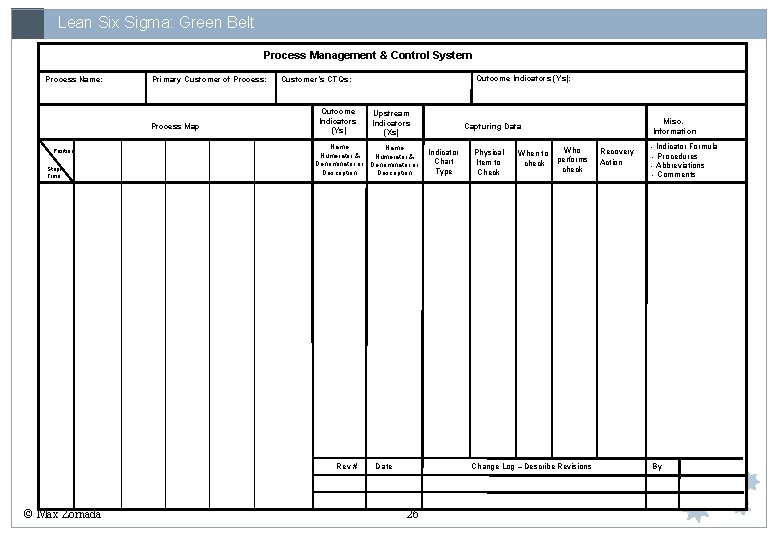
Lean Six Sigma: Green Belt Process Management & Control System Process Name: Primary Customer of Process: Process Map Position Step/ Time Outcome Indicators (Ys) Upstream Indicators (Xs) Name Numerator & Denominator or Description Rev # © Max Zornada Outcome Indicators (Ys): Customer’s CTQs: Misc. Information Capturing Data Indicator Chart Type Physical Item to Check When to check Who performs check Change Log – Describe Revisions Date 26 Recovery Action - Indicator Formula - Procedures - Abbreviations - Comments By
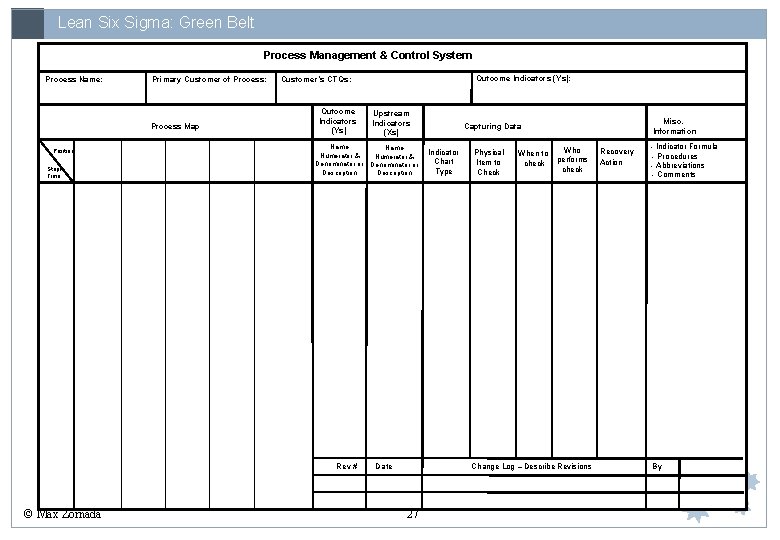
Lean Six Sigma: Green Belt Process Management & Control System Process Name: Primary Customer of Process: Process Map Position Step/ Time Outcome Indicators (Ys) Upstream Indicators (Xs) Name Numerator & Denominator or Description Rev # © Max Zornada Outcome Indicators (Ys): Customer’s CTQs: Misc. Information Capturing Data Indicator Chart Type Physical Item to Check When to check Who performs check Change Log – Describe Revisions Date 27 Recovery Action - Indicator Formula - Procedures - Abbreviations - Comments By
Lean Six Sigma: Green Belt © Max Zornada 28
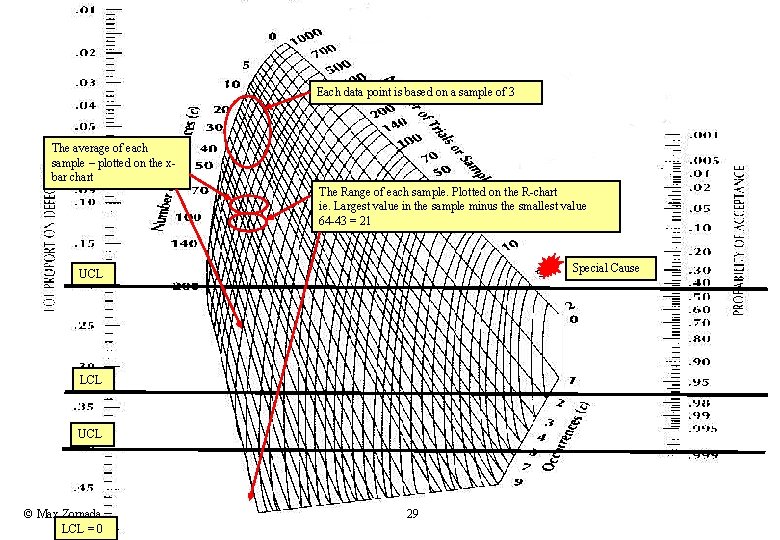
Lean Six Sigma: Green Belt Each data point is based on a sample of 3 The average of each sample – plotted on the xbar chart The Range of each sample. Plotted on the R-chart ie. Largest value in the sample minus the smallest value 64 -43 = 21 Special Cause UCL LCL UCL © Max Zornada LCL = 0 29
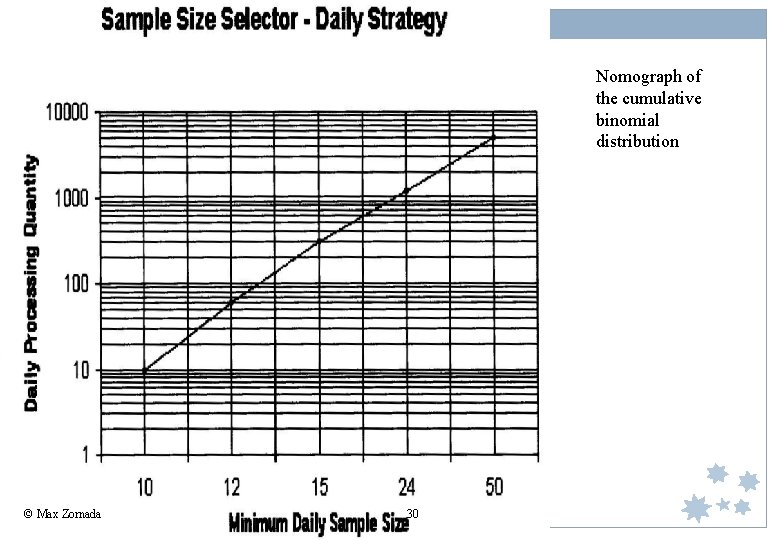
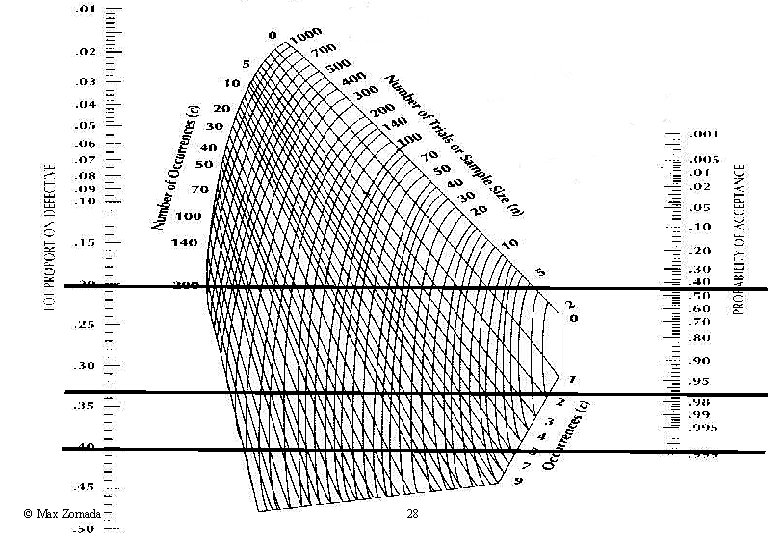
Lean Six Sigma: Green Belt Nomograph of the cumulative binomial distribution © Max Zornada 30
Lean Six Sigma: Green Belt © Max Zornada 31
Lean Six Sigma: Green Belt © Max Zornada 32
Lean Six Sigma: Green Belt © Max Zornada 33
Lean Six Sigma: Green Belt © Max Zornada 34
- Slides: 34