
Lean Six Sigma Bret Cris Jeff Agenda Evolution
Lean & Six Sigma Bret, Cris, & Jeff
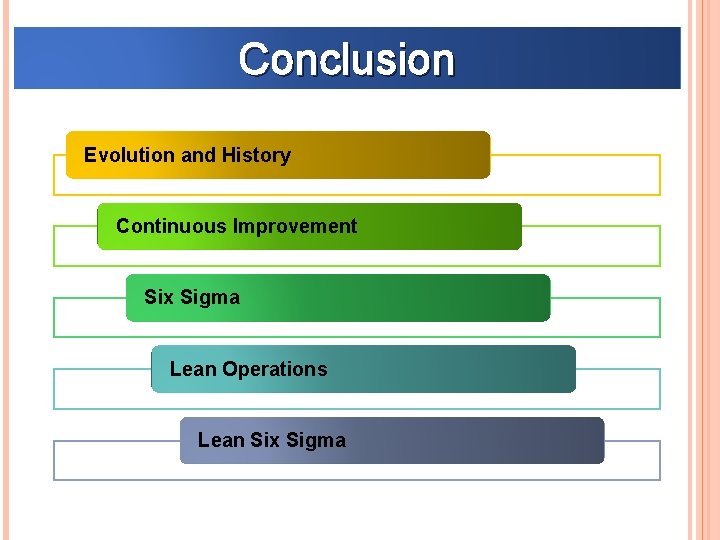
Agenda Evolution and History Continuous Improvement Six Sigma Lean Operations Lean Six Sigma Summary and Questions
HISTORY Total Quality Management (TQM) continually evolved beginning in the 1950 s, with a focus on process management, customer quality, and use of data and systematic procedures for understanding and resolving problems. Six Sigma grew in the 1980 s, beginning at Motorola and spreading to companies including General Electric and Allied. Signal. It incorporated TQM as well as Statistical Process Control (SPC) and expanded from a manufacturing focus to other industries and processes.
HISTORY Lean Operations Lean developed from the concepts comprising the Toyota Production System (TPS): elimination of waste of all types, including excess inventory and increased process speed. It established a focus on the customer definition of value and used that to determine the proper process timing and flow. Lean Six Sigma In the late 1990 s, both Allied. Signal and Maytag independently designed programs which combined aspects of both Lean and Six Sigma. They cross-trained employees in both methodologies, creating project frameworks that combined the two techniques.
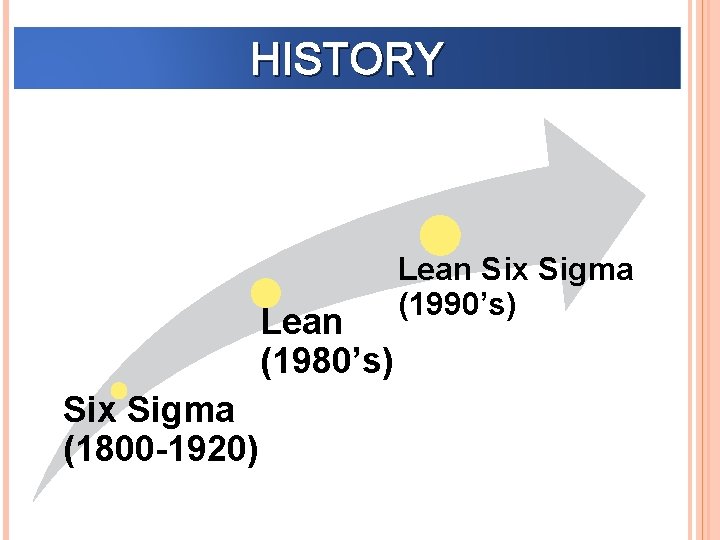
HISTORY Lean (1980’s) Six Sigma (1800 -1920) Lean Six Sigma (1990’s)
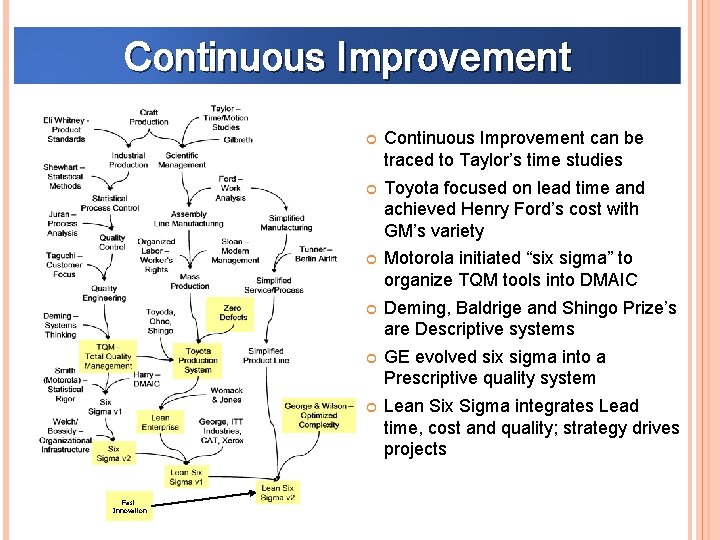
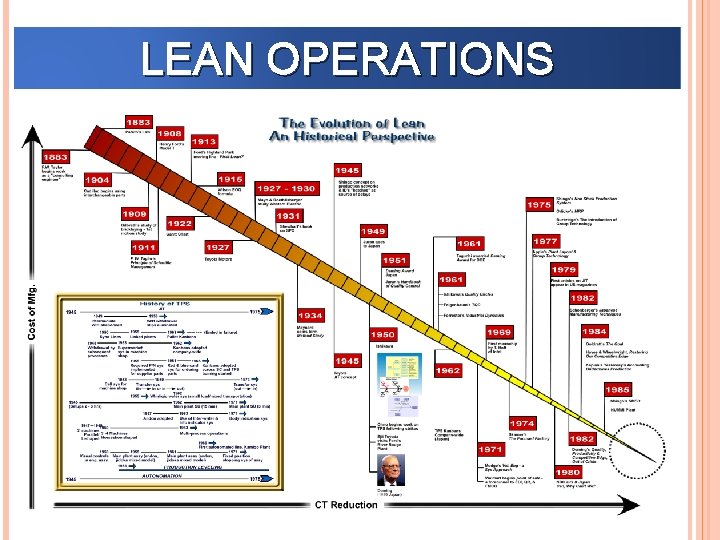
Continuous Improvement Fast Innovation Continuous Improvement can be traced to Taylor’s time studies Toyota focused on lead time and achieved Henry Ford’s cost with GM’s variety Motorola initiated “six sigma” to organize TQM tools into DMAIC Deming, Baldrige and Shingo Prize’s are Descriptive systems GE evolved six sigma into a Prescriptive quality system Lean Six Sigma integrates Lead time, cost and quality; strategy drives projects
SIX SIGMA Measurement Standard Ø Frederick Gauss (1777 -1855) Ø Concept of the normal Product Variation ØWalter Shewhart (1920’s) Multiple Measurement Variations ØMotorola…trademark ØBill Smith ØCoined the term “Six Sigma”
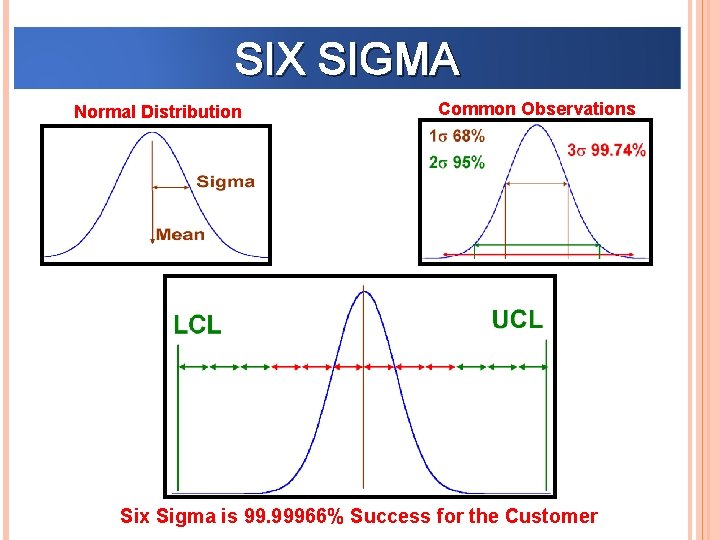
SIX SIGMA Normal Distribution Common Observations Six Sigma is 99. 99966% Success for the Customer
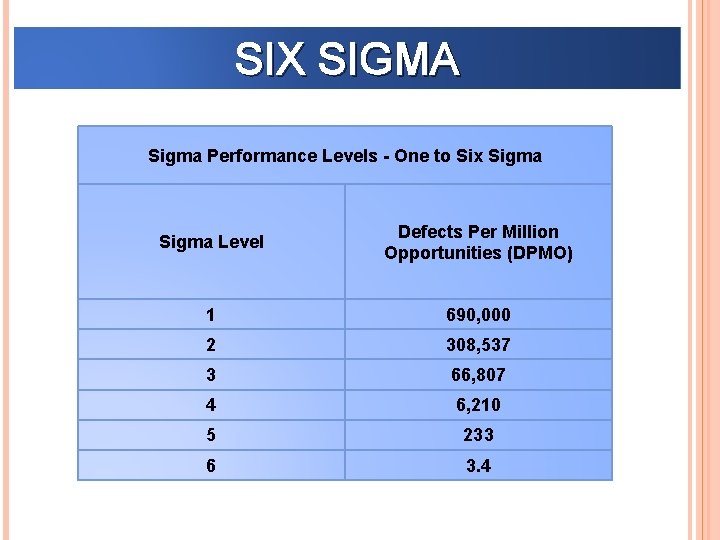
SIX SIGMA Sigma Performance Levels - One to Six Sigma Level Defects Per Million Opportunities (DPMO) 1 690, 000 2 308, 537 3 66, 807 4 6, 210 5 233 6 3. 4

SIX SIGMA Real-world Performance Levels Situation/Example In 1 Sigma World In 3 Sigma World In 6 Sigma World Pieces of your mail lost per year [1, 600 opportunities per year] 1, 106 107 Less than 1 Number of empty coffee pots at work (who didn't fill the coffee pot again? ) [680 opportunities per year] 470 45 Less than 1 Number of telephone disconnections [7, 000 talk minutes] 4, 839 467 0. 02 Erroneous business orders [250, 000 opportunities per year] 172, 924 16, 694 0. 9

SIX SIGMA Methodologies Six Sigma Defect Reduction Cycle Time Reduction DMADOV DMADV DMAIC DSSS CFPM Define Measure Analyze Optimize Verify Measure Analyze Design Verify Measure Analyze Improve Control Develop Six Sigma Software Cross Function Process Mapping Design & Manufacturing Designing New Processes Improving Processes Software Development Improving Cross. Functional Processes
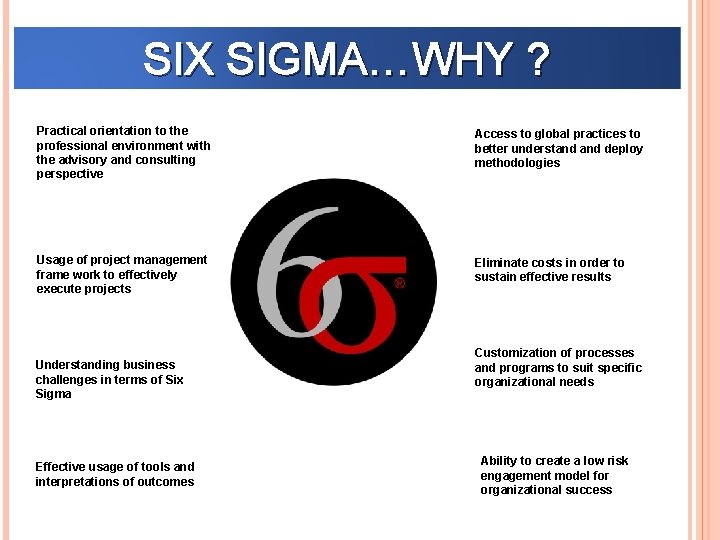
SIX SIGMA…WHY ? Practical orientation to the professional environment with the advisory and consulting perspective Access to global practices to better understand deploy methodologies Usage of project management frame work to effectively execute projects Eliminate costs in order to sustain effective results Understanding business challenges in terms of Six Sigma Effective usage of tools and interpretations of outcomes Customization of processes and programs to suit specific organizational needs Ability to create a low risk engagement model for organizational success
TRAINING EXERCISE
LEAN OPERATIONS
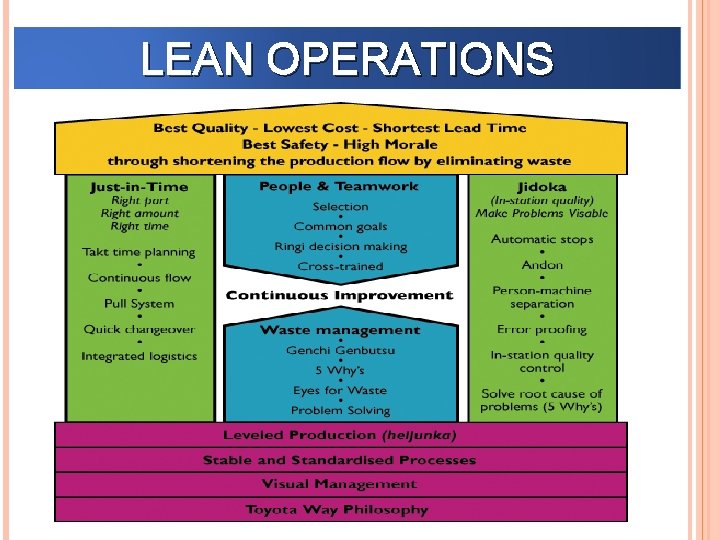
LEAN OPERATIONS What is Lean? (Operations, Manufacturing, or Production) Ø Lean is about doing more with less: less time, inventory, space, labor, and money. "Lean manufacturing", a shorthand for a commitment to eliminating waste, simplifying procedures and speeding up production. Ø Driven by…cost, quality, delivery, safety, & morale
LEAN OPERATIONS
LEAN OPERATIONS Toyota Production System Empowers team members to optimize quality by constantly improving processes and eliminating unnecessary waste in natural, human and corporate resources. Influences every aspect of Toyota’s organization and includes a common set of values, knowledge and procedures. Entrusts employees with well-defined responsibilities in each production step and encourages every team member to strive for overall improvement. Toyota Production System delivers the following key benefits: Ø Quality inherent in Toyota’s products Ø Costs are kept to a minimum thanks to a good return on investment Ø Delivery is on time, and to the expected standard, allowing Toyota’s customers to plan and maintain their operations successfully Ø Environmental concerns are shared by Toyota and its customers, from manufacturing through to recycling at end-of-life Ø Safety is Toyota’s constant concern – both for its employees and for those of its customers.
LEAN OPERATIONS
LEAN OPERATIONS Goals: Ø Ø Ø Ø Eliminate waste Smooth flow Minimize disruptions Minimize inventory Reduce queue, setup, wait, transit times Reduce lead time Introduce flexibility Reduce cost
LEAN OPERATIONS Requirements: Ø Ø Ø Ø Management commitment Quality Training Worker involvement / ownership Flexibility - people and equipment Process changes Supplier partnerships
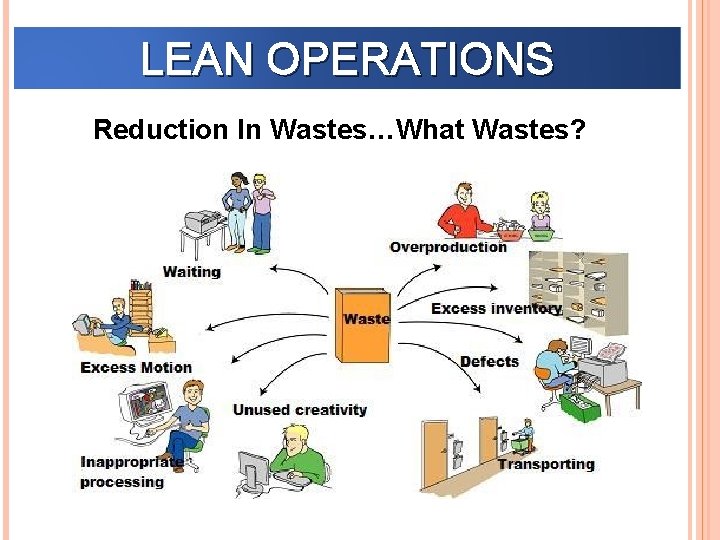
LEAN OPERATIONS Reduction In Wastes…What Wastes?
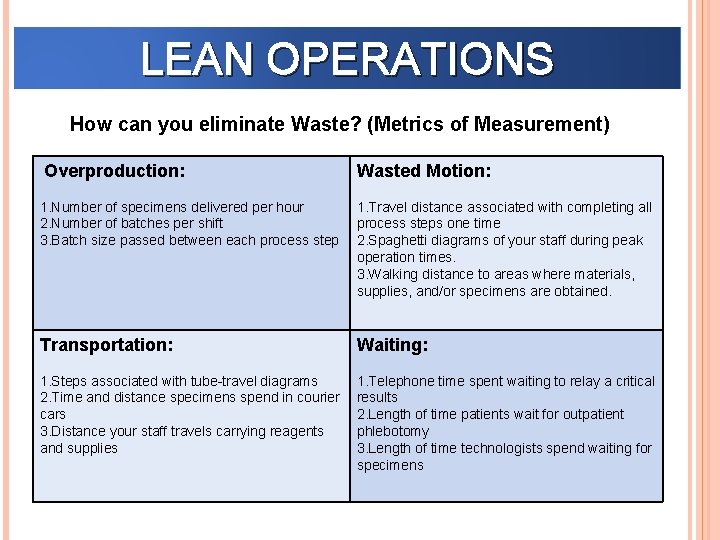
LEAN OPERATIONS How can you eliminate Waste? (Metrics of Measurement) Overproduction: Wasted Motion: 1. Number of specimens delivered per hour 2. Number of batches per shift 3. Batch size passed between each process step 1. Travel distance associated with completing all process steps one time 2. Spaghetti diagrams of your staff during peak operation times. 3. Walking distance to areas where materials, supplies, and/or specimens are obtained. Transportation: Waiting: 1. Steps associated with tube-travel diagrams 2. Time and distance specimens spend in courier cars 3. Distance your staff travels carrying reagents and supplies 1. Telephone time spent waiting to relay a critical results 2. Length of time patients wait for outpatient phlebotomy 3. Length of time technologists spend waiting for specimens
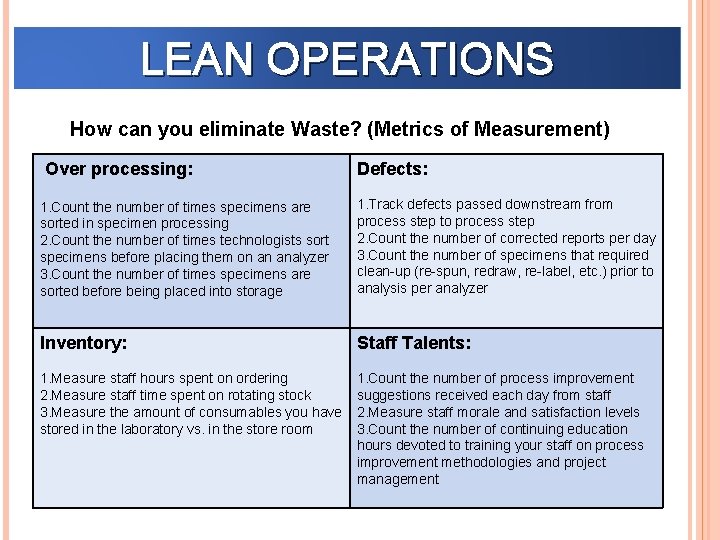
LEAN OPERATIONS How can you eliminate Waste? (Metrics of Measurement) Over processing: Defects: 1. Count the number of times specimens are sorted in specimen processing 2. Count the number of times technologists sort specimens before placing them on an analyzer 3. Count the number of times specimens are sorted before being placed into storage 1. Track defects passed downstream from process step to process step 2. Count the number of corrected reports per day 3. Count the number of specimens that required clean-up (re-spun, redraw, re-label, etc. ) prior to analysis per analyzer Inventory: Staff Talents: 1. Measure staff hours spent on ordering 2. Measure staff time spent on rotating stock 3. Measure the amount of consumables you have stored in the laboratory vs. in the store room 1. Count the number of process improvement suggestions received each day from staff 2. Measure staff morale and satisfaction levels 3. Count the number of continuing education hours devoted to training your staff on process improvement methodologies and project management
LEAN OPERATIONS
TRAINING EXERCISE
LEAN SIX SIGMA Lean, pioneered by Toyota, focuses on the efficient operation of the entire value chain. Focus areas: � Remove non-value added steps to: Reduce cycle time Improve quality � Align production with demand. � Reduce inventory. � Improve process safety and efficiency. Six Sigma, developed by Motorola, made famous by GE, it can be defined as a: � Measure of process capability � Set of tools � Disciplined methodology � Vision for quality � Philosophy � Strategy Lean Sigma is a combination of two powerful and proven process improvement methods Lean and Six Sigma, that builds on existing organization capability in quality, statistics, and project execution.
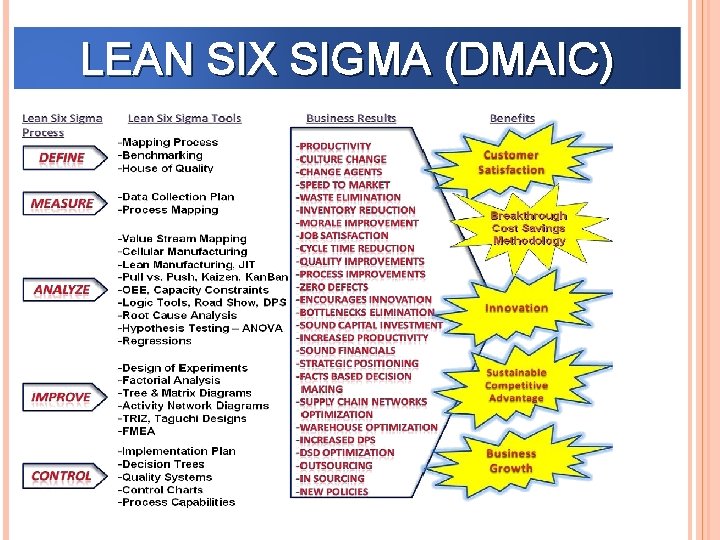
LEAN SIX SIGMA The Roadmap (DMAIC) Define ØIdentify and Prioritize Opportunities ØSelect Your Project ØDefine the Goals and Objectives ØForm Cross functional Team ØUnderstand Customer Requirements Measure ØDefine and Analyze the Current Process ØAssess the Capability of the Measurement Process ØAssess the Current Capability of the Process ØVariance Reduction
LEAN SIX SIGMA The Roadmap (DMAIC) Analyze Ø Identify the Key Input Variables Ø Discover the Relationship between the Inputs and Outputs Ø Identify the Root Causes of the Problems Improve Ø Identify and Test the Proposed Solutions Ø Re-assess Capability Ø Implement Solution Control Ø Document Results and Return on Investment Ø Take Actions to Hold the Gains Ø Celebrate and Communicate
LEAN SIX SIGMA (DMAIC)
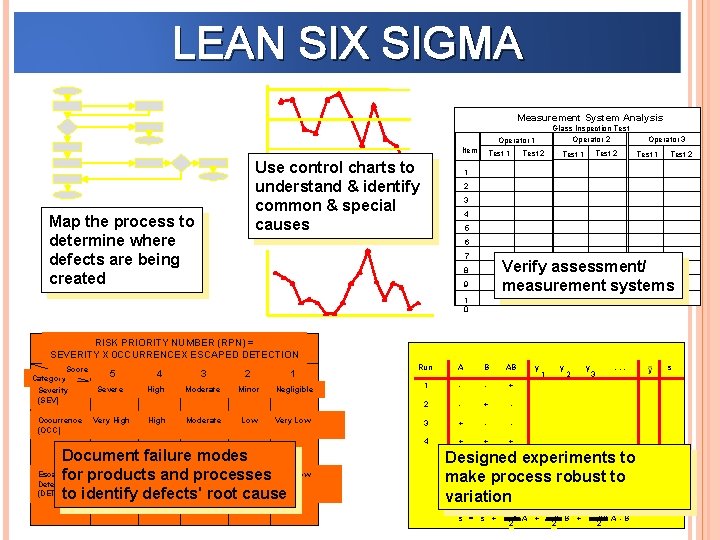
LEAN SIX SIGMA Measurement System Analysis Glass Inspection Test Operator 2 Operator 1 Item Use control charts to understand & identify common & special causes Map the process to determine where defects are being created Test 1 Test 2 Test 1 Operator 3 Test 1 Test 2 1 2 3 4 5 6 7 Verify assessment/ measurement systems 8 9 1 0 RISK PRIORITY NUMBER (RPN) = SEVERITY X 0 CCURRENCEX ESCAPED DETECTION Score Category Severity (SEV) Occurrence (OCC) 5 Severe Very High 4 High 3 2 1 Moderate Minor Negligible Moderate Low Very Low Document failure modes Escaped Very High Low Very Low for products and. Moderate processes Detection (DET) to identify defects' root cause Run A B AB 1 - - + 2 - + - 3 + - - 4 + + + y 1 y 2 y 3 . . . Designed experiments to A A + B B + AB A • B y = y + make process robust 2 2 2 to variation s = s + A A 2 + B B + 2 AB A • B 2 s
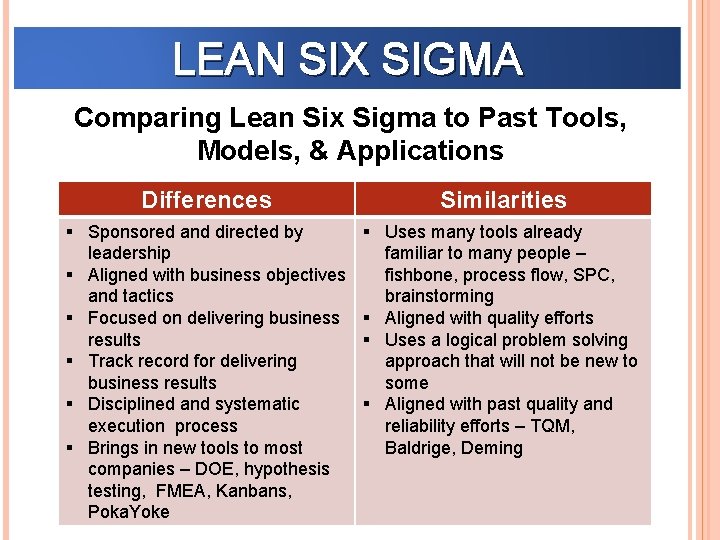
LEAN SIX SIGMA Comparing Lean Six Sigma to Past Tools, Models, & Applications Differences Similarities § Sponsored and directed by leadership § Aligned with business objectives and tactics § Focused on delivering business results § Track record for delivering business results § Disciplined and systematic execution process § Brings in new tools to most companies – DOE, hypothesis testing, FMEA, Kanbans, Poka. Yoke § Uses many tools already familiar to many people – fishbone, process flow, SPC, brainstorming § Aligned with quality efforts § Uses a logical problem solving approach that will not be new to some § Aligned with past quality and reliability efforts – TQM, Baldrige, Deming
LEAN SIX SIGMA
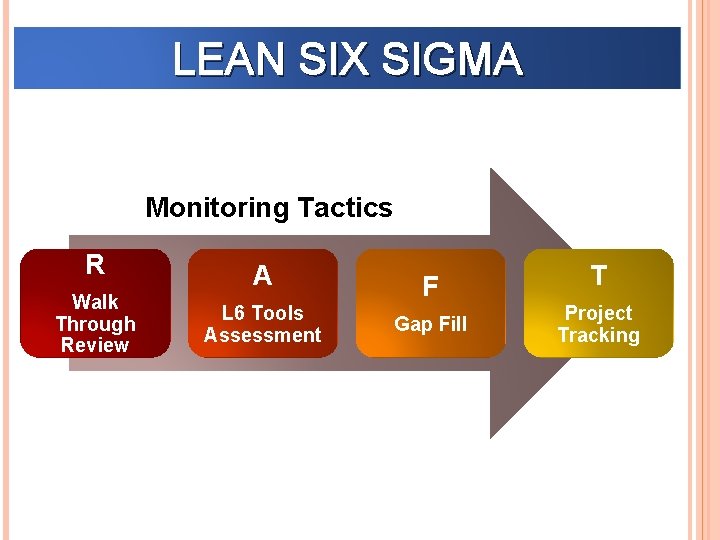
LEAN SIX SIGMA Monitoring Tactics R Walk Through Review A L 6 Tools Assessment F Gap Fill T Project Tracking
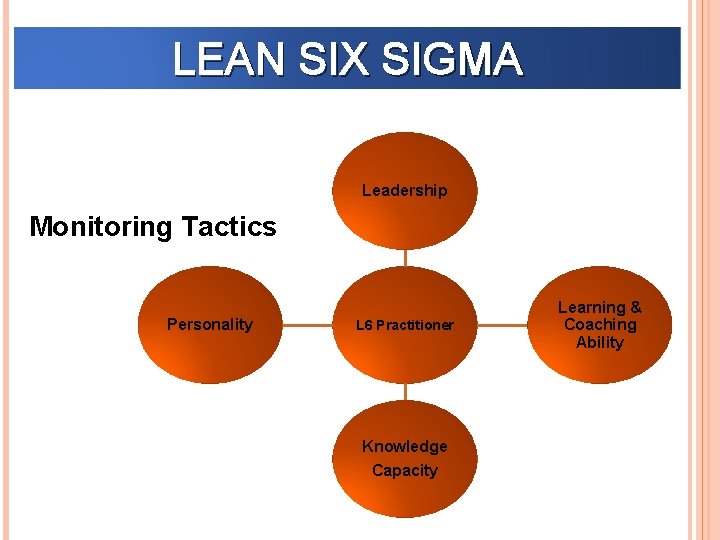
LEAN SIX SIGMA Leadership Monitoring Tactics Personality L 6 Practitioner Knowledge Capacity Learning & Coaching Ability
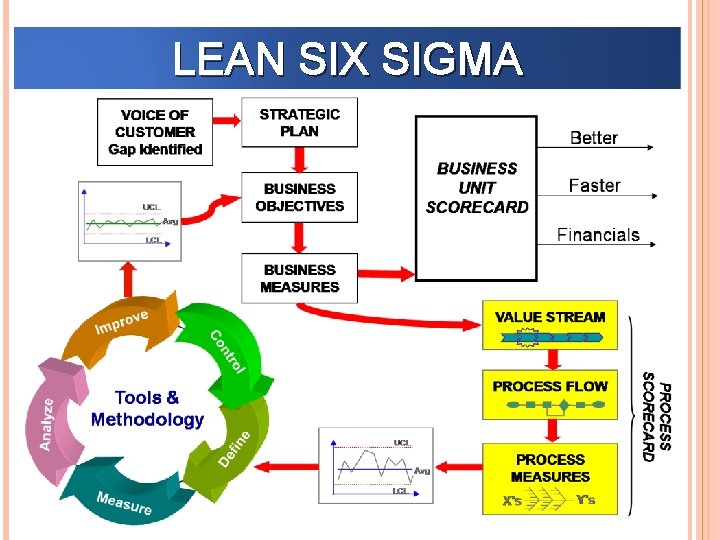
LEAN SIX SIGMA
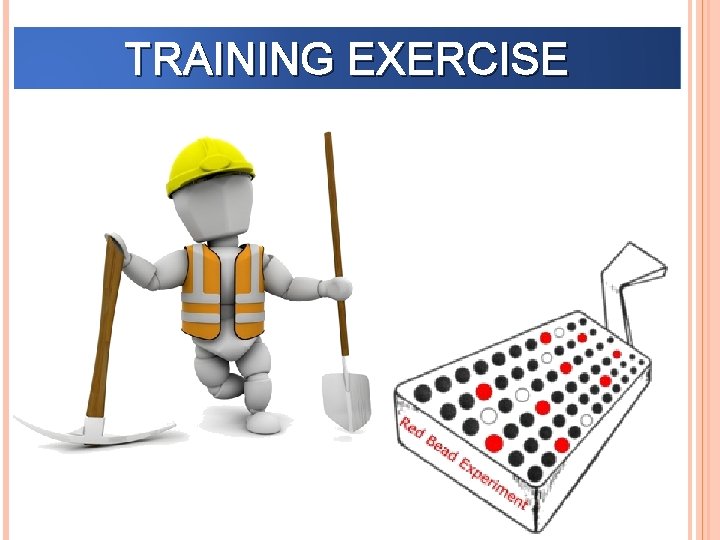
TRAINING EXERCISE
Conclusion Evolution and History Continuous Improvement Six Sigma Lean Operations Lean Six Sigma
Lean & Six Sigma Bret, Cris, & Jeff
- Slides: 41