
Lean Production Operations Management Session 6 1 Objectives
Lean Production Operations Management Session 6 1
Objectives By the end of this session, student will be able to: • Discuss relative merits of different types of relationships with suppliers • Discuss criteria for selection of suppliers • Identify different purchasing strategies • Evaluate different approaches to eprocurement 2
Topics • • • Make/Buy decision Vertical integration Purchasing strategies Kieretsu Supply chain partnerships Virtual companies Supplier selection Purchasing techniques E-procurement 3
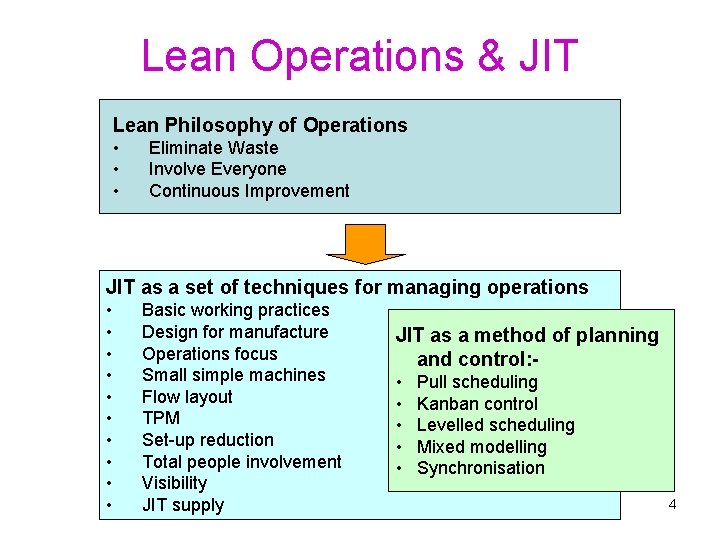
Lean Operations & JIT Lean Philosophy of Operations • • • Eliminate Waste Involve Everyone Continuous Improvement JIT as a set of techniques for managing operations • • • Basic working practices Design for manufacture Operations focus Small simple machines Flow layout TPM Set-up reduction Total people involvement Visibility JIT supply JIT as a method of planning and control: • • • Pull scheduling Kanban control Levelled scheduling Mixed modelling Synchronisation 4
Eliminate Waste • Muda – anything that does not add value for the customer – Products in storage – Products being inspected – Products waiting in queues – Defective products – Unnecessary movement of materials or workers 5
Involve Everyone • “High dependency” – JIT and TQM heighten the dependency of an organisation on its agencies – especially employees and suppliers • “Respect for humans” – Team-based problem solving – Job enrichment – Job rotation – Multi-skilling 6
Continuous Improvement - kaizen • Generate sustained involvement in CI • Ability to link CI activities to the strategic goals of the company • Move CI activity across organisational boundaries • Manage strategically the development of CI • Articulate and demonstrate CI’s values • Ability to learn through CI activity 7
Basic Working Practices • Discipline - standards of quality and safety • Flexibility – removal of grading structures and • • • restrictive practices Equality – fair and egalitarian personnel policies Autonomy – delegate responsibility Development of personnel - training Quality of working life – security of employment, involvement in decision making Creativity – improving the job Total people involvement – selecting new recruits, dealing directly with suppliers and customers, planning and reviewing 8
Design for Manufacture • If a product is easy to make it will be economical to produce • Consider the manufacturability early in the design phase • Integrate product design with process planning and design • Fewer components • Use of sub-assemblies • Better use of materials • Improvement of processing techniques 9
Operations Focus • “Simplicity, repetition and experience breed competence” • Focus each process on a limited set of products, technologies and markets • Structure operations objectives so that they are focused and coherent 10
Small Simple Machines • Several small machines can perform different processes simultaneously • If one large machine breaks down the process stops completely • Small machines can be moved easily • Lower risk investment decision 11
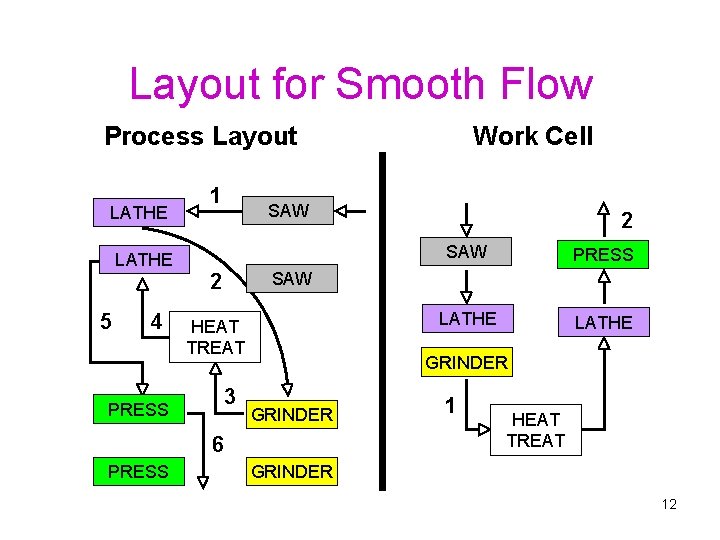
Layout for Smooth Flow Process Layout LATHE 5 4 1 SAW HEAT TREAT SAW PRESS LATHE 3 GRINDER 6 PRESS 2 SAW 2 PRESS Work Cell 1 HEAT TREAT GRINDER 12
Total Productive Maintenance (TPM) Five Goals: 1. Improve equipment effectiveness – examine faults to see if equipment can be used more effectively 2. Achieve autonomous maintenance – operators take part in maintenance leaving engineers to improve systems 3. Plan maintenance – fully worked out approach 4. Train all staff in relevant maintenance skills – appropriate and continuous training 5. Achieve early equipment management – ‘maintenance prevention’ at design and installation stage 13
Set-up Reduction • The time taken to change over the process from one activity to the next. • eg. pre-set tools so that a complete unit is fixed to the machine instead of having to be built up while the machine is stopped 14
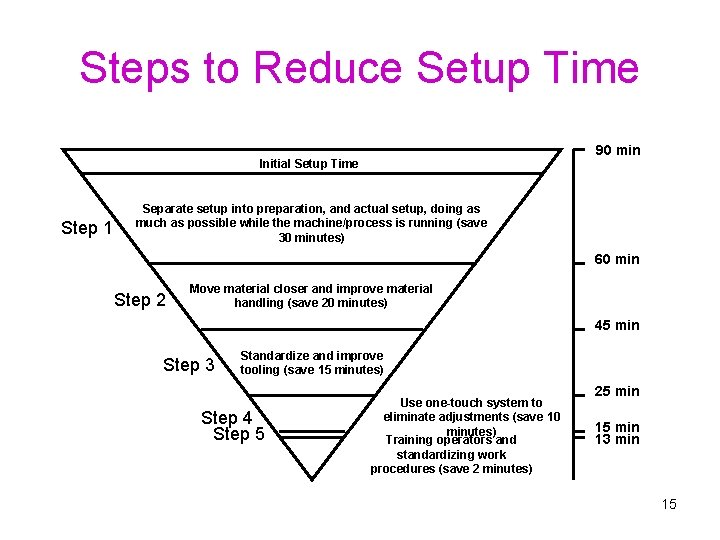
Steps to Reduce Setup Time 90 min Initial Setup Time Step 1 Separate setup into preparation, and actual setup, doing as much as possible while the machine/process is running (save 30 minutes) 60 min Step 2 Move material closer and improve material handling (save 20 minutes) 45 min Step 3 Standardize and improve tooling (save 15 minutes) Step 4 Step 5 Use one-touch system to eliminate adjustments (save 10 minutes) Training operators and standardizing work procedures (save 2 minutes) 25 min 13 min 15
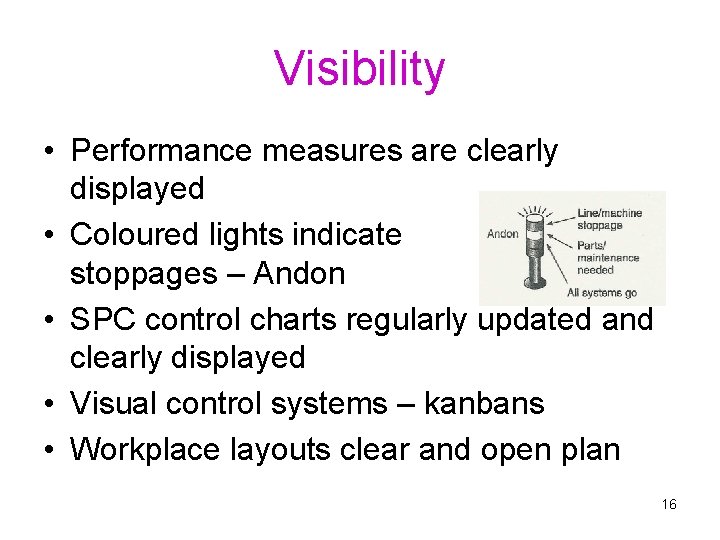
Visibility • Performance measures are clearly displayed • Coloured lights indicate stoppages – Andon • SPC control charts regularly updated and clearly displayed • Visual control systems – kanbans • Workplace layouts clear and open plan 16
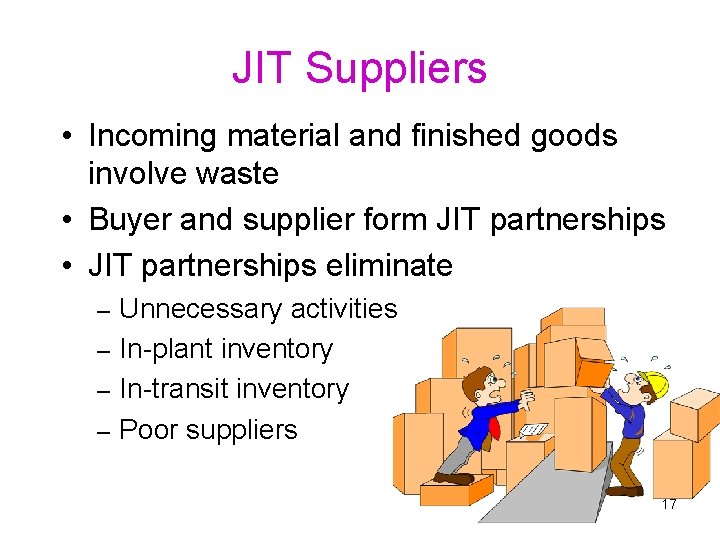
JIT Suppliers • Incoming material and finished goods involve waste • Buyer and supplier form JIT partnerships • JIT partnerships eliminate Unnecessary activities – In-plant inventory – In-transit inventory – Poor suppliers – 17
Kanban Control • Japanese word for card – Pronounced ‘kahn-bahn’ (not ‘can-ban’) • Authorizes production from downstream operations – ‘Pulls’ material through plant • May be a card, flag, verbal signal etc. • Used often with fixed-size containers – Add or remove containers to change production rate 18
Case Study • Toyota Production System • From Operations Management 4 th ed. , Slack et al 19
Levelled Scheduling Heijunka Production needed in 20 day period: • Product A = 3000 • Product B = 1000 • Product C = 1000 Current batch sizes: • Product A = 600 • Product B = 200 • Product C = 200 By reducing set up times can produce batch sizes small enough for 1 day: • Product A = 150 • Product B = 50 • Product C = 50 Considerably reduces inventory and makes the process more responsive 20
Labor Specialization • Involves • Breaking jobs into small component parts • Assigning specialists to do each part • First noted by Adam Smith (1876) • Observed how workers in pin factory divided tasks into smaller components • Found in manufacturing & service industries 21
Labour Specialisation Often Reduces Cost • Greater dexterity & faster learning • Less lost time changing jobs or tools • Use more specialized tools • Pay only for needed skills 22
Job Expansion • Process of adding more variety to jobs • Intended to reduce boredom associated with labor specialization • Methods Job enlargement – Job enrichment – Job rotation – Employee empowerment – 23
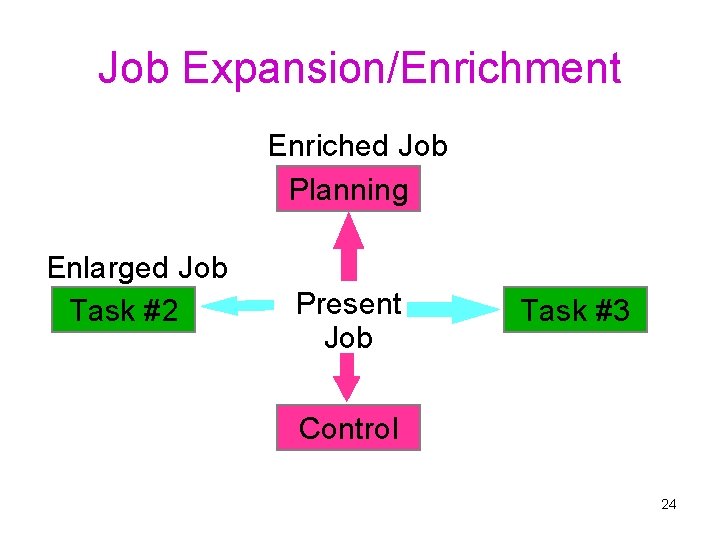
Job Expansion/Enrichment Enriched Job Planning Enlarged Job Task #2 Present Job Task #3 Control 24
Job Expansion Constraints • Higher capital cost • Workers’ preferences – • • Example: Some people prefer simple jobs Higher wages required Smaller labour pool Increased accident rates Lack of technology 25
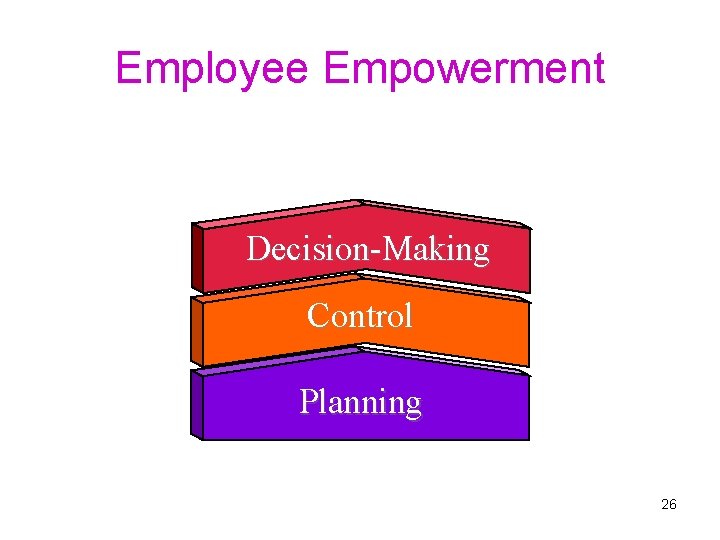
Employee Empowerment Decision-Making Control Planning 26
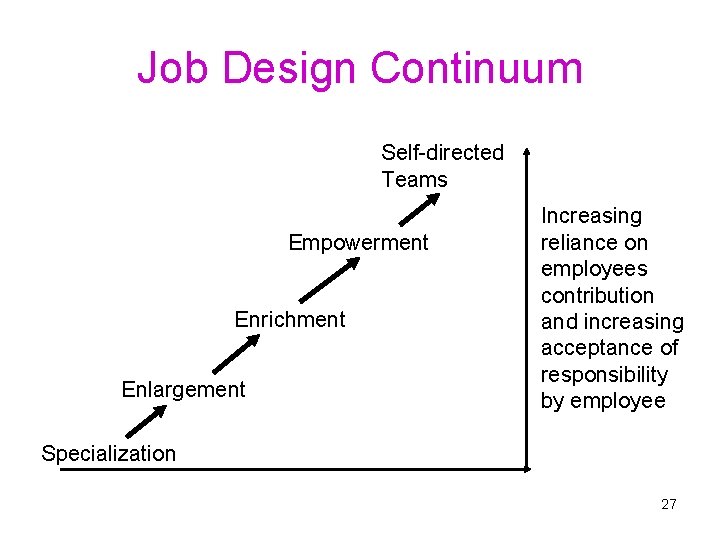
Job Design Continuum Self-directed Teams Empowerment Enrichment Enlargement Increasing reliance on employees contribution and increasing acceptance of responsibility by employee Specialization 27
Limitations to Job Enlargement/Job Enrichment • Higher capital cost • Many individuals prefer simple jobs • Higher wages are required since the worker must utilize a higher level of skill • A smaller labor pool exists of persons able and willing to perform enriched or enlarged jobs • Increased accident rates may occur • Current technology in some industries does not lend itself to job enlargement and enrichment 28
Case Study • Create a schedule for a motor race pit stop 29
- Slides: 29