
Lean Operations Lean operation A flexible system of
Lean Operations • Lean operation – A flexible system of operation that uses considerably less resources than a traditional system • Tend to achieve – – Greater productivity Lower costs Shorter cycle times Higher quality
Lean: Ultimate Goal • The ultimate goal: – Achieve a system that matches supply to customer demand; supply is synchronized to meet customer demand in a smooth uninterrupted flow – A balanced system • One that achieves a smooth, rapid flow of materials and/or work through the system
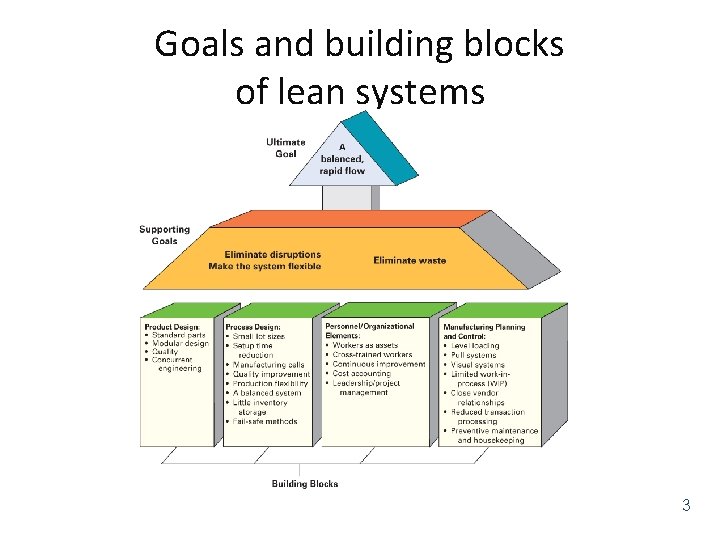
Goals and building blocks of lean systems 3
Lean: Supporting Goals • The degree to which lean’s ultimate goal is achieved depends upon how well its supporting goals are achieved: 1. Eliminate disruptions 2. Make the system flexible 3. Eliminate waste, especially excess inventory 4
Waste (Muda) �Waste �Represents unproductive resources �Seven sources of waste in lean systems: 1. 2. 3. 4. 5. 6. 7. Inventory Overproduction Waiting time Unnecessary transporting Processing waste Inefficient work methods Product defects 5
Lean: Building Blocks • • Product design Process design Personnel/organizational elements Manufacturing planning and control 6

Building Blocks: Product Design • Four elements of product design important for lean systems: 1. 2. 3. 4. Standard parts Modular design Highly capable systems with quality built in Concurrent engineering 7

Building Blocks: Process Design • Seven aspects of process design that are important for lean systems: 1. 2. 3. 4. 5. 6. 7. 8. Small lot sizes Setup time reduction Manufacturing cells Quality improvement Production flexibility A balanced system Little inventory storage Fail-safe methods 8
Process Design: Small Lot Sizes • In the lean philosophy, the ideal lot size is one • Benefits of small lot size – Reduced in-process inventory • Lower carrying costs • Less storage space is necessary – Inspection and rework costs are less when problems with quality do occur – Permits greater flexibility in scheduling – Less inventory to ‘work off’ before implementing product improvements – Increased visibility of problems – Increased ease of balancing operations 9
Process Design: Setup Time Reduction • Small lot sizes and changing product mixes require frequent setups • Unless these are quick and relatively inexpensive, they can be prohibitive • Setup time reduction requires deliberate improvement efforts – Single-minute exchange of die (SMED) • A system for reducing changeover time – Group technology may be used to reduce setup time by capitalizing on similarities in recurring operations 10
Process Design: Manufacturing Cells • One characteristic of lean production systems is multiple manufacturing cells • Benefits include – Reduced changeover times – High equipment utilization – Ease of cross-training workers 11
Process Design: Quality Improvement • Quality defects during the process can disrupt the orderly flow of work • Autonomation (jidoka) – Automatic detection of defects during production • Two mechanisms are employed 1. One for detecting defects when they occur 2. Another for stopping production to correct the cause of the defects 12
Process Design: Work Flexibility • Guidelines for increasing flexibility 1. Reduce downtime due to changeovers by reducing changeover time 2. Use Total Preventive Maintenance/Total Productive Management (TPM) on key equipment to reduce breakdowns and downtime 3. Cross-train workers so they can help when bottlenecks occur or other workers are absent 4. Use many small units of capacity; many small cells make it easier to shift capacity temporarily and to add or subtract capacity 5. Use off-line buffers. Store infrequently used safety stock away from the production area 6. Reserve capacity for important customers 13
Process Design: Balanced System • Takt time – The cycle time needed to match customer demand for final product – Sometimes referred to as the heartbeat of a lean system • Takt time is often set for a work shift • Procedure: 1. 2. 3. 4. Determine the net time available per shift If there is more than one shift per day, multiply the net time by the number of shifts Compute the takt time by dividing the net available time by demand For example if customer requires 100 bulbs a day, the Takt time is 8 hrs /100. This means a bulb to be completed every 4. 8 minutes 14
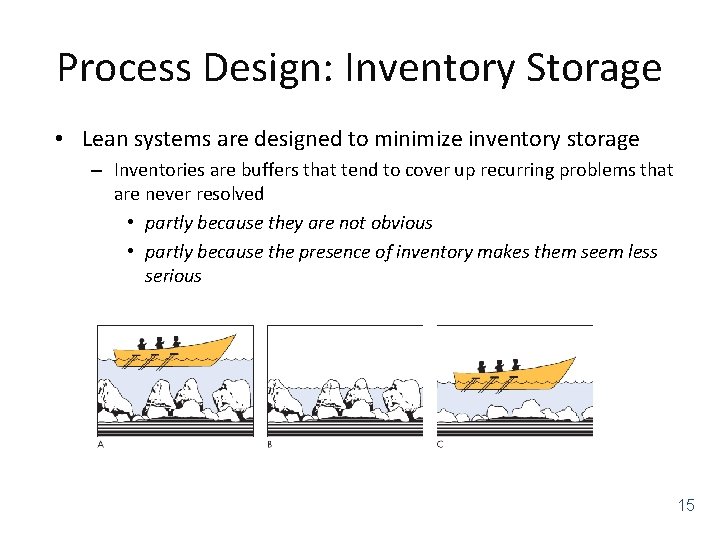
Process Design: Inventory Storage • Lean systems are designed to minimize inventory storage – Inventories are buffers that tend to cover up recurring problems that are never resolved • partly because they are not obvious • partly because the presence of inventory makes them seem less serious 15
Process Design: Fail-Safe Methods • Poka-yoke (Fail Safing) – Building safeguards into a process to reduce or eliminate the potential for errors during a process • Examples – – Electric breakers Seatbelt fastener warnings ATMs that signal if a card is left in a machine Designing parts that can only be assembled in the correct position 16

Focus on Work Flow • Flow manufacturing or work cells • Work toward flexibility – Process flexibility – Machine flexibility – Operator flexibility – Quick changeover with short setup times
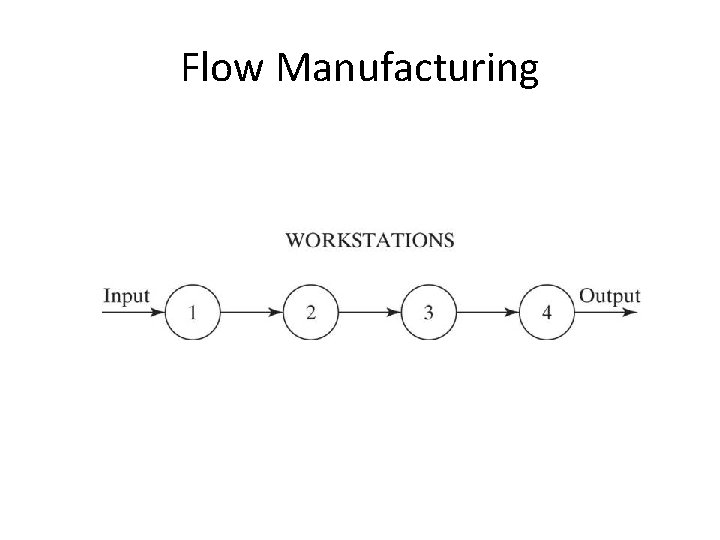
Flow Manufacturing
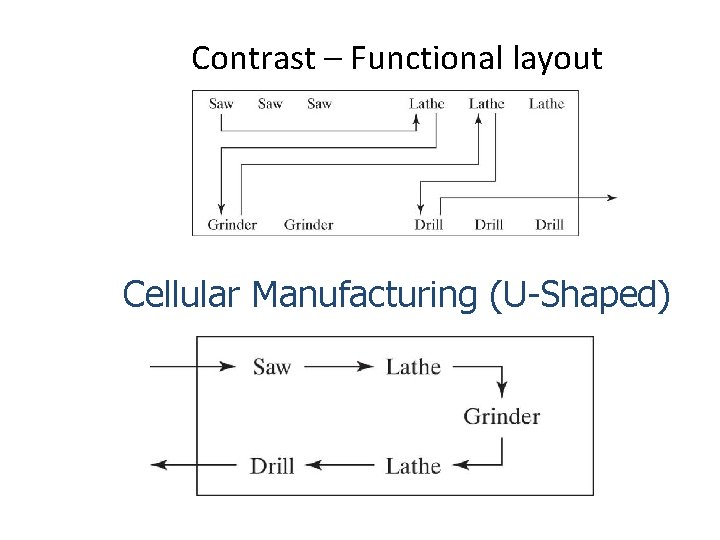
Contrast – Functional layout Cellular Manufacturing (U-Shaped)
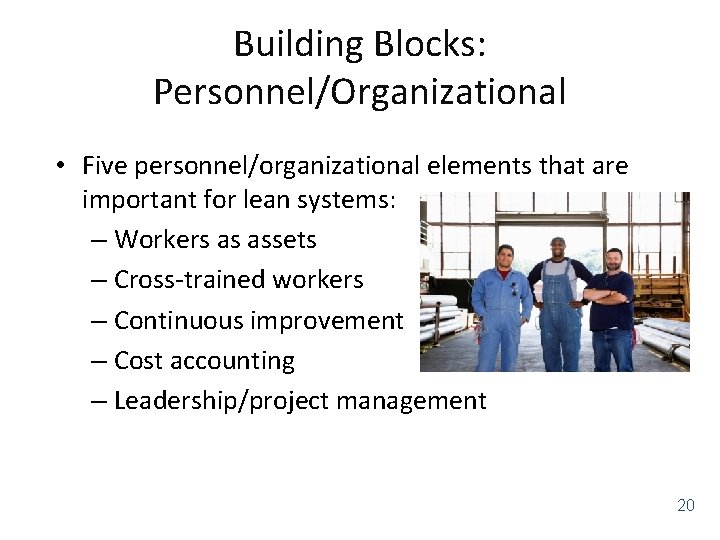
Building Blocks: Personnel/Organizational • Five personnel/organizational elements that are important for lean systems: – Workers as assets – Cross-trained workers – Continuous improvement – Cost accounting – Leadership/project management 20
Personnel/Organizational: Workers as Assets • Workers as assets – Well-trained and motivated workers are the heart of the lean system • They are given greater authority to make decisions, but more is expected of them 21
Personnel/Organizational: Cross-Trained Workers • Cross-trained workers – Workers are trained to perform several parts of a process and operate a variety of machines • Facilitates flexibility • Helps in line balancing Instructor Slides 14 -22
Personnel/Organizational: Continuous Improvement • Continuous improvement – Workers in lean systems have greater responsibility for quality, and they are expected to be involved in problem solving and continuous improvement – Lean workers receive training in • Statistical process control • Quality improvement • Problem solving 23
Personnel/Organizational: Leadership • Leadership/project management – Managers are expected to be leaders and facilitators, not order givers – Lean systems encourage two-way communication between workers and managers 24
Building Blocks: MPC • Seven elements of manufacturing planning and control (MPC) are particularly important for lean system: 1. 2. 3. 4. 5. 6. 7. Level loading Pull systems Visual systems Limited work-in-process (WIP) Close vendor relationships Reduced transaction processing Preventive maintenance and housekeeping 25
MPC: Level Loading • Lean systems place a strong emphasis on achieving stable, level daily mix schedules – MPS – developed to provide level capacity loading – Mixed model scheduling • Three issues need to be resolved – What is the appropriate product sequence to use? – How many times should the sequence be repeated daily? – How many units of each model should be produced in each cycle? 26
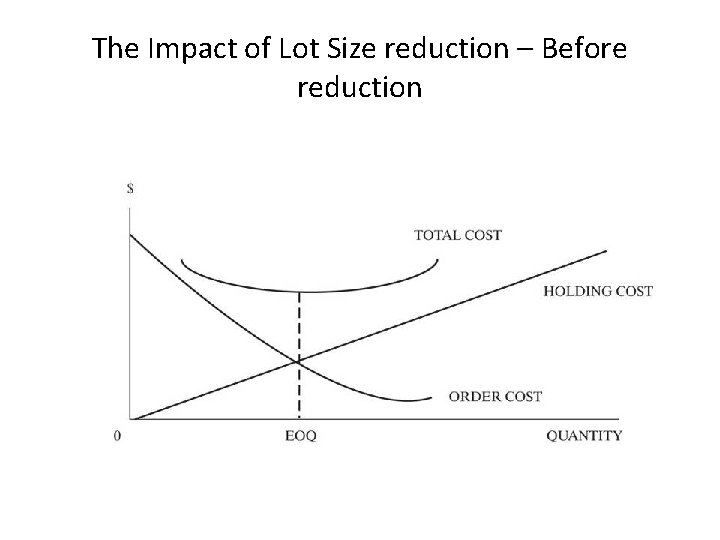
The Impact of Lot Size reduction – Before reduction

After Lot Size reduction
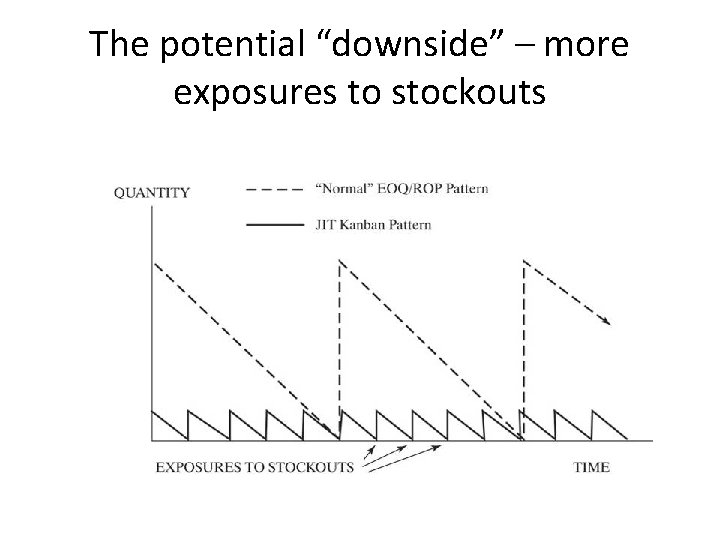
The potential “downside” – more exposures to stockouts
MPC: Pull Systems �Push system �Work is pushed to the next station as it is completed �Pull system �A workstation pulls output from the preceding workstation as it is needed �Output of the final operation is pulled by customer demand or the master schedule �Pull systems are not appropriate for all operations �Large variations in volume, product mix, or product design will undermine the system 30
MPC: Communication • Communication moves backward through the system from station to station – Each workstation (customer) communicates its need for more work to the preceding workstation (supplier) • Assures that supply equals demand – Work moves “just in time” for the next operation • Flow of work is coordinated • Accumulation of excessive inventories is avoided 31

MPC: Visual Systems • Kanban – Card or other device that communicates demand for work or materials from the preceding station • Kanban is the Japanese word meaning “signal” or “visible record” – Paperless production control system – Authority to pull, or produce, comes from a downstream process. – Two main types of kanbans: 1. Production kanban (p-kanban): signals the need to produce parts 2. Conveyance kanban (c-kanban): signals the need to deliver parts to the next work center. 32
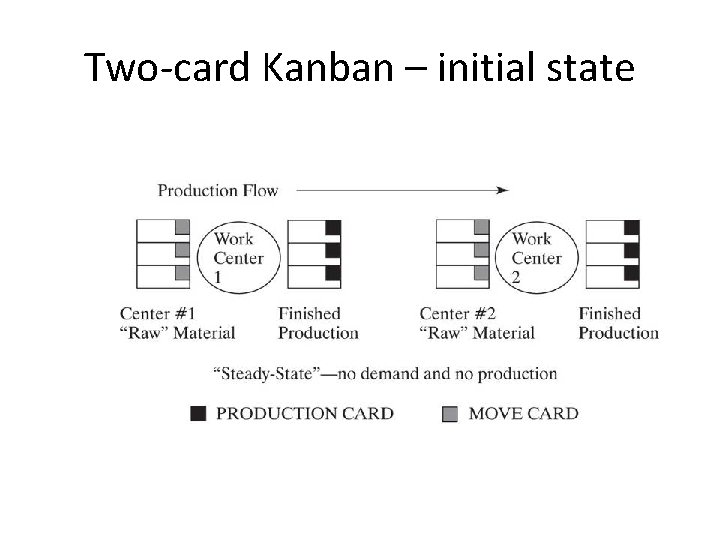
Two-card Kanban – initial state
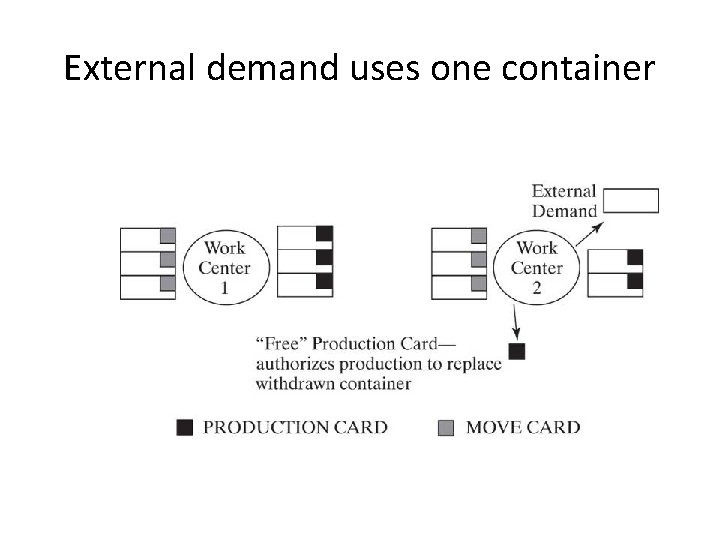
External demand uses one container
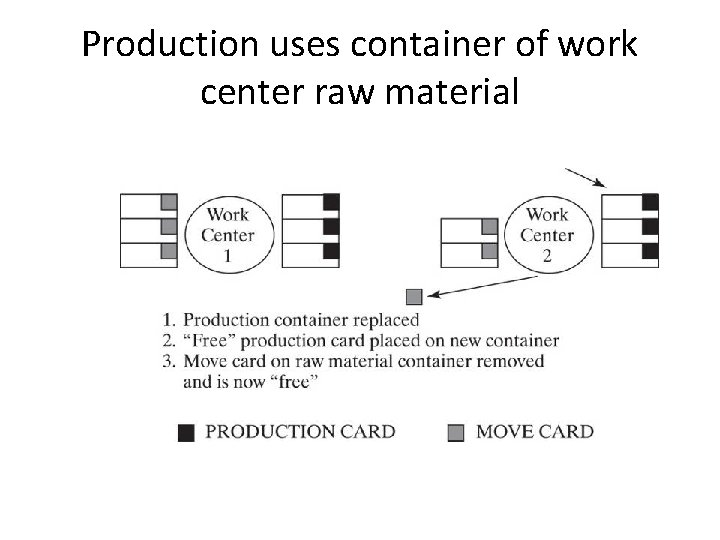
Production uses container of work center raw material

Work Center 1 has signal to replace raw material for Work Center 2

Work Center 1 now can produce more material
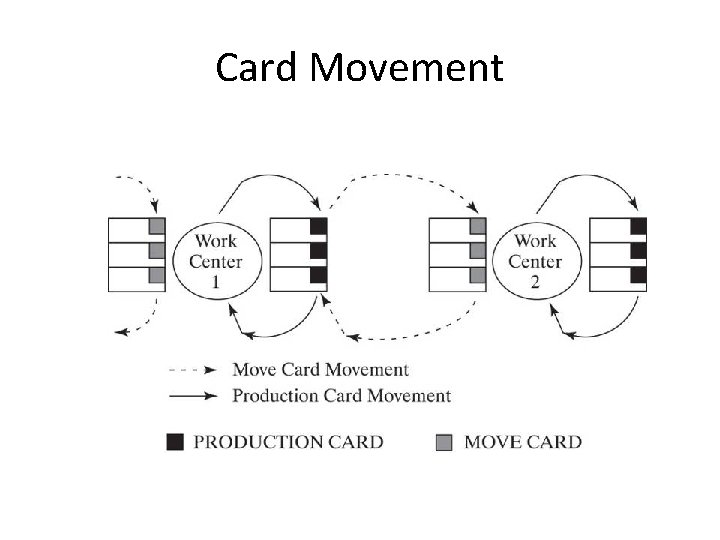
Card Movement
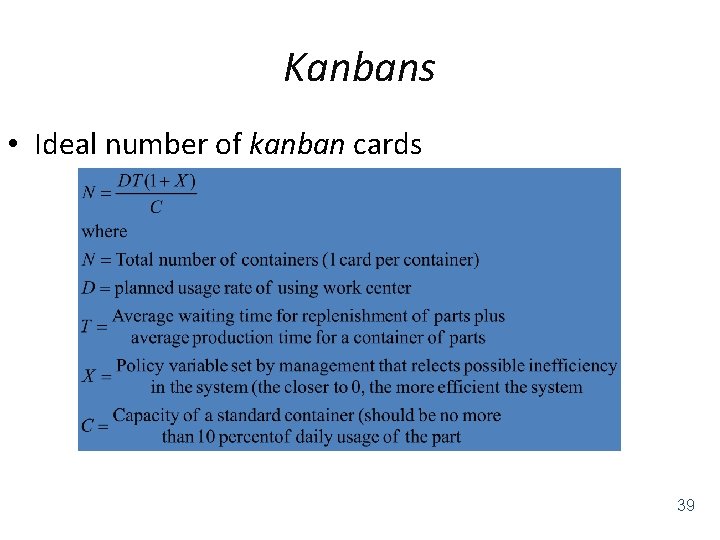
Kanbans • Ideal number of kanban cards 39
MPC: Limited WIP • Benefits of lower WIP – Lower carrying costs – Increased flexibility – Aids scheduling – Saves costs of scrap and rework if there are design changes – Lower cycle-time variability 40
MPC: Close Vendor Relationships • Lean systems typically have close relationships with vendors – They are expected to provide frequent, small deliveries of high-quality goods • A key feature of many lean systems is the relatively small number of suppliers used 41
MPC: Reduced Transaction Processing • Lean systems seek to reduce costs associated with the ‘hidden factory’: – Logistical transactions – Balancing transactions – Quality transactions – Change transactions 42

Preventive Maintenance and Housekeeping • Preventive maintenance – Maintaining equipment in good operating condition and replacing parts that have a tendency to fail before they actually do fail • Housekeeping – Maintaining a workplace that is clean and free of unnecessary materials 43
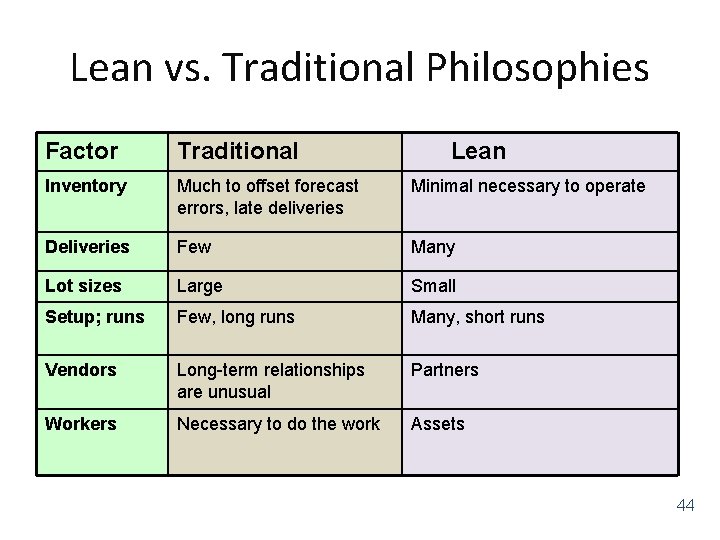
Lean vs. Traditional Philosophies Factor Traditional Lean Inventory Much to offset forecast errors, late deliveries Minimal necessary to operate Deliveries Few Many Lot sizes Large Small Setup; runs Few, long runs Many, short runs Vendors Long-term relationships are unusual Partners Workers Necessary to do the work Assets 44
Transitioning to Lean Systems 1. Make sure top management is committed and that they know what will be required 2. Decide which parts will need the most effort to convert 3. Obtain support and cooperation of workers 4. Begin by trying to reduce setup times while maintaining the current system 5. Gradually convert operations, begin at the end and work backwards 6. Convert suppliers to JIT 7. Prepare for obstacles 45

Obstacles to Conversion 1. Management may not be fully committed or willing to devote the necessary resources to conversion 2. Workers/management may not be cooperative 3. It can be difficult to change the organizational culture to one consistent with the lean philosophy 4. Suppliers may resist 46
Lean Services • In service the focus is often on the time needed to perform the service because speed is often the order winner • Lean benefits can be achieved in the following ways: – Eliminate disruptions – Make system flexible – Reduce setup and lead times – Eliminate waste – Minimize WIP – Simplify the process 47

JIT II • JIT II: • A supplier representative works right in the company’s plant, making sure there is an appropriate supply on hand • It is often referred to as Vendor Managed Inventory (VMI) 48
Operations Strategy • Be careful to study the requirements and benefits of lean systems before making a decision to convert operations – Evaluate strengths and weaknesses of current operations • The decision to convert can be sequential • Weigh the pros and cons of a lean approach to inventories • Supplier management is critical to a lean operation 49

Homework Assignment Problems 9. 7, 9. 8, 9. 9, 9. 10, 9. 11
- Slides: 50